Implementation of Clustering based Unit
Commitment Employing Particle Swarm
Optimization
V.C. Jagan Mohan1, M. Damodar Reddy2, K. Subbaramaiah3
Research scholar, Dept. of EEE, S.V. University College of Engineering,Tirupati, Andhra Pradesh, India1
Professor,Dept. of EEE, S.V. University College of Engineering, Tirupati,Andhra Pradesh, India2
Professor,Dept. of EEE, Yogananda Institute of Technology and Science, Tirupati, A.P, India3
ABSTRACT: Fuel cost savings can be obtained by proper commitment of available generating units. This paper describes a new approach to the unit commitment problem through classification of units into various clusters based on Particle Swarm Optimization. This classification is carried out in order to reduce the overall operating cost and to satisfy the minimum up/down constraints easily. Unit commitment problem is an important optimizing task in daily operational planning of power systems which can be mathematically formulated as a large scale nonlinear mixed-integer minimization problem. A new methodology employing the concept of cluster algorithm called as additive and divisive hierarchical clustering has been employed based on hybrid technique of genetic algorithm and simulated annealing in order to carry out the technique of unit commitment. Proposed methodology involves two individual algorithms. While the load is increasing, additive cluster algorithm has been employed while divisive cluster algorithm is used when the load is decreasing. The proposed technique is tested on a 10 unit system and the simulation results show the performance of the proposed technique.
KEYWORDS: Unit commitment, additive clustering, divisive clustering, Particle Swarm Optimization, base load, intermittent load, semi peak load, peak load.
I. INTRODUCTION
Networks , Fuzzy Logic and Tabu Search, Basic Genetic Algorithm approach and Extended Priority List (EPL) method based on GA[2,3,4,6,7,11,16,20,22].These methods seem to be promising and are still evolving. Though the approaches have yielded attractive results, the linguistic descriptions for generating static crisp output under large number of time dependent constraints in UC may make the approaches highly complex and may even confusing[2]. The Particle swarm Optimization (PSO) approach iteratively evaluates the best solution each time the neighbourhood is updated. The method has good capability only for suboptimal search.
Inspired by the results of PSO method and to overcome the general difficulties in GA approach, a novel method with the application of cluster algorithms has been proposed in this paper. The method uses Additive and Divisive Cluster Algorithms. The proposed methodology can be unfolded in to three stages. In the first stage, four clusters are formed namely base load, intermittent load, semi-peak load and peak load clusters. All the generating units of the plant are segregated into corresponding clusters based on operating costs. The operating costs are obtained by PSO, based on the operating costs of units clusters are formed and also useful for preparing the priority list. In the second stage, UC solution is obtained by developing Additive Cluster algorithm for increasing load pattern. Finally in the third stage a Divisive Cluster algorithm is developed for decreasing load pattern.
The remaining paper is organized as follows: Section 2 deals with problem formulation. The concept of Particle Swarm Optimization based cluster technique is discussed in Section 3. The new methodology using clustered based PSO has been presented in Section 4. Simulation results and discussions are carried out in Section 5 and finally conclusions are drawn in the Section 6.
II. PROBLEM FORMULATION
Subject to the minimization of the cost-objective function in the unit commitment problem, certain units are stated to be as ‘ON’ and remaining as ‘OFF’. The following are the various notations considered during the implementation of the problem
N
:Number of generating units in the plant;T
:Scheduling period in hours (h);i
:Index of Unit ( i = 1,2,….., N);t
:Index of time ( t = 1,2,….., T);I
i(
t
)
:ith unit status att
thhour ( = 1, if the Unit is ON; =0, if the unit is OFF) ;)
(
t
P
i : Generation of ith unit at tth hour;P
imax,P
imin : Maximum / Minimum output power (MW) of ith unit;)
(
t
D
:Demanded power at tth hour;R
(
t
)
:System reserve att
thhour;T
ion:Minimum up time of ith unit;T
ioff : Minimum down time of ith unit;X
ion(
t
)
:Duration during which ith unit is continuously ON;X
ioff :Duration during which ith unit is continuously OFF;SC
i(
t
)
: Start-Up cost of ith unit;FC
i(
t
)
:Fuel cost of ith unit; TC: Total Cost of generation; HC(i): Hot start cost of ith unit; CC(i): Cold start cost of ith unit; CS(i): Cold start hour of ith unit; ai , bi, ci : Fuel cost coefficientsA. Objective Functions and System Constraints
The objective function of UC problem is the minimization of the TC which has the components of FC and SC and is given by:
Min (TC) =
T
t N
i i i
t
SC
t
FC
1 1
))
(
)
(
(
(1) Where Fuel cost of ith unit:2
)
(
)
(
)
(
t
a
b
P
t
c
P
t
FC
i
i
i i
i i (2) and Start-up cost)
(
)
(
:
)
(
)
(
t
HC
i
if
T
X
t
H
t
SC
i
ioff
ioff
ioff or =CC
(
i
)
:
if
X
ioff(
t
)
H
ioff(
t
)
Where
H
ioff(
t
)
T
ioff
CS
(
i
)
(4)The constraints, which must be considered during the optimization process of UC problem (1), are given below.
Load Demand
All the committed units must generate total power equal to load demand as:
N i it
P
t
D
1)
(
)
(
(5) Spinning ReserveTo maintain system reliability for sudden variation of loads, system should have adequate amount of spinning reserve capacity. In this paper 10% of the load demand is taken and which satisfies:
)
(
)
(
)
(
1 maxt
R
t
D
P
t
I
Ni i i
(6) Generated Power Limits
The power output of each unit should satisfy:
max min
)
(
ii
i
P
t
P
P
(7) Minimum Up/Down TimeOnce the unit is committed there is a minimum time before it is de-committed and viz.
)
(
)
(
t
or
T
X
t
X
T
ion
ion ioff
ioff (8)III. FORMULATION OF CLUSTERS EMPLOYING PSO
Particle Swarm Optimization is general purpose optimization technique based on principles inspired from the school of fish or swarm of birds [11-12]. PSO is a population based stochastic optimization technique inspired by social behaviour of bird flocking or fish schooling. In PSO, the search for an optimal solution is conducted using a population of particles, each of which represents a candidate solution to the optimization problem. Particles change their position by flying round a multidimensional space by following current optimal particles until a relatively unchanged position has been achieved or until computational limitations are exceeded. Each particle adjusts its trajectory towards its own previous best position and towards the global best position attained till then. PSO is easy to implement and provides fast convergence for many optimization problems and has gained lot of attention in power system applications recently. By using PSO the operating cost functions of each unit are obtained. Based on these cost function priority list is prepared and clusters are formed. The purpose of Cluster Algorithms (CA) can be stated as, to divide a given group of objects into a number of groups or clusters in order that the objects in a particular cluster would be similar among the objects of the other ones. In the first stage of CA, an attempt is made to place an N object in M clusters according to some optimization criterion additive to clusters. Once the optimization criterion is selected, CA searches the space of all classifications and finds the one that satisfies the optimization function. The proposed methodology for UC problem considers two clustering techniques: Additive Clustering Technique and Divisive Clustering Technique.
In the first type of cluster technique, initially individual data points are treated as clusters. Based on some criteria (nearest operating costs of units) successively two closest clusters are merged until there is only one cluster remains.
A. Basic Additive Clustering Algorithm
Compute operating cost (proximity) matrix;
Repeat;
Merge two closest clusters based on least distance value;
Update the proximity Matrix to reflect the proximity between the new cluster and the original clusters;
Until Only one cluster remains.
B. Basic Divisive Clustering Algorithm
Compute operating cost (Proximity) Matrix;
Separate a cluster from other clusters based on maximum distance value;
Update the proximity Matrix to reflect the proximity between the clusters those remaining;
Until all the clusters are removed.
IV. PROPOSED METHODOLOGY
The proposed methodology can be unfolded in to three stages.
Stage-1: In this stage objective cost function of each unit is obtained by using Particle Swarm Optimization. Priority list of units is prepared based on the minimum objective cost functions and clusters are formed.
Stage-2: The pattern of load variation on the plant is a cycle of increasing and then decreasing takes place. Two separate algorithms are designed for load increasing pattern and for decreasing pattern. In this stage, an algorithm based on additive clustering technique is developed for increasing load pattern
Stage-3: This stage presents an algorithm for UC solution for the decreasing load condition. The algorithm is designed based on divisive clustering technique.
In this methodology Particle Swarm Optimization has been employed to form clusters. The operating cost of each plant is calculated and the plants are clustered based on their fitness values. In this way PSO is employed to bring out the best clusters so that they can be employed to take up the load.
A. Characterization of the Units
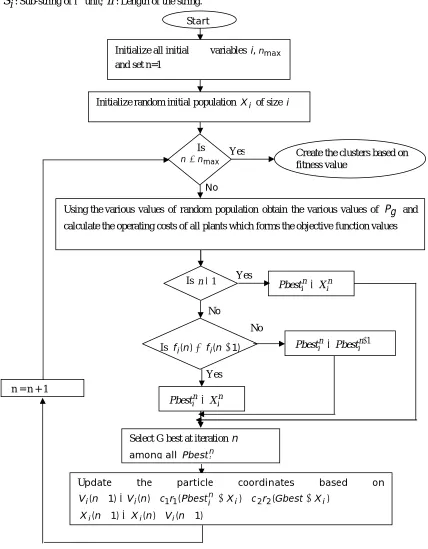
Base load (BL) and Intermittent load (IL) units operate for long period in the day and they generate more number of units (MWH). Therefore, ideally speaking they should have minimum fuel cost, maximum generating capabilities but, can have high start-up costs and start-up times for the reason they are switched ‘on’ for the most of time. In addition, System reliability aspect is decided by the performance of these units. Semi-Peak Load (SPL) and Peak load (PL) units in contrast should have low start-up costs and start-up times as these units are rapidly switched ‘on’ and ‘off’ frequently. These units can have less generating capabilities and can have relatively high costs as they take up small loads above high base load and intermittent loads. Figure 1 shows the flowchart of PSO employed for this purpose. Based on the generation cost functions, the closet cost function units are segregated into clusters as BL, IL, SPL and PL as given in table 5.
BL: Load up to 1000MW duration: 0-24 hours
IL: Load between 1000MW to 1200 MW, duration 0-18 hours SPL : Load 1200MW to 1400 MW, duration 0-6 hours PL : Load 1400MW to 1500MW, duration 0-3 hours The maximum limits for the four loads as:
BL-Max: 1000 MW; IL-Max: 1200 MW; SPL-Max: 1400 Mw and PL-Max: 1500 MW.
For carrying out the additive cluster algorithm, objective function values are stored in ascending order and for divisive cluster algorithm the objective function values are stored in the descending order as given in table 4. The closest values are divided into four clusters as BL, PL, Semi PL and IL.
B. Preparation of priority list using PSO
In this stage the following steps are performed for preparing the priority list.
Step-1: The algorithm begins with the initialization of load patterns, unit characteristic along with the generation of initial population of particles, where each particle is corresponding to generation of a particular generator (Pg). The load
pattern and unit characteristics are presented in table 1 & table 2.
Step-2: The binary coded particles are decoded into their corresponding decimal values of Pg by using linear mapping rule give by the equation (9).
i li
L i U i L i
i
decoded
value
of
S
p
p
p
p
1
2
(9)
U i
i
S
:Sub-string of ith unit;li
:Length of the string.Figure 1: Flow chart of PSO employed for clustered based unit commitment
Step-3: These values are used to calculate the operating cost of each generator, which forms the objective function value. The various steps depicted in Figure 1 are followed to calculate the Gbest and Pbest.
n = n + 1
No
Yes Start
Create the clusters based on fitness value
Is
max
n n
Initialize all initial variables i,nmax
and set n=1
Initialize random initial population Xi of size i
Using the various values of random population obtain the various values of Pg and calculate the operating costs of all plants which forms the objective function values
Is n1 n i n
i X
Pbest
Is fi(n) fi(n 1) Pbestin Pbestin1
No
n i n
i X
Pbest
Select G best at iteration n
among all Pbest in
Update the particle coordinates based on
) (
) (
) ( ) 1
( i 11 ni i 2 2 i
i n V n c r Pbest X c r Gbest X
V
) 1 ( ) ( ) 1
(n X n V n
Xi i i
Yes
No
Step-4: The velocity and position of each particle is updated accordingly and this process continues until the termination criteria is met. The objective function values are brought out and given in table 3.
Step-5: Based on the generation cost functions, the closet cost function units are segregated into clusters as BL, IL, SPL and PL as given in table 5.
BL: Load up to 1000MW duration; IL: Load between 1000MW to 1200 MW; SPL : Load 1200MW to 1400 MW; PL : Load 1400MW to 1500MW.
The maximum limits for the four loads as:
BL-Max: 1000 MW; IL-Max: 1200 MW; SPL-Max: 1400 Mw and PL-Max: 1500 MW.
Step-6: For carrying out the additive cluster algorithm, objective function values are stored in ascending order and for divisive cluster algorithm the objective function values are stored in the descending order as given in table 4. The closest values are divided into four clusters as BL, PL, Semi PL and IL.
The entire process of clustering based unit commitment employing additive clustering and divisive clustering is shown in Figure 2.
NO
YES YES
YES NO
YES
Execute Economic Dispatch for IL cluster
units
Is D (t) +R (t) <
SPL-Max YES
YES Start
Cluster Algorithm
Is the load belongs
to BL
Is the load belongs to IL
Is the load belongs to
SPL NO
NO
Execute Economic Dispatch for BL cluster
units
Execute Economic Dispatch for SPL
cluster units
Execute Economic Dispatch for PL cluster
units
Is D (t) +R (t) <
BL-Max
Is D (t) +R (t) <
IL-Max
Return to Main Program
NO
NO
Merge BL into IL Cluster
Merge IL into SPL Cluster
Merge SPL into PL Cluster
V. RESULT AND DISCUSSIONS
Table1 shows the daily load pattern on the plant.
TABLE-2: UNIT CHARACTERISTICS AND COEFFICIENTS
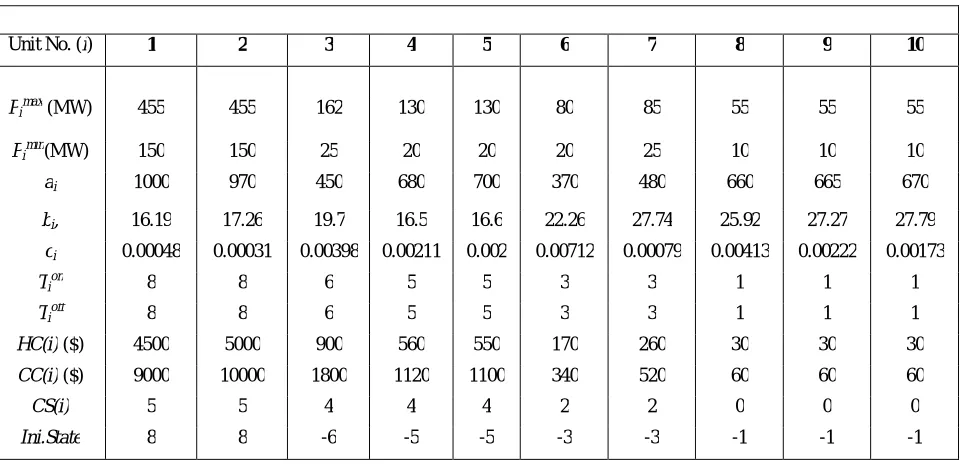
Table 2 shows the operating characteristics of all the plants.
Table 3 shows the values of operating costs of various generators which has been decoded from the randomly generated particles of PSO.
TABLE.3. MINIMUM COST FUNCTION OF EACH UNIT Unit No Cost Function Unit No Cost Function
1 0.0008 6 0.0012 2 0.0007 7 0.0015 3 0.0014 8 0.0009 4 0.0010 9 0.0018 5 0.0010 10 0.0012
Table 4 shows the priority order of various units corresponding to their operating costs with respect to additive clustering and divisive clustering.
Unit No. (i) 1 2 3 4 5 6 7 8 9 10
Pimax(MW) 455 455 162 130 130 80 85 55 55 55
Pi min
(MW) 150 150 25 20 20 20 25 10 10 10
ai 1000 970 450 680 700 370 480 660 665 670
bi, 16.19 17.26 19.7 16.5 16.6 22.26 27.74 25.92 27.27 27.79
ci 0.00048 0.00031 0.00398 0.00211 0.002 0.00712 0.00079 0.00413 0.00222 0.00173
Tion 8 8 6 5 5 3 3 1 1 1
Tioff 8 8 6 5 5 3 3 1 1 1
HC(i) ($) 4500 5000 900 560 550 170 260 30 30 30
CC(i) ($) 9000 10000 1800 1120 1100 340 520 60 60 60
CS(i) 5 5 4 4 4 2 2 0 0 0
Ini.State 8 8 -6 -5 -5 -3 -3 -1 -1 -1
TABLE-1: DAILY LOAD PATTERN ON THE PLANT Hour Load
(MW) Hour
Load
(MW) Hour
Load
(MW) Hour
Load
(MW) Hour
Load
(MW) Hour
TABLE.4. PRIORITY LIST IS FORMED WITH MINIMUM OPERATION COST FOR AC & DC ALGORITHMS Priority Order 1 2 3 4 5 6 7 8 9 10
For Additive 1 2 8 4 5 6 10 3 7 9 For Divisive 9 7 3 10 6 5 4 8 2 1 Table 5 shows the segregation of all the 10 units in order to take up the daily load pattern
TABLE.5. DIVISION OF UNITS INTO CLUSTERS AND THEIR PRIORITY Cluster type Base load Intermittent load Semi peak load Peak load Priority units in the
cluster 1,2 8,4,5 6,10 3,7,9
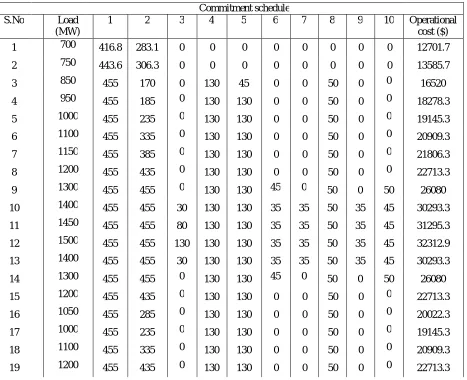
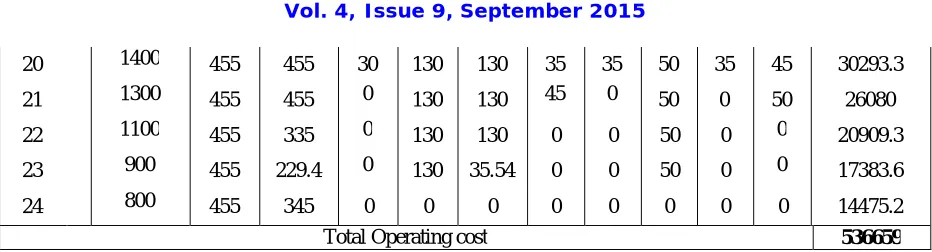
Table 6 shows the allocation of generation to various units based on the daily load pattern and based on the clusters. It can be observed from the table that the clusters only take up the load allotted to them while the other generators do not take up the load until it falls into the other category. The operating costs of the generators taking the load can be observed from the table.
TABLE.6. GENERATION OF UNITS IN 24 HOUR SCHEDULE Commitment schedule
S.No Load (MW)
20 1400 455 455 30 130 130 35 35 50 35 45 30293.3 21 1300 455 455 0 130 130 45 0 50 0 50 26080 22 1100 455 335 0 130 130 0 0 50 0 0 20909.3 23 900 455 229.4 0 130 35.54 0 0 50 0 0 17383.6 24 800 455 345 0 0 0 0 0 0 0 0 14475.2 Total Operating cost 536659
Table 7 shows the comparison in the total operating cost between the proposed method and other clustering methods employed in unit commitment. It can be observed that with the help of the proposed method the total operating cost becomes greatly reduced as compared with the other techniques.
TABLE 7. COMPARISON OF TOTAL OPERATING COST Technique employed Total operating cost
Proposed method Rs 536659/- GASA based clustered UC[22] Rs 541254/- GA based clustered UC[20] Rs 544156/- Conventional GA based UC[7] Rs 565825/-
VI. CONCLUSIONS
The problem of unit commitment has been solved by employing a new PSO based clustering technique. The proposed method is more advantageous and less heuristic. Following load pattern, two individual algorithms based on Additive and Divisive cluster algorithms are proposed for increasing and decreasing load patterns. The operating cost of generation of units is obtained and based on these costs the units are segregated in to clusters. Two separate priorities lists one for increasing and another for decreasing load conditions are prepared based on generation costs. A 10-thermal unit system is considered for simulation study. The simulation results show that the operating cost greatly reduces with this technique and the obtained results are also compared with those of previous techniques. The strategy employed proved to be quite effective and satisfactory as evident through simulation results
REFERENCES
1. Happ. H. H., R. C .Johnson, W. J .Wright, “Large Scale hydro-thermal unit commitment-method and results”, IEEE Transactions on Power Apparatus and Systems, Vol. PAS-90, pp.1373-1383, 1971.
2. K.S.Swarup and S.Yamashiro, “Unit commitment solution methodology using genetic algorithm”, IEEE Tr. on PS, Vol.17, No.1, pp. 87-91, Feb 2002.
3. Dimitris N. Simopoulos, Stavroula D.Kavatza and Costas D.Kavatza and Costas D.Vournas, “Unit Commitment by Enhanced Simulated Annealing Algorithm”, IEEE trans.on Power Systems, Vol.21, No.1, pp. 68-76, Feb 2006.
4. T.Senjyu, H.Yamashiro, K.Uezato and T.Funabasni, “A Unit commitment problem by using genetic Algorithm based on unit characteristic classification”, proceedings of IEEE power Engineering Society winter meeting, Vol. 1, pp. 58 -63, 2002.
5. T. Senjyu, K. Shimabukuro, A Fast technique for unit commitment problem by extended priority list, IEEE Tr.on PS, Vol.18, No.2, May 2003. 6. G. B. Sheble and T. T. Maifeld, Unit commitment by genetic algorithm and expert systems, ESPR, Vol.30, No.2, pp.115-121, 1994.
7. S.A.Kazarlis, A.G.Bakirtzis and V.Petridis, “A genetic algorithm solution to the unit commitment problem”, IEEE Transactions on Power Systems, Vol.11, No 1, pp. 83-91, Feb 1996.
8. Fred N Lee and Qibei Feng, “Multi area unit commitment”, IEEE Transactions on Power Systems, Vol 7, No 2, pp 591-599, May 1992.
9. Sun-Nien Yu, “A Triple-Stage Algorithm for Optimal Unit Scheduling of Thermal Units”, Power systems Conference and Exposition. (PSCE ’09), pp. 1-6, March 2009.
10. K. A. Juste, H. Kitu, E. Tunaka and J. Hasegawa, “An Evolutionary Programming Solution to the Unit Commitment Problem”, IEEE Transactions on Power Systems, Vol. 14, No. 4, pp.1452-1459, Nov 1999.
11. A Rudolf and R Baryrleithner, “A genetic algorithm for solving unit commitment problem of a hydro-thermal power system”, IEEE Transactions on Power Systems, Vol 14, No 4, pp 1460-1468, Nov 1999.
12. Narayana Prasad Padhy, “Unit Commitment-A Bibliographical Survey”, IEEE Transactions on Power Systems, Vol 19, No 2, pp.1196-1205, May 2004.
14. M. Kurban.and U. Basaran Filik, “Unit Commitment Scheduling by Using the Autoregressive and Artificial Neural Network Models Based Short-Term Load Forecasting”, Proc., International Conference on Proc., International Conference on Probabilistic Methods Applied to Power Systems, pp 1-5, May 2008 .
15. Lei Wu, Mohammad Shahidehpour and Tao Li, “Cost of Reliability Analysis Based on Stochastic Unit Commitment”, IEEE Transactions on Power Systems, Vol. 23, No. 3, pp 1364-1374, Aug 2008.
16. Wenping Chang and Xianjue Luo, “A solution to the unit commitment using hybrid genetic algorithm”, TENCON-2008, IEEE Region 10 Conference, pp 1-6, Nov 2008.
17. A Sima Uyar and Belgin Turkay, “Evolutionary algorithms for the unit commitment problem”, Turkish Journal of Electrical Engineering, Vol. 16, No 3, pp.1-16, 2008.
18. Chariklia A.Georgopoulou and Kyriakos C.Giannakoglou, “Two level two objective evolutionary algorithms for solving unit commitment problems”, Applied Energy, 86, pp.1229-1239, 2009.
19. Taher Niknam, Amin Khodaei and Farhad Fallahi, “A new decomposition approach for the thermal unit commitment problem” Applied Energy, 86, pp.1667-1674, 2009.
20. V.C. Jagan Mohan, M. Damodar Reddy, K. Subbaramaiah, “Implementation of clustering based unit commitment employing genetic algorithm”, International Journal of Coimbatore Institute of Information Technology, Vol. 4, No. 12, pp.671-677, Dec 2012
21. V.C. Jagan Mohan, M. Damodar Reddy, K. Subbaramaiah, “Implementation of fast technique for unit commitment based on unit clustering”, International Journal of Energy Technologies and Policy, Vol. 2, No. 7, pp. 54-63, 2012.