High Efficiency Video Coding With Content Split
Block Search Algorithm And Hybrid Wavelet
Transform
Perla Anitha, P. Sudhakara Reddy, M.N.Giri Prasad
Abstract: Nowadays H.265/HEVC is the newest video coding standard. In this Motion Estimation and Compensation, Transformation, scaling, and Quantization and Deblocking filter techniques are playing a major role in HEVC standards. In this paper, Rate-Distortion Performance has been analyzed with various Quantization Parameter values and different frame rates. For Motion Estimation and Compensation analysis using Content Split Block Search Algorithm and analyzed Inter and Intra Prediction techniques with various QP values such as 22,27,32,37. Transformation, Scaling, and Quantization using Hybrid Wavelet Transformation techniques and PSNR and Bit Rate. Subjective analysis is analyzed as well as the content split block search algorithm is implemented with HM 16.7 reference software. Simulation results have been discussed. In this paper, proposed work with Hybrid Wavelet Transform and Content Split Block Search Algorithm is used for results in the form of subjective and objective an alysis, that has been analyzed with different test sequences with YUV PSNR and Bitrate as comparing with Random Access profile and Low Delay profile, and also comparing with Luo's, HM 11 and PVC with different QP values such as 22,27,32,37.
Index Terms: Blocking artefacts, Content, Deblocking Filter, Hybrid Wavelet Transform, Motion Estimation, QP, scaling and Quantization,
—————————— ——————————
1 INTRODUCTION
By the processing of the Video, the content has to be capture with wide immersion for many applications [1] [2]. It's confidential as feature content and texture content. The textural content has to analyze for video processing [3]. This is a novel way of video codec analysis [4]. High Efficiency Video Coding is novel Video Coding Standard [7]. Its performance in terms of coding efficiency is dominantly existing with video coding standard [5][6]. However cost of the complexity standard has to be associated with the encoding scheme.[8] In general encoding process associate with redundant activity, where the process has to be carried out with several times over several qualities with HEVC encoders[9][10]. A video is a sequence of still images displayed at a fixed frame rate. The net follow-up is a video with objects moving in a background [13]. If all the pictures (frames) in the video are encoded individually, then the size of the complete video will be equal to the sum of the bits obtained from each frame [26]. This is practically not possible for large videos either in storage or communication applications [23]. Hence there is a huge necessity to remove the redundant information in a video [24] [25].
1.1.Block Based video Coding:
Block based video coding, the sequence of images is compressed by dividing each frame into blocks. Each block is then motion compensated (predicted using previously coded neighboring blocks), transform coded, quantized and finally entropy coded (removes statistical redundant information). Each of these techniques are explained in the subsequent sections. The decoder receives these coded blocks and generates frames which are displayed at a fixed frame rate [12], [13]. Besides block based coding there are many other types of video coding like pixel-based video coding, content based video coding, fractal based video coding etc.[14][15][16]. But the block based video coding is the most widely used and efficient way of implementing a video codec either in software or in real-time due to its regularity in the coding structure [17][18]. Some of examples of block based codecs include MPEG based codecs like MPEG-1, MPEG-2, MPEG-4, VCEG based codecs H.261, H.263 and their joint collaborated codecs like H.264, HEVC, etc. [19][20] In this
work, the main objective is frame representation of image information of H.265/HEVC is wrapped up with Multi-Rate Motion Estimation Technique with Hybrid Wavelet Transform [21][22].
2 LITERATURE SURVEY
957
intra Luma blocks, that adopted in July 2012 Simulation results has to analyzed with DCT/DST algorithm are shown with HEVC standardization software. In this work, BD-rate has comparing with the conventional DCT based scheme for the Intra Prediction Sequences. DST/DCT transform scheme applies either DCT or DST (Type-7) for all the intra prediction video coding standard such as Vertical and Horizontal, especially to get down complexity.
3
PROPOSED METHODS:
In this paper, two proposed algorithms has been discussed. in that one is Hybrid Wavelet Transform and other is Content Split Block Search Algorithm.
3.1 Hybrid Wavelet Transform:
Video fragments are consolidated in numerous applications with the help of current correspondence innovation. The correspondence models take a shot at top notch assets like data measure without hurting the substance of the video. This depends on the structure of the video. For mobile applications with video communication, for a video communication in mobile applications, the video in its full form should be transferred to a different finish and the video compression has numerous standards. A video could be an assortment of frames should be shrink to a low bit rate level without harming the content and which means of the structure.
Fig: 01 Block Diagram of Hybrid Wavelet Transform
For instance, to store and transfer an image 1024 bytes are required and it has to be reduced by compression. The frames of a video phase are a lot of connected and have to a small degree quantity of changes within the pixels of the frames. For one video phase, there are some frames in keeping with the sort of the video. There are unit high redundancies within the same frame, the spatial redundancies, and among continuous frames, the sequential redundancies. The video compressions strategies are often classified as object primarily based, wave form primarily based, model primarily based and pattern primarily based. The object-based compression is performed by extracting the objects from the video frame and their shape and texture are obtained for coding obtained which is able to be coded otherwise. The compression magnitude relation of
every object is entirely different and yield reasonable compression magnitude relation. In wave type technique, the video frame is reworked to a tiny size of a frame while not missing any feature; this operation additionally achieves high degree of compression. The model-based compression performs 3D structural analysis to compress the frames, and the fractal-based strategies use image committal to writing strategies to compress the video frames. The wavelet transformed image is applied with background subtraction, and the foreground object is used to generate object map. The object map consists of various features and neighbours connected appropriately. The set of object maps between subsequent frames of the scene are computed to identify the difference between them. Generated object maps and variance are used to transmit the image to the other side of the communication. This method generates object maps for each frame, and from the object map, the distance between the previous frames maps is computed. Based on the distance value and map reduction threshold value, a covariant matrix is computed. The reduced features are transmitted to the other end to undergo video decompression. The computed covariance matrix shows the difference between subsequent frames which is computed using object maps. Certain relevant pixels of the images are kept alive, and others are neutralized to perform wavelet transform.
3.2 Content Split Block Search Algorithm
Motion estimation and compensation process is implemented with content split block search algorithm with two layer approach such content search and block search is proposed in this work. its operating directly on compressed bit stream. By resolving content guidance I P B Frames, content of block –based video processing was achieved. Furthermore Modification was done with prediction and also having larger magnitude. It is equal to the content data essentially in the region areas of content on edge, for smooth regions the modifications are small or similarly to zero value, so that high imperceptibility was achieved. First, analyze the presence of content features in video frame, which is when the video signal is less robust to noise. Second, we analyze the specialties of the HEVC block structure in the case of multiple encodings at different SNR qualities with more or less quantization levels. And based on these, the block structure is reused form a high quality reference representation to speed up the dependent encoding of lower quality representations. We implement and assess the proposed method based on the reference HEVC software, it is clearly discussed in earlier papers referred in anitha et.all [13][16] and show that can significantly reduce the encoding time for multiple HEVC representations without notably degrading the rate distortion performance.
4. RESULTS AND DISCUSSIONS:
Table 01: Parameters to be considered for proposed work
Classification Size(W: H)
Sequence No. of Frames Frame Rate (fps)
Class A 2560:1600 PeopleStreet 150 30
Class B 1920:1080 Cactus 240 24
Class C 832:480 BQTerrace 600 60
Class D 416:240 BasketballPass 500 50
4.1 Motion Estimation Result Analysis for HEVC:
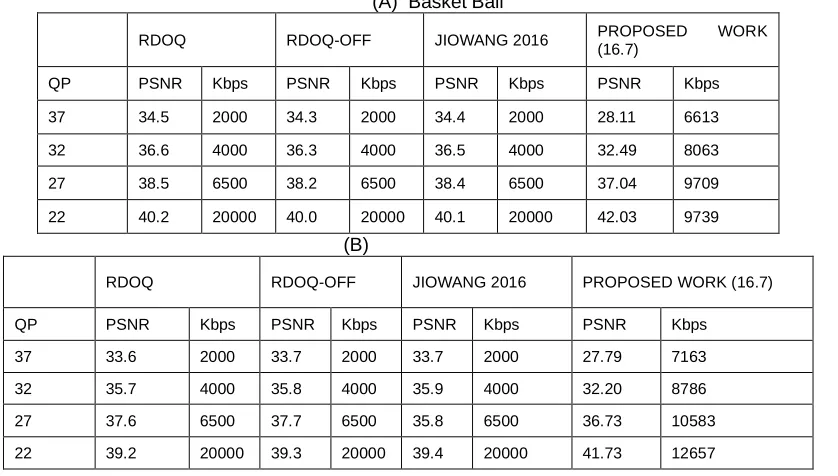
The above results are considered to Basketball Video Sequence with different QP value in the perspective of RDOQ, RDOQ-OFF with JIOWANG et.all. It is observed that as the QP is increasing PSNR is decreasing as well as Bytes written
in the file and Bit rate is
Increased for each (22, 27, 32 and 37) QP value. When the QP size is Small PSNR 40 dB JIOWANG et.all and where as in the proposed work it achieves more than 2dB.
Table 3: RD Performance comparison with JIO-WANG (2016) (A) Basket Ball
RDOQ RDOQ-OFF JIOWANG 2016 PROPOSED WORK
(16.7)
QP PSNR Kbps PSNR Kbps PSNR Kbps PSNR Kbps
37 34.5 2000 34.3 2000 34.4 2000 28.11 6613
32 36.6 4000 36.3 4000 36.5 4000 32.49 8063
27 38.5 6500 38.2 6500 38.4 6500 37.04 9709
22 40.2 20000 40.0 20000 40.1 20000 42.03 9739
(B) Cactus
RDOQ RDOQ-OFF JIOWANG 2016 PROPOSED WORK (16.7)
QP PSNR Kbps PSNR Kbps PSNR Kbps PSNR Kbps
37 33.6 2000 33.7 2000 33.7 2000 27.79 7163
32 35.7 4000 35.8 4000 35.9 4000 32.20 8786
27 37.6 6500 37.7 6500 35.8 6500 36.73 10583
22 39.2 20000 39.3 20000 39.4 20000 41.73 12657
The above results are considered to Cactus Video Sequence with different QP value in the perspective of RDOQ, RDOQ-OFF with JIOWANG et.all. It is observed that as the QP is increasing PSNR is decreasing as well as Bytes written in the file and Bit rate is increased for each (22, 27, 32 and 37) QP value. When the QP size is small PSNR 39.2 dB JIOWANG et.all and where as in the proposed work it achieves more than 1. 5 dB. From the above
959
4.1.1 Low delay configuration: In low-delay configuration, only the first frame is encoded as IDR picture. There are two delay configurations that are supported by HEVC. One is low-delay configuration (or low-low-delay B configuration) and the other is low-delay-P configuration, which is treated as optional configuration. The difference between low-delay configuration and low-delay P
Configuration is, in low-delay P mode all the frames in a GOP are taken as P-pictures only while in low-delay mode all the frames in a GOP are taken as Generalized P and B pictures (GPB) only. In both these configurations the first frame is encoded as IDR picture. The QP for each inter coded picture is derived by adding an offset to configuration.
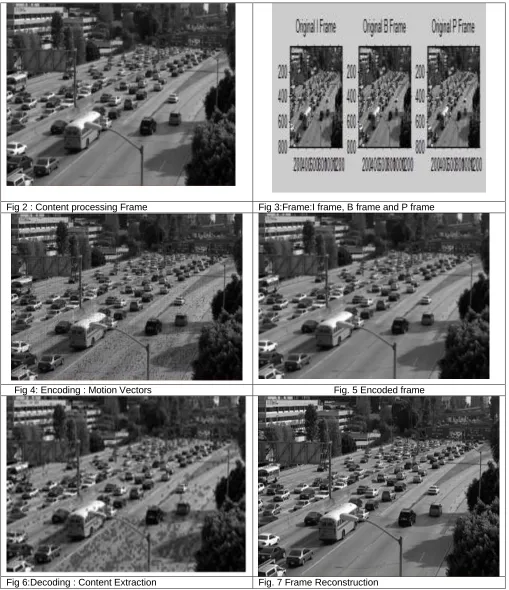
Fig 2 : Content processing Frame Fig 3:Frame:I frame, B frame and P frame
Fig 4: Encoding : Motion Vectors Fig. 5 Encoded frame
Table:4 Objective Test Results PSNR in terms of dB and Bit rate in terms of Kbps for HM 11,LUO's,PVC scheme and Proposed HM16.7 under Low-Delay Main profile
Sequence QP HM 11 in dB Luo's in dB PVC in dB Proposed in dB HM 11 In Kbps Luo's In kbps PVC In kbps Proposed In kbps BQTerrace (1920x1080) 22 27 32 37 38.24 35.4 33.58 31.37 36.85 35.23 33.53 31.37 35.7 34.77 33.37 31.36 40.06 34.69 29.32 23.81 52793 7558 1990 761 32653 6437 1953 760 16788 5273 1918 760 5446 4476 3536 2729 Cactus (1920X1080) 22 27 32 37 38.69 36.7 34.56 32.26 38.35 36.62 34.55 32.25 37.35 36.21 34.47 32.25 39.18 37.24 32.75 27.52 20028 5730 2571 1268 16562 5629 2569 1269 12483 5327 2551 1267 5761 4779 3873 2896 ParkScene (832X420) 22 27 32 37 39.91 36.91 34.18 31.59 39.53 36.92 34.18 31.59 38.14 36.43 34.13 31.59 42.16 37.22 31.80 27.48 7961 3169 1333 576 7492 3125 1332 576 6280 2979 1323 576 5701 4780 3777 3044 BQMall (832X420) 22 27 32 37 40.12 37.25 34.28 31.38 39.32 36.99 34.24 31.28 37.61 36.25 34.09 31.37 42.24 36.40 32.00 27.54 4200 1871 903 458 3888 1830 899 458 3292 1758 895 457 5764 4635 3842 3094 PartyScene (832X420) 22 27 32 37 38.4 34.53 31.05 27.81 36.36 33.87 30.9 27.8 33.91 32.97 30.8 27.8 41.46 36.51 31.51 27.45 8054 3447 1504 644 7174 3292 1483 642 5793 3111 1484 643 5860 4855 3909 3193
4.1.2 Random Access Configuration: In random access configuration, a hierarchical B-structure is used for encoding. As shown in the figure the frames are divided into different layers – L1 to L4. The first picture is encoded as IDR picture. The second picture in the following first pictures is encoded as GPB picture, that can
Refer (for inter prediction) to I-frames or any other GPB pictures. The pictures in the rest of the layers are B-pictures. The pictures in the last layer are non-referenced B-pictures (that are not used as reference frames for any other frames.
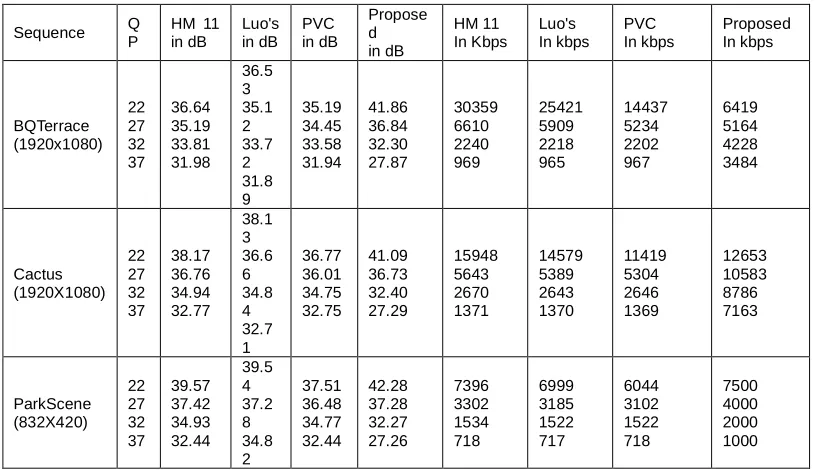
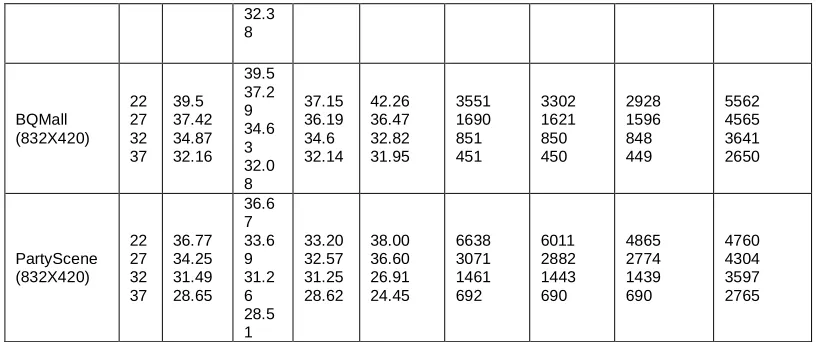
Table 5 Objective Test Results PSNR in terms of dB and Bit rate in terms of Kbps for HM 11, LUO's, PVC scheme and Proposed HM16.7 under Random Access Profile
Sequence Q P
961 32.3
8
BQMall (832X420)
22 27 32 37
39.5 37.42 34.87 32.16
39.5 37.2 9 34.6 3 32.0 8
37.15 36.19 34.6 32.14
42.26 36.47 32.82 31.95
3551 1690 851 451
3302 1621 850 450
2928 1596 848 449
5562 4565 3641 2650
PartyScene (832X420)
22 27 32 37
36.77 34.25 31.49 28.65
36.6 7 33.6 9 31.2 6 28.5 1
33.20 32.57 31.25 28.62
38.00 36.60 26.91 24.45
6638 3071 1461 692
6011 2882 1443 690
4865 2774 1439 690
4760 4304 3597 2765
The above Tables 2 and 3 has shown objective test results for the proposed work with Hm 16.7. Simulation results has evaluated with Original HM11 with Random Access Main Profile and Low Delay Main Profile. YUV PSNR is achived nearly 4dB with QP 22, and also noticeable bitrate reduction is possible. When QP 32,37 is not improved with existing. Test sequences has taken for obsering the objective analysis in terms of YUV PSNR and also Bitrate performed with those test sequences such as BQTerrae(1920x1080), Cactus(1920x1080),PartyScene(832X420),Parkscene(832X42 0),RaceHorses(832X420). A content block is analyzed in the video. Group Of Pictures of Test sequences such as People on Street, Cactus, BQ Terrace, Basketball Pass and so on in the form I Frame, B Frame and P Frame are shown in the below figure 3.Those frames has been represented in the form of gray scale format and residual images has been stretched by 30 times for the display. Analyzed Block extraction is listed in terms of various parameters such as PSNR in dB, and Bit rate in Kbps are shown in Table 2 and 3.
5
CONCLUSION
Subjective analysis as well as content split block search algorim is implemented with HM 16.7 reference software. Simulations The Proposed Algorithm is Content Split Block Search algorithm using with content and block mode searching in the Inter and Intra prediction modes. In this process it has been improved RD performance with YUV PSNR with Bitrate in terms of different QPs such as 22,27,32,37. Transformation and Quantization process and also improved decoding time as comparing with HM Tool 12, 15 with HM 16.7. In this paper, proposed work, Hybrid wavelet transform and content split block search algorithm for the results has been analyzed with different test sequences with YUV PSNR and Bitrate as comparing with Random Access profile and Low Delay profile, and also comparing with Luo's, HM 11 and PVC with different QP values such as 22,27,32,37.
REFERENCES
[1] Philipp Helle, Haricharan Lakshman, Mischa Siekmann, Jan Stegemann, Tobias Hinz, Heiko Schwarz, Detlev Marpe, and Thomas Wiegand, “A Scalable Video Coding Extension of HEVC,” in Data Compression Conference (DCC), Snowbird, UT, USA, Mar. 2013.
[2] Andr´e Zaccarin and Boon-Lock Yeo, “Multi-rate encoding of a video sequence in the DCT domain,” in IEEE
International Symposium on Circuits and Systems, ISCAS 2002, May 2002.
[3] ISO/IEC 23009-1, “Information technology - Dynamic adaptive streaming over HTTP (DASH) - Part 1: Media Presentation description and segment formats,” Tech. Rep., Apr. 2012
[4] Dag Haavi Finstad, Hakon Kvale Stensland, H°avard Espeland, and P°al Halvorsen, “Improved multi-rate video encoding,” in IEEE International Symposium on Multimedia (ISM), Dana Point, CA, USA, Dec. 2011. [5] D. H. Finstad, H. K. Stensland, H. Espeland, and P.
Halvorsen, “Improved multi-rate video encoding,” in Proc. IEEE International Symposium on Multimedia (ISM), Dana Point, CA, USA, Dec. 2011.
[6] S. Wang, S. Ma, S. Wang, D. Zhao, and W. Gao, “Rate-GOP based rate control for high efficiency video coding,” IEEE Journal of Selected Topics in Signal Processing, vol. 7, no. 6, pp. 1101–1111, Dec. 2013.
[7] B. Li, H. Li, L. Li, and J. Zhang, “Lambda domain rate control algorithm for high efficiency video coding,” IEEE Transactions on Image Processing, vol. 23, no. 9, pp. 3841–3854, Sep. 2014.
[8] Y. Chen, Z. Wen, J. Wen, M. Tang, and P. Tao, “Efficient Software H. 264/AVC to HEVC Transcoding on Distributed Multi-Core Processors,” IEEE Transactions on Circuits and Systems for Video Technology, vol. 25, no. 6, pp. 1423–1434, Aug. 2015.
[9] A. Diaz-Honrubia, J. Martinez, P. Cuenca, J. Gamez, and J. Puerta, “Adaptive Fast Quadtree Level Decision Algorithm for H. 264/HEVC Video Transcoding,” IEEE Transactions on Circuits and Systems for Video Technology, vol. 26, no. 1, pp. 154–168, Jan. 2016.
[10] L. P. Van, J. De Cock, A. J. Diaz-Honrubia, G. Van Wallendael, S. Van Leuven, and R. Van de Walle, “Fast motion estimation for closed loop HEVC transrating,” in Proc. IEEE International Conference on Image Processing (ICIP), Paris, France, Oct. 2014, pp. 2492–2496.
[11] Apple. Using HTTP Live Streaming. [Online]. Available: http://goo.gl/fJIwC
[12] Netflix. Per-Title Encode Optimization. [Online]. Available: http://techblog.netflix.com/2015/12/per-title-encode-optimization.html
Sciences Publication’ which has published in ‘International Journal of Recent Technology and Engineering (IJRTE)’, ISSN: 2277-3878 (Online), Volume-8 Issue-2, July 2019.Page No.: 2855-2860.
[14] J. De Praetor, A. J. Diaz-Honrubia, N. Van Kets, G. Van Wallendael, J. De Cock, P. Lambert, and R. Van de Walle, “Fast simultaneous video encoder for adaptive streaming,” in Proc. IEEE International Workshop on Multimedia Signal Processing (MMSP), Xiamen, China, Oct. 2015. [15] T. Wiegand, G. Sullivan, B. Bjontegard, and A. Luthra,
“Overview of the h.264/avc video coding standard,” IEEE Trans. on Circuits and Systems for Video Technology, vol. 13-7, pp. 560–576, July 2003.
[16]Perla Anitha, P. Sudhakara Reddy, M. N. Giri Prasad “Content Split Block Search Algorithm based HEVC”, published from Editorial Board of Journal of Scientific and Industrial Research (JSIR) ISSN: 0975-1084 (online); 0022-4456 (print), Science Citation Index (E).
[17] Sima Valizadeh, Panos Nasiopoulos and Rabab Ward, "Perceptually-Friendly Rate Distortion Optimization In High Efficiency Video Coding", 23rd European Signal Processing Conference (EUSIPCO), 2015 IEEE.
[18] Liquan Shen, Zhaoyang Zhang, and Zhi Liu, "Effective CU Size Decision for HEVC Intracoding", IEEE Transactions On Image Processing, VOL. 23, NO. 10, OCTOBER 2014, pp-4232-4241.
[19] Sung-Ho Bae, Jail Kim, and Munchurl Kim HEVC-Based Perceptually Adaptive Video Coding Using a DCT-Based Local Distortion Detection Probability Model IEEE TRANSACTIONS ON IMAGE PROCESSING, VOL. 25, NO. 7, JULY 2016
[20] Yin H, Cai H, Yang E, Zhou Y, Wu J. Signal Processing : Image Communication "An efficient all- zero block detection algorithm for high-efficiency video coding with RDOQ". Signal Process Image Commun. 2018;60(September 2017):79-90. DOI:10.1016/j.image.2017.09.004.
[21] Zhao T, Wang Z, Chen CW. Adaptive Quantization Parameter Cascading in HEVC Hierarchical Coding. IEEE Trans Image Process. 2016 25(7):2997-3009. DOI:10.1109/TIP.2016.2556941.
[22]Jou SY, Chang SJ, Chang TS. Fast Motion Estimation Algorithm and Design for Real-Time QFHD High-Efficiency Video Coding. IEEE Trans Circuits Syst Video Technol. 2015;25(9):1533-1544.
[ 2 3 ] C. Fehn, “Depth-image-based rendering (DIBR), compression, and transmission for a new approach on 3D-TV,” Proc. SPIE, vol. 5291, pp. 93–104, May 2004.
[ 2 4 ] H. Yuan, S. Kwong, C. Ge, X. Wang, and Y. Zhang,
“Interview rate
distortion analysis-based coarse to fine bit allocation
algorithm for 3-D
video coding,” IEEE Trans. Broadcast., vol. 60, no. 4, pp. 614–625,
Dec. 2014.
[ 2 5 ] L. Fang, N.-M. Cheung, D. Tian, A. Vetro, H. Sun, and O.
C. Au,
“An analytical model for synthesis distortion estimation in
3D video,”
IEEE Trans. Image Process., vol. 23, no. 1, pp. 185–199, Jan. 2014.
[ 2 6 ] Shiba Kuanar1 · K. R. Rao1 · Monalisa Bilas2 · Jonathan