ANALGESIC AND ANTIINFLAMMATORY ACTIVITY OF
LEAF EXTRACTS OF Commiphora caudata IN RODENTS.
Mohan CG 1, Savinay Gokavi 2, GL Viswanatha 3 *,Shylaja.H 4,K. Nandakumar 5
1
Department of Pharmacognosy, Govt. College of Pharmacy, Subbaiah Square Bangalore-27
2
Department of Pharmaceutics, Govt. College of Pharmacy, Subbaiah Square Bangalore-27.
3
Department of Pharmacology , PES College of Pharmacy ,Hanumanthanagar, Bangalore-50.
4
Department of Pharmacognosy , PES College of Pharmacy ,Hanumanthanagar, Bangalore-50.
5
Department of Pharmacology , Manipal College of Pharmaceutical Sciences ,Manipal-.576 104
Summary
The present study was undertaken to evaluate the analgesic and anti-inflammatory activity of
Alcoholic (70%) and Aqueos extracts of leaves of Commiphora caudata in rodents. The dried
powder of the leaves was initially extracted with 70% Alcoholic (ALCC) and Water (AQCC) successively. Acute oral toxicity of ALCC and AQCC were conducted as per OECD guidelines 425. Acute toxicity studies revealed that both the extracts are safe upto 2000mg/kg.The extracts were evaluated for Analgesic activity with formalin induced paw licking test in mice using Pentazocin (2mg/kg,i.p.) as a standard and Anti-inflammatory activity was evaluated with carrageenan induced rat paw edema model in wistar rats using Diclofenac (15mg/kg,i.p) a standard. Acute toxicity results have revealed that both ALCC and AQCC were safe upto 2000 mg/kg dose. In formalin induced paw licking test ALCC at 100, 200 and 400mg/kg , AQCC at 200 and 400mg/kg have showed significant inhibition of paw licking in both early and late phase of the formalin test when compare to control group ; In carrageenan induced rat paw edema model ALCC at 200 and 400mg/kg , AQCC at 400mg/kg have showed significant inhibition in carrageenan induced rat paw when compare to control group, these observations suggests that ALCC and AQCC possess good analgesic and antiinflammatory activity but the Alcoholic is more potent when compare to Aqueous extract.
Keywords: Commiphora caudata, Anti-inflammatory, Analgesic, Carragenan induced rat paw edema. , Formalin induced paw licking test.
_________________________________________________________________________________________
Correspondance:
Mr.G.L.Viswanatha .M.Pharma Scientist
Preclinical Pharmacology and Toxicology Connexios Life sciences Pvt Ltd
J.P.Nagar , Bangalore
Introduction
Inflammation is a chronic disease, which involves (a) increase of vascular permeability resulting in
exudation of fluid from blood into the interstitial space (b) infiltration of leucocytes from the blood
into the tissues and (c) granuloma formation [1]. Currently drugs like opioid analgesics,
corticosteriods, NSAID’s and immunosuppressive agents are used to control the symptoms of
inflammation and pain [2]. The use of these drugs will produce certain side effects like respiratory
depression, sedation, constipation, tolerance, spasm, gastrointestinal disturbances, renal and
hepatic damage, bone marrow depression, suppression of response to infection or injury,
osteoporosis, development of Cushing’s syndrome etc [2].
Natural products in general and medicinal plants in particular are believed to be an important
source of new chemical substances with potential therapeutic efficacy. Taking into account that the
most important analgesic prototypes (e.g. salicylic acid and morphine) were originally derived
from the plant sources, the study of plant species traditionally used as pain killers should still be
seen as a fruitful research strategy in the search of new analgesic and anti inflammatory drugs [3].
Commiphora caudata (Burseraceae) an ethno medicinal plant found in India and Srilanka, The
various parts of Commiphora caudata namely Bark, Leaves has been used in the folk medicine for
treating vata, pitta, diabetes, low back pain, sciatica, fever, arthritis and urinary retention[4][5][6].
Materials And Methods
Drugs and chemicals
All the solvents used for the extraction process are of Laboratory grade. Pentazocin
(Cadila, Genstar), Diclofenac (Novartis, NJ), Carrageenan (SD Fine chemicals. Mumbai),
Formalin (SD Fine chemicals. Surat).
Plant extraction
The leaves of the plant was collected in the month of May – June 2008 and authentified by
Dr.K.P.Sreenath, Reader and Taxonomist, Botany Department from Bangalore University. A
The coarse powder was subjected to extraction with alcohol (70%) in soxhelet apparatus and marc
obtained after the alcoholic extraction was macerated with water to obtain aqueous extract. The
percentage yield of alcoholic and aqueous extract was found to be 18.66% and 12% respectively.
Experimental animals
Wistar albino rats of either sex weighing 150–200 gm and albino mice of either sex weighing 20–
25 gm were used for anti-inflammatory and analgesic activities respectively. They were housed in
standard environmental conditions and fed with standard rodent diet with water ad libitum. All
animal procedures were followed in accordance with the approved protocol for use of experimental
animals set by the Institutional Animal Ethical Committee. Six groups of six animals were used for
each experiment.
Acute oral toxicity
Acute oral toxicity of alcoholic and aqueous extracts of leaves of Commiphora caudata was
determined by using female, nulliparous and non pregnant mice weighing 18-22 g. The animals
were fasted for 3 hrs prior to the experiment. Up and down procedure OECD guideline no. 425
was adopted for toxicity studies. Animals were administered with single dose of extract and
observed for their mortality during 48 hours study period (short term) toxicity. LD50 was calculated
as per OECD guidelines 425 using AOT 425 software [7].
Analgesic activity
Formalin induced paw licking test
100, 200 and 400 mg/kg of the AACC and AQCC were administered to mice by oral route and
animals of the control group received only vehicle control (3% Tween 80). Pentazocin 2mg/kg ,i.p
was used as standard. Fifteen minutes later, the analgesic activity was determined using formalin
test described by Dubuisson and Dennis [8]. 50µl of 2.5% formalin was injected into the dorsal
surface of the left hind paw. The mice were observed for 30 min after the injection of formalin,
and the number of lickings during the 30 mins observation period was recorded. The first 10 min
post formalin injection is known as the early phase and the period between 15 and 30 min is
Anti-inflammatory activity
Carrageenan-induced rat paw edema
Animals were fasted for 24 h before the experiment with free access to water. Approximately 50
µl of a 1% suspension of carrageenan in saline was prepared 1h before each experiment and was
injected into the plantar surface of right hind paw of the animal. 100, 200 and 400 mg/kg of the
AACC and AQCC were administered to animals by oral route. Animals of the control group
received vehicle control (3% Tween 80). Diclofenac (15mg/kg, i.p.) was used as a standard.
Vehicle control, Extract and standard were administered to respective group of animals 1h before
the carrageenan injection, Paw volume was measured immediately after carrageenan injection and
at 1h, 2h, 3h and 4-h intervals after the administration of the noxious agent by using a
plethysmometer (model 7159, Ugo Basile arese, Italy) [11][12].
Statistical analysis
Values are expressed as mean ± SEM from 6 animals. Statistical differences in mean were
analyzed using one way ANOVA (analysis of variance) followed by Dunnett’s test. p<0.05 was
considered significant.
Results
Acute toxicity
Acute toxicity studies was conducted in albino mice according to OECD guidelines no.425 and it
is found that both alcoholic and aqueous extracts were safe upto 2000 mg/kg.
Analgesic activity
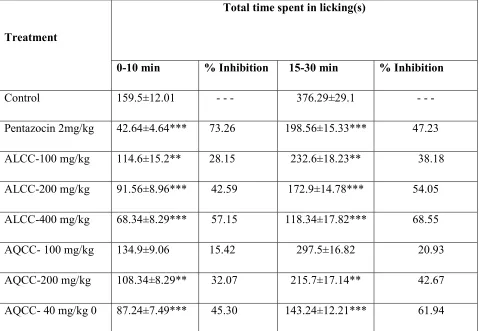
In Formalin induced paw licking test the ALCC at 100, 200, 400 mg/kg and AQCC at 200 and
400 mg/kg have showed significant inhibition in number of lickings in both early phase (0-10
Table 1. Analgesic effect of leave extracts of Commiphora caudata on the Formalin induced
paw licking test.
Total time spent in licking(s)
Treatment
0-10 min % Inhibition 15-30 min % Inhibition
Control 159.5±12.01 - - - 376.29±29.1 - - -
Pentazocin 2mg/kg 42.64±4.64*** 73.26 198.56±15.33*** 47.23
ALCC-100 mg/kg 114.6±15.2** 28.15 232.6±18.23** 38.18
ALCC-200 mg/kg 91.56±8.96*** 42.59 172.9±14.78*** 54.05
ALCC-400 mg/kg 68.34±8.29*** 57.15 118.34±17.82*** 68.55
AQCC- 100 mg/kg 134.9±9.06 15.42 297.5±16.82 20.93
AQCC-200 mg/kg 108.34±8.29** 32.07 215.7±17.14** 42.67
AQCC- 40 mg/kg 0 87.24±7.49*** 45.30 143.24±12.21*** 61.94
Values are mean+S.E.M; n=6; ** P< 0.01 and ***p<0.001 as compared to the control
Anti-inflammatory activity
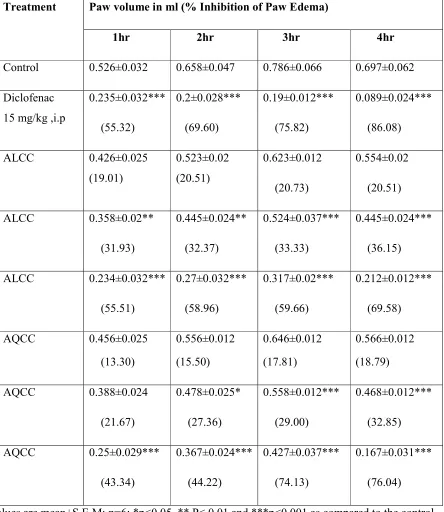
In Carrageenan - induced paw edema test the ALCC at 200, 400 mg/kg and AQCC at 400 mg/kg
have) showed significant reduction in paw volume (% Inhibition of paw edema) when compared to
the control group receiving vehicle control (3% Tween 80). The results of anti-inflammatory
Table 2. Anti-inflammatory effect of leave extracts of Commiphora caudata on
Carrageenan - induced paw edema.
Paw volume in ml (% Inhibition of Paw Edema) Treatment
1hr 2hr 3hr 4hr
Control 0.526±0.032 0.658±0.047 0.786±0.066 0.697±0.062
Diclofenac
15 mg/kg ,i.p
0.235±0.032*** (55.32) 0.2±0.028*** (69.60) 0.19±0.012*** (75.82) 0.089±0.024*** (86.08)
ALCC 0.426±0.025
(19.01) 0.523±0.02 (20.51) 0.623±0.012 (20.73) 0.554±0.02 (20.51) ALCC 0.358±0.02** (31.93) 0.445±0.024** (32.37) 0.524±0.037*** (33.33) 0.445±0.024*** (36.15) ALCC 0.234±0.032*** (55.51) 0.27±0.032*** (58.96) 0.317±0.02*** (59.66) 0.212±0.012*** (69.58)
AQCC 0.456±0.025
(13.30) 0.556±0.012 (15.50) 0.646±0.012 (17.81) 0.566±0.012 (18.79)
AQCC 0.388±0.024
(21.67) 0.478±0.025* (27.36) 0.558±0.012*** (29.00) 0.468±0.012*** (32.85)
AQCC 0.25±0.029***
(43.34) 0.367±0.024*** (44.22) 0.427±0.037*** (74.13) 0.167±0.031*** (76.04)
Discussion
The formalin induced paw licking test is a valid and reliable model for analgesic activity and it is
sensitive for various classes of analgesic drugs. Formalin test produces a distinct biphasic response
and different analgesics may act differently in the early and late phases of this test. Therefore, the
test can be used to clarify the possible mechanism of antinociceptive effect of a proposed analgesic
drug [10]. Centrally acting drugs such as opioids inhibit both phases equally [11] but peripherally
acting drugs such aspirin, indomethacin and dexamethasone only inhibit the late phase. The late
phase seems to be an inflammatory response with inflammatory pain that can be inhibited by
anti-inflammatory drugs [12]. The effect of topical preparation containing extract on the first and late
phase of formalin induced paw licking test suggests that its activity may be because of its central
action.
From these results, we can conclude that the Alcoholic (100, 200 and 400 mg/kg) and aqueous
(200 and 400 mg/kg ) extracts of Commiphora caudata possesses good analgesic effect; where as
the anti-inflammatory studies have revealed that the Alcoholic extract ( 200 and 400 mg/kg) and
aqueous (200 and 400 mg/kg ) extracts of Commiphora caudata possess good anti-inflammatory
activity.
Acknowledgment
The authors are thankful to Prof.Dr.S.Mohan, Principal and management of P.E.S.College of
pharmacy for providing all necessary facilities to carry out the research work. Special thanks to
Dr.K.P.Sreenath, Reader in Botany, Bangalore University for authentifying the plant material.
References
1. Ritter JM. Anti-inflammatory and immunosuppressive drugs. In: Pharmacology edited by
Rang HP, Dale MM, Churchill Livingston, Edinburgh 2000: 229-232
2. Haslett C, Chilvers ER, Boon NA, Colledge NR, Hunter JA. Side effects of NSAIDS.In:
Davidson’s Principles and Practice of Medicine. Churchill Livingstone, Edinburgh 2002:989-990.
3. Shanmugasundaram P and Venkataraman S. Antinociceptive activity of Hygrophila auriculata
(schum) heine. Afr J Trad Complem Alter Med. 2005; 2: 62-69.
4. Prajapathi, Purohit, Sharma, Kumar. In: A hand book of medicinal plants Jodhpur:Dr.Upadesh
purohit for Agrobios (India):2003.p.306-7 (sec II).
5. Nadkarni KM, Nadkarni AK, Editors. Indian Materia Medica; Bombay; Popular prakashan:
6. Deepa VS, Kumar PS, Latha S, Selvamani P., Srinivasan S. Antioxidant studies on the
ethanolic extract of Commiphora spp. African Journal of Biotechnology 2009; 8 (8), pp.
1630-1636,
7. OECD 2001-gudeline on acute oral toxicity (AOT) Environmental health and safety
monograph series on testing and adjustment No.425.
8. Dubuisson D, Dennis SG. The formalin test : a quantitative study of the analgesic effects of
morphine, epedrine, and brain stem stimulation in rats and cats. Pain 1977; 4:161.
9. Shibata M, Ohkubo T, Takahashi H, Inoki R. Modified formalin test characteristic biphasic pain response. Pain 1989; 38: 347.
10.Rosland JH, Tjoisen A, Maehle B, Hole K. The formalin test in mice:effect of formalin concentration. Pain 1990; 42: 235.
11.Vogel GH, Vogel WH, Scholkens BA, Sandow J, Muller G, Vogel WF. Pharmacological
assays. In: Drug discovery and evaluation, 2nd ed. Springer-Verlag, Berlin, 2002:725-772.
12.Niemegeer CJE, Verbruggen FJ, Janssen PAJ. Effect of various drugs in carrageenan-induced