49 Malaysian Association of Education in Medicine and Health Sciences and
Penerbit Universiti Sains Malaysia. 2019
RESOURCE
Volume 11 Issue 2 2019
DOI: 10.21315/eimj2019.11.2.6
ARTICLE INFO
Submitted: 10-03-2019 Accepted: 26-04-2019 Online: 28-06-2019
CORRESPONDING AUTHOR Associate Professor Dr. Muhamad Saiful Bahri Yusoff, Department of Medical Education, School of Medical Sciences, Universiti Sains Malaysia, 16150 Kubang Kerian, Kelantan, Malaysia | E-mail: [email protected]
INTRODUCTION
There are five sources of validity evidence that are content, response process, internal structure, relation to other variables, and consequence (1). Content validity is defined as the degree to which elements of an assessment instrument are relevant to and representative of the targeted construct for a particular assessment purpose (1, 2). An assessment instrument refers to the particular method of acquiring data in psychological assessment such as questionnaires. The elements of an assessment instrument refer to all aspects of the measurement process that can affect the data obtained such as questionnaire items, response formats and instructions. The construct refers to the concept, attribute, domain, or variable that is the target of measurement. The assessment
purpose refers to the expected functions of the measurement tool, for examples, the Medical Student Stressor Questionnaire (MSSQ) was developed to identify the sources of stress in medical students (3) and the Anatomy Education Environment Measurement Inventory (AEEMI) was developed to measure the anatomy educational environment in medical schools (4). The relevance of an assessment tool refers to the appropriateness of its elements for the targeted constructs and functions of assessment, while the representativeness of an assessment tool refers to the degree to which its elements proportional to the facets of the targeted construct (2). Despite the two aspects of content validity (i.e., relevant and representativeness of an assessment tool), the relevant of an assessment tool that was advocated by Davis (5) has been frequently used to measure
To cite this article: Yusoff MSB. ABC of content validation and content validity index calculation. Education in Medicine Journal. 2019;11(2):49–54. https://doi.org/10.21315/eimj2019.11.2.6
To link to this article: https://doi.org/10.21315/eimj2019.11.2.6
ABSTRACT
There are five sources of validity evidence that are content, response process, internal structure, relation to other variables, and consequences. Content validity is the extent of a measurement tool represents the measured construct and it is considered as an essential evidence to support the validity of a measurement tool such as a questionnaire for research. Since content validity is vital to ensure the overall validity, therefore content validation should be performed systematically based on the evidence and best practice. This paper describes a systematic approach to quantify content validity in the form of content validity index based on the evidence and best practice.
Keywords: Content validity, Content validation, Content validity index, Questionnaire validation, Validity
ABC of Content Validation and Content Validity
Index Calculation
Muhamad Saiful Bahri Yusoff
(c) Conducting content validation (d) Reviewing domain and items (e) Providing score on each item (f) Calculating CVI
Each step will be elaborated in the subsequent subchapters.
Step 1: Preparing Content Validation Form
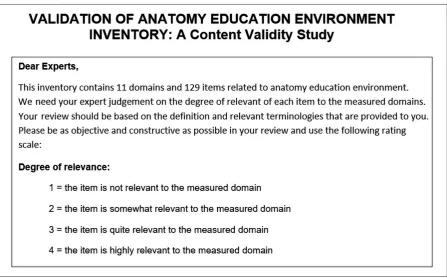
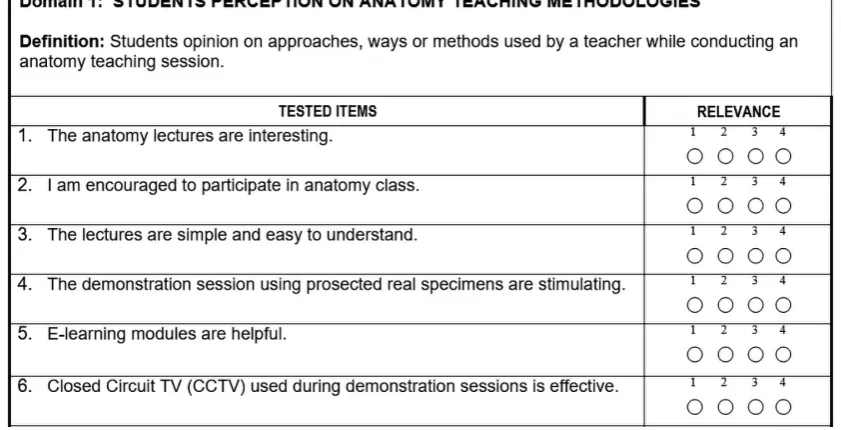
The first step of content validation is to prepare the content validation form to ensure the review panel of experts will have clear expectation and understanding about the task. An example for the instruction and rating scale is provided in Figure 1. The recommended rating scale of relevance (5–8) has been used for scoring individual items (Figure 2). It is recommended to provide the definition of domain to facilitate the scoring process by the experts – please refer to Figure 2 for an example.
the content validity (6, 7). It is important to note that establishing the content validity is vital to support the validity of an assessment tool such as questionnaires, especially for research purpose. Haynes et al. (2) emphasised that, “Inferences from assessment instruments with unsatisfactory content validity will be suspect, even when other indices of validity are satisfactory.” The content validity evidence can be represented by the content validity index (CVI) (5–8), for instances, several recent studies (4, 9–11) established the content validity using CVI to support the validity of an assessment tool. Based on the evidence, this paper describes the best practice to quantify content validity of an assessment tool using CVI.
CONTENT VALIDATION PROCEDURE
The following are the six steps of content validation:
(a) Preparing content validation form (b) Selecting a review panel of experts
Step 3: Conducting Content Validation
The content validation can be conducted through the face-to-face or non-face-to-face approach. For the face-to-face approach, an expert panel meeting is organised, and the researcher facilitates the content validation process through Step 4 to Step 5 (will be described later). For the non-face-to-face approach, usually an online content validation form is sent to the experts and clear instructions are provided (Figure 1) to facilitate the content validation process (Step 4 to Step 5). The most important factors need to be considered are cost, time and response rate. The cost and time might be the challenging factor to conduct the face-to-face approach because of difficulty to get all experts be together, but the response
Step 2: Selecting a Review Panel of Experts
The selection of individual to review and critique an assessment tool (e.g., questionnaire) is usually based on the individual expertise with the topic to be studied. Table 1 summarises the recommended number of experts with its implication on the acceptable cut-off score of CVI.
It can be concurred that for content validation, the minimum acceptable expert number is two, however most of recommendations propose a minimum of six experts. Considering the recommendations (5–8) and the author’s experience, the number of experts for content validation should be at least 6 and does not exceed 10.
Figure 2: An example of layout for content validation form with domain, its definition and items represent (measure) the domain.
Table 1: The number of experts and its implication on the acceptable cut-off score of CVI
Number of experts Acceptable CVI values Source of recommendation
Two experts At least 0.80 Davis (1992)
Three to five experts Should be 1 Polit & Beck (2006), Polit et al., (2007) At least six experts At least 0.83 Polit & Beck (2006), Polit et al., (2007) Six to eight experts At least 0.83 Lynn (1986)
score on each item independently based on the relevant scale (Figures 1 and 2). The experts are required to submit their responses to the researcher once they have completely provided the score on all items.
Step 6: Calculating CVI
There are two forms of CVI, in which CVI for item (I-CVI) and CVI for scale (S-CVI). Two methods for calculating S-CVI, in which the average of the I-CVI scores for all items on the scale (S-CVI/Ave) and the proportion of items on the scale that achieve a relevance scale of 3 or 4 by all experts (S-CVI/UA) (6). The definition and formula of the CVI indices are summarised in Table 2.
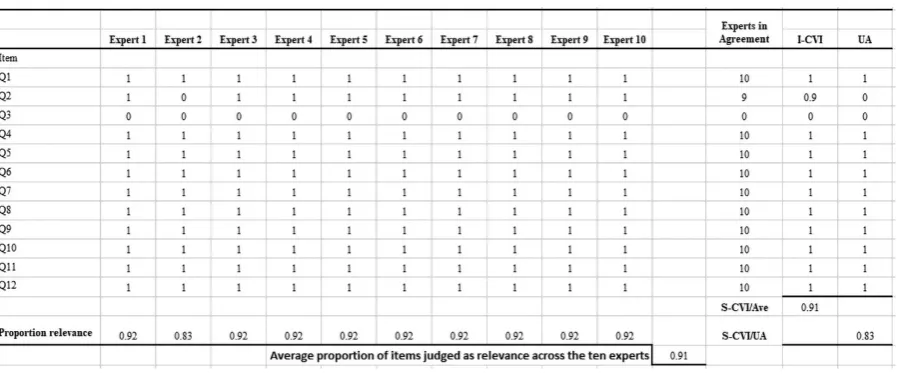
Prior to the calculation of CVI, the relevance rating must be recoded as 1 (relevance scale of 3 or 4) or 0 (relevance scale of 1 or 2) as shown in Table 3. To illustrate the calculation of different CVI indices, the relevance ratings on item scale by ten experts are provided in Table 3.
To illustrate the calculation for the CVI indices (refer to Table 2), the following are examples of calculation based on the data provided in Table 3.
rate will be at the highest. The response rate and time might be the challenging factor for the non-face-to-face approach because of difficulty to get response on time and at risk of not getting response at all from the expert, however the cost saving is the biggest advantage. Nevertheless, based on the author’s experience, the non-face-to-face approach is very efficient if a systematic follow-up is in place to improve the response rate and time.
Step 4: Reviewing Domain and Items
In the content validation form, the definition of domain and the items represent the domain are clearly provided to the experts as shown in Figure 2. The experts are requested to critically review the domain and its items before providing score on each item. The experts are encouraged to provide verbal comment or written comment to improve the relevance of items to the targeted domain. All comments are taken into consideration to refine the domain and its items.
Step 5: Providing Score on Each Item
Upon completion of reviewing domain and items, the experts are requested to provide
Table 2: The definition and formula of I-CVI, S-CVI/Ave and S-CVI/UA
The CVI indices Definition Formula I-CVI (item-level content
validity index) The proportion of content experts giving item a relevance rating of 3 or 4 I-CVI(number of expert) = (agreed item)/
S-CVI/Ave (scale-level content validity index based on the average method)
The average of the I-CVI scores for all items on the scale or the average of proportion relevance judged by all experts. The proportion relevant is the average of relevance rating by individual expert.
S-CVI/Ave = (sum of I-CVI scores)/(number of item)
S-CVI/Ave = (sum of proportion relevance rating)/ (number of expert)
S-CVI/UA (scale-level content validity index based on the universal agreement method)
The proportion of items on the scale that achieve a relevance scale of 3 or 4 by all experts. Universal agreement (UA) score is given as 1 when the item achieved 100% experts in agreement, otherwise the UA score is given as 0.
S-CVI/UA = (sum of UA scores)/(number of item)
vi. S-CVI/UA: the average of UA scores across all items, for example the S-CVI/ UA [(1 + 0 + 0 + 1 + 1 + 1 + 1 + 1 + 1 + 1 + 1 + 1)/12] is equal to 0.83.
Based on the above calculation, we can conclude that I-CVI, S-CVI/Ave and S-CVI/UA meet satisfactory level, and thus the scale of questionnaire has achieved satisfactory level of content validity. For more examples on how to report the content validity index, please refer to papers written by Hadie et al. (4), Ozair et al. (9), Lau et al. (10) and Marzuki et al. (11).
CONCLUSION
Content validity is vital to ensure the overall validity of an assessment, therefore a systematic approach for content validation should be done based on the evidence and best practice. This paper has provided a systematic and evidence-based approach to conduct a proper content validation.
REFERENCES
1. Cook DA, Beckman TJ. Current concepts in validity and reliability for psychometric instruments: theory and application. The American Journal of Medicine. 2006;119(2):166.e7–16. https://doi. org/10.1016/j.amjmed.2005.10.036
i. Experts in agreement: just sum
up the relevant rating provided by all experts for each item, for example, the experts in agreement for Q2 (1 + 0 + 1 +1 + 1 + 1 + 1+ 1 + 1 + 1) = 9
ii. Universal agreement (UA): score ‘1’
is assigned to the item that achieved 100% experts in agreement, for examples, Q1 obtained 1 because all the experts provided relevance rating of 1, while Q2 obtained 0 because not all the experts provided relevance rating of 1.
iii. I-CVI: the expert in agreement divided by the number of experts, for example I-CVI of Q2 is 9 divided by 10 experts that is equal to 0.9.
iv. S-CVI/Ave (based on I-CVI): the
average of I-CVI scores across all items, for example the S-CVI/Ave [(10 + 9 + 0 + 10 + 10 + 10 + 10 + 10 + 10 + 10 + 10 + 10)/12] is equal to 0.91.
v. S-CVI/Ave (based on proportion
relevance): the average of proportion relevance scores across all experts, for example the S-CVI/Ave [(0.92 + 0.83 + 0.92 + 0.92 + 0.92 + 0.92 + 0.92 + 0.92 + 0.92 + 0.92)/10] is equal to 0.91.
8. Lynn MR. Determination and quantification of content validity. Nursing Research. 1986;35(6):381–5.
9. Ozair MM, Baharuddin KA, Mohamed SA, Esa W, Yusoff MSB. Development and validation of the knowledge and clinical reasoning of acute asthma management in emergency department (K-CRAMED). Education in Medicine Journal. 2017;9(2):1–17. https://doi.org/10.21315/ eimj2017.9.2.1
10. Lau AS, Yusoff MS, Lee Y-Y, Choi S-B, Xiao J-Z, Liong M-T. Development and validation of a Chinese translated questionnaire: a single simultaneous tool for assessing gastrointestinal and upper respiratory tract related illnesses in pre-school children. Journal of Taibah University Medical Sciences. 2018;13(2):135–41. https://doi.org/10.1016/j.jtumed.2017.11.003
11. Marzuki MFM, Yaacob NA, Yaacob NM. Translation, cross-cultural adaptation, and validation of the Malay version of the system usability scale questionnaire for the assessment of mobile apps. JMIR Human Factors. 2018;5(2):e10308. https://doi. org/10.2196/preprints.10308
2. Haynes SN, Richard D, Kubany ES. Content validity in psychological assessment: a functional approach to concepts and methods. Psychological Assessment. 1995;7(3):238. https://doi. org/10.1037//1040-3590.7.3.238
3. Yusoff MSB. A systematic review on validity evidence of medical student stressor questionnaire. Education in Medicine Journal. 2017;9(1):1–16. https://doi. org/10.21315/eimj2017.9.1.1
4. Hadie SNH, Hassan A, Ismail ZIM, Asari MA, Khan AA, Kasim F, et al. Anatomy education environment measurement inventory: a valid tool to measure the anatomy learning environment. Anatomical Sciences Education. 2017;10(5):423–32. https://doi.org/10.1002/ase.1683
5. Davis LL. Instrument review: getting the most from a panel of experts. Applied Nursing Research. 1992;5(4):194–7. https:// doi.org/10.1016/s0897-1897(05)80008-4
6. Polit DF, Beck CT. The content validity index: are you sure you know what’s being reported? Critique and recommendations. Research in Nursing & Health. 2006;29(5):489–97. https://doi.org/10.1002/ nur.20147