© Penerbit UTHM DOI: https://doi.org/10.30880/ijie.2018.10.06.012
VANETs Multipath Video Data Streaming Considering Road
Features
Ahmed Aliyu
1,2*,
Abdul Hanan Abdullah
1, Avon Budiyono
3,
Raja Zahilah Raja
Mohd Radzi
1,
Usman Mohammed Joda
1,21
Department of Computer Science, School of Computing, Faculty of Engineering, Universiti Teknologi Malaysia, 81310 Skudai, Johor Bahru, Malaysia
2
Department of Mathematics, Faculty of Science
Bauchi State University Gadau, Itas/Gadau L.G.A Bauchi State Nigeria
3
School of Industrial Engineering, Telkom University, 40257 Bandung, West Java, Indonesia.
Received 28 June 2018; accepted 5 August 2018, available online 24 August 2018
1. Introduction
In recent times, there has been rapid growth in Vehicular Ad hoc Network (VANETs) research work. The VANETs communication paradigm that emanated from the Mobile Ad hoc Networks (MANETs) [1-3]. It is apparent that VANETs is very different from MANETs due to the nature of topology and resource capability. In MANETs, nodes are more scattered in a randomized manner, while VANETs has a defined pathway, which is the road. In addition, MANETs is constrained with limited resources such as battery, memory, and process, which is not the same for VANETs. The VANETs has two major communication type namely, Vehicle to Vehicle (V2V) and Vehicle to Infrastructure (V2I) [4-6]. The V2V is a complete ad hoc based network, which signifies communication only between vehicles. While the V2I involves the use of Road Side Units (RSUs) to aid communication among vehicles on the road. The Video streaming in VANETs has also been related to
cloud computing and Internet of Things (IoT) [7-10]. Some of the application domain of VANETs include safety, infotainment, monitoring. Looking at the application areas, video streaming can be applied in these areas. In the aspect of safety, the incidence of a scenario can be captured by another vehicle or an on-road RSU and transmit to vehicles moving towards the direction of the incidence. This would enable drivers navigating towards the direction to take a swift decision on whether to change route or not. The infotainment is more related to the video streaming services. Video streams can be forwarded to drivers on highways to notify them of good services, which is nearby their navigation location. This good and services include grocery shops, highway filling stations, nearby emergency clinics, restrooms, restaurants, lodging hotels. This will go a long way improving businesses and provide firsthand information to the road users. In addition, video streaming can be used to monitor the surroundings, because vehicles are used Abstract: Multipath video streaming in Vehicular Ad-hoc Networks (VANETs) is an evolving research topic. The adoption of video transmission in VANETs communication has become essential due to the comprehensiveness and applicability of video data for on-road advertisement and infotainment. Meanwhile, several research studies have considered how to apply and improve the transmission of the video quality. Due to this, the concurrent multipath transmission has been employed in order to achieve load balancing and path diversity, because of the high data rate of the video data. However, the main nature of the road, which is the pathway for VANET nodes has not been considered explicitly. In this paper, the road features are considered for VANETs multipath video streaming based on the greedy geographical routing protocol. Thus, VANETs Multipath Video Streaming based on Road Features (VMVS-RF) protocol has been proposed. The protocol was compared with an ordinary Multipath Video Streaming (MVS). The result demonstrates that the proposed VMVS-RF protocol outperforms the MVS in terms of Data Receiving Rate (DRR), Structural Similarity (SSIM) index and Packet Loss Ratio (PLR).
everywhere hence it can assist with monitoring the surroundings.
Video streaming in VANETs has been worked on by several researchers. The major issue in video streaming VANET is the high rate of video data and the high dynamicity of the VANETs nodes. The high data rate has led to numerous video compression standards including H.263/SVC, MPEG-1-2-4, and H.264/AVC. These standards are employed to minimize non-useful and redundant video data. Thus, there is encoding and decoding of video frames. The encoding of video data is at the sending vehicle before transmission, while the decoding is at the destination vehicle after delivery. One of the related ideas for the compression is the video splitting, where video frames are grouped into I-frame, P-frame, and B-frames. These split frames are transmitted through multiple paths in order to achieve path diversity and load balancing (See Fig.1). The I-frames are the most important frames called reference frames. The P and B-frames are less important compared to the I-frame. Due to this, the I-frames are given higher priority over the other frame types. The concept of video transmission via more than one path achieves lower delay and higher packet delivery and improved video quality compared to a single path video transmission.
Fig. 1: The Illustration of Multipath Transmission Video streaming in VANETs has been worked on by several researchers. The major issue in video streaming VANET is the high rate of video data and the high dynamicity of the VANETs nodes. The high data rate has led to numerous video compression standards including H.263/SVC, MPEG-1-2-4, and H.264/AVC. These standards are employed to minimize non-useful and redundant video data. Thus, there is encoding and decoding of video frames. The encoding of video data is at the sending vehicle before transmission, while the decoding is at the destination vehicle after delivery. One of the related ideas for the compression is the video splitting, where video frames are grouped into I-frame, P-frame, and B-frames. These split frames are transmitted through multiple paths in order to achieve path diversity
and load balancing (See Fig.1). The I-frames are the most important frames called reference frames. The P and B-frames are less important compared to the I-frame. Due to this, the I-frames are given higher priority over the other frame types. The concept of video transmission via more than one path achieves lower delay and higher packet delivery and improved video quality compared to a single path video transmission.
Some routing protocols have been considered for video streaming. However, one of the most suitable routing protocol for VANETs video streaming is the geographic routing protocol due to the expedient consideration of vehicle location and minimal communication overhead due to the use of only neighbor vehicle information. Most of the routing protocol considered for video streaming in VANETs have not considered the road features including “U” Turn and junction when considering vehicle selection in the multipath video transmission. Although, the road features have been considered in some VANETs multipath routing. However, the impact on video transmission has not been explored. Therefore, there is need to consider the road features in multipath video streaming.
In this paper, an extensive review has been conducted based on related literature in VANETs multipath video streaming. A video streaming in VANETs considering road features has been proposed. Finally, experimental implementation is carried out and the results are validated. The rest of the paper is planned as follows. Section II involves the detailed review of related literature. Section III comprises of the design and discussion of the proposed protocol. Section IV presents the experimental implementation and result discussions. Section V concludes the research paper.
2.
Related Literature in Multipath Video
Streaming
In this section, an extensive review of related work in multipath video streaming VANETs are discussed. The related works have been divided into three (3) including coding-aware video streaming, adaptive video streaming and normal geographical routing protocols.
2.1
Coding-aware Video Streaming over
VANETs
In this subsection, the coding-aware multipath video streaming related works are discussed. The integration of video compression techniques with the best route estimation and selection techniques. These are the fundamental issues in coding-centric routing. This technique must be designed to guarantee optimal video stream quality. Both the video compression and route selection for video stream need to consider the issues including wireless lossy channels, interference, and severity of the dynamic nature of VANETs. In general, both the stringent requirements of the video stream and VANETs constraint need to be considered to have qualitative video stream delivery. Symbol-level network coding for live multimedia video streaming over VANETs
(CodePlay) is suggested to provide stable video streaming and high streaming rate for willing vehicles [11]. CodePlay adopts the Symbol Level Network Coding (SLNC) strategy to organize local push scheme. The streaming video is fully transmitted from a dedicated source to willing vehicles through local coordination of non-centralized designated relay. Which ensures smooth playback for vehicles in the surrounding. Meanwhile, Playback freezes are not sufficient for evaluating qualitative video streaming. Razzaq and Mehaoua [12] proposed a Multi-Stream Coding that includes Network Coding (MCNC) for multi-path video transport in VANETs. It employs scalable video coding, which has path variation and network coding. Gonzalez, Ghafoor [13] suggest an approach, which is based on Fuzzy redundant adaptation and Joint source and Network Coding (FJNC) for VANETs video streaming. The aim is to accomplish flexible and robust video streaming over VANETs
An Evaluation analysis of High Efficient Video Coding (E-HEVC) video transmission in VANETs based on packet loss scenarios is proposed [14]. The E-HEVC analysis is motivated due to error-prone, high mobility networks and nature of the wireless channel of VANETs. The evaluation demonstrates that HEVC is very sensitive to packet loss. Further, creating a different number of slices from a single frame can either worsen or improve the situation. Therefore, a simple procedure for error concealment is introduced in the HEVC software. However, there is a need for incorporation of error resilient technique at the application layer and packet protection at the network layer in order to attain the minimum the video quality needed.
2.2
Adaptive Video Streaming over VANETs
This subsection discusses video streaming schemes that are adaptive in their design approach. One of the essential constituents of virtually all network solution is the link layer. The implementation of any of the current class of IEEE 802.11 protocol is the effort of most existing studies in link layer technology. The use of MAC layer during network optimization provides significant benefits. The MAC layer is often manipulated to modify the frame size based on the physical rules to achieve the best balance between the higher delay of smaller frames and the potential distortion of losing larger video frames [15]. At the MAC layer, so many parameters can be manipulated including retransmission limit in order to achieve robust adaptation of the video transmission [16]. MAC scheme that improves video quality through monitoring and frame size changing based on network event. The scheme uses adaptation and dynamic parameters for enhancing the quality of video and experience of the end-user. A Measurement-based analysis of Multi-hop pre-recorded video streaming Transmission (MTRM) using dedicated short-range communication devices is presented [17]. The performance of multi-hop transmission is measured to overcome the problem of high packet loss rate. High packet loss causes video quality degradation. The measurement also considers interference of the
communication channel. Further, startup catching and retransmission strategies are introduced to enhance the video application. In addition, performance measurement of the retransmission strategy and analysis of the strategy are conducted. Although, the retransmission strategy adopted might lead to delay in the video transmission.
2.3
Multipath Geographical Routing over
VANETS
The Geographical DIstance Routing (GEDIR) is a protocol that considers the distance of a vehicle according to it region for packet forwarding [18]. Another of its kind is the packet forwarding using the Voronoi diagram for GEographic DIstance Routing (V-GEDIR) which is an extension of GEDIR [19]. A loop-aware position-based routing protocol has been proposed. The protocol selects next hop vehicle considering the Voronoi region of the vehicle, which either covers or cut the assumed destination vehicles’ sector. However, the dynamic nature of vehicle node is considered during formation Voronoi diagram. Hence, might not be suitable for vehicular communication. In Raw and Das [20], a packet forwarding techniques based on Peripheral vehicles GEographical DIstance Routing (P-GEDIR) has been suggested. It is based on all vehicles available inside the circular strip coverage area of width R/2 where R is the transmission range of a vehicle, which is in the direction of destination vehicle. The vehicles in the circular strip coverage area are called the peripheral vehicle. In junction-based multipath data forwarding, more than one routes from source to destination are employed with logics of characteristics of the road junction in order to deliver data packet successfully. The junction is a point where vehicles are likely to change direction during data communication. This made the selection of next forwarding vehicle to be very challenging due to direction changing. Some few research studies on multipath data forwarding have been suggested in [21-24]. Thus, in Sermpezis, Koltsidas [21], an analytical Junction-centric Multipath Source Routing mechanism (JMSR) has been suggested. JMSR features include the junction-aware logics, the multipath route from source to destination and the source routing scheme. The JMSR employs the geographic routing protocols, such that the location of vehicles and junctions of a street are leveraged through the street’s digital maps for data forwarding purpose. In the next section, the proposed video streaming protocol over VANETs is discussed.
3.
VANETs Multipath Video Streaming
Considering Road Features
forwarded through a different path, which is the same. Thus, in the study, only two paths are considered for the multipath video transmission. In the proposed protocol, it is assumed that each vehicle node has information pertaining it neighbors and the source vehicle knows the location of the destination vehicle, this information(s) are used to select the next forwarding vehicles in the multipath transmission. The detailed discussion of each module is as follows.
3.1
Neighbor Information Acquisition
At this stage, each vehicle sends a Hello Packet to its neighbor vehicles, which are within the range of its network coverage. Since the source vehicle is already aware of the location of the destination vehicle. Therefore, each vehicle forwards information including speed, direction, and current position to its neighboring vehicle. Most current information(s) are utilized to select the forwarding vehicle based on the aforementioned information.
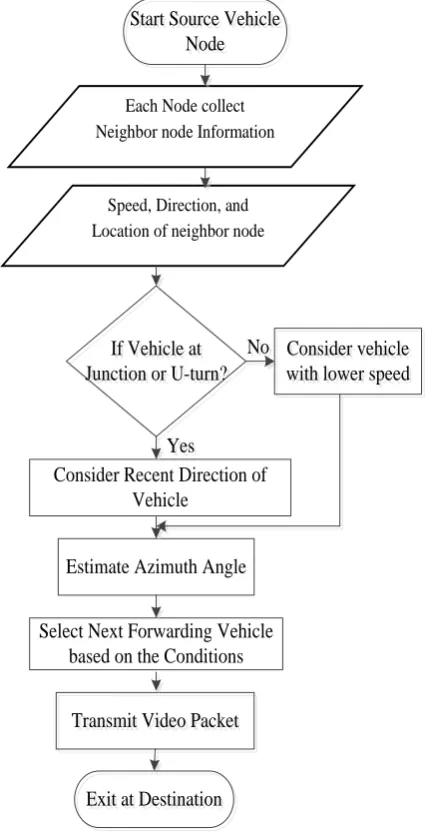
Start Source Vehicle Node
Start Source Vehicle Node
Each Node collect Neighbor node Information
Speed, Direction, and Location of neighbor node
If Vehicle at Junction or U-turn?
If Vehicle at Junction or U-turn?
Yes
Yes
No
No
Consider Recent Direction of Vehicle
Consider vehicle with lower speed
Consider vehicle with lower speed
Estimate Azimuth Angle
Select Next Forwarding Vehicle based on the Conditions
Transmit Video Packet
Transmit Video Packet
Exit at Destination
Exit at Destination
Fig. 2: The Flowchart of the VMVS-RF
3.2
Next Forwarding Vehicle Selection
In this part, when the forwarding vehicle is at the junction or a U-turn, it waits for some random time and request for neighbor vehicles information. At this point, priority is given to the direction of navigation. Only vehicles in the direction of the destination vehicle at the junction or U-turn are selected as next forwarding vehicle. The slowest vehicle is selected if there no vehicle in the direction of the destination vehicle. There two forms of vehicle location at the junction area, namely vehicle before the junction and the vehicle that has already exited the junction. The vehicle, which has already exited the junction in the direction of the destination vehicle is selected. This strategy guarantees video packet delivery since the vehicle is navigating in the direction of the destination vehicle.
3.3
Route Path Direction based on Azimuth
Angle
In this subsection, the route path is maintained by estimating the azimuth angle of each intermediary vehicle in order to have a node-disjointed path. When selecting an intermediary vehicle to serve as next forwarding vehicle for the video transmission, the position, and azimuth angle of the vehicle are estimated. This will also minimize the interference between different vehicles in the multiple paths. The related flowchart is depicted in Fig. 2.
The flowchart in Fig. 2demonstrate the steps and flow of the algorithm. This is employed in simulation experimentation to validate its performance of the proposed protocol.
4.
Results and Discussion
In this section, the simulation experiment and the obtained results are discussed. The proposed VANETs Multipath Video Streaming based on Road Features (VMVS-RF) protocol is simulated using NS-2, SUMO and Evalvid video framework. The results obtained from the simulation are compared against the ordinary Multipath Video Streaming (MVS) protocol. The performance is evaluated in terms of Data Receiving Rate (DRR), Structural Similarity (SSIM) Index and video Packet Loss Ratio (PLR). Table 1 highlights the parameters considered during simulation implementation. The parameters are represented along with their corresponding values.
Table 1: Simulation Parameters
Parameters Values
Simple lane area 2,000 1,200 m2 Urban simulation area 2500 1800 m2
Simulation time 600 s
Vehicle speed 2.78 to 13.89 m/s (10 to 50 km/h)
Number of vehicles 50 to 150 MAC protocol IEEE 802.11p
Video Name akiyo_cif
Video resolution 352 288
Parameters Values Video play duration 9 seconds Transmission range 200 m
Frequency 5.9 GHz
Propagation model Shadowing Antenna model Omni-directional
Channel type Wireless
Packet type UDP
Hello packet timeout 1 second Simple lane area 2,000 1,200 m2 Urban simulation area 2500 1800 m2
Simulation time 600 s
The table presents all parameters employed and their individual corresponding values. Further, the results obtained are discussed considering the two metrics including DRR and SSIM index.
4.1
Data Receiving Rate
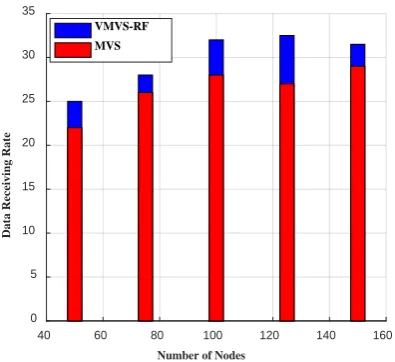
The average video Data Receiving Rate (DRR) at the destination vehicle has been evaluated. The proposed VMVS-RF protocol supersedes the ordinary Multipath Video Streaming protocol. The relationship of the results is depicted in Fig. 3, which shows that VMVS-RF performs better because the vehicle nodes that move away from the direction of the destination vehicle. Thus, high delivery of video packet is achieved.
40 60 80 100 120 140 160
Number of Nodes
0 5 10 15 20 25 30 35
Data Receiving Rate
VMVS-RF MVS
Fig. 3: Data Receiving Rate
4.2
Structural Similarity Index
The Structural Similarity (SSIM) index is employed to ascertain the quality of the video received at the destination vehicle. The SSIM index is evaluated and compared against MVS. The result depicted in Fig. 4, shows that VMVS-RF performs better than the MVS and its relationship is demonstrated. The improved output might be related to the reason that road features are considered in video packet forwarding process.
40 60 80 100 120 140 160
Number of Nodes
0 0.1 0.2 0.3 0.4 0.5 0.6 0.7 0.8 0.9 1
Structural Similarity (SSIM) Index
VMVS-RF MVS
Fig. 4: Structural Similarity Index
4.3
Packet Loss Ratio
The video Packet Loss Ratio (PLR) is used to assess the performance improvement of the proposed VMVS-RF protocol against a normal multipath video packet transmission, which does not consider the junction or U-turn situated on the roads for video packet transmission. The result obtained in the simulation shows that the proposed protocol outperforms the ordinary video transmission scheme as demonstrated in Fig. 5. This improvement might be related to the strategies employed in the proposed protocol. Therefore, fewer video packet loss was experienced in the simulation.
40 60 80 100 120 140 160
Number of Nodes
0 5 10 15 20 25 30 35
Packet Loss Ratio %
MVS VMVS-RF
Fig. 5: Packet Loss Ratio
5.
Conclusion
VMVS-RF has been compared against an ordinary Multipath Video Streaming (MVS) protocol. The VMVS-RF protocol achieves higher video Data Receiving Rate with 7% increase and higher video quality in term of Structural Similarity (SSIM) index with 5% increase. The performance gain on the Packet Loss Ratio (PLR) is 19.5% compared to the MVS. Based on the aforementioned results, the proposed protocol has depicted it an improvement and its strengths in multipath video streaming over VANETs.
References
[1] Schoch, E., F. Kargl, and M. Weber. Communication
patterns in VANETs. IEEE Communications
Magazine, Volume 46, (2008), pp. 11.
[2] Li, F. and Y. Wang. Routing in vehicular ad hoc networks: A survey. IEEE Vehicular technology magazine, Volume 2, (2007), pp. 2.
[3] Yousefi, S., M.S. Mousavi, and M. Fathy. Vehicular ad hoc networks (VANETs): challenges and
perspectives. in ITS Telecommunications
Proceedings, 6th International Conference on. (2006).
[4] Biswas, S., R. Tatchikou, and F. Dion. Vehicle-to-vehicle wireless communication protocols for
enhancing highway traffic safety. IEEE
communications magazine, Volume 44, (2006), p. 74-82.
[5] Cho, W., Kim, S.I., kyun Choi, H., Oh, H.S. and Kwak, D.Y. Performance evaluation of V2V/V2I communications: The effect of midamble insertion. in
Wireless Communication, Vehicular Technology, Information Theory and Aerospace & Electronic
Systems Technology, Wireless VITAE 1st
International Conference IEEE on. (2009).
[6] Santa, J., A.F. Gómez-Skarmeta, and M. Sánchez-Artigas. Architecture and evaluation of a unified V2V and V2I communication system based on cellular networks. Computer Communications, Volume 31, (2008), pp. 2850-2861.
[7] Aliyu, A., Abdullah, A.H., Kaiwartya, O., Cao, Y., Lloret, J., Aslam, N. and Joda, U.M. Towards video streaming in IoT Environments: Vehicular
communication perspective. Computer
Communications, Volume 118, (2018), pp. 93-119. [8] Aliyu, A., Abdullah, A.H., Kaiwartya, O., Cao, Y.,
Usman, M.J., Kumar, S., Lobiyal, D.K. and Raw, R.S. Cloud Computing in VANETs: Architecture, Taxonomy, and Challenges. IETE Technical Review, (2017), pp. 1-25.
[9] Aliyu, A., Abdullah, A.H., Kaiwartya, O., Ullah, F., Joda, U.M. and Hassan, A.N. Multi-Path video streaming in vehicular communication: Approaches and challenges. in Student Project Conference (ICT-ISPC), 2017 6th ICT International (2017), pp. 1-4 IEEE.
[10] Ahmed, A., Hanan, A.A., Omprakash, K., Usman, M.J. and Syed, O. Mobile Cloud Computing
Energy-aware Task Offloading (MCC:ETO). in
Communication and Computing Systems: Proceedings of the International Conference on Communication and Computing Systems (ICCCS 2016) CRC Press, Gurgaon, India, 9-11 September,
(2016), pp. 359.
[11]Yang, Z., M. Li, and W. Lou. Codeplay: Live multimedia streaming in vanets using symbol-level network coding. in Network Protocols (ICNP), 2010 18th IEEE International Conference on, (2010). IEEE.
[12] Razzaq, A. and A. Mehaoua. Video transport over VANETs: Multi-stream coding with multi-path and network coding. in Local Computer Networks (LCN), 2010 IEEE 35th Conference on, (2010). IEEE. [13] Gonzalez, A.J., Ghafoor, K.Z., Piney, R., Rios, A.,
Alcober, J. and Bakar, K.A. Fuzzy redundancy adaptation and joint source-network coding for VANET video streaming. in International Conference on Wired/Wireless Internet Communications, (2011). Springer.
[14] Pinol, P., Torres, A., Lopez, O., Martinez, M. and Malumbres, M.P. Evaluating HEVC video delivery in VANET scenarios. in Wireless Days (WD), 2013 IFIP, (2013), pp. 1-6, IEEE.
[15] Wu, D., S. Ci, and H. Wang, Cross-layer optimization for video summary transmission over wireless networks. IEEE Journal on Selected Areas in Communications, Volume 25 (2007), pp.841-850. [16] Zhu, C. Streaming Media Architectures, Techniques,
and Applications: Recent Advance, (2010), IGI Global.
[17]Jiang, X., X. Cao, and D.H. Du. Multihop transmission and retransmission measurement of real-time video streaming over DSRC devices. in A World of Wireless, Mobile and Multimedia Networks (WoWMoM) 2014 IEEE 15th internation symposium on, (2014). IEEE.
[18] Hassan, A.N., Abdullah, A.H., Kaiwartya, O., Sheet, D.K. and Aliyu, A. Geographic forwarding techniques: Limitations and future challenges in IVC. in Student Project Conference (ICT-ISPC), 2017 6th ICT International, (2017) pp. 1-5, IEEE.
[19] Stojmenovic, I., A.P. Ruhil, and D. Lobiyal, Voronoi diagram and convex hull based geocasting and
routing in wireless networks. Wireless
communications and mobile computing, Volume 6, (2006), pp. 247-258.
[20] Raw, R.S. and Das, S. Performance analysis of P-GEDIR protocol for vehicular ad hoc network in urban traffic environments. Wireless personal communications, Volume 6,(2013), pp. 65-78.
[21] Sermpezis, P., Koltsidas, G. and Pavlidou, F.N.
Investigating a junction-based multipath source
routing algorithm for VANETs. IEEE
Communications letters, Volume 17, (2013), pp. 600-603.
[22] Lai, W.K., Tai, C.K., Wu, T.Y., Anpalagan, A. and Chen, J.Z. PBMP: priority‐based multi‐path packet routing for vehicular ad hoc network system in city
environment. Transactions on Emerging
Telecommunications Technologies, Volume 27, (2016), pp. 1331-1344.
[23] Salkuyeh, M.A. and Abolhassani, B. An Adaptive Multipath Geographic Routing for Video Transmission in Urban VANETs. IEEE Transactions on Intelligent Transportation Systems, Volume 17 (2016), pp. 2822-2831.
1] Schoch, E., F. Kargl, and M. Weber. Communication
patterns in VANETs. IEEE Communications
Magazine, Volume 46, (2008), pp. 11.
[2] Li, F. and Y. Wang. Routing in vehicular ad hoc networks: A survey. IEEE Vehicular technology magazine, Volume 2, (2007), pp. 2.
[3] Yousefi, S., M.S. Mousavi, and M. Fathy. Vehicular ad hoc networks (VANETs): challenges and
perspectives. in ITS Telecommunications
Proceedings, 6th International Conference on. (2006).
[4] Biswas, S., R. Tatchikou, and F. Dion. Vehicle-to-vehicle wireless communication protocols for
enhancing highway traffic safety. IEEE
communications magazine, Volume 44, (2006), p. 74-82.
[5] Cho, W., Kim, S.I., kyun Choi, H., Oh, H.S. and Kwak, D.Y. Performance evaluation of V2V/V2I communications: The effect of midamble insertion. in
Wireless Communication, Vehicular Technology, Information Theory and Aerospace & Electronic Systems Technology, Wireless VITAE 1st International Conference IEEE on. (2009).
[6] Santa, J., A.F. Gómez-Skarmeta, and M. Sánchez-Artigas. Architecture and evaluation of a unified V2V and V2I communication system based on cellular networks. Computer Communications, Volume 31, (2008), pp. 2850-2861.
[7] Aliyu, A., Abdullah, A.H., Kaiwartya, O., Cao, Y., Lloret, J., Aslam, N. and Joda, U.M. Towards video streaming in IoT Environments: Vehicular
communication perspective. Computer
Communications, Volume 118, (2018), pp. 93-119. [8] Aliyu, A., Abdullah, A.H., Kaiwartya, O., Cao, Y.,
Usman, M.J., Kumar, S., Lobiyal, D.K. and Raw, R.S. Cloud Computing in VANETs: Architecture, Taxonomy, and Challenges. IETE Technical Review, (2017), pp. 1-25.
[9] Aliyu, A., Abdullah, A.H., Kaiwartya, O., Ullah, F., Joda, U.M. and Hassan, A.N. Multi-Path video streaming in vehicular communication: Approaches and challenges. in Student Project Conference (ICT-ISPC), 2017 6th ICT International (2017), pp. 1-4 IEEE.
[10] Ahmed, A., Hanan, A.A., Omprakash, K., Usman, M.J. and Syed, O. Mobile Cloud Computing
Energy-aware Task Offloading (MCC:ETO). in
Communication and Computing Systems: Proceedings of the International Conference on Communication and Computing Systems (ICCCS 2016) CRC Press, Gurgaon, India, 9-11 September,
(2016), pp. 359.
[11]Yang, Z., M. Li, and W. Lou. Codeplay: Live multimedia streaming in vanets using symbol-level network coding. in Network Protocols (ICNP), 2010 18th IEEE International Conference on, (2010). IEEE.
[12] Razzaq, A. and A. Mehaoua. Video transport over VANETs: Multi-stream coding with multi-path and network coding. in Local Computer Networks (LCN), 2010 IEEE 35th Conference on, (2010). IEEE. [13] Gonzalez, A.J., Ghafoor, K.Z., Piney, R., Rios, A.,
Alcober, J. and Bakar, K.A. Fuzzy redundancy adaptation and joint source-network coding for VANET video streaming. in International Conference on Wired/Wireless Internet Communications, (2011). Springer.
[14] Pinol, P., Torres, A., Lopez, O., Martinez, M. and Malumbres, M.P. Evaluating HEVC video delivery in VANET scenarios. in Wireless Days (WD), 2013 IFIP, (2013), pp. 1-6, IEEE.
[15] Wu, D., S. Ci, and H. Wang, Cross-layer optimization for video summary transmission over wireless networks. IEEE Journal on Selected Areas in Communications, Volume 25 (2007), pp.841-850. [16] Zhu, C. Streaming Media Architectures, Techniques,
and Applications: Recent Advance, (2010), IGI
Global.
[17]Jiang, X., X. Cao, and D.H. Du. Multihop transmission and retransmission measurement of real-time video streaming over DSRC devices. in A World of Wireless, Mobile and Multimedia Networks (WoWMoM) 2014 IEEE 15th internation symposium on, (2014). IEEE.
[18] Hassan, A.N., Abdullah, A.H., Kaiwartya, O., Sheet, D.K. and Aliyu, A. Geographic forwarding techniques: Limitations and future challenges in IVC. in Student Project Conference (ICT-ISPC), 2017 6th ICT International, (2017) pp. 1-5, IEEE.
[19] Stojmenovic, I., A.P. Ruhil, and D. Lobiyal, Voronoi diagram and convex hull based geocasting and
routing in wireless networks. Wireless
communications and mobile computing, Volume 6, (2006), pp. 247-258.
[20] Raw, R.S. and Das, S. Performance analysis of P-GEDIR protocol for vehicular ad hoc network in urban traffic environments. Wireless personal communications, Volume 6,(2013), pp. 65-78. [21] Sermpezis, P., Koltsidas, G. and Pavlidou, F.N.
Investigating a junction-based multipath source
routing algorithm for VANETs. IEEE
Communications letters, Volume 17, (2013), pp. 600-603.
[22] Lai, W.K., Tai, C.K., Wu, T.Y., Anpalagan, A. and Chen, J.Z. PBMP: priority‐based multi‐path packet routing for vehicular ad hoc network system in city
environment. Transactions on Emerging
Telecommunications Technologies, Volume 27, (2016), pp. 1331-1344.
on Intelligent Transportation Systems, Volume 17 (2016), pp. 2822-2831.
[24] Angreni, I.A., Adisasmita, S.A., Ramli, M.I. and Hamid, S. Evaluating the Road Damage of Flexible Pavement Using Digital Image. International Journal of Integrated Engineering, Special Issue 2018: Civil & Environmental Engineering, Vol. 10 (2) (2018) pp. 24-27..