Evaluation of Fluidized Bed Reactor in
treating Dyeing effluent
K.Balaji* and S. Poongothai**
*Assistant Professor in Department of Civil Engineering Annamalai University, Annamalainagar.
** Professor of Civil Engineering, Department of Civil Engineering Annamalai University, Annamalainagar- 608 002
*e-mail:[email protected]
Abstract
Textile dyeing industries one of the complicated industries which use many chemicals like dyes, starch, acids, alkalis, surfactants and refractory organics for their process. As it is a wet process it requires more amount of water ranging 65-104 L/Kg of product and it discharges 52-95 L/Kg of product as wastewater. The COD, BOD, TDS, Colour and SS are the major pollutants from these industries to the receiving streams. Biological treatment is employed mostly when compared to the physicochemical treatment. More sludge, toxic bye products and cost for the treatment are the reasons for not employing the physiochemical treatment processes. Biological treatments like aerobic and anaerobic processes overcome the disadvantages of physicochemical treatment. The present study evaluates the Aerobic Fluidized bed Reactor for the treatment of Dyeing effluent. It has been observed through this study that 89% colour removal and 83.3% COD removal were achieved.
Key words: COD, Colour, HRT, OLR, Decolourisation, Biodegradation, Aerobic.
1. Introduction
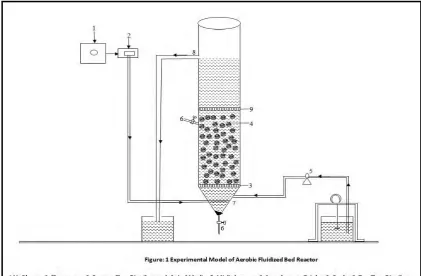
volume of 0.02m. The specification of the experimental set up is given in Table.1. and schematic is shown in Fig.1.
2.2. Preparation of Synthetic Waste Water
The synthetic wastewater was simulated towards the characteristics of a real textile dying effluent. Three different reactive dyes namely Drimarene Red X 6BN, Drimarene Blue X 3LR CDG and Drimarene Yellow X4RN were purchased from Colour Chemicals Pvt. Ltd. (Erode, India). Dyes were mixed in equal proportions with various chemicals like sodium chloride, sodium carbonate, soap oil, wetting agent, acids, alkalis and Hydrogen peroxide.
2.3. Start-up Process
The experiment was initiated with the feeding of domestic wastewater and real textile dyeing wastewater for the acclimatization process. The nutrients supplied during the start up process were in the ratio of COD: N: P as (100:5:1). After attaining the steady state condition within 14 days, the synthetic wastewater was fed into the reactor.
2.4 Experimental Run
The operational parameters were the HRT and OLR. The experiment was run for five different COD concentrations of 750mg/L, 1000mg/L, 1250mg/L, 1500mg/L and 2000mg/L. The operational parameters HRT were varied as 26 hrs, 20 hrs, 13 hrs and 10 hrs for each COD concentration subsequently. With respect to the COD concentrations and the influent flow rate the OLR is varied from 0.648 Kg.COD/ m3day to 4.816 Kg.COD/ m3day. Samples were collected regularly according to the HRT varying period from inlet and outlet for the analysis. The evaluation is based on the %COD removal and %Colour removal.
2.5 Analytical Methods
Samples were collected from the inlet and outlet of the reactor at 26hrs, 20hrs, 13 hrs and 10 hrs for each COD concentrations of 750mg/L, 1000 mg/L, 1250 mg/.L, 1500mg/L and 2000 mg/L for the analysis. COD was measured by the closed reflux method and colour was determined by measuring the absorbance (OD) @ 600nm using UV-VIS spectrophotometer by standard methods (APHA 2005). The %Colour removal is obtained from the equation (1).
% Colour Removal = A - B A Where, A = Inlet OD B = Outlet OD
Table -1: Physical features and process parameters
S.No. Specifications Details
1. Volume of Reactor 0.03 m3
2. Effective volume of Reactor 0.02 m3
3. Diameter of Reactor 0.15m
4. Height of Reactor 1.17m
5. Height of packed bed before fluidization 0.25m
6. Flow Distributer 2 Nos.
7. Pump used for the influent feed Peristaltic Pump PP-30 model (Miclin’s Product).
8. Media Packed Fujino Spirals, (PVC material) 9. Specific area of filling media 500m2/m3
10. Void ratio of the media 87%
11. Expansion of bed Restricted by the top flow distributor 50% ie. 0.5m From the bottom Flow distributor
12. Air blower 270 L/min
13. Air Supply 0.025m/s
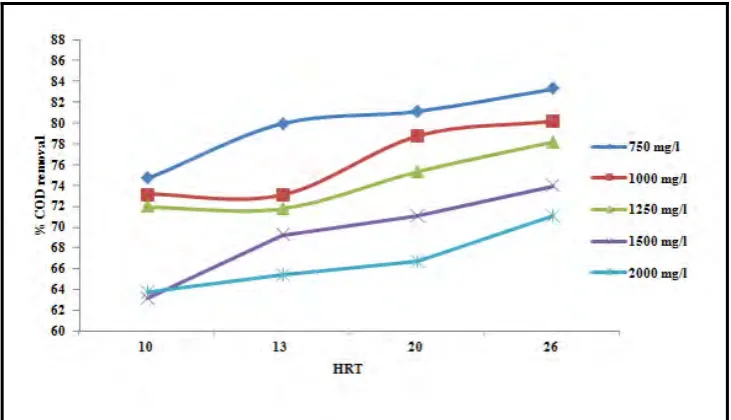
1250mg/L, 1500mg/L and 2000 mg/L at 26 hrs HRT respectively.
Fig 2.b shows the overall performance of the reactor with the maximum colour removal of 89% , 88%, 86%, 85.7% and 83% for the COD concentrations of 750mg/L, 1000mg/L, 1250mg/L, 1500mg/L and 2000 mg/L at 26 hrs HRT respectively.
The above results show that the maximum %COD removal and maximum %Colour removal were achieved at 26 hrs HRT.
Fig.3.a and Fig.3.b shows that %COD removal and %Colour removal shows the gradual decrease towards increasing OLR ranging from 0.648 to 4.896 Kg COD/m3.day. The maximum %COD removal is achieved at lower OLR value and the minimum %COD removal is achieved at higher OLR value.
Fig. 2a. HRT Vs %COD Removal
Fig.3a OLR Vs %COD Removal
Fig.3b. OLR Vs %Colour removal
Conclusion
The Aerobic Fluidized bed reactor was found to be more effective in treating the textile dyeing wastewater for a maximum COD removal of 83.3% for a COD concentration of 750mg/L and minimum %COD removal of 71.4% for a COD concentration of 2000mg/L. The Colour removal shows that the maximum %Colour removal of 89% and minimum %Colour removal of 83% for a COD concentrations of 750mg/L and 2000mg/L respectively.
References
[1] APHA,AWWA & WEF,Standard methods for the Examination of Water and Wastewater 21stedition 2005.
[2] Berberidou C, Avlonitis S, Poulios I (2009) Dyestuff effluent treatment by integrated sequential photocatalytic oxidation and membrane filtration. Desalination 249:1099–1106.
[3] Boer CG, Obici L, Souza CG, Peralta RM (2004) Decolourization of synthetic dyes by solid state cultures of Lentinula (Lentinus)edodes producing manganese peroxidase as the main lignolytic enzyme. Bioresour Technol 94:107–112.
coupled with membrane processes or adsorption on powdered activated carbon. Desalination 235:330–339.
[8] Khalid A, Arshad M, Crowley DE (2008) Accelerated decolourization of structurally different azo dyes by newly isolated bacterialstrains. Appl Microbiol Biotechnol 78:361–369.
[9] Kolekar YM, Pawar SP, Gawai KR, Lokhande PD, Shouche YS,Kodam KM (2008) Decolourization and degradation of disperse blue 79 and acid orange 10, by Bacillus fusiformis KMK5 isolated from the textile dye contaminated soil. Bioresour Technol 99:8999– 9003.
[10] Parshetti GK, Kalme SD, Gomare SS, Govindwar SP (2007) Biodegradation of Reactive blue-25 by Aspergillus ochraceus NCIM- 1146. Bioresour Technol 98:3638–3642.
[11] Singh K, Arora S (2011) Removal of synthetic textile dyes from wastewaters: a critical review on present treatment technologies. Crit Rev Environ Sci Technol 41(9):807–878.
[12] Zeroual, Y., Moutaouakkil, A., & Blaghen, M. (2001). Current Microbiology, 43, 322– 327.