CLASS ATTENDANCE RECORD BASED FACE
RECOGNITION USING RASPBERRY PI
Rajaa Al-Badri [1], Sulaiman Al Hasani[1]
[1] Department of Electronics & Telecommunication Engineering, Global College of Engineering and Technology
Muscat, Oman Email: [email protected]
Abstract
Educational institutions are concerned about regularity of student attendance. This is mainly due to students’ overall academic performance is affected by attendance in the institute. Mainly there are two conventional methods of marking attendance which are calling out the roll call or by taking student sign on paper. They both were more time consuming and difficult. Hence, there is a requirement of computer-based student attendance management system which will assist the faculty for maintaining attendance record automatically. In this project the automated attendance system using Raspberry pi 3B+ with OpenCV/Python libraries have been implemented. Our ideas have been projected to implement “Class Attendance System Based on Facial Recognition”, in which it compasses large applications. The application includes face identification, which saves time and eliminates chances of proxy attendance because of face authentication. Hence, this system can be implemented in a field where attendance plays an important role. In addition, as the project objectives and the design criteria all met, it’s greatest to say this project is an engineering solution for all university and colleges to track and manage the attendance.
Keywords
Attendance, Detection, Recognition, Deep learning, Raspberry pi3B+.
I. INTRODUCTION
In the recent years, Image processing which deals with extracting useful information from a digital image plays a unique role in the advent of technological advancements. It focusses on two tasks, improvement of pictorial information for human interpretation, also processing of image data for storage, transmission and representation for autonomous machine perception. Recently, it has been proven that students engage better during lectures only when there is effective classroom control (ResearchGate, 2018). The need for high level student engagement is an important thing in any institution. Similarly, people have started to use image capturing devices never as before with the advent of smart phones and closed-circuit television. Since the application of
detection. Face is a typical multidimensional structure and needs good computational analysis for recognition. Biometrics methods have been used for the same purpose since a long time now. Although it is effective, and it is still not completely reliable for purpose of detecting a person.
II. LITERATURESURVEY
In this section, we highlight some related works that were developed to recognize faces and takedown attendance together with the advantages and disadvantages of each system. First system, auto attendance using face recognition (By Mahvish), in this project the admin selects a camera to capture, gather and save photos to database or a folder. After the collection and saving the process accomplished the training set manager begin to extract faces from the picture by face detection. The instructor chooses the course ID and the class ID to begin the attending process (UKEssays, 2013). Second system, attendance system on face detection (By Nevon projects) which is mainly created for using a simple and a secure way of recording attendance. Firstly, the software program takes a photo of all the approved individuals and stores the information into the system’s database. Then, the system stores images via mapping it into a face match structure. The system will recognize the registered person and mark his/her attendance along with the arrival time (Nevoproject, 2012). By analysing the two systems we found that both has the advantage of storing the faces and automatically marks attendance, multiple face detection and maximize the number of extracted faces from an image. However, the accuracy of the system is not 100%, data processes a little bit slow (with Mahvish), detect face from a limited distance (with Nevoproject) and cannot repeat live video to recognize missed faces (with Nevoproject).
III. METHODOLOGY
Based on the related works which have been reviewed to clarify the investigation methods a relevant task is followed, by identifying the advantages and disadvantages of previous
206
GSJ: Volume 7, Issue 5, May 2019, Online: ISSN 2320-9186
proposed for this project is a neural network architecture with LBPH.
IV. PROPOSED SYSTEM STRUCTURE
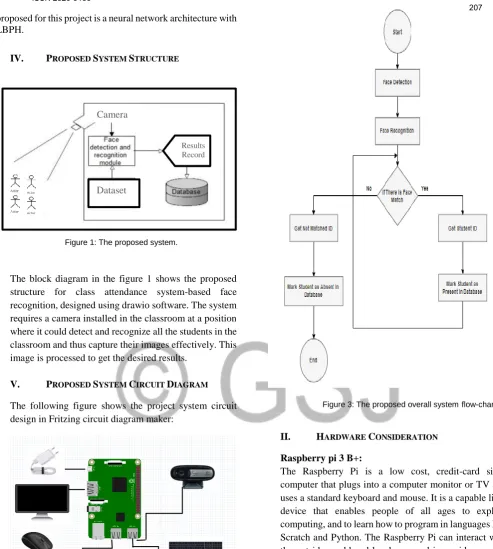
The block diagram in the figure 1 shows the proposed structure for class attendance system-based face recognition, designed using drawio software. The system requires a camera installed in the classroom at a position where it could detect and recognize all the students in the classroom and thus capture their images effectively. This image is processed to get the desired results.
V. PROPOSED SYSTEM CIRCUIT DIAGRAM
The following figure shows the project system circuit design in Fritzing circuit diagram maker:
I. PROPOSED SYSTEM FLOWCHART
The following figure shows the project system
flow-II. HARDWARE CONSIDERATION
Raspberry pi 3 B+:
The Raspberry Pi is a low cost, credit-card sized computer that plugs into a computer monitor or TV and uses a standard keyboard and mouse. It is a capable little device that enables people of all ages to explore computing, and to learn how to program in languages like Scratch and Python. The Raspberry Pi can interact with the outside world and has been used in a wide array of digital maker projects, from music machines and parent detectors to weather stations and tweeting birdhouses with infra-red cameras. The Raspberry Pi set up needs: A. Screen
B. Mouse & Keyboard C. VGA to HDMI Cable Figure 1: The proposed system.
structure.
Dataset
Results Record
Atte
Stu
Camera
Figure 2: The proposed system circuit diagram.
Figure 3: The proposed overall systemflow-chart.
III. SOFTWARE CONSIDERATION
OpenCV-Python software:
OpenCV supports a wide variety of programming languages such as C++, Python, Java, etc., and is available on different platforms including Windows, Linux, OS X, Android, and iOS. Interfaces for high-speed GPU operations based on CUDA and OpenCL are also under active development. OpenCV-Python is a library of Python designed to solve computer vision problems (OpenCV, 2018).
IV. IMPLEMENTATION
1. Firstly, connecting Raspberry pi with required components as shown in the following figure:
2. Testing face detection algorithm for a number of volunteers and the results are within approximately 98% accuracy to 100%.
3. Testing face recognition algorithm for a number of volunteers.
4. Testing MySQL connectivity with python and Gmail, the output is as following below:
5. Dataset creation from live video, using python script. All the files will be in one directory named with dataset and each file labelled with student name. 6. Creating database for attendance using MySQL:
• Table for Students information. • Table for attendance:
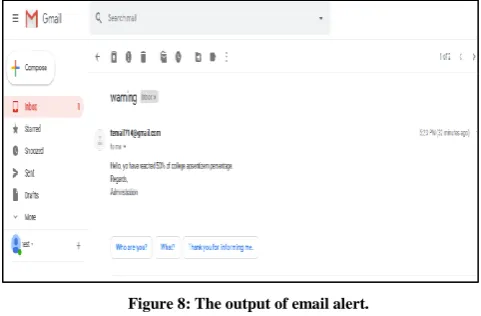
7. we will use Raspberry pi 3B+ features along with python to send emails to the students who reach or exceed the absentee’s percentage. An email will be sent if A.P% ≥50% as shown below:
Figure 7: The table of attendance MySQL.
Figure 4: The project system set-up.
Figure 5: Testing MySQL connectivity with python.
Figure 6: Testing python connectivity with Gmail.
8. The system is implemented in GUI using pyQt5 designer and the result is as following:
V. RESULTS AND DISCUSSION
After ensuring the connectivity, the programming phases can be implemented. As have been mentioned in the design specifications the first thing to be done is dataset creation, and this have been implemented with satisfied results. The dataset python script is basically, capturing the trained images from a live video frames, then store them in one directory called dataset. Next, is database creation which are important for attendance record process. There are three tables created in MySQL, user table, module table and attendance table. This code is combined with the recognition code so that based on recognized face IDs the attendance will be inserted. Thirdly,
sent directly to the student. GUI has been implemented to make the system operation more intuitive and easier to learn.
VI. CONCLUSION
In this approach, a face recognition based automated student attendance system is thoroughly described. The proposed approach provides a method to identify the individuals by comparing their input image obtained from recording video frame with respect to train image. This proposed approach able to detect and localize face from an input facial image, which is obtained from the recording video frame. Besides, it provides a method in pre-processing stage to enhance the image contrast and reduce the illumination effect. Extraction of features from the facial image is performed by applying both LBP and Haarcascaed. The algorithm designed to combine LBP and deep learning neural network able to stabilize the system by giving consistent results. The accuracy of this proposed approach is 100 % for high-quality images, and good lighting condition.
VII. ACKNOWLEDGMENT
I wish to express my indebtedness to the god for completing this project and to those who helped me which are the reason of the preparation of the manual script of this text. This would not have been made successful without their help and precious suggestions. I would like to extent my heartfelt gratitude towards my colleagues, who encouraged me to an extent, which made the project successful. Apart from that I would also like to thank the University for providing all the facilities upon completion of this project. Finally, I would like to say thank you to my parent who are my constant source of inspiration, motivation and pillar of for me to complete this final year project.
VIII. REFERENCES
[1] Docs.opencv.org. (2018). OpenCV: Introduction to OpenCV-Python Tutorials. [online] Available at: https://docs.opencv.org/3.4/d0/de3/tutorial_py_intr o.html [Accessed 10 Nov. 2018].
[2] Engr.uconn.edu. (n.d.). RASPBERRY PI BASICS.
[online] Available at:
http://engr.uconn.edu/~song/classes/nes/RPi.pdf [Accessed 15 Oct. 2018].
[3] Foundation, R. (2018). Raspberry Pi — Teach, Learn, and Make with Raspberry Pi. [online] Raspberry Pi. Available at: https://www.raspberrypi.org/ [Accessed 7 Aug.
Figure 9: GUI design of the final system. Figure 8: The output of email alert.
Recognition System. [online] Available at: https://www.matrixaccesscontrol.com/facerecognit ion.html [Accessed 15 Oct. 2018].
[5] NevonProjects. (2018). Face Recognition Attendance System Project. [online] Available at:
http://nevonprojects.com/face-recognition-attendance-system/ [Accessed 17 Oct.2018]. [6] Raspbian.org. (2018). FrontPage - Raspbian.
[online] Available at: https://www.raspbian.org/ [Accessed 10 Nov. 2018].
[7] ResearchGate. (2003). Face Recognition: A Literature Survey. [online] Available at: https://www.researchgate.net/publication/2205660 92_Face_Recognition_A_Literature_Survey [Accessed 30 Nov. 2018].
[8] Ukessays.com. (2018). Face Recognition Attendance System. [online] Available at: https://www.ukessays.com/essays/education/recog nition-attendance-system-6424.php?vref=1 [Accessed 30 Nov. 2018].
[9] W.-K. Chen, Linear Networks and Systems. Belmont, Calif.: Wadsworth, pp. 123-135, 1993. (Book style)
[10]H. Poor, “A Hypertext History of Multiuser Dimensions,” MUD History,
http://www.ccs.neu.edu/home/pb/mud-history.html. 1986. (URL link *include year) [11]K. Elissa, “An Overview of Decision Theory,"
unpublished. (Unplublished manuscript)
[12]R. Nicole, "The Last Word on Decision Theory," J. Computer Vision, submitted for publication. (Pending publication)
[13]C. J. Kaufman, Rocky Mountain Research Laboratories, Boulder, Colo., personal communication, 1992. (Personal communication) [14]D.S. Coming and O.G. Staadt, "Velocity-Aligned
Discrete Oriented Polytopes for Dynamic Collision Detection," IEEE Trans. Visualization and Computer Graphics, vol. 14, no. 1, pp. 1-12, Jan/Feb 2008, doi:10.1109/TVCG.2007.70405. (IEEE Transactions )
[15]S.P. Bingulac, “On the Compatibility of Adaptive Controllers,” Proc. Fourth Ann. Allerton Conf. Circuits and Systems Theory, pp. 8-16, 1994. (Conference proceedings)
[16]H. Goto, Y. Hasegawa, and M. Tanaka, “Efficient Scheduling Focusing on the Duality of MPL Representation,” Proc. IEEE Symp. Computational Intelligence in Scheduling (SCIS ’07), pp. 57-64, Apr. 2007, doi:10.1109/SCIS.2007.367670. (Conference proceedings)
[17]J. Williams, “Narrow-Band Analyzer,” PhD dissertation, Dept. of Electrical Eng., Harvard Univ., Cambridge, Mass., 1993. (Thesis or dissertation)
[18]E.E. Reber, R.L. Michell, and C.J. Carter, “Oxygen Absorption in the Earth’s Atmosphere,” Technical Report TR-0200 (420-46)-3, Aerospace Corp., Los Angeles, Calif., Nov. 1988. (Technical report with report number)
[19]L. Hubert and P. Arabie, “Comparing Partitions,” J. Classification, vol. 2, no. 4, pp. 193-218, Apr. 1985. (Journal or magazine citation)
[20]R.J. Vidmar, “On the Use of Atmospheric Plasmas as Electromagnetic Reflectors,” IEEE Trans. Plasma Science, vol. 21, no. 3, pp. 876-880,
available at
http://www.halcyon.com/pub/journals/21ps03-vidmar, Aug. 1992. (URL for Transaction, journal, or magzine)
[21]J.M.P. Martinez, R.B. Llavori, M.J.A. Cabo, and T.B. Pedersen, "Integrating Data Warehouses with Web Data: A Survey," IEEE Trans. Knowledge and Data Eng., preprint, 21 Dec. 2007, doi:10.1109/TKDE.2007.190746.(PrePrint) [22]Y. Yorozu, M. Hirano, K. Oka, and Y. Tagawa,
“Electron spectroscopy studies on magneto-optical media and plastic substrate interface,” IEEE Transl. J. Magn. Japan, vol. 2, pp. 740–741, August 1987 [Digests 9th Annual Conf. Magnetics Japan, p. 301, 1982].
[23]M. Young, The Technical Writer’s Handbook. Mill Valley, CA: University Science, 1989.