IMAGE RESTORATION USING
WAVELET BASED IMAGE FUSION
Anni U. Gupta
Department of E&TC Engineering, MET’s BKC IOE, Nashik, India
Prof. Dr. Alice N. Cheeran
Department of electrical Engineering, VJTI, Matunga, Mumbai, India.
Mangesh D. Nikose
Department of electrical Engineering, VJTI, Matunga, Mumbai, India.
Abstract :
This paper presents a method to restore images affected by motion blur. Motion blur is the result of the relative motion between the camera and the scene during image exposure time. This happens due to motion of camera or objects in the scene or both. This work is carried out in three stages. In the first stage a comparison of two image restoration methods was carried out, namely wiener filter and blind de-convolution. To improve the quality of image wavelet based image fusion was proposed in second stage. Finally in third stage the fused images are again restored using a low pass filter. The effectiveness ofthe methods was compared using parameters like RMSE and PSNR. The experimental evaluation showed that Wiener filter followed by Wavelet based Image Fusion provided the better results than iterative blind de-convolution method followed by Wavelet based Image Fusion.
Keywords: Image restoration; Point Spread Function;Motion blur;Wiener Filter;Wavelet,;Image Fusion.
1. Introduction
Images acquired through any modern sensors consist of variety of noises, resulting from stochastic variations and deterministic distortions or shading. In order to extract image data, smoothing algorithms should be applied initially to reduce noises before further analysis and processing.
Motion blur occurs in many image formation systems due to limited performance of both optical and electronic systems [1, 2]. If shutter speed is relative to the object velocity, the obtained image is degraded by motion blur [7]. Blurring can significantly degrade the visual quality of images taken with low-cost cameras. One solution that reduces the degree of blur is to capture images using shorter exposure intervals [5]. This however increases the amount of noise in the image, especially in dark scenes. An alternative approach is to try to remove the blur off-line.
Blur is usually modeled as a linear convolution of an image with a blurring kernel, also known as the point spread function (PSF). In remotely sensed images the relative motion is slow and it results in fatal failure of detecting important information. Better approach is to try to remove the blur off-line. Eq. (1) shows the relationship between the observed image g(x, y) and its uncorrupted version f(x, y). [1]
g(x, y) = f(x, y) * h(x, y) + v(x, y) (1)
2. Proposed Method
Restoration techniques are oriented toward modeling the degradation and applying the inverse process in order to recover the original image. The image gets blurred due to the degradation. Blur is of many types but for our work we have considered the motion blur only.
2.1 Block diagram
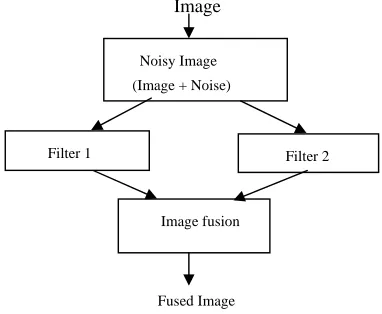
Fig. 1 shows the block diagram of the proposed method. In the original image noise is added to get blurred noisy image. To remove motion blur, the blurred image is restored using restoration algorithms. Finally the filtered images are fused using image fusion method to get the fused image.
Image
Fused Image
Fig. 1.Block diagram
2.2Noise model
Generally the noise is modeled as zero mean white Gaussian additive noise. But here we have modeled noise as sum of the multiplicative noise and additive Gaussian noise as,
v(x, y) = f(x, y)*σ1(x, y)+ σ2(x, y) (2)
where σ1(x, y) is the multiplicative noise and σ2(x, y) is the additive noise.
2.3 Image restoration
In order to remove motion blur, various image restoration algorithms have been proposed. Blind deconvolution adopts regularized iteration to restore the degraded image. But it requires large computational complexity. For this reason, this work proposes the implementation of wiener filter to reduce the computational complexity with better acceptable restoration results of image restoration method.
3. Point Spread Function (PSF)
The General form of motion blur function [6] is given as follows,
(3)
As seen that motion blur function depends on two parameters: motion length (L) and motion direction ().
4. Image Fusion
Here we use a wavelet based image fusion, in which first discrete wavelet transform (DWT) was performed on source image (second level DWT). The method used here for fusion is called as pixel level maxima (PLM). Here all the four sub-bands of the fused image F is simply formed by taking the wavelet coefficients from source images which is having the maximum value,
Noisy Image
(Image + Noise)
Filter 1 Filter 2
Fj,k = max (Aj,k Bj,k ) and Fj = max (lAj, lBj)
where lAj(x, y) and lBj (x, y) are low frequency sub images of A (j, k) and B (j, k). It is an intensity based image fusion technique.
5. Experimental Results
In this section we demonstrate some experimental results of this proposed method.
1) The results are compared on the basis of the PSNR and RMSE, for different image size (64 64, 128 128, 256 256, 512 512) for “Rice” image restored using wiener filter and blind deconvolution (N = 5 and N = 10 iterations). The comparison results between blind deconvolution and wiener filter are as shown in Table 1 and Table2.
Table 1Comparison of RMSE between blind deconvolution and wiener filter.
Sr. No. SIZE OF IMAGE BLURED NOISY IMAGE
BLIND DECONVOLUTION WIENER
FILTER WITH RATIO R
N = 5 N = 10
1 64×64 32.2808 37.8449 41.1904 17.1288
2 128×128 28.4943 31.8843 34.1993 16.6618
3 256×256 18.7636 20.0639 20.9406 13.9331
4 512×512 12.0682 13.4167 14.1434 10.8483
Table 2Comparison of PSNR between blind-deconvolution and wiener filter
Sr. No. SIZE OF IMAGE BLURED NOISY IMAGE
BLIND DECONVOLUTION WIENER
FILTER WITH RATIO R N=5 N=10
1 64×64 20.6679 19.0777 18.2306 27.0050
2 128×128 21.9156 20.7915 20.0906 27.2815
3 256×256 26.0935 25.4234 24.9957 29.0700
4 512×512 30.5069 29.4476 28.9202 31.5725
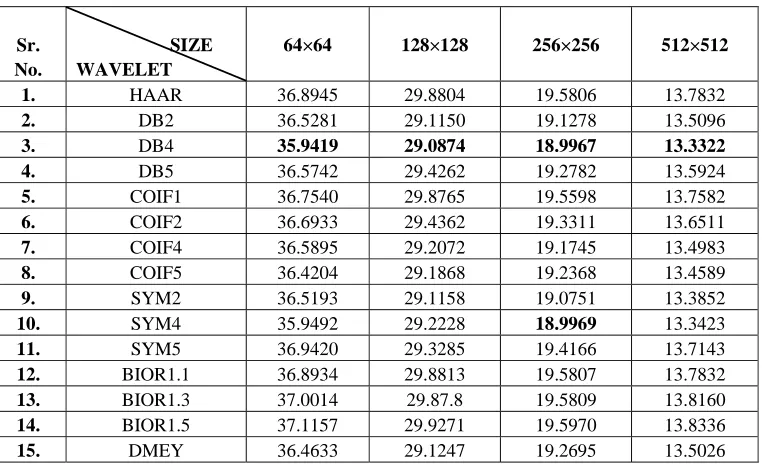
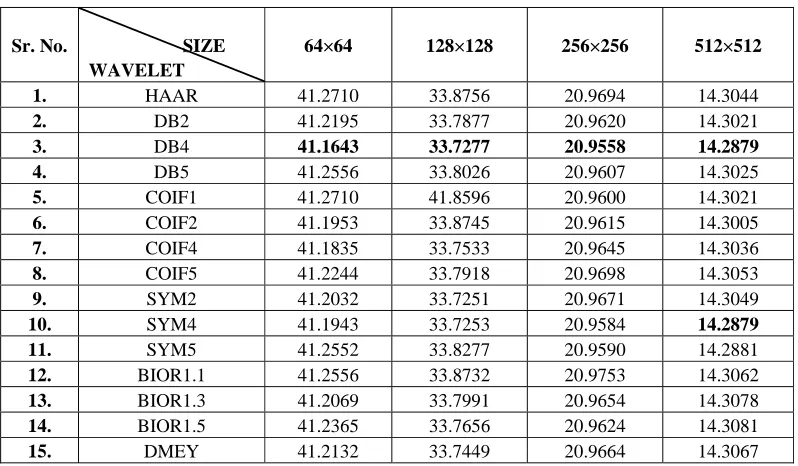
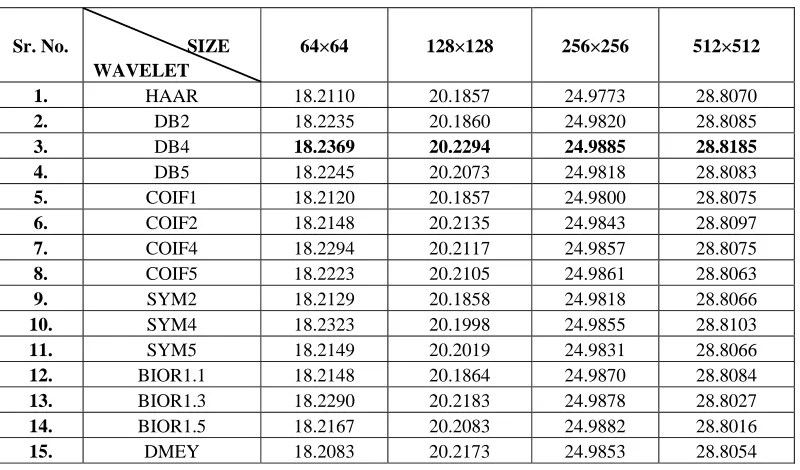
2) The Results of the second experiment of Wavelet based Fusion are shown in Table 3, Table 4 (Fused image_1) and Table 5, Table 6 (Fused image_2), the performance using the different types of wavelets.
Table 3Comparison of RMSE between different wavelets for Fused image_1
Sr. No.
SIZE WAVELET
64×64 128×128 256×256 512×512
1. HAAR 36.8945 29.8804 19.5806 13.7832
2. DB2 36.5281 29.1150 19.1278 13.5096
3. DB4 35.9419 29.0874 18.9967 13.3322
4. DB5 36.5742 29.4262 19.2782 13.5924
5. COIF1 36.7540 29.8765 19.5598 13.7582
6. COIF2 36.6933 29.4362 19.3311 13.6511
7. COIF4 36.5895 29.2072 19.1745 13.4983
8. COIF5 36.4204 29.1868 19.2368 13.4589
9. SYM2 36.5193 29.1158 19.0751 13.3852
10. SYM4 35.9492 29.2228 18.9969 13.3423
11. SYM5 36.9420 29.3285 19.4166 13.7143
12. BIOR1.1 36.8934 29.8813 19.5807 13.7832
13. BIOR1.3 37.0014 29.87.8 19.5809 13.8160
14. BIOR1.5 37.1157 29.9271 19.5970 13.8336
Table 4Comparison of PSNR between different wavelets for Fused image_1
Sr. No.
SIZE WAVELET
64×64 128×128 256×256 512×512
1. HAAR 19.3320 21.4406 25.3372 29.1782
2. DB2 19.4150 21.7001 25.8670 29.3786
3. DB4 19.5936 21.7096 25.9700 29.5108
4. DB5 19.4192 21.5938 25.8229 29.3175
5. COIF1 19.3374 21.4521 21.3370 29.2054
6. COIF2 19.3867 21.5904 25.7955 29.2745
7. COIF4 19.4318 21.6685 25.8768 29.3870
8. COIF5 19.4614 21.6755 25.8112 29.4162
9. SYM2 19.4342 21.7000 25.9288 29.4712
10. SYM4 19.5816 21.6631 25.9098 29.5107
11. SYM5 19.3191 21.6271 25.7513 29.2282
12. BIOR1.1 19.3323 21.4403 25.6672 29.1782
13. BIOR1.3 19.3031 21.4438 25.6671 29.1544
14. BIOR1.5 19.2722 21.4250 25.6589 29.1416
15. DMEY 19.4096 21.6802 25.7794 29.3838
3) Comparison of Fused image_1 (fusion between Wiener filter and Blind de-convolution N = 5) and Fused image_2 (fusion between Blind de-convolution) are shown in Table 7 and Table 8,
Table 5Comparison of RMSE between different wavelets for Fused image_2
Sr. No.
SIZE WAVELET
64×64 128×128 256×256 512×512
1. HAAR 41.2710 33.8756 20.9694 14.3044
2. DB2 41.2195 33.7877 20.9620 14.3021
3. DB4 41.1643 33.7277 20.9558 14.2879
4. DB5 41.2556 33.8026 20.9607 14.3025
5. COIF1 41.2710 41.8596 20.9600 14.3021
6. COIF2 41.1953 33.8745 20.9615 14.3005
7. COIF4 41.1835 33.7533 20.9645 14.3036
8. COIF5 41.2244 33.7918 20.9698 14.3053
9. SYM2 41.2032 33.7251 20.9671 14.3049
10. SYM4 41.1943 33.7253 20.9584 14.2879
11. SYM5 41.2552 33.8277 20.9590 14.2881
12. BIOR1.1 41.2556 33.8732 20.9753 14.3062
13. BIOR1.3 41.2069 33.7991 20.9654 14.3078
14. BIOR1.5 41.2365 33.7656 20.9624 14.3081
Table 6Comparison of PSNR between different wavelets for Fused image_2
Sr. No.
SIZE WAVELET
64×64 128×128 256×256 512×512
1. HAAR 18.2110 20.1857 24.9773 28.8070
2. DB2 18.2235 20.1860 24.9820 28.8085
3. DB4 18.2369 20.2294 24.9885 28.8185
4. DB5 18.2245 20.2073 24.9818 28.8083
5. COIF1 18.2120 20.1857 24.9800 28.8075
6. COIF2 18.2148 20.2135 24.9843 28.8097
7. COIF4 18.2294 20.2117 24.9857 28.8075
8. COIF5 18.2223 20.2105 24.9861 28.8063
9. SYM2 18.2129 20.1858 24.9818 28.8066
10. SYM4 18.2323 20.1998 24.9855 28.8103
11. SYM5 18.2149 20.2019 24.9831 28.8066
12. BIOR1.1 18.2148 20.1864 24.9870 28.8084
13. BIOR1.3 18.2290 20.2183 24.9878 28.8027
14. BIOR1.5 18.2167 20.2083 24.9882 28.8016
15. DMEY 18.2083 20.2173 24.9853 28.8054
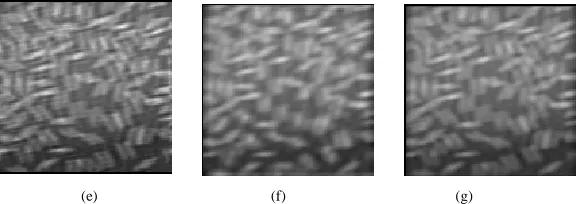
4) Fig. 2 shows the results of filtering and fusion on “rice” image of size 128 128. The restored blurred image with Blind de-convolution method with 5 and 10 numbers of iteration, it is found to have higher RMSE than blurred noisy image. The results of restoration of the same images with wiener filter were found to be very good. It is found that the blind de-convolution with the image fusion method provide significant improvement in the PSNR and RMSE, as compared to the normal method for this many iterations.
Table 7 Comparison of RMSE between Fused image_1 and Fused image_2
Sr. No.
SIZE OF IMAGE
BLURED NOISY IMAGE
FUSED IMAGE_1 FUSED IMAGE_2
1. 64×64 32.2808 35.9419 41.1643
2. 128×128 28.4943 29.0874 33.7277
3. 256×256 18.7636 18.9967 20.9558
4. 512×512 12.0682 13.3322 14.2879
Table 8 Comparison of PSNR between Fused image_1 and Fused image_2
Sr. No.
SIZE OF IMAGE
BLURED NOISY IMAGE
FUSED IMAGE_1 FUSED IMAGE_2
1. 64×64 20.6679 19.5936 18.2369
2. 128×128 21.9156 21.7096 20.2294
3. 256×256 26.0935 25.9700 24.9885
4. 512×512 30.5069 29.5108 28.8185
(e) (f) (g)
Fig. 2 Rice image with size (128 128) (a) Original image (b) Blur noisy image (c) Wiener filter with ratio R (d) Blind deconvolution
N = 5 (e) Blind deconvolution N = 10 (f) Fused image_1 (g) Fused image_2
5) The three source images used for the analysis are “cameraman.tif, rice.png, and football.jpg”. The results are compared on the basis of the PSNR and RMSE, for different image size (64 64, 128 128, 256 256, 512 512).
From the comparative analysis of the results it is clear that except (64 64) size results are good and it is found that with the increasing resolution, there is significant improvement in the PSNR and RMSE.
Table 9 Comparison of RMSE between cameraman, rice and football images
Sr. No.
Size of Image
Cameraman.tif Rice.png Football.jpg Fuse-1 Fuse-2 Fuse-1 Fuse-2 Fuse-1 Fuse-2
1. 64 x 64 35.1462 41.1183 35.9419 41.1643 17.6699 19.8835
2. 128 x 128 29.1792 30.1268 29.0874 33.7277 14.7645 16.6792
3. 256 x 256 22.3576 23.1955 18.9967 20.9558 12.5148 13.8032
4. 512 x 512 19.0406 20.1818 13.3322 14.2879 9.7582 10.4967
Table 10 Comparison of PSNR between cameraman, rice and football images
Sr. No.
Size of Image
Cameraman.tif Rice.png Football.jpg Fuse-1 Fuse-2 Fuse-1 Fuse-2 Fuse-1 Fuse-2
1. 64 x 64 18.7105 17.0873 19.5936 18.2369 26.694 25.5174
2. 128 x 128 20.8355 19.3826 21.7096 20.2294 28.4903 27.2722
3. 256 x 256 23.4452 22.6727 25.9700 24.9885 30.1435 29.1667
4. 512 x 512 25.9469 25.3682 29.5108 28.8185 32.6316 31.902
6. Conclusion
This paper proposes a method to remove the motion blur present in the image taken from any cameras. The blurred image is restored using Blind de-convolution method with 5 and 10 number of iteration and wiener filter with ratio R. The results based on wiener filter provided better results than iterative blind deconvolution method.
Further different wavelets were compared for fusion, and DB4 gave the best results. Result based on the Wavelet Image Fusion with wiener filter (Fused image_1) provided the better results than iterative blind deconvolution (Fused image_2) method. Even the results with fusion for Blind-deconvolution are improved significantly as compared to simple method. For the further work the performance of this method can be compared with the other fusion algorithm like edge based fusion and region based fusion can be compared.
Acknowledgement
References
[1] R. C. Gonzalez, R. E. Woods, S. L. Eddins, “Digital Image Processing Using MATLAB” Pearson, 3rd
Edition 2005. [2] A. K. Jain, “Fundamental of Digital Image Processing”, PHI 2005.
[3] Y. Xia, and M. S. Kamel “Novel Cooperative Neural fusion Algorithms for Image Restoration, Image Fusion”, Feb 2007.
[4] M. Tico, M. Vehvilainen, Nokia Research CenterFinland,[email protected], “Estimation of motion blur PSF from differently exposed image frames.”
[5] A. Levin, “Blind motion deblurring using image statistics”, school of computer science and Engineering, The Hebrew University, MIT CSAIL, [email protected], Jerusalem.
[6] M. Tehran, “Linear Motion Blur Parameter Estimation in Noisy Images Using Fuzz Sets and Power Spectrum”, Iran, March 2006. [7] S. K. Kang, J. H. Min and J. K. Paik, “Segmentation-based spatially adaptive motion blur removal and its application to surveillance
systems”, Proc. International Conf. Image processing, Vol. l, pp.245-248, Thessaloniki, Greece, Oct 2001
[8] J. Portilla, V. Strela, M. J. Wainwright and E. P. Simoncelli, “Image Denoising Using Scale Mixtures of Gaussians in the Wavelet Domain”, IEEE transactions on image processing, Vol. 12, No.11, Nov 2003.