A Novel Culture Algorithm for Knowledge
Integration
Si-hua Chen
Institute of Information Resource Management, School of Information Management Jiangxi University of Finance And Economics, Nanchang, China, 330013
Abstract—Integrating knowledge from different subjects and sources to obtain an effective knowledge base is the key to improve decision quality and enhance organizational core competency. We put forward a knowledge integration strategy under the framework of culture algorithm. It encodes the knowledge uniformly and through the evolvement of the two phases of population space and belief space the communication protocol is established among the two spaces. Then an effective and concise knowledge base is automatically produced without any knowledge of specific fields. The experiment shows that comparing with traditional genetic algorithm, the model can classify the knowledge more precisely, reduce redundant knowledge and remove contradictory knowledge.
Index Terms—Cultural Algorithm; Genetic Algorithm; Knowledge Coding; Knowledge Integration
I. INTRODUCTION
In knowledge-based environment, the main factor which decides the status of organization has shifted from tangible physical assets and financial assets to the intangibles knowledge elements. Grant and Volberda further pointed out that it is the integration of knowledge rather than knowledge itself that has formed a core competency of enterprises. It shows that enterprises should not only acquire knowledge through organizational learning but also make it become a knowledge system and dynamic knowledge process and combine it with other resources to form continued competitive advantage[1,2].
About knowledge integration many scholars at home and abroad have done abundant excellent work. Boer(1999) proposes that the knowledge integration capability is the combination of three capabilities: (1) systems capabilities; (2)coordination capabilities; (3) socialization capabilities[2]. Only covering and improving
the three capabilities can the knowledge integration be enhanced[3]. Kogut and Zander (1992) thinks the capability of knowledge integration is the one the enterprise comprehensively use present knowledge and obtain knowledge[4]. The capability is not only the use of tool but more important is the communication and coordination among people and the common knowledge possessed by people. The knowledge integration capability has great impact on an enterprise’s core competitiveness. Hu Han-Hui (2001) considers that the real source of competitiveness comes from the knowledge integration capability[5]. It makes manager be able to integrate the internal knowledge based on the judgement
of future and hold the opportunities of changes. The rise of enterprise’s short and long performance also depends on the improvement of knowledge integration capabilities. Volberda (1999) further points out that it is the knowledge integration not knowledge itself which form an enterprise’s core capabilities[6]. Petroni (1996) proposes the relationship between knowledge integration and core competitiveness[7]. He emphasizes the great impact of development of knowledge integration on cultivation of core competitiveness. Besides, from the perspective of resource theory, Boer (1999) thinks the efficiency, scale and elasticity of knowledge has great impact on lasting competitiveness[3]. Grant (1996) points out that in the process of knowledge integration, the more an enterprise has the knowledge, the more the knowledge is expressed by common language and then it enhance the knowledge integration[8]. Scholars have made fruitful research on knowledge integration. However, most of them focus on the impact of knowledge integration on improvement of organizational competitiveness, organizational innovation and organizational performance and have not provided specific theoretical guidance on how to integrate knowledge. From the angle of culture algorithm, this paper proposes the concept model of internal knowledge integration and on the basis of two hypothesis analyzes the mechanism of knowledge integration improving organizational performance.
specialized knowledge[15]. Thomas (1996) reports in his longitudinal study of 200 industries that an industry’s knowledge base, and management’s ability to enact change based on that knowledge, was a key determinant of innovation success[16]. Kogut and Zander (1992) coined the term combinative capability to represent the synthesis and application of new and existing knowledge culminating in innovation success[4]. They view the firm as a repository of capabilities comprised of knowledge (information and know-how) and the recombination of knowledge gives rise to new skills and routines for innovation. Grant (1996) refines our understanding of the relationship between knowledge and organizational capabilities by arguing that the integration of multiple types of knowledge is key to forming capabilities[8].
Kwahk(2007) has proposed a method which can integrate the knowledge of departments and therefore support organizational decision[17]. Xiangyan Li(2007) put forward a knowledge integration model under complicated network background based on information theory[18]. In recent years more and more scholars adopt the technology of artificial intelligent to study knowledge integration. In 1997 Cordon etc optimized the rule sets by genetic algorithm[19]. And from 1995 to 2000 Wang, Hong and Tseng proposed multiple knowledge integration algorithms based on gene searching[20]. Myoung etc took the advantage of fuzzy theory and genetic algorithm to develop a mixed knowledge integration algorithm and has achieved good effect by applying it to Korea stock market[21].
The common characteristic of the above algorithms is that all of them need knowledge of specific fields. Some even need the participation of experts. All this bring certain limitations to the application of algorithms. Besides, the redundant problem of knowledge integration has not been perfectly solved.
Culture algorithm is an algorithm with multi-evolution process, which provides a frame of the combination of search mechanism and knowledge management. And any evolution algorithm can be embedded in this frame. Culture is defined by Durham(1994) as a“system of symbolically encoded
conceptual phenomenon that are socially and historically transmitted within and between populations”[22]. It has
been suggested by Renfrew(1994) that over time humans have evolved a unique set of capacities that support the formation, encoding, and transmission of cultural information[23]. In human society, culture is regarded as carrier of storing information. The information is widely transferred among group and between groups. The information can be inherited by all members of the group and can effectively guide members’ behaviors and solve problems. The cultural algorithm is established through inspiration of it, Cultural Algorithm (Reynolds 1994) are a class of computational models of cultural evolution that support dual inheritance perspective, He depict cultural evolution process from both a micro evolutionary perspective in terms of the transmission of behaviors or traits between individual in a population and a macro evolutionary perspective in terms of the formation of generalized beliefs based upon individual experiences[24]. These generalized beliefs can serve to
constrain the behaviors of individuals within the associated population. A dual inheritance cultural system supports the transmission of information at both the individual and group level.
Cultural Algorithm has general features which is given below:
1. Dual Inheritance (at population and knowledge levels)
2. Knowledge are „beacons‰ that guide evolution of the population
3. Supports hierarchical structuring of population and belief spaces
4. Domain knowledge separated from individuals 5. Supports self adaptation at various levels
6. Evolution can take place at different rates at different levels
7. Supports hybrid approaches to problem solving. A computational framework within which many all of the different models of cultural change can be expressed.
The cultural algorithm exceeds the traditional evolutionary algorithm and more accurately reflects the evolutionary process by imitating the micro and macro evolution. The application of cultural algorithm is not too widely, It has successful application in the field of cluster analysis, function optimization, knowledge management, multi objective optimization,semantic networks, data mining, evolutionary programming, dynamic environment and other fields[25-57]. Scholars both domestic and abroad to study just start, and gradually become the focus of research, At present, we start to pay attention to cultural algorithm and the research is mainly focused on evolutionary programming (Zhang Chun Xian 2007) [58]、data mining(Zhang Di
2009)[59].
Quin (1992)thinks the knowledge especially tacit knowledge is the most strategic resource[27]. But tacit knowledge is fused rational knowing, based on personal experience(Tim Ray 2009)[28]. Therefore, it is the key of knowledge integration how to effectively integrate individual knowledge, systemize it and melt it in the present organizational knowledge structure. The present research seldom makes study on how to integrate knowledge and which mechanism makes knowledge integration more effective. Aiming at the above problems, this paper proposes an internal knowledge integration model to discuss the mechanism of internal knowledge integration.
Cultural algorithms are based on some theories which originated in sociology and archaeology which try to model cultural evolution. Such theories indicate that cultural evolution can be seen as an ginheritance process operating at two levels:
1. a micro evolutionary level, which consists of the genetic material that an offspring inherits from its parents.
2. a macro evolutionary level, which consists of the knowledge acquired by individuals through generations.
Cultural algorithms operate in two spaces. First, there is the population space, which consists of (as in all evolutionary algorithms) a set of individuals. Each individual has a set of independent features that are used to determine its fitness. Through time, such individuals can be replaced by some of their descendants, which are obtained from a set of operators applied to the population. The second space is the belief space, which is where the knowledge acquired by individuals through generations is stored. The information contained in this space must be accessible to each individual, so that they can use it to modify their behavior.
The culture algorithm from micro and macro levels simulates the evolution of biological level and the evolution of cultural level. The evolution process relates with each other and influences each other according to agreed protocol and in the end obtains population with best fitness value.
The essence of knowledge integration is the issue of multi-goal optimization. According to the characteristics of culture algorithm, this paper proposes a knowledge integration strategy based on culture algorithm. This algorithm does not need knowledge of special fields. Through two-stage genetic algorithm the rule sets are optimized, which can effectively solve the problem of redundancy and contradiction of rule sets and therefore produces a concise and effective rule sets. In the forecasting experiment of Ozone Level Detection Data Set and Iris Data Set, firstly the initial rule population is randomly formed and then we use the algorithm to optimize each rule of population space and belief space and good affect is achieved.
II. ALGORITHM FRAMEWORK
A. Knowledge Coding Stage
This paper proposes a knowledge integration strategy based on culture algorithm, using two-stage genetic algorithm and optimizing knowledge from two levels. In this paper knowledge is denoted by heuristic rule. This algorithm is divided into two stages: coding stage and integration stage.
The purpose of this stage is to uniformly encode each rule into the fixed-length bit string for the preparation for the next knowledge integration. For the length of each rule is different, we need to transfer the rules to a consistent condition. In this algorithm, knowledge is denoted by the heuristic rule “IF… THEN…”. The coding process is as follows:
Step 1 collect all condition features and class /*j suppose there are m features and n classes*/ Step 2 encode condition features
For k=1 to m IF k is discrete
Collect all possible value of k and encode as a bit string
Else
Discretize k and encode as a bit string Step 3 encode classes
encode n classes as a bit string
If some features in the global feature set are not used by the rule, dummy tests are inserted into the condition
part of the rule. All rules are unified in form. The following is an example of discretization rule coding.
Cerebral hemorrhage and cerebral thrombosis are totally different Cerebrovascular accidents. They have different medical treatment while having similar clinic display. Especially little cerebral hemorrhage and cerebral thrombosis almost have the same clinic display. Therefore rapid diagnosis has great significance for the timely treatment. We can clinically diagnose the two diseases through the following phenomenon: 1. whether having hypertension; 2. whether pupils are the same big; 3. whether knee-jerk reflex is active; 4. whether having language barriers;5. whether mode of onset is quick; 6. whether having deep conscious barrier; 7. whether the progression of the disease is rapid; 8. whether having arteriosclerosis. Each feature has two different values; There are two classes, cerebral thrombosis is 1, cerebral hemorrhage is 0.
There is a rule:
IF(the progression of disease = slow) ∧
(arteriosclerosis = exist) THEN cerebral thrombosis Unicode as:11 11 11 11 11 11 01 10 10
The feature which is not involved in rules is uncoded as 1.
The length of coding is:
1
( ) ( )
N
i
number i number C
=
+
∑
i is feature,number(i)is all the values the feature may have;C is class,number(C)is all the values the class may have.
B. Knowledge integration stage
The purpose of this stage is to finally obtain a concise, effective rule set. Firstly several rules are produced randomly and become the initial ones in population space. According to certain rules the eligible ones are uploaded to belief space and then update belief space; through another round of evolution the eligible ones are feedbacked to population space. The algorithm framework is shown in figureⅠ:
FigureI Framework of Algorithm
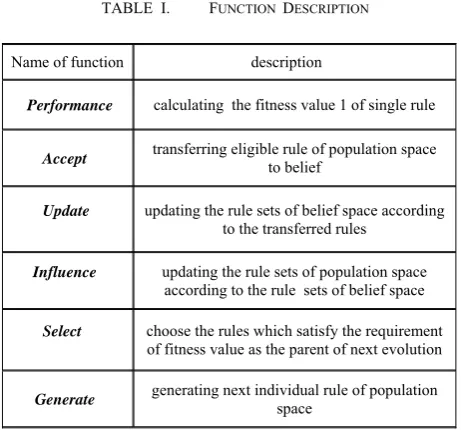
The functions in the framework is described in Tab.1:
TABLE I. FUNCTION DESCRIPTION
Integrating pseudocode is as follows: t=0;
initialize Population space POP (t); initialize Belief space BLF (t); Repeat
Performance (POP(t)); Select (POP(t));
Update (BLF(t),Accept(POP(t))); Generate (POP(t),Influence(BLF(t))); t=t+1;
Performance (POP(t));
until termination condition achieved; END
III. ALGORITHM DESCRIPTION
In summary this paper applies two-stage genetic algorithm to culture algorithm to realize knowledge integration and carry out genetic operators in population space and belief space. The design of genetic algorithm is mainly decided by the following four factors: coding, design of fitness function, design of genetic operators, setting of controlling parameters.
C. Coding
According to above section, coding is divided into continuous valued coding and discrete valued coding. Continuous value feature discretizes as 16 uniform intervals and encode into a bit string of 4 bits long; discrete value feature is encoded into a fixed length binary string, whose length is equal to the number of possible value. In order to unify the length of chromosome, dummy tests are inserted into features which are not involved into rules. The coding of classes is similar to the discrete value features.
D. Design of fitness function
Fitness is the only criterion to measure “good” or “bad” chromosome and is the basis of iterative evolution of genetic algorithm. The precision of forecasting is undoubtedly the most important indicator to measure
chromosome and therefore this paper define the precision of forecasting of chromosome as following:
U U U
i ri
ri r
precision
=
Ω +Ω(2)
U ri
Ω denotes the sample number which can be correctly forecasted by chromosome ri in training data
set U. Uri denotes the sample number which can be wrongly forecasted by chromosome ri in training data set
U.
In belief space the first generation chromosomes are all transferred from population space through Accept ()function and have high precision. However the purpose of belief space is to obtain a concise rule set through evolution. And therefore this paper defines validity as another important indicator for chromosome. If only one sample of training data set can be correctly forecasted by a chromosome, the validity of the chromosome on the sample is 1; if one sample of training data set can be correctly forecasted by m chromosomes, the validity of one chromosome on the sample is 1/m; if one sample of training data set can not be correctly forecasted by the chromosome, the validity of the chromosome on the sample is 0. The validity of chromosome is the sum of all validity of chromosome on all samples. The forecasting validity of chromosome is defined as following:
( , ) ( , )
S U i
i r
r s r s
effectiveness
∈
Ψ Ψ
=
∑
∑
(3)
S is one sample of training data set U. ri is the chromosome of current space
( , )
r s
i⎧
Ψ
=
⎨
⎩
In genetic algorithm the fitness function is nonnegative and the more big the better. For the experiment implemented by this paper is on Matlab platform and the fitness function defined by the toolbox is that the small the better, in order to facilitate calculation we define the fitness function of chromosome as:
( , ) ( , )
U U U
S U i
i i
r ri
ri
r s r s r
Fitness
precision effectiveness
∈
Ψ Ψ Ω
Ω +
= −
−
= −
−
∑
∑
(5) E. Design of genetic operator
We adopt the elitist selection strategy to choose operators to ensure the best chromosome can revolute to next generation; Crossover operators adopt single crossover strategy; mutation operators adopt floating-point mutation strategy.
F. Setting of controlling parameters
The controlling parameters of this algorithm are shown in Tab. 2.
Name of function description
Performance calculating the fitness value 1 of single rule
Accept transferring eligible rule of population space to belief
Update updating the rule sets of belief space according
to the transferred rules
Influence updating the rule sets of population space
according to the rule sets of belief space
Select choose the rules which satisfy the requirement
of fitness value as the parent of next evolution
Generate generating next individual rule of population space
1 S can be forecasted by ri
TABLE II. CONTROLS PARAMETER OF ALGORITHM
Controlling parameter value
Initial population 50
Crossover probability 0.8
Mutation probability 0.005
Terminating condition 102
IV. EXPERIMENT ANALYSIS
The soft environment of the experiment is Matlab7.0; The hard environment of the experiment is AMD Athlon 2.19GHz and 1.00GB with EMS memory.
Source of data: UC Irvine Machine Learning Repository. website: http://archive.ics.uci.edu/ml/ This paper chooses a big sample data set and a small sample data set to test the algorithm. And they are Ozone Level Detection Data Set and Iris Data Set. The description of the testing data set is as follows:
TABLE III. OZONE LEVEL DETECTION DATA SET DESCRIPTION
TABLE IV. IRIS DATA SET DESCRIPTION
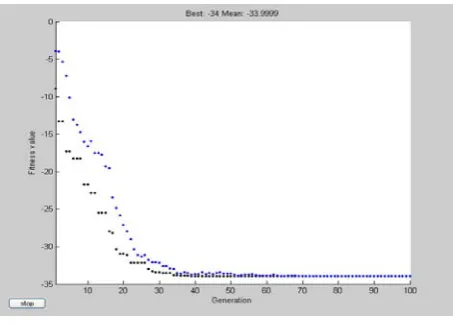
We use culture algorithm to carry out experiments on these two data sets and it shows: both have good convergence. The data sets with big sample converge at 40 generations and the fitness value is -67; the data sets with small sample converge at 30 generations and the fitness value is -34. The two scatter lines in the table respectively denote the maximum and average value of fitness of the whole chromosomes of population space and belief space during evolution. The results of the experiments are as follows:
FigureII Result of Ozone Level Detection Data Set
FigureIII Result of Iris Data Set
In experiments the initial population is generated randomly. Therefore, there is redundancy and contradiction among individuals in initial population. In above example: IF(the progression of disease = slow) ∧
(arteriosclerosis = exist) THEN cerebral thrombosis contradicts with IF(the progression of disease = quick) ∧
(arteriosclerosis = exist) THEN cerebral thrombosis;
IF(the progression of disease = slow) ∧ (arteriosclerosis = exist) THEN cerebral thrombosis have redundancy with IF(the progression of disease = quick) ∧ (arteriosclerosis = exist) ∧(language barrier = exist) THEN cerebral thrombosis.
We randomly generate 100 group initial populations and carry out experiments on Iris Data Set. In 50 individuals of initial population there are average 4.24 individuals contradicts with others; there are average 5.18 individuals are redundant with others. We have the final population by culture algorithm and the result is respectively compared with the genetic algorithm defined by fitness function as precision and the genetic algorithm defined by fitness function as validity. The result is as follows:
TABLE V. COMPARISON OF CA WITH GA
Algorithm Number of contradictory individuals
Number of redundant individuals
Precision of forecasting
CA 0 0 85.1%
GA(precision) 0 4.93 83.9%
GA(effectiveness)4.01 0 81.2%
From the result of the experiment we know that culture algorithm can improve the precision of forecasting and effectively remove contradictory and redundant individuals of initial population. Therefore an effective and concise knowledge base is generated which help to make decisions. However, the traditional genetic algorithm can only reduce the number of contradictory individuals or the number of redundant individuals and there also is gap in the precision of forecasting.
V. CONCLUSION
This paper proposes a knowledge integrating strategy based on culture algorithm. It does not need knowledge of specific fields. It divides the evolution Data Set Characteristics Multivariate Number of Instances 2536
Missing Values Yes Number of Attributes 73
Associated Tasks Classification Number of Class 2
Data Set Characteristics Multivariate Number of Instances 150
Missing Values No Number of Attributes 4
process into population space and belief space and makes the two spaces influence each other by establishing communication protocol among the two spaces. By transferring the good individuals with larger fitness value among the two spaces we can finally obtain a concise and effective knowledge base. Experiments show that this method can effectively remove the contradictory and redundant individuals and improve the precision of forecasting.
ACKNOWLEDGMENT
The authors are wish to grateful for the anonymous reviewers who made constructive comments. This work was supported in part by a grant from NSFC(71073073).
REFERENCES
[1] Grant R.M. Toward a knowledge-based theory of the firm [J]. Strategic Management, 1996, 11(7): 109-122. [2] Volberda H.W. Toward the flexible form: How to remain
vital in hyper competitive environments[J]. Organization Science, 1996, 7(4): 359-374.
[3] D. M. Boer, J. Fransa, D. B. Van, H. W. Volberda. Management Organizational Knowledge Integration in the Emerging Multimedia Complex[J]. Journal of Management Studies, 1999(6):379-398.
[4] B. Kogut, U. Zander. Knowledge of the Firm, Integration Capabilities, and the Replication of Technology[J]. Organization Science, 1992, 3(3): 383- 397.
[5] Hu han-hui, Zhou zhi-han. Core Competence:the Integration of Knowledge[J]. Journal of Industrial Engineering and Engineering Management, 2001 (4): 16-19. (in chinese)
[6] W. H. Volberda, A. Rutges. FARSYS: A knowledge-based system for managing strategic change [J]. Decision Support Systems. 1999, 8(26):99-124.
[7] A. Petroni. The Analysis of Dynamic Capabilities in a Competence-Oriented[J]. Organization. Thchnovation. 1996 (18):179-189.
[8] R. M. Grant. Prospering in dynamically competitive environments Organization capability as knowledge integration[J]. Organization Science. 1996 (7): 375-387. [9] P. Lawrence, J. Lorsch. Organization and
Environment[M]. Boston, Harvard Business School Press. 1967:85-96.
[10] I. Nonaka. A Dynamic Theory of Organizational Knowledge Creation[J]. Organization Science. 1994, 5(1):14-37.
[11] G. Okhuysen, K. Eisenhardt. Integrating Knowledge in Groups: How Formal Interventions Enable Flexibility [J]. Organization Science. 2002, 13(4): 370-386.
[12] W. Tasi. Knowledge Transfer in Intra organizational Networks: Effects of Network Position and Absorptive Capacity on Business Unit Innovation and Performance [J]. Academy of Management Journal. 2001, 44(5): 996-1004.
[13] A. Marjchrzak, L. Cooper, O. Neece. Knowledge Reuse for Innovation[J]. Management Science. 2004, 50(2):174-188.
[14] C. Terwiesch, C. Loch. Measuring the Effectiveness of Overlapping Development Activities [J]. Management Science. 1999, 45(4) :455-465.
[15] Andrea Kienle. Integration of knowledge management and collaborative learning by technical supported communication processes[J]. Education and Information
Technologies. 2006, 11(4):161-185.
[16] L. G. Thomas. The Two Faces of Competition: Dynamic Resourcefulness and the Hypercompetitive Shift[J]. Organization Science. 1996, 7(3):221-243.
[17] Kee Young Kwahk, Hee Woong Kim, Hock Chuan Chan. A Knowledge Integration Approach for Organizational Decision Support[J]. Journal of Database Management, 2007, 18(2): 41-61.
[18] Xiangyang Li , Charu Chandra. A knowledge integration framework for complex network management[J]. Industrial Management & Data Systems, 2007, 107(8): 1089-1109.
[19] Cordon O, Herrera F., Lozano M. On the combination of fuzzy logic and evolutionary computation: a short review and bibliography[J]. Fuzzy evolutionary computation, 1997, 20(10): 33–56.
[20] Wang C. H, Tseng S. S, Hong, T. P. Design of a self-adaptive brain tumor diagnostic system[J]. Journal of Information Science and Engineering, 1995, 11(2): 275– 294.
[21] Myoung JongKim, Ingoo Han, Kun ChangLee. Hybrid knowledge integration using the fuzzy genetic algorithm: prediction of the Korea stock price index[J]. Intelligent System in Accounting, Finance and Mangement. 2004, 12(1): 43-60.
[22] W. H. Durham. Co-evolution: Genes, Culture, and Human Diversity[M]. Stanford University Press, Stanford, California. 1994.
[23] A. C. Renfrew. Dynamic modeling in archaeology: What, when, and where? In Dynamical Modeling and the Study of Change in Archaelogy[M]. S. E. van der Leeuw, (Ed.), Edinburgh University Press, Edinburgh, Scotland. 1994. [24] R. G. Reynolds. An introduction to cultural
algorithms[C]. In Proceedings of the Third Annual Conference on Evolutionary Programming, A. V. Sebald and L. J. Fogel, (Eds.). World Scientific, River Edge, New Jersey, 1994:131–139.
[25] J.B. Quin. Intelligent enterprise [M]. New York: Free Press, 1992.
[26] Tim Ray. Rethinking Polanyi’s Concept of Tacit Knowledge: From Personal Knowing to Imagined Institutions. Minerva (on line). 2009(3):1573-1591. [27] A. C. Renfrew. Dynamic modeling in archaeology: What,
when, and where? In Dynamical Modeling and the Study of Change in Archaelogy[M]. Edinburgh: Edinburgh University Press. 1994.
[28] R. G. Reynolds. An introduction to cultural algorithms [C]. In Proceedings of the Third Annual Conference on Evolutionary Programming, World Scientific, River Edge, New Jersey, 1994:131–139.
[29] Meng Fan-rong, Hao Xiao-yun, Zhou Yong. Selective Neural Network Ensemble Approach Based on Cultural Algorithm[J]. Journal of Chinese Computer Systems, 2009, 30(5): 933-936.
[30] Gao Li-li, Liu Hong, LI Tong-xi. Research on cultural genetic algorithm based on schema fetching[J]. Computer Engineering and Applications. 2007, 43(22): 38-40. [31] Peng B. Knowledge and population swarms in cultural
algorithms for dynamic environments[D].USA:Wayne State University,2005.
[32] G Yi-nan,G Dun-wei,X Zhen-gui. Hybrid optimization method based on genetic algorithm and cultural algorithm[C]//The 6th World Congress on Intelligent Control and Automation,2006:3471-3475.
approach[C]//IEEE Congress on Evolutionary Computation,1999:1672-1678.
[34] Saleem S M. Knowledge-based solution to dynamic optimization problems using cultural algorithms[D]. USA:Wayne State University, 2001.
[35] Ostrowski D A,Tassier T,Everson M,et al. Using cultural algorithms to evolve strategies in agent-based models[C]//IEEE Congress on Evolutionary Computation,2002,:741-746.
[36] Iacoban R,Reynolds R G,Brewster J. Cultural swarms:modellingthe impact of culture on social interaction and problem solving[C]//IEEE Swarm Intelligence Symposium,2003:205-211.
[37] Iacoban R,Reynolds R G,Brewster J.Cultural swarms:assessing the impact of culture on social interaction and problem solving[C]// IEEE Swarm Intelligence Symposium,2003:212-219.
[38] Coelho L D S,Mariani V C. An efficient particle swarm optimization approach based on cultural algorithm applied to mechanicaldesign [C]//IEEE Congress on Evolutionary Computation,2006:1099-1104.
[39] Becerra R L,Coello C A. Culturizing differential evolution for constrained optimization[C]//The 5th Mexican International Conference in Computer Science,2004:304-311.
[40] Becerra R L,Coello C A. Solving hard multiobjective optimization problems usingε-constraint with cultured differential evolution[C]//The 9th International Conference on Parallel Problem Solving from Nature,Iceland,2006,4193:543-552.
[41] Chung C J. Knowledge-based approaches to self-adaptation in cultural algorithms[D].USA:Wayne State University,1997.
[42] J Xidong,Reynolds R G.. Using knowledge-based system with hierarchical architecture to guide the search of Evolutionary computation[C]//The 11th IEEE International Conference on Tools with Artificial Intelligence,1999:29-36.
[43] Reynolds R G,Chung C J. Fuzzy approaches to acquiring experimental knowledge in cultural algorithms[C]//The 9th IEEE International Conference on Tools with Artificial Intelligence,1997:260-267.
[44] Rychtyckyj N,Reynolds R G.Using cultural algorithms to improve performance in semantic networks[C]/IEEE Congress on Evolutionary Computation,1999,3:1651-1656.
[45] Rychtyckyj N,Reynolds R G. Assessing the performance of cultural algorithms for semantic network re-engineering[C]//IEEE Congress on Evolutionary Computation,2000,2:1482-1491.
[46] Reynolds R G, Al-Shehri H. The use of cultural algorithms withevolutionary programming to control the data mining of large scale spatio-temporal databases[C]//IEEE International Conference on Systems,Man and Cybernetics,1997,5:4098-4103.
[47] J Xidong,Reynolds R G.. Data mining using cultural algorithms and regional schemata[C]//The 14th IEEE International Conference on Tools with Artificial Intelligence,2002:33-40.
[48] Reynolds R G,Peng B,Alomari R S. Cultural evolution of ensemble learning for problem solving[C]//IEEE Congress on Evolutionary Computation,2006:1119-1126. [49] Sverdlik W,Reynolds R G. Incorporating domain specific
knowledge into version space search[C]//The 5th IEEE International Conference on Tools with Artificial Intelligence,1993:216-223.
[50] Coello C A,Becerra R L. Evolutionary multiobjective
optimization using a cultural algorithm[C]//IEEE Swarm Intelligence Symposium,2003:6-13.
[51] C Xiao-fang,G Wei-hua,C Li-hui,et al. A multi-population genetic algorithm based on chaotic migration strategy and its application to inventory programming[C]//The 5th World Congress on Intelligent Control and Automation,2004,3:2159-2162.
[52] S Kai,Y Genke.An effective hybrid optimization algorithm for the flow shop scheduling problem[C]//IEEE International Conference on Information Acquisition,2006:1234-1238.
[53] Kwon Y K,Moon B R. A hybrid neurogenetic approach for stock forecasting[J].IEEE Transactions on Neural Networks,2007,18(3):851-864.
[54] Kwedlo W,Bandurski K.A parallel differential evolution algorithm for neural network training[C]//International Symposium on Parallel Computing in Electrical Engineering,2006:319-324.
[55] Li B,Wada K.Parallelizing particle swarm optimization[C]//IEEE Pacific Rim Conference on Communications , Computers and Signal Processing,2005:288-291.
[56] Digalakis J G,Margaritis K G. A multipopulation cultural algorithm for the electrical generator scheduling problem[J].Mathematics and Computers in Simulation,2002,60:293-301.
[57] Alami J,Imrani A E,Bouroumi A. A multipopulation cultural algorithm using fuzzy clustering[J].Applied Soft Computing,2007,7(2):506-519.
[58] Zhang Chun-Xian, Zhuang Feng-Ting, Zhang Lei, Gao Shang. A Cultural Algorithm Based on Evolutionary Programmin. Journal of Jiangnan University Natural Science Edition[J]. 2007, 6(6):782-786.
[59] Zhang Di, Yang Yan, Tang Rui-Xue. New hybrid clustering algorithm based on cultural algorithms. Computer Engineering and Applications[J]. 2009, 45(4):159-161.
Si-hua Chen was born in Jiangxi province of the People's
Republic of China in July 1977.Bachelor's degree was earned in Nanjing University of Science and Technology, major in Computer science in 1998; in 2006, earned master degree in Jiangxi University of Finance and Economics, major in Management science and engineering; Currently, studying doctor degree in Jiangxi University of Finance and Economics.
Dorian is a member of the Faculty staff of school of Information Management Jiangxi University of Finance And Economics where he is involved in teaching and R&D work. Publishing more than 20 papers on journal of Information & Computational Science, Journal of Chinese computer systems .