Prevalence, Patterns, and Persistence of Sleep
Problems in the First 3 Years of Life
WHAT’S KNOWN ON THIS SUBJECT: Sleep problems are common during childhood, but screening for sleep problems in the clinic setting is often cursory. Moreover, there are few longitudinal studies examining the prevalence and persistence of sleep problems in young children.
WHAT THIS STUDY ADDS: Patterns of sleep problems vary across early development, but sleep problems arising in infancy persist in 21% of children through 36 months of age. Parent response to a nonspecific query about sleep problems may overlook relevant sleep symptoms and behaviors.
abstract
OBJECTIVE: Examine the prevalence, patterns, and persistence of parent-reported sleep problems during thefirst 3 years of life.
METHODS:Three hundred fifty-nine mother/child pairs participated in a prospective birth cohort study. Sleep questionnaires were administered to mothers when children were 6, 12, 24, and 36 months old. Sleep variables included parent response to a nonspecific query about the presence/absence of a sleep problem and 8 specific sleep outcome domains: sleep onset latency, sleep maintenance, 24-hour sleep duration, daytime sleep/naps, sleep location, restlessness/vocalization, nightmares/night terrors, and snoring.
RESULTS:Prevalence of a parent-reported sleep problem was 10% at all assessment intervals. Night wakings and shorter sleep duration were associated with a parent-reported sleep problem during infancy and early toddlerhood (6–24 months), whereas nightmares and restless sleep emerged as associations with report of a sleep problem in later developmental periods (24–36 months). Prolonged sleep latency was associated with parent report of a sleep problem throughout the study period. In contrast, napping, sleep location, and snoring were not associated with parent-reported sleep problems. Twenty-one percent of children with sleep problems in infancy (compared with 6% of those without) had sleep problems in the third year of life.
CONCLUSIONS:Ten percent of children are reported to have a sleep problem at any given point during early childhood, and these problems persist in a significant minority of children throughout early develop-ment. Parent response to a single-item nonspecific sleep query may overlook relevant sleep behaviors and symptoms associated with clinical morbidity.Pediatrics2012;129:e276–e284
AUTHORS:Kelly C. Byars, PsyD,a,bKimberly Yolton, PhD,c
Joseph Rausch, PhD,bBruce Lanphear, MD, MPH,dand
Dean W. Beebe, PhDb
Divisions ofaPulmonary Medicine,bBehavioral Medicine and Clinical Psychology, andcGeneral and Community Pediatrics, Cincinnati Children’s Hospital Medical Center, Cincinnati, Ohio; anddFaculty of Health Sciences, Simon Fraser University and Child and Family Research Institute, British Columbia Children’s Hospital, Vancouver, British Columbia, Canada
KEY WORDS
sleep problems, infants, toddlers, prevalence, persistence
ABBREVIATION
OSA—obstructive sleep apnea
Each author made a substantive intellectual contribution to the study. Dr Byars participated in early conceptualization and design of sleep measurement methodology and collaborated with coauthors on data interpretation; he took a lead role with drafting and revising the article. Dr Rausch provided critical contributions to formulating the data analytic plan and assisted with data interpretation as well as reviewing and revising the article for important intellectual content. Dr Yolton was a primary investigator in the research laboratory that secured funding for this project. She had primary responsibility for the study design and oversight of its execution and participated in the conceptualization and design of the sleep measurement tools. Dr Yolton also played a significant role with respect to data collection and interpretation as well as critically reviewing and revising the article. Dr Lanphear was the principal investigator who secured funding for this project. He had primary responsibility for the study design and oversight of its execution. Dr Lanphear also played a significant role with respect to data collection and interpretation as well as critically reviewing and revising the article. Dr Beebe also participated in early conceptualization and design of sleep measurement methodology, conducted data analysis and interpretation of studyfindings, and drafted and critically revised the article. www.pediatrics.org/cgi/doi/10.1542/peds.2011-0372
doi:10.1542/peds.2011-0372
Accepted for publication Sep 26, 2011
Address correspondence to Kelly C. Byars, PsyD, Divisions of Pulmonary Medicine and Behavioral Medicine and Clinical Psychology, Cincinnati Children’s Hospital Medical Center, ML 2021, 3333 Burnet Ave, Cincinnati, OH 45229-3039. E-mail: Kelly. [email protected]
PEDIATRICS (ISSN Numbers: Print, 0031-4005; Online, 1098-4275).
Copyright © 2012 by the American Academy of Pediatrics
Sleep problems are common in child-hood and may persist if not adequately managed.1–5 The importance of
de-tection and treatment of pediatric sleep disorders is underscored by a growing literature that links sleep problems with other morbidities.6–15
For example, cardiovascular morbidity and metabolic syndrome have been linked with obstructive sleep apnea (OSA).9,10 Sleep problems are also
as-sociated with impairments in daytime functioning and decreased quality of life in affected children6,7,11–15as well
as secondary effects on families (eg, disrupted parent sleep; marital dis-cord; maternal stress).16–20
Because sleep is essential to daily functioning, sleep is routinely addressed through anticipatory guidance in pe-diatric settings.21 However, research
indicates that pediatric sleep problems may go undetected during routine clin-ical care.22–24 In a survey of
pedia-tricians it was revealed that roughly half do not screen for sleep disturbance or use singular screening questions when talking with parents of infants and tod-dlers (eg, “Does your child have any sleep problems?”23). Furthermore, little
is known about how parents interpret and report sleep problems. Thus
super-ficial inquiry and parent interpretation about what constitutes a sleep problem are factors that likely play a role in the underdiagnosis or misdiagnosis of pediatric sleep problems. For example, clinically important symptoms such as snoring, a hallmark symptom of OSA, might be missed if they are not en-compassed within parents’typical defi -nitions of a “sleep problem.” Further, once a sleep problem is identified, the decision to intervene rests in part upon the physician’s belief about whether the problem will persist. The bulk of the literature supports the persistence of early-onset sleep problems2–5,25–35 but
has relied on nonspecific dichotomous measures or focused on a narrowly
defined sleep behavior (eg, bedtime refusal). Few authors have serially measured a comprehensive measure of parent-reported sleep patterns dur-ing early childhood.
Clinical decision-making may be ham-pered by gaps in our knowledge of the utility of a nonspecific single sleep screening question and the prevalence and persistence of sleep problems during early childhood. The purpose of the current study was tofill these gaps by examining the prevalence, patterns, and persistence of broadly defined sleep problems and more specific domains of sleep behavior during the
first 3 years of life.
METHODS
Sample
The study cohort comprised mother/ child pairs participating in the Health Outcomes and Measures of the Envi-ronment Study, an ongoing prospective birth cohort in the Cincinnati, Ohio, metropolitan area.36 Beginning in
March 2003, women were identified from 7 prenatal clinics associated with 3 hospitals. Eligible mothers were identified at #19 weeks of gestation, were age$18 years, negative for HIV, and not taking medications for seizure or thyroid disorders. Letters were mailed to 5184 prospective subjects; 468 of the 1263 eligible respondents were consented and enrolled. Sixty-seven enrollees dropped out before delivery; 3 children were stillborn. Nine sets of twins were excluded because their sleep arrangements could fundamen-tally differ from those of singleton chil-dren. Thirty (8%) of the 389 women with singleton live births did not complete sleep questionnaires, resulting in afinal sample of 359 subjects.
Procedures
The institutional review board of Cin-cinnati Children’s Hospital Medical Center provided oversight for the
study. All mothers provided written in-formed consent before enrollment. Enrollees received phone calls regu-larly to maintain contact and interest in the study. Study assessments were completed annually during clinic and home visits, and telephone surveys were conducted at the 6-month mid-point each year.
Sleep Questionnaire
Questionnaires were administered via structured interviews by trained re-search assistants by telephone when the children were 6 months of age. Face-to-face interviews were con-ducted during a home visit when the children were 12, 24, and 36 months of age. There is no gold standard for sleep assessment that spans infancy and early childhood, so 2 questionnaires were developed based upon previous validated sleep instruments. The questionnaire for 6- to 12-month-olds included 26 items adapted from several scales,26,37–41 whereas the
question-naire for 24- to 36-month-olds included 53 items adapted from the Child Sleep Habits Questionnaire.42 Both
ques-tionnaires included the nonspecific di-chotomous item “Do you think ____ (child’s name) has problems sleeping?” Because this is similar to the single question that is often asked in pedia-tricians’offices, the response comprised 1 of our key outcomes:“nonspecific sleep problem.”
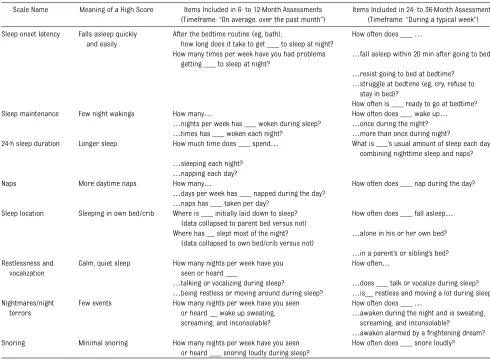
representative of these sleep domains. The sleep behavior domains and their composition were refined based upon an examination of item variability and factor analyses from each time point. Thefinal item content for the 8 domains is presented in Table 1 (see Supple-mental Information for response options and endorsement patterns at each time point). Items had differing response options, so we converted each item’s response set to a commonz
score metric relative to the cohort mean and SD at each time point. For multi-item domains, individual item scores were averaged before further analyses. The result was a matrix of continuous domain scores for each subject at each time point that (a) was conceptually consistent over time, (b) was placed on a common statistical
metric, and (c) mirrored the dis-tributions of the raw data.
Statistical Analysis
Preliminary x2 and Mann-Whitney U
tests compared the demographic characteristics of subjects with avail-able sleep data at each time point against those with missing data to as-sess for differential attrition over time. These tests and Spearman correla-tions also examined whether the sleep domain scores or rate of overall sleep problems differed reliably by child gender, family income, or race. Finally, using Fisher’s z test, we examined whether the correlations described in our primary analyses varied signifi -cantly by race or gender. Finding no substantive difference in the pattern of correlations among the subgroups, we
subsequently used the full sample for primary analyses.
We calculated frequency data for parent report of a nonspecific sleep problem at the 6-, 12-, 24-, and 36-month as-sessments. We also examined which of the 8 sleep behavior domains were associated with parent report of a sleep problem at each time point. We calculated Spearman correlations to determine the association between con-tinuous sleep behavior domain scores at each time point with analogous scores obtained later. Finally, to de-termine the risk for persistence of parent-reported sleep problems, we calculated odds ratios and associated Fisher’s exact tests. A two-tailed signifi -cance threshold ofP,.05 was adopted across all analyses.
TABLE 1 Sleep Domains, Interpretation, and Item Composition
Scale Name Meaning of a High Score Items Included in 6- to 12-Month Assessments (Timeframe:“On average, over the past month”)
Items Included in 24- to 36-Month Assessments (Timeframe:“During a typical week”)
Sleep onset latency Falls asleep quickly and easily
After the bedtime routine (eg, bath),
how long does it take to get ___ to sleep at night?
How often does ___…
How many times per week have you had problems getting ___ to sleep at night?
…fall asleep within 20 min after going to bed?
…resist going to bed at bedtime?
…struggle at bedtime (eg, cry, refuse to stay in bed)?
How often is ___ ready to go at bedtime? Sleep maintenance Few night wakings How many… How often does ___ wake up…
…nights per week has ___ woken during sleep? …once during the night?
…times has ___ woken each night? …more than once during night?
24-h sleep duration Longer sleep How much time does ___ spend… What is ___’s usual amount of sleep each day, combining nighttime sleep and naps?
…sleeping each night?
…napping each day?
Naps More daytime naps How many… How often does ___ nap during the day?
…days per week has ___ napped during the day?
…naps has ___ taken per day? Sleep location Sleeping in own bed/crib Where is ___ initially laid down to sleep?
(data collapsed to parent bed versus not)
How often does ___ fall asleep…
Where has __ slept most of the night? (data collapsed to own bed/crib versus not)
…alone in his or her own bed?
…in a parent’s or sibling’s bed? Restlessness and
vocalization
Calm, quiet sleep How many nights per week have you seen or heard ___
How often…
…talking or vocalizing during sleep? …does ___ talk or vocalize during sleep?
…being restless or moving around during sleep? …is__ restless and moving a lot during sleep? Nightmares/night
terrors
Few events How many nights per week have you seen or heard __ wake up sweating, screaming, and inconsolable?
How often does ___…
…awaken during the night and is sweating, screaming, and inconsolable?
…awaken alarmed by a frightening dream? Snoring Minimal snoring How many nights per week have you seen
or heard ___ snoring loudly during sleep?
RESULTS
Demographics
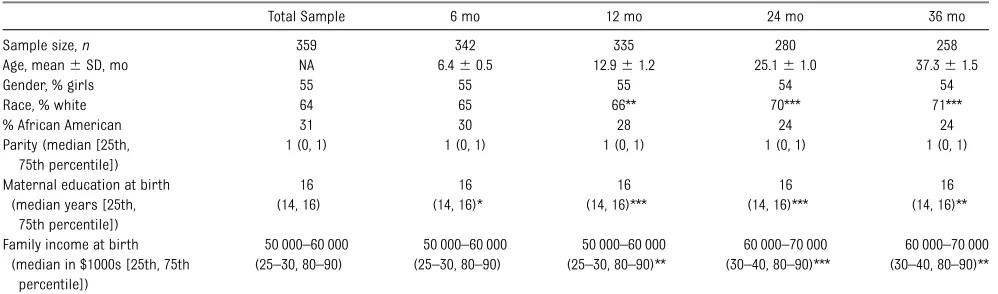
Of the 359 eligible mother/child dyads, sleep data were available for 342 (95%) at 6 months, 335 (93%) at 12 months, 280 (78%) at 24 months, and 258 (72%) at 36 months. Demographic characteristics are summarized in Table 2. The sample, which was evenly divided by gender, was comprised primarily offirst- and second-born children and covered broad socioeconomic strata. At the 6-month survey point, the sample was 64% white participants and 31% Afri-can AmeriAfri-can participants. There was differential attrition over time among African Americans and those in the lowest education and income groups (P,.005).
African American children and those from lower-income families were reported to have longer sleep onset latency, shorter overall sleep duration, less independent sleep, and more snoring than were white children and those from higher-income families at all time points (P , .01; Supplemental Tables 5 and 6). However, the overall rate of parent-reported nonspecific sleep problems and behaviors around sleep maintenance did not significantly differ by race or family income at any time point. Reported napping/daytime sleep, vocalization/restlessness, and nightmares/night terrors differed by
race or family income at only 1 time point each. Sleep variables differed by child gender in only 3 of 36 analyses, well within expectations based upon chance variation alone.
Prevalence and Patterns of Parent-Reported Sleep Problems
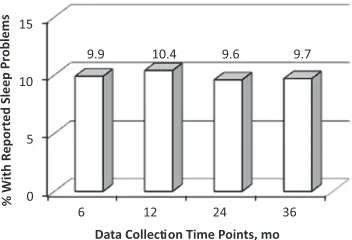
As shown in Fig 1, the presence of a nonspecific sleep problem was repor-ted by roughly 10% of parents at each time point. Parent report of a sleep problem was significantly associated with longer sleep onset latency across all age ranges, as well as poorer sleep maintenance and shorter sleep dura-tion at 6 to 24 months but less strongly at 36 months (Table 3). Nightmares/ night terrors and restlessness/ vocalization were significantly associ-ated with parent report of a sleep problem from 12 to 36 months of age. Parent report of a sleep problem was significantly associated with snoring only at 12 months and with the location of a child’s sleep only at 24 months. The frequency of naps or daytime sleep was never significantly associated with pa-rental report of a sleep problem.
Stability of Sleep-Related Behaviors and Parent-Reported Sleep
Problems
Table 4 presents correlations between sleep domain scores obtained at each
time point with the equivalent domain score collected at later time points. Medium (r= 0.30) to large (r= 0.50) effects43were observed for nearly all
correlations from 1 time point to the next, and significant correlations were evident between our 2 most distant measurement points (6 and 36 months) in sleep onset latency, sleep duration, sleep location, restlessness/ vocalization, and snoring.
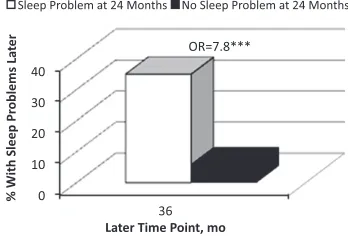
Compared with those who were not reported to have an early sleep prob-lem, infants and toddlers with a repor-ted sleep problem had much higher rates of such problems at later time points (Figs 2, 3, and 4). Only 6% to 8% of children without a reported sleep problem at 1 time point developed such a problem later. In contrast, 21% to 35% of those who were reported to have a sleep problem during early childhood showed persistent sleep problems 1 to 2 1/2 years later.
DISCUSSION
Prevalence and Patterns of Sleep Problems
Our findings indicate that the overall prevalence of parent-reported sleep problems remains stable during early development. At each time point, 1 in 10 parents reported the presence of a sleep problem in response to a single, nonspecific screening question that
TABLE 2 Sample Demographics
Total Sample 6 mo 12 mo 24 mo 36 mo
Sample size,n 359 342 335 280 258
Age, mean6SD, mo NA 6.460.5 12.961.2 25.161.0 37.361.5
Gender, % girls 55 55 55 54 54
Race, % white % African American
64 65 66** 70*** 71***
31 30 28 24 24
Parity (median [25th, 75th percentile])
1 (0, 1) 1 (0, 1) 1 (0, 1) 1 (0, 1) 1 (0, 1)
Maternal education at birth (median years [25th,
75th percentile])
16 (14, 16)
16 (14, 16)*
16 (14, 16)***
16 (14, 16)***
16 (14, 16)**
Family income at birth (median in $1000s [25th, 75th
percentile])
50 000–60 000 (25–30, 80–90)
50 000–60 000 (25–30, 80–90)
50 000–60 000 (25–30, 80–90)**
60 000–70 000 (30–40, 80–90)***
60 000–70 000 (30–40, 80–90)**
is similar to what many physicians use during routine clinic visits.22–24
This falls well within the broad range of reported prevalence rates (2%– 33%) based on cross-sectional re-search.4,25–27,30,31
There appear to be developmental shifts over thefirst 3 years of life in what parents mean when they report a non-specific sleep problem. Our data sug-gest that sleep onset difficulties are
considered problematic by parents throughout early childhood, consistent with previous studies documenting that this is a common complaint of parents with young children.5,25,29,33
Our findings also suggest that night wakings and shorter sleep duration were perceived as sleep problems by 6 months of age and then remained particular concerns for parents through 2 years of age. In contrast, parental
endorsement of a sleep problem was not linked to sleep behaviors char-acteristic of partial arousal para-somnias (ie, nightmares/terrors; vocalizations/restlessness during sleep) until 12 to 36 months of age.
Parents who reported that their child had a sleep problem did not report atypical snoring, sleep location, or napping/daytime sleeping behaviors during early childhood. It is noteworthy that the failure of a parent to recognize and report problems related to these domains could lead to errors in clinical decision making. For example, 12% to 20% of our sample snored multiple nights per week, placing them at high risk for OSA, a nocturnal breathing disorder associated with medical mor-bidity and neurobehavioral deficits in children.44 However, parents did not
seem to associate snoring with sleep problems, and previous research has shown that routine screening for snoring occurs in only 25% or less of well-child visits.42As a result, snoring
could be completely overlooked during well-child visits, despite its known risk for morbidity. The American Academy of Pediatrics recommends that all children be specifically screened for snoring and that children deemed at risk for OSA be referred for sub-specialty evaluation.44
Sleeping arrangements, particularly infant sleep location, has received considerable attention in the pediatric literature.45–49Cosleeping is on the rise
in North America and other indus-trialized countries and is an accepted and common practice in many ethnic groups.46–48In our study, data for sleep
location were collapsed to examine solitary sleeping versus sleeping in other contexts (eg, parent’s/sibling’s bed). Across all time points, the ma-jority of children (62.5%–81.9%) were sleeping in their own bed; infants and toddlers 16.6% and 17.2%, respec-tively, were sleeping with a parent. Our
FIGURE 1
Prevalence of parent-reported sleep problems. Percent of children reported by their parent to have a sleep problem at 6, 12, 24, and 36 months of age.
TABLE 3 Associations between Parental Endorsement of an Overall Sleep Problem and Sleep Domain Scores
6 mo 12 mo 24 mo 36 mo
Sleep onset latency 20.23*** 20.22*** 20.20** 20.31*** Sleep maintenance 20.27*** 20.29*** 20.31*** 20.15* 24-h sleep duration 20.16** 20.17** 20.23*** 20.13* Naps/daytime sleep 20.01 0.03 20.04 20.04 Sleep location 20.06 20.03 20.18** 20.11 Restlessness/vocalization 20.07 20.13* 20.24*** 20.24*** Nightmares/night terrors 20.07 20.20*** 20.31*** 20.21**
Snoring 20.09 20.15** 20.04 20.08
Two-tailed point-biserial correlation significance: *P,.05, **P,.01, ***P,.001.
TABLE 4 Correlations of Sleep Domain Data Collected at 6, 12, and 24 Months With the Same Domain at Later Time Point(s)
Correlation of Data at 6 Mo With That Collected Later at…
Correlation of 12-Mo Data With Data Collected at…
Correlation of 24-Mo Data With Data From
…12 mo …24 mo …36 mo …24 mo …36 mo …36 mo Sleep onset latency 0.35*** 0.17** 0.19** 0.39*** 0.24*** 0.41*** Sleep maintenance 0.34*** 0.13* 0.11 0.16** 0.17** 0.20** 24-h sleep duration 0.44*** 0.30*** 0.29*** 0.35*** 0.20** 0.37*** Naps 0.17** 20.09 0.00 0.07 0.20** 0.33*** Sleep location 0.50*** 0.33*** 0.29*** 0.55*** 0.42*** 0.66*** Restlessness and
vocalization
0.34*** 0.23*** 0.19** 0.32*** 0.27*** 0.32***
Nightmares/night terrors
0.10 0.12 0.09 0.22*** 0.03 0.18*
Snoring 0.37*** 0.19** 0.23*** 0.31*** 0.23*** 0.29***
findings suggest that parents do not systematically consider the sleep loca-tion of their 6- to 36-month-old child to be, in and of itself, a problem. Sleep lo-cation may be more relevant in the
context of specific sleep symptoms/ behaviors. For example, night wakings may be considered more problematic to parents if they cosleep with their child. Future research examining sleep
location in the context of prevalence and persistence of pediatric sleep problems should consider more refined analyses of specific sleep symptoms/behaviors (eg, breastfeeding; smoking exposure) that were not a focus of this study.
Finally, our studyfindings contrast with anecdotal evidence indicating that pa-rents of young children struggle with nap issues (eg, irregular nap sched-ule).45Our data show that parents of
infants and toddlers do not systemati-cally relate napping behavior to the presence of a sleep problem; if a clini-cian is interested in learning about nap-ping, specific queries are necessary.
Stability of Sleep Problems and Sleep Behaviors
Our findings provide guidance to pediatricians about the persistence of sleep problems in young children. When compared with nonproblem sleepers at the same age, children reported by their parents to have a sleep problem at any time point in early childhood had a three- tofivefold greater risk for later sleep problems. In our data, 23% to 35% of children who were reported to have a sleep problem at 6, 12, or 24 months of age went on to also have a similar problem at later measurement points. These observations are generally con-sistent with other longitudinal studies that have documented the persistence of infant onset sleep problems in 30% to 40% of children through 36 months of age.4,25,26Thus, although the majority of
infants and toddlers identified as hav-ing a sleep problem at any given time are not identified as having such a problem later, a significant minority continue to have problems over spans of months to years.
We also examined the stability of more specific domains of sleep behavior (eg, sleep duration, sleep location, snoring), allowing for 3 broad inferences. First, as might be expected, sleep domain scores measured closer in time correlated
FIGURE 2
Persistence of parent-reported sleep problems. Percent of children with a sleep problem at 6 months of age (open bars) versus without a sleep problem at 6 months (black bars) who went on to have a sleep problem at later time points. OR, odds ratio. Significance values from Fisher’s exact test: *P,.05, **P,
.01, ***P,.001.
FIGURE 3
Persistence of parent-reported sleep problems. Percent of children with a sleep problem at 12 months of age (open bars) versus without a sleep problem at 12 months (black bars) who went on to have a sleep problem at later time points. OR, odds ratio. Significance values from Fisher’s exact test: *P,.05, **P,
.01, ***P,.001.
FIGURE 4
Persistence of parent-reported sleep problems. Percent of children with a sleep problem at 24 months of age (open bars) versus without a sleep problem at 24 months (black bars) who went on to have a sleep problem at 36 months of age. OR, odds ratio. Significance values from Fisher’s exact test: *P,.05, **P,
more strongly than those collected over longer time spans, suggesting partic-ular stability in sleep behaviors across 6- to 12-month time spans. Second, there was generally moderate stability in sleep behaviors over time, with the greatest stability in sleep behaviors tending to be in the domains of sleep onset latency, sleep duration, sleep lo-cation, restlessness/vocalization, and snoring. Thus, parent-report in these areas cannot be expected to change markedly across the infant and pre-school years. In contrast, daytime sleep/naps, nightmares/terrors, and nocturnal arousals were less stable over time. Finally, significant corre-lations between our 2 most distant measurement points (6 and 36 months) in sleep onset latency, sleep duration, sleep location, restlessness/ vocalization, and snoring suggest that these sleep behaviors, or at least parent-report of these behaviors, may establish themselves quite early in development.
Study Limitations
There are several study limitations that should be considered when interpret-ing our results. First, samplinterpret-ing error may have influenced prevalence esti-mates of sleep problems; approxi-mately one third of eligible respondents completed baseline study procedures and approximately one fourth of the original sample was lost to attrition by thefinal follow-up interval. Additionally, in light of the sampling methodology involving recruitment from prenatal clinics in metropolitan Cincinnati, Ohio, results may not be applicable to the
general population of children across North America. Second, all sleep mea-sures were based on parent-report, and although this is likely to be the primary source of information in the clinic, rater bias cannot be ruled out. Third, since there is no single validated instrument for assessing sleep prob-lems in children aged 6 to 36 months, we were required to pool data from 2 in-dependent sleep questionnaires. We took steps in our statistical analyses to ensure comparability of data, and it was reassuring that the correlations be-tween behavior domain scores col-lected at 12 and 24 months (spanning the infant and preschool question-naires) were similar to those between 6 and 12 months or between 24 and 36 months (within a given questionnaire). Nevertheless, measurement impreci-sion could have been introduced by the lack of parallel measures at all as-sessment points. Fourth, because the sleep problem and behavioral domains that were the focus of this study are culturally defined to varying degrees, the potential impact of cultural differ-ences in defining sleep problems must be considered. Our analyses indicated there were differences between the majority and minority groups with re-spect to several domains of sleep behaviors. However, there were no differences in the prevalence and per-sistence of sleep problems between groups and thus the cultural differ-ences did not appear to have materially influenced our study findings. Finally, this descriptive study did not pro-pose nor examine potential mecha-nisms underlying sleep problems.
Consequently, we did not consider po-tential confounding variables during data analysis. Future investigations examining the persistence of sleep problems should consider underlying mechanisms and potential confounding variables.
CONCLUSIONS
Parent interpretation and report of a sleep problem during early childhood may be inconsistent with clinical cri-teria for diagnosing pediatric sleep disorders, especially when assessed via a nonspecific query. To clarify pa-rental concerns about sleep during early development and ensure that clinically relevant sleep issues are not overlooked, we recommend that sleep problems be screened by using afl exi-ble family-centered approach while addressing specific sleep behaviors and symptoms that have known clinical significance. Owens and Dalzell50have
developed a tool that has proven utility in the clinic setting, facilitates brief sleep screening, is developmentally sensitive, and is behavior/symptom specific. Although we did not directly test the utility of that tool, the current study confirms the importance of fo-cused screening for sleep problems during infancy and early childhood that goes further than merely asking if the child has problems sleeping.
ACKNOWLEDGMENT
This work was partially supported by grants from the National Institute of En-vironmental Health Sciences (R01 ES015517-01A1, P01 ES11261).
REFERENCES
1. Lozoff B, Wolf AW, Davis NS. Sleep problems seen in pediatric practice.Pediatrics. 1985; 75(3):477–483
2. Pollock JI. Predictors and long-term asso-ciations of reported sleeping difficulties in
infancy. J Reprod Infant Psychol. 1992;10 (3):151–168
3. Pollock JI. Night-waking atfive years of age: predictors and prognosis.J Child Psychol Psychiatry. 1994;35(4):699–708
5. Kataria S, Swanson MS, Trevathan GE. Persistence of sleep disturbances in pre-school children.J Pediatr. 1987;110(4):642– 646
6. Beebe DW, Gozal D. Obstructive sleep apnea and the prefrontal cortex: towards a com-prehensive model linking nocturnal upper airway obstruction to daytime cognitive and behavioral deficits.J Sleep Res. 2002; 11(1):1–16
7. Beebe DW, Groesz L, Wells C, Nichols A, McGee K. The neuropsychological effects of obstructive sleep apnea: a meta-analysis of norm-referenced and case-controlled data.
Sleep. 2003;26(3):298–307
8. Lumeng JC, Chervin RD. Epidemiology of pediatric obstructive sleep apnea.Proc Am Thorac Soc. 2008;5(2):242–252
9. Amin RS, Kimball TR, Kalra M, et al. Left ventricular function in children with sleep-disordered breathing.Am J Cardiol. 2005; 95(6):801–804
10. Larkin EK, Rosen CL, Kirchner HL, et al. Variation of C-reactive protein levels in adolescents: association with sleep-disordered breathing and sleep duration.
Circulation. 2005;111(15):1978–1984 11. Goodwin JL, Kaemingk KL, Fregosi RF, et al.
Clinical outcomes associated with sleep-disordered breathing in Caucasian and Hispanic children—the Tucson Children’s Assessment of Sleep Apnea study (TuCASA).
Sleep. 2003;26(5):587–591
12. O’Brien LM, Mervis CB, Holbrook CR, et al. Neurobehavioral correlates of sleep-disordered breathing in children.J Sleep Res. 2004;13(2):165–172
13. Sadeh A, Gruber R, Raviv A. Sleep, neuro-behavioral functioning, and behavior problems in school-age children.Child Dev. 2002;73(2):405–417
14. Owens J, Opipari L, Nobile C, Spirito A. Sleep and daytime behavior in children with obstructive sleep apnea and behav-ioral sleep disorders.Pediatrics. 1998;102 (5):1178–1184
15. Lavigne JV, Arend R, Rosenbaum D, et al. Sleep and behavior problems among pre-schoolers.J Dev Behav Pediatr. 1999;20(3): 164–169
16. Dahl RE, El-Sheikh M. Considering sleep in a family context: introduction to the special issue.J Fam Psychol. 2007;21(1):1–3 17. Hiscock H, Wake M. Randomised
con-trolled trial of behavioural infant sleep intervention to improve infant sleep and maternal mood.BMJ. 2002;324(7345):1062– 1065
18. Wolfson A, Lacks P, Futterman A. Effects of parent training on infant sleeping patterns, parents’stress, and perceived parental
competence.J Consult Clin Psychol. 1992;60 (1):41–48
19. Durand VM, Mindell JA. Behavioral treat-ment of multiple childhood sleep disorders: effects on child and family.Behav Modif. 1990;14(1):37–49
20. Adams LA, Rickert VI. Reducing bedtime tantrums: comparison between positive routines and graduated extinction. Pediat-rics. 1989;84(5):756–761
21. Olson LM, Inkelas M, Halfon N, Schuster MA, O’Connor KG, Mistry R. Overview of the content of health supervision for young children: reports from parents and pedia-tricians. Pediatrics. 2004;113(6 Suppl): 1907–1916
22. Meltzer LJ, Johnson C, Crosette J, Ramos M, Mindell JA. Prevalence of diagnosed sleep disorders in pediatric primary care prac-tices.Pediatrics. 2010;125(6). Available at: www.pediatrics.org/cgi/content/full/125/6/ e1410
23. Owens JA. The practice of pediatric sleep medicine: results of a community survey.
Pediatrics. 2001;108(3). Available at: www. pediatrics.org/cgi/content/full/108/3/e51 24. Meissner HH, Riemer A, Santiago SM, Stein
M, Goldman MD, Williams AJ. Failure of physician documentation of sleep com-plaints in hospitalized patients.West J Med. 1998;169(3):146–149
25. Wake M, Morton-Allen E, Poulakis Z, Hiscock H, Gallagher S, Oberklaid F. Prevalence, stability, and outcomes of cry-fuss and sleep problems in thefirst 2 years of life: prospective community-based study. Pedi-atrics. 2006;117(3):836–842
26. Lam P, Hiscock H, Wake M. Outcomes of infant sleep problems: a longitudinal study of sleep, behavior, and maternal well-being.
Pediatrics. 2003;111(3). Available at: www. pediatrics.org/cgi/content/full/111/3/e203 27. Anders TF, Halpern LF, Hua J. Sleeping
through the night: a developmental per-spective.Pediatrics. 1992;90(4):554–560 28. Simard V, Nielsen TA, Tremblay RE, Boivin M,
Montplaisir JY. Longitudinal study of pre-school sleep disturbance: the predictive role of maladaptive parental behaviors, early sleep problems, and child/mother psychological factors. Arch Pediatr Ado-lesc Med. 2008;162(4):360–367
29. Jenni OG, Fuhrer HZ, Iglowstein I, Molinari L, Largo RH. A longitudinal study of bed sharing and sleep problems among Swiss children in thefirst 10 years of life. Pedi-atrics. 2005;115(1 Suppl):233–240 30. Gaylor EE, Goodlin-Jones BL, Anders TF.
Classification of young children’s sleep problems: a pilot study. J Am Acad Child Adolesc Psychiatry. 2001;40(1):61–67
31. Gaylor EE, Burnham MM, Goodlin-Jones BL, Anders TF. A longitudinal follow-up study of young children’s sleep patterns using a de-velopmental classification system. Behav Sleep Med. 2005;3(1):44–61
32. Wolke D, Meyer R, Ohrt B, Riegel K. The incidence of sleeping problems in preterm and fullterm infants discharged from neo-natal special care units: an epidemiological longitudinal study.J Child Psychol Psychi-atry. 1995;36(2):203–223
33. Jenkins S, Owen C, Bax M, Hart H. Conti-nuities of common behaviour problems in preschool children. J Child Psychol Psy-chiatry. 1984;25(1):75–89
34. Jones NB, Rossetti Ferreira MC, Farquar M, Macdonald BL. The association be-tween perinatal factors and later night waking.Dev Med Child Neurol. 1978;20(4): 427–434
35. Bernal JF. Night waking in infants during thefirst 14 months.Dev Med Child Neurol. 1973;15(6):760–769
36. Geraghty SR, Khoury JC, Morrow AL, Lanphear BP. Reporting individual test results of environmental chemicals in breastmilk: potential for premature wean-ing.Breastfeed Med. 2008;3(4):207–213 37. Morrell J. The infant sleep questionnaire: A
new tool to assess infant sleep problems for clinical and research purposes. Child Adolesc Ment Health. 1999;4(1):20–26 38. Matthey S. The sleep and settle
question-naire for parents of infants: psychometric properties.J Paediatr Child Health. 2001;37 (5):470–475
39. Richman N. A community survey of char-acteristics of one- to two-year-olds with sleep disruptions.J Am Acad Child Psychi-atry. 1981;20(2):281–291
40. Johnson CM. Infant and toddler sleep: a telephone survey of parents in one community.J Dev Behav Pediatr. 1991;12(2): 108–114
41. Sadeh A. A brief screening questionnaire for infant sleep problems: validation and findings for an Internet sample.Pediatrics. 2004;113(6). Available at: www.pediatrics. org/cgi/content/full/113/6/e570
42. Owens JA, Spirito A, McGuinn M. The Children’s Sleep Habits Questionnaire (CSHQ): psychometric properties of a sur-vey instrument for school-aged children.
Sleep. 2000;23(8):1043–1051
43. Cohen J.Statistical Power Analysis for the Behavioral Sciences, 2nd ed. Hillsdale, NJ: Lawrence Erlbaum Associates; 1988 44. Section on Pediatric Pulmonology,
and management of childhood obstructive sleep apnea syndrome.Pediatrics. 2002;109 (4):704–712
45. Mindell JA, Owens JA. Sleep in infancy, childhood, and adolescence. In: Mindel JA, Owens JA, eds.A Clinical Guide to Pediatric Sleep: Diagnosis and Management of Sleep Problems, 2nd ed. Philadelphia, PA: Lippin-cott Williams & Wilkins; 2010:12–29 46. Hauck FR, Signore C, Fein SB, Raju TN.
In-fant sleeping arrangements and practices
during the first year of life. Pediatrics. 2008;122(Suppl 2):S113–S120
47. Horsley T, Clifford T, Barrowman N, et al. Benefits and harms associated with the prac-tice of bed sharing: a systematic review.Arch Pediatr Adolesc Med. 2007;161(3):237–245 48. American Academy of Pediatrics Task Force
on Sudden Infant Death Syndrome. The changing concept of sudden infant death syndrome: diagnostic coding shifts, contro-versies regarding the sleeping environment,
and new variables to consider in reducing risk.Pediatrics. 2005;116(5):1245–1255 49. US Consumer Product Safety Commission.
CPSC Warns Against Placing Babies in Adult Beds.Washington, DC: US Consumer Product Safety Commission; 1999; Report SPSC, Document 5091
DOI: 10.1542/peds.2011-0372 originally published online January 4, 2012;
2012;129;e276
Pediatrics
Beebe
Services
Updated Information &
http://pediatrics.aappublications.org/content/129/2/e276 including high resolution figures, can be found at:
References
http://pediatrics.aappublications.org/content/129/2/e276#BIBL This article cites 47 articles, 17 of which you can access for free at:
Subspecialty Collections
al_issues_sub
http://www.aappublications.org/cgi/collection/development:behavior Developmental/Behavioral Pediatrics
following collection(s):
This article, along with others on similar topics, appears in the
Permissions & Licensing
http://www.aappublications.org/site/misc/Permissions.xhtml in its entirety can be found online at:
Information about reproducing this article in parts (figures, tables) or
Reprints
DOI: 10.1542/peds.2011-0372 originally published online January 4, 2012;
2012;129;e276
Pediatrics
Beebe
Kelly C. Byars, Kimberly Yolton, Joseph Rausch, Bruce Lanphear and Dean W.
Life
Prevalence, Patterns, and Persistence of Sleep Problems in the First 3 Years of
http://pediatrics.aappublications.org/content/129/2/e276
located on the World Wide Web at:
The online version of this article, along with updated information and services, is
http://pediatrics.aappublications.org/content/suppl/2012/01/02/peds.2011-0372.DCSupplemental Data Supplement at:
by the American Academy of Pediatrics. All rights reserved. Print ISSN: 1073-0397.