University of Pennsylvania
ScholarlyCommons
Publicly Accessible Penn Dissertations
1-1-2014
The Acquisition of Formulaic Sequences in
High-Intermediate ESL Learners
Hoa Nguyen
University of Pennsylvania, [email protected]
Follow this and additional works at:
http://repository.upenn.edu/edissertations
Part of the
Education Commons
This paper is posted at ScholarlyCommons.http://repository.upenn.edu/edissertations/1385
Recommended Citation
Nguyen, Hoa, "The Acquisition of Formulaic Sequences in High-Intermediate ESL Learners" (2014).Publicly Accessible Penn Dissertations. 1385.
The Acquisition of Formulaic Sequences in High-Intermediate ESL
Learners
Abstract
This study investigates the relative effectiveness of three types of form-focused instruction on the acquisition of English formulaic sequences (FSs), which learners of all proficiency levels seem to struggle with. 40 Mandarin-speaking graduate students were randomly assigned to 4 groups: 1 control group and 3 treatment groups. Over 2 weeks all groups received 3 reading comprehension lessons based on 3 reading passages with 10 target FSs in each. The control group received no instruction on FSs, while in the three treatment groups, after the reading comprehension activity, learners received three types of intervention: (i) Input Enhancement in combination with Explicit Instruction, (ii) Collaborative Gap-fill tasks, and (iii) Spot-the-Difference tasks. A Vocabulary Knowledge Scale test and an Awareness test were used as pre-tests, while immediate and delayed post-tests included a cued gap-fill test followed by a multiple-choice question test and the same Awareness test. Findings obtained from ANOVAs and Cohen's d effect size calculations showed that three types of form-focused instruction benefited learners in acquiring higher levels of productive and receptive knowledge of new FSs. Form-focused instruction was particularly successful in helping learners produce the newly learnt FSs in a different context. Results also revealed that effective retention of the target FSs' form was associated with higher levels of productive knowledge. Furthermore, learners' engagement in understanding the meaning of new FSs in their context had a durable positive effect on their retention of the form and productive knowledge of these FSs. Direct instruction of new FSs' meaning helped learners retain meaning most efficiently, while explicit strategy teaching tended to enhance learners' ability to notice FSs in L2 input. Correlation analyses also suggested a complex interaction of factors related to the acquisition of FSs as frequency, n-gram length and MI Score separately could not fully account for the levels of success in acquiring new FSs receptively and productively among learners.
Degree Type Dissertation
Degree Name
Doctor of Philosophy (PhD)
Graduate Group Education
First Advisor Yuko G. Butler
Keywords
form-focused instruction, formulaic sequences, second language acquisition, task-based language learning
ACKNOWLEDGMENTS
I would like to thank Dr. Yuko Butler, for her constant support and prompt, detailed feedback. I
am also thankful to Dr. Christina Frei, who has been giving me valuable advice on designing
testing instruments and refining my arguments. I have received tremendous support from
Professor Diane Larsen-‐Freeman, whose knowledge and advice have been crucial to the
completion of my study. Professor Larsen-‐Freeman’s knowledge inspires me, while her warm-‐
heartedness and her confidence in my abilities touch my heart and give me strength. I am also
indebted to Professor Nancy H. Hornberger in many indescribable ways. Without Professor
Hornberger’s care and support, especially after Professor Teresa Pica, my initial supervisor at
Penn, passed away in 2011, completing the program would have been much more challenging
for me.
I would also like to thank all of my research participants, as well as my colleagues and friends,
many in the Educational Linguistics division, who helped with piloting my research instruments.
I especially want to express my gratitude and thankfulness to members of my family: my
husband, my daughter, my parents, my sister, my in-‐laws, for their unfaltering support of my
ABSTRACT
THE ACQUISITION OF FORMULAIC SEQUENCES IN HIGH-INTERMEDIATE ESL LEARNERS
Hoa T. H. Nguyen Yuko G. Butler
This study investigates the relative effectiveness of three types of form-‐focused instruction on the acquisition of English formulaic sequences (FSs), which learners of all proficiency levels seem to struggle with. 40 Mandarin-‐speaking graduate students were randomly assigned to 4 groups: 1 control group and 3 treatment groups. Over 2 weeks all groups received 3 reading
comprehension lessons based on 3 reading passages with 10 target FSs in each. The control group received no instruction on FSs, while in the three treatment groups, after the reading comprehension activity, learners received three types of intervention: (i) Input Enhancement in combination with Explicit Instruction, (ii) Collaborative Gap-‐fill tasks, and (iii) Spot-‐the-‐
TABLE OF CONTENTS
ACKNOWLEDGMENTs ... iii
ABSTRACT ... vi
LIST OF TABLES ... vii
LIST OF ILLUSTRATIONS ... ix
CHAPTER 1: INTRODUCTION ... 1
1.1. Vocabulary acquisition in SLA research ... 2
1.2. Vocabulary research and the “word” ... 5
1.3. Formulaic sequences in second language acquisition ... 7
CHAPTER 2: LITERATURE REVIEW ... 12
2.1. Beyond the word: Formulaic sequences ... 12
2.2. The ubiquity of formulaic sequences ... 16
2.3. The roles of formulaic language in second language acquisition ... 22
2.4. L2 learners have difficulty with FSs ... 25
2.5. The processing of FSs ... 30
2.6. Intervention to facilitate the acquisition of FSs ... 35
2.7. Task-‐based intervention in teaching FSs ... 43
2.8. Research questions ... 50
CHAPTER 3: METHODOLOGY ... 52
3.1. Participants and Setting ... 52
3.2. Variables: Independent and Dependent ... 52
3.3. Materials ... 53
3.4. Pre-‐tests, post-‐tests and delayed post-‐tests ... 56
3.5. Treatment ... 60
3.6. Qualitative data ... 64
3.7. Data Analysis ... 64
CHAPTER 4: FINDINGS ... 66
4.1. Productive Knowledge ... 66
4.1.1. Overall Results ... 67
4.1.2. Results from the immediate post-‐test ... 70
4.1.3. Results from the Delayed Post-‐test ... 74
4.2. Receptive Knowledge ... 79
4.2.1. Overall Results ... 80
4.2.2. Results from the Immediate Post-‐test ... 81
4.2.2. Results from the Delayed Post-‐test ... 88
4.3. The Awareness Test ... 93
4.3.1. Overall results ... 93
4.3.2. Results from the Immediate Post-‐test ... 95
4.3.3. Results from the Delayed Post-‐test ... 98
4.3.4. Words underlined in the Awareness test ... 101
4.4. Frequency, n-‐gram length and MI Score in correlation to test scores ... 102
CHAPTER 5: DISCUSSION ... 104
5.1. Do IEEI, Gap-‐fill and SpotDif help learners acquire higher levels of productive knowledge of FSs? If yes, which type of treatment is more effective? ... 104
5.2. Do IEEI, Gap-‐fill and SpotDif help learners acquire higher levels of receptive knowledge of FSs? If yes, which type of treatment is more effective? ... 109
5.3. Do IEEI, Gap-‐fill and SpotDif help learners improve their ability to notice FSs in a reading passage? If yes, which type of treatment is more effective? ... 114
5.4. Are frequency, MI-‐score, and n-‐gram length of FSs related to learners’ acquisition of receptive and productive knowledge of FSs? ... 117
5.5. Other important findings ... 122
Control group: Did incidental learning occur? ... 122
Acquisition of FSs is incremental and complex ... 124
5.6. Limitations ... 126
5.7. Implications ... 128
5.8. Concluding remarks ... 131
APPENDICES ... 135
Appendix A: List of target FSs and Reading Passages ... 135
Appendix B: Pre-‐test 1 – Vocabulary Knowledge Scale ... 143
Appendix C: Pre-‐test 2 Underlining useful words and phrases in passage ... 145
Appendix D: Post-‐tests 1 -‐ Productive knowledge tests ... 147
Appendix E: Post-‐tests 2 -‐ Receptive knowledge tests (Multiple-‐choice) ... 153
Appendix F: Post-‐test 3 Underlining useful words and phrases in passage ... 165
Appendix G: Test scores by FSs ... 167
Appendix H: Number of target FSs underlined by members of the Control group in 3 treatment sessions ... 169
REFERENCES ... 170
LIST OF TABLES
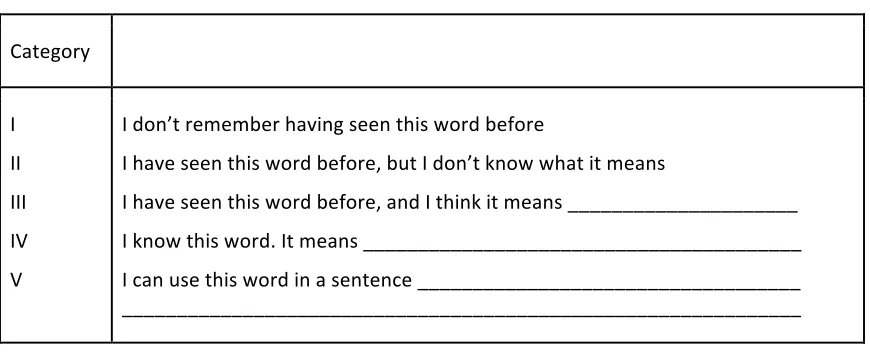
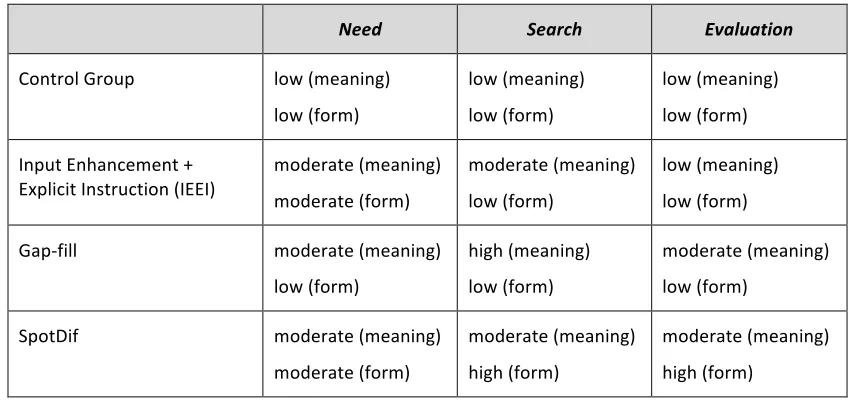
Table 1: The Vocabulary Knowledge Scale (VKS) (Paribakht and Wesche, 1997) 19 Table 2: Hypothetical levels of Need, Search and Evaluation in the three treatment types 50 Table 3: Mean scores of the four groups on the Productive Knowledge pre-‐tests,
immediate and delayed post-‐tests 67
Table 4: Results of mixed between-‐within subjects ANOVA for the mean scores of four groups in the Productive Knowledge pre-‐test, immediate and delayed post-‐test 68
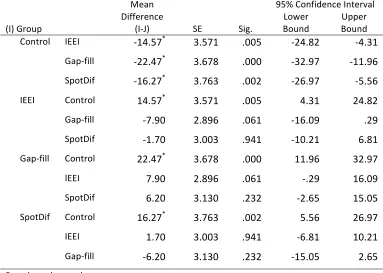
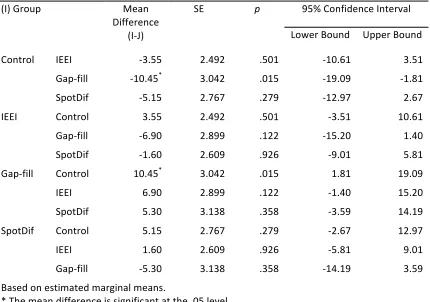
Table 5: Multiple comparisons of groups for Productive Knowledge immediate and
delayed post-‐tests using Games-‐Howell 69
Table 6: Results of mixed between-‐within subjects ANOVA for the mean scores of four groups in the Productive Knowledge pre-‐test and immediate post-‐test 71
Table 7: Multiple comparisons of groups for Productive Knowledge immediate post-‐test
using Games-‐Howell (α =.05) 72
Table 8: Results of mixed between-‐within subjects ANOVA for the mean scores of four groups in the Productive Knowledge pre-‐test and delayed post-‐test 74
Table 9: Multiple comparisons of groups for Productive Knowledge delayed post-‐test
using Games-‐Howell (α = .05) 75
Table 10: Mean scores of the four groups on the Receptive Knowledge pre-‐tests,
immediate and delayed post-‐tests 78
Table 11: Results of mixed between-‐within subjects ANOVA for the mean scores of four groups in the Receptive Knowledge pre-‐test, immediate and delayed post-‐test 79
Table 12: Multiple comparisons of groups for Receptive Knowledge immediate and
delayed post-‐tests using Games-‐Howell (α = .05) 80
Table 13: Results of mixed between-‐within subjects ANOVA for the mean scores of four groups in the Receptive Knowledge pre-‐test and immediate post-‐test 82
Table 14: Multiple comparisons of groups for Receptive Knowledge immediate post-‐test
using Games-‐Howell (α = .05) 83
Table 15: Mean scores of by the four groups on the Form and Meaning sections of the
Receptive Knowledge immediate and delayed post-‐test 85
Table 16: Multiple comparisons of groups for Receptive Knowledge immediate post-‐test
(Form section) using Games-‐Howell (α = .05) 86
Table 17: Multiple comparisons of groups for Receptive Knowledge immediate post-‐test
Table 18: Results of mixed between-‐within subjects ANOVA for the mean scores of four groups in the Receptive Knowledge pre-‐test and delayed post-‐test 88
Table 19: Multiple comparisons of groups for Receptive Knowledge delayed post-‐test
using Game-‐Howell (α = .05) 89
Table 20: Multiple comparisons of groups for Receptive Knowledge delayed post-‐test
(Form section) using Bonferroni (α = .05) 91
Table 21: Multiple comparisons of groups for Receptive Knowledge delayed post-‐test
(Meaning section) using Bonferroni (α = .05) 92
Table 22: Mean scores of the four groups on the Awareness pre-‐test, immediate and
delayed post-‐test 93
Table 23: Results of mixed between-‐within subjects ANOVA for the mean scores of four groups in the Receptive Knowledge pre-‐test, immediate and delayed post-‐test 94
Table 24: Results of mixed between-‐within subjects ANOVA for the mean scores of four groups on the Awareness pre-‐test and immediate post-‐test 96
Table 25: Multiple comparisons of groups for Awareness immediate post-‐test using
Bonferroni (α =.05) 97
Table 26: Results of mixed between-‐within subjects ANOVA for the mean scores of four groups in the Awareness pre-‐test and delayed post-‐test 99
Table 27: Multiple comparisons of groups for Awareness immediate post-‐test using
Bonferroni (α =.05) 100
Table 28: Mean scores of the four groups on the Awareness pre-‐test, immediate and delayed post-‐test with regards to number of words underlined 102
Table 29: Correlation between FREQ, n-‐gram length and MI Score and test scores 103
LIST OF ILLUSTRATIONS
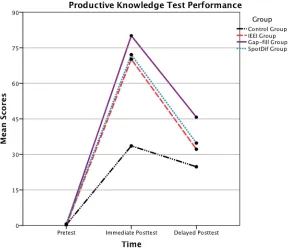
Figure 1: Productive Knowledge test scores in the pre-‐test, immediate and delayed
post-‐tests 70
Figure 2: Productive Knowledge test scores in the pre-‐test and immediate post-‐test 73
Figure 3: Productive Knowledge test scores in the pre-‐test and delayed post-‐test
76
Figure 4: Receptive Knowledge test scores in the pre-‐test, immediate and delayed
post-‐tests 81
Figure 5: Receptive Knowledge test scores in the pre-‐test and immediate post-‐test
84
Figure 6: Receptive Knowledge test scores in the pre-‐test and delayed post-‐test 90
Figure 7: Awareness test scores on the pre-‐test, the immediate post-‐test and the
delayed post-‐test 95
Figure 8: Awareness test scores in the pre-‐test and immediate post-‐test
98
Figure 9: Awareness test scores in the pre-‐test and delayed post-‐test
CHAPTER 1: INTRODUCTION
This study aims to contribute to the recent escalation of research on formulaic language in
second language (L2) learners. As will be discussed in later parts of the study, scholars in the
fields of L2 vocabulary acquisition, corpus linguistics and L2 classroom pedagogy have brought
to light the need for learners to accumulate a sizeable pool of L2 formulae in order to
comprehend and produce the target language. These formulae range from phrasal verbs (e.g.
bank on), collocations (e.g. pay attention to, firmly entrenched), to idioms and proverbs (e.g. all
the rage, haste makes waste). This learning process is daunting given the length, semantic
opaqueness of many, and low frequency of most formulaic sequences (FSs). Moreover, the
obstacles stem from learners’ inclination to notice and learn new words, rather than lexical units
beyond words, and their commonly held belief that semantically equivalent L2 words are
interchangeable in larger units of language. Abundant research evidence shows that learners,
regardless of their proficiency levels struggle with learning and appropriately using formulaic
language.
Facilitating the acquisition of such FSs through classroom activities entails aiding learners to
notice such sequences, which otherwise tend to be clouded by individual words, and to
incorporate these lexical units into their receptive and productive knowledge. As necessary as
this is, however, only a limited number of research studies have put different pedagogical
interventions specifically designed for promoting the acquisition of L2 formulaic language to the
test. Most of these studies attest to the effectiveness of instructional techniques and activities
in raising learners’ awareness of formulaic language, improving their perceived fluency, and
treatment condition, interactive tasks, a type of classroom focus-‐on-‐form activities empirically
proven to be effective for instructed L2 learners. This study, consequently, aims at comparing
the effectiveness of two such tasks, collaborative Gap-‐fill and Spot the Difference with that of
enhancing the input in combination with explicit instruction.
This chapter will discuss first the necessity for more research in vocabulary acquisition, then the
necessity to extend the object of vocabulary research from individual words to larger chunks of
language. It will end with a brief discussion of the ubiquity of formulaic sequences followed by a
working definition of the term, a discussion of the roles of FSs in the language of both native and
non-‐native speakers, as well as brief synopsis of research that inspires the current study.
1.1. Vocabulary acquisition in SLA research
Much of second language acquisition (SLA) research is concerned with the acquisition of
grammar, since in the history of linguistics and applied linguistics, grammar and phonology have
generally been treated as the core and vocabulary as periphery. The situation of lexis is known
in Bloomfield’s statement (1933): “The lexicon is really an appendix of the grammar, a list of
basic irregularities” (as cited in Bogaards, 1996, p. 274). Holley (1972) notes that in the three
decades before the 1970s, there had been little interest in foreign language vocabulary learning,
due to the influence of behaviorist psychology and linguistic structuralism, which held
vocabulary learning as a complex case of stimulus-‐response learning; however, research findings
in the field of human memory and linguistics at that time suggested that vocabulary learning is
more serious and more interesting than expected. Gleitman and Landau (1994) opine that “for
many years, the topic of lexical acquisition was a stepchild in linguistic inquiry” (p. 1). First
maps perceptual experience onto phonetic entities. Mainstream linguistic theories regarding
lexical rules and constructions, levels of representations, constraints on rules, underlying
principles and parameters are not comparable to those of syntax (Wunderlick, 2006). Several
theories besides the mainstream were developed and in the late 1980s, there was a “strong
tendency towards favouring the lexicon as a structure-‐giving reservoir” (Wunderlick, 2006, p. 2;
for a more detailed discussion, see Wunderlick, 2006). Wunderlick explains that each lexical
item bears phonological, semantic and categorical properties; the lexicon is highly structured;
and the distributed information of the lexicon determines the working of the components of
grammar. On the upside, many researchers continue to side with lexical aspects of language.
For example, Pinker (1984) and Hoey (1994, 2005) propose that the rules of a grammar are
acquired by learning lexical items that instantiate them (Pinker, 1984) and that “lexis is
complexly and systematically structured and grammar is an outcome of this lexical structure”
(Hoey, 2005, p.1).
Second language acquisition research has long been influenced by developments in linguistic
theories; hence it is no surprise that lexical acquisition theorizing in the field has not been a
central concern (Appel, 1996; Gass, 1988; Laufer, 1986; Levenston, 1979; Meara, 1980; Richards,
1976; Zimmerman, 1997). Levenston (1979) sees second language lexical acquisition as not
merely neglected, but a “victim of discrimination” (p. 147) and notes that in all fields of
research, “language” or “interlanguage” is synonymous with “grammar” or “interlanguage
grammar”. Syntactic structures are considered to be the most complex, worth researching
aspects of language, while lexis is regarded as superficial, trivial and brittle pieces of crystalline
structures (Aitchison, 1987). Syntax is also considered unique to humans, while animals can
lexical acquisition, including questions of whether L1 vocabulary acquisition is parallel with
processes in SLA, the stages of lexicon building and the factors that influence learners’ lexicon
growth and expansion, and the relationship between active/productive and passive/receptive
knowledge of vocabulary. Meara (1980) reviews research on L2 vocabulary acquisition, which he
describes as a research area that has been neglected in applied linguistics, and concludes that
much of research in the field has been “atheoretical and unsystematic.” (p. 221). He also notes
that most scholarly work has been concerned more with vocabulary teaching but has not
revealed much about the processes whereby learners’ lexicon is acquired. Vocabulary learning,
as Laufer (1986) and Appel (1996) argue, is the core of second language acquisition: without
lexical items, grammatical rules are useless, and lexical problems are more relevant to second
language didactics than phonology and syntax (Laufer, 1986). Lexical errors in learners’ language
can cause nonunderstandings or misunderstandings, and second language lexicon is crucial for
successful communication in the language (Gass, 1988). The task of acquiring L2 vocabulary,
which consists of tens of thousands of words, most of which are polysemous, can be more
daunting than the acquisition of grammar (Appel, 1996). Schmitt (2010) notes that the constant
need for L2 learners to look up new words in a dictionary illustrates the importance of lexical
acquisition. Furthermore, there are always strong correlations between vocabulary and various
measures of language proficiency, between vocabulary and language skills (Alderson, 2005).
Vocabulary acquisition research has proliferated especially in recent years (Haastrup &
Henriksen, 2001; Juffs, 2009; Laufer, 2009; Schmitt, 2008, 2010), resulting in more lexical
acquisition theories and a wider pool of empirical research. However, research on L2 vocabulary
acquisition continues to be eclipsed by research in other areas of language teaching and
“slow to filter into mainstream pedagogy” (p. 330). Haastrup and Henriksen (2001) acknowledge
that research in the field of second language vocabulary acquisition has flourished in the last
decade of the 20th century, but also point out a much less favorable truth – “vocabulary is studied as a thing apart, since mainstream SLA theory has syntax as its core” (p. 69). Juffs (2009)
agrees that regardless of the importance of the lexicon, it has not always been the focus of
mainstream second language acquisition research. Commenting on the importance of studying
the lexicon, Jackendoff asserts that almost all theories of language can agree that the lexicon
contains items that contain “a long-‐term memory association of phonological, syntactic and
semantic features” (p. 130).
1.2. Vocabulary research and the “word”
Vocabulary is commonly equaled with a collection of “words.” In fact, words are doubtlessly the
central concept of much vocabulary research. Aichitson’s (1987) entire book is devoted to
answering questions centering on the concept of word: How are words stored in the mind? How
do people find the words they want when they speak? Do children remember words in the same
way as adults? According to Aichitson (1987), it is a common folk belief that one needs to know
a lot of words, and people start to worry if they cannot recall a word they want. A dictionary, a
must-‐have companion of language learners, is compiled as a list of words in a language, each
with its meanings and perhaps illustrative examples of how the word is used in a phrase or
sentence. This reinforces the assumption that a word is the basic lexical unit that carries
meaning (Sinclair, 2004b). Most research in second language vocabulary acquisition begins by
defining what a word is and what word knowledge entails. Nation (2001) begins his classical
work on L2 vocabulary learning by investigating how many words there are in a language and
frequency words. In literate societies, native speakers seem to master wordhood, but what
segments one word from another in their perception is mostly orthographical (Himmelmann,
2006; Jones & Sinclair, 1974; Sinclair, 2004b). Apparently the segmentation of language into
words is heavily influenced by orthography in literate societies. Himmelmann goes on to note
that people in illiterate societies have some perception of what seems to look like the word, but
it becomes less clear where the word ends and compounds, particle constructions and formulaic
sequences begin. The separation of one word from another by conventionalized physical space
gives words the “appearance of discrete units” (Sinclair, 2004b, p. 24); learning how to read
begins with the recognition of individual words, hence the position of the word as the basic unit
of linguistic analysis is naturalized.
In the same vein, Schmitt (2010) points out that “languages like English indicate individual words
in text by placing spaces around them” (p. 10). Sinclair (1991) calls it word-‐form and defines it as
“an unbroken succession of letters” (p. 28) with a special note on the hyphen and the
apostrophe, about which he did not go into detail. Sinclair also points out the spacing between
words is “structurally bogus, may disappear in time, as we see in maybe, anyway, another” (p.
110). According to Bybee and Scheibman (1999), echoed by Diessel (2007), it is the frequency
effect that causes words which are frequently used next to each other to be automatized and
become a single storage and processing unit, e.g. don’t know and dunno, hence the
disappearance of word boundaries. Gardner (2007) opines that the greatest challenge of
corpus-‐based vocabulary research is in determining what constitutes the “word”, emphasizing
that this does not only influence how such items are counted and analyzed, but also has
important ramifications for pedagogical theories and practices that derive from them. In
subsumed by ‘Word’, and hypothesizes that if the work of Sinclair and his colleagues is accurate,
this will be a powerful indictment of the traditional approach of counting individual word-‐forms
in corpus linguistics, at least with regards to alphabetical languages.
The approach in corpus linguistics to analyzing language based on words stems from the
tendency to associate meaning with the shortest possible segment of language and the one that
shows the least variation, i.e. the word (Sinclair, 2004a). The same approach can be also found
in psychological experiments since its early days, an approach whereby language is deemed a
string of discrete words which can be further analyzed into morphemes, syllables, phonemes
and letters, or combined together to form phrases and sentences (Shaoul and Westbury, 2011).
While Sinclair names this approach the minimal approach (p. 280), Shaoul and Westbury refer to
it as the reductionist approach. According to Sinclair as well as Shaoul and Westbury, this
approach is limited in its ability to illuminate vocabulary research. In language teaching, Schmitt
(2010) observes that “vocabulary instruction has tended to focus on individual words because
they have been considered the basic lexical unit, but also because they are easier to work with
than formulaic language” (p. 8).
1.3. Formulaic sequences in second language acquisition
Formulaic language has now become more acknowledged by researchers as an important part
of the lexicon. The most well-‐known research that highlights the importance of formulaic
sequences includes work by scholars such as Moon (1998), Nattinger and DeCarrio (1992),
Pawley and Syder (1983), Schmitt and Carter (2008), Sinclair (1991). In this study, the term
formulaic sequences (henceforth FSs), instances of formulaic language, will be used to indicate
(e.g. firmly entrenched), idioms (e.g. dropped the ball, short end of the stick) -‐ expressions that
are mostly prefabricated but also allow the insertion or deletion of variable items. There are
several reasons why FSs are gaining more attention in SLA research. First, they comprise a large
proportion of any type of discourse, both spoken and written. Researchers have procured
different percentages, depending on their methodologies and definitions of formulaic language,
but they all fall within the range of 30-‐50% of a given text. Second, FSs are useful in acquiring a
second language. Early L2 learners often resort to FSs in order to acquire L2 rules directly or
indirectly, starting with simple unanalyzed chunks, then low scope patterns and fully analyzed
sequences. These sequences also play a number of functions in communication. They also
provide processing benefits as they reduce the time of online language processing and increase
fluency.
The formation and ubiquity of these sequences as a type of linguistic construction can be
explained by theories in usage-‐based approach to first and second language acquisition. The
sequences are, in fact, the result of a typical cognitive process, chunking, which is in turn the
result of repetitive use (Bybee & Beckner, 2010; N. Ellis & Simpson-‐Vlach, 2009; Tomasello,
2003; Wulff, 2008). I will revisit the concept of ‘chunking’ in section 2.3.). Each use of such
sequence has an effect on the entrenchment of the form-‐meaning link, which reduces the
semantic autonomy of the individual components (N. Ellis, 2001, 2003; Wulff, 2008). Frequency
and repetition not only affects but “ultimately bring about form in language” (N. Ellis &
Simpson-‐Vlach, 2009). The plethora of formulaic sequence is a counter-‐argument against the
Chomskyan concept of universal grammar or an innate language acquisition device since if we
are to accept the validity of a universal grammar, there would be no prefabricated sequences of
2009; Sinclair, 1991) as long as grammaticality is present. Proponents of the usage-‐based
approach to language learning instead are in favor of a general cognitive principle in which
language use is primarily influenced by frequency besides other factors such as salience,
prototypicality of meaning, contingency, redundancy, overshadowing and attention (N. Ellis,
2006; N. Ellis & Larsen-‐Freeman, 2006).
FSs serve some important functions in the storage and retrieval of language in the mind of the
native speakers. L2 learners, including those who have reached advanced levels of proficiency,
continue to experience difficulty when processing (Gerald, 2007) or producing FSs in both the
spoken and written channels (see, for example, Howarth, 1998a, 1998b; Laufer & Waldman,
2011; Nesselhauf, 2003, 2007). How second language learners process and acquire these
sequences is a newly emergent research area. In the past few years there has been research
about the acquisition, processing and use of formulaic sequences among ESL learners (e.g.
Schmitt, 2004), but research results remain tentative and inconclusive. Further theoretical
discussion on this issue is necessary in the field of second language acquisition.
There is a need for further theoretical discussions on how FSs are processed and acquired by L2
learners. Wray’s proposition that L2 learners tend to store FSs analytically, as opposed to the
holistic processing of native speakers, and the known difficulty that L2 learners have when
processing FSs suggest that the acquisition of FSs is likely to be analytical and incremental. The
nature of acquiring FSs in L2, according to Schmitt and Carter (2004), has important implications
for selecting pedagogical materials and intervention. In this research I will look at corpus-‐
informed variables of target FSs, namely frequency, MI-‐score and n-‐gram and how they
correlate with learners’ acquisition of FSs as a result of instruction in terms of their Productive
with learners’ acquisition process at different levels at different times, as some have argued that
SLA is a complex dynamic system (Larsen-‐Freeman, 2006; Larsen-‐Freeman & Cameron, 2010;
Beckner et al., 2009), and these three variables are not the only ones playing a role in the
acquisition process.
From pedagogical perspectives, research on classroom intervention that helps facilitate the
acquisition of such sequences is even more needed. Empirical evidence of the effectiveness of
such techniques and activities can be found only in a few research studies, such as those by
Bishop (2004), Boers, Demecheleer and Eyckmans (2004), Boers, Eyckmans, Kappel, Stengers
and Demecheleer (2006), Boers and Lindstromberg (2005), Jones and Haywood (2004), Rott
(2009) (see also Boers and Lindstromberg (2012) for a review of these intervention studies).
Intervention types, such as awareness raising, using corpora, stimulating lookups through input
enhancement or explicit instruction, and semantically focused instruction to facilitate learners’
memorization of formulaic sequences (Boers & Lindstromberg, 2012), have generated some
positive results and also less encouraging evidence of the effect of particular types of instruction
on the learning of formulaic sequences. Moreover, since much of this research area is
concerned with techniques such as input enhancement, explicit instruction that encourages
learners to look up certain sequences, explaining semantic aspects of FSs, there is a pressing
need for research on intervention types that fit better into a communicative classroom.
This study was inspired and informed by the work in FSs by previous scholars and aims at
contributing to a much needed research focus in the field. The overarching aim of this study is to
compare the effectiveness of techniques and activities that have been proved to be effective in
different studies conducted by other researchers, as well as a new activity that has never been
Difference, or SpotDif, widely recognized in the field of SLA as promoting learners’ ability to
notice otherwise low-‐saliency language features as well as promoting learners’ acquisition of
such forms, has never been used in experimental research related to FSs. I hope to put to the
test the effectiveness of this communicative task, together with Gap-‐fill, as used in Jones and
Haywood (2004), two tasks easy to design and implement in the classroom, with the view to
providing new empirical findings for language instructors and other researchers. Following in
the footsteps of senior scholars, I examined the effectiveness of different techniques and
activities on learners’ ability to notice FSs in a reading text, and on learners’ receptive as well as
CHAPTER 2: LITERATURE REVIEW
In this chapter, I will first attempt to define formulaic sequences and examine the characteristics
of these sequences that English L2 learners are sensitive to and need to be sensitized to. Next, I
will draw on evidence in corpus-‐driven and corpus-‐based research to prove the prevalence of
formulaic sequences in the English language. A discussion of the various roles that FSs play in
different stages of SLA will then follow. After that, I will delve into the challenges that L2
learners face using data from both cross-‐sectional and longitudinal studies, revealing that
learners tend to underuse certain FSs, overuse others, or avoid using FSs. An analysis of
somewhat contradictory evidence as to how learners process FSs will then be conducted to
explain the obstacles that learners face when acquiring FSs. Most importantly, I will review
experimental studies that attempt to test the effectiveness of different instruction types in
teaching FSs, then argue for the need of using task-‐based intervention to teach these
sequences. The chapter will end with my research questions, which build on all of these
theoretical issues and previous research.
2.1. Beyond the word: Formulaic sequences
In his most widely-‐cited work, Sinclair (1991) introduces the very influential idiom principle,
which states that “a language user has available to him or her a large number of semi-‐
preconstructed phrases that constitute single choices, even though they might appear to be
analysable into segments’ (1991, p. 110). The idiom principle is complementary to, but no less
important than, the open choice principle, whereby the language user has structures and can
structure is retained. However, not all words are open choice items: for example, it is unnatural
to say totally functional or big catastrophe; more widely accepted would be conventionalized
phrases such as fully functional and major catastrophe, even though the former phrases are
perfectly grammatical.
In his later works, Sinclair (1996, 2004b) argues that the notion of word being the central unit of
lexical meaning should be challenged. His corpus-‐driven work has proven that beyond the word
(or what he terms word form), there are a large number of multiword units, those which are
usually “tucked away, well off-‐centre” because they seem to be “anarchic, individual, unstable,
one-‐off items that just do not fit into a tidy description” (1996, p. 78). The anarchic items include
phrasal verbs, idioms, fixed phrases, variable phrases, clichés, proverbs -‐ lexical units where the
sum of meaning of constituent words cannot account for the meaning of the holistic item.
Over time work by Corrigan, Moravcisk, Ouali, and Wheatley (2009), Moon (1998), Nattinger
and DeCarrio (1992), Schmitt (2010), Schmitt and Carter (2008), Sinclair (1991, 1996, 2004a,
2004b), Wray (2002, 2008), to name a few, has drawn attention to the importance of formulaic
language in language learning and teaching. Observations of any instance of language use, be it
oral or written, will reveal that there are a lot of formulae – chunks of words that seem to
concur. Formulae are common in language, just as they are in other parts of life:
So far the terms formulaic sequences, formulaic language and formulae have been used to refer
to lexical units beyond words. These are not the only terms used by researchers interested in
the topic. Wray (2002) lists nearly 60 terms that have been used, though they are not identical,
ranging from chunks, collocations, fixed expressions, fossilized forms, lexical simplex, lexical(ized)
phrases, to prefabricated routines and patterns, schematas set phrases, multiword items/units.
Another term not included in Wray’s list but relatively well-‐known is lexical bundles (Biber et al,
1999; Biber & Conrad, 1999; Biber, Conrad, & Cortes, 2004; Cortes, 2004, 2006; Tremblay,
Derwing, Libben, & Westbury, 2011). Other terms that did not make Wray’s list are multiword
sequence (Bybee, 2002; Siyanova-‐Chanturia, Conklin & Van Heuven, 2011; Stubbs, 2007; Wade
& Mobius, 2010), routinized building block (De Cock, 2007), conventional sequence (Forsberg,
2010). Formulaic sequence, however, seems to stand out and is used by many researchers, most
notably Bishop (2004, 2005), Boers et al. (2006), Conklin and Schmitt (2008), Jiang and
Nekrasova (2007), Schmitt (2004), Simpson-‐Vlach and N. Ellis (2010), Wood (2005, 2006, 2009),
Wray (2000, 2002, 2008). They all conceptualize FSs more or less similar to Wray and Perkins
(2000) and Wray (2002), who defines formulaic sequence as:
“a sequence, continuous or discontinuous, of words or other elements, which is, or appears to be, prefabricated: that is, stored and retrieved whole from memory at the time of use, rather than being subject to generation or analysis by the language grammar” (Wray & Perkins 2000, p. 1; Wray 2002, p. 9).
Wray (2002) points out that “The word formulaic carries with it some associations of ‘unity’ and
of ‘custom’ and ‘habit’, while sequence indicates that there is more than one discernible internal
The above definition also highlights two important characteristics of FSs: (i) they are sequences
of words or other elements and (ii) in terms of mental representation, they are or appear to be
represented as wholes.
This research builds on the parameters of FSs that have been established in previous research
and examines the correlation between these parameters and learners’ post-‐treatment
performance. These parameters include: n-‐gram, frequency, Mutual Information score. FSs can
be short (e.g. bigrams such as wind down, mull over) or very lengthy (e.g. You can lead a horse to
water, but you can’t make him drink). n-‐gram is simply the number of words in a FS. Frequency
of FSs also varies. One in the higher frequency band is usually rendered as possessing a higher
teaching worth (N. Ellis, Simpson-‐Vlach & Maynard, 2008). Another key feature of FSs is Mutual
Information score (MI score). MI score is “a statistical measure commonly used in the field of
information science designed to assess the degree to which the words in a phrase occur
together more often than would be expected by chance (N. Ellis et al., 2008, p. 380). A high MI
score reflects a stronger association between the words. N. Ellis et al.’s research suggests that
ESL learners are sensitive to the frequency of FSs, while native fluents are more sensitive to the
MI score of FSs. Results from this study also show both native speakers and ESL learners to be
sensitive to n-‐gram length of the formulas.
All of these features are likely to affect, to different degrees, learners’ acquisition of FSs. As
discussed previously, learners tend not to be sensitized by MI score. If that holds true in this
study, it means that teachers are responsible to draw learners’ attention to these high-‐MI FSs
more than, for example, frequently used FSs. Larger n-‐gram are likely to pose difficulty for
instructional techniques, even within one activity, in order to help learners overcome the
disheartening task of acquiring different types of FSs.
2.2. The ubiquity of formulaic sequences
Corpus-‐based and corpus-‐driven evidence shows that FSs are prevalent (Biber, 2009). In corpus-‐
based studies, FSs pre-‐selected from the corpus are studied to examine how they are used,
whereas in corpus-‐driven studies, the inductive approach allows the researcher to find what
linguistic structures emerged from the corpus. Both approaches have lent evidentiary support
for the preponderance of formulaic sequences. Moon (1998) is one of the first major corpus-‐
based studies on formulaic sequences. The retrieving of formulaic sequences was accomplished
not by automatic retrieving but by preselecting a number of fixed expressions and idioms. Other
corpus-‐based studies include those of Liu (2012). The work of Sinclair (1991), Biber and his
colleagues (Biber & Conrad, 1999; Biber, et al., 1999: Biber et al., 2004; Biber, 2009) and
Simpson-‐Vlach and N. Ellis (2010) exemplify the corpus-‐driven strand.
From a small sample of the London-‐Lund corpus of spoken English, Altenberg (1998) found over
201,000 recurrent word-‐combinations, which are more or less conventionalized expressions. He
estimates that over 80 percent of the words in the corpus form part of a recurrent word
combination in one way or another. Altenberg’s (1998) study also provides a tentative answer to
the question as to how many types of conventional expressions are known to the average native
speaker of a language: over 68,000 of varying length and frequency. Erman and Warren (2000)
claim that over 50% of both spoken and written English language they analyzed was formulaic,
and Foster’s (2001) findings reveal a figure of 32% using different procedures and criteria. The
consists of approximately one trillion word tokens of text found in publicly accessible Web
pages, lists approximately 78 million formulaic sequences of two words, 244 million sequences
of three words, 328 million of four words, and 294 million of five words.
According to Pawley (2007), it is not even necessary to study large corpora to show that
conventional expressions are ubiquitous. He cited studies which analyzed small samples of
spoken and written text and highlighted that “about 35-‐45 percent of all sequences of a given
structural type consisted of restricted collocations” (p. 20). Pawley and Syder (1983) showcase
the fact that the fluency of advanced language users is not merely grammatical but also natural
and idiomatic. This fluency depends on knowledge of a large number of what they term
lexicalized or institutionalized sentence stems, which are largely or wholly fixed units of clause
length or longer. Besides, semi-‐lexicalized sequences also play a role in high-‐level fluency, as will
be shown in the next section.
While research in corpus linguistics has shown the prevalence of FSs, this abundance of these
sequences lends evidence to usage-‐based approach to language learning, i.e. experience with
languages gives rise to its cognitive organization (N. Ellis & Larsen-‐Freeman, 2009; Goldberg,
2006, 2013) and counters the proposition that grammar is an abstract set of rules or structures.
The existence of such a great number of such patterns can only be explained by the cumulative
effect of language experience as language users retain statistical information about which words
co-‐occur with each other, and by acknowledging the effect that frequency of use has on
language use (N. Ellis & Larsen-‐Freeman, 2009). Over time frequency reinforces entrenchment
and the frequently co-‐occurring words as holistic, unified entities, become accepted as
Before progressing to a discussion of the roles of FSs, there is a need to return to the concept of
word. I will now survey how vocabulary researchers have been striving to define what it means
to know a word, that is, what word knowledge entails.
Richards (1976) was the first modern scholar to attempt an answer to the question “what does
it mean to know a word?” His word knowledge framework states that knowing a word means (i)
knowing the degree of probability of encountering that word in speech or print (ii) knowing the
limitations imposed on the use of the word according to variations of function and situation,
such as temporal, geographical, social variations and variations in social role, field and mode of
discourse (iii) knowing the syntactic behavior associated with that word (iv) having knowledge of
the underlying form of a word and the derivations that can be made from it (v) having
knowledge of the network of the associations between that word and other words in language
(vi) knowing the semantic value (vii) knowing many of the different meanings associated with
the word.
Drawing on Richards’ word knowledge framework, Nation (1990, 2001) identifies various
aspects of word knowledge both at the receptive and productive levels. Nation’s list includes the
form (spoken, written, word parts), meaning (form-‐meaning relationships, concepts and
referents, associations) and use (grammatical functions, collocations, constraints on use). One of
the characteristics that distinguish Nation’s from Richards’ word knowledge framework is that
Nation specifies each feature of word knowledge at two levels – receptive and productive. In
addition, Nation’s word knowledge aspects seem to follow a logical order from word form to
word meaning to word use, while Richards seem to place his assumptions about word
knowledge in no such order. As Schmitt (2008) suggests, some of these word knowledge aspects