120 | P a g e
STRUCTURAL CONTROL SYSTEM FOR MID RISE
BUILDINGS
Varsha B.R
1, Dr.H.R Prabhakara
21
M.Tech (CADS), University BDT Collage of Engineering, Davangere (India)
2
Professor, University BDT Collage of Engineering, Davangere (India)
ABSTACT
In recent year’s considerable attention as been paid to research and development of structural control devices
with particular emphasis on mitigation on seismic response of buildings. Control system has been recognized as
a very efficient tool for controlling the seismic response of a structure during an earthquake. This paper
presents Seismic design concept in which super structure is divided into several segments. Each segment may
comprise a few stories and is interconnected by additional vibrational isolation systems. The seismic response
of a typical segmental building subjected to the El Centro earthquake inputs are evaluated and compared with
the response of the corresponding fixed-base and conventional base-isolated buildings.
Keywords: Isolators, Segmental Concept, Structural Control System, New Design Approach,
SAP 2000.
I. INTRODUCTION
For seismic design of building structures, the traditional method, i.e., strengthening the stiffness, strength, and
ductility of the structures, has been in common use for a long time. Therefore, the dimensions of structural
members and the consumption of material are expected to be increased, which leads to higher cost of the
buildings as well as larger seismic responses due to larger stiffness of the structures. Thus, the efficiency of the
traditional method is constrained. To overcome these disadvantages associated with the traditional method,
many vibration-control measures, called structural control, have been studied and remarkable advances in this
respect have been made over recent years. Structural Control is a diverse field of study. Structural Control is the
one of the areas of current research aims to reduce structural vibrations during loading such as earthquakes and
strong winds. Vibration control is the mechanism to mitigate vibrations by reducing the mechanical interaction
between the vibration source and the structure, equipment etc to be protected Structural control relies on
stiffness (i.e. energy storage) and damping (i.e. energy absorption/dissipation) devices in a structure to control
its response to undesirable excitations caused by winds and moderate earthquakes. This control has, in most
cases, been achieved passively by means of bracing systems and shear walls, which do not require any
additional external energy input. More recently, we have seen the emergence of more modem passive structural
control systems. The segmental and base isolation systems are examples of such relatively modern passive
121 | P a g e
II. PROBLEM DESCRIPTION
Number of stories 16
Height of storey 3m
Number of storey in segment 4
Damping ratio 5%
Plan Area 8mx8m
Size of Beams 0.3x0.45m
Column schedule
1st to 8th floor 0.3mx0.9m
9th to 12th floor 0.3mx0.75m
13th to 16th floor 0.3mx0.6m
Ground motion El Centro Earth quake
Analysis type Time History
III. METHODOLOGY
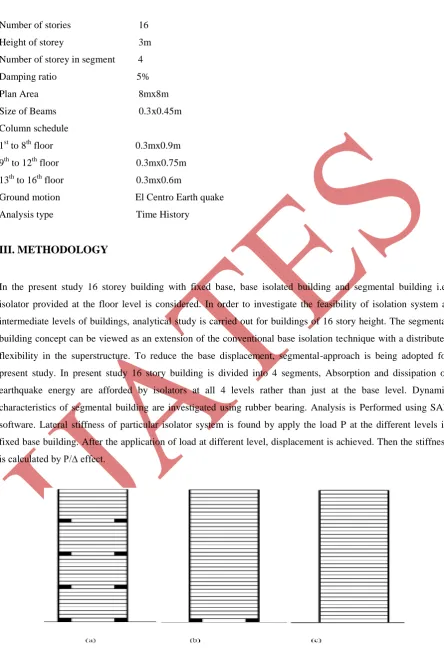
In the present study 16 storey building with fixed base, base isolated building and segmental building i.e.
isolator provided at the floor level is considered. In order to investigate the feasibility of isolation system at
intermediate levels of buildings, analytical study is carried out for buildings of 16 story height. The segmental
building concept can be viewed as an extension of the conventional base isolation technique with a distributed
flexibility in the superstructure. To reduce the base displacement, segmental-approach is being adopted for
present study. In present study 16 story building is divided into 4 segments, Absorption and dissipation of
earthquake energy are afforded by isolators at all 4 levels rather than just at the base level. Dynamic
characteristics of segmental building are investigated using rubber bearing. Analysis is Performed using SAP
software. Lateral stiffness of particular isolator system is found by apply the load P at the different levels in
fixed base building. After the application of load at different level, displacement is achieved. Then the stiffness
is calculated by P/∆ effect.
Fig 1: (A) Segmental Building (B) Base Isolation Building (C) Fixed Base Building.
122 | P a g e
Storey Level Displacementsalong X in mm
Displacements along Y in mm
Load P in N K along x in N/mm
K along Y in N/mm
4th 125.524483 223.19 100000 796.6573 448.0488
8th 291.931302 433.2191 100000 342.5463 230.8301
12th 420.841118 586.7355 100000 237.6194 170.4346
16th 500.251184 677.9669 100000 199.8996 147.4998
Total initial stiffness(K) 1576.723 996.8133
TABLE 2: Stiffness of Isolators for Base Isolation Building and Segmental Building.
Type of Buiding K along X in N/mm K along Y in N/mm
Base Isolation Building 31600 20000
Segmental Building
K1 15934 8961
K2 6851 4616
K3 4752 3408
K4 3998 2950
IV. RESULTS
Time history analysis has been carried out for building with fixed base, building with isolators at the base and
building with isolators at segments under El Centro ground motion and the results has been compared for storey
displacements, velocity, acceleration and base shear.
4.1. Natural Time Periods
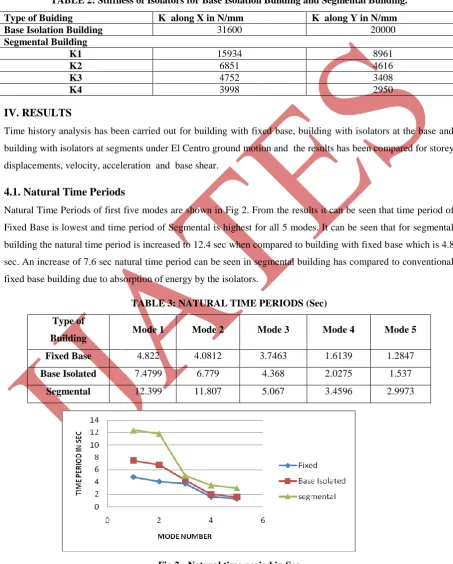
Natural Time Periods of first five modes are shown in Fig 2. From the results it can be seen that time period of
Fixed Base is lowest and time period of Segmental is highest for all 5 modes. It can be seen that for segmental
building the natural time period is increased to 12.4 sec when compared to building with fixed base which is 4.8
sec. An increase of 7.6 sec natural time period can be seen in segmental building has compared to conventional
fixed base building due to absorption of energy by the isolators.
TABLE 3: NATURAL TIME PERIODS (Sec)
Type of
Building Mode 1 Mode 2 Mode 3 Mode 4 Mode 5
Fixed Base 4.822 4.0812 3.7463 1.6139 1.2847
Base Isolated 7.4799 6.779 4.368 2.0275 1.537
Segmental 12.399 11.807 5.067 3.4596 2.9973
123 | P a g e
4.2. Displacement
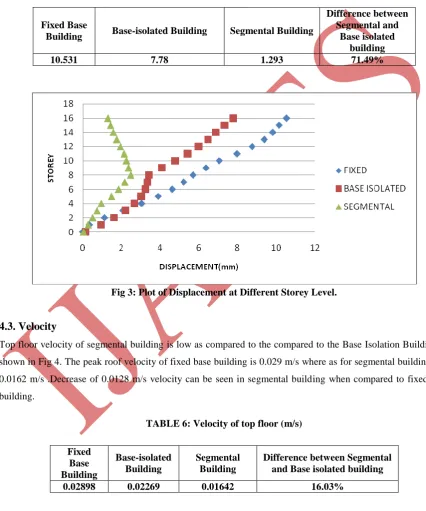
Considerable reduction in top floor displacement can be seen in Segmental Building when compared to Base
Isolation Building as shown in Fig 3. It can be seen that for fixed base building the top floor displacement is
10.5 mm where as for the segmental building it is 1.3 mm. Reduction of 9.2 mm displacement can be seen in
segmental building when compared to fixed base building and reduction of 6.5 mm displacement can be seen in
segmental building when compared to base isolation building.
TABLE 5: Displacement of Top Floor (Mm)
Fixed Base
Building Base-isolated Building Segmental Building
Difference between Segmental and
Base isolated building
10.531 7.78 1.293 71.49%
Fig 3: Plot of Displacement at Different Storey Level.
4.3. Velocity
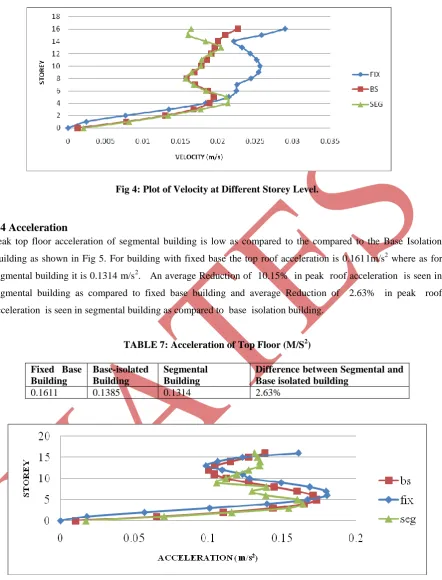
Top floor velocity of segmental building is low as compared to the compared to the Base Isolation Building as
shown in Fig 4. The peak roof velocity of fixed base building is 0.029 m/s where as for segmental building it is
0.0162 m/s .Decrease of 0.0128 m/s velocity can be seen in segmental building when compared to fixed base
building.
TABLE 6: Velocity of top floor (m/s)
Fixed Base Building
Base-isolated Building
Segmental Building
Difference between Segmental and Base isolated building
124 | P a g e
Fig 4: Plot of Velocity at Different Storey Level.4.4 Acceleration
Peak top floor acceleration of segmental building is low as compared to the compared to the Base Isolation
Building as shown in Fig 5. For building with fixed base the top roof acceleration is 0.1611m/s2 where as for
segmental building it is 0.1314 m/s2. An average Reduction of 10.15% in peak roof acceleration is seen in
segmental building as compared to fixed base building and average Reduction of 2.63% in peak roof
acceleration is seen in segmental building as compared to base isolation building.
TABLE 7: Acceleration of Top Floor (M/S2)
Fixed Base Building
Base-isolated Building
Segmental Building
Difference between Segmental and Base isolated building
0.1611 0.1385 0.1314 2.63%
Fig 5: Plot of Acceleration at Different Storey Level.
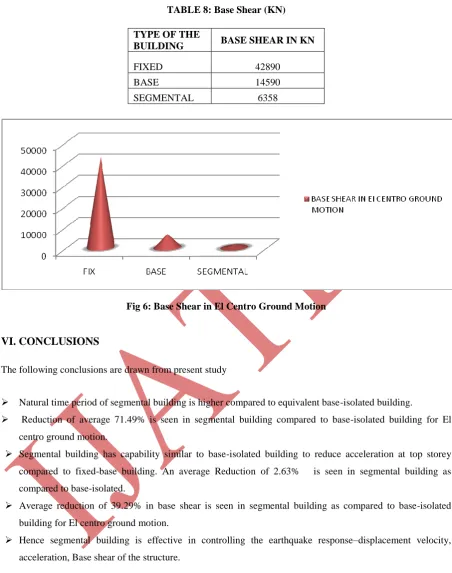
4.5. Base Shear
Considerable reduction in Base Shear can be seen in segmental building as compared to Fixed Base and
Segmental building as shown in Fig 6.Reduction of 39.29% can be seen in segmental building as compared to
125 | P a g e
TABLE 8: Base Shear (KN)TYPE OF THE
BUILDING BASE SHEAR IN KN
FIXED 42890
BASE 14590
SEGMENTAL 6358
Fig 6: Base Shear in El Centro Ground Motion
VI. CONCLUSIONS
The following conclusions are drawn from present study
Natural time period of segmental building is higher compared to equivalent base-isolated building.
Reduction of average 71.49% is seen in segmental building compared to base-isolated building for El
centro ground motion.
Segmental building has capability similar to base-isolated building to reduce acceleration at top storey
compared to fixed-base building. An average Reduction of 2.63% is seen in segmental building as
compared to base-isolated.
Average reduction of 39.29% in base shear is seen in segmental building as compared to base-isolated
building for El centro ground motion.
Hence segmental building is effective in controlling the earthquake response–displacement velocity,
acceleration, Base shear of the structure.
VII. ACKNOWLEDGEMENTS
The author wish to thank the Dr H. R Prabhakara whose inspiration, motivation, guidance and support from the
126 | P a g e
REFERENCES
[1] A.Sharma and R.S Jangid (2009),” Behavior of Base Isolated Structure with High Initial Isolator Stiffness,”
Journal of World Academy of Science Engineering and Technology, No.50, pp. 186-191
[2] Desai Amit (2012)”Structural control system for mid-rise building”, International Journal of Advanced
Engineering Technology E-ISSN 0976-3945.
[3] Hadi Nasir Ghadhban and Al Malika (2013)“Analytical Behavior of Multi-Storied Building with Base Isolation Subjected to Earthquake Loading”, Journal of Engineering and Development, Vol. 17, No.2, ISSN
1813- 7822
[4] Himat T Solanki (2008)“Seismic isolation for medium rise reinforced concrete frame buildings”.33rd
Conference, Singapore
[5] Hossein Monfared (2013)“An investigation into the seismic base isolation from practical perspective”,
International journal of civil and structural engineering Volume 3, No 3.
[6] Shirule P A , Jagtap (2012) “ Time History Analysis of Base Isolated Multi-Storyed Building”, Journal of
Engineering and Development ISSN 0974-5904, Volume 05, No. 04.
[7] Tso Chein Pan and Wei Cui (1998) “Response of segmental building to random seismic motion” ISET