Examining The Effect of The Magnetic Field on Free Convection
Flows in Liquid Metals, Electrolytes and Ionized Gases
Ruchi Gupta
1, Tarun Singh
21Department of Mathematics, Manav Rachna University, Faridabad, Haryana, India 2
Mechanical Department, Manav Rachna University, Faridabad, Haryana, India
Abstract
This paper present research result of the behavior of unsteady free convection flow of a visco-elastic fluid past an infinite porous plate with constant suction under the action of the time depend plate temperature. A uniform magnetic field is applied transversely to the porous plate and the magnetic lines of forced are taken to be fixed relative to the fluid. It is assumed that the plate temperate fluctuates about a constant mean, in the magnitude but not in direction. The numerical results of the real part Mr and imaginary part Mi of the fluctuating part of the velocity are tabulated. It is determined that the velocity distribution inside the boundary layer lags behind the
wall fluctuation by the constant angle
. The results obtained in the paper are useful in analyzing the effect of the magnetic field on free convection flows in liquid metals, electrolytes, and ionized gases.Keywords : Visco-Elastic, Magnetic field, Porous Plate, Free Convection, Visco-elastic jetting.
I.
INTRODUCTION
In the recent years the non-Newtonian fluids finds an increasing interest in industry and technology due to growing use of such fluids in many activities. The objective of this work is to analyze the flow of an elastico-viscous fluid in a compliant annulus.
Bikesh Chandra Ghosh, N. C. Ghosh has studied the MHD flow of a visco-elastic fluid through porous medium and he found analytical expression velocity profiles of the fluid and dust particles using the Laplace transform technique [6]. Ignacio Lira studied scales of free convection around a vertical cylinder and he showed that non dimensionalizing the momentum and energy equations in the terms of the Rayliegh or Boussinesq numbers allows the use of the Prandtl number as a criterion to establish whether the motive buoyancy force is the mainly balanced by inertia or by friction [11]. O Anwar et al have studied numerical study of heat transfer of a third grade visco-elastic fluid in non-Darcy porous media with thermo physical effects and a numerical solution is presented for natural convective
dissipative heat transfer of the an incompressible, third grade, non-Newtonian fluid flowing past an infinite porous plate. The mathematical model is developed in an (x-y) co-ordinate system. Using a set of transformations the momentum equation is rendered one-dimensional and a partly linearized heat conservation equation is derived [10].
Hall Effect on magneto-hydrodynamic free-convection flow at a stretching surface with a uniform free stream presented by Emad M Abo-Eldahab and found that the free convection flow of a conducting fluid near an isothermal sheet with a uniform free stream of constant velocity and temperature is investigated. The effects of the magnetic field, the hall and the hear source/sink parameters on these functions are discussed [7].
Themed Section : Engineering and Technology
Rita Choudary and Alok Das has investigated elastico-visous flow in a compliant annulus[5] Highly efficient lattice Blotzmann model for compressible fluids: two dimensional case presented by Chen Feng et al. He analyzed the (i) shock tube such as the sod, Lax, Sjogreen, Colella explosion wave and collision of two strong shocks. (ii) Regular and Mach shock reflection and (iii) shock wave reaction on cylindrical bubble problems. [13]
Yadav and Ray studied the unsteady flow of an-immiscible visco-elastic fluid through porous medium between two parallel plates in the presence of a transverse magnetic field. These studies have been carried for inviscid fluid [1] Srivastava and Khare have investigated the Ralyelgh-Taylor instability of two viscous superposed conducting fluids on a vertical magnetic field [2] Gravity field in porous medium has been given by Veena Sharma and Gin Chand Rana [8].
P Kumar has studied the instability if the visco-elastic superposed fluids with the suspended particles and variable magnetic field in porous medium porosity and found that the stability criterion is independent of the effects of visco-elastic medium porosity and suspended particles but is dependent on the orientation and magnitude of the magnetic field [3]
R. C. Sharma and S K Kango, studied the stability of two superposed Walter B‟ visco-elastic fluids in the presence of suspended particles and variable magnetic filed in porous medium [4] Yu, J.D., et al studies Two-Phase Viscoelastic Jetting [9]
In the present Paper we derive the separate expressions for the real part Mr and imaginary part
Mi of the fluctuating part of the velocity and their
Numerical study has been presented.
The phase angle
andM
M
2r
M
2i arecalculated and tabulated.
II.
NOMENCLATURE
U = is the velocity in the direction of x – axis, V = is the velocity normal to the plate
T = time variable
o
= The limiting viscosity at small rate of shearK0 = Elastic constant
fx = acceleration due to gravity.
= Thermal ConductivityT = Temperature in the boundary layer. T = Temperature far away from the plate
III.
FORMULATION OF THE PROBLEM AND
PERTURBATION EQUATIONS
v
3 3 2
3 2
2
{ )
(
y u v t y
u K y
u T
T f y u v t u
o o
x
u B y
u y v y
v y u
o 2 2 2
2 2
} 2
3
(2)
t y
v K y
v y
p y v v t v
o
o
2 3 2
2
( 2
2
2 2 3
3
3 y
v y v y
v v
) (3)
2 2
y T y
T v t T cp
(4)
In the equation(4) terms representing viscous and elastic dissipation are assumed to be
neglected.-
B
02u
is the value of J*B, Jand
B
being givenby Maxwell‟s equation in ohm‟s law namely:-
B
u
B
J
where
t
B
B
B
J
H
0
.
4
from (1) for constant suction velocity
v
00
v
v (5)
applying (5) in equations (2) and (3)
mu y u t y u k y u T T f y u v t u o xo
3 3 2 3 2 2 (6) where o ,
o
o k
K and mBo2
y p t v 1 (7)
The boundary conditions are
y
at
0
=
T
and
0
=
u
0
y
at
Tw(t)
T
and
0
u
(8)Introducing the following non-dimensional quantities. number prandtl the c P Number Grashoff the v T T f G T T T T T v t p o o w x w o 3 2 2 o o 2 o o ) ( K K Gv u u u v t yv (9)
Equation (6) and (4) thus reduce to
T Mu u n t u k t u u
u
3 3 2 3 2 2 4 1 4 1
(10)
where
2 o v m M 0 4 2 2 t T T T (11)
Boundary conditions (8) now reduce to
0
u , T = 1 at
0
u = 0 , T= 0 at
(12)let temperature and the velocity in the neighborhood of the plate be assumed.
21 1
1
,t f e f
T it
(13)
and u
,t g1
eg2
t i
(14)
respectively. Substituting equation (13) in equation (11) and comparing the harmonic terms. We have
e
Pf
1
1
Themed Section : Engineering and Technology
e PHf2 1 (16)
where 2 1 1 1 2 1 P i
H and f1 and f2 satisfy
the reduced boundary conditions
0 0 2
1f at
f
(17)
. 1
2
1f at
f
substitution of equation (13) and equation(14) in equation(10) and comparison of harmonic terms yields to ) 19 ( 1 4 4 1 ) 18 ( 1 2 2 2 ' 2 '' 2 '' 2 '' ' 2 1 1 ' ' '' ' '' ' ' PH P e f Mg g i g g g i k kg e f Mg g g kg
The corresponding boundary conditions now become.
g1 = g2 = 0 when
0
(20) g1 = g2 = 0 when
equation (18) and (19) reduce to these governing the flow of a Newtonian fluid, if k=0
Let us assume the solution in the form given.
)
( 2
11 01
1 g kg ok
g (21)
g2g02kg120(k2) (22)
inserting (21) and (22) in (18) and (19) and equating the coefficients of k , we obtain after substituting for f1 and f2 respectively from (15) and (16).
g Mg e
g ' 01
01 ''
01 (23)
'' ' 01 11 ' 11 '
11 g Mg g
g (24)
g Mg e h
i g
g' ' (25)
The corresponding boundary conditions on
12 02
11 ,
01
g
,
g
,
andg
g
are at g g g g at g g g g 0 0 0 12 02 11 01 12 02 11 01 (27)
on solving equation (23) to equation (26) which satisfy equation(27) the velocity field in the boundary layer is obtained for P
1 as 2 2 3 2 1 2 1 ) ( 2 2 M P P e e kP M P P e e g where g g u p P t i (28) 2 2 2 2 2 2 2 2 2 ) 4 ( ) 4 )( ( 4 2 2 i M PH H P i PH e e H P k i M PH H P e e g PH pH ) ( 1 1 2 A iB
, 2 4 1 1 2 m m B 4 1 4 1 , HC1iD1 , 2 2 1 16 1 1 P C ,
P D 4 1
we may write
t M t M g
u 1( rcos isin ) (29) (The imaginary part being neglected for obvious reasons)
whereMr and Mi are the real and imaginary
parts of the fluctuating part of the velocity when P1 and are given by
2
g M
Mr i (30)
Equating real and imaginary parts we have:
2 2 1 2 1
1 1 1 1 1 1 2 1 2 1 1 1 1 1 2 2 1 2 1
1 1 1 1
) (
)] (
2 ) )( [(
H G
J F I E H G H G I F J E kP H G
H E G F Mi
(32)
where )
4 ( 2 )
( 1 1 1 1
2 1 2 1 1
C D PC CD PD
I
1 2 1 1
2 1 2 1
1 ) 2
4 )(
(C D PD PC D
J
M PC D P G P
G 2 21 2 12 1
4 2 2 1 1 1 1
PCD PD
H
) cos( )
cos( 1 1
1
1
1 e PD
e
E A PC
)
sin(
)
sin(
1 11
1
1
A
PC
e
PD
e
F
(33)2 2
1
16 1 1
P C ,
P
D
4 1
1
Equation (31) and (32) together yield
i r iM
M M
21
2 1 2 1
2
1 2 1 2
1 2 1 2 1 2 1
H G
J KP H I KP G F E
(34)
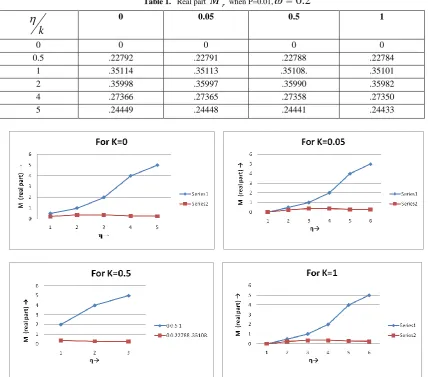
Table 1. Real part Mr when P=0.01,
0.2k
0 0.05 0.5 10 0 0 0 0
0.5 .22792 .22791 .22788 .22784
1 .35114 .35113 .35108. .35101
2 .35998 .35997 .35990 .35982
4 .27366 .27365 .27358 .27350
5 .24449 .24448 .24441 .24433
Themed Section : Engineering and Technology
Table 2. Imaginary Part Mi when P=0.1,
=0.2k
0 0.05 0.5 1.00.5 -.01743 -.01744 -.01758 -.01773
1 -.03328 -.03330 -.03353 -.03378
2 -.05117 -.05119 -.05142 -.05167
4 -.06680 -.05119 -.06695 -.05167
5 -.07246 -.07247 -.07261 -.07276
Figure 2. Graphs showing the variation in values of „Mi‟ with respect to the change in value of „η‟ for different values of „K‟ i.e K=0, K=0.05, K=0.5 and K=1.0.
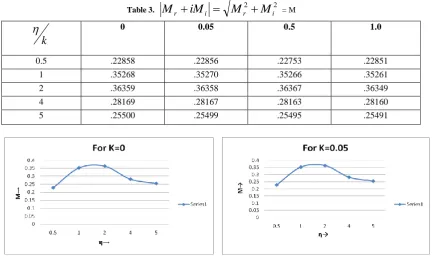
Table 3.
M
r
iM
i
M
r2
M
i2 = Mk
0 0.05 0.5 1.00.5 .22858 .22856 .22753 .22851
1 .35268 .35270 .35266 .35261
2 .36359 .36358 .36367 .36349
4 .28169 .28167 .28163 .28160
Figure 3. Graphs showing the variation in values of „M‟ with respect to the change in value of „η‟ for different values of „K‟ i.e K=0, K=0.05, K=0.5 and K=1.0.
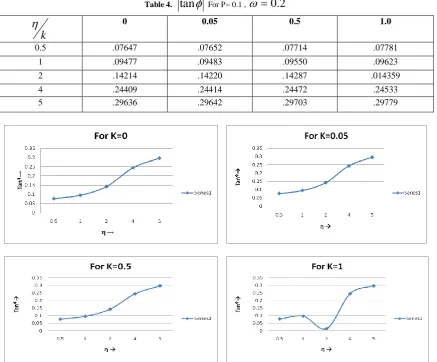
Table 4.
tan
For P= 0.1 ,
0.2k
0 0.05 0.5 1.00.5 .07647 .07652 .07714 .07781
1 .09477 .09483 .09550 .09623
2 .14214 .14220 .14287 .014359
4 .24409 .24414 .24472 .24533
5 .29636 .29642 .29703 .29779
Figure 4. Graphs showing the variation in values of „tan ᶲ‟ with respect to the change in value of „η‟ for different values of „K‟ i.e K=0, K=0.05, K=0.5 and K=1.0.
IV.
CONCLUSIONS
The effect of magnetic field on free convection flows in liquid metals, electrolytes and ionized gases has been studied, when the plate temperature oscillates about a constant mean in magnitude but not in direction. The values of Mr for different
Themed Section : Engineering and Technology
It does not show any remarkable change for any value of
in the region0K .05, but shows comparatively an appreciable change in the region after it.In table 2, Mi is entered, an examination of this
table shows that Mi is negative throughout. It is
zero at
0
for every value of K=0. Its magnitude is maximum at K=1 for
0
.
5
at K=1 for
1
at K=1 for
2
, at K=1 at
4
,at K=1 at
5
. Its magnitude does not show an appreciable change for any value of
in the region 0K .05 but shows comparatively appreciable change in the region after that.In table 3, the values of
M
M
r2
M
i2 forvarious sets of values of
and K have been incorporated. The study of this table indicates that M is at
0
for every value of K. Its magnitude is maximum at K=0 for
0
.
5
, at K=0.5 for
1
at K=0.5 for
2
, at K=0 for
4
, at K=0 for5
.In the velocity distribution eq. 29 the coefficient of
is)
cos(
)
sin
cos
(
M
r
t
M
i
t
M
r2
M
i2
t
. The term lags or leads over fluctuations by an angle
. In our case
is negative. The values of
tan
for various K are entered in table 4.V.
REFERENCES
[1]. B Yadav and T. Y. Ray(1991), “Unsteady flow of n-immiscible Visco elastic fluid through a poprous medium between two parallal plates in the presence of a transverse magnetic field”, Proc. Nat. Acad. Sci.( 81)389.
[2]. A K. Srivastava and H.C. Khare, (1996), “Rayeligh-Taylor instability of two viscous susperposed
[3]. P Kumar(1996), “The instability of two visco-elastic suspended particles and variable magnetic fields in porous medium porosity” J poly m-plast. Tech Engg‟; (35)591.
[4]. RC. Sharma and S. K. Kango(1999) , “The stability of two superposed walter B visco-elastic fluid in the presence of suspended particles and the variable magnetic field in porous medium” Appl. Mech. Engg; (4 )255.
[5]. Rita Choudhary and Alok Das Dec (2001) “Elastico-Viscous flow in a compliant annulus”; Indian J. Pure and Appl. Math: 32(12)): 1905-1915. [6]. Bikash Chandra Ghosh, N.C. Ghosh (2001) “ MHD flow of a Visco-elastic fluid through porous medium” International Journal of Numerical Methods for Heat & Fluid Flow Vol.11 No7,682-698.
[7]. Emad M Abo-Eldahab (2001) “Hall Effects on Magnetohydrodynamic Free-Convection Flow at a Stretching Surface with a Uniform Free-Stream” Phys. Scr. 63 No 1 29-35.
[8]. Veena Sharma and Glan Chand Rana Jan (2002) “Gravity field in porous medium” Indian J. Pure Appl. Math 33(1): 97-109.
[9]. Yu, J.D., Sakai, S., and Sethian, J.A., (2006) “Two – phase Viscoelastic jetting”
[10]. to appear, J. Computational Physics.
[11]. O Anwar Bég, H S Takhar, R Bhargava, S Rawat and V R Prasad (June 2008) “Numerical study of heat transfer of athird grade Viscoelastic fluid in non-Darcy porous media with thermo-physical effect” Phys. Scr. 77 No 6 065402 (11pp).
[12]. Ignacio Lira (November 2008) “Scales of free convection around a vertical cylinder” Eur. J. Phys . 29 No 6 1301-1306.
[13]. Y Wei, E Rame, L M Walker and S Garoff (18 November 2009) “Dynamic wetting with viscous Newtonian and Non-Newtonian fluid” J. Phys.: Condens. Matter 21 No 46,464126 (12 pp).
vertical wall in a medium with variable suction in the presence of radiation”, AMSE J.Mod. Meas. Cont .B, vol. 73(3), pp.61-68, 2004.
[16]. Singh P.and Gupta C.B. “MHD free convective flow of viscous fluid through a porous medium bounded by an oscillating porous plate in slip flow regime with mass transfer” .Ind. J.Theo. Phys. Vol. 53(2), pp. 111-120, 2005.
[17]. Khandelwal A.K. and Jain N.C. “Unsteady MHD flow of stratified fluid through porous medium over a moving plate in slip flowregime” . Ind.J. Theo. Phys. Vol. 53(1), pp. 25-35, 2005.
[18]. Ogulu A.and Abbey T.M. “Simulation of heat transfer on an oscillatory blood flow in an indented porous tube”. Int. Comm. Heat Masstransfer, vol. 32, pp. 983-989, 2005.
[19]. Das S.S., Tripathy R.K., Sahoo S.K.and Dash B.K. , “Mass transfer effects on free convective MHD flow of a viscous fluid bounded by anoscillating porous plate in the slip flow regime with heat source”. J.Ultra Scientiest of Phys Sci., vol. 20(1M), pp. 169-176, 2008.
[20]. Choudhury R. and Dey D., “Free convective visco-elastic flow with heat and mass transfer through a porous medium with periodic permeability”. Int. J. heat and mass transfer, vol. 53, pp.1666-1672, 2010.
[21]. Choudhury R. and Das S.K., “Boundary Layers in oscillatory MHD visco-elastic flow past a porous vertical plate with periodic suction”, Int.J. of App andEng.res.,vol.6(9),pp.1127-1139,2011.
[22]. Choudhury R. and Mohanta M., “MHD mixed convective oscillatory flow of visco –elastic fluid in a porous channel”. JP Journal of heat and mass transfer. Vol.6 (2), pp.177-190, 2012.
[23]. Choudhury R. and Das U.J., “Heat transfer to MHD oscillatory visco-elastic flow in a channel filled with porous medium”, physics research international, Ar ID 879537, 5 pages ,2012
[24]. Choudhury R. and Das S.K., “Visco-elastic free convective flow and heat transfer past an oscillatory porous plate in the slip flow regime”, Adv. theor. and appli math, vol. 7(4), pp. 403-416, 2012.
[25]. Choudhury R. and Das S.K., “Visco-elastic MHD oscillatory horizontal channel flow and heat
Transfer with heat source”, Appl Math and comp sci., vol. 4, PP. 49-67,2013.
[26]. L. Harikrishna, M. Veerakrishna, M.C. Raju, Hall current effects on unsteady
[27]. MHD flow in a rotating parallel plate channel bounded by porous bed on the lower half Darcy lap wood model, Mathematical sciences International research journal, Vol.4 (2015), 29-39.
[28]. L. Rama Mohan Reddy, M. C. Raju, G. S. S. Raju, Natural convection boundary layer flow of a double diffusive and rotating fluid past a vertical 590 P. Gurivi Reddy porous plate. Int. J. Appl. Comput. Math. (2016). DOI 10.1007/s40819-n0174-7.
[29]. L. Rama Mohan Reddy, M. C. Raju, G. S. S. Raju, & N. A. Reddy., Thermal diffusion and rotational effects on magneto hydrodynamic mixed convection flow of heat absorbing/generating visco- elastic fluid through a porous channel", Frontiers in Heat and Mass Transfer, Vol.7 (1), 2016. DOI: 10.5098/hmt.7.20
[30]. M.Umamaheswar, M. C. Raju and S. V. K. Varma, MHD convective heat and mass transfer flow of a Newtonian fluid past a vertical porous plate with chemical reaction, radiation absorption and thermal diffusion, International Journal of Engineering Research in Africa Vol. 19 (2016), 37-56, doi:10.4028/www.scientific.net/JERA.19.37. [31]. M. Umamaheswar, M. C. Raju, S. V. K. Varma,
Effects of Time Dependent Variable Temperature and Concentration Boundary Layer on MHD Free Convection Flow Past a Vertical Porous Plate in the Presence of Thermal Radiation and Chemical Reaction, Int. J. Appl. Comput. Math. DOI 10.1007/s40819-015-0124-9. 2016.
Themed Section : Engineering and Technology [33]. P. G. Reddy., Raju M.C., Mamatha B. and Varma
S.V.K. (2016) Thermal Diffusion Effect on MHD Heat and Mass Transfer Flow past a Semi Infinite Moving Vertical Porous Plate with Heat Generation and Chemical Reaction, Applied Mathematics, 7, 638-649.
[34]. S.H. Reddy, M. C. Raju, E. Keshava Reddy, Radiation absorption and chemical reaction effects on MHD flow of heat generating Casson fluid past Oscillating vertical porous plate, Frontiers in Heat and Mass Transfer (FHMT), 7, 21 (2016). DOI: 10.5098/hmt.7.21
[35]. L. Rama Mohan Reddy, M. C. Raju, G. S. S. Raju., Unsteady MHD free convection flow of a visco-elastic fluid past a vertical porous plate in the presence of thermal radiation, radiation absorption, heat generation/absorption and chemical reaction, International Journal of Applied Science and Engineering, Vol.14 (2), 2016, 69-85.