R E S E A R C H
Open Access
Efficient authenticated key exchange
protocols for wireless body area networks
Jingwei Liu
*, Qian Li, Rui Yan and Rong Sun
Abstract
Secure protocol is a vital guarantee in all kinds of communication network environment. Designing on authenticated key exchange protocols is a hotspot in the field of information security at present, and the related theories have been increasingly mature. However, there is still scarcely any appropriate security protocol to guarantee the
communication security of wireless body area networks (WBANs). In this paper, according to the standards on WBAN, we define a layered network model in accordance with the definition of two-hop star network topology firstly. In line with this model, we put forward two new authenticated key exchange protocols based on symmetric cryptosystem, which are suitable for WBAN application scenario. The proposed protocols support the selective authentication between nodes in WBAN. Simultaneously, two pairs of session key are generated efficiently and succinctly in each certification process. Finally, after security analyzing and performance evaluating demonstrate that the proposed key agreement protocols are proved to meet desired security properties with light computation and communication overhead. The proposed protocols provide a primitive to develop efficient and secure WBAN systems.
Keywords: Security protocol; Wireless body area network; BAN logic; AES
1 Introduction
Authenticated key exchange protocols are important and have been widely applied in network communication. By a pre-registration, two communication parties share a secret symmetric key with a trusted server correspond-ingly. When the two participants try to exchange any information with authentication property confidentially in an insecure environment, they must be in agreement on a new secret session key by the help of a server. This kind of key exchange method is called three-party authenticated key exchange (3PAKE), and the 3PAKE pro-tocols typically are employed for mutual authentication and secure communication in various applications.
A good design of 3PAKE protocols should meet various security requirements of different applications, which are described as follows.
• Mutual authentication: The participants of protocols should be authenticated by the server and also they must be authenticated each other by themselves.
*Correspondence: [email protected]
Xidian University, Taibai South Road, 710071 Xi’an, China
• Session key security: The agreed session key should only be known by parties who participate in communication process.
• Perfect forward secrecy: Perfect forward secrecy is the property that a session key derived from a set of long-term keys will not be compromised if one of the long-term key is compromised in the future.
In recent years, many three-party authenticated key exchange protocols have been proposed [1–10] in recent years. Yeh et al. [4] proposed two 3PAKE protocols for secure communication over a public network. One was a plaintext-equivalent authentication protocol and the other was a verifier-based authentication protocol. Lee et al. [8] proposed an improved encrypted key exchange protocol developed by Yeh’s scheme. They claimed that the pro-posed protocols had the same computation complexity as Yeh’s protocol. In [2] and [6], the server’s public keys were both needed in their schemes. Lu and Cao [5] pro-posed a new simple three-party password-based authen-ticated key exchange protocol (S-3PAKE) which did not require any server’s public key. Guo et al. [11] found that S-3PAKE in [5] was vulnerable to a kind of man-in-the-middle attack that exploited an authentication flaw in the
protocol and is subject to the undetectable online dic-tionary attack. Then, they have provided an improved version. Kim and Choi [12] proposed another improved version of S-3PAKE against the online password guess-ing attack. However, both of the two improved versions in [11] and [12] had more computation cost than the original S-3PAKE protocol though they are more secure.
With efficiency and security in consideration, the num-ber of protocol execution steps and the complexity of cryptographic operations have been used to measure the performance of the existing 3PAKE schemes. Different from the above existing 3PAKE protocols with less consid-eration of computation cost, Huang [7] proposed a 3PAKE protocol in five steps without improving the server’s pub-lic key. In [1–3], the authors presented several symmetric key-based authenticated key exchange protocols, respec-tively. In order to further improve the efficiency of 3PAKE protocols, in this paper, we propose two new efficient three-party authenticated key exchange protocols with one-time key for WBANs especially, which achieve more security properties as Huang’s scheme claimed.
WBAN is the embranchment of wireless sensor net-work, which can benefit to monitor and improve health conditions of people, surveillance of old age, and handi-capped people [13]. It can further improve quality of life by monitoring and examining the vital signs (e.g., tem-perature, blood pressure, etc.) of healthy people to avoid future health problems. The study on wireless body area network is in a fledging period at present, meanwhile IEEE raised 802.15.6 standard for wireless body area network in 2012, which regulates the technical requirements in each layers of WBAN. WBANs include various types of medical and non-medical sensors equipped in and on human bod-ies to monitor different biological information of people. All BAN nodes send monitored data to a BAN controller. In WBANs, each BN with biosensors must be operated with extremely stringent constrains, especially implanted BAN nodes. So, simplicity is an important factor in devis-ing a new protocol for WBANs. Design considerations for efficient key exchange protocols for WBANs are as follows:
• The proposed key agreement protocol should not require lots of energy and memory because sensor nodes are already resource constraints.
• It must suit the topology structure of wireless body area network.
• Communication messages should be of low redundancy rate and minimum message exchange between the nodes.
Possible attacks in wireless channel (such as replay-ing attack, eavesdroppreplay-ing attack, denial of service attack, Byzantine attack, etc.) have raised concerns of users and
medical service providers. The detail security require-ments of WBANs are introduced in [14] that is not altogether different from general WSNs.
Star topology is largely used in the WBANs, which is simple and easy to control. In this topology, it is possible to partition the sensor nodes according to their location: on the head; on the torso; and on the limbs [15]. However, it will impose higher energy costs for communications involving nodes that are distant from the BAN Network Controller. For these nodes, we could consider using relay nodes. Till date, there are very few security protocols [16–18] designed for this kind of network topology in WBANs.
In this paper, the main contributions of our work can be summarized as follows:
• We propose two novel three-party authenticated key exchange protocols between controller node and sensor nodes in different situations. Due to the calculation ability and the storage capacity of sensor nodes, new protocols are specially based on
symmetric cryptography.
• The BAN logic formal verification tool has been employed in aid design of 3PAKE protocol for authentication and security verification.
• The quantified performance analysis on the proposed 3PAKE protocols is conducted.
The rest of this paper is structured as follows. Section 2 briefly introduces the network model of WBANs. In Section 3, two three-party key exchanged protocols are proposed in different application scenarios, namely nor-mal situation and critical or special situation. Section 4 presents the formal demonstration by BAN logic and security analysis of the new protocols. The performance comparisons between proposed protocols and others are conducted in Section 5. Finally, conclusion is drawn in Section 6.
2 Network model of the wireless body area network
WBAN is a special branch of the wireless sensor network. It is a human body-centered communication network [19], consisting of body-related elements, including devices such as sensors distributed within and deployed around the human body. Through WBAN, people can transfer data of intracorporal sensors to the terminal equipments taken along, implement real-time health monitoring and auxiliary diagnosis of disease further for the patients [20], and meanwhile realize the network interconnection within the scope of human and so forth.
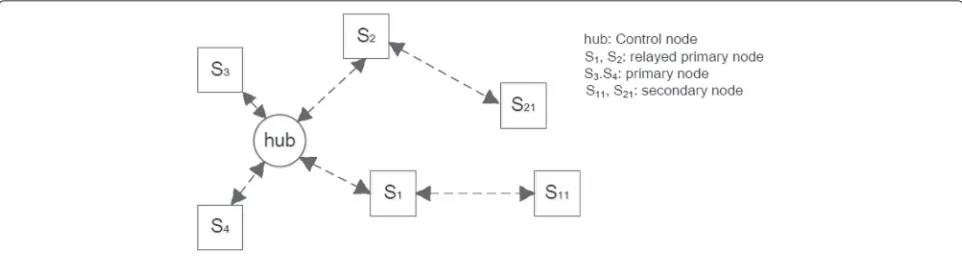
which ranges from several to dozens. Here, except the hub, we differentiate the nodes as primary node and secondary node logically while the nodes have the same attribute. The affiliation of the nodes is shown in Fig. 1. The link hub-S1-S11 means the two-hop connection between the hub and secondary node S11, and hub-S2-S21 means the two-hop connection between the hub and secondary node S21.
Considering the net as a two-tier architecture, the con-trol node (hub) is linked together with the primary sensor node S1, S2· · ·Sn logically so as to transmit data. Simul-taneously, a portion of primary nodes Si are connected with the corresponding secondary nodes Si1in the second layer. Here, actually, the primary node plays the rule of relay node. In the initial condition, authentication process of each node should be conducted at the first place, before the session key is generated. It requires the adoption of authentication and key exchange protocol.
3 New authenticated key exchange protocols for wireless body area network
In this section, we give the description of two proposed protocols using two-hop star topology. The protocols are explained in two different application scenarios. For the sake of simplicity, we makeSdenote the control node and B,C,Drepresent the primary nodes respectively, withA representing a secondary node. In the initial state, the con-trol node S keeps the pre-shared key Kbs with primary node B, and Kcs with C, also Kds with D, S shares the pre-shared key Kaswith secondary nodesAidentically.
3.1 Formalizing description of protocol I
In normal cases, the normal nodes periodically collect data from sensor nodes in WBANs and then send these data to the hub. If secondary node is near enough to the hub, it can establish connection with the hub directly. If not, it has to find a primary node as a relay to complete the connection.
Protocol I begins with a message broadcasted by a secondary node A. After receiving the message fromA,
the adjacent nodeB, C, Dgenerates encrypted message respectively according to the received message, then send it to the control nodeS. Subsequently,Sdetermines which primary node is appropriate to be connected with nodeA. Assuming thatBis the most appropriate one, the protocol will accomplish the authentication betweenSandA,Sand B, as well asAandB, respectively, and generate a session key namedKEYbetweenSandB, session key Kabbetween AandBcorrespondingly. At the same time,Sreplies toC, Dto inform about the connection failure. Authentication flow diagram is shown in Fig. 2.
The formalizing description of protocol I:
Message1:A broadcast: A, Na Message2:B−→S: B, {A, B, Na, Nb}Kbs
Message3:S−→B: {B, Na,Kab}Kas, {A, Nb,Kab, KEY}Kbs Message3’:S−→C: {Nc, text}Kcs
Message4:B−→A: {B, Na,Kab}Kas, {Na, Nb}Kab Message5:A−→B: {Nb}Kab
The analysis of the protocol I:
(1) The secondary nodeA, which is supposed to access to the network for authentication, broadcasts Message 1 including its own identifierAand generates a random numberNa. After receiving the broadcasted message,B,C,Dsends Message 2 toS. (2) Bsends a message encrypted with the pre-shared key
KbstoS, which contains identifierA, randomNa,
identifierB, and random numberNbgenerated by nodeB. NodeC,Dalso sends the same type of messages.
(3) After receiving the request messages sent by primary nodes,Sdecrypts the messages by pre-shared key. Noticing that it is secondary nodeAthat wants to be authenticated to join the network,Sdetermines the most suitable primary node to be connected withA
and sends Message 3 to the right nodeBas a reply, meanwhileSsends Message 3’ toC,D. Message 3 involves{B,Na,Kab}encrypted with Kasand {A,Nb,Kab,KEY}encrypted with Kbs. Among them,
Fig. 2The flow chart of the certification process of protocol I
Kabis the session key forAandBgenerated byS, and KEY is the session key betweenBandSgenerated by
S.
(4) After receiving Message 3,Bdecrypts the message with Kbsand gets the sessionKEYand Kabthen
encrypts the random numberNa,Nbwith Kab,
together with{B,Na,Kab}Kasand forwards them to
nodeA. At the same time, nodeC,Dreceives the replied messages fromSand knows that it is unable to connect withA.
(5) After receiving the previous message,Adecrypts message{B,Na,Kab}Kaswith Kasfirstly to obtain the
session key Kab, then decrypts message{Na,Nb}Kab
with Kabto get two random numbersNaandNb,
and finally verifies whether they are same. If so,A
sendsNbencrypted with KabtoB, otherwise the
authentication fails.
(6) After receiving the message from nodeA, nodeB
tests whether the assumedNbis identical with the original one, if so it shows that nodeAhas received the correct session key, then end the protocol.
3.2 Formalizing description of protocol II
In some special cases, the primary node and the sec-ondary node must work together to analyze the data collected from the human body, for example, measuring the blood circulation system. The primary node measures blood pressure, while the secondary node measures blood oxygen. Each primary node measuring blood pressure is connected to a secondary node measuring blood oxy-gen. That is to say, whenever a primary node broadcasts requirements, there must be a synergistic secondary node in response. The protocol II is proposed for this kind of special application cases.
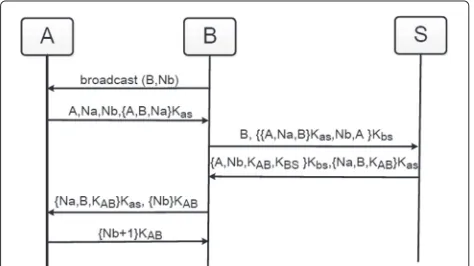
The primary node B broadcasts a message first, and then the corresponding coordination secondary node A generates an encrypted message and sends it to the pri-mary nodeBafter receiving the broadcast message. On receiving message from nodeA, nodeBattaches its own information and encrypts all of them, then sends them to
the control nodeS.Sdecrypts and certificates the received message. If the message is proved correctly,S sends the feedback information which contains the session keys to nodeB, such as KABbetween nodeAand nodeBand KBS between nodeS and nodeB. NodeBsends the message which includes KABto A, andAgives a reply to nodeB after receiving and confirming it correctly. Authentication flow chart is shown in Fig. 3.
The formalizing description of protocol II:
Message1:B broadcast: B, Nb
Message2:A−→B:A,Na,Nb,{A,B,Na}Kas Message3:B−→S:B,{{A,Na,B}Kas,A,Nb}Kbs
Message4:S−→B:{A,Nb,KAB,KBS}Kbs,{Na,B,KAB}Kas Message5:B−→A:{Na,B,KAB}Kas,{Nb}KAB
Message6:A−→B:{Nb+1}KAB
The analysis of the protocol II:
(1) The primary nodeBbroadcasts its own identifierB
and generates a random numberNb.
(2) The secondary nodeAwhich cooperates with nodeB
sends a message, which contains plain text identifier
A, randomNa,Nb, identifierB, and identifierA, identifierB, randomNaencrypted with the pre-shared key Kas.
(3) After receiving the messages sent by secondary nodes
A,Bencrypts the encrypted message{A,B,Na}Kas
and identifierA, randomNbwith pre-shared key Kbs,
along with plain text identifierB, and sends them to the control nodeS.
(4) After receiving Message 3,Sdecrypts the message and verifies it. If correct,Sgenerates the session key KBSbetweenSandB, and session key KAB, between AandB.Suses Kbsto encryptA,Nb, KAB, and KBS
and uses Kasto encryptB,Naand KAB, then send
them to nodeB.
(5) After receiving the previous message and decrypting the first part, nodeBuses Kbsto get session key KBS
and KAB, uses KABto encryptNb, and sends nodeA
the message{Na,B,KAB}Kas.
(6) After receiving the message from nodeB,Adecrypts the front part of the message and uses Kasto get KAB,
random number and identifier, then verifies if the characteristic is right. If so, nodeAdecrypts the second part and uses the new received session key KABto getNb. If the receivedNbis the same with
original one generated by nodeB,AsendsNb+1
encrypted with KABto nodeB.
(7) After receiving the message, nodeBdecrypts it to get
Nb+1, then hasNb+1minus one, and checks if it is the same with the randomNbgenerated in the first step. If so, the protocol performs successfully, otherwise the authentication fails.
Primary and secondary nodes are synergistic, that is to say, the primary node sends messages to the control node Swhile the secondary node sends messages by virtue of primary nodes at the same time. After the protocol com-pletes initialization and certification, the primary nodeB will send Message 2 to control node S, and secondary nodeAwill send Message 1 toS. Simultaneously, nodeA encrypts Message 1 with session key KABand sends the original message to node B. B decrypts Message 1 with KABconcatenate Message 2 and encrypts them with KBS then sends the original message toS. Finally,S decrypts messages with KBSand obtains Message 1 and Message 2.
4 Security analysis
Security analysis is an important way of detecting pos-sible security flaws in security protocols. In this section, we give both the formalization analysis by BAN logic and non-formalization analysis of the proposed protocols.
4.1 Formal analysis
The two kinds of authenticated key exchange protocols are testified by the celebrated BAN logic in this subsec-tion. The authentication logic is one of the most com-monly used analysis tools of cryptographic protocols. BAN logic [21, 22] has not only revealed lots of flaws of famous protocols but also found the redundancy of many protocols. In BAN logic, messages are being ideal-ized as formulas in the first place. After that, the initial state assumptions are defined as the case may be. Then, by making use of the known conditions and the logic regula-tions, it is reasonable to judge and to ratiocinate whether the protocols meet the goals or not.
4.1.1 Logical symbol
Below are logical symbols of BAN logic used in this paper:
1. P, Q: subjects, those are the principles participant in the protocol
BAN logic contains message-meaning rules, nonce-verification rule, jurisdiction rules, and so forth. The messages above the horizontal line are known conditions while below line are the results deduced from the known conditions.
1. Message-meaning rules:Pshares the secret keyK
withQ. IfPreceives a messageXencrypted withK, thenPbelieves thatQhas sentX.
M1 : P| ≡P K
←→Q,P{X}KX
P| ≡Q| ∼X
2. Nonce-verification rule: ifPbelieves that messageX
is fresh and believes thatQhas sentX, thenP
believes thatQbelievesX.
N1 :P| ≡(X),P| ≡Q| ∼X P| ≡Q| ≡X
3. Jurisdiction rules: ifPbelievesQhas sent messageX, andPbelievesQbelievesX, thenPbelievesX.
J1 : P| ≡Q⇒X,P| ≡Q| ≡X P| ≡X
4. Belief-joint rules: ifPbelievesXandY, thenP
believes messages of a cascade ofXandY; ifP
believes thatQbelieves messages of a cascade ofX
andY, thenPbelievesQbelievesXorY; ifPbelieves
5. Freshness-joint rule: ifPbelieves thatXis fresh,P
believes the entire message that cascade withXis fresh.
F1 : P| ≡(X) P| ≡(X,Y)
6. Reception rules: ifPreceives messages of a cascade of
receivesXorY;Pshares secret keyKwithQ. IfP
receives messageXencrypted withK, we can infer thatPreceivesX.
7. Additional rules: secret keyKis fresh. IfPreceives messageXencrypted withKandPbelievesPshares secret keyKwithQ, we can infer thatPbelievesQ
has sent messageX, andPbelievesQbelievesP
shares secret keyKwithQ.
(K),P{X}K,P| ≡P←→K Q P| ≡P| ∼X,P| ≡Q| ≡P←→K Q
4.1.3 The deduction of protocol I
(1) Idealization
• MS2 :B→S, B,{A,B,Na,Nb}Kbs
• MS3 :S→B,{Na,B,Kab}Kas,{A,Nb,Kab,KEY}Kbs • MS4 :B→A,{B,Na,Kab}Kas,{Na,Nb}Kab
• MS5 :A→B,{Nb}Kab
The idealization of messages1 is omitted since it does not contribute to the logical properties of the protocol.
(2) Initial state assumptions
The initial state assumptions of S are:
1. S| ≡S←→Kas A 2. S| ≡S←→Kbs B
3. S⇒KEY
4. S⇒Kab
The initial state assumptions of B are:
1. B| ≡B←→Kbs S 2. S| ≡(Nb)
3. B| ≡S| ⇒B←→KEY S 4. B| ≡S| ⇒A←→Kab B
The initial state assumptions of A are:
1. A| ≡A←→Kas S
(4) Final faith After the protocol runs successfully, it should achieve the following certification targets.
- SandBrealize two-way authentication
S| ≡B| ∼XB
B| ≡S| ∼XS(XSandXBare the messages generated bySandB)
- BandArealize two-way authentication
B| ≡A| ∼XA
A| ≡B| ∼XB(XAandXBare the messages generated
byAandB)
According to MS5:
From the above derivation, we can draw the following conclusions:Bhas theKEY and believes that it is shared withS;Bhas theKaband believes that it is shared withA; Ahas theKaband believes that it is shared withB;Sand Brealize two-way authentication;BandArealize two-way authentication.
4.1.4 The deduction of protocol II
(1) Idealization
The idealization of Message 1 and part of Message 2 are omitted since it does not contribute to the logical properties of the protocol.
(2) Initial state assumptions
The initial state assumptions ofSare:
1.S| ≡S←→Kas A
2.S| ≡S←→Kbs B 3.S⇒KBS 4.S⇒KAB
The initial state assumptions ofBare:
1.B| ≡B←→Kbs S 2.S| ≡(Nb)
3.B| ≡S| ⇒B←→KBS S
4.B| ≡S| ⇒A←→KAB B
The initial state assumptions ofAare:
1.A| ≡A←→Kas S
After the protocol runs successfully, it should achieve the following certification targets.
- SandBrealize two-way authentication
S| ≡B| ∼XB
B| ≡S| ∼XS(XSandXBare the messages generated
bySandB)
- BandArealize two-way authentication
B| ≡A| ∼XA
A| ≡B| ∼XB(XAandXBare the messages generated
byAandB)
8.B|≡S|≡{A,Nb,KAB,KBS}
From the above derivation, we can draw the following conclusions:Bhas theKBS and believes that it is shared withS;Bhas theKABand believes that it is shared withA; Ahas theKABand believes that it is shared withB;Sand B realize two-way authentication;BandArealize two-way authentication.
4.2 Security properties analysis
Firstly, the proposed protocols have the following proper-ties.
Mutual authentication: By our protocols,Scan authen-ticate A and B respectively from the authentication request with the random number Na and Nb. Also, A andBauthenticate each other identity through Kaband Nb. The protocols have mutual authentication property to make the man-in-the-middle attacks necessarily unsuc-cessful.
Perfect forward secrecy: Our protocols possess forward secrecy. An agreed key will not be compromised even if the other agreed keys derived from the same long-term keying material in a subsequent run are compromised. By the proposed protocols, the session keyKabandKEY are randomly selected, so they are independent among each protocol execution. Therefore, the compromised keysKas andKbscannot reveal any previous session keys.
Then, we analyze the proposed protocols under the following kinds of attacks.
Trivial substitution and replay attack: Replaying attack means that an adversary first intercepts some commu-nication data in the currently running of key exchange protocol run. Then, he replays the intercepted data with receiver in a future protocol running. The replay attack does not succeed in the proposed protocols because the freshness of messages transmitted between participants are guaranteed by the random nonces Na and Nb. Only A, B, and S can use the pre-shared key to encrypt the random nonces. Moreover, the proposed protocols do
not require the time-stamp information to prevent replay attack which requires extremely imperative precise clock synchronization.
Man-in-the-middle attack: A man-in-the-middle attack means that an attacker can intercept, replay, substitute, or modify the information that is significant to the com-munication parties. Since all critical messages in the pro-posed protocols are encrypted to prevent eavesdropping, it is rarely able to modify the messages exchanged between entities. However, if an attacker I eavesdrops the com-munication channel betweenAandB, he can replace the authentication request {Na, A} with {Ni, I}. The replaced {Ni, I} will be forward to theStogether with {Nb, B}. The attacker can be successfully authenticated by S if he is really a legitimate user in the system. However, the man-in-the-middle attack can still not be successful because the attacker cannot generate a correct{Ni}Kab to respond to the {Ni, I}. Therefore, we conclude that a man-in-the-middle attack could not succeed against the proposed protocols.
Fake base station attack: False base station attack is that a fake node pretends to be a participant node in the pro-tocol, to grasp the secret information. For pre-shared key is only known betweenA,B, andSin the new protocols, the transmitted information encrypted by the pre-shared secret key Kas and Kbs will not be decrypted by illegal entities. The fake entities do not know the pre-shared key, thereby it cannot get the resulting session key even-tually. If the entities decrypt the messages correctly and obtain the right contents, we can make sure that the iden-tities of the nodes are legal. Then, the authentication is accomplished.
5 The performance analysis of the protocols
In this paper, we propose two efficient key exchange protocols under normal conditions and special condi-tions, respectively. From the performance perspective, we mainly concern the computational time and energy consumption of our protocols. To detail the quantitative result, we conduct simulations and compare our protocols with several typical protocols. Firstly, we make detail anal-ysis of the computation time which is vital to the efficiency of the protocols. Then, we conclude a discussion of energy consumption on computation.
5.1 Computation time
In this section, we analyze and test the computation time associated with the efficiency of protocols.
scheme and SHA256 for hash function. The random number is generated with three times AES-128 cryp-tographic algorithm and two times XOR operations. The simulations are run several times to eliminate the randomness.
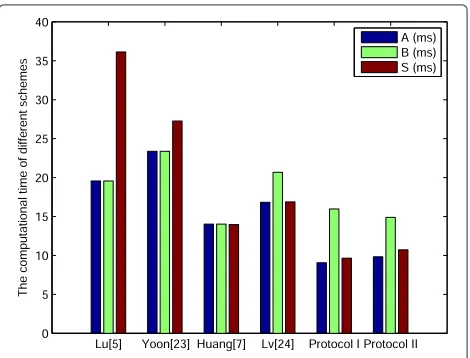
Simulation results: Noting that the computation over-head of these schemes mainly results from the crypto-graphic operations, thus the computation time consumed on the cryptographic operations can be used to approxi-mate the efficiency of the schemes for the sake of simplic-ity. Table 1 shows the operating time of each algorithm. Given the cryptographic operations and their correspond-ing consumcorrespond-ing time, we can calculate the computation time of each protocol as shown in Table 2. The corre-sponding figure is shown in Fig. 4.
From the simulations, we can find that the modular computations still cost much. It is clear that a good design of authenticated key exchange protocols should adopt suitable cryptographic operations with less computation in order to achieve better performance and efficiency. By comparing with other schemes, the proposed protocols show a relatively short time among all six schemes. In other four schemes, the computation time of relay node are time-consuming and will shorten the lifetime of the relay nodes which are not suited for WBAN environment. Therefore, this feature makes our protocols more effec-tive. Based on these analyses, our schemes show a better performance in WBAN scenario.
5.2 Energy consumption
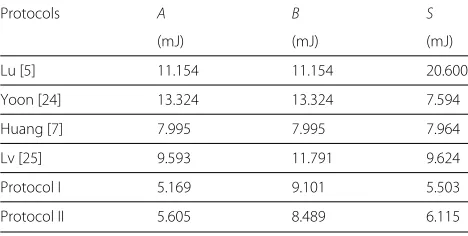
In this part, the energy consumption consumed by cryp-tographic operations is used to evaluate the schemes. This time, we use a low-processor and 64 MB memory run-ning Windows Mobile 5.0 for packet pc. According to PXA270 [23], the typical power consumption of PXA270 in active is 570 mW. Therefore, using the computation time in Table 3, we can calculate the corresponding energy consumption. For example, if it takes 0.919 ms to com-plete a AES-128, the energy consumption is approximately 0.919∗570/1000=0.523 mJ. Similarly, based on Table 2, the energy consumption of all schemes is calculated as shown in Table 3. The corresponding figures are shown in Fig. 5.
Table 1Computational time
Operations Time(ms)
Secret key encrypt(AES-128) 0.919
Secret key decrypt(AES-128) 1.074
Random number 2.781
Hash 0.054
Modular 5.542
Table 2Different schemes’ computational time
Protocols A B S
(ms) (ms) (ms)
Lu [5] 19.569 19.569 36.141
Yoon [24] 23.377 23.377 27.266
Huang [7] 14.027 14.027 13.973
Lv [25] 16.831 20.686 16.885
Protocol I 9.07 15.968 9.655
Protocol II 9.834 14.894 10.729
Due to the computation energy consumption being pro-portional to the computational time, we can draw the same conclusions as the ones in Section 5.1.
5.3 Memory requirement of the protocols
In the protocols, a 2-byte-long node identifier is used to identify each node in the network, which starts from 0001 and increases on a sequential basis. In Table 4, we can find that the length of the random numbers generated by the nodes is 16 bytes, while pre-shared keyKas,Kbs and session keyKEY,Kab,KAB andKBS are all 16 bytes long. In the running process of the protocols, each node only needs to store the node identifier and the relevant ran-dom numbers, while the control node needs to generate and store the session keys additionally. The overall mem-ory cost is no more than 1 KB. The ROM requirement of ordinary nodes including its identifier and pre-shared key is no more than 0.145 KB, and the memory requirement of RAM including random number and session key is no more than 0.25 KB. The ROM requirement of the control node including the pre-shared keys is at most 0.125 KB, and the RAM requirement including two pairs of the ses-sion key is no more than 0.25 KB. In summary, the overall
Table 3Different schemes’ computational energy consumption
Protocols A B S
(mJ) (mJ) (mJ)
Lu [5] 11.154 11.154 20.600
Yoon [24] 13.324 13.324 7.594
Huang [7] 7.995 7.995 7.964
Lv [25] 9.593 11.791 9.624
Protocol I 5.169 9.101 5.503
Protocol II 5.605 8.489 6.115
memory requirement is quite small, which conforms to the limited capacity of WBAN nodes.
- The proposed protocol I : the total message size of the scheme is equal to
|A+Na| + |B| + |Ebs{A+B+Na+Nb}| + |Eas{B+ Na+Kab}| + |Ebs{A+Nb+Kab+KEY}| + |Eas{B+ Na+Kab}| + |Kab{Na+Nb}| + |Eab{Nb}|Here,| ∗ | denotes the size of ∗ in byte.Ec(∗)represents the
AES encryption algorithm calculated for the contents inside the bracket withc. The total message size of protocol I is 274 bytes.
- The proposed protocol II : the total message size of the scheme is equal to
|B+Nb| + |A+Nb+Na| + |Eas{A+B+Na}| + |B| + |Ebs{Eas{A+Na+B} +Nb+A}| + |Ebs{A+ Nb+KAB+KBS}| + |Eas{Na+B+KAB}| + |Eas{Na+B+KAB}| + |EAB{Nb}| + |EAB{Nb+1}|. The total message size is 422 bytes.
In the implementation procedure of authentication and session key generation of the authenticated key exchange protocols, the communication traffic is constant. That is to say, the length of messages is consistent. In protocol I
Fig. 5Energy consumption on computation
Table 4ROM requirement for keys
ROM (byte)
Identify(A,B) 2
Random number(Na,Nb) 16
Pre-shared key(Kas,Kbs) 16
Session key(KEY,Kab,KAB,KBS) 16
and protocol II, the maximum communication traffic is no more than 0.5 KB. Communication traffic of the two protocols is extremely small, so the efficiency is higher.
6 Conclusions
In this paper, we propose two authenticated key exchange protocols that are suitable for WBANs. The two schemes are proved to be secure in BAN logic model. The perfor-mance analysis of them are also given. The analysis results show that the proposed protocols achieve the expecta-tive goals and possess several advantages: they provide favorable security performance and are capable of resist-ing sundry common attacks to guarantee communication security; the participants accomplish authentication and generate session key by five or six steps without tangle-some cryptographic operation; on account of majority security protocols utilizing timestamp to guarantee the freshness of messages, the participants must keep clock synchronization which is rather untoward and costly. However, the proposed protocols adopt random number instead of timestamp, reducing the complexity of the net-work as well as decreasing the cost. The performance analysis shows that the protocols have superior running time performance, less memory costs, and so forth. How to design more and better protocols for WBANs is the next target of further research.
Competing interests
The authors declare that they have no competing interests.
Acknowledgements
This work is supported by the National Natural Science Foundation of China (No. 61100232), National Science and Technology Major Project of the Ministry of Science and Technology of China (No. 2013ZX03005007), the Fundamental Research Funds for the Central Universities (No. K5051301012), the 111 Project (B08038).
Received: 5 September 2014 Accepted: 1 June 2015
References
1. J Liao, B Zhu, Y He, Security analysis of NSSK protocol and its
improvement. IEEE Int. Conf, 115–118 (2009). doi:10.1109/DASC.2009.44 2. Li, Shi L MX, in3rd IEEE Conference on Industrial Electronics and Applications.
Security analysis and improvement of Yahalom protocol, (2008), pp. 1137-40
3. YJ Deng, Based on BAN logic analysis Otway-Rees protocol[J]. Chaohu Coll. J.78(3), 36–37 (2006)
5. R Lu, Z Cao, Simple three-party key exchange protocol. Comput. Secur.
26(1), 94–97 (2007)
6. T Chen, WB Lee, HB Chen, A round and computation-efficient three-party authenticated key exchange protocol. J. Syst. Softw.81(9), 1581–1590 (2008)
7. HF Huang, A simple three-party password-based key exchange protocol. Int. J. Commun. Syst.22(7), 857–862 (2009)
8. TF Lee, JL Liu, MJ Sung, SB Yang, CM Chen, Communication-efficient three-party protocols for authentication and key agreement. Comput. Math. Appl.58(4), 641–648 (2009)
9. X Li, JW Niu, S Kumari, MK Khan, J Liao, W Liang, Design and analysis of a chaotic maps-based three-party authenticated key agreement protocol. Nonlinear Dyn.80(2015). doi:10.1007/s11071-015-1937-0 in press 10. X Li, J Niu, MK Khan, JG Liao, An enhanced smart card based remote user
password authentication scheme. J. Netw. Comp. Appl. 365, 1365–1371 (2013)
11. H Guo, Z Li, Y Mu, X Zhang, Cryptanalysis of simple three-party key exchange protocol. Comput. Secur.27(1-2), 16–21 (2008) 12. HS Kim, JY Choi, Enhanced password-based simple three-party key
exchange protocol.Comput. Electrical Eng.35(1), 107–114 (2009) 13. HB Li, T Ken-ichi, B Zhen, K Ryuji, Body area network and its standardization
at IEEE 802.15.MBAN. Mob. Wirel. Commun. Summit.16th IST, 1–5 (2007) 14. B Zhen, P Maulin, L SungHyup, W EunTae, A Arthur, TG6 technical
Requirements Document (TRD). IEEE (2008). ID: 802.15-08-0644 15. W Burleson, SS Clark, B Ransford, K Fu, inProceedings of Design Automation
Conference(DAC), 49th ACM/EDAC/IEEE. Design challenges for secure
implantable medical devices (IEEE, 2012), pp. 12–17
16. JM Ho, inThe 8th International Wireless Communications and Mobile
Computing Conference (IWCMC). A versatile suite of strong authenticated
key agreement protocols for body area networks (IEEE, Limassol, 2012), pp. 683–688. doi:10.1109/IWCMC.2012.6314287
17. SD Bao, YT Zhang, LF Shen, inProceeding of Wearable and Implantable
Body Sensor Networks. A design proposal of security architecture for
medical body sensor networks (IEEE, BSN, 2006), pp. 84–90. doi:10.1109/BSN.2006.2
18. JW Liu, ZH Zhang, XF Chen, K Sup Kwak, Certificateless remote anonymous authentication schemes for wireless body area networks. IEEE Trans. Parallel Distributed Syst.25(2), 332–342 (2014)
19. B Latré, B Braem, I Moerman, A survey on wireless body area networks. J. Wireless Netw.17(1), 1–18 (2011)
20. M Rostami, W Burleson, A Juels, inDesign Automation Conference (DAC). Balancing security and utility in medical devices? (IEEE, 2013), pp. 1-6. 50th ACM/EDAC/IEEE
21. M Burrows, M Abadi, R Needham,A logic of authentication.In:William
Stallings. (IEEE Computer Society Press, Practical Cryp tography for Data
Internetworks, 1996)
22. JH Wen, M Zhang, X Li, The study on the application of BAN logic in formal analysis of authentication protocols. ACM Int. Conf. Proc. Series.
113, 744-747 (2005). 7th International Conference on Electronic Commerce, ICEC05: Towards Ubiquitous Business
23. PXA270 processor electrical, mechanical, and thermal specification. http://pdf.dzsc.com/CXX/NHPXA270Cxxx.pdf
24. EJ Yoon, KY Yoo, Improving the novel three-party encrypted key exchange protocol. Comput. Stand. Interfaces.30(5), 309–314 (2008) 25. C Lv, M Ma, H Li, J Ma, An efficient three-party authenticated key
exchange protocol with one-time key. IEEE INFOCOM, 1-5 (2010).
doi:10.1109/INFCOMW.2010.5466648
Submit your manuscript to a
journal and benefi t from:
7Convenient online submission
7 Rigorous peer review
7Immediate publication on acceptance 7 Open access: articles freely available online 7High visibility within the fi eld
7 Retaining the copyright to your article