R E S E A R C H
Open Access
Joint frequency offset, time offset, and
channel estimation for OFDM/OQAM systems
Ali Baghaki
*and Benoit Champagne
Abstract
Among the multicarrier modulation techniques considered as an alternative to orthogonal frequency division multiplexing (OFDM) for future wireless networks, a derivative of OFDM based on offset quadrature amplitude modulation (OFDM/OQAM) has received considerable attention. In this paper, we propose an improved joint estimation method for carrier frequency offset, sampling time offset, and channel impulse response, needed for the practical application of OFDM/OQAM. The proposed joint ML estimator instruments a pilot-based maximum-likelihood (ML) estimation of the unknown parameters, as derived under the assumptions of Gaussian noise and independent input symbols. The ML estimator formulation relies on the splitting of each received pilot symbol into contributions from surrounding pilot symbols, non-pilot symbols and additive noise. Within the ML framework, the Cramer-Rao bound on the covariance matrix of unbiased estimators of the joint parameter vector under consideration is derived as a performance benchmark. The proposed method is compared with a highly cited previous work. The improvements in the results point to the superiority of the proposed method, which also performs close to the Cramer-Rao bound.
Keywords: OFDM/OQAM, Joint estimation, Filter bank multicarrier, Carrier frequency offset, Sampling time offset, Channel impulse response, Cramer-Rao bound
1 Introduction
Due to the several benefits of multicarrier modulation (MCM) over single carrier modulation, the former has been considered as the primary choice in the physical layer implementation of telecommunication systems for quite a long time. Among the MCM family, orthogonal frequency division multiplexing (OFDM) has been largely studied and adopted in many wireless and wireline stan-dards [1, 2]. Still, as an alternative and promising form of MCM for future generations of wireless networks, a vari-ant of OFDM based on offset quadrature amplitude mod-ulation (OFDM/OQAM) has attracted much research interest in recent years, due to its many advantages over classical OFDM, including higher spectral efficiency and reduced sensitivity to timing and frequency mismatch [3]. In spite of these advantages, accurate carrier fre-quency and timing synchronization along with channel estimation (for the purpose of equalization) remain of
*Correspondence: [email protected]
Department of Electrical and Computer Engineering, McGill University, 3480 University Street, H3A 0E9 Montreal, Canada
paramount importance for the successful application of OFDM/OQAM in practical systems.
There exist three main categories of synchronization and channel estimation methods for OFDM/OQAM sys-tems: blind, semi-blind and pilot-based methods. While blind methods, e.g., [4–7], provide higher spectral effi-ciency by avoiding the overhead of training sequences, the requirement of a longer observation window for accurate estimation limits their tracking ability, rendering them less popular in most practical applications. In contrast, the semi-blind methods only require the transmission of a small number of parameters to resolve an estimation ambiguity, e.g., [8] and as such, they offer a useful trade-off between spectral efficiency and estimation accuracy. However, since in practical scenarios, the training symbol overhead needed to obtain a better estimation perfor-mance is usually tolerated, our focus here is on pilot-based synchronization and channel estimation.
Compared to channel estimation, pilot-based car-rier frequency offset (CFO), and sampling time off-set (STO) estimation has received less attention in the OFDM/OQAM literature. In [9], a maximum likelihood (ML) symbol timing estimator is derived by using two
training symbols per burst transmission. In [10], using the same preamble structure, the authors extend this work by proposing a joint ML-based estimator of the CFO and STO. Then, to avoid the computational complexity of a two dimensional ML search, a feasible joint estimation method, called approximate maximum-likelihood (AML), is developed by assuming a small CFO and using only one OQAM preamble symbol per burst. The same authors, in [11], propose a joint least-squares (LS) CFO and STO estimation method by using two identical OFDM/OQAM pilot symbols per burst transmission. Therein, as a time-domain method, the estimation is performed before the analysis filter bank (AFB) at the receiver. In [12], by using a polyphase network implementation of OFDM/OQAM, the preloading technique, and a conjugate-symmetric preamble, the CFO and STO are separately estimated. The CFO estimation exploits the phase difference between the adjacent pilots while the frame detection and STO estimation are derived based on the conjugate-symmetry property. Moreover, in [13, 14], a joint CFO and STO estimation method is proposed by using a four-column preamble per burst transmission, which contains zeros in every other subcarrier and every other symbol time index.
In contrast to the CFO and STO estimation, during the past decade, many pilot-based channel estimation schemes have been proposed for OFDM/OQAM systems, which can be broadly classified into frequency domain and time domain methods. Frequency domain methods, e.g., [15–23], rely on the assumption that the symbol dura-tion is much longer than the maximum channel delay spread. While these methods are generally characterized by a lower computational complexity, when the above condition is not satisfied, they will suffer from a perfor-mance degradation. Time domain methods, e.g., [24–26], attempt to estimate the channel impulse response (CIR) by using sequences of pilot tones. In [24], a time domain CIR estimator is proposed based on the multiple sig-nal classification (MUSIC) and LS algorithms. In [25], a per-subchannel estimator is proposed in which the CIR on each subcarrier is estimated separately. In [26], the authors exploit pilot tone structures in OFDM/OQAM systems to derive two new CIR estimators, namely the lin-ear minimum mean square error (LMMSE) and weighted least-square (WLS) estimators. The former exploits a pri-ori knowledge of the CIR covariance matrix while the latter only requires the knowledge of the channel length; both methods are benchmarked against the Cramer-Rao bound (CRB). In a recent paper [27], based on a combina-tion of the ideas of [15] and [28], a coded auxiliary pilot scheme is proposed for frequency domain channel esti-mation. The coded auxiliary pilots are carefully designed to compensate for the inherent imaginary interference of OFDM/OQAM.
Although the aforementioned synchronization and equalization problems have been separately addressed throughout the literature on OFDM/OQAM systems, only a few research papers can be found, e.g., [29], that are devoted to STO, CFO and channel estimation at the same time, let alone a joint estimation approach based on a uni-fied criterion. In fact, to the best of our knowledge, a joint estimation method for OFDM/OQAM systems, account-ing for all the three error sources, i.e., CFO, STO, and CIR, has not yet been developed. Hence, our focus in this paper is to develop and investigate a general estimation method to fill this need.
Specifically, a new formulation of the joint parame-ter estimation problem in OFDM/OQAM system is first introduced, which is based on splitting the interference term on the desired received pilot into adjacent pilot, non-pilot and noise contributions. Then, by assuming Gaus-sian noise and independent input symbols, a pilot-based joint ML estimator of CFO, STO, and CIR is derived. Such a general approach offers many advantages, includ-ing a unified framework for the estimation of multiple parameters using a common preamble/burst structure and the proper treatment of different types of interfer-ence in the estimator derivation. More importantly, a significant performance improvement is expected in the joint estimation of the aforementioned error sources as opposed to their separate estimation. Through numeri-cal simulations of wireless OFDM/OQAM transmission over multipath fading channels, the proposed estimator is evaluated by comparing the accuracy of the result-ing parameter estimates to that obtained with a selected benchmark approach among a few existing works where all the three error sources of our focus are estimated1, as well as to the CRB. The simulation results show that, the proposed method is capable of significant improvements in parameter estimation accuracy, performing close to the CRB. In turn, this improved performance leads to a lower bit error rate (BER) of the compensated (i.e., synchronized and equalized) transceiver system.
This paper is a more developed and improved version of our previous work [30] addressing the joint estima-tion problem under a more restrictive set of assumpestima-tions. Specifically, the new contributions of the current work include the following:
• In [30], orthogonality of the OFDM/OQAM analysis/synthesis filters in the complex domain is assumed, as opposed to orthogonality in the real domain only. The former condition leads to
important simplifications in the derivation of the ML estimator, especially in the statistical properties of the subband noise and data interference.
approximate ML estimator, although it shows performance improvements compared to earlier work. In contrast, herein, by invoking the true orthogonality condition of OFDM/OQAM in the real domain, we can strive for an exact ML-based
estimator, which achieve even better estimation accuracy.
• Another important contribution of this paper is the analysis of the distributions of the subband noise and data interference terms in the general OFDM/OQAM framework, where the pilot tones can be scattered or appended as preamble to the data. In particular, we show that the subband noise contributions, after the real operation, are uncorrelated along the time and frequency axes, as a consequence of the exact orthogonality relation. Furthermore, we show through analysis and numerical simulations that the data interference terms are well modeled by a Gaussian distribution for which we derive the second order statistics. We further show that the data interference terms are only weakly correlated along the time and frequency axes. We conclude that with a carefully designed pilot distribution, their correlation can be confidently approximated as zero.
• Based on this reformulation of the problem and subsequent derivation of an accurate log-likelihood function for the received pilot tones, we derive in detail the CRB for the joint parameter estimation problem under consideration. The former plays a key role in demonstrating the near optimality of the newly derived joint ML-based estimator, whose performance (estimation error) comes within 1 dB or less from the bound.
• In addition to the above new theoretical contributions, the paper contains a number of improvements, including a computational complexity analysis and discussion of practical approaches to reduce implementation complexity.
The paper is organized as follows. Section 2 is dedi-cated to reviewing the OFDM/OQAM system model as implemented in this work. In Section 3, the joint ML esti-mator of the CFO, STO, and CIR is developed in details based on a new formulation. Several related aspects are also discussed, including: computational simplifications for efficient implementation; evaluation of computational complexity; CFO and STO compensation and channel equalization. The CRB on the unbiased estimator of the aforementioned parameters is derived in Section 4. The methodology used in our simulations and the results are provided in Section 5, while Section 6 concludes the paper. Appendices A and B provide important developments about statistical properties of the subband noise and data interference terms.
Notations:Bold-faced letters indicate vectors and matri-ces, e.g., A. The(i,j)th entry of a matrix is represented by [A]i,j. The superscriptsT andH stand for the
trans-pose and Hermitian transtrans-pose of a vector or matrix, respectively. The operator∗represents a linear convolu-tion while the superscript∗denotes complex conjugation. The identity and zero matrices are denoted byI and0, respectively. The paraconjugate operation on a matrix functionE(z)is defined byE˜(z) = E(1/z∗)H. The opera-tors E{.},R[ .] andI[ .] stand for the expected value, real part and imaginary part of their arguments, respectively. The floor operation is denoted by.while||.||represents the second norm operation.
2 Problem formulation
In this section, the OFDM/OQAM system model is pre-sented along with its input-output relation over a fre-quency selective fading channel. The effects of the CFO and STO on the reconstructed signal are discussed and finally, the joint estimation problem for the CFO, STO, and CIR is stated.
2.1 OFDM/OQAM System Model
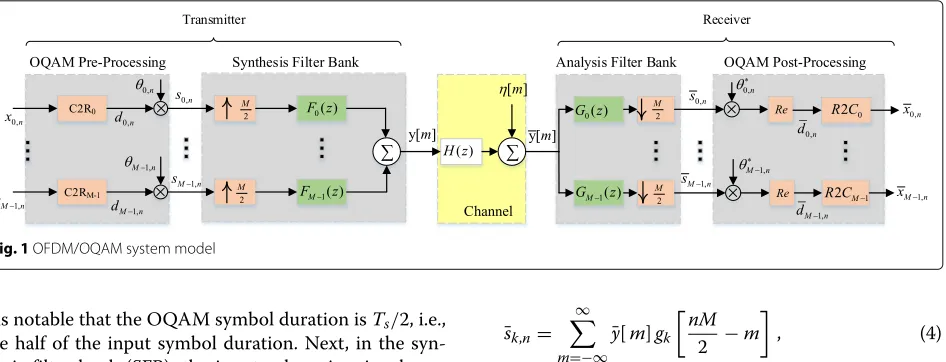
The OFDM/OQAM system model, as implemented in this work and commonly used in the literature, e.g., [31], is illustrated in Fig. 1. OFDM/OQAM makes use of a specific filter bank structure where the upsampling and downsampling factor equals half the number of subcar-riers, denoted by M. At each input symbol time, with symbol duration Ts, a vector of discrete input symbols
is loaded on the Mavailable subcarriers. The latter are separated in frequency byFs = 1/Ts, so that the system
occupies a total bandwidth ofW =MFs.
On the transmitter side, letxk,n∈Adenote the complex
valued symbols at the input, wherek ∈ {0, 1,. . .,M−1} is the frequency index,n ∈ Zis the symbol time index, andAis the digital constellation from which the symbols are drawn. In the first stage of pre-processing, eachxk,nis
converted to a pair of real symbols,dk,n, according to the
following equations,
dk,2n=
Rxk,n
, keven
Ixk,n
, kodd dk,2n+1=
Ixk,n
, keven
Rxk,n
, kodd.
(1)
This complex-to-real (C2R) operation doubles the sam-pling rate of the subcarrier signals. The second stage of pre-processing involves multiplication of the real OQAM symbols, dk,n, by the sequence θk,n = ej
π
2(k+n), which
results in complex symbols
sk,n=dk,nθk,n=dk,nej π
Fig. 1OFDM/OQAM system model
It is notable that the OQAM symbol duration isTs/2, i.e., one half of the input symbol duration. Next, in the syn-thesis filter bank (SFB), the input subcarrier signals sk,n
are first upsampled byM/2, and then passed through syn-thesis filters with finite impulse responses (FIR)fk[m] of
length Lp and corresponding system functions Fk(z) =
Lp−1
m=0fk[m]z−m. Finally, the individual filter outputs are
added together to form the baseband output y[m] as follows,
y[m]=
M−1
k=0
n∈Z sk,nfk
m−nM 2
. (3)
In a practical implementation of OFDM/OQAM, the output signaly[m] is passed through a pulse shaping fil-ter and up-converted to an appropriate frequency band for transmission over the physical medium. In this work, however, we consider an equivalent baseband channel model for simplicity. Specifically, the channel is mod-eled as a linear time-invariant system with FIR h[l] of length Q, and corresponding system function H(z) = Q−1
l=0 h[l]z−l. The filter lengthQis proportional to the
channel delay spreadτds, that is,Q= Mτds/Ts +1. The
channel coefficientsh[l] are assumed to remain constant during the transmission time of one data block ofN sym-bols, i.e., block duration plus overall processing delay of the transceiver system. Finally, the channel output is cor-rupted by additive white Gaussian noise (AWGN)η[m], assumed to be circularly complex with zero mean and varianceE[|η[m]|2]=σ2
η. A more detailed discussion of
the effects of fading channels, CFO and STO is provided in Subsection 2.2.
On the receiver side, lety¯[m] denote the received base-band signal after transmission through the noisy chan-nel. In the analysis filter bank (AFB), signal ¯y[m] is passed through the analysis filters with FIR gk[m] of
lengthLpand corresponding system functions2Gk(z) =
0
m=−Lp+1gk[m]z
−m, whose outputs are downsampled
byM/2 afterwards. The resulting symbols at the output of the AFB can be represented as
¯ sk,n=
∞
m=−∞ ¯ y[m]gk
nM
2 −m
, (4)
where the range of summation overmis determined by the finite support of the subband FIR filters.
The symbols ¯sk,n then pass through the first
post-processing stage, which involves multiplication by the sequenceθk∗,nfollowed by taking the real part, i.e.,
¯ dk,n=R
¯ sk,nθk∗,n
=R ¯sk,ne−j π
2(k+n)
. (5)
The second post-processing stage is the real-to-complex (R2C) conversion, where two consecutive real valued sym-bols are combined into a complex one as follows,
¯ xk,n=
¯
dk,2n+jd¯k,2n+1, keven ,
¯
dk,2n+1+jd¯k,2n, kodd .
(6)
We consider a complex-valued, uniform modulated fil-ter bank, where the subchannel filfil-ters are all generated from a common low-pass prototype filter,p[m], by means of exponential modulation as follows,
fk[m]=p[m]ej
2πkm
M , gk[m]=f∗
k[−m] , (7)
wherek∈ {0, 1,. . .,M−1}.
The prototype filter used in this work is a near perfect reconstruction (NPR), real-valued linear phase (symmet-ric) FIR low-pass filter with lengthLpand support region m∈ {0, 1,. . .,Lp−1}. It is derived by using the frequency
sampling technique, as in [31], with overlap factor K, so that its non-zero coefficients can be represented in closed form as
p[m]= α KM
1+2
K−1
l=1
(−1)lA[l] cos
2πl
KM(m+1)
,
(8)
In particular, for the adopted value of the overlap factor, i.e.,K=4, we have
A[ 1]=x, A[ 2]=1/√2, A[ 3]=1−x2, (9)
whereA[ 1]=xcan be determined by using various opti-mization criteria. Since the LS criterion is used in this work (i.e., minimizing stopband energy), we set A[ 1]= 0.97741677 according to Table 1 in [31]. Since the totype filter is linear-phase (symmetric), the overall pro-cessing delay of the complete OFDM/OQAM transceiver system will beLpTs/M.
By using the paraconjugates of the synthesis filters as the analysis filters in the receiver, as specified in (7), the orthogonality condition of the transceiver system can be expressed as
R
θ∗
k,nθk,n
∞
m=−∞ fk∗
m− nM 2
fk
m− n
M 2
≈δkkδnn ,
(10)
whereδkkdenotes the Kronecker delta function [3, 32, 33]3.
2.2 Effects of fading channel, carrier frequency offset, and sampling time offset
In addition to channel fading and additive noise, as illus-trated in Fig. 1, the received signaly¯[m] at the front-end of the receiver will be affected by CFO due to oscillator mis-match or Doppler effect, as well as STO due to imperfect sampling. These effects can be mathematically modeled as
¯
y[m]=(h[m]∗y[m−τ0])e−j2πμ0m/M+η[m] (11)
= ⎛ ⎝Q−1
l=0
h[l]y[m−l−τ0]
⎞
⎠e−j2πμ0m/M+η[m] ,
(12)
whereτ0is the normalized STO4with respect to the
sam-pling period at the baseband transmitter output, Ts/M, andμ0is the normalized CFO with respect toFs, the
sub-carrier frequency spacing. It is worth mentioning that, similar to previous works on this subject (e.g., [12, 13]) the second-order effects, i.e., those of CFO, STO, and CIR on one another, have been neglected in this model. It has been observed through simulations that these effects are, indeed, negligible.
From (12), (4), and (5), useful expressions can be obtained for the real-valued output symbols d¯k,n that appear in the OQAM post-processing module on the receiver side in Fig. 25. Specifically,
¯
dk,n=ζk,n+ηk,n, (13)
whereζk,nrepresents the contribution from the
transmit-ted data (pilot and information symbols) as given by
ζk,n=R
θk∗,n
∞
m=−∞
(h[m]∗y[m−τ0])
e−j2πμ0m/Mg
k
nM
2 −m
, (14)
andηk,n represents the additive noise (i.e., the
contribu-tion fromη[m]) passed through analysis filter bank and first post-processing stage, as given by
ηk,n=R
θk∗,n
∞
m=−∞
η[m] gk
nM
2 −m
. (15)
Substituting (3) into (14) and using (7), ζk,n can be
further developed as follows,
ζk,n=R
⎧ ⎨ ⎩
Q−1
l=0
h[l]λk,n(l,μ0,τ0)
⎫ ⎬
⎭, (16)
where we define
λk,n(l,μ0,τ0)=
M−1
k=0
∞
n=−∞ dk,nγk
,n
k,n (l,μ0,τ0), (17)
γk,n
k,n (l,μ0,τ0)=θk∗,nθk,n
∞
m=−∞ fk
m−l−τ0−
nM 2
fk∗
m−nM 2
e−j2πμ0m/M. (18)
The term γkk,n,n(l,μ0,τ0) in (18), known as
ambigu-ity function [34], characterizes the level of the ‘intrinsic interference’ of the nth real input sample from the kth subband,dk,n, on thenth output sample from thekth
sub-band, through thelth channel tap,h[l], in the presence of CFO,μ0, and STO,τ0. In the special casel =μ0= τ0 =
0, the quantity γkk,n,n(0, 0, 0) describes the level of com-plex orthogonality of the analysis/synthesis filters of the OFDM/OQAM transceiver system up to a multiplicative factorθk,n θk∗,n. The values ofγkk,n,n(0, 0, 0)for the filter bank adopted in this work, with the prototype filterp[m] and its parameters as described in Section 2.1, are given in Table 1. We note that due to the finite length of the subband filters fk[m], the summation in (18) is, in fact,
performed over a finite range.
For the same reason, the range of summation over the symbol time indexnin (17) is also finite.
2.3 Problem statement
If estimates of the CFO and STO are available, they can be compensated at the receiver front-end to avoid their degrading effects. Likewise, if estimates of the CIR coeffi-cients are available, they can be used on the receiver side to design a set of subband equalizers to compensate for the distortion caused by the multipath fading channel6. The estimation and compensation of these imperfections
is critical to achieve the low level of bit error rate (BER) required for the practical operation of multi-carrier mod-ulation in broadband communication systems.
The main focus of this work, therefore, lies in the joint estimation and compensation of above imperfections for the OFDM/OQAM system. To this end, the use of pilot-based estimation is preferred over the blind approach, since the latter generally requires a longer data record to achieve a desired level of accuracy, which in turns increases the computational complexity and limits appli-cations to static or very slowly time-varying channels. Furthermore, the framework of point estimation theory is employed here, where the parameters under estimation are modeled as unknown, yet deterministic quantities, i.e., no prior distribution is assumed. By transmitting a sequence of known pilot tones, and observing the received sequence over a given time interval, our specific interest lies in developing and investigating the properties of the joint ML estimator of the CFOμ0, STOτ0and CIRh[l]
for the generic OFDM/OQAM transceiver system illus-trated in Fig. 1 and described in mathematical terms in Section 2.1. We shall denote the resulting ML estimates by
ˆ
μ,τˆandhˆ[l], respectively.
3 Joint estimation
In this section, we first introduce our proposed approach to the estimation problem by splitting a received pilot symbol into pilot, data, and noise contributions. Next, we formulate and develop a pilot-based joint ML esti-mator of the CFO, STO and CIR. We then present possible simplifications to reduce the implementation complexity of the resulting joint ML estimator and dis-cuss its computational requirements. Finally, we explain how the jointly estimated parameters can be used to compensate the detrimental effects of STO, CTO, and CIR.
3.1 Structure of received pilots
In this work, for convenience in analysis, a real OQAM symbol at time n is defined as the ordered set of M subband symbols dk,n fork ∈ {0, 1,. . .,M−1}, as they
appear at the output of the C2R modules in the pre-processing stage of the SFB in Fig. 1 To allow for flexibility in the application of the derived pilot-based estimation method, we consider a general framework for the alloca-tion of pilots. Specifically, within a burst ofNconsecutive
Table 1Transmultiplexer responseγkk,n,n(0, 0, 0)of the OFDM/OQAM system using Bellanger’s (also known as PHYDYAS) filter [41, 42] withK=4 (numerical values truncated to 4 digits)
n=n−4 n=n−3 n=n−2 n=n−1 n=n n=n+1 n=n+2 n=n+3 n=n+4
k=k−1 0.0107 j 0.0506 j 0.1246 j 0.1980 j 0.2283 j 0.1980 j 0.1246 j 0.0506 j 0.0107 j
k=k -0.0002 0.0765 j -0.0005 0.5720 j 1 -0.5720 j -0.0005 -0.0765 j -0.0002
symbols (e.g., from time n = 0 to N − 1), a total of Np symbols, denoted asdk,n ≡ dkp,n, are transmitted as
pilots with time and frequency indexes(k,n) ∈P, where P ⊆ {0,. . .,M−1} × {0,. . .,N −1}. In order to sim-plify the mathematical developments, we may consider a rectangular distribution of pilots, as inP =S×T where S ⊆ {0,. . .,M−1} andT ⊆ {0,. . .,N −1}; however, the extension of the resulting estimator to an arbitrary time-frequency gridP is straightforward. By definition, the pilot symbolsdkp,nare deterministic quantities, known to the receiver side.
For clarity in the presentation, the data or information symbols (i.e., non-pilot) are denoted asdk,n≡ dkd,nwhere (k,n) /∈ P. These symbols, unknown to the receiver, are modeled as independent and identically distributed (i.i.d.) random variables with zero-mean and variance 12σ2
x.
As mentioned earlier, a demodulated pilot symbol on the receiver side of the OFDM/OQAM system, assuming a general pilot distributionP which is scattered among the data symbols, consists of additive contributions from surrounding pilot symbols, surrounding data symbols and noise. Specifically, for the case(k,n)∈P, the real-valued output symbold¯k,n≡ ¯dkp,nin (13) can be written as
¯
dkp,n= ζkp,n+ζkd,n+ηk,n, (19)
whereζkp,nandζkd,n, respectively, denote the contributions from surrounding pilots and data. The pilot contribution can be expressed as
ζ p
The data contribution, which can be interpreted as “data interference”, can be expressed as
ζ d
In the sequel, we use the described splitting of a received symbol into pilot, data and noise contribu-tions to develop the joint ML estimator of CFO, STO and CIR for a general pilot-data distribution. When the received symbol d¯k,n = ¯dkp,n corresponds to a transmitted pilot, in the aforementioned formulation in (20) and (21), the various terms dkp,n represent the contribution from the corresponding transmitted pilot
i.e.dkp,n, as well as, depending on the pilot distribution, possible contributions from surrounding pilot symbols
i.e. ,dkp,n for(k,n)∈Pand(k,n)=(k,n)
. Since the pilots are known symbols, this part can be accounted for as a deterministic component (albeit dependent on the unknown parametersμ0,τ0andh[l]) in the derivation of
the ML estimator. To further proceed with this derivation, we therefore need to characterize the statistical prop-erties of the noise term ηk,n and the data contribution
termζkd,nin the decomposition (19) of the received pilot symbold¯kp,n.
From the AWGN assumption made earlier on the addi-tive channel noiseη[m], and the linearity of the processing operations involved in the OFDM/OQAM receiver, it fol-lows that the subband noise contributionηk,n is a jointly
Gaussian (real) random process in the variables(k,n). Fur-thermore, on account of the orthogonality property of the analysis and synthesis filters, as stated in (10), it follows that the various random variablesηk,n(for different pairs (k,n)) are uncorrelated and therefore statistically inde-pendent. Specifically, it can be shown (see Appendix A) that the receiver and therefore should be modeled as a (real-valued) random process. Based on the assumptions made above ondkd,n, we note that the expression (22) involves the weighted sum of a large number of statistically indepen-dent, zero-mean termsdkd,n. Hence, invoking the central limit theorem, we shall assume thatζkd,nin (22) can be con-veniently modeled as zero-mean (real-valued) Gaussian random process. This assumption is further investigated in Appendix B. In addition, under mild assumptions usu-ally satisfied in applications, it can be shown that the random variablesζkd,n(for different pairs(k,n)) are nearly uncorrelated. Specifically (see Appendix B), we have that
E
and assuming that the data and the additive noise are statistically independent, it follows that the terms vk,n
are independent Gaussian random variables with variance
σ2
3.2 Pilot-based joint ML estimator
Focusing on the pilot contribution in (20), we have
ζ p
where the superscriptsRandIare used in the sequel to identify the real and imaginary parts of the underlying quantity. Hence, by letting
λR
we can obtain the relationship between the received sym-bol and the channel taps as
ζ p
over the time indexnand then over the frequency index k, we arrive at the following matrix-vector equation,
¯
As a result of the AWGN assumption and the ensu-ing assumptions on the noise and data interference terms
ηk,n and ζkd,n, V will be a real Gaussian random vector
with zero mean and a nearly diagonal covariance matrix
CV = E[V VT]≈ σv2I. Similarly, for given values ofμ0,
τ0andh, the observationD¯p is also a Gaussian random
vector with mean(μ0,τ0)hand covarianceCD¯p ≈σv2I.
Hence, the probability density function (PDF) ofD¯pcan be presented as,
Thus, the log-likelihood function (LLF) is written, up to a constant, as,
The joint ML estimators of the CFO, CIR and STO can be obtained by maximizing the derived LLF with respect to the parametersμ0,τ0andh. Let the unknown search
pseudo-inverse of(μ,τ). By substituting the resulting channel guess of (32) into the LLF we can obtain the CFO and STO estimates using a two-dimensional search according to
(μˆ,τ)ˆ =arg max
(μ,τ) L( ¯
Dp;μ,τ,h˜). (33)
The ML estimate of the CIR can be obtained by substi-tuting the estimates(μˆ,τ)ˆ , resulting in
ˆ
h= ˜h(μˆ,τ)ˆ =(μˆ,τ)ˆ †D¯p. (34)
3.3 Computational simplifications
Herein, three simplifications are introduced in comput-ing λk¯ ,n(l,μ0,τ0) in (21) to speed up the calculation of
the LLF (31) significantly. To this end, we first consider the termγkk,n,n(l,μ0,τ0)in (18), whose definition includes
a summation over the length (pretty large) of the proto-type filterp[m]. Since for the filter banks, we havefk[m]=
with a discrete phase factor as in (35). The number of pos-sible values ofαdepends on the distribution of the pilots over the frequency axis.
¯
λk,n(l,μ0,τ0), we might assume that, owing to the
excel-lent spectral containment of the prototype filters, the main source of the CFO-induced interference on each subband is due to its first few neighboring subbands; i.e, the interference from more distant subbands is negligi-ble. Hence, to derive the total interference from subbands kon the subband with indexkin (21), it suffices to take into the account the interference from a few neighboring pilot-carrying subbands on each side of thekth subband. Consequently, (21) can be approximated as
¯
λk,n(l,μ0,τ0)≈
k+β
k=k−β (k,n)∈(P)
dkp,nγk ,n
k,n (l,μ0,τ0), (37)
where in practice, the value ofβcan be set7to 2.
To reduce the complexity of the estimator even further and make the two-dimensional search for CFO-STO more practical, the third compromise is to only consider the first few channel taps in computing pilot contribution in (27). This is due to the fact that these taps contribute the most to the entire power of the channel. By considering the implemented channel as described in Section 5.1, this reduces the running time of the proposed method approx-imately by three times. As our experiments confirm, this simplification only introduces a marginal degradation to the performance of the estimator, while maintaining it still significantly superior to that of the benchmark.
It is notable that, from (32) to (34), a second iteration of this estimation method can be performed by running a two-dimensional search over(μ,τ)using the obtained channel estimate and continuing to obtain a new set of estimates. However, our experiments indicate that the improvement gained by performing a second iteration is not significant enough to justify the additional complex-ity. Indeed, as it will be seen from the results, performing close to the CRB, a single iteration suffices to provide a significant improvement over the benchmark method.
As the LLF in (31) provides a closed form solution to the estimation problem, the multi-dimensional ML esti-mation is reduced to a two-dimensional search over the unknown CFO and STO, μ and τ. The search is per-formed in two stages, namely, a coarse search followed by a fine one in proximity of the coarse estimate. The decisive factor in the complexity of the proposed ML estimator is the number of operations required for each evaluation of the LLF. This is approximately calculated as C 8MQNp2+8Q2Np+O(QNp)complex-valued
oper-ations where the first term is the cost of forming(μ,τ), the second term is the cost of QR decomposition to solve
¯
Dp = (μ,τ)h˜(μ,τ) and the third term is the cost of forming the LLF. Since the first term is dominant for typicalNpandQ, we conclude that the overall
complex-ity is proportional to the squared number of pilot tones
in the burst. This complexity evaluation is based on the case where none of the aforementioned practical simplifi-cations above in Subsection (3.3) are applied. Employing these simplifications reduces the complexity of the practi-cal implementation by a factor ofO QM2!, where the first two foregoing simplifications each reduce the complexity by a factorO(M)and the third one by a factorO(Q).
3.4 Compensation of the estimated parameters
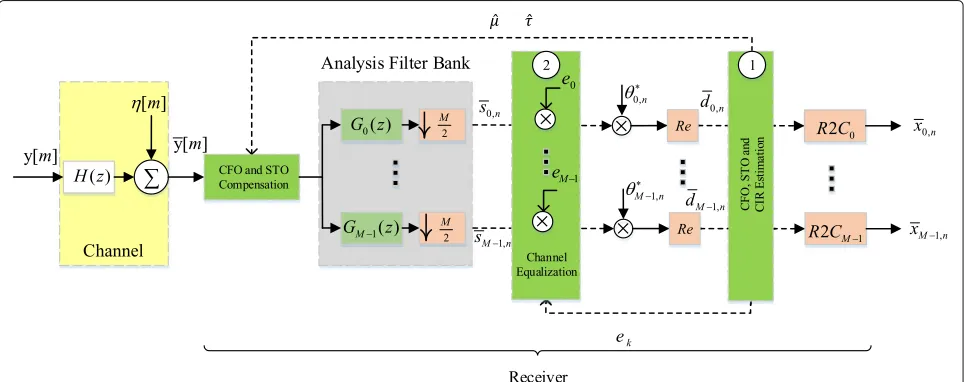
Figure 2 illustrates the block diagram of the OFDM/OQAM receiver as implemented in the proposed method for estimation and compensation of CFO, STO and CIR. First, after passing through the AFB and mul-tiplication by θk∗,n and real taking, the received symbols are used to obtain the ML estimates of the CFO, STO and CIR. The CFO and STO estimates are then fed back to correct the signal at the front-end of the receiver. The CFO-STO compensated signal can be written as
¯
yc[m]=WI[m;τˆ]∗
¯
y[m]ej2πMμˆm
, (38)
whereWI[m;τˆ] represents the hamming-windowed sinc
fractional-delay interpolation filter used for STO simu-lation [35]. Next, the CFO-STO corrected symbols pass through the AFB again where, this time, a single-tap per subcarrier equalization is performed based on the DFT of the estimated CIR according to the following equation,
ek=
1 ˆ H(z)
(( ((
z=ej2πk/M
, (39)
whereek fork ∈ {0,. . .,M−1}is the coefficient of the
equalizer for subbandkandHˆ(z) = Ql=−01hˆ[l]z−l,hˆ[l] being the estimated CIR coefficients. It is notable that although a single-tap per subcarrier equalizer is used here, generalizations to other, more advanced types of equaliz-ers are possible. This simple equalization scheme inverts the channel at the center frequency of the corresponding subcarrier and it works well in mildly selective channels as long as the number of subcarriers is sufficiently large [36]. The equalized symbols can be represented as,
¯ sck,n=
∞
m=−∞ ¯ yc[m]gk
nM
2 −m
ek. (40)
The final received symbols are then obtained by under-going the OQAM post-processing stage.
been performed in the frequency domain by using one-tap-per-subcarrier scheme, which is a common equaliza-tion technique in MCM systems including OFDM and OFDM/OQAM. In addition to simplicity, this technique allows for flexibility of equalization in a multi-user sce-nario where different subchannels need to be equalized separately.
4 Joint Cramer-Rao bound analysis based on the Gaussian assumption for data interferenceζkd,n In this section, assuming known transmitted symbols, i.e., pilots, the CRB on the covariance matrix of unbiased esti-mators of the CFO, STO and CIR are derived [37]8. Letting θ be the vector including the unknown (real) parameters we have,
θ = μ,τ,(hR)T, hI!T
T
. (41)
Therefore, θ holds (2Q+ 2) real entries with indexes denoted byaandb∈ {1, 2,. . ., 2Q+2}. The Fisher infor-mation matrix (FIM),J, is then (2Q+ 2)× (2Q+ 2). For the covariance matrixCV, since for allain the
afore-mentioned interval∂CV/∂θa = 0, the entries of FIM are derivative ofAwith respect toθafor four different ranges of the indexesaandb, namelya = 1, a = 2, 3 ≤ a ≤
where according to (42)–(47) we have,
J1,1=
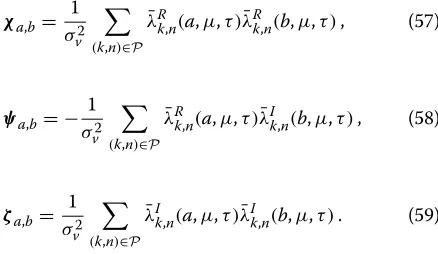
In addition,χ, ψ andζ are Q×Q matrices with the following entries,
χa,b=
1
σ2
v
(k,n)∈P ¯ λR
k,n(a,μ,τ)λ¯Rk,n(b,μ,τ), (57)
ψa,b= −
1
σ2
v
(k,n)∈P ¯ λR
k,n(a,μ,τ)λ¯Ik,n(b,μ,τ), (58)
ζa,b=
1
σ2
v
(k,n)∈P ¯ λI
k,n(a,μ,τ)λ¯Ik,n(b,μ,τ). (59)
The CRB of an unbiased estimator ofθ, denoted asθˆ, is expressed as Cov(θˆ) ≥ J(θ)−1. As a result, we
can compute the variance of the unbiased CFO estimator, ˆ
μ, as
Var(μ)ˆ ≥[(J)−1]1,1=CRBμ. (60) Similarly, the variance of the unbiased STO estimator,τˆ, is derived as
Var(τ)ˆ ≥[(J)−1]2,2=CRBτ. (61)
Finally, for thelth tap of the channel, the lower bound of the unbiased estimator can be obtained as
Var(hˆ[l])=Var(hˆR[l])+Var(hˆI[l])≥[(J)−1]l+2,l+2
=+[(J)−1]Q+l+2,Q+l+2CRBh[l]. (62)
The lower bound on the average variance of the CIR estimator over different taps can be obtained by assuming that the tap estimates are independent. Then, we can write
CRBh=
1
Q tr[(J)
−1(θ)]−[(J)−1(θ)]
1,1−[(J)−1(θ)]2,2
! .
(63)
It is worth emphasizing that in general the entries of the vectorsκ,,φ,ρ andχ are not negligible, i.e., there is a coupling between the estimation errors that can be achieved forμ,τ, andh. This means that, for example, the CRB onμwith no channel knowledge will be greater than the one obtained with a known channel, which could be directly computed as the inverse of the first entry of the FIM, i.e. (J1,1)−1. This also applies to the STO and CIR
estimators with or without knowledge of other parame-ters. Furthermore, as it has been mentioned in [38], the derivations imply that the CRB is a function of the par-ticular channel realization. This has also been observed through simulations. Also, it should be noted that in the derivation and implementation of the CRB, the simplifi-cations of Section 3.3 are not introduced, i.e., on a given
output symbol, the impact of all the subbands are taken into account.
5 Performance evaluation
This section begins with the simulation setup and param-eter settings for performance evaluation of the proposed method compared to the existing one, followed by pre-sentation and discussion on their estimation results and complexity evaluation.
5.1 Methodology
The prototype filter of the transceiver system is obtained using the frequency sampling technique with overlap fac-tor K = 4 as described in [31] and used in [29]. The data are modulated to a 4-QAM constellation. The input sampling frequency isFs = 175 kHz corresponding to a
channel bandwidth ofMFs=11.2 MHz.
To obtain BER that are more representative of a practical digital communications system, a punctured convolutional channel coding scheme is applied to the information sequence with the overall rate of 2/3 by using constraint lengths vector [5 4] and vector of function generators [23 35 0; 0 5 13]. A frequency selective wireless channel is used with Q = 8 randomly gen-erated coefficients h[l] based on the ITU-Vehicular A channel guidelines [39]. The channel is assumed constant during the transmission of a burst but changes over differ-ent transmissions910. During each transmission, the STO
and CFO obey a uniform distribution within the intervals −Ts
4
Ts
4
and −Fs
4
Fs
4
. The root mean squared error (RMSE) and BER results are obtained by running 500 independent Monte-Carlo simulations for given values of the SNR per bit. The latter is expressed asEb/N0, where
Ebdenotes the bit energy andN0is the noise power
spec-tral density level. Regarding the implementation results of [29], we follow the estimation and equalization algo-rithms and structure precisely as described in the paper. This method is referred to as “Stitz” in Figs. 4, 5, 6 and 7.
Fig. 3Pilot distribution in WiMAX, DL-PUSC configuration [29]
5.2 Results and discussion
The performance and the complexity comparison of the proposed estimator vis-a-vis the benchmark are, respec-tively, presented in this subsection.
5.2.1 Estimation results
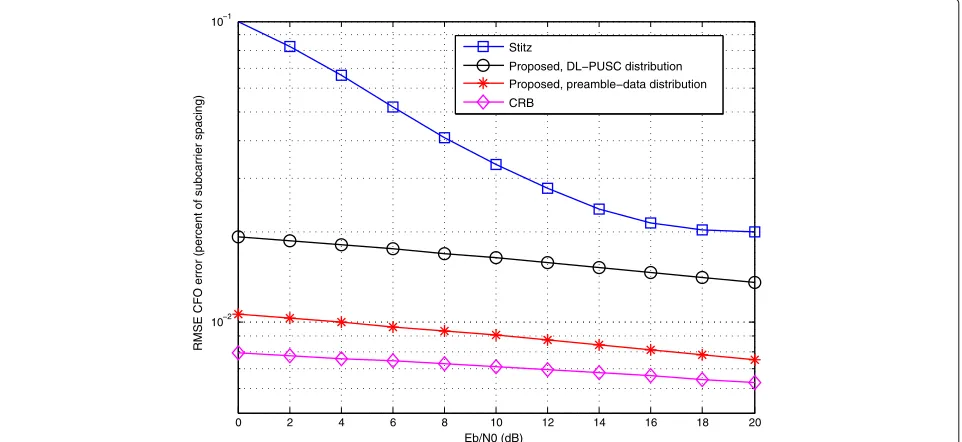
Figure 4 compares the proposed method with [29] in terms of RMSE of CFO as a function ofEb/N0. The
aver-age CRB of the CFO estimation is also presented in the figure. The estimation is jointly performed in the presence of other sources of error, namely, a fixed STO of 2.5% with respect to Ts, and Rayleigh fading channel as described
earlier. The figure indicates that the proposed method not only outperforms the other method as implemented with a preamble of full 64× 4 pilot tones, but also, is capa-ble of significant improvement when adopting the burst structure of DL-PUSC. Especially in the former case, the
performance of the proposed estimator is very close to the average CRB as a lower bound.
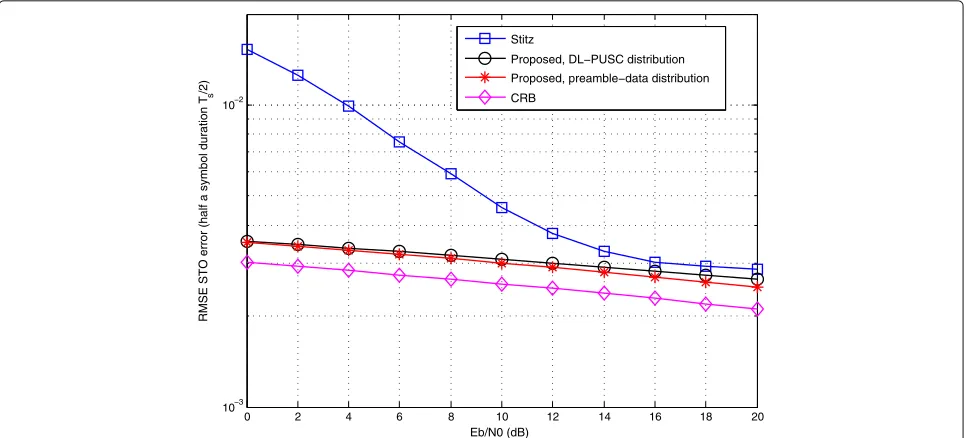
Comparison of the two methods and the average CRB in terms of RMSE of STO is depicted in Fig. 5, where a fixed CFO of 5% and the multi-path chan-nel are used. The superior performance of the pro-posed method implemented in both configurations can be seen in the figure. Again, the best result belongs to the one based on a full grid of pilot tones fol-lowed by the data; although, the proposed method remarkably reduces the estimation error with the same burst structure as in [29]. Similar to the previous figure, the average CRB runs closest to the full-preamble case.
In Fig. 6 , the RMSE of CIR, in the presence of fixed CFO and STO, is depicted for the three implementations along with the average CRB. Similar to the previous figures,
0 2 4 6 8 10 12 14 16 18 20
10−2 10−1
Eb/N0 (dB)
RMSE CFO error (percent of subcarrier spacing)
Stitz
Proposed, DL−PUSC distribution Proposed, preamble−data distribution
CRB
0 2 4 6 8 10 12 14 16 18 20 10−3
10−2
Eb/N0 (dB)
RMSE STO error (half a symbol duration T
s
/2)
Stitz
Proposed, DL−PUSC distribution
Proposed, preamble−data distribution
CRB
Fig. 5Comparative RMSE error of STO estimation versus inputEb/N0with CFO = 5% and Rayleigh channel
the proposed method achieves a lower estimation error in both configurations. The figure indicates that the CIR estimator performs very close to the average CRB over different channels.
It is worth mentioning that, in this work, all the CRB
terms are inversely proportional toσ2
v = σζ2d+ σ2
η
2. This
explains the mild slope of the estimation error graphs with respect toEb/N0. In other words, in our range of
inter-est ofEb/N0, the dominant term is the power of the data
interference,σζ2d rather than the noise power. However, our experiments show that the noise power effect begins to rise when applying lower SNR values with an abrupt increase in the estimation error aroundEb/N0= −10dB.
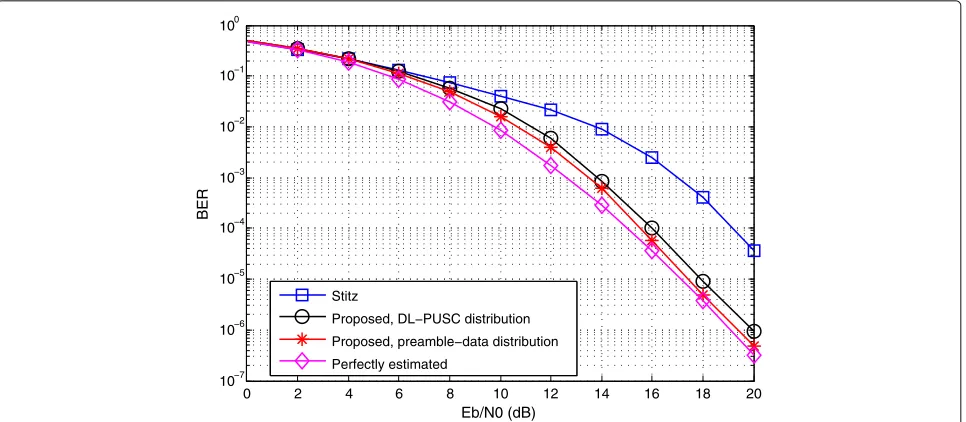
The coded BER performance of the methods, after esti-mation and compensation, are compared in Fig. 7. The figure indicates that, in both configurations, the proposed method is capable of a significant decrease in BER of the system especially at high inputEb/N0.
0 2 4 6 8 10 12 14 16 18 20
10−2 10−1 100
Eb/N0 (dB)
RMSE CIR error (power normalized)
Stitz
Proposed, DL−PUSC distribution
Proposed, preamble−data distribution
CRB
0 2 4 6 8 10 12 14 16 18 20 10−7
10−6 10−5 10−4 10−3 10−2 10−1 100
Eb/N0 (dB)
BER
Stitz
Proposed, DL−PUSC distribution
Proposed, preamble−data distribution
Perfectly estimated
Fig. 7Comparative coded BER versus inputEb/N0in the presence of CFO, STO and channel estimation
5.2.2 Complexity evaluation and discussion
The complexity of the two methods is compared in Table 2 in terms of the running time needed for the processing of a burst transmission of size 64×54. For the proposed method, three different implementations are considered as follows:
• Prop 0 : the proposed method with the basic simplification in (35)-(36);
• Prop 1 : as above with additional simplification (37); • Prop 2 : as Prop 1, but by considering only the first
three channel taps in computing the pilot contribution in (27).
In addition, Table 2 includes the RMSE figures of CFO, STO and CIR (for Eb/N0 = 20dB), to illustrate the achievable trade-off between estimation accuracy and computational complexity. The RMSE figures are obtained based on the average of 500 burst transmissions of size 64× 54 with the scattered pilot distribution as described in Section 5.1, on an ordinary quad-core PC running MATLAB 2016 b. The table indicates that the performance degradation due to the suggested simplifi-cations is rather small, i.e., on the order of 10% for Prop 1 and 25% for Prop 2. Furthermore, by employing all the foregoing simplifications, the obtained running time of the proposed method comes within about two times that of the benchmark, which implies that, by using state-of-the-art DSP technology, the running time of the proposed method remains practical. It should be noted that, as can be seen from the results in Subsection 5.2.1, in mid and specially low SNR regime, the performance gap between the two methods is much larger than that presented in Table 2 for Eb/N0 = 20dB. Hence, considering the
performance gain of the proposed estimator presented in Section 5.2, the complexity compromise seems justifiable. From a theoretical perspective, a key advantage of the proposed ML-based approach is to offer a unified treat-ment leading to a compact solution format (i.e., near closed form) for the joint estimation of CFO, STO and CIR in OFDM/OQAM systems, in contrast to making use of different signal processing techniques (correlation, phase estimation, etc.) for the treatment of different impair-ment sources. Another important motivation behind the ML-based approach lies in its asymptotic optimality, as observed in many practical situations of interest, under conditions of high SNR or long observation time [37].
From a practical perspective, the proposed joint ML-based estimator leads to significant improvements in estimation accuracy compared to existing methods, as demonstrated by the simulation results in this section. Specifically, over the complete range of SNR consid-ered (from 0 to 20dB), the proposed estimator achieves the best performance for the three types of parameters, i.e., CFO, STO and CIR coefficients. For each parameter type, the resulting RMSE obtained with the joint-ML estimators comes within 1dB of the CRB. In turn, the
Table 2Comparative running time and RMSE estimation errors of the simplified versions of the proposed method vs. Stitz for Eb/N0=20dB[29]
Prop 0 Prop 1 Prop 2 Stitz
Running time (s) 4617 65 28 15
RMSE CFO 1.1×10⁻² 1.2×10⁻² 1.4×10⁻² 2.0×10⁻²
RMSE STO 2.2×10⁻³ 2.4×10⁻³ 2.7×10⁻³ 2.8×10⁻³
improved estimation accuracy results in lower BER for the OFDM/OQAM transceiver with ML-based compen-sation.
The main limitation of the proposed method is the addi-tional computaaddi-tional burden. Indeed, the calculation of the joint ML estimator involves several matrix operations and a two-dimensional search over the CFO and STO space. However, by allowing a number of possible sim-plifications to reduce the processing time as discussed in Section 3.3, the proposed method offers a trade-off between complexity and performance.
6 Conclusions
A new general pilot-based ML joint estimation method for OFDM/OQAM systems has been developed and eval-uated. The CFO, STO, and CIR effects have been jointly estimated and compensated. The CRB on the joint esti-mator variance was also derived and implemented as a reference to evaluate the performance of the proposed algorithm. The comparison has been made with a highly-cited method among the few research papers of the same focus. The results have shown the significant improve-ment that the proposed method offers in both transmis-sion modes, i.e., as scattered pilots in data and as a full preamble of pilot tones followed by the data. As it was observed on the figures, the proposed estimator, espe-cially when used in a full-preamble setup, performs close to the CRB and can robustly estimate the CFO, STO, and CIR. Furthermore, by comparing the performance and running times of the simplified versions of the proposed method to those of the benchmark, we conclude that the former provides a significant improvement over the estimation result while maintaining computational com-plexity in a feasible range. This, in turn, offers a useful trade-off between performance and complexity.
Appendix A: Statistical properties of the subband noiseηk,n
Letη[m] be a zero-mean complex circular AWGN process with varianceση2. By definition, we have,
E{η[m]η[m]}=0 , E{η[m]η∗[m]}=δmmση2, ∀m,m. (64)
According to (15) and (7), we can write
ηk,n=R
Due to the linearity of this expression, it follows thatηk,n
is a (real) Gaussian random variable with zero mean. For the second order moments we have,
E{ηk,nηk,n}
where we have used the orthonormality relation (10) for OFDM/OQAM systems.
Appendix B: Statistical properties of the data interference termζkd,n
-5 -4 -3 -2 -1 0 1 2 3 4 5 Data interference at pilot locations
0
Histogram of data interference at pilot locations Zero-mean Gaussian pdf with standard deviation =0.45
Fig. 8Histogram ofζd
k,nat pilot locations in presence of fading channel, STO and CFO
In addition, to examine the covariance of these data interference terms at pilot locations, let the data symbols dkd,n be i.i.d. (real) random variables with zero mean and variance 12σx2. By definition, we have
According to (22) we can write
ζd
Following the observation above in the opening of this appendix, by invoking the central limit theorem and the assumptions made on dkd,n, it follows from (75) thatζkd,n can be modeled as a zero-mean (real-valued) Gaussian random process. For the second order moments, it follows from (75) that
for which we can write
Eζkd,n2
It can be seen from (79) that the variance of the data interference term depends on the particular channel real-ization and the unknown CFO and STO parameters. However, since the filter bank response γkk,n,n(l,μ0,τ0)
10 20
30 40
50 60 70
20 40
60 0 0.2 0.4 0.6 0.8 1
Symbol index Subcarrier index
Covariance magnitude
Fig. 9Covariance of data interference at a pilot location with data interference in other pilot locations
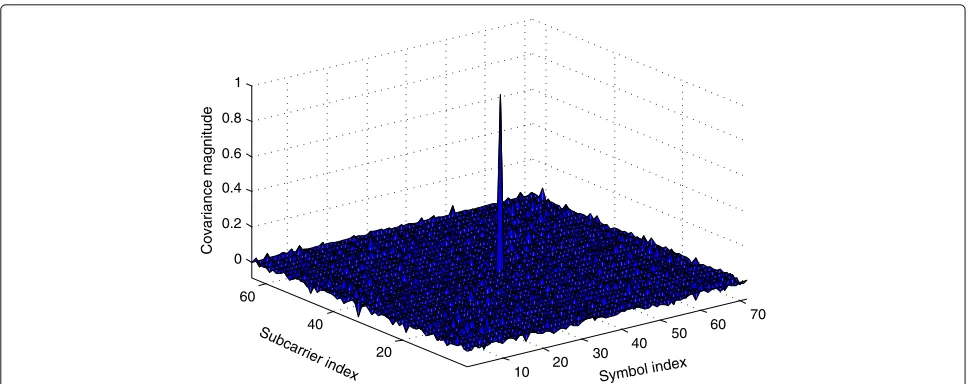
covariance is less than 10% of the peak value. Although only one sample is presented here, we were able to verify the consistency of this result for different values of CFO and STO with various fading channels, indicating that the observed maximum off-center covariance value does not exceed 14% of the peak value. This result is consistent with our approximation above in (77) and (79).
Endnotes
1The authors’ intention in the performance
compari-son is not to include the existing estimators in which only one or two of the aforementioned error sources are considered.
2For convenience in our analysis,Gk(z)is assumed
non-causal; although, in practice, causality can be restored simply by introducing an appropriate delay in the receiver.
3 The precise orthogonality condition corresponding
to the specific configuration of OFDM/OQAM system adopted in this work does not exist in the literature. How-ever, by applying appropriate modifications pertained to the changes in the configuration, the presented orthogo-nality condition can be derived.
4In practice, non-integer STO can be modeled with
the help of an ideal low-pass interpolation filter (see Section 3.4).
5Due to the inherent property of OFDM/OQAM, as
implied in (10), which only sustains real orthogonal-ity, estimation is performed on the received pilots after extracting the real part.
6In this work, we develop a single-tap-per-subcarrier
equalizer, although generalizations to other, more
advanced types of equalizers are possible. This simple equalization scheme inverts the channel at the center frequency of the corresponding subcarrier and it works well in mildly selective channels as long as the number of subcarriers is sufficiently large [36].
7This is only valid for the PHYDYAS filter. There
are other prototype filter functions in discussion for OFDM/OQAM systems which may require a different value forβ[34].
8It is worth emphasizing that the CRB derived in this
section is based on the approximation of Gaussian dis-tribution for the data interference term ζkd,n; hence, it provides a benchmark for the performance of the esti-mators developed on such an assumption. Nevertheless, as it can be seen later, the proposed estimator obtains satisfactory results by a significant improvement over the existing method.
9The authors have also evaluated the performance of
the proposed and the existing method by adopting a time-varying fading channel in contrast to the static channel used in the following simulations. However, the results show the same relative trend among the curves corre-sponding to the two methods and the two pilot distribu-tion schemes described in this secdistribu-tion.
10Although, in the proposed method, the channel
BER performance is considerable. In a practical system, to mitigate this problem, as a conventional way to make the channel estimation task more robust, the channel length can be matched to a worst-case scenario and may be modified adaptively [40].
Funding
This work was supported by a grant from the Natural Sciences and Engineering Research Council of Canada, under sponsorship of InterDigital Canada.
Authors’ contributions
AB has contributed to the conception and design of this research, mathematical developments, performing the simulations, analysis and interpretation of the results, and drafting the manuscript. BC has participated in the conception and design of this research, mathematical developments, analysis and interpretation of the results, and critical revision of the research and the manuscript. Both authors read and approved the final manuscript.
Competing interests
The authors declare that they have no competing interests.
Publisher’s Note
Springer Nature remains neutral with regard to jurisdictional claims in published maps and institutional affiliations.
Received: 3 July 2017 Accepted: 25 December 2017
References
1. L Hanzo, Y Akhtman, L Wang, M Jiang,OFDM for Wireless Multimedia Communications. (John Wiley, Hoboken, 2011)
2. P Golden, H Dedieu, KS Jacobsen,Fundamentals of DSL Technology. (CRC Press, Boca Raton, 2005)
3. B Farhang-Boroujeny, OFDM versus filter bank multicarrier. IEEE Signal Process. Mag.28, 92–112 (2011)
4. P Ciblat, E Serpedin, A fine blind frequency offset estimator for OFDM/OQAM systems. IEEE Trans. Signal Process.52(1), 291–296 (2004) 5. G Lin, L Lundheim, N Holte, inIEEE GLOBECOM ’06. Blind carrier frequency
offset estimation for OFDM/OQAM systems based on subchannel signals (IEEE eXpress Conference Publishing, New York, 2006), pp. 1–6 6. T Fusco, M Tanda, Blind frequency-offset estimation for OFDM/OQAM
systems. IEEE Trans. Signal Process.55(5), 1828–1838 (2007) 7. D Mattera, M Tanda, Blind symbol timing and CFO estimation for
OFDM/OQAM systems. IEEE Trans. Wirel. Commun.12(1), 268–277 (2013)
8. W Hou, B Champagne, Semiblind channel estimation for OFDM/OQAM systems. IEEE Signal Process. Lett.22(4), 400–403 (2015)
9. T Fusco, A Petrella, M Tanda, inProc. IEEE Int. Conf. Communications (ICC). Data-aided symbol timing estimation for multiple-access OFDM/OQAM systems (IEEE eXpress Conference Publishing, New York, 2009), pp. 1–5 10. T Fusco, A Petrella, M Tanda, Joint symbol timing and CFO estimation for
OFDM/OQAM systems in multipath channels. EURASIP J. Adv. Signal Process.2010(1), 897607 (2010)
11. T Fusco, A Petrella, M Tanda, Data-aided symbol timing and CFO synchronization for filter bank multicarrier systems. IEEE Trans. Wirel. Commun.8(5), 2705–2715 (2009)
12. D Mattera, M Tanda, Data-aided synchronization for OFDM/OQAM systems. Signal Process.92, 2284–2292 (2012)
13. C Thein, M Fuhrwerk, J Peissig, inProc. IEEE 14th SPAWC. Frequency-domain processing for synchronization and channel estimation in OQAM-OFDM systems (IEEE eXpress Conference Publishing, New York, 2013), pp. 634–638
14. C Thein, M Schellmann, J Peissig, Analysis of frequency domain frame detection and synchronization in oqam-ofdm systems. EURASIP J. Adv. Signal Process.2014(1), 83 (2014)
15. J-P Javaudin, D Lacroix, A Rouxel, inProc. 57th IEEE Semiannual Veh. Technol. Conf. (VTC). Pilot-aided channel estimation for OFDM/OQAM (IEEE eXpress Conference Publishing, New York, 2003), pp. 1581–1585
16. C Lélé, P Siohan, R Legouable, J-P Javaudin, inProc. IEEE Int. Symp. Power Line Commun. Its Appl. (ISPLC). Preamble-based channel estimation techniques for OFDM/OQAM over the powerline (IEEE eXpress Conference Publishing, New York, 2007), pp. 59–64
17. C Lélé, P Siohan, R Legouable, inProc. IEEE Int. Conf. Commun. (ICC). 2 dB better than CP-OFDM with OFDM/OQAM for preamble-based channel estimation (IEEE eXpress Conference Publishing, New York, 2008), pp. 1302–1306
18. J Du, S Signell, inProc. IEEE Int. Conf. Commun. (ICC). Novel preamble-based channel estimation for OFDM/OQAM systems (IEEE eXpress Conference Publishing, New York, 2009), pp. 1–6
19. S Hu, G Wu, S Li, Preamble design and iterative channel estimation for OFDM/Offset QAM system. J. Netw.4(10), 1050–1057 (2009) 20. D Katselis, E Kofidis, A Rontogiannis, S Theodoridis, Preamble-based
channel estimation for CP-OFDM and OFDM/OQAM systems: a comparative study. IEEE Trans. Signal Process.58(5), 2911–2916 (2010)
21. H Lin, P Siohan, Robust channel estimation for OFDM/OQAM. IEEE Commun. Lett.13(10), 724–726 (2009)
22. D Kong, D Qu, P Gao, C Wang, T Jiang, inProc. IEEE Wireless Commun. Networking Conf. (WCNC). Frequency domain averaging for channel estimation in OQAM-OFDM systems (IEEE eXpress Conference Publishing, New York, 2013), pp. 3116–3121
23. E Kofidis, D Katselis, A Rontogiannis, S Theodoridis, Preamble-based channel estimation in OFDM/OQAM systems: a review. Signal Process. 93(7), 2038–2054 (2013)
24. G Garbo, S Mangione, V Maniscalco, inProc. 2nd Int. Conf. Signal Process. Commun. Syst. (ICSPCS). MUSIC-LS modal channel estimation for an OFDM-OQAM system (IEEE eXpress Conference Publishing, New York, 2008), pp. 1–8
25. LG Baltar, M Newinger, JA Nossek, inProc. ISWCS. Structured subchannel impulse response estimation for filter bank based multicarrier systems (IEEE eXpress Conference Publishing, New York, 2012), pp. 191–195
26. D Kong, D Qu, T Jiang, Time domain channel estimation for OQAM-OFDM systems: algorithms and performance bounds. IEEE Trans. Signal Process. 62(2), 322–330 (2014)
27. W Cui, D Qu, T Jiang, B Farhang-Boroujeny, Coded auxiliary pilots for channel estimation in FBMC-OQAM systems. IEEE Trans. Veh. Technol. 65(5), 2936–2946 (2016)
28. C Lélé, R Legouable, P Siohan, inProc. IEEE 9th Workshop Signal Process. Advances Wireless Commun. (SPAWC). Channel estimation with scattered pilots in OFDM/OQAM (IEEE eXpress Conference Publishing, New York, 2008), pp. 286–290
29. TH Stitz, T Ihalainen, A Viholainen, M Renfors, Pilot-based synchronization and equalization in filter bank multicarrier communications. EURASIP J. Adv. Signal Process.2010(1), 741429 (2010)
30. A Baghaki, B Champagne, inProc. 82nd IEEE Semiannual Veh. Technol. Conf. (VTC-2015 Fall). Joint carrier frequency offset, sampling time offset and channel estimation for OFDM-OQAM systems (IEEE eXpress Conference Publishing, New York, 2015)
31. A Viholainen, T Ihalainen, TH Stitz, M Renfors, M Bellanger, inProc. 17th Eur. Signal Process. Conf. (EUSIPCO), Glasgow, Scotland. Prototype filter design for filter bank based multicarrier transmission, vol. 17 (IEEE eXpress Conference Publishing, New York, 2009), pp. 1359–1363
32. H Bölcskei,Orthogonal Frequency Division Multiplexing Based on Offset QAM. (Birkhäuser Boston, Boston, MA, 2003), pp. 321–352
33. P Siohan, C Siclet, N Lacaille, Analysis and design of OFDM-OQAM systems based on filter bank theory. IEEE Trans. Signal Process.50(5), 1170–1183 (2002)
34. M Fuhrwerk, S Moghaddamnia, J Peissig, Scattered pilot-based channel estimation for channel adaptive FBMC-OQAM systems. IEEE Trans. Wirel. Commun.16(3), 1687–1702 (2017)
35. JG Proakis, DK Manolakis,Digital Signal Processing,4th edn. (Prentice Hall, Upper Saddle River, 2006)
36. F Duplessis-Beaulieu, B Champagne, inProc. Int. Symp. Signals, Syst. Electron. One-tap equalizer for perfect reconstruction DFT filter bank transceivers (IEEE eXpress Conference Publishing, New York, 2007), pp. 391–394
38. S Rahimi, B Champagne, Joint channel and frequency offset estimation for oversampled perfect reconstruction filter bank transceivers. IEEE Trans. Commun.62(6), 2009–2021 (2014)
39. ITU-R M. Guidelines for evaluation of radio transmission technologies for IMT-2000 1225 (1997)
40. P Hoeher, S Kaiser, P Robertson,Pilot-symbol-aided channel estimation in time and frequency. (Springer US, Boston, MA, 1997), pp. 169–178 41. MG Bellanger, in2001 IEEE International Conference on Acoustics, Speech,
and Signal Processing.Proceedings (Cat. No.01CH37221). Specification and design of a prototype filter for filter bank based multicarrier transmission, vol. 4 (IEEE eXpress Conference Publishing, New York, 2001),
pp. 2417–2420
![Table 1 Transmultiplexer responsewith γ k′,n′k,n (0, 0, 0) of the OFDM/OQAM system using Bellanger’s (also known as PHYDYAS) filter [41, 42] K = 4 (numerical values truncated to 4 digits)](https://thumb-us.123doks.com/thumbv2/123dok_us/882258.1106004/6.595.53.540.679.734/transmultiplexer-responsewith-bellanger-phydyas-numerical-values-truncated-digits.webp)