Phonological Reconstruction of a Dead Language
Using the Gradual Learning Algorithm
Eric J. M. Smith Department of Linguistics
University of Toronto 130 St. George Street, Room 6076
Toronto, Ont. M5S 3H1 Canada
Abstract
This paper discusses the reconstruction of the Elamite language’s phonology from its orthography using the Gradual Learning Al-gorithm, which was re-purposed to “learn” underlying phonological forms from surface orthography. Practical issues are raised re-garding the difficulty of mapping between orthography and phonology, and Optimal-ity Theory’s neglected Lexicon Optimiza-tion module is highlighted.
1 Introduction
The purpose of this paper is to reconstruct the phonology of Elamite, an extinct language known only from written sources, whose phonology is cur-rently poorly understood. Given that the mecha-nisms provided by Optimality Theory are powerful enough for a language learner to acquire a natural language given only overt forms, it should be possi-ble to apply the same mechanisms to “learn” Elamite phonology given only its orthography.
The research described here was carried out with the aid of a piece of software, nicknamed Grote-fend, which was developed as part of a larger re-search project into Elamite.1 The data used in this paper consisted of the contents of the Elamisches W¨orterbuch (Hinz and Koch, 1987) marked up as XML with attributes such as morphology, cognates,
1Grotefendwas written in C++ using Trolltech’s Qt toolkit,
and runs under Mac OS X. The portions that implement the Gradual Learning Algorithm (§4.3) were adapted from Paul Boersma’s Visual Basic source code for theOTSoftprogram, which was kindly provided by Bruce Hayes.
semantics, corpus frequency, and chronology. The
W¨orterbuchwas used because it is the only source that incorporates Elamite data from all historical pe-riods. It also has the virtue of containing every sin-gle attested form known to the authors, which is par-ticularly useful for this project, since we have spe-cial interest in alternative spellings of given words.
2 Elamite Language
2.1 Historical and geographical context
Elamite is an extinct language spoken in what is now southwestern and central Iran. Elamite-language texts dating from 2400 BCE until 360 BCE are attested, written in the cuneiform script borrowed from the Sumerians and Akkadians.2 Elamite has no known linguistic affiliations, although a connec-tion to the Dravidian family has been proposed by McAlpin (1982) and others.
Since both the language and scribal practices are certain to have changed over such a long time-span, this study will restrict itself to text from a single era. The Achæmenid Elamite period (539 BCE to 360 BCE) was chosen, because this period contains the largest volume of texts, and also because those texts are particularly rich in Old Persian names and loan-words that provide a useful starting point for esti-mating the phonology.
2.2 The cuneiform writing system
As part of their adaptation of cuneiform, the Elamites abandoned most of the logographic
ele-2Early texts from Elam using two other indigenous writing
systems are not well-enough understood to provide useful lin-guistic information.
ments found in Sumerian and Akkadian usage, mov-ing to an almost completely phonetic system, which would be a “core syllabary” in Sproat’s (2000) typol-ogy. That is, each grapheme represents a syllable, but the system lacks graphemes to represent all of the language’s syllables. This is particularly the case for many hCVCi graphemes, which must be writ-ten using “syllable telescoping”, where ahCV-VCi combination is written, with the internal vowel being repeated. For example, lacking a hlani grapheme, the syllable /lan/ would have to be writtenhla-ani3. Even when the hCVCi grapheme does exist, the hCV-VCiwriting is often preferred.
2.3 Hypotheses to be tested
The strategy of this research is to use the techniques of Optimality Theory to reconstruct the language’s phonology. We will take the various hypotheses pre-sented by earlier authors and attempt to encapsulate each in the form of an OT constraint.
Altogether 30 separate hypotheses were evalu-ated, arranged into 11 major groupings. Within each grouping, the sub-hypotheses (which may or may not be mutually exclusive) refer to a related context or related orthographic phenomenon. This paper will largely restrict its discussion to only two of the groupings: H3 (Geminate consonants) and H4 (Nasal vowels).4
H3Geminate consonants
H3a Geminate orthographies represent underlying geminate phonologies.
H3bGeminate orthographies indicate voicelessness (Reiner, 1969).
H3c Certain geminate spellings indicate a distinc-tion other than voicing, such as retroflex/alveolar (McAlpin, 1982).
H4Nasal vowels
H4a Alternations in the writing of nasals indicate
3Orh7i, but since the readership of this paper is
un-likely to be familiar with cuneiform, all graphemes will be pre-sented in the traditional transliterated form used in Assyriology.
4The full list of hypothesis groups also includes: H1
(In-terpretation of brokenhCV1-V2Ci writings), H2 (Voicing of
stops), H5 (Word-final vowels), H6 (Sibilants), H7 (Existence of an /h/ phoneme), H8 (Existence of an /f/ or /v/ phoneme), H9 (Existence of a /j/ phoneme), H10 (Existence of a /w/ phoneme), and H11 (Existence of an /e/ phoneme). Full discussion of the results for these hypotheses can be found in Smith (2004).
the presence of nasal vowels (e.g. /h˜uban/ → hhu-um-bani,hhu-bani).
H4b Alternations in the writing of nasals can be explained by underlying nasal consonants (e.g. /humban/→ hhu-um-bani,hhu-bani).
3 Theory of Writing Systems
The discussion of Elamite orthography will be framed within the theory of writing systems pro-posed by Sproat (2000), whose core claim that “par-ticular (sets of) linguistic elements license the oc-currence of (sets of) orthographic elements”. The details of which linguistic elements license which orthographic ones are specific to any given combi-nation of spoken language and writing system.
The licensing is implemented by a mapping func-tion, MORL→Γ, whose input is the Orthographically
Relevant Level (ORL), and whose output is the orthography(Γ). In the case of Elamite, the rele-vant level is the surface phonology after the applica-tion of phonological processes such as assimilaapplica-tion and cluster simplification, so in Sproat’s schema, Elamite is classified as having a “shallow” ORL.5
4 Applying OT to Orthography
In the normal application of Optimality Theory, the input and the output are both the same type of lin-guistic entity. However, in the problem dealt with here, the relationship is between an input that is phonological and an output that is orthographic. The comparison of phonological apples to orthographic oranges leads to complications that will be discussed in§6.1. All the modules of Optimality Theory must be adapted for use with orthography.
4.1 Background
As originally formulated, Optimality Theory can be considered as a set of three interconnected modules: GEN, H-EVAL, and Lexicon Optimization (Prince and Smolensky, 1993). Together GENand H-EVAL
comprise the grammar proper. For any given in-put, GEN generates a set of output candidates, and these candidates are then evaluated against a set of constraints by the H-EVALmodule. Lexicon Opti-mization is not part of the grammar, but it provides
5For instance, the nounkittin‘length’ is spelledh
a mechanism by which language learners can use that grammar to determine underlying forms based on the overt forms that are presented to them.
Optimality Theory can be seen as a model for how a language learner acquires a natural language, pre-sented only with overt forms (Tesar and Smolensky, 2000). At first, the learner’s constraint rankings and underlying forms will be inaccurate, but as more in-formation is presented the estimates of the under-lying forms become more accurate, which in turn improves the constraint rankings, which further im-proves the estimates of the underlying forms, and so on. In this study, the “learner” is theGrotefend soft-ware, which is presented with surface orthography and attempts to deduce the phonology.
4.2 Adaptation for orthography
The GENmodule must be adapted to generate plau-sible overt forms (i.e. rival orthographies). The gen-eral strategy for GEN is described in §5, with the
specific details given in§5.2.
The constraints are used by a ranking algorithm (§4.3) that compares the rival orthographies from GEN against underlying phonological forms in or-der to determine the number of constraint violations. In order to start the process, those underlying forms have to be seeded with reasonable initial estimates. If the word is a loanword, the initial estimate is based on the Old Persian or Akkadian phonology. If there is no available loanword phonology, the ini-tial estimate is a direct transcription of the grapheme values as if the word were being read in Akkadian.
Once the constraints have been ranked, Lexical Optimization takes the orthographic forms and the newly-ranked constraints, and calculates an esti-mated phonology for each of the forms. At this point, the process can stop, or else it can proceed through another iteration of the ranking algorithm, using the new improved estimated phonologies as underlying forms.
4.3 Gradual Learning Algorithm
The Gradual Learning Algorithm (Boersma, 1997; Boersma and Hayes, 2001) is an evolution of the Constraint Demotion algorithm (Tesar, 1995), but avoids the infinite-looping which can arise in Con-straint Demotion if underlying forms have more than one overt form. This limitation of Constraint
Demo-tion is a serious one given the data from Elamite or-thography; not only are the orthographic forms sub-ject to considerable variation, but also this variation is a key piece of information in attempting to recon-struct the phonology.
In the GLA, constraints each have a numeric rank-ing value associated with them. It is no longer the case that Constraint A consistently outranks Con-straint B; whenever a conCon-straint is evaluated, a ran-dom “noise” factor is added to each of the ranking values, and an instantaneous constraint ordering is determined based on these adjusted values. If the ranking values for two constraints are far apart, the noise is unlikely to alter the ordering, and the re-sults will be effectively the same as ordinary OT. If the ranking values for two constraints are close to-gether, the noise could put either constraint on top, but ties are avoided.
In the GLA implementation withinGrotefend, all constraints start with ranking values of 100.00. With each iteration of the algorithm, one of the observed forms is selected as an exemplar, and rivals (pro-duced by GEN) are compared against the observed exemplar form. Whenever a rival beats the exemplar form, the constraint ranking values must be adjusted: all constraints that picked the wrong winner are pe-nalized (adjusted downwards), and all constraints that picked the right winner are rewarded (adjusted upwards). The size of this adjustment is determined by a variable called “plasticity”, which starts at 2.00 and is reduced gradually to 0.002 as the algorithm proceeds through its iterations.
5 Implementation ofGEN
The purpose of GEN is to generate a set of plausi-ble overt forms consisting of the real form and a set of rivals which will lose out to the real form. In this problem the overt forms are orthographies, so for any underlying form the challenge is to gener-ate orthographic strings that compete with the real orthography, but which are “wrong” with respect to one or more of the constraints.
5.1 Background
There have been a number of computational imple-mentations of GEN, but the most promising one for
algorithm proceeds by choosing a starting point and then adding constraints to the system. As each con-straint is added, new candidates are generated using what she calls “relevant” GEN operations. A GEN
operation is considered to be relevant for the current constraint if the operation could affect a candidate’s harmony relative to that constraint. So for instance, if the constraint being added evaluates the [+back] feature, the only GEN operations that are relevant are those which affect [+back] or its associations.
The candidates at each stage of the algorithm are not fully formed, and are slowly refined as the con-straints are added to the system. One advantage of Heiberg’s algorithm is that it functions even if the relative rankings of the constraints are not known. If the constraint rankings are known, the algorithm can operate more efficiently, by culling known losers, but knowing the rankings is not essential.
5.2 Adaptation ofGENfor orthography
Generating all “plausible” orthographic candidates for a given form is computationally prohibitive.6 So, borrowing Heiberg’s notion of “relevant” oper-ations, our approach is to generate candidates that specifically exercise one of the constraints in the constraint system.
Each of the hypothesis groups described in §2.3 refers to a particular orthographic context, and each context has a miniature version of GENto generate appropriately test-worthy rivals. For example, the mini-GENfunction for context H3 is as follows:
GENH3(Geminate consonants)
Rule Whenever a geminate consonant is found in the orthography, generate a rival with the non-geminate equivalent.
Examplehhu-ut-tai → { hhu-tai }
6 Implementation ofH-EVAL
The H-EVAL module is responsible for the actual evaluations of the various candidates. It takes any output candidate produced by GEN, and counts the
violation marks for each of the constraints.
6Initial experiments indicated that a moderately long string
of four graphemes would generate in the neighbourhood of 18000 rivals. It seemed unrealistic to evaluate tens of thousands of rivals for each of the 8000+ forms in the database.
um
PHON
SEM divinity: d
a h u
ORTH u mas‡ da
m a
r a z d h
ri
a¤
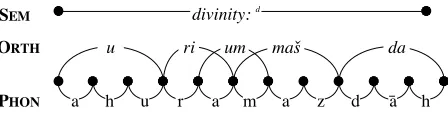
Figure 1: Annotation graph for Ahuramazd¯ah → hdu-ri-um-maˇs-dai
Each constraint is implemented as a function which takes two inputs (an underlying form and a surface form), and produces as an output the num-ber of violations incurred by the comparing the two inputs. For full generality, both inputs are anno-tation graphs (Bird and Liberman, 1999; Sproat, 2000) such as the one shown in Figure 1. As imple-mented inGrotefend, the comparison involves only the PHONtier of the underlying form’s graph and the ORTHtier of the surface form’s graph.
Constraints were written to test each of the hy-potheses described in§2.3. Since there is no prior art in the area of constraints involving orthography and phonology, they were developed in the most straightforward way possible. The implementation of these functions is described in§6.2.
6.1 Implementation of alignment
In order to count violations, the two inputs must be properly aligned. For an annotation graph to be “aligned”, every grapheme must be licensed by some part of the phonology, and every phoneme must be represented in the orthography. Without such a licensing relationship, it is impossible to make the comparisons needed to count constraint vi-olations.
There is considerable previous work in the area of alignment, most recently summarized by Kondrak and Sherif (2006). The algorithm used in this study is a similarity-based approach, not unlike ALINE (Kondrak, 2000). It differs in some significant re-spects, notably the use of binary features.
deter-Table 1: Feature weights for computing distance
Phonological Feature Weight
delayed release, voice, labio-dental, anterior, distributed, strident
1
approximant, continuant, nasal, lateral, round, low, pharyngeal
2
syllabic, consonantal, constricted glot-tis, spread glotglot-tis, high, front, back
4
sonorant, place of articulation 8
mined empirically, selecting the weightings that did the best job of aligning the orthography for the Old Persian loanwords given by Hinz and Koch (1987).
For the actual alignment, several approaches were tried, but the most effective one was simply to line up the consonants and let the vowels fall where they may. For instance, the licensing of hdu-ri-um-maˇs-daiin Figure 1 used the Old Persian phonology as the best available initial estimate for the Elamite phonology, and proceeded as follows:
hdi is the divine determinative, and is licensed by the semantic tier of the annotation graph, so it does not need to be anchored to the phonology. huiis anchored at the left edge of the phonology. hrii starts at /r/, but has no clear right edge. The anchoring of /r/ sets a right boundary on the hui, which must therefore be licensed by the initial /ahu/ of /ahuramazd¯ah/.
humiright edge at phoneme /m/; since thehumihas no clear left edge, the second /a/ of /ahuramazd¯ah/ is left floating between thehriiand thehumi. Since there is no clear choice between the two locations, the /a/ will be shared byhriiandhumi.
hmaˇsi starts at /m/ and ends at /z/, which is suffi-ciently similar to matchˇs. The /m/ will be shared by humiandhmaˇsi.
hdaistarts at /d/; sincehdaiis the last grapheme, it must be licensed by the remainder of the phonology.
The general strategy of aligning consonants proved to be an effective one. In the working dataset of Achæmenid Elamite words, there were 3045 that used Old Persian or Akkadian data to provide an ini-tial estimate of the underlying phonology. The algo-rithm successfully aligned 2902 of those words, for
a success rate of over 95%.
6.2 Implementation of constraints
Once the orthography has been successfully aligned with the underlying phonology, it is possible to evaluate the forms for violations against all the con-straints in the system. In terms of the tiers shown in annotation graphs like Figure 1, the constraints are performing comparisons between the underlying forms in the PHONtier and overt forms in the ORTH
tier. For example, the rules for calculating constraint violations for H3 are as follows:
H3aGeminate spellings indicate geminate pronun-ciations.
RuleCount a violation if the orthography contains a geminate consonant not matched by a geminate in the phonology.7
Violation/ata/→ hat-tai
Non-violations/atta/→ hat-tai, /atta/→ ha-tai
H3bGeminate spellings indicate voicelessness.
Rule Count a violation if 1) the orthography con-tains an intervocalic geminate stop not matched by a voiceless stop in the phonology, or 2) the orthogra-phy contains an intervocalic non-geminate stop not matched by a voiced stop in the phonology, or 3) the phonology contains an intervocalic voiceless stop not matched by a geminate in the orthography, or 4) the phonology contains an intervocalic voiced stop not matched by a non-geminate in the orthography.8
Violations /duba:la/→ hdu-ib-ba-lai, /garmapada/ → hdkar-ma-ba-taˇsi
Non-violations /gauma:ta/ → hkam-ma-ad-dai, /babili/→ hba-pi-lii
H3c Certain geminate spellings indicate a distinc-tion other than voicing, such as retroflex/alveolar.
Rule Count a violation if 1) the orthography con-tains ahVl-lViorhVr-rVisequence not matched by a retroflex in the phonology, or 2) the phonology contains a /í/ or /ó/ not matched by a hVl-lVi or
7The claim made by Grillot-Susini and Roche (1988) was
only that a geminate orthography represents a geminate phonol-ogy; a non-geminate orthography could still conceal a geminate phonology.
8Reiner (1969) restricted her claim about gemination
hVr-rViin the orthography.
Violations/talu/→ hta-al-lui, /taíu/→ hta-lui
Non-violation/taíu/→ hta-al-lui
7 Implementation of Lexicon Optimization
Given the set of constraints provided in §6.2 and rankings determined by the Gradual Learning Algo-rithm (§4.3), it is now possible to move on to the final stage of the “learning” process: Lexicon Opti-mization, which is responsible for choosing the most harmonic input form for any given output form.
There has been surprisingly little literature de-voted to Lexicon Optimization, and discussions of how it might be implemented have been restricted to toy algorithms such as Itˆo et al’s (1995) “tableau des tableaux”. Hence, a novel approach was devised, based on the observation that Lexicon Optimization is a sort of mirror image of H-EVAL. For H-EVAL, there exists a separate GEN module whose task is to generate the possible output candidates. Clearly, Lexicon Optimization needs an equivalent module, but one that would generate a range of rival input forms. Since the GEN algorithm described in§5.2 uses a constraint-driven technique for generating output candidates, it seems appropriate to also use a constraint-driven technique for generating input candidates. Accordingly, this anti-GEN is imple-mented as a set of miniature anti-GENs, each of
which is responsible for generating “relevant” input candidates for one of the hypothesis groupings. For example, the anti-GENfunction for H3 is as follows:
Anti-GENH3(Geminate consonants)
Rule Whenever a geminate consonant is found in the orthography, create input candidates with the geminate phonology and the equivalent non-geminate phonology. If the non-geminate orthography is ahVl-lViorhVr-rVi, also create an input candidate with a “retroflex” phonology.9
Examplehta-al-lui → {/tallu/, /talu/, /taíu/}
8 Results and Discussion
We ran 40000 iterations of the Gradual Learning Algorithm against the Achæmenid Elamite forms
9McAlpin (1982) hedges on whether the phonology
repre-sented by these geminates actually represents retroflexion, but he then proceeds to discuss Proto-Elamo-Dravidian cognates as if this orthography actually did represent a retroflex articulation.
Table 2: Final constraint rankings for H3 and H4
Hypo-thesis
Constraint Ranking
Value
H4b NasalConsonants −136.93
H3b hGeminatei=/Voiceless/ −283.70
H4a NasalVowels −1434.77
H3c hGeminatei=/Retroflex/ −1629.74 H3a hGeminatei=/Geminate/ −3189.11
found in theElamisches W¨orterbuch. The final con-straint rankings for hypothesis groups H3 and H4 are shown in Table 2.10The combination of constraints, GEN, and anti-GEN functions used by Grotefend
tends to penalize constraints much more often than it rewards them. The absolute ranking values are not significant; what matters is their relative values.
8.1 Results for H3 (Geminate consonants)
The results for H3 strongly support the hypothesis (Reiner, 1969) that geminate orthographies are an attempt to indicate voicelessness; the opposing hy-pothesis (Grillot-Susini and Roche, 1988) that gem-inate orthographies represent gemgem-inate phonologies ended up being very heavily penalized.
What was surprising was that hypothesis H3c, that hVl-lVi and hVr-rVi geminates represent a sepa-rate phoneme from the non-geminate orthographies, ranked so poorly. The problem here is a side-effect of the process for generating input candidates.
Consider the Akkadian nameNabˆu-kudurri-us.ur; the hur-rii sequence that occurs in the various spellings of this name would appear to be an ideal context for evaluating H3c. However, when gen-erating input candidates forNabˆu-kudurri-us.ur, the various anti-GENfunctions create 238 permutations (mostly permutations of voicing), but only four of those input candidates contain an /ó/ phoneme, with the rest having an /rr/ or an /r/. Since the anti-GEN
function produces so few /ó/ input candidates for the hur-riiorthography, it is likely that the software will find an /r/ in the underlying phonology, and will count a violation against this constraint.
The prejudice against /í/ and /ó/ highlights the im-portance of having a fair and balanced anti-GEN
PHON h ˆ) d u ß
ORTH hi in du is‡
PHON h ˆ) d u ß
ORTH hi in du is‡
1 H4a (nasal vowel) violation 0 H4b (nasal consonant) violations
0 H4a (nasal vowel) violations 1 H4b (nasal consonant) violation
Figure 2: Licensing ofhhi-in-du-iˇsi‘Indian’
function. The proposal to be discussed in §8.3 for cross-permuting the results of the constraint-specific anti-GEN functions would probably also improve
the results for this hypothesis.
8.2 Results for H4 (Nasal vowels)
The effectiveness of the constraints for evaluating nasals was undermined by choices made in the align-ment algorithm. Although constraint H4b (Nasal-Consonants) is ranked significantly higher than H4a (NasalVowels), this may be merely a side-effect of the alignment algorithm.
Consider the word for ‘Indian’, which shows up as hhi-du-iˇsi, hhi-in-du-iˇsi, or hin-du-iˇsi. It is not unreasonable to postulate an underlying phonol-ogy of /h˜ıduS/, based both on the range of written forms, and on the Old Persian phonology. However, when the alignment algorithm attempts to deter-mine which phoneme sequences are licensing which graphemes, it has a difficult choice to make for the hinigrapheme. Licensing the vowel portion ofhini is straightforward, but what should be done for the consonant? If the software assumes that the most salient features are [+consonantal] and [−syllabic], we get the first annotation graph shown in Figure 2, but if the most salient features are [+nasal] and [+sonorant], we get the second graph.
The choice of how to license the hini grapheme makes a difference for how the H4a and H4b con-straints are evaluated. Using the weightings given in Table 1, the software will alignhiniwith /˜ıd/, be-cause the distance between /n/ and /d/ is less than that between /n/ and /˜ı/. Hence, the alignment algo-rithm chooses the first of the two annotation graphs
given in Figure 2. This has the result of prejudic-ing the learnprejudic-ing algorithm in favour of H4b instead of H4a. Ideally, the alignment algorithm should be neutral with respect to the various constraints.
The licensing of the hini sign in this example is one case of several where it appears that us-ing phonological segments as the basis for licensus-ing may be the wrong thing to do. It would be better to think of the second portion of thehinisign in hhi-in-du-iˇsias being licensed by a [+nasal] feature, with-out attempting to tie the feature down to either the /i/ or the /d/ segment.11
8.3 Discussion of Lexicon Optimization
The generation of useful input candidates is limited by the information that is available to us. For all we know, Elamite had an /W/ vowel, andGrotefend
could even generate input candidates that contained an /W/. However, none of the constraints would weigh either for or against it, so there is no point in generating such an input candidate. Consequently, the correct underlying form may well be inaccessi-ble to Lexicon Optimization. At best, Lexicon Opti-mization can produce an estimated underlying form that leaves as underspecified any features that can-not be verified by a corresponding constraint. This is a limitation of Lexicon Optimization in general, not just of the implementation inGrotefend.
One problem specific to our constraint-based gen-eration of input candidates is that the anti-GEN func-tions work in isolation from each other. For exam-ple, when processinghda-iˇsi, the H1 (broken-vowel) anti-GEN produces /daiS/, /dajS/, /dES/, and /daS/. Separately, the H6 (sibilant) anti-GENwill produce
/dais/, /daiS/, /daiz/, /daitS/, and /daits/. Since the two functions operate independently, the software fails to generate a whole range of candidates. If the actual underlying phonology were /dEtS/, Grote-fendwould never find it, since that particular phonol-ogy will never be generated and presented to Lexi-con Optimization as a possible input candidate. A more sophisticated anti-GENimplementation would allow for the input candidates produced by one con-straint’s anti-GEN function to be further permuted
11Sproat (2000) uses phonological segments to describe
by the anti-GENfunction of another constraint.
9 Conclusions
This project represented an expedition into three largely unexplored territories: the application of Op-timality Theory to orthography, the implementation of Lexicon Optimization in software, and the mass analysis of Elamite phonology. All three presented unanticipated challenges.
The problem of implementing GEN algorithmi-cally appears to be at an early stage even in the pro-cessing of phonological data. The constraint-driven GENadopted from Heiberg (1999) does appear to be a useful starting point for working with orthography.
The determination of the mapping between phonology and orthography can have unexpected consequences for the evaluation of constraints. Even when properly aligned, implementing meaningful constraints to evaluate the mismatches between phonology and orthography proved to be surpris-ingly complex. An alternative representation, licens-ing graphemes based on bundles of features rather than phonemes, might be more effective.
The whole area of Lexicon Optimization has re-ceived surprisingly little mention in the literature of Optimality Theory. The notion that there must be some form of anti-GEN module to produce suitable input candidates appears never to have been raised at all. The existence of anti-GENis hardly specific
to the study of orthography, but would seem to be an omission from Optimality Theory in general.
The constraint-driven implementation of the anti-GEN function does seem like a promising strategy,
although the details need work. In particular, there is a need for the outputs of the various constraint-specific anti-GENs to be permuted together in order
to produce all plausible input candidates.
Elamite has always been problematic both due to its status as an isolate and because the available clues end up being obscured by the writing system. So far, we can claim that this computational analysis of the body of Elamite vocabulary has succeeded in duplicating some of the tentative conclusions drawn from a century of hard work “by hand”.
References
Steven Bird and Mark Liberman. 1999. A formal frame-work for linguistic annotation. Technical Report Tech-nical Report MS-CIS-99-01, Department of Computer and Information Science, University of Pennsylvania.
Paul Boersma and Bruce Hayes. 2001. Empirical tests of the gradual learning algorithm. Linguistic Inquiry, 32:45–86.
Paul Boersma. 1997. How we learn variation, option-ality, and probability. Proceedings of the Institute of Phonetic Sciences of the University of Amsterdam, 21:43–58.
Franc¸oise Grillot-Susini and Claude Roche. 1988. El´ements de grammaire ´elamite. Etudes elamites. Edi-tions Recherche sur les civilisaEdi-tions, Paris.
Andrea Heiberg. 1999. Features in Optimality Theory: A computational model. Ph.D. thesis, University of Arizona.
Walther Hinz and Heidemarie Koch. 1987. Elamisches W¨orterbuch. D. Reimer, Berlin.
Junko Itˆo, Armin Mester, and Jaye Padgett. 1995. NC: Licensing and underspecification in optimality theory. Linguistic Inquiry, 26(4):571–613.
Grzegorz Kondrak and Tarek Sherif. 2006. Evaluation of several phonetic similarity algorithms on the task of cognate identification. InProceedings of the Work-shop on Linguistic Distances, pages 43–50.
Grzegorz Kondrak. 2000. A new algorithm for the align-ment of phonetic sequences. In Proceedings of the First Meeting of the NAACL, pages 288–295.
David W. McAlpin. 1982. Proto-Elamo-Dravidian: The evidence and its implications. Transactions of the American Philosophical Society, 71(3):1–155.
Alan Prince and Paul Smolensky. 1993. Optimality the-ory.Rutgers Optimality Archive, #537.
Erica Reiner. 1969. The Elamite language. Handbuch der Orientalistik I/II/1/2/2, pages 54–118.
Eric J. M. Smith. 2004. Optimality Theory and Orthog-raphy: Using OT to Reconstruct Elamite Phonology. M.A. forum paper, University of Toronto.
Richard Sproat. 2000. A Computational Theory of Writ-ing Systems. Cambridge University Press.
Bruce Tesar and Paul Smolensky. 2000. Learnability in Optimality Theory. MIT Press, Cambridge, Mass.