Domainless Adaptation by Constrained Decoding on a Schema Lattice
Young-Bum Kim Microsoft Redmond, WA [email protected]
Karl Stratos∗ Bloomberg L. P.
New York, NY [email protected]
Ruhi Sarikaya† Amazon Seattle, WA
Abstract
In many applications such as personal digital assistants, there is a constant need for new domains to increase the system’s coverage of user queries. A conventional approach is to learn a separate model every time a new domain is introduced. This approach is slow, inefficient, and a bottleneck for scaling to a large number of domains. In this paper, we introduce a framework that allows us to have a single model that can handle all domains: including unknown domains that may be cre-ated in the future as long as they are covered in the master schema. The key idea is to remove the need for distinguishing domains by explicitly predicting the schema of queries. Given permitted schema of a query, we perform constrained decoding on a lattice of slot sequences allowed under the schema. The proposed model achieves competitive and often superior performance over the conventional model trained separately per domain.
1 Introduction
Recently, there has been much investment on the personal digital assistant (PDA) technology in industry (Sarikaya, 2015). Apple’s Siri, Google Now, Microsoft’s Cortana, and Amazon’s Alexa are some exam-ples of personal digital assistants. Spoken language understanding is an important component of these examples that allows natural communication between the user and the agent (Tur, 2006; El-Kahky et al., 2014; Kim et al., 2015a; Kim et al., 2016b). PDAs support a number of scenarios including creating reminders, setting up alarms, note taking, scheduling meetings, finding and consuming entertainment (i.e. movie, music, games), finding places of interest and getting driving directions to them. The number of domains supported by these systems constantly increases, and whether there is a method that allows us to easily scale to a larger number of domains is an unsolved problem (Kim et al., 2015d; Kim et al., 2016a).
The main reason behind the need for additional domains is that we require a new set of schema (i.e., query topics), composed of intents, and slots for processing user queries in a new category. For example, a query in theTAXIdomain is processed according to domain-specific schema that is different from those
in theHOTELdomain. This in turn requires collecting and annotating new data, which is time consuming
and expensive. Once the data is prepared, we also need to build a new system (i.e., models) for this specific domain. In particular, slot modeling is one of the most demanding components of the system in terms of costs in annotation and computation.
In this paper, we introduce a new approach that entirely removes the costs traditionally associated with enlarging the set of supported domains while significantly improving performance. This approach uses a single model to handle all domains: including unknown domains that may be created in the future using a combination of intents and slots in the master schema. The key idea is to remove the need for distinguishing domains by explicitly predicting topics/schema of queries. Thus we obviate the need and directly predict the schema from queries by multi-label classification (either with an RNN or with binary
∗Work done while at Columbia University. †Work done while at Microsoft.
This work is licensed under a Creative Commons Attribution 4.0 International Licence. Page numbers and proceedings footer are added by the organisers. Licence details: http://creativecommons.org/licenses/by/4.0/
logistic regressions). Given permitted schema of a query, we perform constrained decoding on a lattice of slot sequences allowed under the schema.
In experiments on slot tagging 17 Cortana personal digital assistant domains, we observe that our single model outperforms each of the 17 models trained separately on different domains. This is because our model is able to leverage the data in all domains by reusing the same slots. It can be viewed as a form of domain adaptation, although “domainless adaptation” may be a more accurate description since we remove the need for distinguishing domains!
2 Background
2.1 Domain Adaptation
The goal of domain adaptation is to jointly leverage multiple sources of data (i.e., domains) in attempt to improve performance on any particular domain. There is a rich body of work in domain adaptation for natural language processing. A notable example is the feature augmentation method of Daum´e III (2009), who propose partitioning the model parameters to those that handle common patterns and those that handle domain-specific patterns. This way, the model is forced to learn from all domains yet preserve domain-specific knowledge.
Another domain adaptation technique used in natural language processing utilizes unlabeled data in source and target distributions to find shared patterns (Blitzer et al., 2006; Blitzer et al., 2011). This is achieved by finding a shared subspace between the two domains through singular value decomposition (SVD). Unlike the feature augmentation method of Daum´e III (2009), however, it does not leverage labeled data in the target domain.
This work is rather different from the conventional works in domain adaptation in that we remove the need to distinguish domains: we have a single model that can handle arbitrary (including unknown) domains. Among other benefits, this approach removes the error propagation due to domain misclassi-fication. Most domain adaptation methods require that we know the data’s domain at test time (e.g., the feature augmentation method). But in practice, the domain needs to be predicted separately by a domain classifier whose error propagates to later stages of processing such as intent detection and slot tagging.
2.2 Constrained Decoding
In a later section, we perform constrained decoding on a lattice of possible label sequences. This technique was originally proposed for transfer learning by T¨ackstr¨om et al. (2013). Suppose we have sequences that are only partially labeled. That is, for each token xj in sequence x1. . . xn we have
a set of allowed label types Y(xj). T¨ackstr¨om et al. (2013) define a constrained lattice Y(x,y) =˜
Y(x1,y˜1)×. . .× Y(xn,y˜n)where at each positionja set of allowed label types is given as:
Y(xj,y˜j) =
{y˜j} ify˜j is given
Y(xj) otherwise
We compute the most likely sequence in the lattice for a given observation sequencexunder modelθas: y∗ = arg max
y∈Y(x,˜y)pθ(y|x)
3 Methods
In this section, we describe our domainless prediction framework. It consists of two stages:
3.1 Schema Prediction
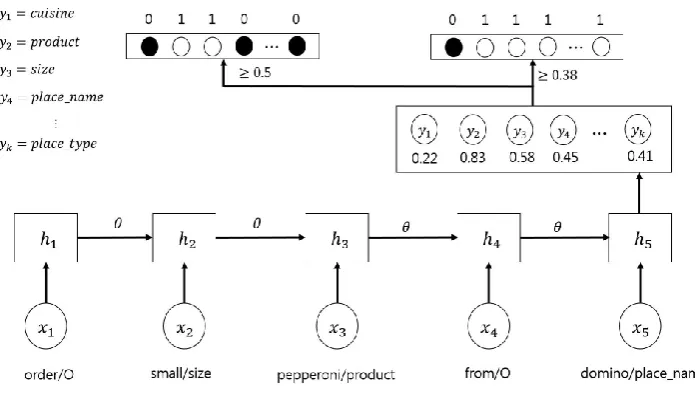
The first stage produces a set of label types that serve as constraints in the second stage. To this end, we use Long Short-Term Memory (LSTM) (Hochreiter and Schmidhuber, 1997) (Figure 1). The LSTM processes the given query to produce a fixed-size vector where the input at each time step is the word embedding corresponding to the word used at the time. We initialize these word embeddings with GloVe vectors (Pennington et al., 2014). Then the network maps the query vector to a distribution over schema types.
In more detail, we first map each word of the utterance into d-dimensional vector space using an embedding matrix of sizeV byd(which is trained along with other parameters in the network), where V is the size of the vocabulary. Then we map the sequence of the word vectors,{x1, . . . xT}, to LSTM
outputs{h1, . . . hT}where we take the last output to be ad-dimensional summary vector of the utterance
s=hT. We then use parametersW ∈Rk×dandb∈Rkwherekis the number of slot types and compute
ˆ
y=softmax(W s+b)
Thusyˆi ∈[0,1]is the probability of slotifor the given utterance. To train the model, we minimize the
sum of squared errors||yˆ−y||(we could certainly use other metrics such as the KL divergence, but we did not pursue this direction).
At test time, we need to perform multi-label classification with the predicted probabilities of slot types ˆ
y ∈ [0,1]k. We achieve this by thresholding. But rather than using 0.5 as the threshold, we use the
minimumprobability of a ground-truth schema type from the training data. This results in predictions that are very high in recall at the expense of some precision. This trade-off is suitable in our setting, since these labels are only constraints in the second stage: while missing true labels causes the second stage to fail, over-predicting labels does not.
Since the minimum probabilities of ground-truth schema types are observed in the training data, we can train an separate model (SVM) to predict the threshold value for unseen inputs. In summary, given a test utterance, we first use the LSTM network to compute a distribution of slot typesyˆ, next use the trained regressor to predict a suitable value of threshold, and take labels that have probabilities higher than the threshold. Figure 1 illustrates the process.
3.2 Constrained Decoding
In sequence learning, given a sample queryx1. . . xn, the decoding problem is to find the most likely tag
sequence among all the possible sequences,y1. . . yn:
f(x1. . . xn) = arg max
y1...yn p(x1. . . xn, y1. . . yn)
Here, given constraints y˜ from the first stage, we can simply define a constrained lattice lattice
Y(x,y) =˜ Y(x1,y)˜ ×. . .× Y(xn,y)˜ by pruning all tags not licensed by the constraints, as shown
in Figure 2. Then, to find the most likely tag sequence which does not violate the given constrained lattice, we perform the decoding in the constrained lattice:
f(x1. . . xn,y) = arg max˜
Y(x,y˜) p(x1. . . xn, y1. . . yn)
In experiments, we train a single sequence labeling model (CRF) on all domains, but at test time apply this constrained decoding with slot types predicted by the model in Section 3.1.
3.3 Relation to the Union Method
Figure 1: Illustration of schema prediction. In given a query, “order small pepperoni from domino”, the word “small”, “pepperoni” and “domino” is tagged assize, product andplace name, respectively. Therefore, LSTM multi-label classification model should predict a set of slots a query would be tagged with. When we fix a threshold for final result to0.5, we can get two permitted labels,productandsize. Whereas, we select different threshold corresponding to each query such as0.38in this example, we can obtain four permitted labels,product,size,place nameandplace type.
Figure 2: Constrained Lattice: Disabling nodes and transition while decoding the lattice to honor given constraints of domain schema.
[image:4.595.171.424.429.618.2]make more efficient use of labeled data.
4 Experiments
In this section, we turn to experimental findings to provide empirical support for our proposed methods.
4.1 Setting
# of labels # of shared label #train #test #dev #vocab Description
Alarm 8 6 178K 14K 13K 3628 Set alarms
Calendar 20 16 220K 17K 15.6K 11574 Set events in calendar
Comm. 21 13 780K 72K 29K 69817 Make a call and sent text
Entertain. 15 5 173K 11K 9.3K 17521 Search movies and music
Events 6 4 12K 6K 5K 835 Purchase tickets to events
Hotel 17 9 7.3K 5.7K 4.9K 8172 Book hotel
Mediactrl 10 8 132K 19K 16K 12802 Set up a music player
Mvtickets 7 7 13K 8.2K 7.8K 2298 Buy movie tickets and find showtime
Mystuff 18 12 6.4K 3.6K 3.2K 8824 Find files and attachments
Note 3 1 7.8K 2.9K 2.5K 4756 Find, edit and create a note
Ondevice 6 5 259K 9.4K 6.4K 5386 Control the device
Orderfood 11 10 20K 2.7k 2.6K 3745 Order food using app
Places 32 19 488K 9.4K 8.7K 51611 Find location and direction
Reminder 16 12 338K 21.8K 18K 27823 Find, edit and create reminders
Reservations 12 11 17K 4K 3K 2920 Make a restaurant reservations
Taxi 10 10 10.7K 4.9K 3.1K 451 Find and book a cab
Weather 9 2 302K 5.5K 5.2K 12344 Ask weather
[image:5.595.77.524.158.374.2]Overall 131 62 2964K 217K 153K 245K
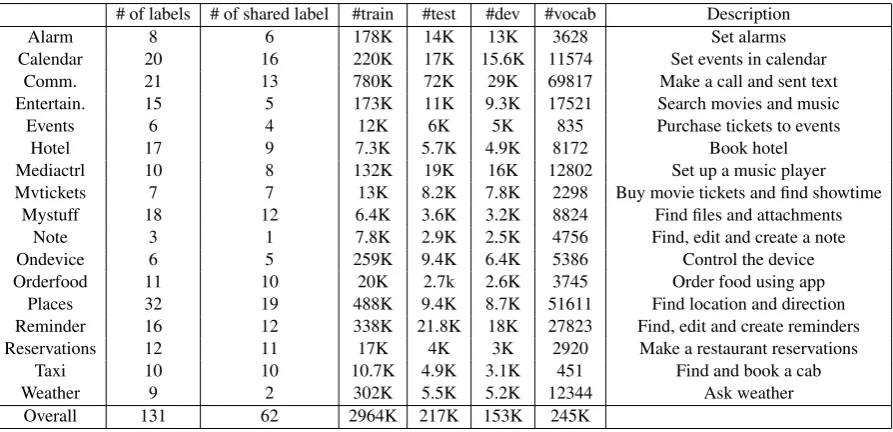
Table 1: Data sets used in the experiments. For each domain, the number of unique slots, the number of examples in the training, development, and test sets, input vocabulary size of the training set, and short description about domain.
To test the effectiveness of the proposed approach, we apply it to a suite of 17 Cortana personal assistant domains for slot (label) tagging tasks, where the goal is to find the correct semantic tags of the words in a given user utterance. For example, a user could say “reserve a table at joeys grill for thursday at seven pm for five people”. Then the goal is to tag “joeys grill” with restaurant, “thursday” withdate, “seven pm” withtime, and “five” withnumber people. The data statistics and short descriptions about the 17 domains are shown in Table 1. As the table indicates, the domains have very different granularity and diverse semantics. The total numbers of training, test and development queries across domains are 2964K, 217K and 153K, respectively. Note that we keep domain-specific slots such asalarm state, but there are enough shared labels across domains. To be specific, we have shared 62 labels among 131 labels. In ALARM domain, there are 6 shared slots among 8 slots.
4.2 Results
In all our experiments, we follow same setting as in (Kim et al., 2015b; Kim et al., 2015c). We trained Conditional Random Fields (CRFs)(Lafferty et al., 2001) and usedn-gram features up ton= 3, regular expression, lexicon features, and Brown Clusters (Brown et al., 1992). With these features, we compare the following methods for slot tagging1:
• In-domain: Train a domain-specific model using the domain-specific data covering the slots sup-ported in that domain.
• Binary: Train a binary classifier for each slot type, assuming prediction for each slot type is inde-pendent of one another. Then combine the classification result with the slots needed for a given schema. For each binary slot tagger targeting a specific slot type, the labeled data is programatically
1For parameter estimation, we used L-BFGS (Liu and Nocedal, 1989) with 100 as the maximum number of iterations and
Domain In-domain Binary Post Const(CRFs) Const(LSTM) Alarm 92.89 74.49 89.81 93.56 94.23 Calendar 90.03 75.62 82.14 88.57 88.16 Communication 92.94 84.17 86.93 92.14 90.39 Entertainment 93.83 83.28 91.26 93.17 94.37 Events 85.84 69.84 78.30 85.00 85.80 Hotel 91.25 73.86 77.45 91.12 90.81 Mediacontrol 86.39 83.70 86.22 87.07 86.43 Movietickets 91.75 85.39 87.03 91.06 91.35 Mystuff 87.92 51.30 80.48 84.88 82.46 Note 87.60 51.25 71.67 84.32 83.87 Ondevice 93.59 70.13 88.26 94.27 94.08 Orderfood 93.52 83.34 90.74 92.84 91.84 Places 91.75 75.27 87.69 89.55 90.96 Reminder 89.31 72.67 81.38 88.57 88.27 Reservations 92.68 86.10 91.07 93.56 94.32 Taxi 88.27 76.91 85.50 90.32 89.65 Weather 96.27 89.12 94.38 96.44 96.50 Average 90.93 75.67 85.31 90.38 90.21
Table 2: F1 scores for models which can handle all domains.
mapped to create a new labeled data set, where only the target label is kept while all the other labels are mappedotherlabel.
• Post: Train a single model with all domain data, take the one-best parse of the tagger and filter-out slots outside the a given schema.
• Const: Train a single model with all domain data and then perform constrained decoding using a given schema.
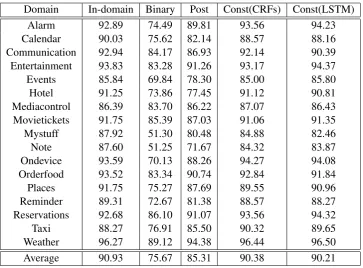
To evaluate performance of the constrained decoding approach without schema prediction, we com-pare the performance among possible models, which can handle all domains in Table 2. Here, a schema is given from a pre-trained domain classifier with an average accuracy of 97%.
We consider In-domain as a plausible upper bound of the performance, yielding 90.93% of F1 on average. Second,Binaryhas the lowest performance of 75.67%. When we train a binary classifier for each slot type, the other slots that provide valuable contextual information are ignored. This leads to the degradation in tagging accuracy. Third,Post improves F1 scores across domains, resulting in 85.31% F1 on average. Note that this technique does not handle ambiguities and data distribution mismatches due to combining multiple domain specific data with different data sizes. Finally, Const(CRF) leads to consistent gains across all domains, achieving 90.38%, which almost matches theIn-domain perfor-mance.Const(CRF)performs better thanBinarybecauseConst(CRF)constrains the best path search to the target domain schema. It does not consider the schema elements that are outside of the target do-main schema. By doing so, it addresses the training data distribution issue as well as overlap on various schema elements.
Also, we performed experiments with LSTM for slot tagging by masking scores of predicted class labels from predicted schema. LSTM is one of the most popular deep learning techniques for sequence tagging (Bahdanau et al., 2014; Dyer et al., 2015), but we observe that the LSTM results (Const(LSTM)) on our dataset are very similar to that of CRFs (Const(CRF), as shown in Table 2. In the following experiments, we mostly focus on theConstversion of CRFs for simplicity.
Constrained by Query Domain In-domain BinF ix BinMin MultF ix MultMin GoldQ PredD
Alarm 92.89 90.56 84.89 91.37 96.29 97.74 93.56 Calendar 90.03 87.6 80.03 89.17 91.86 92.08 88.57 Comm. 92.94 91.28 77.94 91.89 93.29 95.97 92.14 Entertain. 93.83 92.41 81.83 91.9 95.54 96.5 93.17 Events 85.84 82.71 74.84 84.23 88.26 89.57 85
[image:7.595.90.510.60.340.2]Hotel 91.25 89.25 82.25 90.75 92.23 93.21 91.12 Media. 86.39 82.94 85.39 84.58 92.99 93.99 87.07 Mvtickets 91.75 87.86 72.75 86.16 91.67 92.8 91.06 Mystuff 87.92 83.09 83.92 85.12 90.36 91.86 84.88 Note 87.6 81.84 78.6 83.38 87.58 88.42 84.32 Ondevice 93.59 91.87 69.59 92.22 97.79 98.6 94.27 Orderfood 93.52 91.25 76.52 93.62 95.92 96.24 92.84 Places 91.75 89.82 79.75 87.59 94.27 96.8 89.55 Reminder 89.31 86.1 71.31 87.18 93.89 94.07 88.57 Reservations 92.68 89.57 85.68 91.29 94.28 96.28 93.56 Taxi 88.27 86.63 72.27 89.07 95.42 97.11 90.32 Weather 96.27 94.65 89.27 95.8 98.5 99.11 96.44 Average 90.93 88.20 79.23 89.14 93.55 94.73 90.38
Table 3: F1 scores forConst with various schema prediction methods across 17 personal assistant do-mains.
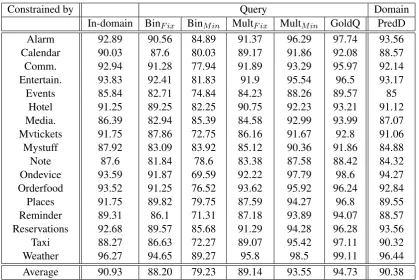
determines if a query has a specific slot or not, whileMultapproaches use a single LSTM to predict a set of allowed schema for a query. SubscriptF ixdenotes that a fixed threshold (0.5) is used to make a decision of positive versus negative label, andMindenotes that the threshold is set to be the minimum of positive label thresholds, which hence gives the maximum recall rate. GoldQdenotes the decoding was constrained by true schema for a query and andPredDdenotes the decoding was constrained by a predicted domain. HereIn-domainalso uses domain classifier.
In the preliminary experiments, we observed that there are significant performance improvements when performing constrained decoding given a gold standard schema of a query(GoldQ). However, it is very difficult to get similar performance by the predicted schema. The main reason is because it does not guarantee recall. As you can see, all methods based on schema prediction except forMultMin, fail
to achieve any improvement compared toIn-domainandPredD. So, we use the minimum probability of a ground-truth schema type per query to increase recall. Using predicted minimum boundaryMultMin
finally boost up performance up to 93.55%, huge relative error reduction of 33% over In-domain ap-proach.
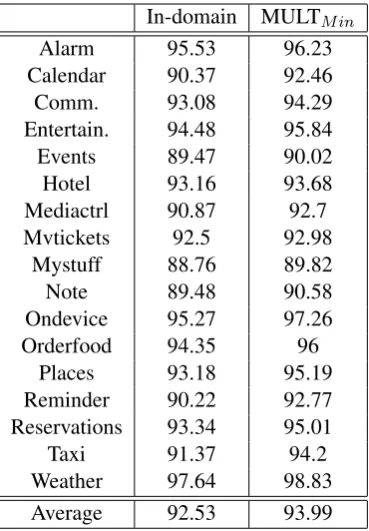
Unlike previous experiments, the experiments shown in Table 4 assume that the true domain and its schema are given. So, there are no domain classification error.MULTMinremoves the predicted schema
elements that are outside of the true domain schema. In-domain yields 92.53% F1 score. MULTMin
boosts the performance to 93.99%.
To further compare classification approach to binary approach, we show performance for multi-class labeling task in Table 5. Unlike slot tagging performance,MultF ixhas the highest F1 score because
of its precision. MultMin has high recall at the slight expense of precision. However, binary logistic
regression (BinMin) fails to keep reasonable precision. This is because logistic regression models are
over-fitted to each label, minimum boundary is very low and thus it causes a lot false positives.
For the last scenario shown in Table 6, we assume that we do not have training data for the test domains. The amount of test data is about 2k. TheMultMinperforms reasonably well, yielding 96.48%
In-domain MULTMin
Alarm 95.53 96.23 Calendar 90.37 92.46 Comm. 93.08 94.29 Entertain. 94.48 95.84 Events 89.47 90.02 Hotel 93.16 93.68 Mediactrl 90.87 92.7 Mvtickets 92.5 92.98
Mystuff 88.76 89.82 Note 89.48 90.58 Ondevice 95.27 97.26 Orderfood 94.35 96
[image:8.595.207.392.61.327.2]Places 93.18 95.19 Reminder 90.22 92.77 Reservations 93.34 95.01 Taxi 91.37 94.2 Weather 97.64 98.83 Average 92.53 93.99
Table 4: F1 score for In-domain and MULTMin across domains for constrained with predicted multi
labels given true domain schema.
BinF ix BinMin MultF ix MultMin
[image:8.595.79.521.372.650.2]Prec Rec F1 Prec Rec F1 Prec Rec F1 Prec Rec F1 Alarm 87.7 67.6 76.4 65.2 99.2 78.7 88.2 86.5 87.3 69.3 99.1 81.6 Calendar 83.7 83.4 83.5 72.8 99.2 86.1 90.1 80.7 85.1 70.5 99.7 82.4 Comm. 78.7 86.1 82.2 66.1 98.8 79.2 86.5 85 85.7 74.8 98.9 85.2 Entertain. 87.4 72.6 79.3 58.4 99.7 73.5 88.3 84.6 86.4 63.3 99.1 77.4 Events 74.8 75.6 75.2 62.2 99.1 83.5 84.3 85.9 85.1 70.8 98.8 82.6 Hotel 87.3 85.9 86.6 58.2 98.4 73.1 84.9 89.2 87 82.2 98.2 89.6 Mediactrl 91.9 68.6 78.5 69.9 99.8 82.1 86 92.4 89.1 79.8 99.5 88.6 Mvtickets 81.3 77 79.1 72.4 99.3 83.8 86.4 87.7 87.1 73.2 99.3 84.3 Mystuff 87.6 82.4 84.9 61.7 98.9 79.5 78.8 82.4 80.5 78.3 98.5 87.4 Note 84.7 77.7 81.1 64.5 98.7 77.8 92.3 87.5 89.8 67.3 98 80 Ondevice 87.2 84.7 85.9 72.3 99.3 83.4 89.2 85.5 87.3 75.7 98.6 85.9 Orderfood 85 70.2 76.9 69.1 99.4 81.4 92.4 82.5 87.2 82.5 99.1 90.2 Places 89.9 83.5 85.9 73.1 99.6 85.9 87.2 70.7 75.8 68.9 99 75.7 Reminder 86.5 75.9 80.9 71.9 98.5 84.7 91.4 84.8 88 83.5 99.2 90.4 Reservations 90.7 85.2 87.9 51.1 99.3 67.5 90.7 80.5 85.3 79.9 99.5 88.6 Taxi 87.7 82 84.8 71.9 99.3 84.6 94.4 88.5 91.3 78.5 98.9 87.7 Weather 85 72.2 78.1 52.6 99.4 68.8 91.6 88.2 89.9 65.9 99.5 79.3 85.7 78.3 81.6 65.5 99.2 79.6 88.4 84.9 86.4 74.4 99 84.5 Table 5: Multi-labeling task performance for schema prediction methods.
Ferry Bus ShopElectric. AVG. MultMin 96.86 99.5 93.08 96.48
domain is partially covered.
5 Conclusion
In this paper, we proposed a solution for scaling domains and experiences potentially to a large number of use cases by reusing existing data labeled for different domains and applications. The single slot tag-ging coupled with schema prediction and constrained decoding achieves competitive and often superior performance over the conventional model trained in per domain fashion. This approach enables creation of new virtual domains through any combination of slot types covered in the single slot tagger schema, reducing the need to collect and annotate the same slot types multiple times for different domains.
Acknowledgements
We thank Minjoon Seo and anonymous reviewers for their constructive feedback.
References
Dzmitry Bahdanau, Kyunghyun Cho, and Yoshua Bengio. 2014. Neural machine translation by jointly learning to align and translate. arXiv preprint arXiv:1409.0473.
John Blitzer, Ryan McDonald, and Fernando Pereira. 2006. Domain adaptation with structural correspondence
learning. InProceedings of the 2006 conference on empirical methods in natural language processing, pages
120–128. Association for Computational Linguistics.
John Blitzer, Sham Kakade, and Dean P Foster. 2011. Domain adaptation with coupled subspaces. InAISTATS,
pages 173–181.
Peter F Brown, Peter V Desouza, Robert L Mercer, Vincent J Della Pietra, and Jenifer C Lai. 1992. Class-based n-gram models of natural language. Computational linguistics, 18(4):467–479.
Hal Daum´e III. 2009. Frustratingly easy domain adaptation.arXiv preprint arXiv:0907.1815.
Chris Dyer, Miguel Ballesteros, Wang Ling, Austin Matthews, and Noah A Smith. 2015. Transition-based
depen-dency parsing with stack long short-term memory.arXiv preprint arXiv:1505.08075.
Ali El-Kahky, Derek Liu, Ruhi Sarikaya, Gokhan Tur, Dilek Hakkani-Tur, and Larry Heck. 2014. Extending domain coverage of language understanding systems via intent transfer between domains using knowledge graphs and search query click logs. IEEE, Proceedings of the ICASSP.
Sepp Hochreiter and J¨urgen Schmidhuber. 1997. Long short-term memory. Neural computation, 9(8):1735–1780.
Young-Bum Kim, Minwoo Jeong, Karl Stratos, and Ruhi Sarikaya. 2015a. Weakly supervised slot tagging with partially labeled sequences from web search click logs. InProceedings of the NAACL. Association for Compu-tational Linguistics.
Young-Bum Kim, Karl Stratos, Xiaohu Liu, and Ruhi Sarikaya. 2015b. Compact lexicon selection with spectral
methods. In Proc. of Annual Meeting of the Association for Computational Linguistics: Human Language
Technologies.
Young-Bum Kim, Karl Stratos, and Ruhi Sarikaya. 2015c. Pre-training of hidden-unit crfs. InProc. of Annual
Meeting of the Association for Computational Linguistics: Human Language Technologies, pages 192–198. Young-Bum Kim, Karl Stratos, Ruhi Sarikaya, and Minwoo Jeong. 2015d. New transfer learning techniques for
disparate label sets.ACL. Association for Computational Linguistics.
Young-Bum Kim, Alexandre Rochette, and Ruhi Sarikaya. 2016a. Natural language model re-usability for scaling
to different domains. InProceedings of the Empiricial Methods in Natural Language Processing (EMNLP).
Association for Computational Linguistics.
Young-Bum Kim, Karl Stratos, and Ruhi Sarikaya. 2016b. Scalable semi-supervised query classification
us-ing matrix sketchus-ing. In Proc. of Annual Meeting of the Association for Computational Linguistics: Human
Language Technologies. Association for Computational Linguistics.
John Lafferty, Andrew McCallum, and Fernando CN Pereira. 2001. Conditional random fields: Probabilistic
Dong C Liu and Jorge Nocedal. 1989. On the limited memory bfgs method for large scale optimization. Mathe-matical programming, 45(1-3):503–528.
Jeffrey Pennington, Richard Socher, and Christopher D Manning. 2014. Glove: Global vectors for word
represen-tation. Proceedings of the Empiricial Methods in Natural Language Processing (EMNLP 2014), 12:1532–1543.
Lance A Ramshaw and Mitchell P Marcus. 1999. Text chunking using transformation-based learning. InNatural
language processing using very large corpora, pages 157–176. Springer.
Ruhi Sarikaya. 2015. The technology powering personal digital assistants. Keynote at Interspeech, Dresden,
Germany.
Oscar T¨ackstr¨om, Dipanjan Das, Slav Petrov, Ryan McDonald, and Joakim Nivre. 2013. Token and type con-straints for cross-lingual part-of-speech tagging. Transactions of the Association for Computational Linguistics, 1:1–12.
Gokhan Tur. 2006. Multitask learning for spoken language understanding. InIn Proceedings of the ICASSP,