QUD-Based Annotation of Discourse Structure and Information Structure:
Tool and Evaluation
Kordula De Kuthy
∗, Nils Reiter
†, Arndt Riester
†∗Department of Linguistics, Wilhelmstr. 19, 72074 T¨ubingen, Germany
†Institute for Natural Language Processing, Pfaffenwaldring 5B, 70569 Stuttgart, Germany [email protected],{nils.reiter,arndt.riester}@ims.uni-stuttgart.de
Abstract
We discuss and evaluate a new annotation scheme and discourse-analytic method, theQUD-treeframework. We present an annotation study, in which the framework, based on the concept ofQuestions under Discussion,is applied to English and German interview data, usingTreeAnno, an annotation tool specially developed for this new kind of discourse annotation. The results of an inter-annotator agreement study show that the new annotation method allows for reasonable agreement with regard to discourse structure and good agree-ment with regard to the annotation of information structure, which coversfocus, background, contrastive topicandnon-at-issue material.
Keywords:discourse structure, information structure, annotation, inter-annotator agreement, Question under Discussion
1.
Introduction
In this paper, we evaluate a new annotation scheme and discourse-analytic method, the QUD-tree framework, de-veloped in Reyle and Riester (2016), Riester (to appear) and Riester et al. (to appear). Its purpose is the cross-linguistic analysis of information structure anddiscourse structure
of textual data. We furthermore introduce a new tool,
TreeAnno, which enables the analyst to semi-automatically segment texts, systematically enhance them with implicit
Questions under Discussion (QUDs), and transform the data into a new kind of discourse tree calledQUD tree.
2.
QUD trees
For several decades scholars have been claiming that im-plicit questions (so-calledQuestions under Discussion, or QUDs) are constitutive of the internal structure of texts, e.g. Polanyi (1988), Stutterheim and Klein (1989), van Kup-pevelt (1995) or, recently, e.g. Onea (2016), Velleman and Beaver (2016), Riester (to appear). This means that ev-ery statement contained in a text is seen as the immediate answer to precisely one implicit or explicit QUD, and po-tentially also as an indirect answer to one or several more general QUDs. QUDs can be thought of as fine-grained, silent headlines of sections, subsections etc., down to the bottom-level of atomic assertions. The content of the lat-ter bottom-level QUDs is, at the same time, thebackground
(ortopic) of the assertions dominated by it, while the con-stituent of the assertion that answers the question is called thefocus. Therefore, QUDs also determine the information structure of the assertions contained in the text (Roberts, 2012), which is then reflected in specific choices of con-stituent order or the use of cleft constructions and, as to spoken discourse, in a characteristic prosodic realization. To our knowledge, the QUD-tree method (Riester et al., to appear), briefly sketched in the following, is the first cor-pus annotation framework which actually implementsthe reconstruction of QUDs, which have, so far, mainly been discussed from a theoretical or experimental perspective. It is at the same time one of the few frameworks that deals with discourse structure and information structure
simulta-neously; but compare e.g. Kruijff-Korbayov´a and Steedman (2003), Polanyi et al. (2003), Pol´akov´a et al. (2013).
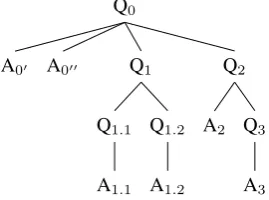
In our framework, we opt for a particular compact repre-sentation format for QUD trees, in which the textual as-sertions (A) represent the terminal nodes of a discourse tree (preserving the linear order of the text from left to right) while (implicit or explicit) QUDs (Q) form the non-terminal nodes. An abstract QUD tree is shown in Figure 1.
Q0
Q2
Q3
A3 A2 Q1
Q1.2
A1.2 Q1.1
A1.1 A000 A00
Figure 1: QUD tree
QUD trees combine properties of two types of structures from the literature. On the one hand, they comprised-trees
3.
QUDs and information structure
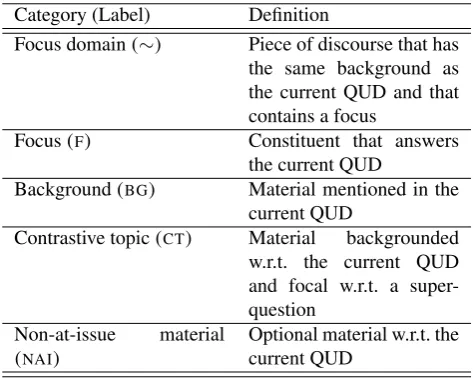
In line with e.g. Rooth (1992), B¨uring (2003), Beaver and Clark (2008), Krifka (2008) or Roberts (2012), we assume a question-based definition of information-structural cate-gories, shown in Table 1, which is also used in the examples below.1Category (Label) Definition
Focus domain (∼) Piece of discourse that has the same background as the current QUD and that contains a focus
Focus (F) Constituent that answers
the current QUD
Background (BG) Material mentioned in the current QUD
Contrastive topic (CT) Material backgrounded w.r.t. the current QUD and focal w.r.t. a super-question
Non-at-issue material (NAI)
Optional material w.r.t. the current QUD
Table 1: Information structure: Label inventory
(1) Q15: {What did the President want to do?}
>A15: [It was clear from the President’s speech that]NAI [[he wanted to]BG [make minor changes]F]∼
(1) is an example demonstrating the assignment of information-structure labels in the context of a QUD (in curly brackets). Note that the indentation (>) ofA15in the textual representation marks subordination in the discourse tree, as shown in Figure 2.
Q15
A15
Figure 2: Question-answer pair as part of a discourse tree
4.
QUDs and discourse structure
The QUD-tree framework can be applied to any kind of written or spoken discourse or conversation. It is not language-specific and can, in principle, be used in order to investigate data from any language the analyst is able to un-derstand. Since the analysis procedure is described at great length within a separate guidelines document (Riester et al., to appear), we will limit the account to a minimum here.4.1.
Segmentation
Raw texts are segmented into atomic assertions. Apart from orthographic sentence boundaries, segmentation also
1
Aboutness topics (T), defined in the guidelines as “referential entities (terms) in the background”, were left out of consideration, in order to avoid categorical embedding.
applies at (2) (information-structurally relevant) coordina-tions and (3) before (optional) syntactic adjuncts. (Obliga-tory) sentential arguments (4) are not split off.
(2) A1: You were working until last summer for the NSA A2: and during this time you secretly collected
thou-sands of confidential documents.
(3) A27: So there is a sort of a trading dynamic there A28: but it’s not. . . it’s not open.
(4) A30: What they are saying isthat they will not then target people within that data.
4.2.
QUD principles for given information
The actual identification of a QUD for each assertion is guided by a number of well-established principles adapted from the formal literature on information structure (Rooth, 1992; Schwarzschild, 1999; B¨uring, 2008; B¨uring, 2016), cf. Riester et al. (to appear):
Q-A-CONGRUENCE: QUDs must be answerable by the assertion(s) that they immediately dominate.
Q-GIVENNESS: Implicit QUDs can only consist of given (or, at least, highly salient) material.
MAXIMIZE-Q-ANAPHORICITY: Implicit QUDs should contain as much given (or salient) material as possible.
Example (5) shows that from these principles we can derive QUDQ32for assertionA32in the context ofA31, whereas any of the questions in (6), used in place ofQ32, would vio-late at least one of the QUD constraints in the same context.
(5) A31: So, if they want to spy on a British citizen, they can spy on a British citizen.
Q32: {What can they do with that data?}
>A32: and [[then they can even]BG [share]F [that data]BG[with the British government]F]∼
(6) a.{What about spying?} (#Q-A-CONGRUENCE)
b.{What about the British government?}
(#Q-GIVENNESS) c.{What can they do next?}
(#MAXIMIZE-Q-ANAPHORICITY)
The tree corresponding to (5) is shown in Figure 3. As a rule, the fact that an assertion contains given material leads to the subordination of that assertion under the assertion containing the antecedent. (Recall our definition of subor-dinationat the end of Section 2.)
. . .
Q32
A32 A31
Figure 3: Subordinated assertion A32, containing given ma-terial
4.3.
QUD principle for parallel information
PARALLELISM: The background of a QUD with two or more parallel answers consists of the (semantically) com-mon material of the answers.
(7) Q19: {What about the programs?}
>A190: [[they’ve]BG[never stopped a terrorist attack in the United States]F]∼
>A1900: and [[they have]BG [marginal utility at best for other things]F]∼.
The resulting tree structure is shown in Figure 4.
Q19
A1900 A190
Figure 4: Two coordinated (parallel) assertions
5.
TreeAnno
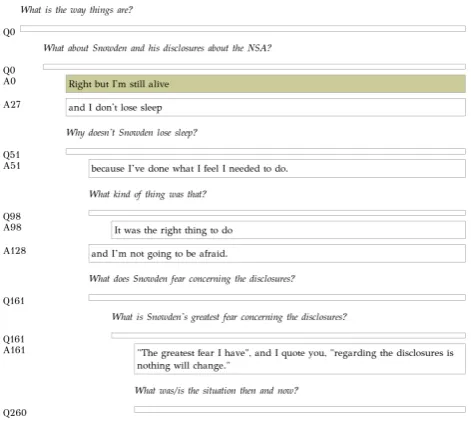
To support the annotation of QUDs according to the above described QUD principles, we developedTreeAnno, a web-based tool for the transformation of written text into QUD trees. Conceptually, two distinct steps are involved in the annotation: The segmentation of the text into appropri-ate units, and their hierarchical organization in the form of QUD trees. The tool imports plain text files, and first adds automatically detected sentence (and token) bound-aries (using LanguageTool2), as an initial segmentation. The boundaries can later be changed by the annotators. The tree annotation works by indenting segments, similarly to an outliner. This allows for fast annotation of large text segments. Implicit QUDs can be inserted as well. Figure 5 shows a screenshot of the annotation view ofTreeAnno.
Figure 5: Annotation view ofTreeAnno: discourse structur-ing and added QUDs(italics)
Behind the scenes, the sentences (and implicit QUDs) are represented as annotations in a UIMA3document. The
con-2
https://languagetool.org 3http://apache.uima.org
nection to actual textual positions is always kept and allows future integration with other linguistic annotation layers. The tree structure is provided by maintaining a reference to the parent of each annotation.
In addition, TreeAnno supports the export of annotated doc-uments as a simple, tree-oriented XML format, bracket ex-pression (with or without node ids), visually rendered trees (by using GraphViz) or a chart-like matrix.
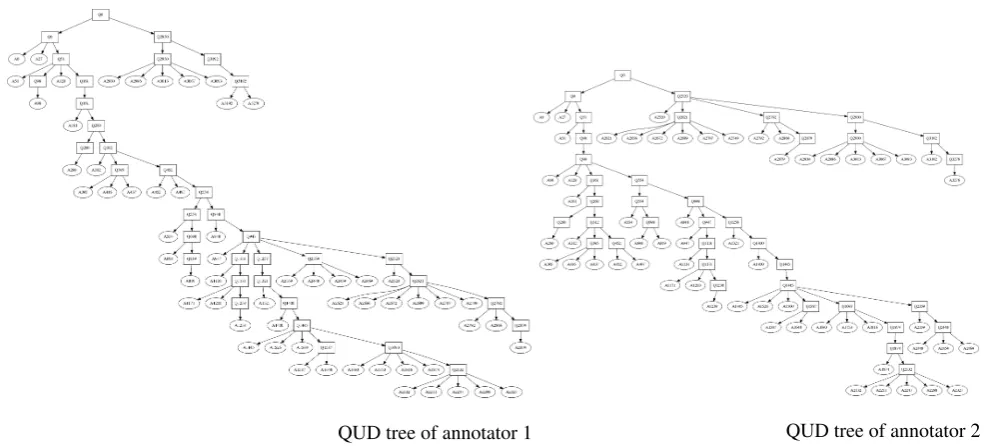
To sum up,TreeAnnoallows for an easy transfer of QUD-tree annotations, which have, for instance, initially been carried out by various annotators in a text editor, into a generic XML or bracketing format. It furthermore provides the possibility to visualize, compare and evaluate different annotations, e.g. the ones shown in Figure 6. The tool will be made available as open source software released with this publication.4
6.
Evaluation: Discourse structure
In a first evaluation of the QUD guidelines, our goal is to show that the above described method of discourse anno-tation in terms of QUDs can be applied reliably to natu-rally occurring data. We conducted an empirical study, in which annotators followed the QUD guidelines described in Riester et al. (to appear) to annotate English and Ger-man interview data with QUDs, using the above described TreeAnno tool.
6.1.
Evaluation setup
Two trained annotators analyzed two sections from a tran-script of an (English) interview with Edward Snowden, broadcast on German ARD TV on Jan. 26, 2014.5The first section of the transcript consists of 60 text segments, the second has 69 text segments. The two resulting discourse trees for the first segment are shown in Figure 6.
Two other trained annotators analyzed a German radio in-terview (SWR2 radio inin-terview with Thomas Oppermann, Social Democratic Party, Sept. 12, 2015), in the form of a single document consisting of 158 segments.6
6.2.
Method and results
For the comparison of two QUD annotations we need to be able to calculate an inter-annotator agreement score that takes into account, for every segment and every possible span of segments, whether a QUD is present or not. In or-der to compute aκstatistics based on our QUD annotations, we follow the method described in Marcu et al. (1999), which was developed for measuring agreement in the label-ing of rhetorical structure categories in texts. The method is based on the idea of mapping the hierarchical structure of a discourse tree onto a matrix filled with categorical values (in our case whether there exists a (Q)uestion spanning the
4
http://hdl.handle.net/11022/ 1007-0000-0007-C634-F
5
https://archive.org/details/snowden_ interview_en
6The interview is part of the GRAIN corpus (Schweitzer et al.,
QUD tree of annotator 1 QUD tree of annotator 2
Figure 6: Two different QUD tree analyses for the same document
respective segments – start to end – or (n)ot). The result-ing chart for the sample QUD tree of Figure 1 is shown in Figure 7, in which we observe, for instance, that the root nodeQ0spans over all the tree segments, i.e. fromA00 to
A3. Note that the indices on the segments/assertions and questions in this Figure are marked only for the purpose of demonstration, while, in fact, the labels are binary.
A00 A000 A1.1 A1.2 A2 A3
A00 n n n n n Q0
A000 – n n n n n
A1.1 – – Q1.1 Q1 n n
A1.2 – – – Q1.1 n n
A2 – – – – n Q2
A3 – – – – – Q3
Figure 7: A text segment chart representing a QUD tree
A κ statistics can now be computed between two charts that represent two different QUD annotations for the same text; more precisely between the two resulting sets of cells in the upper half of each chart. In the case of Figure 7, this amounts to sets of 21 pairs of cells. Generally, for n
segments contained in a document, the number of cells is n×(n+1)
2 .
For our three annotated documents we calculated κ (Co-hen, 1960), based on the the described method. For the text
Snowden 1, consisting of 60 segments, we calculated the
κstatistics based on 1,830 items, for Snowden 2with 69 segments based on 2,415 items. And for the German Op-permanntext, theκis based on 12,535 items resulting from 158 segments. The results are shown in Table 2
The values show moderate agreement between the anno-tator pairs. It is entirely clear, though, that the basis of computation in this new task is rather different than, for instance, in a word-based classification task. It is, there-fore, perhaps still too early to interpret the results, due to the overall complexity of the task and the lack of a
reason-Text Segments Cells κ
Snowden 1 (ENG) 60 1,830 .50 Snowden 2 (ENG) 69 2,415 .53 Oppermann (GER) 158 12,561 .45
Table 2: Kappa values for QUD-annotated spoken dialogue
able baseline. However, the results can provide a point of reference for future developments in this area.
7.
Evaluation: Information structure
The second major issue we are interested in is to evaluate the reliability of information-structure annotation based on the previous identification of QUDs.
7.1.
Evaluation setup
For the evaluation of the information structure mark-up, the same two documents from the English Snowden interview as well as the transcript of the German Opperman inter-view were annotated. The same pairs of trained annotators now performed an information-structure annotation of the text segments, still in keeping with the guidelines of Ries-ter et al. (to appear). To keep matRies-ters simple, we
trated on the four categories focus (F), background (BG), non-at-issue material (NAI) and contrastive topic (CT).
Fo-cus domain labels (∼) were not annotated, since each text segment (assertion) already corresponds to one focus do-main. The annotators based their annotations on the pre-viously performed QUD analysis in the TreeAnno tool de-scribed in Section 6.2. As an annotation tool for the token-based information-structure annotation, WebAnno (Yimam et al., 2013) was chosen. Figure 8 shows a screenshot of the information-structure annotation of the beginning part ofSnowden 1.
7.2.
Method and results
Following previous work on the evaluation of informa-tion structure annotainforma-tion (Ritz et al., 2008; Calhoun et al., 2010), we calculatedκvalues on the annotated data based on tokens. In addition to the specifications in Riester et al. (to appear), in particular the QUD-to-information-structure mapping from Table 1, we defined a number of heuristic (but potentially debatable) rules in order to prevent dis-agreement due to theoretically unclear issues:
• Discourse connectors (but, and, although, because, thereforeetc.) at the beginning of discourse segments are not annotated.
• All pronouns (including possessive pronouns), unless contrastive, receive the labelBG.
• Function words like auxiliaries, prepositions, dis-course particles, articles or complementizers are either labeled asBGor asF, depending on what they adjoin to. In case a function word occurs between a focus and a background, it is backgrounded, on the assumption that it represents salient information.
(8) Q: {What about John?}
A: [Hehas been]BG[lucky]F.
Exceptions:
– If the wh-word provides that a function word is part of the focus, or if two function words are explicitly contrasted against each other, then they receive the labelF.
(9) Q: {Whom did she meet?}
A: [She met]BG[thePope]F.
– If a function word is adjoint to an overtly con-trastive word, it stays in the background.
(10) Q: {What kind of cars were there?}
A’: [A]BG[red]F[one]BG A”: and [a]BG[green]F[one]BG.
• Punctuation: Quotation marks around an expression, commas within and at the right edge of an expression are part of the markable. Periods, colons, semicolons, exclamation marks are not.
Text Label Tokens κ
Snowden 1 all 657 .69
(ENG) F .67
BG .46
CT .55
NAI .71
Snowden 2 all 842 .67
(ENG) F .65
Table 3: Kappa for information structure annotation
Results are shown in Table 3, divided into scores for all labels taken together, and individual scores for each of the four labels.
The results show that the described method supports the successful information-structure annotation with substan-tial agreement (i.e.κ > .6) between two annotators: On the
Snowden 1text, the agreement score for all annotated cate-gories taken together is at .69, for the categoryF(focus) the
score is .67, while onSnowden 2, the score for all categories is at .67, for Fat .65. As for the German text, the overall agreement score is again .67, for the categoryFthe score is .63. However, the score forCT(contrastive topic) was very low here. Moreover, in general, there was a high agreement for the classification of non-at-issue material (NAI). These agreement scores are much higher and exhibit more reliable annotation results than, for example, the results re-ported in (Ritz et al., 2008) for a similar annotation study on naturally occurring data. In their study, the highestκvalue calculated for focus on all tokens of a spoken dialogue is at .44. Other studies reporting higherκvalues usually did not base their annotation on all tokens of a text or used fewer categories in the annotation. Calhoun et al. (2010), for example, report aκvalue of .67 for the binary distinction between kontrast (their terminology for focus) and back-ground. However, in their study not all tokens of a text but only certain words were annotated, i.e. nouns, verbs, ad-jectives, adverbs and pronouns. Summing up, these high agreement scores show that the successful annotation of in-formation structure in spoken-language data based on ex-plicit QUDs is very promising, despite the fact that there is still some degree of disagreement on the QUD-based dis-course structures.
8.
The formulation of QUDs
formulations, since language allows for endless possibili-ties of variation when expressing any statement or ques-tion. But this is not an important point, as far as our task is concerned. What counts is that the two QUDs chosen by the annotators have the same denotation, i.e. give rise to the same discourse-structure analysis and information-structure classification, which in the case of Figure 9 is ful-filled.
Annotator 1: Annotator 2:
Q9: {What did the politi-cal class do?}
{What exactly did the government do?}
>A9: [Instead of circling around the public and pro-tecting their rights]NAI [the political class]BG [circled around the security state]F
Figure 9: Two different QUDs by two annotators, which lead to the same discourse and information structure
9.
Conclusion
We have presented a novel method for the annotation of information structure which achieves good inter-annotator scores. The method is based on the reconstruction of QUDs, which moreover leads to the definition of a new kind of discourse structure, QUD trees. Although initially ear-marked for the annotation of information structure, QUD trees represent an interesting contribution to discourse the-ory itself, which can be analyzed with a reasonable agree-ment. Finally, we introduced a new annotation tool for QUD trees, TreeAnno, which is made available as open source software.
10.
Acknowledgements
We would like to thank our student annotators Daniel Knaus and Nadja Sch¨afer for their dedicated work and help-ful comments. We would also like to thank Detmar Meur-ers for his insightful comments and discussion. This work was funded by the German Research Foundation (DFG) via the T¨ubingen Sonderforschungsbereich 833, Project A4 and the Stuttgart Sonderforschungsbereich 732, Project A6. TreeAnno has been developed within the Center for Re-flected Text Analytics (CRETA), funded by the German Ministry of Education and Research.
11.
Bibliographical References
Asher, N. and Lascarides, A. (2003). Logics of Conversa-tion. Cambridge University Press.
Beaver, D. and Clark, B. (2008). Sense and Sensitivity. How Focus Determines Meaning. Wiley-Blackwell, Ox-ford.
B¨uring, D. (2003). On D-trees, beans, and B-accents. Lin-guistics and Philosophy, 26(5):511–545.
B¨uring, D. (2008). What’s new (and what’s given) in the theory of focus? In Proceedings of the 34th Annual Meeting of the Berkeley Linguistics Society, pages 403– 424.
B¨uring, D. (2016). Intonation and Meaning. Oxford Uni-versity Press.
Calhoun, S., Carletta, J., Brenier, J., Mayo, N., Jurafsky, D., Steedman, M., and Beaver, D. (2010). The NXT-format Switchboard corpus: A rich resource for investi-gating the syntax, semantics, pragmatics and prosody of dialogue. Language Resources and Evaluation, 44:387– 419.
Cohen, J. (1960). A coefficient of agreement for nom-inal scales. Educational and Psychological Measure-ment, 20(1):37–46.
Krifka, M. (2008). Basic notions of information structure.
Acta Linguistica Hungarica, 55(3-4):243–276.
Kruijff-Korbayov´a, I. and Steedman, M. (2003). Discourse and information structure. Journal of Logic, Language and Information, 12:249–259.
Marcu, D., Amorrortu, E., and Romera, M. (1999). Ex-periments in constructing a corpus of discourse trees. InProceedings of the ACL Workshop on Standards and Tools for Discourse Tagging, pages 48–57, College Park, MD, USA.
Onea, E. (2016). Potential Questions at the Semantics-Pragmatics Interface. Brill, Leiden.
Pol´akov´a, L., M´ırovsk´y, J., Nedoluzhko, A., J´ınov´a, P., Zik´anov´a, ˇS., and Hajiˇcov´a, E. (2013). Introducing the Prague Discourse Treebank 1.0. InProceedings of the International Joint Conference on Natural Language Processing, pages 91–99, Nagoya.
Polanyi, L., van den Berg, M., and Ahn, D. (2003). Dis-course structure and sentential information structure: An initial proposal. Journal of Logic, Language and Infor-mation, 12:337–350.
Polanyi, L. (1988). A formal model of the structure of dis-course.Journal of Pragmatics, 12(5-6):601–638. Reyle, U. and Riester, A. (2016). Joint information
struc-ture and discourse strucstruc-ture analysis in an Underspec-ified DRT framework. In Julie Hunter, et al., editors,
Proceedings of the 20thWorkshop on the Semantics and Pragmatics of Dialogue (JerSem), pages 15–24, New Brunswick, NJ, USA.
Riester, A., Brunetti, L., and De Kuthy, K. (to appear). Annotation guidelines for Questions under Discussion and information structure. In Evangelia Adamou, et al., editors,Information Structure in Lesser-Described Lan-guages: Studies in Syntax and Prosody. Benjamins, Am-sterdam.
Riester, A. (to appear). Constructing QUD trees. In Malte Zimmermann, et al., editors,Questions in Discourse. Vol. 2: Pragmatics. Brill, Leiden.
Ritz, J., Dipper, S., and G¨otze, M. (2008). Annotation of information structure: An evaluation across differ-ent types of texts. In Proceedings of the Sixth Interna-tional Conference on Language Resources and Evalua-tion (LREC), pages 2137–2142, Marrakesh.
Roberts, C. (2012). Information structure in discourse: To-wards an integrated formal theory of pragmatics. Seman-tics and PragmaSeman-tics, 5(6):1–69.
Schwarzschild, R. (1999). GIVENness, AvoidF, and other constraints on the placement of accent. Natural Lan-guage Semantics, 7(2):141–177.
Schweitzer, K., Eckart, K., G¨artner, M., Fale´nska, A., Riester, A., R¨osiger, I., Schweitzer, A., Stehwien, S., and Kuhn, J. (2018). German Radio Interviews: The GRAIN release of the SFB732 silver standard collection. InProceedings of the Eleventh Language Resources and Evaluation Conference (LREC), Miyazaki, JP.
Stutterheim, C. v. and Klein, W. (1989). Referential move-ment in descriptive and narrative discourse. In Rainer Dietrich et al., editors, Language Processing in Social Context, pages 39–76. North Holland, Amsterdam. van Kuppevelt, J. (1995). Discourse structure, topicality
and questioning.Journal of Linguistics, 31:109–149. Velleman, L. and Beaver, D. (2016). Question-based
mod-els of information structure. In Caroline F´ery et al., ed-itors, The Oxford Handbook of Information Structure, pages 86–107. Oxford University Press.