c e-ISSN: 2348-6848, p- ISSN: 2348-795X Volume 2, Issue 12, December 2015
International Journal of Research (IJR)
Available at http://internationaljournalofresearch.org
Augmenting Distributed data deduplication System
with Improved Security
1
P. Sitaram &
2Dr.G Rama swamy
1
M.Tech (CSE), Priyadarshini Institute of Technology & Science
2
Professor ( Dept.of CSE), Priyadarshini Institute of Technology & Science Abstract:
Data deduplication is a technique for evaluating copy duplicates of information and has been widely utilized as a part of distributed storage to cloud server and transfer data transfer capacity. Then again, there is one and only duplicate for every record put away in the cloud regardless of the fact that such a document is claimed by countless. In like manner, deduplication framework advances capacity usage while decreasing dependability. Moreover, the date of protection for touchy information likewise happens when they are outsourced by Clients to a cloud. Wanting to address the above crudity test, this paper develops the first push to commend the thought of scattered solid deduplication framework. This paper recommends a new distributed deduplication systems with upper dependability in which the data chunks are distributed from corner to cornering multiple cloud servers. The safety needs of data privacy and tag stability are also accomplish by introducing a
deterministic secret sharing scheme in
distributed storage systems, instead of using
convergent encryption as in previous
deduplication systems.
Keywords—Deduplication; secret sharing;
distributed storage system; reliability
1.
INTRODUCTION
By the unpredictable development of digital data, deduplication techniques are broadly engaged to backup data and decrease network
and storage transparency by notice and eradicate redundancy among data. As an alternative of maintaining multiple data copies with the same content, deduplication reducing redundant data by maintaining only single copy and referring other redundant data to that copy. Deduplication has inward much concentration from both academic world and industry since it can really recover storage utilization and keep storage space, particularly for the applications with high deduplication ratio such as archival storage systems. A number of deduplication systems have been projected based on various deduplication scheme such as client-side or server-side deduplication, file-level or block-level deduplications.Specially, with the advent of cloud storage, data deduplication procedure grow to be more gorgeous and essential for the management of ever-increasing quantity of data in cloud storage services which inspires endeavour and club to outsource data storage to third-party cloud providers, If we consider some of the examples as proofs:
[i]Today’s cloud storage services, such as, Google Drive, Dropbox have been pertaining deduplication to save the network bandwidth
and the storage cost with client-side
deduplication.
Two types of deduplication in terms of the size:
(a) block-level deduplication, which find out and eliminate redundancies among data blocks.
c e-ISSN: 2348-6848, p- ISSN: 2348-795X Volume 2, Issue 12, December 2015
International Journal of Research (IJR)
Available at http://internationaljournalofresearch.org
determine redundancies between different files and eradicate these redundancies to decrease ability demands, and the file can be separated into lesser fixed-size. Using fixed-size blocks shorten the calculation of block bound-arise, even as using variable-size blocks .[ii]Despite the fact that deduplication method can accumulate the storage space for the cloud storage service providers, it decreases the consistency of the system. Data consistency is really a very vital issue in a deduplication storage system because there is only one copy for each file accumulates in the server pooled by all the owners. If such a pooled file was lost, a excessively large amount of data becomes unreachable because of the unavailability of all the files that share this file. If the value of a file were calculated in terms of the amount of file data that would be lost in case of behind a single chunk, then the quantity of user data lost when a file in the storage system is spoiled grows with the number of the unity of the chunk. Thus, how to assurance of high data consistency in deduplication system is a vital Problem. Most of the preceding deduplication scheme has only been measured in a single-server location. on the other hand, as lots of deduplication systems and cloud storage systems are planned by users and function for higher dependability, particularly in archival storage systems where data are vital and should be potted over long time point. This involve that the deduplication storage systems provide reliability comparable to other high-available systems.
Furthermore, the challenge for data privacy also arises as more and more sensitive data are being outsourced by users to cloud. Encryption mechanisms have usually been utilized to protect the confidentiality before outsourcing data into cloud. Most commercial storage
service provider is reluctant to apply
encryption over the data because it makes deduplication impossible. The reason is that the traditional encryption mechanisms, including public key encryption and symmetric key encryption, require different users to encrypt their data with their own keys. As a result, identical data copies of different users will lead to different ciphertext. To solve the problems of confidentiality and deduplication, the notion of convergent encryption has been pro-posed
and widely adopted to enforce data
confidentiality while realizing deduplication.
However, these systems achieved
confidentiality of outsourced data at the cost of decreased error resilience. Therefore, how to protect both confidentiality and reliability while achieving deduplication in a cloud storage system is still a challenge.
2. Our Contributions:
c e-ISSN: 2348-6848, p- ISSN: 2348-795X Volume 2, Issue 12, December 2015
International Journal of Research (IJR)
Available at http://internationaljournalofresearch.org
access a minimum number of storage servers through authentication and obtain the secret shares to reconstruct the data. In other words, the secret shares of data will only be accessible by the authorized users who own the
corresponding data copy. Another
distinguishing feature of our proposal is that data integrity, including tag consistency, can be achieved.
The traditional deduplication methods cannot be directly extended and applied in distributed and multi-server systems. To explain further, if the same short value is stored at a different cloud storage server to support a duplicate check by using a traditional deduplication method, it cannot resist the collusion attack launched by multiple servers. In other words, any of the servers can obtain shares of the data stored at the other servers with the same short value as proof of ownership. Fur-thermoses, the tag consistency, which was first formalized by [5] to prevent the duplicate/ciphertext replacement attack, is considered in our protocol. In more details, it prevents a user
from uploading a maliciously-generated
ciphertext such that its tag is the same with another honestly-generated ciphertext. To achieve this, a deterministic secret sharing method has been formalized and utilized. To our knowledge, no existing work on secure
deduplication can properly address the
reliability and tag consistency problem in distributed storage systems.
This paper makes the following contributions.
Four new secure deduplication systems
are pro-posed to provide efficient deduplication with high reliability for file-level and block-level deduplication, respectively. The secret splitting technique, in-stead of traditional encryption methods, is utilized to protect data confidentiality. Specifically, data are split into fragments by using secure secret sharing
schemes and stored at different servers. Our proposed constructions support both file-level and block-level deduplication.
Security analysis demonstrates that the proposed deduplication systems are secure in terms of the definitions specified in the proposed security model. In more details, confidentiality, reliability and integrity can be achieved in our proposed system. Two kinds of collusion attacks are considered in our solutions. These are the collusion attack on the data and the collusion attack against servers. In particular, the data remains secure even if the adversary controls a limited number of storage servers.
We implement our deduplication
systems using the Ramp secret sharing scheme that enables high re-liability and confidentiality levels. Our evaluation results demonstrate that the new proposed constructions are efficient and the redundancies are optimized and comparable with the other storage system supporting the same level of reliability.
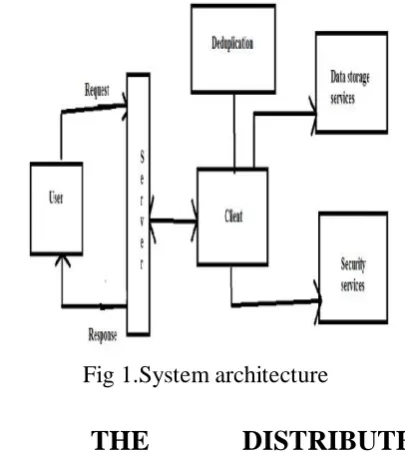
Fig 1.System architecture
3.
THE
DISTRIBUTED
DEDUPLICATION SYSTEMS:
c e-ISSN: 2348-6848, p- ISSN: 2348-795X Volume 2, Issue 12, December 2015
International Journal of Research (IJR)
Available at http://internationaljournalofresearch.org
objective is to allow deduplication and distributed storage of the data diagonally multiple storage servers. As an alternative encrypting the data to keep the privacy of the data, new structures put on the top-secret intense technique to split data into shards.
These shards will then be distributed
transversely in multiple storage servers.
3.1 The File-level Distributed Deduplication System
To maintain efficient duplicate check, tags for each file will be calculated and are directed to S-CSPs. To avoid a conspiracy attack hurled by the S-CSPs, the tags deposited at different
storage servers are computationally
autonomous and different. The details of the structure as follow System setup. In our structure, the number of Storage servers S-CSPs is expected to be i with identities denoted by id1, id2,· · ·, idn, correspondingly. Describe the security parameter as 1 and set a secret sharing scheme SS = (Share, Recover), and a tag generation algorithm TagGen. The file storage system for the storage server is set to be #.File Upload. To upload a file F , the user relates with S-CSPs to achieve the deduplication. More exactly, the user firstly calculates and sends the file tag ϕF = TagGen(F ) to S-CSPs for the file duplicate check.
• When a duplicate is found, the user calculates and sends ϕF;idj=TagGen′(F, idj)to the j-th server with identity idj via the secure channel for 1 ≤j≤n. The motive for presenting an index j is to avoid the server from receiving the shares of other S-CSPs for the same file or block, which will be described in detail in the security analysis. If XF;idj equals the metadata stored with XF , the user will be provided a pointer for the shard stored at server idj . • Else, if no duplicate is found, the user will continue as follows. He runs the secret sharing algorithm SS over F to get {cj} = Share(F ),
where cj is the j-th shard of F . He also calculates XF;idj = TagGen′(F, idj ), which helps as the tag for the j-th S-CSP. As a final point, the user uploads the set of values {ϕF , cj , XF;idj } to the S-CSP with identity idj via a secure channel. The S-CSP stores these values and returns a pointer back to the user for local storage.
File Download. To download a file F , the user first downloads the secret shares {cj} of the file from k out of n storage servers. Exactly, the user sends the pointer of F to k out of n S-CSPs. After meeting enough shares, the user reconstructs file F by using the algorithm of Recover ({cj}).This method provides fault tolerance and lets the user to remain available even if any limited subsets of storage servers fail.
3.2 The Block-level Distributed
Deduplication System
We demonstrate how to attain the fine-grained block-level distributed deduplication. In a block-level deduplication system, the user also needs to firstly achieve the file-level deduplication before uploading his file. If no duplicate is found, the user splits this file into blocks and does block-level deduplication. The system arrangement is the same as the file-level deduplication system; excluding the block size parameter will be defined in addition. Following, the details of the algorithms of File Upload and File Download are mentioned.
File Upload. To upload a file F, the user first achieves the file-level deduplication by sending ϕF to the storage servers. If a duplicate is found, the user will achieve the file-level deduplication, else, if no duplicate is found, the user achieves the block-level deduplication as follows.
c e-ISSN: 2348-6848, p- ISSN: 2348-795X Volume 2, Issue 12, December 2015
International Journal of Research (IJR)
Available at http://internationaljournalofresearch.org
by computing XBi = TagGen(Ai), where the data handling and duplicate check of block-level deduplication is the same as that of file-level deduplication if the file F is substituted with block Bi.
Upon getting block tags {XBi}, the server with identity idj computes a block signal vector RBi for each i.
i) If RBi =1, the user additionally computes and sends XBi;j=TagGen′(Bi, j)to the S-CSP with identity idj. If it also equals the matching tag stored, S-CSP sends a block pointer of Bi to the user. At that time, the user keeps the block pointer of Bi and does not need to upload Bi.
ii) If RBi =0, the user runs the secret sharing algorithm SS over Bi and gets {cij} = Share (Bi), where cij is the j-th secret share of Bi. The user also computes XBi;j for 1 ≤j≤n and uploads the set of values {XF , XF;idj , cij , XBi;j} to the server idj through a secure channel. The S-CSP returns the consistent pointers back to the user.
File Download. To download a file F = {Ai}, the user first downloads the secret shares {cij} of all the blocks Ai in F from k out of n S-CSPs. Exactly, the user sends all the pointers for Ai to k out of n servers. Subsequently gathering all the shares, the user recreates all the fragments Ai using the algorithm of Recover ({·}) and gets the file F ={Ai}.
3.3 Building Blocks:
Here we discuss about Secret Sharing Scheme. Let us have a look on two algorithms in a secret sharing scheme, which are Share and Recover. The secret is separated and shared by using Share. With enough shares, the secret can be pull out and improved with the algorithm of Recover. Here, the Ramp secret sharing scheme (RSSS) [7], [8] is assumed to secretly split a secret into shards. Definitely, the (i, j,
p)-RSSS (where ni> j> p ≥ 0) produces n shares from a secret so that (i) the secret can be improved from any j or more shares, and (ii) No evidence about the secret can be assumed from any p or less shares. Two algorithms, Share and Recover, are defined in the (I,j,p)-RSSS.
• Share splits a secret S into (j -p) pieces of equal size, generates p random pieces of the same size, and translates the j pieces using a non-systematic j of-i removal code into i shares of the same size;
• Improve takes any j out of i shares as inputs and then outputs the original secret S.
We can say that when p= 0, the (i ,j , 0)-RSSS turn into the (i ,j ) Rabin’s Information Dispersal Algorithm (IDA) [9]. When p = j− 1, the (I, j, j− 1)-RSSS becomes the (i, j) Shamir’s Secret Sharing Scheme (SSSS) [10].
Tag Generation Algorithm. In our structures below, two kinds of tag generation algorithms are defined, that is, TagGen and TagGen’. TagGen is the tag generation algorithm that records the original data copy C and outputs a tag T (C). This tag will be produced by the user and practical to achieve the duplicate check with the server. Alternative tag generation algorithm TagGen’ precedes as input a file C and an index j and outputs a tag. This tag, generated by users, is used for the proof of ownership for C.
Message authentication code. A message authentication code (MAC) is a tiny piece of data used to authenticate a message and to
make available integrity and validity
c e-ISSN: 2348-6848, p- ISSN: 2348-795X Volume 2, Issue 12, December 2015
International Journal of Research (IJR)
Available at http://internationaljournalofresearch.org
confirm the exactness of the MAC value and notice whether the file has been changed or not.
Advantages of Proposed work:
Unique feature of the proposal is that data integrity, as well as tag consistency, can be achieved.
For our knowledge, no current work on
safe deduplication can appropriately address the reliability and tag consistency problem in distributed storage systems.
The proposed constructions maintain
both file-level and block-level deduplication.
Security analysis determines that the
proposed deduplication systems are safe in terms of the definitions stated in the proposed security model. If we want to elaborate we can also say that confidentiality, reliability and integrity can be achieved in the proposed system. Two kinds of collusion attacks are measured in our solutions. These are the collusion attack on the data and the collusion attack against servers. In specific, the data remains secure even if the opponent controls a limited number of storage servers.
The implementation of deduplication
systems using the Ramp secret sharing scheme allows high reliability and confidentiality levels. The evaluation results prove that the proposed constructions are efficient and the redundancies are optimized and similar with the other storage system supporting the same level of dependability.
4. CONCLUSION:
The proposed distributed deduplication systems are to expand the consistency of information however accomplishing the security of the client's outsourced information without an encryption machine. The security of label
consistency and trustworthiness were
accomplished. The execution of deduplication systems utilizing the Incline mystery sharing
plan here gives the exhibit that it gets little
Encoding/deciphering overhead contrasted
with the system transmission overhead in customary download/transfer operations.
REFERENCES
[1] J. Gantz and D. Reinsel, “The digital universe in 2020: Big digital shadows and
biggest growth in the fareast,”
http://www.emc.com/collateral/analyst-reports/idc-the-digital-universe-in-2020.pdf, Dec 2012.
[2] M. O. Rabin, “Fingerprinting by random polynomials,” Center for Research in Computing Technology, Harvard University, Tech.Rep. Tech. Report TR-CSE-03-01, 1981.
[3] J. R. Douceur, A. Adya, W. J. Bolosky, D. Simon, and M. Theimer,“Reclaiming space from duplicate files in a serverless distributed file system.” in ICDCS, 2002, pp. 617–624.
[4]M. Bellare, S. Keelveedhi, and T.
Ristenpart, “Dupless: Server-aided encryption for deduplicated storage,” in USENIX Security Symposium, 2013.
[5] “Message-locked encryption and secure deduplication,” in EUROCRYPT, 2013, pp. 296–312.
[6]G. R. Blakley and C. Meadows, “Security of ramp schemes,” in Advances in Cryptology: Proceedings of CRYPTO ’84, ser. Lecture Notes in Computer Science, G. R. Blakley and
D. Chaum, Eds.Springer-Verlag
Berlin/Heidelberg, 1985, vol. 196, pp. 242– 268.
c e-ISSN: 2348-6848, p- ISSN: 2348-795X Volume 2, Issue 12, December 2015
International Journal of Research (IJR)
Available at http://internationaljournalofresearch.org
[8]M. O. Rabin, “Efficient dispersal of information for security, load balancing, and fault tolerance,” Journal of the ACM, vol. 36, no. 2,pp. 335–348, Apr. 1989.
[9]A. Shamir, “How to share a secret,” Commun. ACM, vol. 22, no. 11, pp. 612–613, 1979.
[10]J. Li, X. Chen, M. Li, J. Li, P. Lee, and W. Lou, “Secure deduplication with efficient and reliable convergent key management,” in IEEE Transactions on Parallel and Distributed Systems, 2014, pp. vol.25(6), pp. 1615–1625.
[11] S. Halevi, D. Harnik, B. Pinkas, and A. Shulman-Peleg, “Proofs of ownership in remote storage systems.” in ACM Conference on Computer and Communications Security, Y. Chen, G. Danezis, and V. Shmatikov, Eds. ACM, 2011, pp. 491–500.
[12]J. S. Plank, S. Simmerman, and C. D. Schuman, “Jerasure: A library in C/C++
facilitating erasure coding for storage
applications - Version 1.2,” University of Tennessee, Tech. Rep. CS-08-627,
August 2008.
[13] J. S. Plank and L. Xu, “Optimizing Cauchy Reed-solomon Codes for fault-tolerant network storage applications,” in NCA-06: 5th
IEEE International Symposium on Network Computing Applications,Cambridge, MA, July 2006.