University of South Carolina
Scholar Commons
Theses and Dissertations
1-1-2013
Made in Japan: Kumi-Daiko as a New Art Form
Anna Marie VivianoUniversity of South Carolina
Follow this and additional works at:https://scholarcommons.sc.edu/etd
Part of theMusic Performance Commons
This Open Access Thesis is brought to you by Scholar Commons. It has been accepted for inclusion in Theses and Dissertations by an authorized administrator of Scholar Commons. For more information, please [email protected].
Recommended Citation
MADE IN JAPAN:
KUMI-DAIKO AS A NEW ART FORM
by
Anna Viviano
Bachelor of Music Vanderbilt University, 2007
Master of Music
University of Maryland, 2010
________________________________________________________ Submitted in Partial Fulfillment of the Requirements
For the Degree of Doctor of Musical Arts in
Music Performance
School of Music
University of South Carolina
2013
Accepted by:
Scott Herring, Major Professor Chairman, Examining Committee
Reginald Bain, Committee Member
Julie Hubbert, Committee Member
Scott Weiss, Committee Member
DEDICATION
I dedicate this paper to the most awesome husband in the world, Joseph
Viviano. Without his support and encouragement I would have never gotten to
ACKNOWLEDGEMENTS
First of all, I am grateful to Dr. Scott Herring, who has been an excellent
teacher and mentor throughout my studies at the University of South Carolina.
Without his encouragement and aid I would not have been able to finish this
program so smoothly from eight hours away.
I would also like to thank all of the other members of both of my doctoral
committees, Drs.Julie Hubbert, Reginald Bain, Scott Weiss, and Daniel Jenkins.
Through their thoughtful questions, high standards of expectations, and sincere
wish to help me succeed, they have made me a better musician and scholar.
In making me a more informed researcher and writer through her class
and whenever I had questions at the library, I would like to extend my gratitude
to the Head of the Music Library, Ms. Ana Dubnjakovic.
I take this opportunity to sincerely thank all of my family and friends who
have supported me throughout my studies. I do not know how well I would
have done these past few years of schooling without their unceasing
ABSTRACT
Japanese taiko ensemble drumming, known in Japan as kumi-daiko, is an
art form that has only taken shape within the past fifty years. This new
performance style involving taiko seems, on the surface, to have much in
common with traditional Japanese court and theater music, regarded by scholars
as the art music of Japan. Using drums that have a long history in Japan,
however, does not necessarily make that ensemble part of ancient Japanese
tradition. By studying the most famous groups in Japan, such as Kodo, it is easy
to discern that kumi-daiko has many different inspirations, but is not in itself
ancient. Along with historical references available from previous musicologists
and new first-hand information provided by taiko players themselves, I will
show that the art of kumi-daiko pays tribute to, but is not a slave to, the
traditions of Japan's musical past. Kumi-daiko, along with most traditional
Japanese musics, is mainly transmitted through rote training. As a result, one
way to gain an understanding of the larger picture of kumi-daiko becoming its
own Japanese art form is through the viewing of live performances. Kodo
provides excellent performances that showcase the eclectic pieces of tradition
and contemporary music that are melded together to form a kumi-daiko work.
Through historical research and performance analysis of the most popular and
respected Japanese kumi-daiko group, kumi-daiko will be revealed to be Japan's
TABLE OF CONTENTS
DEDICATION...ii
ACKNOWLEDGEMENTS...iii
ABSTRACT...iv
LIST OF FIGURES...vi
LIST OF MUSICAL EXAMPLES...vii
CHAPTER 1: Introduction...1
CHAPTER 2: The History of Kodo...12
CHAPTER 3: Kabuki Influences...15
CHAPTER 4: Gagaku Influences...24
CHAPTER 5: Folk Music Influences...30
CHAPTER 6: Non-percussive Kumi-daiko Instruments...33
CHAPTER 7: The Beginning of the Kumi-daiko Movement...36
CHAPTER 8: Conclusion...39
BIBLIOGRAPHY...40
APPENDIX A: Set-up Chart for Sado e...43
APPENDIX B: Sado e Musical Examples...44
LIST OF FIGURES
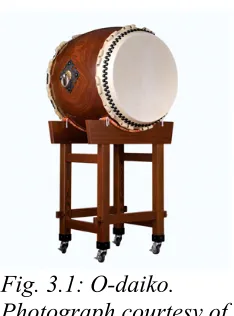
Figure 3.1. O-daiko...18
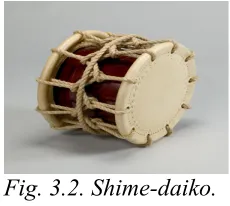
Figure 3.2. Shime-daiko...20
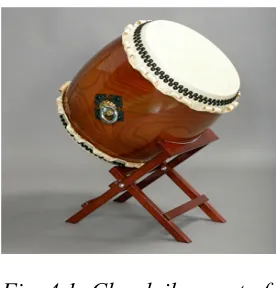
Figure 4.1. Chu-daiko, part of the Nagado-daiko family...26
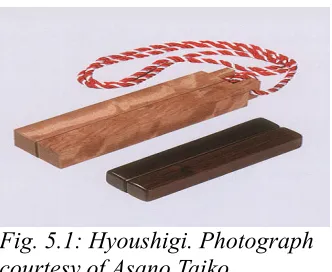
Figure 5.1. Hyoushigi...31
Figure 6.1. Takebue...33
LIST OF MUSICAL EXAMPLES
Example 3.1. O-daiko feature in Sado e....19
Example 3.2. Time-keeping pattern used by the kneeling shime-daiko players...22
Example 3.3. Multi-drum solo from Sado e...23
CHAPTER 1
INTRODUCTION
“The Way of Taiko is over a thousand years old, and its development has
taken many paths in Japan.”1 This statement is supported in numerous books,
journals, and documentaries about taiko drumming. Terry O'Mahoney, in an
article about a taiko ensemble, states, “Taiko have been used for centuries in
many forms of Japanese music, including gagaku, kabuki, kyogen and noh, as
well as for religious ceremonies and festivals.”2 The documentary Spirit of Taiko
further emphasizes the age of this idiom by saying, “One of those [Japanese]
ancient traditions is taiko.”3 These statements are verifiably true, but when used
in the full context of the works they come from, misconceptions about the
meaning of the word taiko can arise. The problem with these statements is not
their veracity, but that they are used as introductory material for articles about
kumi-daiko, or Japanese ensemble drumming.
“Taiko” in Japanese literally means “fat drum.” This word is often used in
publications to describe both the instruments themselves as well as traditions in
military, religious, court, theater, and folk music. Each music has its own variety
of taiko drums, with unique sounds, techniques, and specific purposes within the
music. While each drum has its own unique name, because taiko (or the other
common Japanese romanization, daiko) is a part of each drum name, the generic
1
Heidi Varian, The Way of Taiko (Berkeley: Stone Bridge Press, 2005), 16.
2 Terry O'Mahoney, “Kodo: Japanese Taiko Masters.” Percussive Notes 35 (February 1997), 1.
3 The Spirit of Taiko, DVD, by Steven Dung, Dianne Fukami, and Gayle K. Yamada, (Davis, CA: Bridge
word taiko can and has been used to describe any number of a variety of drums.
One must take into account the entire context when the word taiko is being
utilized, or the generic use of the word to both describe musical traditions and
instruments alike can obscure the meaning being imparted. “Kumi-daiko” is a
word that describes a performing ensemble of various Japanese traditional
instruments, mostly percussive in origin. It has become a community driven
music phenomenon, with thousands of groups world-wide forming over the past
eighty years. Kumi-daiko is popularly abbreviated as “taiko,” and as a result can
create the misinformed idea that kumi-daiko is a direct off-shoot of traditional
musics. The use of taiko in the ensemble, however, does not necessarily make
kumi-daiko part of an ancient tradition. Kumi-daiko is a modern musical form
that utilizes taiko in its ensemble. Kumi-daiko is too far removed from tradition
to be accurately considered an ancient art form.
Understanding the history of the instruments used in a kumi-daiko group
and how these instruments were traditionally utilized in Japan's music history is
essential to uncovering the metamorphosis that has taken place in Japanese
traditional musics over the last fifty years. The structures of many of Japan's
traditional musics are very strict in regards to performers, instruments, and
techniques. William Malm, an eminent musicologist who has written many
books on different aspects of Japanese traditional musics, wrote:
Japanese artists were able to refine rather than expand their techniques.4
Many of Japan's music traditions, believed to have achieved their fullest
development long ago, have remained essentially the same for hundreds of
years.5 The enduring conventions in the traditional musics helped lead to the
development of a new art form in kumi-daiko. It is important to note that the
structure of any kumi-daiko group is fluid, with no set rules as to how many
people can play in the ensemble or what instruments have to be played. This is a
significant cultural and musical development in Japanese music, as it shows that
old traditions in music can be re-imagined into something new and inclusive to
all of the people of Japan and not just a small population of traditional music
experts/performers. Examining the history and repertoire of the most famous
kumi-daiko group in Japan, Kodo, reveals the true innovation taking place in
Japanese music today. Kumi-daiko, along with most traditional Japanese music,
is mainly transmitted through rote training. As a result, one way to gain an
understanding of the larger picture of kumi-daiko becoming its own Japanese art
form is through the viewing of live performances. Kodo, designated cultural
ambassadors of kumi-daiko music throughout the world, provides excellent
performances that showcase the eclectic pieces of tradition and contemporary
music that are melded together to form a kumi-daiko work.6 Through historical
research and performance analysis of the most popular and respected Japanese
kumi-daiko group, kumi-daiko will be revealed to be Japan's new evolving
4 William Malm, Japanese Music and Musical Instruments (Rutland, Vermont: Charles E. Tuttle
Company, 1959), 39.
5 Carl Wolz, Bugaku: Japanese Court Dance (Providence, RI: Asian Music Publications, 1971), 10. 6 "Kodo: Frequently Asked Questions,” accessed April 7, 2012,
musical art form.
Need for Study
The purpose of this study is two-fold. There is a lack of scholarly research
to correct the common misconception that kumi-daiko is a direct off-shoot of
Japanese art music. The other ambition for this study is simply to add new
scholarly research into the origins of kumi-daiko. Thanks to the generous
subsidizing given by the Japanese government to new taiko groups and schools,
there has been a huge growth in the number of people playing in kumi-daiko
groups in Japan.7 Because famous kumi-daiko groups like Kodo tour all over the
world to expose and teach people about kumi-daiko, in North America alone
there are over one hundred known kumi-daiko groups to date.8 This
international popularity, coupled with the previous lack of an established global
musical identity, created the misconception that kumi-daiko is an ancient
Japanese historical tradition.
This new performance style involving taiko seems on the surface to have
much in common with traditional Japanese court and theater music, which are
regarded by scholars as the art music of the time. Along with historical references
available from previous musicologists and more contemporary information
provided by taiko players themselves, I will show that the art of kumi-daiko is a
new musical idiom that pays tribute to, but is not a slave to, the traditions of
Japan's musical past.
7 “Nippon Taiko Foundation,” Nippon Foundation official government website, accessed October 14,
2012, http://www.nippon-taiko.or.jp/english/profile/index.html.
8 “Taiko Groups in North America,” Taiko.com website, accessed October 14, 2012,
Related Literature
The topic of kumi-daiko in scholarly research is limited when compared
to older Japanese traditional art forms such as kabuki and gagaku court music. It
can be speculated that because kumi-daiko is such a relatively new Japanese art
form and is constantly evolving, scholastic scrutiny of the topic has not had
sufficient time to gain a solid foundation in ethnomusicologists' studies. There
are not enough people in the field yet to fill in the gaps in the study of
kumi-daiko as much as an older Japanese musical tradition like Shinto festival music.
Despite the sparsity of kumi-daiko research, in the past decade there has been a
small, valuable nucleus of articles, dissertations, and books published that are
essential to a researcher of this topic.
Brian Vogel, in his “Transmission and Performance of Taiko in Edo
Bayashi, Hachijo, and Modern Kumi-daiko Styles,” has produced an extremely
informative dissertation on the modern practices of three particular styles of
taiko drumming, with transcriptions of musical works normally passed on from
teacher to student orally.9 In the dissertation, “Drumming between tradition and
modernity: Taiko and neo-folk performance in contemporary Japan,”10 Shawn
Morgan Bender provides detailed background information about Japan's famous
kumi-daiko group Kodo, along with an anthropological study into the cultural
origins found in kumi-daiko. Approaching the view of kumi-daiko from a
pedagogical standpoint, Mark Tusler's dissertation “Sounds and Sights of Power:
Ensemble Taiko Drumming (kumi daiko) Pedagogy in California and the
9 Brian Vogel, “Transmission and Performance of Taiko in Edo Bayashi, Hachijo, and Modern
Kumi-Daiko Styles” (DMA diss., Rice University, 2009).
10 Shawn Morgan Bender, “Drumming Between Tradition and Modernity: Taiko and Neo-folk
Conceptualization of Power”11 gives invaluable insight into the approach
Japanese kumi-daiko teachers who have set up groups in California take to
transmit taiko drumming techniques and ideas to students. Yet, none of these
dissertations directly address the issue of kumi-daiko as a contemporary and
evolving art form not directly descended from any one Japanese traditional
musical style. However, they all touch on issues that aid in putting together a
picture of kumi-daiko's origins and practices, without which an argument for
kumi-daiko's unique placement in Japanese music could not be made.
Apart from these dissertations, the most recent research published about
taiko drumming and kumi-daiko comes from various articles published in
respected journals such as Percussive Notes. Terry O'Mahoney wrote an article
detailing Kodo's history and how the group has become a global icon for
Japanese music in “Kodo: Japanese Taiko Masters.”12 Like Mark Tusler's
dissertation, Kimberly Powell's article “The Apprenticeship of Embodied
Knowledge in a Taiko Drumming Ensemble” looks at how the body and mind
work together when performing in a kumi-daiko group.13 In the article “Taiko
Today: Performing Soundscapes, Landscapes, and Identities,” Millie Creighton
explores various uses of taiko drumming in contemporary Japanese society and
how it is used to represent Japanese culture outside of its home country.14
11 Mark Tusler, “Sounds and Sights of Power: Ensemble Taiko Drumming (kumi daiko) Pedagogy in
California and the Conceptualization of Power” (PhD diss., University of California Santa Barbara, 2003).
12 O'Mahoney, “Kodo,” 1.
13 Kimberly Powell, “The Apprenticeship of Embodied Knowledge in a Taiko Drumming Ensemble,” in
Knowing Bodies, Moving Minds: Towards Embodied Teaching and Learning (London: Kluwer Academic, 2004).
14 Millie Creighton, “Taiko Today: Performing Soundscapes, Landscapes, and Identities” in Performing
Similarly, Linda Fujie questions the possible loss of local musical traditions in
kumi-daiko in lieu of a more uniform national musical style in her article,
“Japanese Taiko Drumming in International Performance: Converging Musical
Ideas in the Search for Success on Stage.”15
The impact of kumi-daiko on the cultural image of Japan is an area of
interest to many scholars and the resulting articles are invaluable in structuring
an argument around kumi-daiko as a separate musical idiom in Japanese music.
Yōgaku: Japanese Music in the Twentieth Century, by Luciana Galliano, addresses a
myriad of topics relating to traditional Japanese music and its place in twentieth
century Japan.16 Shawn Morgan Bender looks at the social and racial aspects
related to kumi-daiko in “Of Roots and Race: Discourses of Body and Place in
Japanese Taiko Drumming.”17
In his article “Gozo Daiko,” Michael Gould treats the idea of kumi-daiko
as a blending of various musical traditions. “It is only within the past seventy
years that the Japanese taiko drum has come out of its traditional setting and
become the centerpiece of its own ensemble.”18 The article's main discussion,
however, is centered around the author's experience of various pedagogical
approaches to teaching a kumi-daiko ensemble. The same author has published
an excellent article, “Taiko Classification and Manufacturing,”19 which is a
concise dictionary of many of the drums used in a kumi-daiko ensemble,
15 Linda Fujie, “Japanese Taiko Drumming in International Performance: Converging Musical Ideas in the
Search for Success on Stage” The World of Music 52, no. 1-3 (2010).
16 Luciana Galliano, Y!gaku: Japanese Music in the Twentieth Century, trans. Martin Mayes (Lanham:
Scarecrow Press, 2002).
17 Shawn Morgan Bender, “Of Roots and Race: Discourses of Body and Place in Japanese Taiko
Drumming,” Social Science Japan Journal 8, no. 4 (August 2005).
18 Michael Gould, “Gozo Daiko,” Percussive Notes 24, no. 2 (April 1996).
detailing the original uses of the drums in Japanese traditional music. Gould's
articles give good points in forming a larger picture of kumi-daiko's repurposing
of traditional instruments into a new idiom.
Much of the literature review research done for this study is necessarily
composed of peripheral topics, due to the sparsity of scholarly research on the
topic of kumi-daiko ensembles and the historical background needed to build a
foundation of kumi-daiko's multi-faceted origins. Infinitely helpful to this
research are the countless resources on the instruments and traditions of the
various musical idioms that have been borrowed from in the formation of
kumi-daiko. From these the analysis of Kodo's performances will be well-informed and
the ideas about kumi-daiko as a new tradition supported.
Sir Francis Piggott, a late nineteenth century resident of Hong Kong, took
many trips to Japan and later wrote a book about his keen observations of
Japanese traditional music and performance practices in The Music and Musical
Instruments of Japan.20Japanese Music, a book by Hisao Tanabe, gives a scholarly
overview of most Japanese traditional music and instruments from the viewpoint
of someone who had grown up within those musical traditions.21 A detailed
history of Japanese music is invaluable when researching kumi-daiko and its
origins, and Eta Harich-Schneider's A History of Japanese Music is great resource
for foundational background research into this topic.22
One of the most prolific musicologists writing on the subject of Japanese
music is Dr. William P. Malm. In his book Japanese Music & Musical Instruments he
20 Sir Francis Piggott, The Music and Musical Instruments of Japan (1909; reprint, New York: Da Capo
Press, 1971).
21 Hisao Tanabe, Japanese Music (Tokyo: Kokusai Bunka Shinkokai, 1959).
not only covers, in great detail, the history of music and musical instruments in
Japan, but he categorizes them into three main groups of musical idioms
(religious/festival, theatre, and court) and discusses the meaning of specific
instruments to each group.23 Beyond strictly historical research, Malm also
explores various ideas about how traditional Japanese music has functioned in
society in the past and present in his book Six Hidden Views of Japanese Music.24 In
researching the various instruments used in kumi-daiko groups, it can be helpful
to separate the instruments in William Malm's categories of music. The categories
of theatre music, court music, and religious/festival music do have some overlap
in their musical traditions and instruments, but even examining the overlaps can
help explain how a certain instrument moved from a seventh century Japanese
court ensemble to appear in a twenty-first century kumi-daiko group.
Exemplified in noh and kabuki traditions, some of the most treasured of
Japanese musical customs come from the music used in Japanese theatre. In his
book Nagauta: The Heart of Kabuki Music, Malm explores a specific form of kabuki
theatre music, and he discusses dance and the place such an art form has in
Japanese traditional music.25 Samuel L. Leiter's Kabuki Encylcopedia: An
English-language Adaptation of 'Kabuki Jiten, an English-English-language adaptation of a famous
kabuki research book, provides useful dictionary definitions and short articles on
various aspects of kabuki music and practice.'26 Sumi Gunji gives a brief
23 William P. Malm, Japanese Music & Musical Instruments.
24 William P. Malm, Six Hidden Views of Japanese Music (Berkeley, CA: University of California Press,
1986).
25 William P. Malm, Nagauta: The Heart of Kabuki Music (1963; reprint, Westport, CT: Greenwood Press,
1973).
26 Samuel L. Leiter, Kabuki Encyclopedia: An English-language Adaptation of 'Kabuki Jiten' (Westport,
overview of a few of the drums used in the theatre traditions in her articles
“Kotsuzumi”27 and “Shimedaiko.”28
Japanese court music has many traditions, with two broad categories
being music for an instrumental ensemble only and music for ensemble and
dancers. The book Music of a Thousand Autumns: The Togaku Style of Japanese Court
Music, by Robert Garfias, explores the history and performance practice of a
particular style of Japanese court music, with invaluable transcriptions of pieces
and rhythms frequently used by the court drummers.29 Stylized court dance and
its musical accompaniment, called bugaku in Japanese, is discussed in Carl Wolz's
book Bugaku: Japanese Court Dance.30 Robert Garfias, in his book Gagaku: The
Music and Dances of the Japanese Imperial Household, intelligently traces the
significance of the interaction between the stage, instruments, costumes, and
dances chosen in Japanese court performances.31
Many of the previously mentioned resources do delve into
festival/religious music and its instruments, just not as its main focus. There are
a few specific articles to be found on the topic that would relate to the
kumi-daiko and its use of festival drums and traditions in performance. Onno
Mensink's article, “The Hatchogane; Oral and Literary Aspects of an Almost
Forgotten Musical Instrument,” takes a look at a Buddhist percussion instrument
that is presently also used in street performance and the ways in which its use
27 Sumi Gunji, “Kotsuzumi,” in Musical Voices of Asia, ed. Richard Emmert and Yuki Minegishi (Tokyo,
Japan: Heibon-sha Tokyo, 1980).
28 Sumi Gunji, “Shimedaiko,” in Musical Voices of Asia, ed. Richard Emmert and Yuki Minegishi (Tokyo,
Japan: Heibon-sha Tokyo, 1980).
29 Robert Garfias, Music of a Thousand Autumns: The Togaku Style of Japanese Court Music (Los
Angeles: University of California Press, 1975).
30 Carl Wolz, Bugaku: Japanese Court Dance.
31 Robert Garfias, Gagaku: The Music and Dances of the Japanese Imperial Household (New York:
has been transformed.32 In “Shoden: A Study in Tokyo Festival Music: When is
Variation an Improvisation?” William Malm details how musicians in a festival
ensemble will vary the traditional tunes and whether the variations are
traditional and expected or if they cross the line into improvisation.33 To fill in the
background of some of the non-percussive instruments that can be found in a
kumi-daiko ensemble, Willem Adriaansz's The Kumiuta and Danmono Traditions of
Japanese Koto Music provides an in-depth look into koto music, notation, and
performance practice.34 With this look into the peripheries of topics surrounding
the origin of kumi-daiko, a proper historical context can be created and utilized
when viewing a kumi-daiko group's performance.
32 Onno Mensink, “The Hatchogane: Oral and Literary Aspects of an Almost Forgotten Musical
Instrument,” in The Oral and the Literate in Music, ed. Tokumaru Yoshihiko and Osamu Yamaguchi (Tokyo, Japan: Academia Music Tokyo, 1986).
33 William P. Malm, “Shoden: A Study in Tokyo Festival Music: When is Variation an Improvisation?”
Yearbook of the International Folk Music Council 7 (1975).
34 Willem Adriaansz, The Kumiuta and Danmono Traditions of Japanese Koto Music (Los Angeles:
CHAPTER 2
THE HISTORY OF KODO
The history of Japan's most famous taiko ensemble reveals the diverse
influences that have acted upon the group and formed it into the most
recognizable kumi-daiko around the world. A wandering historian, Den
Tagayasu, formed the group Ondekoza in 1969. He was disgusted with the lack
of knowledge festival musicians and artists had of the old ways, but there was no
one authority on what those old ways actually were and how they could be
brought back into common knowledge. He professed a love of taiko, though he
was no musician himself, and hoped to build a community of artists interested in
revitalizing the traditions of Japanese folk art and music. He rented an old school
house on Sado Island and invited a small group of ordinary Japanese citizens to
live with him and learn how to be self-sufficient artists and musicians. The
troupe was to focus on stage performance, traveling around earning money
toward the final goal of an “Artisans' University.” The first few years were very
difficult. The people living in the commune had no musical training; they had no
training in the folk arts at all. Due to their lack of musical knowledge, the group
progressed slowly. 35
A turning point came when Mr. Tagayasu sent out several members to the
town of Chichibu to attend the local festival and learn a specific drumming piece
found only in that region. The members watched the local drummers' practices
and recorded the piece many times. They did not have the training to notate the
rhythms, and general custom for festival music was for everything to be
transmitted through oral and aural repetition. When the Ondekoza members
returned to the Sado Island compound to try to recreate this piece, Den Tagayasu
transcribed it as best he could, often simplifying the rhythms to make the piece
easily understandable to the himself and his group. In the end, the group's
version of the Chichibu drumming piece was, by their own accounts, a
mechanical and spiritless interpretation. However, the piece's significance cannot
be overestimated; Ondekoza's playing of this piece represents the first time an
“outsider” group had learned and performed a local drumming style. From this
quaky start, Ondekoza continued to learn regional drumming pieces and spread
the knowledge acquired in the performing of these pieces to other beginning
taiko groups.36
Soon after, Ondekoza changed direction and began integrating many
different musical styles into their playing. Tagayasu brought teachers from
touring puppeteering groups, kabuki theater, noh theater, dance troupes, and
court ensembles. These individuals would have residencies with the group,
imparting their genre-specific knowledge. Material was still being drawn from
festival music, but this new information allowed for the integration of new ideas
into their historically-minded repertoire. Armed with this knowledge, Ondekoza
gained performance ability and broadened their scope. Their performance was
no longer purely historically minded; rather, it was a reimagining of the past
with new techniques. This was the beginning of a new Japanese musical idiom.
In 1981, Den Tagayasu, the founder and coordinator for Ondekoza for
over a decade, found himself at a philosophical impasse with a number of his
members. Mr. Tagayasu left Sado Island that year, taking some members with
him to form another taiko group elsewhere. The members that were left on Sado
Island decided to continue with the group under a new name, Kodo. They chose
this name because it can mean both “heartbeat” and “children of the drum.”37
Their repertoire continued to have a folk-inspired style with art music
techniques, but more often than not Kodo chose to perform new works. Since
1981, Kodo has become the most prominent, both popularly and academically,
kumi-daiko in Japan. From their extensive touring schedule comes their 2004
DVD Kodo: One Earth Tour Special. Included in the DVD is some of their
interpretations of traditional pieces, along with performances of newly
composed works for kumi-daiko. The finale piece of this DVD is called Sado e.
As the name suggests, the influence for this piece came from the group's
long-term residence on the island of Sado. It is the longest and most extensive piece of
their tour (see Appendix A and B for an instrument chart and analytical
breakdown of Sado e). Sado e is a piece that uses all of the members of Kodo to
show the group's talent for highlighting Japanese traditional instruments and
techniques, while continuing to be an innovative force in the modern musical
world .
CHAPTER 3
KABUKI INFLUENCES
Part of the innovation kumi-daiko presents in modern Japanese music is
the mixed instrumentation used in performances. Instruments from court,
theater, religious, and folk music can be seen working seamlessly together, with
no demarkation between these different traditional styles. Kodo's Sado e is an
excellent representation of the approach kumi-daiko has to Japanese
instruments and traditions in a way that honors the old but does not remain in
the past. At stage-left, there are multi-drum set-ups. Upstage, there are two huge
taiko. To the right of the set-ups are a column of kneeling drummers, each with
one drum in front and one to the left of the player. Finally, at stage-right is a
variety of non-taiko instruments that have become an important part of many
larger kumi-daiko, including string and wind instruments. Every tradition flows
together without a notice as to what drum came from what background. To make
these instruments and genres work together in a functional musical context, a
new style is needed to balance these widely disparate musical influences.
Kabuki theatre, while not the oldest theatrical art form in Japanese history,
is an art form nurtured and popularized by regular townsfolk with its dramatic
plots and bright costumes.38 In the first half of the seventeenth century, Japan saw
kabuki become the biggest theatrical contribution of the Edo period, synthesizing
all of the previous theatrical forms, both secular and religious, that had come
before it.39 A young female dancer at a temple, Okuni of Izumo, is often credited
with inventing a combination of incantations and dances that later developed
into kabuki plays. Decidedly secular, kabuki was originally performed with
troupes of prostitutes, banned by the government, then banned again when the
all-male troupes that formed afterward were found offensive for their obvious
homosexual themes.40 Kabuki managed to thrive throughout its trials, however,
largely due to the theatre being open to members of all social classes. In a society
where one's ranking normally limited what activities were deemed proper,
kabuki allowed all classes to mingle and become excited about the same plays,
actors, and singers.41
Revealing the underlying structure of a traditional kabuki play can aid in
understanding the way music is woven tightly into the kabuki tradition. The
dances of kabuki originally incorporated three different styles: dances with
circular movements, dances with leaps, and dances consisting mainly of
pantomimed gestures.42 Classically, there are six sections that make up a kabuki
play, and much of the nomenclature and order is borrowed from the older, more
aristocratic theatrical tradition of noh drama.
The first section of a play, the okiuta, is a brief introduction of music and
text, setting the scene and preparing the audience for the entrance of the
players.43 Instrumentation depends on what the play is and what type of
characters are being prepared. For instance, if a samurai character is to enter, then
39 Ibid., 213.
40 See note 39 above. 41 See note 39 above.
traditionally an ensemble of three different drums and a flute are used, while if a
goddess is about to enter then the instrumentation changes to a lone drum and a
stringed instrument.44 The next two sections, the michiyuki and the kudoki,
consist of the entrances of the actors and a display of intricate choreography. The
center of the kabuki play is the fourth section, the odoriji. It is often known by the
entrance of the taiko stick drum, which has before this point been silent, and is
frequently accompanied by the bamboo flute, voice, and stringed lute called the
shamisen. After this highly stylized main dance form has taken place, a freer
section of music is developed and then quickly concluded in the fifth and sixth
sections, the chirashi and the dangire.45
The opening of Kodo's Sado e is an excellent example of the influence
kabuki theater has had on kumi-daiko. The first sound the audience hears is a
drum called the o-daiko. This is a large drum, three to five feet in diameter, with
a convex body and heads tacked on to the body at either end. One or both heads
may be used, and the main playing areas are either the skins themselves or the
rims near where the heads are tacked to the body.46 Due to the size of the playing
areas, the o-daiko is played with a pair of large wooden sticks or one even larger
club.47
44 Leiter, Kabuki encyclopedia, 85. 45 Ibid., 35-36.
Being such a large instrument, it would seem to be a difficult task to
integrate it into the kabuki theatrical tradition, which is not known for its large
productions. However, ever since kabuki was developed, the o-daiko has played
an important role in the hayashi, or musical group, that makes up kabuki
tradition.48 The main roles for the odaiko in kabuki music are split into two main
categories: ceremonial music and sound effects.49In its ceremonial role, the
o-daiko is used to announce the opening of the theatre, the starting of the play, the
entrance/exit of new characters, and the end of acts. As a sound effect drum,
different playing techniques can be utilized to create things like the sound of
wind blowing, rain falling, water flowing, sumo wrestlers fighting, and samurai
swords clashing.50
Each sound in kabuki, as in most Japanese traditional musics, has become
highly stylized, with slight variations in sound only between different schools of
kabuki training. In kabuki and Sado e, small rattles made of strung-together shells are brushed lightly against the heads of the o-daiko to simulate the sound of
48 Leiter, Kabuki Encyclopedia, 76. 49 Ibid., 77-91.
50 See note 49 above.
wind. Kodo does not stray from the canon of sounds allowed the o-daiko, but instead changes the focus of the sound from just a background effect to the foreground of the audience's attention. Kabuki uses the o-daiko as a rhythmic basis for the dancers and as sound effects for other parts of the play. Japanese theater music is very much a melodically driven entity, so the drums used cannot be more prominent than the flutes and plucked instruments.51
Sado e employs two o-daiko in full view on stage, where as in kabuki there
would be one in a screened room at stage right.52 As the piece progresses, the
o-daiko become a very important feature musically and theatrically, with the two
players using large sticks and powerful movements to emphasize the dynamic
capability of the drums. During a short feature of the o-daiko a few minutes into
the piece, the audience is greeted with grandiose, theatrical movements from the
o-daiko players. The physicality required to be able to play this massive drum
with such vigor is a sight to behold, and one that is not utilized in the traditions
of Japanese theatre. While the o-daiko is a traditional kabuki drum, Kodo's
re-imagining of its uses in an ensemble show a clear separation from tradition in an
approach that can only be called new.
51 Malm, Nagauta, 78.
52 Leiter, Kabuki encyclopedia, 76.
The other main drum from theatrical music presented in Sado e is the taiko
stick drum (also known as the shime-daiko). This is a much smaller cylindrical
drum than the o-daiko, and though it is small enough to fit under a performer's
arm and play with the other arm, traditionally it is placed on a wooden stand
that tilts the head of the drum toward the player and to the right.53 The word
shime is derived from the Japanese verb “to bind,” and the binding of the heads
to the shell is what is most notable about this drum. The hides used for this drum
are stretched over steel rings and then sewn to themselves to make a separate
drum head for each side of the hardwood body.54 The heads are secured to the
body by ropes tied through ten holes drilled along the edges of the head, and a
tuning rope ties all of the pieces together to allow the drum to be tuned with one
rope instead of ten separate ones.55
The most common version of the shime-daiko has a very dry and high
pitched sound compared to many other Japanese drums. The shime-daiko is a
versatile instrument, and had been known as a folk instrument before the arts of
noh and kabuki came about. Noh theater musicians use this drum as a main
53 Gunji, “Shimedaiko,” 262. 54 Varian, The Way of Taiko, 54-55. 55 Gunji, “Shimedaiko,” 262.
instrument of the ensemble, divorcing its use of the shime-daiko from the drum's
folk origins.56 Its role in kabuki, however, embraces the shime-daiko's familiarity
to most people as a drum seen at folk festivals and ceremonies by using smaller,
thinner sticks to imitate the sound of the drum when used in folk music.57 Lively
dance scenes, festival scenes, and fanciful scenes with larger-than-life characters
like ghosts and samurai are where the shime-daiko are most often used.58
Audiences would hear the shime-daiko and understand that the drum was not
only being played to create music, but to also represent the idyllic version of folk
music that theatre music often portrays.
The rhythmic patterns used in theatre traditions are, like the plays
themselves, highly stylized. Certain patterns are used with specific drums, and
while there are pattern substitutions available to avoid having the same music
droning on indefinitely, the order of substitutions has been codified.59 The
patterns used in noh and kabuki are separately named, and for the most part a
piece of music consists of a list of the pattern names instead of notated music.
Noh drum rhythms are most often set in eight-beat lines, with slight variations
allowing the drummer to signal cadences or modulations to the other ensemble
players.60 Kabuki rhythms are a little freer, as they were originally developed to
accompany the shamisen, a banjo-like instrument that can move a piece forward
vertically (harmony) or horizontally (melody).61 Overall, rhythms are simple,
with minutiae like accents, varying head sounds, and body movements helping
56 Malm, Nagauta, 77. 57 See note 56 above.
58 Leiter, Kabuki Encylclopedia, 89. 59 Malm, Nagauta, 80.
to distinguish the percussionists' art from just basic time-keeping and making it a
soloing instrument in the theatre.
Kodo's use of the shime-daiko breaks tradition with all of the previously
known uses of the drum. Unlike noh tradition, the shime-daiko is not used as a
feature drum in the ensemble. In contrast to its folk origins and its idealized folk
representation in kabuki music, the shime-daiko is not played as a solo drum in a
musical ensemble. Instead, Kodo uses the stick drum as a part of two different
multi-drum setups. In the first set-up introduced in Sado e the shime-daiko is the
highest drum out of a set-up consisting of five drums. To create a cohesive and
mellow sound among the five disparate sounding drums, the players use
felt-covered mallets to cut down on the attack of the drums. The second set-up
involves just the shime-daiko placed in front of the players, with a larger drum
placed to the side of the player with its head perpendicular to the floor. Even
though the stick drum is used soloistically for brief points in Sado e, the sound
and usage of the drum has been modified from its theater background. These
multi-drum set-ups are essentially new instruments, because the player must
learn how to navigate around the set-up on a micro and a macro level. From
adjusting the touch of each drum separately to creating a cohesive sound across
the instruments, Kodo is showing kumi-daiko is not just a melting pot of
Example 3.3. Multi-Drum Solo from Sado e. Musical example created by author.
CHAPTER 4
GAGAKU INFLUENCES
While Sado e opens with instruments found in the musical traditions of
Japanese theatre, it quickly becomes apparent that Kodo found inspiration in
gagaku, the imperial court music and dance of Japan. It is Japan's oldest musical
institution, founded at the turn of the eighth century under the government's
Bureau of Music and continuing unceasingly to the present day.62 Gagaku
contains a mixture of music taken from China, Korea, India, and Vietnam. From
its founding until the twelfth century, the Japanese were prone to reforming the
court music under each emperor, with the result being an interesting blend of
repertoire.
It is important to point out that the art music of Japan became and still is
strictly regulated by its performers. Emperor Saga enacted what is believed to be
the last reforms made to the court music during the early Heian period of 833 to
850 AD.63 This period in Japan's history is often referred to as its most
sophisticated, with subtle emotions and restrained perfection in activities
becoming aesthetic characteristics of Japanese high society that endure to this
day. 64 The result of these aesthetic changes was that gagaku's repertoire and
techniques were pared down and refined to become elegant simplicity in
performance. From the end of the Heian period, the close of the twelfth century,
to the present day, gagaku has remained largely unchanged.
Since the 12th century, orchestral court music has been divided into two
large categories: pieces claiming influence from China and India and pieces
coming from Korea and Japan.65 Depending on what class of music the piece is,
different instruments are specifically grouped together from the three categories
of wind, stringed, and percussion instruments. Musicians learning the gagaku
percussion instruments take a great effort to preserve the limitations in style and
technique set upon the ensemble. Everything from the strokes of each hand to the
players' breathing are tightly choreographed. The percussion instruments have a
set list of varying metric patterns, and for the most part those patterns are strictly
adhered to regardless of what melodic material is being played. The result is a
unique independence among the percussion section, playing at the same time as
the other instruments but not necessarily being subservient to the melodic
instruments.66
The idea of independence among instrument groups and the use of
traditional drums are the most obvious influences that gagaku has had on
kumi-daiko. Kodo uses the instruments of gagaku to create independent set-ups and
rhythms that are cleverly interwoven to make a new whole. One of the most
common drums associated with kumi-daiko is the gagaku-rooted chu-daiko, most
commonly referred to as just taiko.This drum is not a rope tensioned drum. The
body of the drum is one piece of wood that has been hollowed out. There is a
head on each end of the drum tacked directly on the wood body. This drum is
now played at almost a forty-five degree angle toward the player, requiring a
65 Tanabe, Japanese Music, 17.
special stand to keep it at the proper height and angle. When this drum was first
used in court music, it was suspended from a stand so that the heads were
perpendicular to the floor.67 Still in use today is the tradition of only one of the
heads being struck, even though the original set-up allowed a player access to
both heads of the drum. Unfortunately, many records used by musicologists use
the word “taiko” in reference to different drums used in the court ensemble. As a
result, specific descriptions of the drums and how they were used in the
ensemble are not always readily available. Because the word “taiko” is used in so
much research, the importance and influence of court music can be blown out of
proportion in regards to modern kumi-daiko. Yes, the taiko used in the
traditional court ensemble is the most recognizable drum in an ensemble today.
However, groups like Kodo do not follow the rigid guidelines that court
musicians follow in regards to how they play the taiko.
The rules binding the traditional musics of Japan are strict and are
controlled by a governmental department that has existed for centuries. Masters
of the instruments of court music only train a certain number of apprentices, and
67 Malm, Japanese Music and Musical Instruments, 92.
only after so many years of practice and tutelage can apprentices be allowed to
perform with an actual ensemble.68 The rules set upon noh and kabuki theater are
much the same, even though their traditions came centuries later. As a result, the
art music of Japan is seen as an exclusionary art-form, something that is not
within the reach or understanding of the ordinary Japanese citizen.
Kodo, as exemplified in Sado e, respects the discipline and vast knowledge
that artists of the traditional Japanese musics possess, but melds the various
drums, styles of playing, and rhythmic patterns into an entirely different musical
idiom.In a normal theatre or court setting, there is a hierarchy of drums and a
limitation on what patterns can be played on specific drums. Kodo does away
with this idea in several different ways. First, the sheer number of drums on
stage is a break from tradition. Traditionally, each style of drum is able to be
featured due to small numbers in the ensembles overall, hence the development
of specific style and sound minutiae. Second, the multi-drum configurations
create an equality between the different drums, for they are chosen for their basic
sound and how that sound blends with the others. It is not important to
distinguish the minute sound differences available on the small shime-daiko that
have been explored by the traditional arts, because within the context of playing
the shime-daiko next to a large chu-daiko, such minutiae would be inaudible to
the audience.
Kodo takes its large variety and number of drums available in Sado e and
uses them in ways to give momentum to the piece. A good example of this is the
main rhythmic theme present throughout Sado e. This piece starts out featuring
one instrument group or soloist after another. These features are often set into
four bar increments, often with little or no transition material from one to the
next. Many of the features seem improvised to a certain extent. With little
melodic or harmonic progression, Sado e could be viewed as a collection of
disparate phrases, if not for the main rhythmic theme. This simple phrase, which
could be argued to be a two-bar theme with variations or a full eight-bar theme,
is repeated by all of the drummers at various points to create impacts and
momentum during Sado e. In keeping with traditional musics, it is a simple duple
based rhythm. Kodo uses this theme brilliantly, not only using it for big ensemble
moments, but keeping it in the audience's mind by having the soloists' improvise
around it and having it serve as the time-keeping rhythmic cell at certain points.
By distributing the theme around the ensemble and using it tutti, reminiscent of
Western orchestral writing, Sado e gains a forward momentum that would
otherwise be difficult to achieve in an improvisatory piece featuring mostly
non-pitched percussion.
This strict adherence to rules and ancient practices of traditional Japanese
music is a large part of why kumi-daiko cannot be regarded as a direct
descendant of art music. The innovation inherent in kumi-daiko does not mix
guidelines set forth for traditional musicians, court and theater players can only
hope to perfect the ancient techniques and strive for a historically accurate
performance of a centuries-old piece of music. Kumi-daiko is an art-form that
breaks all those rules, choosing instruments and techniques from many different
sorts of music and creating something new and entirely separate. Kumi-daiko
takes the availability of folk music and the prestige of art music and melds their
CHAPTER 5
FOLK MUSIC INFLUENCES
Many of the drums used by groups like Kodo are not commonly found in
Japanese art music. A large portion of the drums used come from a folk music
background. For over fifteen-hundred years the Shinto and Buddhist religions
have played a major factor in Japanese peoples' lives. Religious and folk music of
Japan are tightly entwined, and all traditional Japanese festivals have some root
in religion. Buddhist temples use various drums to help with the chanting of
prayers, believing Buddha's voice can be heard through the sound. Shintoists
believe that the spirit world can be accessed through the use of drums, making
taiko very useful for regular townsfolk to communicate with the gods.69 Japanese
festivals grew out of religious rites, so it is common to see the same drums and
techniques used in religious and festival music.70 There are several taiko seen in
Sado e with a festival music background including the shime-daiko, ko-daiko,
chu-daiko, and o-daiko. The shime-daiko is identical to the taiko stick drum used
in kabuki theather; their difference lies in the way they are used. The ko-daiko,
chu-daiko, and o-daiko make the Nagado family of taiko, each one different only
in its size (ko daiko being the smallest and o-daiko being the largest). These taiko
are the most popular instrument at festivals; all Japanese people recognize what
they are and how they can be used to celebrate a harvest, call a spirit, or honor
69 Gould, “Gozo Daiko,” 41.
the dead.71 Festival and religious tradition shows that one person plays one
drum, with few exceptions. Festivals usually consisted of only a few drums, so
there was no reason to have more than one person on a drum. Only a certain
amount of people per village would know the proper techniques, so festival
drums are larger to accommodate the crowds. In Sado e Kodo does not use these
drums as the soloistic instruments that tradition dictates. Instead, they become
part of a multi-drum setup and are balanced with the other drums. They are
never allowed to be the prominent sound, instead supporting the drums that do
not normally have a chance to stand out in their traditional roles.
Kodo does not adapt just the drums from festival and religious music to
their new uses. An interesting homage to Buddhist chanting and Shinto music
can be heard during a melodically driven section suddenly introduced after a
feature of the multi-drum configurations. The koto, shamisen, and bamboo flutes
play repeating melodic patterns, after which the voices join in. Contrary to the
chanting of the Buddhist tradition, the voices in Sado e remain wordless. The
hyoushigi, small wooden clappers similar to Latin claves, join the singers.
Hyoushigi are one of the three main instruments found in Shinto music.72
71 “Taiko Drums,” Taiko.com website, accessed on Nov. 30, http://www.taiko.com/index.php?
option=com_wrapper&Itemid=39.
72 Malm, Japanese Music and Musical Instruments, 46.
This interesting meld of instruments creates a very peaceful and
meditative atmosphere on stage, but Kodo is careful to remain neutral and uses
the instruments in a way that creates an atmosphere of tranquility and not
necessarily one of religious devotion. Kodo has always had world-wide
knowledge of taiko as a goal of their organization, and modifying their Japanese
religious traditions for use in their group is a diplomatic way to celebrate their
CHAPTER 6
NON-PERCUSSIVE KUMI-DAIKO INSTRUMENTS
Not all students of kumi-daiko are aware that there are many instruments
involved in the ensemble other than drums. Sado e introduces the audience to
some of the melodic instruments that can be found in kumi-daiko, such as the
koto, shamisen, kokyū, and the takebue. The koto is a Chinese-derived plucked
string instrument that traces its roots back to the court music of ancient Japan.
The shamisen and the takebue (also known as a bamboo flute) are both
commonly found in theater and court music.The shamisen is a plucked lute with
three strings, rectangular body, and an unfretted neck.73 It resembles a Western
banjo and is played in much the same way, but the tuning gives a distinctly
Eastern sound. The kokyū is Japan's only bowed instrument, and it has a history
as an accompanying instrument in koto ensembles. With a sound similar to the
Western violin, the kokyū was popular also in accompanying dance ensembles
and playing off-stage in theatre ensembles.74 Unfortunately, with the introduction
of Western instruments to Japanese musical culture, solo kokyū literature is now
rare and its use in ensembles becoming increasingly sparse.75
73 Malm, Naguata, 56.
These instruments are a testament to the long-standing Japanese view of
drums being a support for the melodic instruments, but not to be seen as the
foremost instruments in this ensemble. Whether the drums are sound effects
off-stage in kabuki theater or support for the koto in a court music piece, traditional
drums in Japanese art music have been seen as a secondary instrument. Kodo Fig. 6.1- Takebue. Photograph
courtesy of Asano Taiko.
seeks to break this idea in Sado e, combining the theatrical and bombastic
approach to drums that festival drumming has embodied for centuries with the
support of some of the most traditional melodic instruments Japan has to offer.
When the bamboo flute and the koto enter the piece, it is as transition material
from one set of taiko to another. Just before the melodic instruments enter, the
large o-daiko are soloing, with one man on each drum with huge sticks flying
above head level. The rhythms are not complex, as it is difficult to play the
o-daiko quickly, but the playing is bombastic and theatrical. The bamboo flute and
kodo enter as the o-daiko players finish a phrase of music and put their sticks
down. The transition music does place an emphasis on the melodies being
played and not the drums, showing Kodo's familiarity with kabuki's usage of
drums in the theater ensemble. What makes this different from theater, though,
are the length of the melodic phrases and its use in the piece as a whole. The
melodic material is twenty seconds long, and there is never a full stop to the use
of taiko. The bamboo flutes come in strong, followed by the group of koto. The
taiko are played very quietly at the beginning of the transition material, and by
the end of the twenty seconds they have taken the emphasis from the melodic
instruments and placed it upon themselves. This passage shows how Kodo pays
homage to kabuki theater, but is not chained to its traditions; the members are
taking previously conceived ideas about how drums function in a mixed
ensemble and changing them to show how versatile taiko can be in a musical
CHAPTER 7
THE BEGINNING OF THE KUMI-DAIKO MOVEMENT
Kodo chooses to teach and tour world-wide to spread their love of taiko to
as many different cultures as possible. This is appropriate for kumi-daiko
because the first ensembles other than Ondekoza formed in the 1960s and 1970s
were started by men with backgrounds in Western musical styles. O-suwa Daiko
and Sukeroku Daiko, along with Ondekoza (later becoming Kodo), were the first
three major taiko ensembles formed and made popular throughout Japan, not
just regionally.76
Daihachi Oguchi was the founder of O-suwa Daiko. In the late 1960s he
was making a living as a jazz musician, when a friend asked him to interpret a
manuscript that had been found in the city of O-suwa. As he researched, Oguchi
learned the basic ideas of how the piece was originally played; however, he did
not perform the piece as it was written. Instead of playing the piece with the bare
minimum of performers that are usually used at festivals, he decided to add
drums and parts to fill out the piece. He reinvented how taiko could be used in a
piece, choosing to set up various taiko in a drum-set-like arrangement. This
allowed for new sounds and techniques for taiko to develop. O-suwa Daiko is
one of the largest taiko schools in existence today, influencing thousands of
kumi-daiko world-wide through apprenticeships, workshops, and performances.
Kodo uses Oguchi's ideas in Sado e with their own ideas incorporated, with the
multi-drum setups used by many of the members. The sets are not standardized
in any way, so there are multitudes of sounds available for the performers to use.
Like the jazz influences Oguchi brought to O-suwa Daiko, Kodo often lays down
a simple beat with one drummer while having other players embellishing
rhythms on top of the established pattern. In other pieces played by the group,
swing rhythms are incorporated at times. These are things that come from a
Western jazz tradition. While at times elements of popular Western music seem
to appear in Kodo and other kumi-daiko's music, there has been no published
academic research on the influence of commercial music on kumi-daiko.
Sukeroku Daiko is the third part of the trio of main kumi-daiko
influencers. In the early 1960s in Tokyo, festivals were enjoying a revival due to
government-sponsored community building efforts.77 Four teenagers from
different areas came to know each other at a large summer festival, each
competing for the top prize in a solo taiko contest held every year. They started a
taiko club together and began experimenting with adding rhythms and
acrobatics to the traditional pieces that they had learned at festivals. Through one
of the members, the group started to play in a nightclub. Their shows
incorporated dance, folk songs, and shamisen and taiko playing.78 They played
various taiko at different angles than was tradition, and used a medley of
musical styles in their playing. The shows had a Western approach, emphasizing
the theatrical aspect inherent in Western popular music. Through the years
Sukeroku Daiko's flashy style and bombastic approach to music has influenced
many kumi-daiko throughout Japan and in the United States.79 Kodo, while not
as flashy as Sukeroku, has adopted some of the more theatrical approaches to
their shows. Sado e is a perfect example, with having two large o-daiko featured
by men waving the sticks high above their heads before slamming them into the
drumheads. All of the members use coordinated movements, making simple
rhythms seem like a dance with special stick twirls and arm movements. The
energy that Kodo's members display every moment of Sado e reveals the
innovation and vitality that this new music idiom creates in the Japanese people.
CHAPTER 8
CONCLUSION
It cannot be denied that kumi-daiko owes its origins to the Japanese
traditional music genres. However, too many facets of kumi-daiko are based on
contemporary innovations for this genre to be a direct descendant of any
Japanese traditional art form. These new innovations are revealed through
compositional style, instrumentation, and performance techniques. The
instruments used in Kodo's Sado e have long histories in Japanese traditional
music, but the ways they are utilized show a clear break with tradition.
Innovation that is generally denied to musicians of the historical arts is now
freely accepted and encouraged in groups like Kodo and thousands of other
kumi-daiko. The “Way of Taiko” may be thousands of years old, but kumi-daiko
is an emerging art form finding its own way into a nation caught between
BIBLIOGRAPHY
Adriaansz, Willem. The Kumiuta and Danmono Traditions of Japanese Koto Music. Los Angeles: University of California Press, 1973.
Bender, Shawn Morgan. “Drumming Between Tradition and Modernity: Taiko and Neo- folk Performance in Contemporary Japan.” PhD diss., University of California, San Diego, 2003.
Bender, Shawn Morgan. “Of Roots and Race: Discourses of Body and Place in Japanese Taiko Drumming.” Social Science Japan Journal 8, no. 2 (August 2005): 197-212.
Creighton, Millie. “Taiko Today: Performing Soundscapes, Landscapes and Identities.” In Performing Japan: Contemporary Expressions of Cultural Identity, edited by Henry Johnson and Jerry Jaffe, 34-67. Kent, UK: Global Oriental Folkestone, 2008.
Dung, Steven, Dianne Fukami, and Gayle K. Yamada. The Spirit of Taiko, DVD. Davis, CA: Bridge Media, 2005.
Fujie, Linda. “Japanese Taiko Drumming In International Performance:
Converging Musical Ideas In the Search for Success on Stage.” The World of Music 52, no. 1-3 (2010): 193-201.
Galliano, Luciana. Yōgaku: Japanese Music in the Twentieth Century. Translated by Martin Mayes. Lanham: Scarecrow Press, 2002.
Garfias, Robert. Gagaku: The Music and Dances of the Japanese Imperial Household.
New York: Theatre Art Books, 1959.
--- Music of a Thousand Autums: The Togaku Style of Japanese Court Music. Los Angeles: University of California Press, 1975.
Gould, Michael. “Gozo Daiko,” Percussive Notes 34, no. 2 (April 1996): 41-46.
--- “Taiko Classification and Manufacturing.” Percussive Notes 36, no. 3 (1998): 12-20.
Gunji, Sumi. “Kotsuzumi.” in Musical Voices of Asia, edited by Richard Emmert and Yuki Minegishi, 229-231. Tokyo, Japan: Heibon-sha Tokyo, 1980.
--- “Shimedaiko.” Musical Voices of Asia, edited by Richard Emmert and Yuki
Harich-Schneider, Eta. A History of Japanese Music. London: Oxford University Press, 1973.
Kisaku, Katada. “Hayashi.” In Collected Work: Japanese Tradition: Search and Research, edited by Judith Susilo, 18-21. Los Angeles, CA: University of
California Press, 1981.
Kodo, Kodo: One Earth Tour Special, DVD. Directed by Tamasaburo Bando. Tokyo:
Sony Music Japan, 2003.
Leiter, Samuel L. Kabuki Encyclopedia: An English-Language Adaptation of 'Kabuki Jiten.' Westport, CT: Greenwood Press, 1979.
Malm, William P. Japanese Music and Musical Instruments. Rutland: Charles E.
Tuttle Company, 1959.
--- Nagauta: The Heart of Kabuki Music. 1963. Reprint, Westport, CT: Greenwood Press, 1973.
--- “Shoden: A Study in Tokyo Festival Music. When is Variation an
Improvisation?” Yearbook of the International Folk Music Council 7 (1975): 44-66.
--- Six Hidden Views of Japanese Music. Berkeley: University of California Press, 1986.
Mensink, Onno. “The hatchogane: Oral and Literary Aspects of an Almost
Forgotten Musical Instrument.” In The Oral and the Literate in Music, edited by Tokumaru Yoshihiko and Osamu Yamaguchi, 342-352. Tokyo, Japan: Academia Music Tokyo, 1986.
O'Mahoney, Terry. “Kod!: Japanese Taiko Masters.” Percussive Notes 35, no. 1
(February 1997): 6-10.
Piggott, Sir Francis. The Music and Musical Instruments of Japan. 1909. Reprint, New York: Da Capo Press, 1971.
Powell, Kimberly. “The Apprenticeship of Embodied Knowledge in a Taiko Drumming Ensemble.” In Knowing Bodies, Moving Minds: Towards Embodied Teaching and Learning, 183-195. London: Kluwer Academic, 2004.
Sukeyasu, Shiba. “Invitation to Gagaku: Japan's Ancient Court Music.” Japan Spotlight 26, no. 2 (2007): 49-51.
Tusler, Mark. “Sounds and Sights of Power: Ensemble Taiko Drumming (kumi daiko) Pedagogy in California and the Conceptualization of Power.” PhD diss., University of California Santa Barbara, 2003.
Varian, Heidi. The Way of Taiko. Berkeley: Stone Bridge Press, 2005.
Vogel, Brian. “Transmission and Performance of Taiko in Edo Bayashi, Hachijo, and Modern Kumi-Daiko Styles.” DMA diss., Rice University, 2009.
Wataru, Uenami. “The Characteristics of Japanese Postwar Music.” Orientation Seminars on Japan, Tokyo, Japan, July, 1985.
APPENDIX B- SADO E MUSICAL EXAMPLES
(in chronological order)
Player 1: Multi-drum Solo (first 8 bars after the Introduction)
Players 8-12: Time-keeping rhythmic cell during the second half of Player 1's solo
(second 8 bars after the Introduction)
Player 5 and Ensemble: 4 Bar Section of Call, then ensemble Response
All Drummers: Main Rhythmic Theme: Tutti Passage (this is played by