Tools for determination of humid air state for experimental
and numerical investigation of equilibrium physical
processes
Magda Vestfálová1,* and Pavel Šafaík2
1KEZ, TU Liberec, Studentská 1402/2, 461 17 Liberec 1, Czech Republic 2
CTU in Prague, FME, Department of Fluid Dynamics and Thermodynamics, Technická 4, 166 07 Praha 6, Czech Republic
Abstract. The presented article deals with the solution of processes in humid air involving the particular elimination of moisture contained in the air. In the case that all of the moisture in the humid air is in the gaseous state, it is a homogeneous mixture. In the case that a part of the moisture in the humid air is in the state of liquid or solid, it is a heterogeneous mixture. In the presented paper processes, where the partial elimination of moisture from humid air (either as a liquid or as a solid phase) can appear, are studied. They are the processes, where the moist air mixture becomes heterogeneous. Based on the theory of ideal mixtures the computational methods enabling determination of the thermodynamic state of the beginning of the elimination of moisture are developed. The thermodynamic properties of dry air and water are applied. Subsequently there are designed diagrams that can be used as an aid to identify interfaces of homogeneous and heterogeneous humid air.
1 Introduction
Moist air is a mixture of dry air and moisture. To simplify the physical description of humid air which occurs in nature or participates in technical processes, it is possible to consider only those of its constituents. The presence of other substances in the air (such as various gaseous impurities, a liquid component of substances from different technologies, solid dust) will not be considered.
If all of the moisture in the humid air is in the state of gas, it is homogeneous mixture. Moist air as the
heterogeneous mixture contains moisture
- partially in the vapour state and partially in the liquid state, or
- partially in the vapour state and partially in the solid state, or
- partially as a vapour state, partially in the liquid state and partially in the solid state
.
Moisture in the atmospheric air is present in relatively small amounts, but it is of great importance.
A very common problem is the determination of the parameters of the state when moist air as a homogeneous mixture becomes heterogeneous mixtures, i.e. a state in which a moist air begins to secrete moisture. This condition is usually at isobaric conditions, referred to as dew point. This paper focuses on the theoretical tools to determine the equilibrium conditions on the border of homogeneous and heterogeneous mixtures.
2 Components of moist air
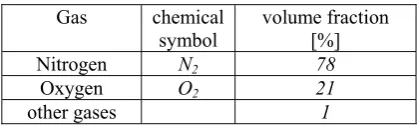
Dry air can be considered as an ideal gas in the wider area around the atmospheric conditions. For the needs of aviation, the composition of dry air was adopted according to Table 1 by the international convention [1]. It is the standard used as a reference, especially for instrument calibration.
Table 1. Composition of dry air.
Gas chemical symbol
volume fraction [%]
Nitrogen N2 78
Oxygen O2 21
other gases 1
Basic physical and thermodynamic properties of dry air as the ideal gas:
- average molecular weight:
kmol kg M 28.9583
- specific gas constant:
K kg
J r
12 .
287
- isobaric specific heat capacity:
K kg
J cp
9 . 005
1
- isochoric specific heat capacity:
K kg
J cV
- Poisson ratio: N 1.399
A theoretical model of an ideal gas for dry air near atmospheric conditions is sufficient for working calculations. For the purposes of exact solutions, especially for scientific applications, it is appropriate to apply the theoretical model of semi-ideal or real gas for dry air. For cases of high pressure dry air (pressure above 1 MPa) and dry air at a higher temperature (the temperature above 250 °C) it is necessary to use the model of a real gas, for example NIST (National Institute for Standards and Technology, USA) [2].
Water is thermodynamically relatively complex matter. It is most widely used and best available medium for energy transfer. Therefore, extensive research concentrates and focused at her. For work of professionals are gradually approved documents by the International Association for the Properties of Steam (IAPWS) as a reference for determining the values of thermodynamic and thermophysical properties of water and steam. Important documents are:
• 1995 (Revision 2014) - Formulation of thermodynamic properties of ordinary water substance for general and scientific use (abbreviated IAPWS-95)
• 1997 - New international formulation of the thermodynamic properties of water and steam for industrial purposes (abbreviated IAPWS IF-97).
The equation of state for water and steam under those two documents are substantially distant ideal gas.
Basic physical properties of water and water vapour, according to [3]:
- molar weight:
kmol kg M 18.015
- specific gas constant:
K kg J r 26 . 461
- triple point:
the temperature of the triple point:
K T
C
t tr
o
tr 0.01 , 273.16
the pressure at the triple point: Pa
ptr 611.657
- critical point:
the temperature of the critical point: K T
C
t cr
o
cr 373.946 , 647.096
the pressure at the critical point: MPa
pcr 22.064
Thermodynamic behaviour of moisture occurring in a homogeneous moist air (it is water vapour) may be at normal atmospheric conditions described by the model of an ideal gas.
Basic thermodynamic properties of steam as an ideal gas:
- isobaric specific heat capacity:
K kg J cp 56 . 898 1
- isochoric specific heat capacity:
K kg J cV 56 . 398 1
- Poisson ratio: N 1.33
In field of conditions, when the moist air becomes a heterogeneous mixture, it is, when it begins to eliminate of moisture from the moist air in the form of liquid or solid phase, it is necessary to take into account the real properties (behaviour) of H20 when describing the properties of moisture.
For the thermodynamics of moist air it is very important determination of thermodynamic properties of water vapour at saturation limits.
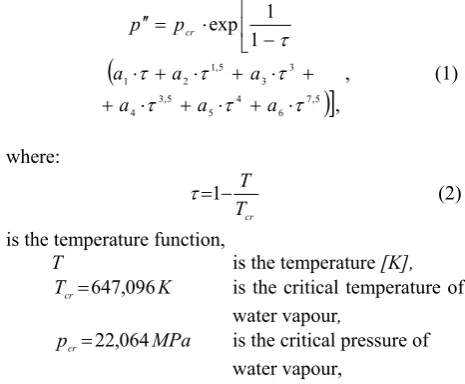
The dependence of the pressure of saturated steam at a temperature function on the saturation limit vapour-liquid from the triple point to the critical point determines the scientific formulation (IAPWS 95) [4]
@
, 1 1 exp 5 , 7 6 4 5 5 , 3 4 3 3 5 , 1 2 1 W W W W W W W « ¬ ª cc a a a a a a p p cr, (1)
where: cr T T 1
W (2)
is the temperature function,
T is the temperature [K], Tcr 647,096K is the critical temperature of
water vapour,
MPa
pcr 22,064 is the critical pressure of
water vapour,
theconstants in equation (1) are listed in Table 2.
Table 2. The constants in equation (1).
1
a a2 a3
83 517 7.59
1.84408259 11.7866497
4
a a5 a6
1 741
22.680 15.9618719 1.80122502
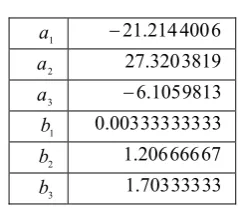
Pressure depending on the temperature from 50 K to the triple point on the saturation limit between the solid and gas phase H2O, it is for sublimation and desublimation, is solved according to equation [5]
¸ ¹ · ¨ © §
cc
¦
31 1 exp i i b i tr a p
p T T , (3)
where:
tr
T T
T (4)
is the temperature function
T is the temperature [K], K
Ttr 273.16 is the temperature of triple point of water,
Pa
ptr 611.657 is the pressure of triple point
the constants in equation (3) are shown in Table 3.
Table 3. The constants in equation (3).
1
a 21.2144006
2
a 27.3203819
3
a 6.1059813
1
b 0.00333333333
2
b 1.20666667
3
b 1.70333333
3 Moist air
Moist air as a thermodynamic system is a mixture of dry air and water substance. Moisture (water) contained in the moist air is always in the form of steam, but also (in the case of a heterogeneous mixture) may be part of the moisture in the moist air also in a state of liquid or solid.
The object of this paper is to find a boundary at which ends the existence of moisture in the air only in the form of steam.
The temperature of the moist air t
> @
oCMA is equal to
the temperatures of its components
tMA tDA tV t. (5)
The pressure of the moist air pMA
> @
Pa according toDalton's law is equal to the sum of the partial pressures of dry air and water vapour
pMA pDApV. (6)
The weight of the moist air mMA
> @
kg ismMA mDAmH2O. (7)
The density of the moist air
»¼ º «¬ ª
3 m kg
MA
U is a ratio of
weight of moist air to its volume, it is assuming that the moisture in humid air only as vapour
UMA UDAUV. (8)
The pressure of saturated steam pVcc
> @
Pa is for moistair a significant magnitude determining the limit among of moisture in the air for the existence of a homogeneous mixture:
- if pVpVcc, the humid air is unsaturated and the
mixture is homogenous,
- if pV pVcc, the humid air is saturated and the mixture is
homogenous,
- if pV!pVcc, the humid air is supersaturated and the
mixture is heterogeneous.
The pressure of saturated steam is an unequivocal function of temperature
pVcc pVcc t , (9)
(see equations (1), (3))
Dew point temperature t
> @
oCDP is the temperature of
moist air, in which the humid air reaches the saturation state after isobaric cooling
pV t pVcc tDP , (10)
it is when all water as vapour, which is contained therein, is in a state of saturated steam.
Absolute humidity of moist air
»¼ º «¬ ª
3 m kg
a is the mass
of vapour contained in a unit volume of air. It is the density of vapour UV at a pressure of vapour pV and at
the temperature t. Absolute humidity is defined only for a homogeneous mixture, and can be at a given temperature at the range 0;UVcc. t .
Relative humidity of moist air M
> @
is the ratio of the absolute humidity to the absolute humidity of saturated air at a given temperaturea
a cc
M . (11) Relative humidity is defined only for a homogeneous
mixture and can at the range 0;1 . Assuming that the
water vapour containing in the humid air can be
described by the model of an ideal gas
V V
p p cc
M . (12)
Specific humidity » ¼ º « ¬ ª
DA V
kg kg
x is the ratio of the mass
of water to the weight amount of dry air
DA O H
m m
x 2
. (13)
In the case of a homogeneous mixture the contained moisture is in vapour form and
DA V
DA V
m m x
U
U . (14)
In the supersaturated air, it is heterogeneous mixture, a part of moisture is as saturated steam and the remaining moisture will be excluded. For t > 0 °C will be portion of the moisture
xc xxcc (15) excluded as a liquid. For t < 0 °C, a portion of the moisture
xccc xxcc (16) will be excluded as solid phase. For t = 0 °C may be part of the moisture excluded as a liquid phase and a part as a solid phase
xcccxc xxcc. (17)
If the moist air forms a homogeneous mixture and its components (dry air and steam) can be described by the model of an ideal gas, it is possible to derive the relationship between the specific and the relative humidity
0,622 .
V MA
V
DA V
p p
p x
cc
cc
M M U
U
(18)
For specific humidity of saturated homogeneous mixture
M 1t x t p
p t p x
V MA
V cc
cc
cc
4 Equilibrium
p - t
and
t - x
diagrams for
moist
air
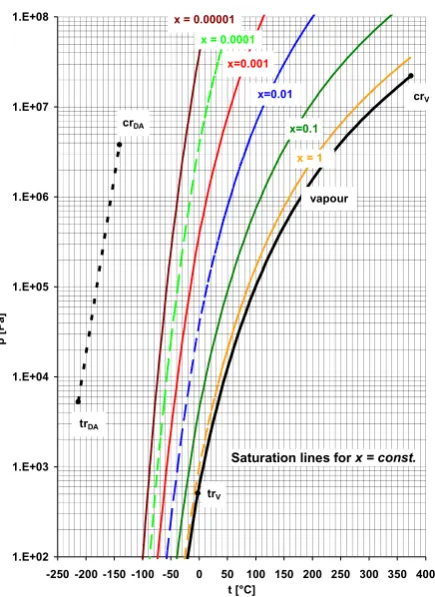
For a given value of specific humidity of moist air it is possible to solve the dependence of the pressure of saturated moist air on the temperature from equations (19) and (1) respectively (3), it means the curve at steady
p - t diagram (with parameter specific humidity x) at which there occur the elimination of moisture from humid air, see Figure 1. In the diagram there is marked the triple point for the dry air - trDA , the critical point for the dry air - crDA , the saturation line of the vapour with the triple point for the vapour - trV and the critical point for the vapour - crV and curves of pressure of saturated
moist air on the temperature for selected values of specific humidity x. Figure 2 is a detail of p - t diagram which is thus a tool for displaying the state of moist air and the equilibrium processes in moist air, and for distinguishing whether the moist air is a homogeneous or heterogeneous mixture.
Saturation lines for x = const.
1.E+02 1.E+03 1.E+04 1.E+05 1.E+06 1.E+07 1.E+08
-250 -200 -150 -100 -50 0 50 100 150 200 250 300 350 400 t [°C]
p [Pa]
x=0.1
x=0.01 x=0.001
x = 0.0001
x = 1
vapour
x = 0.00001
crDA
trDA
crV
trV
Fig 1. Curves of saturated moist air for different values of specific humidity x [kgV/kgDA]in p – t diagram.
For a given value of the pressure of moist air it is possible to solve the dependence of the temperature of saturated moist air on specific humidity from equation (19), it means the curve in the t - x diagram (with parameter total pressure pMA) at which there occur the elimination of moisture from humid air, see Figure 3. Such a diagram is a tool for displaying the state of moist air and the equilibrium processes in humid air, and for distinguishing whether the humid air is a homogeneous or heterogeneous mixture.
It should be noted that for the pressures and temperatures greatly differing from normal atmospheric conditions is no longer possible to describe the components of the moist air by a model of ideal gas and the shape of the curves of saturation would deviated in
p - t and t - x diagram from the ideal shapes counted on the basis of these simplifying assumptions in paragraph 2.
Saturation lines for x = const.
1.E+04 1.E+05 1.E+06
-50 0 50 100 150 200
t [°C]
p [Pa]
x = 0.1
x = 0.01 x = 0.001
x = 0.0001
x = 1
vapour x = 0.00001
Fig. 2. Curves of saturated moist air for different values of specific humidity x [kgV/kgDA]in p – t diagram (detail).
5 Basic reversible processes in
unsaturated moist air of unchanging
composition
In moist air different thermodynamic processes can run. Under certain conditions the originally unsaturated - homogeneous - moist air can get on the border between homogeneous and heterogeneous mixtures during thermodynamic process, it is to the state of saturated moist air. The above-mentioned diagrams can be used for finding those conditions advantageously.
To the equilibrium p - t diagram can be drawn isochoric network, it is lines of constant specific volume of moist air (dashed curves in Figure 4), respectively isentropic network, it is lines of constant entropy moist air (dotted curves in Figure 4).
displayed as vertical line, whose position is determined by the value of its specific humidity. When isobaric heating (temperature increase), the amount of moisture which may contain a homogenous moist air, increases, the saturation therefore can not occur. Conversely, when cooling, the quantity of moisture which may contain homogeneous moist air decreases, i.e. when a certain temperature value is achieved, the moist air becomes saturated. The value of this temperature can be easily detected from any of the diagrams.
-100 -50 0 50 100 150 200 250 300 350 400
0.0001 0.001 0.01 0.1 1
x [kgV/kgDA]
t [
°C
]
100 MPa
10 MPa
1 MPa
0.1 MPa
0.01 MPa
The limit curves of the solubility of water vapour in the air
Fig. 3. The curves of saturated moist air for different values of the total pressure pMA in the t - x diagram.
If the isothermal process carried in the unsaturated moist air, it can be displayed in the p - t diagrams in Figure 1, Figure 2 and Figure 4, as a vertical line (t = const.). If it is an isothermal expansion, the process runs in diagrams toward "down", it is to the lower pressure values, conversely, isothermal compression toward "up". In t - x diagram on Figure 3 is each isothermal process displayed as a single point, given by the temperature and composition. When isothermal expansion (pressure reduction), the amount of moisture which may contains homogeneous moist air, increases, saturation can not occur. Conversely, when isothermal compression (pressure increase), the quantity of moisture which may contain homogeneous moist air decreases, it is when a certain pressure value is achieved, the moist air becomes saturated. The value of this pressure can be easily detected from any of the diagrams.
Isochoric processes occurring in the unsaturated moist air are shown in Figure 4 as a set of dashed lines - isochors (v = const.). If it is an isochoric heating, the process runs in diagrams "to the right and up", it is to the higher temperature values and higher pressure values,
conversely, isochoric cooling runs in diagrams "to the left and down". When isochoric heating (temperature increase), the amount of moisture which may contain a homogenous moist air, increases, the saturation therefore can not occur. Conversely, when cooling, the quantity of moisture which may contain homogeneous moist air decreases, it is when a certain temperature value is achieved, and the moist air becomes saturated. The value of this temperature can be easily detected from diagrams in Figure 4.
1.E+04 1.E+05 1.E+06 1.E+07
-20 0 20 40t [°C] 60 80 100
p [P
a
] x = 0.1
x = 0.01 x = 0.001
v = const.
s = const.
Fig. 4. The curves of saturated moist air for different values of specific humidity x [kgV/kgDA] in the p - t diagram
supplemented with network of isentropic lines (dotted curves) and isochoric lines (dashed curves).
Isentropic processes occurring the unsaturated moist air are shown in Figure 4 shows a set of dotted lines - isentropic lines (s = const.). If it is an isentropic compression, the process runs in diagrams toward "up and right", it is to the higher pressure values and higher temperature values, conversely, isentropic expansion toward "down and left". When isentropic compression (pressure increase), the amount of moisture which may contains homogeneous moist air, increases, saturation can not occur. Conversely, when isentropic expansion (pressure reduction), the quantity of moisture which may contain homogeneous moist air decreases, it is when a certain pressure value is achieved, the moist air becomes saturated. The value of this pressure can be easily detected from diagrams in Figure 4.
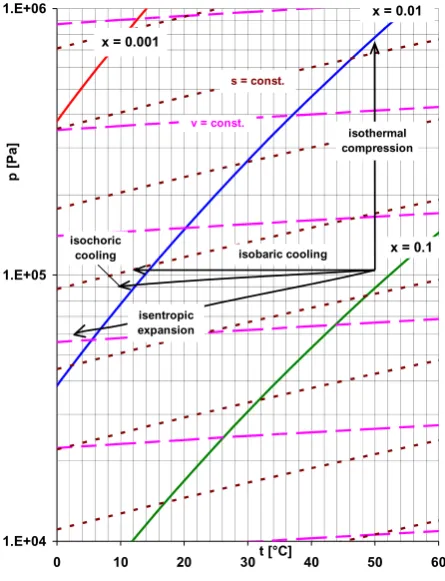
For illustration, the particular processes are compared in p - t diagram in Figure 5: It is assumed unsaturated moist air at 50 °C, 100 kPa and a specific humidity
saturation is achieved at about 12 °C, the pressure is about 90 kPa. If the isentropic process proceeds in this moist air, the state of saturation is reached by air expansion to a pressure of 55 kPa and a temperature of
5 °C. If the isothermal process proceeds in this moist air, the state of saturation is reached by air compression to a pressure of 600 kPa.
1.E+04 1.E+05 1.E+06
0 10 20 30t [°C] 40 50 60
p [
P
a
]
x = 0.1 x = 0.01
x = 0.001
v = const.
s = const.
isothermal compression
isobaric cooling
isentropic expansion isochoric
cooling
Fig. 5. The curves of saturated moist air for different values of the total pressure pMA in the p - t diagram
supplemented with network of isentropic lines (dotted curves) and isochoric lines (dashed curves). (Detail with illustrative examples) (Specific humidity x [kgV/kgDA]).
Conclusions
Assuming ideal behaviour of the gaseous components of moist air (dry air and water vapour) there were constructed diagrams (equilibrium p - t diagram and t - x
diagram) allowing for experimental and numerical investigation of the processes in the humid air easily to find a boundary at which the existence of moisture air only as vapour ends. Upon reaching this limit (it is upon reaching the states lying on curves of saturation in the diagrams), the moisture begins exclude from the moist air, it is moist air becomes the heterogeneous mixture, which is illustrated in the cases of the isobaric cooling, isothermal compression, isochoric cooling and isentropic expansion for x = const. in unsaturated moist air.
Acknowledgment
This publication was written at the Technical University of Liberec, Faculty of Mechanical Engineering with the support of the Institutional Endowment for the Long Term Conceptual Development of Research Institutes, as
provided by the Ministry of Education, Youth and Sports of the Czech Republic in the year 2016.
The second author, P.Šafaík, expresses thanks for support from the Technology Agency of the Czech Republic in the frame of the Competence Centre Advanced Technology of Heat and Electricity Output, No.TE01020036.
References
1. International Standard Atmosphere, ISO 2533:1975, International Organization for Standardization, (1975)
2. Lemmon, E.W., Jacobsen, R.T., Penoncello, S.G., Friend, D.G., Thermodynamic Properties of Air and Mixtures of Nitrogen, Argon, and Oxygen from 60 to 2000 K at Pressures to 2000 MPa, Journal of Physical and Chemical Reference Data, Vol. 29, No. 3: 331-385 (2000)
3. O.Šifner, J.Klomfar, International Standards of Thermophysical Properties of Water and Steam (in Czech) (1996)
4. IAPWS: Revised Release on the IAPWS Formulation 1995 for the Thermodynamic Properties of Ordinary Water Substance for General and Scientific Use (2014)