More on Correcting Errors in RSA Private
Keys: Breaking CRT-RSA with Low Weight
Decryption Exponents
Santanu Sarkar and Subhamoy Maitra
Applied Statistics Unit, Indian Statistical Institute, 203 B T Road, Kolkata 700 108
[email protected],[email protected]
Abstract. Several schemes have been proposed towards the fast encryp-tion and decrypencryp-tion in RSA and its variants. One popular idea is to use integers having low Hamming weight in the preparation of the decryp-tion exponents. This is to reduce the multiplicadecryp-tion effort in the square and multiply method in the exponentiation routine, both in encryption and decryption. In this paper we show that such schemes are insecure in CRT-RSA when the encryption exponent is small (e.g.,e= 216+ 1). In particular, we show that the CRT-RSA schemes presented in SAC 1996 and ACISP 2005 with low weight decryption exponents can be broken in a few minutes in certain cases. Further, the scheme of CT-RSA 2010, where the decryption exponents are not of low weight but they have large low weight factors, can also be cryptanalysed. To mount the attack, we exploit the heuristic proposed by Henecka et al (Crypto 2010) that is capable of correcting errors in the secret parameters when the encryp-tion exponent is small. In the process, we identify a few modificaencryp-tions of the error correction strategy that provides significantly improved experi-mental outcome and also beats the theoretical bounds given in the work of Henecka et al.
Keywords:CRT-RSA, Cryptanalysis, Error Correction, Exponents, Hamming Weight, RSA.
1
Introduction
In the seventies, the path-breaking idea of public key cryptosystem has been introduced by Diffe and Hellman [5] and as an outstanding follow-up, RSA public key cryptosystem [19] has been proposed by Rivest, Shamir and Adleman. RSA is undoubtedly the most attractive research area in cryptology with immediate applications in practice.
Before proceeding further, let us briefly explain the RSA public key cryp-tosystem. In RSA, a large integer N is generated such that N = pq, where p, q are primes of same bit lengths. The encryption and decryption exponents are denoted by e, d respectively and they are chosen in such a manner that ed ≡ 1 modφ(N), where φ(N) = φ(pq) = (p−1)(q−1), the Euler’s totient function. The parameters e, N are distributed as the public key and the partd is kept secret. In the encryption process, we haveC=MemodN, whereas, the
decryption is performed asM =CdmodN.
It is clear that the cost of modular exponentiation can be reduced if one can reduce the exponentse, d. However,ed > φ(N) provides the constraint that one cannot make bothe, dsmall. For any integerx, let us denote its bit-length as`x
and thus`e+`d≥`N. Towards making the decryption process faster, the secret
decryption exponentdhas to be made small. In this direction, using the idea of continued fraction, Wiener [20] showed that whend < 13N14, one can factor N
efficiently. Later, using lattice based techniques, this result has been improved by Boneh and Durfee [3, 2] till the upper boundN0.292. To achieve further efficiency during encryption process, smalleis considered. Coppersmith [4] has shown that RSA with very small e, e.g., e= 3 is not secure. For practical purposes, little larger encryption exponents are used. For example, it is a common practice to usee= 216+ 1 and it is believed to be quite secure. Given smalle,dbecomes of the order ofN, and the decryption process will be much less efficient than the encryption.
To achieve further efficiency during the decryption process, Wiener [20] pre-scribed use of Chinese Remainder Theorem (CRT) that has earlier been studied by Quisquater and Couvreur [18]. This is known as CRT-RSA. In CRT-RSA, one uses dp = dmod (p−1) and dq =dmod (q−1), instead of d, for the
de-cryption process. This is the most widely used variant of RSA in practice, and decryption becomes more efficient if one pre-calculates the value of q−1modp. Thus, in PKCS [16] standard for the RSA cryptosystem, it is recommended to store the RSA secret parameters as a tuple (p, q, d, dp, dq, q−1modp). For
all the cryptanalytic strategy we mention here, the term q−1modpcould not be exploited. Thus, in this paper, we will refer the secret key of RSA as a tu-ple SK = (p, q, d, dp, dq). Let us now discuss the cryptanalytic results related
to CRT-RSA. The birthday attack has been pointed out by Pinch (as referred in [17]) in case of very smalldp, dq (one may also have a look at [15]). Further,
ifdp, dq < N0.073, one can factorN in polynomial time [10]. In [9], it has been
shown that CRT-RSA is weak if dp−dq is known and dp, dq are smaller than
N0.099. Broadly speaking, it is easy to see that CRT-RSA can be broken inO(e) time ifdp−dq can be obtained with small effort.
used in several papers. In such a case, the multiplication effort will be reduced a lot in square and multiply algorithm. Initially Lim and Lee [13] considered the RSA keys with relatively low Hamming weight of the decryption exponent d. Later, Galbraith et al [6] proposed a key generation algorithm for CRT-RSA. Using that idea, one can generate CRT-RSA modulus N which allows the cost of encryption and decryption to be balanced according to the requirements of the applications. For faster decryption, one can choosedp, dq with low Hamming
weight. In this regard, Galbreath et al [6] mentioned ‘In some settings we may also want to choose the di to have low Hamming weight. This is easily done if
theki are small.’ Towards the security analysis, for smalle, the estimated time
complexity to attack such a scheme [6] has been presented asO√wdp
`dp/2
wdp/2
,
where wx is the Hamming weight of the binary representation of the integerx.
In line of the work of [6], another efficient scheme has been proposed in [14] that also relied on large low weight factors in the decryption exponent dp, dq.
The security analysis of [14] show that the exhaustive search for the low Ham-ming weight factors in the decryption exponents is an approach to attack such a scheme.
To the best of our knowledge, there has been no cryptanalytic result on the security of such schemes so far. For the first time, in contrary to the claims in [13, 6, 14], we show that the ideas exploiting low weight integers in the secret decryption exponents, can be broken much faster. The basic technique we use in this paper is the work of [7] related to error correction of RSA secret key. In Crypto 2010, Henecka et al [7] studied the case when the bits of SK were known with some error probability for each bit. We refer a noisy version ofSK as SK˜ , i.e., SK˜ = (˜p,q,˜ d,˜d˜p,d˜q). That is, each bit of the parameters in SK
is considered to be flipped with some probability δ ∈ [0,12). The authors [7] could show that one can correct the errors in the secret key (i.e. recover the secret key) in polynomial time (for small e) when the error rate δ is less than 0.237,0.160,0.084 when noisy versions of (p, q, d, dp, dq) or (p, q, d) or (p, q) are
available.
The algorithm presented in [7] guesses the bits of one of the primes and then uses the reconstruction technique for cold-boot attack in [8] as to get approxima-tions of the other parameters inSK. The verification of each guess is achieved by comparing the Hamming distance of the guess with the erroneous version ofSK obtained through side-channel attacks. This is equivalent to pruning the search space towards the correct solution, and hence higher bit-error can be corrected if one uses more parameters fromSK during the pruning phase.
In CRT-RSA situation, we have edp ≡1 mod (p−1). Thus, one can write
edp = 1 +kp(p−1) where kp < e. Similarly we have edq = 1 +kq(q−1)
where kq < e. For small values of e, one may assume kp, kq are known to the
attacker in O(e) time complexity as we explain in Section 2. In general, for a randomly chosen integer x, we havewx≈ `2x. However, for efficient decryption, sometimes wdp, wdq are taken significantly smaller than the random case. For
example, consider that `dp =`dq = 512 andwdp, wdq ≈50. In such a scenario,
dp, dq, where the error rate is around51250 ≈10%. As the error rate is significantly
small, one can apply the error correcting algorithm of [7] to recover the secret key. Denoting the time complexity of the error-correction algorithm [7] asτ, our strategy attacks the schemes [13, 6] inτ O(e) time, and the scheme [14] inτ O(e3) time.
While attacking the schemes [13, 6, 14], one can attempt to recover all the bits ofpas it is done for the error correcting algorithm in [7]. However, one can also try to construct only the least significant half ofpusing the same strategy and then use the lattice based result of [1] to get the complete p. While describing the experimental results, we present separate data for constructing all the bits ofpand only least significant half ofp.
While applying the heuristic [7], we noted a few modifications that can im-prove the performance significantly and the central idea is as follows. This is explained in detail in Section 3. Instead of a single fixed threshold related to bit-matching in [7], we use multiple thresholds towards the motivation that we involve several constraints on the secret parameters in our case whereas a single constraint has been taken into consideration in [7]. We present detailed experi-mental results to show the improvement achieved incorporating our ideas.
Contribution of this paper:In Section 2, we efficiently exploit the error cor-rection strategy of [7] to show that CRT-RSA schemes that involve low weight secret parameters are not secure. We could break CRT-RSA based schemes of [13, 6] with certain parameters in a few minutes and present cryptanalytic results on the scheme presented in [14]. Further, in the process, we provide modifications to the error correction heuristic of [7] that provides significantly improved ex-perimental results. This is presented in Section 3. Thus the contribution of this paper is two-fold.
To present a glimpse of our improvement, let us provide a brief comparison of our results1 with that of [7] in Table 1.
Parameters Upper bound ofδ[7] Success probability (expt.) upper bound ofδ
theoretical experimental [7] our achieved in our expt. (p, q) 0.084 0.08 0.22 0.61 0.12 (p, q, d) 0.160 0.14 0.15 0.52 0.17 (p, q, d, dp, dq) 0.237 0.20 0.21 0.50 0.25
Table 1. Experimental results of [7] with maximum possible δ as available from [7, Section 6, Tables 2, 3, 4].
1
2
The idea of Cryptanalysis
We start with the basic relations of CRT-RSA, such asedp = 1 +kp(p−1)⇒
kp−1 ≡ kppmode, and edq = 1 +kp(q−1) ⇒ kq −1 ≡ kqqmode. From
these we get kq ≡(kp−1) (kp(1−N)−1)−1mode. Since bothkp, kq < e and
from the above equation a choice ofkp fixeskq, there areO(e) possible choices
for the pairs (kp, kq). As we have assumed, the Hamming weight of dp, dq are
considered to be significantly lower than the random case. Further, the presence of 1’s in the binary representation ofdp, dq are considered to be i.i.d. For better
explanation, from now on, we will assume thatkp, kq are known to the attacker
and finally the complexity of the attack will be obtained by multiplying anO(e) factor, unless mentioned otherwise.
Our idea is to guess a few bits (sayamany bits) ofpfrom the least significant side and let the corresponding integer bep0. Fromp0, we get an approximationq0 ofq. Fromp0, q0 and using the knowledge ofe, kp, kq, we obtain the
approxima-tions ofdp, dq, that we denote byd0p, d0q respectively. If the Hamming weights of
d0p, d0q are less than some predefined threshold, thenp0would be a possible choice of p. This process will be repeated until we have obtained a setA of possible guessesp0forp. Then we extend the solutions by addingamore bits in the more significant side with the possible partial solutions in A. The process continues till we get a set of possible solutions for pitself.
In Algorithm 1, we present the algorithm formally. For that we need to use certain notations. For two integers x, y, by xky we denote the integer formed by the concatenation of the binary representations ofx, y. We also consider the notation XkY ={xky : x ∈X, y ∈ Y}. Steps 4 and 5 in Algorithm 1 can be calculated efficiently using the relations [7, Equations (8), (10), (11)].
Input:N, e, kp, kq anda, C
Output: SetA, containing possible guesses forp.
Initializeb= 0, A=∅, A−1=∅; 1
whileb <`N
2 do 2
A={0,1}ak A−1; 3
For each possible optionsp0∈A, calculateq0= (p0)−1Nmod 2b+a; 4
For eachp0, q0, calculate
5
d0p= (1 +kp(p
0−
1))e−1mod 2b+a, d0
q= (1 +kq(q
0−
1))e−1mod 2b+a;
If the number of 0’s taking together the binary patterns ofd0p, d0q in the 6
positionsbtob+a−1 from the least significant side is less thanC, then deletep0 fromA;
Ifb6= 0 andA=∅, then terminate the algorithm and report failure;
7
A−1=A;b=b+a; 8
end ReportA;
9
2.1 Cryptanalysis of [13, 6]
In [13, 6], CRT-RSA secret keys are generated in a manner such that the weights of dp, dq are small. By δ we denote the probability that a bit ofdp or dq is 1.
Thus,δcan be estimated as wdp
`dp or wdq
`dq . Following the theoretical results of [7],
we immediately get the following.
Theorem 1. Let a = dln`N
42 e, γ0 = q
(1 +1a)ln 24 and C = a+ 2aγ0. We also consider that the parameterskp, kq of CRT-RSA are known. Then one can obtain
p in timeO(l2+
ln 2 22
N ) with success probability greater than 1−
22
ln`N −
1
`N if δ≤
1
2−γ0−.
Proof. One can exactly follow different parts of the proof of [7, Main Theorem 3] to get this result. Following [7, Lemma 4], in each step, the expected value of |A|cannot exceed 2a+1. We consider only two parametersd
p, dq are known and
the all zero patterns are the noisy versions. Then, following [7, Lemma 5], one
can calculate the success probability. ut
To maximize δ, we need that should converge to zero and in such a case a tends to infinity. Then the value ofγ0 converges to 0.416. Thus, asymptotically Algorithm 1 works when δ is less than 0.5−0.416 = 0.084. However since in this case abecomes very large, the algorithm will not be efficient and may not be implemented in practice. This is the reason, experimental results could not reach the theoretical bounds in [7].
Generally,dp, dq are taken to be of same bit size which is equal to `2N. Thus,
following the idea of Theorem 1 above, one can cryptanalyze CRT-RSA having wdp, wdq≤0.04`N inO(e·poly(`N)) time. For each possible option ofkp, kq (this
requires O(e) time), one needs to apply Algorithm 1 to obtain p. It is indeed clear that for smallethe attack remains efficient.
In [13, Page 9, end of paragraph 3], example parameters have been pro-posed, where`N = 768,`dp= 384 andwdp= 30. This falls under the condition
mentioned above and we could cryptanalyze all the CRT-RSA keys with such parameters in a few minutes in practice. In another example [13, Table 2, Sec-tion 7], it has been considered that `N = 768, `dp = 377 and wdp = 45 and
e = 257. In this case δ = w`dp
dp ≈0.12> 0.08, and thus it is not in the bound
given in Theorem 1 and so Algorithm 1 would not work as it is. However, in the next section (Section 3) we will present some modifications over Algorithm 1 to get Algorithm 2 that provides significantly improved results experimentally than what presented in Theorem 1. That helps us in easily breaking CRT-RSA with the above mentioned parameters in a few minutes again.
In [6, Figure 1], parameters are proposed as (`e, `dp, `kp) = (176,338,2) with
wdp = 38. Note that in this situation, one could easily obtainkp and kq, even
2.2 Cryptanalysis of [14]
In [14], the CRT-RSA decryption exponentsdp, dq have been chosen in a slightly
different manner. Here the weight ofdp, dq are not small, but they are of the form
dp =dp1dp2 and dq =dq1dq2. The factorsdp1 and dq1 are of size O(e) and the
other factorsdp2 ofdp anddq2 ofdq are of significantly small Hamming weight.
So, in this case we have edp1dp2 = 1 +kp(p−1) and edq1dq2 = 1 +kq(q−1).
There areO(e2) choices ofd
p1, dq1. Sincekq ≡(kp−1) (kp(1−N)−1) −1
mode, withinO(e3) many attempts one can get the correct choice of (d
p1, dq1, kp, kq).
Hence one can consider that the attacker knowsdp1, dq1, kp andkq, perform the
attack and then multiply the effort byO(e3) to get the total time complexity of the cryptanalysis. Letamany LSBs ofpbe known andp0 be the corresponding integer. Then a many LSBs of dp2, dq2 can be obtained through the following
identities:
dp2≡(edp1)
−1(1 +k
p(p0−1)) mod 2a,
dq2≡(edq1) −1
1 +kq N(p0)−1mod 2a−1
mod 2a. (1)
We use the Equation (1) in step 5 of the Algorithm 1 instead of what is given there towards the cryptanalysis of [14]. Here`dp2 ≈
`N
2 −`e. Thus, whenwdp2, wdq2 ≤
0.08 `N
2 −`e
, one could cryptanalyze the CRT-RSA scheme with the
parame-ters proposed in [14] in timeO(e3`2+ln 222
N ).
Five challenges have been presented in [14], wheree= 216+1,`
N = 1024 and
wdp2 =wdq2 = 40. As bothdp1anddq1are ofO(e),`dp2 ≈`dq2 ≈512−16 = 496.
Hence δ = 49640 ≈ 0.08. Thus, the proposal of [14] can be cryptanalysed using Algorithm 1 with a modification in step 5 as described above.
Let us now explain the efficiency of our cryptanalysis on the proposal of [14] as we could not break it in real time as had been done on the examples of [13, 6]. Note that foreas described in [14],e3 is around 248 and that many runs of Algorithm 1 or Algorithm 2 are required.
The parameters of [14] are so chosen that if one tries to go for an exhaus-tive search, then it will require around 294 effort. Based on this, it has been claimed [14] that such a scheme is secure as the best possible factorization strat-egy using NFS [12] requires around 286 time complexity and one cannot attack the scheme in a lower complexity than that.
Now we show that one can indeed attack the scheme of [14] in a time complex-ity much less than 286. One can implement the attack with all possible values of dp1, dq1, kp, kq that requires 2
48many invocations of Algorithm 1 or Algorithm 2 when e is 16-bit integer. As Algorithm 2 works significantly better than Algo-rithm 1, we estimate the time complexity of each invocation of AlgoAlgo-rithm 2. Given a block length a= 10, to getp, we need d512
3
Heuristics for further improvement of the error
correction algorithm [7]
The theoretical bounds on the noise rateδin [7] for whichSKcan be recovered from a noisy version of it are as follows: (i) δ < 0.237, when ˜p,q,˜ d,˜d˜p,d˜q are
available, (ii)δ <0.160, when ˜p,q,˜ d˜are available, and (iii)δ <0.084 when ˜p,q˜ are available. However one cannot achieve these bounds due to high length of the block size. The experimental bounds achieved in [7, Section 6, Tables 2, 3, 4] are presented as 0.20, 0.14 and 0.08 for cases 1, 2 and 3 respectively with success probability less than 0.25. In this section we explain certain heuristics to improve these experimental results significantly. We present experimental results having error rates better than the theoretical upper bound of [7]. This we get for the parametera= 10 which is much lower than the values used in the experiments of [7] and increasingain our strategy improves our results further. Let us now present the broad ideas behind our improvements.
Different values of the threshold C. Instead of one fixed thresholdC, we take different thresholds in different steps, that depend on the valueb+a. During the pruning, we count the number of bits at which the noisy parameters and the possible solutions match for the positions 0 to b+a−1. Thus the number of comparison for each parameter is (b+a) at each step and then based on that we decide whether we will accept or reject a solution. Thus we consider a cumulative measure, where for the initial steps, the bit strings compared are of the lesser size and as the solution grows, the bit strings in comparison are of larger size. The threshold parameters are chosen based on the error rate and length of the the-then solutions (which are actuallyb+aat that point of time).
Multiple constraints on each round.Instead of considering the total number of mismatched bits for each component of the secret key, all possible constraints are considered at the same time in our strategy. Suppose we want to factor N =pq where p, q are available with some noise. Consider an instance of the algorithm where we have reached up to the bit positioni.
For proceeding further, let us have a few notations. For an integerx, byx[i], we denote the i-th least significant bit of x. Further, byx[i], we mean the bit-string x[i], x[i−1], . . . , x[1], x[0] and this will also be interpreted as an integer. As example, for a prime, say,p= 23, we have the binary representation 10111 and thus,p[3]= 0111, which is 7 as an integer.
Let the number of matched bits between the partial solution p0 and the
corresponding bits of the noisy version ˜p, i.e., ˜p[i] be µ1 and for q0 and ˜q[i] be µ2. We impose constraints on both the values ofµ1, µ2along withµ3=µ1+µ2 to achieve better pruning. In [7], the pruning was applied on the sum of the individual values only. Here, in case of m many components of the secret key, total number of constraints in each iteration would bePm
i=1
m i
= 2m−1. When
we work with the five parametersp, q, d, dp, dq, we use a total of 31 constraints
Suppose that the secret key has m components. For the l-th component (1 ≤l ≤m) of the key, let µ2l−1 denote the number of matched bits between
the partial solution and the noisy version of the component at the corresponding bits. Then for each individual component, numbers of matched bits are given by{µ1, µ2, µ4, . . . , µ2m−1}respectively. Now, for any general k∈[1,2m−1], we
define the term µk as follows: µk = Pmi=1kiµ2i−1, where ki are the bits of k
for 1 ≤ i ≤ m. Thus the total number of matched bits in all components of the secret key is given byµ2m−1=Pmi=1µ2i−1. In practice, when we work with
m= 5 parametersp, q, d, dp, dq of the secret key,µ31=µ1+µ2+µ4+µ8+µ16
represents the cumulative sum of matched bits between the partial solution and corresponding bits of the noisy version for all parameters.
Value of threshold parameters and its run-time modifications.For each µi, we choose the value of the threshold Cia+b depending upon the noise rate
δ and the value of a+b at that stage. For a fixed noise rate δ, we choose the minimumCia+b such that
Cai+b
X
j=1
w
i(a+b)
j
δj(1−δ)a+b−j> ν, (2)
where wi is the Hamming weight of i as we have mentioned earlier. In the
experiments we take ν = 0.99 for a+b < 150 andν = 0.98 for a+b ≥150. We choose the thresholds like this so that the possibility of rejecting a correct partial solution remains very low. It is clear that one cannot allow the size of A to increase exponentially. Thus one needs to keep some upper bound on|A| while running the algorithm. Let |A| be restricted by a constant upper bound B. Considermsecret parameters and take certain threshold for eachµi. While
creating the set A from A−1 in a loop, if |A| > B, we reduce C2am+−b1 by 1.
One may ask, why do we reduce only the threshold corresponding toµ2m−1 =
µ1+µ2+. . .+µ2m−1. We have tried in manipulating other thresholds as well, but
found that this is quite an effective idea to obtain good experimental results. The study of such thresholds and their modifications during the run of the algorithm is an interesting question and requires serious attention that is not in the scope of this work.
The modified algorithm.Based on the above discussion, our improved error correction strategy is presented below. We have presented the algorithm with all the five parameters ˜p,q,˜ d,˜d˜p,d˜q, though one can easily modify it for less number
of parameters.
Input:N, e, k, kp, kq
Input: ˜p,q,˜d,˜dp,˜ dq˜
Input:a, Band threshold parameters as described in (2). Output: SetA, containing possible guesses forp.
Initializeb= 0, A=∅, A−1=∅; 1
whileb <`N
2 do 2
A={0,1}ak A−1; 3
For each possible optionsp0∈A, calculateq0= (p0)−1Nmod 2b+a; 4
Calculated0= (1 +k(N+ 1−p0−q0))e−1) mod 2b+a;
5
Calculate
6
d0p= (1 +kp(p
0
−1))e−1mod 2b+a, d0
q= (1 +kq(q
0
−1))e−1mod 2b+a;
Calculateµi’s fori= 1 to 31 comparing least significantb+abits of the
7
noisy strings and the corresponding possible partial solution strings of lengthb+a, i.e., through the positions 0 tob+a−1;
Ifµi< Cia+bfor anyi∈[1, . . . ,31], delete the solution fromA;
8
If|A|> B, reduceC31a+bby 1 and go to Step 8; 9
Ifb6= 0 andA=∅, then terminate the algorithm and report failure;
10
A−1=A;b=b+a; 11
end ReportA;
12
Algorithm 2: Improved Error Correction algorithm.
4
Experimental Results
We have implemented Algorithm 2 using C programming language (with GMP library for processing large integers) on Linux Ubuntu 2.6. The hardware plat-form is an HP Z800 workstation with 3GHz Intel(R) Xeon(R) CPU. Our imple-mentation is not optimized and for each run the time required varied from a few seconds to a few minutes depending on the error rates. The time estimations presented in our tables are the averages of the time required in the successful runs only. In all the experiments, we take 1024-bit RSA with public exponent e= 216+1. We considera= 10 andB= 1000. For each experiment, we generate 20 different RSA secret keys and for each secret key, we generate 20 many noisy versions by incorporating independently and uniformly distributed errors with noise rateδ. So, we have a total of 400 samples.
First we go for only two parameters. This can be interpreted in two ways: (i) the noisy versions ofp, qare available with error rateδor (ii)p, qare completely unknown, but the weights of p, qare small, i.e., wp
`p ≈
wp
`p ≈δ.
with [7] as well as the success probability to obtain least significant half ofp, that is actually required for the attack. We refer the second one as success probability (half) in the tables. The error rate of the order of 0.08 could be achieved with success probability 0.22 in [7], and one may see in Table 2 that our results are significantly improved.
δ 0.08 0.09 0.10 0.11 0.12 0.13 Success probability 0.61 0.36 0.19 0.06 0.02
-Time (in seconds) 338.66 327.83 323.69 308.66 297.13 -Success probability (half) 0.71 0.55 0.41 0.23 0.13 0.08
Time (in seconds) 102.38 100.77 97.68 94.76 98.12 91.04
Table 2.Experimental results with Algorithm 2 with two parametersp, q.
δ 0.08 0.09 0.10 0.11 0.12 0.13 Success probability 0.59 0.27 0.14 0.04 -
-Time (in seconds) 307.00 294.81 272.72 265.66 - -Success probability (half) 0.68 0.49 0.25 0.18 0.08 0.02
Time (in seconds) 87.41 84.47 80.18 74.57 79.33 76.04
Table 3.Experimental results with Algorithm 2 with two parametersdp, dq.
In Table 3, we present experimental results related to our attack in Section 2. Takinge= 216+ 1, we have generated CRT-RSA secret exponentsdp, dq having
small Hamming weights using the idea of [6]. In Table 3, we present experimental results taking 5-bitkp, kq. The results in Table 3 is slightly worse than Table 2.
This is because in the least`kpmany bits ofdp, dq, the error rate is not small due
to the key generation algorithm of [6]. We obtained similar kinds of results for cryptanalysis of [14] too, with similar parameters as in the benchmark examples of [14, Appendix A]. However, in these cases, for practical experiments in a few minutes, we need to consider thatdp1, dq1, kp, kq are available. That is, the time
need to be multiplied by 248for actual attack, whene= 216+ 1, say.
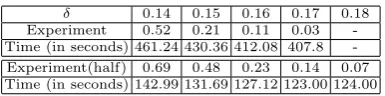
Next, in Table 4, we consider the case with three parameters p, q, d. When δ= 0.14, the success probability in [7, Table 3] has been reported as 0.15. The success probability using our modification is 0.52 in this scenario. Further we could demonstrate experimental results till δ = 0.17 which is better than the theoretical bound of 0.16 in [7].
δ 0.14 0.15 0.16 0.17 0.18 Experiment 0.52 0.21 0.11 0.03 -Time (in seconds) 461.24 430.36 412.08 407.8 -Experiment(half) 0.69 0.48 0.23 0.14 0.07 Time (in seconds) 142.99 131.69 127.12 123.00 124.00
Table 4.Experimental results with Algorithm 2 with three parametersp, q, d.
δ 0.20 0.21 0.22 0.23 0.24 0.25 Experiment 0.50 0.44 0.33 0.14 0.02 0.005 Time (in seconds) 699.82 639.16 607.23 580.45 540.10 502.00 Experiment(half) 0.70 0.58 0.55 0.31 0.12 0.065 Time (in seconds) 221.00 192.35 190.94 173.96 168.00 169.61
Table 5.Experimental results with Algorithm 2 with five parametersp, q, d, dp, dq.
5
Conclusion
In this paper, first we apply the recently proposed error correction strategy of se-cret keys for RSA [7] to actual cryptanalysis. We studied two kinds of schemes. The first one considers that the CRT-RSA decryption keys are of low weight as in [13, 6]. In these cases, we demonstrate complete break in a few minutes for 1024 bit RSA moduli. The next one considers the scenario when the de-cryption exponents are not of low weight, but they contain large low weight factors [14]. Though this scheme seems more secure than the ones in [13, 6], it is also prone to cryptanalysis with much lower complexity than what claimed by the proposers [14]. Further, we had a detailed look at the actual error correction algorithm of [7] and provided significant improvements as evident from exper-imental results. The experexper-imental results are better than the ones presented in [7] and more importantly, we could demonstrate that the theoretical bound of [7] can also be crossed using our heuristic. Our current implementation is only towards proof-of-the-concept. The results are expected to improve further after optimized implementation on which we are working now.
References
1. D. Boneh, G. Durfee and Y. Frankel. An Attack on RSA Given a Small Fraction of the Private Key Bits. In Proceedings of Asiacrypt, volume 1514 of Lecture Notes in Computer Science, Springer, pages 25–34, 1998.
2. D. Boneh and G. Durfee. Cryptanalysis of RSA with private key less thanN0.292. In Proceedings of Eurocrypt, volume 1592 of Lecture Notes in Computer Science, Springer, pages 1–11, 1999.
3. D. Boneh and G. Durfee. Cryptanalysis of RSA with Private KeydLess Than
N0.292. IEEE Transactions on Information Theory, 46(4):1339–1349, 2000.
5. W. Diffie and M. E. Hellman. New directions in cryptography. IEEE Transactions on Information Theory, IT-22(6):644–654, 1976.
6. S. D. Galbraith, C. Heneghan and J. F. McKee. Tunable balancing of RSA. In Proceedings of ACISP, volume 3574 in Lecture Notes in Computer Science, Springer, pages 280–292, 2005. Available athttp://www.isg.rhul.ac.uk/~sdg/
full-tunable-rsa.pdf[last accessed December 8, 2011]
7. W. Henecka, A. May and A. Meurer. Correcting Errors in RSA Private Keys. In Proceedings of Crypto, volume 6223 in Lecture Notes in Computer Science, Springer, pages 351–369, 2010.
8. N. Heninger and H. Shacham. Reconstructing RSA private keys from random key bits. In Proceedings of Crypto, volume 5677 in Lecture Notes in Computer Science, Springer, pages 1–17, 2009.
9. E. Jochemsz and A. May. A Strategy for Finding Roots of Multivariate Poly-nomials with new Applications in Attacking RSA Variants. In Proceedings of Asiacrypt, volume 4284 in Lecture Notes in Computer Science, Springer, pages 267–282, 2006.
10. E. Jochemsz and A. May. A polynomial time attack on RSA with private CRT-exponents smaller thanN0.073. In Proceedings of Crypto, volume 4622 in Lecture Notes in Computer Science, Springer, pages 395–411, 2007.
11. A. Lenstra. Generating RSA Moduli with a Predetermined Portion. In Proceed-ings of Asiacrypt, volume 1514 in Lecture Notes in Computer Science, Springer, pages 1–10, 1998.
12. A. K. Lenstra and H. W. Lenstra, Jr., The Development of the Number Field Sieve, Springer-Verlag, 1993.
13. C. H. Lim and P. J. Lee. Sparse RSA Secret Keys and Their Generation. In Proceedings of (SAC), pages 117–131, 1996. Available athttp://dasan.sejong. ac.kr/~chlim/english_pub.html[last accessed December 8, 2011]
14. S. Maitra and S. Sarkar. Efficient CRT-RSA Decryption for Small Encryption Exponents. In Proceedings of CT-RSA, volume 5985 in Lecture Notes in Com-puter Science, Springer, pages 26–40, 2010.
15. A. May. New RSA Vulnerabilities Using Lattice Reduction Methods. PhD thesis, University of Paderborn, Germany, 2003.
16. Public-Key Cryptography Standards (PKCS) #1 v2.1: RSA Cryptography Stan-dard. RSA Security Inc., 2002. Available at http://www.rsa.com/rsalabs/ node.asp?id=2125.
17. G. Qiao and K.-Y. Lam. RSA Signature Algorithm for Microcontroller Imple-mentation. In Proceedings of CARDIS (1998), volume 1820 in Lecture Notes in Computer Science, Springer, pages 353–356, 2000.
18. J. -J. Quisquater and C. Couvreur. Fast decipherment algorithm for RSA public-key cryptosystem. Electronic Letters, 18:905–907, 1982.
19. R. L. Rivest, A. Shamir and L. Adleman. A Method for Obtaining Digital Signa-tures and Public Key Cryptosystems. Communications of ACM, 21(2):158–164, February 1978.
![Table 1. Experimental results of [7] with maximum possible δ as available from [7,Section 6, Tables 2, 3, 4].](https://thumb-us.123doks.com/thumbv2/123dok_us/7893506.1310060/4.595.146.471.478.525/table-experimental-results-maximum-possible-available-section-tables.webp)