Experimental Study on Partial Replacement of
Various Wastes in Concrete
Mankare Ulka S.¹, Asst.Prof.Ajay A. Hamne²
1,2
Department of Civil Engineering, M.S Bidwe Enginerring college,Latur (MS)
Abstract- This experimental study conducted to examine the potential of Bagasse ash as a cement replacing material which is similar to that of Portland Pozzolona Cement and Copper slag as a fine aggregate replacement material. Four different concrete mixes with the Bagasse Ash replacement of 0%, 5%, 10%, and 15% to the Portland Pozzolona cement and copper slag replacement of 0%,30%, 40% and 50% were prepared for M20 grade concrete with water to cement ratio of 0.46.The properties of these mixes have then been assessed both at the fresh and hardened state. The results of the present study depicts that up to 10% replacement of the Portland Pozzolona Cement by Bagasse ash and 40% replacement of the fine aggregate by Copper slag achieved a higher compressive strength, split tensile strength and Flexural strength and at all test ages of 7,and 28 days.
Keywords- Sugarcane Bagasse Ash, Copper slag, Compressive strength, split tensile strength, Flexural strength.
I. INTRODUCTION
Cement which is one of the ingredients of concrete plays a great role, but it is most expensive. Therefore requirements for economical and more environmental-friendly cementing materials have extended interest in other cementing material that can be used as a partial replacement of the normal Portland cement. Currently, there has been an attempt to utilize the large amount of bagasse ash, the residue from an in-line sugar industry and the bagasse-biomass fuel in electric generation industry..When this waste is burned under controlled conditions, it also gives ash having amorphous silica, which has pozzolanic properties. Therefore it is possible to use bagasse ash (SCBA) as cement replacement material to improve quality and reduce the cost of construction materials. The sugarcane bagasse consists of approximately 50% of cellulose, 25% of hemicellulose and 25% of lignin. Each ton of sugarcane generates approximately 26% of bagasse (at a moisture content of 50%) and 0.62% of residual ash. The residue after combustion presents a chemical composition dominates by silicon dioxide (SiO2). In spite of being a material of hard degradation and that presents few nutrients, the ash is used on the farms as a fertilizer in the sugarcane harvests. Sugarcane bagasse ash contains silica which provide pozzolanic property.
Copper slag is a massive metallurgical residue obtained from the transformation of copper ore concentrates into metallic copper in the smelters. Slags are deposited in landfills that occupy large areas of land. Their chemical composition is rich in iron, silicon and aluminum oxides and in their mineralogical composition, the presence of fayalite and magnetite, among other compounds is common. The main environmental impact produced by slag disposition is a change in land use and the visual pollution of the landscape. It is estimated that in the copper industry, for every ton of metallic copper production, approximately 2.2 tons of copper slag is generated and in the world, about 24.6 million tons of slag is produced annually. These metallurgical centers produced 2,360,000 metric tons of copper slag in the year 2002, leaving this waste deposited indefinitely as a hard floor, without current industrial utility.
II. LITERATURE REVIEW
Kawade et al. studied the effect of use of SCBA on strength of concrete by partial replacement of cement at the ratio of 0%, 10%, 15%, 20%, 25% and 30% by weight for compressive strength. If some of raw material having similar composition can be replaced by weight of cement in concrete then cost could be reduced without affecting its quality [25]. It was found that the cement could be advantageously replaced with SCBA up to maximum limit of 15%. Partial replacement of cement by SCBA increases workability of fresh concrete; therefore use of super plasticizer is not essential. All tests were done in accordance with American Standards.
compared to the control sample. It was also shown from the microstructure that the presence of bagasse ash definitely reduced the porosity of samples. Consequently, the bending strengths were improved for samples replaced with 30% bagasse ash . Ganesan et al. [2007] studied the effects of bagasse ash content as partial replacement of ordinary Portland cement on physical and mechanical properties of hardened concrete. They found that the bagasse ash was an effective mineral admixture, with 20% as optimal replacement ratio of cement.
Biruk Hailu et al.(2011) studied the application of sugarcane bagasse ash as a partial cement replacement material. OPC and PPC was replaced by sugarcane bagasse at different % ratio for M-35 concrete at w/c 0.55. The test results indicated that up to 10% replacement of OPC cement by bagasse ash results in better or similar concrete properties and further environmental and economical advantages can also be exploited by using bagasse ash as a partial cement replacement material.
Shruthi H R,Dr.H Eramma,Yashwanth M K,Keerthi gowda B S et al.(2013) observed that the experimental result for the 10% replacement of bagasse ash to OPC has increase in strength in comparison with 0% and 5% replacement. Beyond 10% replacement of bagasse ash, the strength was decreased. Copper slag is a by-product obtained during matte smelting and refining of copper. One of the greatest potential applications for reusing copper slag is in concrete production Concrete, is the most versatile construction material.
Al-Jabri et al (2009, 2011) investigated the performance of high strength concrete made with copper slag as a replacement for fine aggregate at constant workability and studied the effect of super plasticizer addition on the properties of High Strength Concrete made with copper slag. They observed that the water demand reduced by about 22% for 100% copper slag replacement. The strength and durability of High Strength Concrete improved with the increase in the content of copper slag of upto 50%. However, further additions of copper slag caused reduction in the strength due to increase in the free water content in the mix.
Biruk Hailu et al.(2011) studied the application of sugarcane bagasse ash as a partial cement replacement material. OPC and PPC was replaced by sugarcane bagasse at different % ratio for M-35 concrete at w/c 0.55. The test results indicated that up to 10% replacement of OPC cement by bagasse ash results in better or similar concrete properties and further environmental and economical advantages can also be exploited by using bagasse ash as a partial cement
replacement material.
Alnuaimi (2012) Use of copper slag (CS) as a replacement for fine aggregate (FA) in RC slender columns and observed that Replacement of up to 40% of FA with CS caused no major changes in column failure load increasing the ratio of CS to FA reduced the concrete strength and column failure load, and increased concrete slump and lateral and vertical deflections. R R Chavan & D B Kulkarni (2013) conducted experimental investigations to study the
effect of using copper slag as a replacement of fine aggregate on the strength properties and concluded that Maximum Compressive strength of concrete increased by 55% at 40% replacement of fine aggregate by copper slag and flexural strength increased by 14 % for 40 % replacement.
T. Ch. Madhavi (2014) conducted experiment on Copper Slag In Concrete As Replacement and concluded that Various proportions of copper slag replacement with sand (0%, 10%, 20%, 30%, 40% & 50%) and partial replacement of fly ash with cement 30% in concrete revealed that the compressive strength of concrete cubes with 40% replacement of fine aggregate with copper slag shows an increase of 15% when compared to the normal concrete cube. Similarly, there was increased in the split tensile strength of concrete with 40% replacement of fine aggregate with copper slag shows an increase of 34% when compared to conventional concrete.
Srinivas and Muranal (2015) conducted experiment on Study of the properties of concrete containing copper slag as a fine aggregate and concluded that the workability was increase up to 31.57 for 100% replacement of copper slag as a fine aggregate. The maximum compressive strength of concrete increases up to 8.63% for 20% replacement of fine aggregate.They also revealed that 40% of the copper slag can be replaced which is greater than the target strength.
III. MATERIALS AND METHODOLOGY
A. Materials
1) Cement: The cement used in this study was 43 grade Portland Pozzolona cement (PPC).The properties of cement used are given in Table 1.
Table 1: Properties of cement Properties Value Fineness of cement 6%
Grade of cement PPC (43 grade) Specific gravity of cement 2.90
Initial setting time 112 Final setting time 320 Normal consistency 34%
[image:4.612.175.434.77.174.2]2) Fine Aggregate: The fine aggregate (sand) used was clean dry sand. The sand was sieved in 4.75mm Sieve to remove all pebbles. The properties of fine aggregate are given in table 2.
Table 2: Properties of fine aggregate Properties Value Specific Gravity 2.44 Fineness Modulus 2.25 Water absorption 1.5%
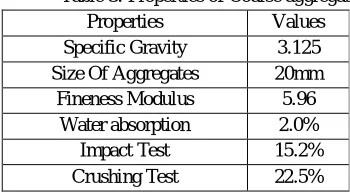
[image:4.612.218.393.330.428.2]3) Coarse aggregate: Coarse aggregate are used for making concrete. They may be in the form of irregular broken stone or naturally occurring gravel. Material which are large to be retained on 4.75mm sieve size are called coarse aggregates. Its maximum size can be up to 63mm.
Table 3: Properties of Coarse aggregate Properties Values Specific Gravity 3.125 Size Of Aggregates 20mm Fineness Modulus 5.96
Water absorption 2.0% Impact Test 15.2% Crushing Test 22.5%
4) Water: Water plays an important role in the formation of concrete as it participates in chemical reaction with cement. Due to the presence of water the gel is form which helps in increase of strength of concrete. Almost any natural water that is drinkable and has no pronounced taste or odour can be used as mixing water. Water from lakes and streams that contain marine life are also usually suitable.
5) Sugarcane Bagasse Ash : Is one of the major crops grown in over 110 countries and its total production is over 1500 million tons. In India production is over 300 million tons/year that cause around 10 million tons of bagasse ash as an un-utilized and waste material. After the extraction of all economical sugar from , about 40-45 percent fibrous residue is obtained, which is reused in the same industry as fuel in boilers for heat or power generation leaving behind 8 -10 percent ash as waste, known as bagasse ash (SCBA).
Table 4: Properties of Bagasse ash
Composition of Bagasse Ash Component mass % SiO2 78.34
6) Copper Slag: Copper slag is a by-product during copper smelting and refining process. As refineries draw metal out of copper ore, they produce a large volume of non-metallic dust, soot, and rock.
Table 5: Chemical Properties of Copper Slag
B. Methodology
[image:5.612.165.449.117.261.2]The aim of the experiment was to assess the properties of concrete made with Sugarcane Bagasse ash and copper slag and to study the various important aspects such as compressive strength, flexural strength and split tensile strength of concrete prepared by using Sugar cane Bagasse ash and copper slag and with different percentage of replacements with cement and Fine aggregate respectively. The studies were carried out for mix design of Grade of concrete-M20 and Design-IS 456:2000 & IS 10262:2009. In this study, a total 126 numbers of concrete specimens were casted. In those 42 numbers of cubes, 42 numbers of cylinders and 42 numbers of beams respectively. All the values are the average of the two trails in each case in the testing program of this study.
Table 6: Specimens used
Type of test Type of Specimen Dimensions(mm) Compression test Cube 150x150x150
Split tensile test Cylinder 150 diax300 height Flexural strength test Beam 750x150x150 According to IS 456:2000 & IS 10262:2009. Mix proportion of M20 Grade becomes
Table 7: Mix proportion
Cement(kg) Fine aggregate(kg) Coarse aggregate(kg) Water (Litres)
404 559 1233 186
1 1.38 3.05 0.46
IV. TEST RESULTS AND DISCUSSION A. Experiment No.1
In this study SCBA has been partially replaced in the ratio of 0%, 5%,10%, And 15%, by weight of cement in concrete. The strength results obtained from the experimental investigations are showed in tables. All the values are the average of the two trails in each case in the testing program of this study. The results are discussed as follows.
Table 8: Compressive strength results for SCBA Concrete (N/mm²) Replacement of cement with
SCBA
7 Days 28 Days % of increase in compressive strength in 28 days 0% 28.67 33.33 -
5% 29.80 34.10 2.31 10% 32.27 36.20 8.61 15% 29.20 33.90 1.71
Table 9: Split tensile strength results for SCBA Concrete (N/mm²) Chemical Component % of Chemical Component
SiO2 37.26 Fe2O3 47.45 Al2O3 3.95
CaO 2.38
Na2O 0.65
K2O 2.62
Mn2O3 0.086
TiO2 0.33
SO3 2.75
[image:5.612.119.492.484.527.2]Replacement of cement with SCBA
7 Days 28 Days % of increase in Split tensile strength in 28 days 0% 6.21 8.53 -
[image:6.612.119.494.71.252.2]5% 6.54 8.80 3.16 10% 7.30 9.21 7.97 15% 6.43 8.71 1.99
Table 10: Flexural strength results for SCBA Concrete (N/mm²) Replacement of cement with
SCBA
7 Days 28 Days % of increase in Flexural strength in 28 days
0% 5.20 6.34 - 5% 5.80 6.63 4.57 10% 6.50 7.14 12.61 15% 5.13 6.54 3.15
From above results we observed that the Compressive strength, Split tensile strength and Flexural strength of the SCBA 5% & SCBA 10% at the age of the 28 days has reached its target mean strength. However the compressive strength was increased by 2.31 % & 8.61%, Split tensile strength was increased by 3.16 % & 7.97% and flexural strength was increased by 4,57% &12.61 % when compared to the normal mix. It was observed that the overall strength of SCBA 15% at the age of 28 days has decreases rapidly when compared to the normal mix. We can conclude that the cement can be replaced with baggase ash upto 10% without much loss in overall strength. Considerable decrease in overall strength was observed from 15% cement replacement.
B. Experiment No.2
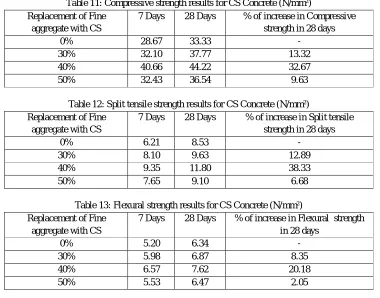
[image:6.612.117.497.396.694.2]In this study Copper slag has been partially replaced in the ratio of 0%, 30%, 40% and 50%, by weight of Fine aggregate in concrete. The strength results obtained from the experimental investigations are showed in tables.
Table 11: Compressive strength results for CS Concrete (N/mm²) Replacement of Fine
aggregate with CS
7 Days 28 Days % of increase in Compressive strength in 28 days 0% 28.67 33.33 -
30% 32.10 37.77 13.32 40% 40.66 44.22 32.67 50% 32.43 36.54 9.63
Table 12: Split tensile strength results for CS Concrete (N/mm²) Replacement of Fine
aggregate with CS
7 Days 28 Days % of increase in Split tensile strength in 28 days 0% 6.21 8.53 -
30% 8.10 9.63 12.89 40% 9.35 11.80 38.33 50% 7.65 9.10 6.68
Table 13: Flexural strength results for CS Concrete (N/mm²) Replacement of Fine
aggregate with CS
7 Days 28 Days % of increase in Flexural strength in 28 days
0% 5.20 6.34 - 30% 5.98 6.87 8.35 40% 6.57 7.62 20.18 50% 5.53 6.47 2.05
split tensile strength and flexural strength of the concrete decreases rapidly. For M20 Grade mix concrete with 40% of copper slag replacement 7days& 28 days compressive strength 40.66 N/mm² & 44.22 N/mm², Split tensile strength 9.35 N/mm² & 11.80 N/mm², Flexural strength 6.57N/mm² & 7.62N/mm² compared with the control mixture.
C. Experiment No.3
In this study SCBA has been partially replaced in the ratio of 0%, 5%, 10% and 15% and Copper slag replaced in the ratio of 0%, 30%,40% and 50% by weight of Cement and Fine aggregate in concrete respectively. The strength results obtained from the experimental investigations are showed in tables.
Table 14: Compressive strength results for SCBA + CS Concrete ( N/mm²) Replacement of Cement with SCBA and
Fine aggregate with CS
7 Days 28 Days % of increase in Compressive strength in 28 days 0% 28.67 33.33 -
5%+30% 29.78 34.23 2.70 10%+40% 31.54 35.13 5.40 15%+50% 29.30 33.97 1.92
Table 15: Split tensile strength results for SCBA + CS Concrete ( N/mm²) Replacement of Cement with SCBA and
Fine aggregate with CS
7 Days 28 Days % of increase in Split tensile strength in 28 days
0% 6.21 8.53 -
[image:7.612.92.520.331.684.2]5%+30% 7.07 9.67 13.36 10%+40% 7.45 10.30 20.75 15%+50% 6.80 8.98 5.27
Table 16: Flexural strength results for SCBA + CS Concrete ( N/mm²) Replacement of Cement with SCBA and
Fine aggregate with CS
7 Days 28 Days % of increase in Flexural strength in 28 days
0% 5.20 6.34 -
5%+30% 5.45 6.48 2.20 10%+40% 5.96 6.97 9.93 15%+50% 5.08 6.38 0.63
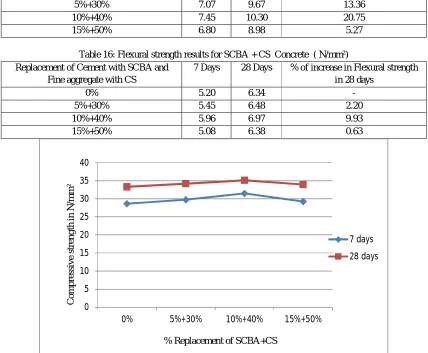
Fig 1: Graph % replacement of SCBA+CS vs Compressive strength (N/mm²)
0 5 10 15 20 25 30 35 40
0% 5%+30% 10%+40% 15%+50%
7 days
28 days
% Replacement of SCBA+CS
C
o
m
p
re
ss
iv
e
str
en
g
th
i
n
N
/m
m
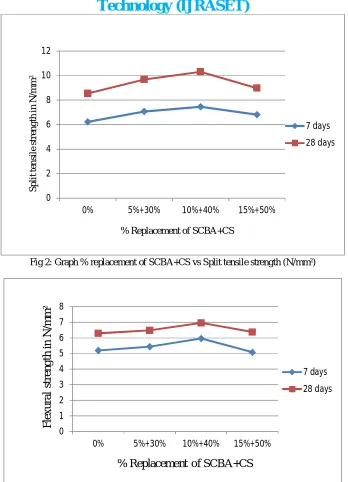
Fig 2: Graph % replacement of SCBA+CS vs Split tensile strength (N/mm²)
Fig 3: Graph % replacement of SCBA+CS vs Flexural strength (N/mm²)
When graphs are plotted for M20 grade of at the age of 28 days of curing it is observed that when SCBA5%+CS30% and SCBA10%+CS40% is added the overall strength of the concrete was increased when compared to the normal mix but it was observed that the compressive strength, Split tensile strength and flexural strength was decreased rapidly with the partial replacement of SCBA 15%+CS40% when compared to the normal mix, we can conclude that the Cement and Fine aggregate can be replaced with SCBA and CS upto 10% and 40% respectively without much loss in the overall strength of the concrete.
V. CONCLUSIONS
Based on the experimental investigations, the following conclusions can be drawn.
It has been observed that the experimental result for the 10% replacement of bagasse ash to OPC has increase in strength in comparison with 0% and 5% replacement. Beyond 10% replacement of bagasse ash, the strength was decreased.
As the percentage of sugarcane bagasse ash increases the compressive strength of concrete tends to increase up to certain percentage and then start’s decreasing with the increase of ash content. SCBA concrete performed better when compared to ordinary concrete up to 10% replacement of sugar cane bagasse ash.
0 2 4 6 8 10 12
0% 5%+30% 10%+40% 15%+50%
7 days
28 days
% Replacement of SCBA+CS
S p li t te n sil e str en g th i n N /m m ² 0 1 2 3 4 5 6 7 8
0% 5%+30% 10%+40% 15%+50%
7 days
28 days
% Replacement of SCBA+CS
The utilization of bagasse ash in concrete solves the problem of its disposal thus keeping the environment free from pollution. Since bagasse ash is a by-product material, its use as a cement replacing material reduces the levels of CO2 emission by the cement industry and also saves a great deal of virgin materials. In addition its use resolves the disposal problems associated with it in the sugar industries.
The greatest compressive strength, split tensile strength and flexural strength were achieved when the mixture contained 10% of Cement replacement of SCBA with the water cement ratio of 0.46. Hence we concluded that the Cement upto 10% can be effectively replaced with sugarcane bagasse ash without considerable loss of workability and strength.
Based on Experiment no.2 The basic material test results showed that the properties of copper slag is similar to that of natural sand and can be used as natural sand.
The results of compression & split-tensile test indicated that the strength of concrete increases with respect to the percentage of slag added by weight of fine aggregate upto 40% of additions.
The optimum level of replacement of copper slag was found to be 40% and the results were better than that of control mix. Based on the conducted experiment no.3 and according to the results obtained, it can be concluded that: Bagasse ash can increase the overall strength of the concrete when used up to a 10% Cement replacement level and Copper slag can increase the overall strength of the concrete when used upto 40% fine aggregate replacement with w/c ratio of 0.46.Bagasse ash and copper slag ar the valuable pozzolanic materials and it can potentially be used as a partial replacement for cement and fine aggregate respectively. This could reduce the environmental problems.
VI. ACKNOWLEDGEMENT
The author thankfully acknowledge to Asst Prof. Ajay A.Hamane.M.S.Bidwe Engineering college,Latur (Maharashtra State) for providing all the facilities for carrying out this work.
REFERENCES
[1] IS 383 -1970 “Specifications for Coarse and Fine Aggregates from Natural Sources for Concrete”, Bureau of Indian Standards, New Delhi. [2] IS 10262 -1981 “IS Method of Mix Design”, Bureau of Indian Standards, New Delhi.
[3] IS 516 -1959 “Methods of Tests for strength of concrete”, Bureau of Indian Standards, New Delhi. [4] IS 456 -2000 “Code of Practice for Plain and Reinforced Concrete”, Bureau of Indian Standards, New Delhi.
[5] Kawade U.R.,Rathi V.R.,Vaishali D. Girge,International Journal of Innovative Research in Science, Engineering and Technology Vol. 2, Issue 7, July 2013.
[6] Prashant O Modania and Vyawaharebnology M. R,Utilization of Bagasse Ash as a Partial Replacement of Fine Aggregate in Concrete, 51: 25 – 29, 2013 [7] Siva kumar M. And Mahindra N, Experimental Studies of Strength and Cost Analysis of Concrete Using Bagasse Ash, International Journal of
Engineering Research & Technology, 2(4):1-8, April 2013
[8] Sabir BB, Wild S, Bai J,Metakaolin and calcined clays as pozzolans for concrete: a review.;23(2):441– 54, 2001
[9] Cordeiro ,G.C., Toledo Filho, R.D., Tavares, L.M., Fairbairn, E.M.R.: Pozzolanic activity and filler effect of sugar cane bagasse ash in Portland cement and lime mortars. Cement and Concrete Composites 30, 410–418, 2008
[10] N.B.singh, V.D.Singh and Sarita Rai,”Hydration of bagasse ash-blended Portland cement”, Cement and conc. research., 30,1485- 1488, 2000
[11] Pazahani. K and Jeyaraj. R,"Study on durability of high performance concrete with industrial wastes", Applied technology & Innovations, vol. 2, pp. 19-28, 2010
[12] D. Brindha and Nagan.S, "utilization of copper slag as a partial replacement of fine aggregate in concrete", International journal of earth sciences and engineering, vol. 03, no. 04, pp. 579-585, 2010
[13] Pazahani. K and Jeyaraj. R,"Study on durability of high performance concrete with industrial wastes", Applied technology & Innovations, vol. 2, pp. 19-28, 2010
[14] Khalifa S. Al-Jabri, Abdullah H. Al-Saidy, Ramzi Taha,"Effect of copper slag as a fine aggregate on the properties of cement mortars and concrete", Construction and building material, vol. 2, no. 25, pp. 933-938, 2011
[15] A S Alnuaimi, "Effects of copper slag as a replacement for fine aggregate on the behavior and ultimate strength of reinforced concrete slender columns", The journal of engineering research, vol. 9, no. 2, pp. 90-102, 2012
[16] R R Chavan and D B kulkarni," Performance of copper slag on strength properties as partial replace of fine aggregate in concrete mix design", International journal of advance engineering research and studies, vol. 2, no. 4, pp. 95-982013
[17] Suresh Reddy S, Kishore Kumar M "Utilization of copper slag as a partial replacement of fine aggregates in concrete", International journal of mechanical engineering and computer applications, vol. 1, no. 7, pp. 140-144,2013
[18] Meenakshi Sudarvizhi. S, Ilangovan. R, "Performance of copper slag and ferrous slag as partial replacement of sand in concrete", International journal of civil and structural engineering, vol.1, no. 4, pp. 916-927, 2011
[19] Akihiko, Y. and Takashi, Y, “Study of utilisation of copper slag as fine aggregate for concrete”, Ashikaya Kogyo Daigaku Kenkyu Shuroku, Vol. 23, pages 79-85, 1996
[20] Al-Jabri, K.S. and Makoto Hisada,“Copper slag as sand replacement for high performance concrete”, Cement and Concrete Composites, Vol. 31, pages 483- 488,2009
[21] Arivalagan.S, "Experimental study on the flexural behavior of reinforced concrete beams as replacement of copper slag as fine aggregate", Journal of Civil Engineering and Urbanism, Vol. 3, pages 176-182, 2013