International Journal of Emerging Technology and Advanced Engineering
Website: www.ijetae.com (ISSN 2250-2459, ISO 9001:2008 Certified Journal, Volume 6, Issue 5, May 2016)
157
Damage Detection in Composite Materials Via Optimization
Techniques Based on Dynamic Parameters Changes
Guilherme Ferreira Gomes
1, Sebastião Simões Cunha Jr.
2, Antônio Carlos Ancelotti Jr
3,
Mirian de Loudes Noronha Motta Melo
41,2,3Mechanical Engineering Institute, Federal University of Itajubá, Av. BPS, 1303, Itajubá, Brazil
Abstract— Structures with complex maintenance and restrict access need to have as an ally a monitoring process of structural integrity. The structural health monitoring by means of damage detection studies is present in many engineering applications because they enable that corrective actions be applied to ensure the structural integrity of a given machine or equipment. In this work, we developed a study, using numerical simulations in order to assess damage detection techniques applied to composite materials, because the application of these materials in components and structures have replaced metallic materials due to its low weight and high strength. This research will be based on solving the direct and inverse problem by combining data from a model and the experimental case in order to detect structural damage. It carried out the mechanical modeling of the forward problem by finite element method and heuristic optimization techniques in order to minimize a particular objective function written in function of dynamic parameters. The structure studied is constituted of a laminate of carbon fiber, and two damage models were used: (a) circular holes and (b) multiple damages. The robustness of the proposed method is investigated by adding Gaussian random white noise as a noise effect to mode natural frequency and accelerations, which are used in the objective functions. Finally, the advantages and limitations of each method explored in this work have been summarized to provide a useful guide for selecting inverse algorithms for vibration-based damage detection in composite plates.
Keywords— Damage Detection, Composite Materials, Genetic Algorithm, Natural Frequency, Pareto Front.
I. INTRODUCTION
The existence of structures with complex maintenance and restrict access or as in the case of spatial structures, which should work with small margins of dynamic range, they need to have as an ally a monitoring process of structural integrity. Such monitoring attempts to detect vulnerable areas at an early stage as soon as possible allowing appropriate action to be taken quickly, ensuring survival and structural integrity. [2]
A particular type of structural damage can be characterized as the presence of holes, cracks and other irregularities that leads to a change in structural properties of mass, stiffness or damping of the structure [3]. According to [7], the interest in the ability to monitor a structure and detect damage at the earliest stage possible permeates the fields of mechanical, aerospace and civil engineering. The vast majority of current damage detection methods are located using visual or experimental methods such as ultrasound or acoustic methods, magnetic particles, x-rays, eddy currents and other methods. All these techniques require that the experimental damage of the neighborhood is known a priori and the structure to be inspected is easily accessible. The need for additional methods of detection of global injury that can be applied to complex structures has led to the development of methods that examine the changes in the vibration characteristics of the structure.
According to [11], the application of advanced materials as composite materials, components and structures evolved due to the need to reduce weight and improve structural performance. Other attributes of composite materials, such as corrosion resistance, excellent surface finish, good
fatigue resistance capability and high structural
International Journal of Emerging Technology and Advanced Engineering
Website: www.ijetae.com (ISSN 2250-2459, ISO 9001:2008 Certified Journal, Volume 6, Issue 5, May 2016)
158
In this work, we employed the finite element method due to the complexity of an anisotropic material (carbon fiber composite) with several layers of laminated material, which does not adapt using the contour methods that are widely used for structures with two-dimensional simplification. Optimization using heuristic methods such as genetic algorithm (GA) are used as the optimization procedure for being able to find a global optimum efficiently and not get stuck in a great location, allowing properly locate the damage, as well as no need for derivatives valuation the objective function, which can become a problem for cases where discontinuities may be present. The optimization routines of damage detection were performed using the
MATLAB® software working linked with the commercial
finite element software ANSYS® for creation of direct and
inverse problems. Numerical test cases are employed to evaluate the performance of the algorithms in predicting the damaged parameters and pros and cons of each algorithm are summarized.
II. STRUCTURAL DAMAGE DETECTION VIA DYNAMIC
PARAMETERS
The Structural Health Monitoring (SHM) aims to give, at every moment during the structure’s life, a diagnosis of the ―state‖ of the constituent materials, of the different parts, and of the full assembly of these parts constituting the structure as a whole. The state of the structure must remain in the domain specified in the design, although normal aging due to usage can alter this, by the action of the environment, and by accidental events. Thanks to the time-dimension of monitoring, which makes it possible to consider the full history database of the structure, and with the help of Usage Monitoring, it can also provide a prognosis (damage evolution, residual life, etc.). [1]
Knowing the integrity of in-service structures on a continuous real-time basis is a very important objective for manufacturers, end-users and maintenance teams. In effect, SHM: allows an optimal use of the structure, a minimized downtime, and the avoidance of catastrophic failures. Gives the constructor an improvement in his products and drastically changes the work organization of maintenance services. In practice, inverse methods combine an initial model of the structure and measured data to improve the model or test a hypothesis. In practice, the model is based on finite element analysis and the measurements are acceleration and force data, often in the form of a modal database, although frequency response function (FRF) data may also be used. [10]
The four levels of the estimated damage primarily addressed by [17] are set as detection, location, quantification and prognosis. Detection is readily accomplished by methods of pattern recognition or detection of new structural changes. The key question for the inverse methods is the location, which equals the error location in the model. Since the damage is found, it can be parameterized with a limited set of parameters and quantified. A structural damage can be defined as the modification of the stiffness or mass of an element. One of the main ways to assess the presence of a local damage is to be based on the variation of structural dynamic parameters. This method assumes that the damage results in alterations in the properties of the structure, i.e., may cause a variation in the mass matrix, damping and stiffness in the classical equation of motion of a body, which in turn will lead to changes in the dynamic response of thereof, such as natural frequencies, vibration modes and modal damping.
A. Changes in Natural Frequencies
Frequency changes have significant practical limitations for applications depending on the analyzed structure. The low natural frequency range of sensitivities require very precise measurements or high levels of damage to detect.[7]
The change of natural frequencies can be considered as a method of detecting prevalent in structural damage assessment procedures. When a damage exists in a structure, the stiffness and the mass are reduced and consequently decreasing the natural frequency of the system can be observed. One major advantage of this detection technique is that frequency measurements can be quickly and easily performed. Moreover, the experimental techniques used for the determination of natural frequencies are classical measurement techniques of classical vibration. In addition, knowledge of the overall dynamic behavior of undamaged systems is very easy to obtain developments using analytical or finite element models; thus allowing the measurement points being properly chosen to not only a quick and efficient detection of changes in frequency, but also the identification of the location and severity of damage. [18]
A commonly known from the literature damage detection criterion being composed exclusively of a set of n natural frequencies is DLAC (Damage Location Assurance Criterion), which compares the frequency obtained experimentally with a finite element model to locate and quantify damage. The DLAC calculates the correlation
between the change in frequency, {Δω}, expected from the
finite element model and the actual changes, {δω}
International Journal of Emerging Technology and Advanced Engineering
Website: www.ijetae.com (ISSN 2250-2459, ISO 9001:2008 Certified Journal, Volume 6, Issue 5, May 2016)
159
{ } { }
{ } { }
} { } {
T T
T DLAC
(1)
The DLAC assumes the value of 1 for an exact pattern match between the sets of natural frequencies and 0 for patterns that are uncorrelated. This method only requires the measurement of a few frequency changes between the undamaged and damaged states of the structure, and the accuracy of the damage predictions is further improved by including antiresonances into the criterion. The accuracy of predictions damage can be further enhanced by inclusion of antiresonance frequencies the criterion. In the application, a DLAC value of 0.9 (90%) would be considered good correlation between the model and the actual structure, values above 0.9 are considered similar and values below 0.9 represent dynamic data that are significantly different. [8]
III. DIRECT AND INVERSE PROBLEM MODELING
The modeling of the damage detection problem addressed in this paper was formulated on two fronts: modeling the direct problem, modeled by the finite element method and the modeling of the inverse problem, if consisting of the optimization method for the search of variables great project for the identification of structural damage tax.
A. Direct Problem: Finite Element Model
Finite element models have a priori information available about the continuous models, behavior of the material and internal constraints. The response to a given excitation modeled by a finite element model is governed by a set of coefficients that are closely related to physical quantities like the mass or stiffness matrix coefficients. These physical quantities represent the parameters of such models [9]. The optimal values to be calculated are determined to minimize the difference between the amounts of measured response (real) and planned (simulated). The formulation of a structural finite element model becomes an important objective of the structural identification, such as typically used in direct problems. On the other hand, it is the only model that is potentially able to give location information on the structural properties, which are crucial for the detection of damage. [14]
The direct problem was modeled on a square plate side equal to one meter, or simply can take into account the value of a unit because there is no relevance to the optimization process. The structure is symmetrically laminated composite material consisting of four layers of different orientations.
The laminate has dimensions of a square unit of one meter side. The layer thicknesses are all t = 0.0025 m oriented symmetrically [0/90]3s. Please note that this work
is intended solely to the study of the damage detection method in laminated composite material using optimization algorithms, giving emphasis on geometric parameters and specific characteristics of the laminate material.
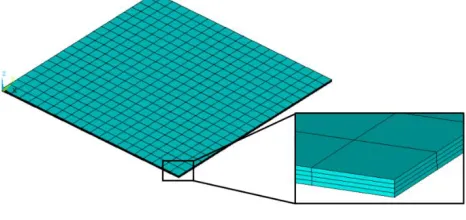
[image:3.612.327.560.366.476.2]Before meshing the model, and even before you build it, it is important to think about the concept of free and mapped mesh is suitable for analysis. A mesh mapped typically has a regular pattern, with ordered elements, allowing greater control over the elements, but requires more time and computational effort to generate these. Thus, it took shell elements freely generated on the structural surface. Figure 1 shows the results of modeling the laminate square geometry, with open mesh (in this case without the presence of damage, the fabric was uniform due to the symmetry and simplicity of the structure) generated on the surface of the structure studied.
Figure 1. Laminated composite plate created by finite element method with shell elements.
Damage Models
Two models of damage and three cases are discussed in this study. The first damage is considered in a circular hole (Figure 2), which is parameterized according to three variables, which are also known as the design variables in optimization search process. These variables are given by the Cartesian x and y positions on the board, and the position of the center of the hole, and its radius r. Therefore, there is a vector α, called vector of decision variables given by α = {x1, y1, r1}. The damage was
International Journal of Emerging Technology and Advanced Engineering
Website: www.ijetae.com (ISSN 2250-2459, ISO 9001:2008 Certified Journal, Volume 6, Issue 5, May 2016)
160
The second case of damage was modeled with the presence of multiple circular holes, followed by combination of positions, a central position on the plate and displaced from another central (Figure 2). The parameters of the damage is by its position relative to the Cartesian x and y axis and its radius, so the decision variables in this case will be n times greater than the previous model. Therefore, the decision variables are grouped in a vector α given by α = {x1, y1, r1, x2, y2, r2}, and the indices 1 and 2
[image:4.612.336.531.325.443.2]refer to the first and second damage, respectively. For this second damage model, we needed to add a constraint equation for the objective function to be minimized. The constraint equation developed guides the optimization algorithm does not generate the same random hole concentricity and overlapping, that is, so enabling the search for multiple distant from each other damage.
Figure 2. Modelling of circular holes as damages on the laminated composite plate.
B. Inverse Problem: Genetic Algorithm Optimization
Find the best solution for a given problem is an important area of research and has application in various fields of engineering. Several optimization problems can be identified in the monitoring area of structural integrity. Genetic algorithms are now frequently applied to problems of maximizing or minimizing a given objective function, often subject to some constraints. Genetic algorithms have been applied to a wide range of optimization problems in engineering which have this form. The genetic algorithm works with an initial population which may, for example, correspond to numerical values of a particular variable. The size of this population may vary and is generally related to the problem under consideration. The members of this population are usually strings of zeros and ones i.e. binary strings. In practice, the population may be far larger than this and the strings longer. The strings themselves may be the encoded values of a variable or variables that we are examining. This initial population is generated randomly and we can use the terminology of genetics to characterize it. [22]
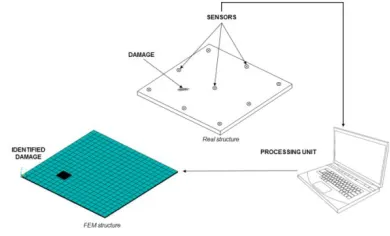
As mentioned in previous paragraphs, the solution damage detection problems in the location of the damage and its quantification are parameters to be determined are necessary data corresponding to the vibrational response of the structure under study. The vibrational response can be
obtained by means of a laser vibrometer and
accelerometers, which are input data transmitted to a processing unit, which ultimately determines the location and extent of the damage with the use of specific algorithms (Fig.3). This work will be undertaken simulated cases (real case of a damaged structure) and information related to natural frequencies of the real-damaged structure and model for a first objective function and a second function adds the acquisition of data the accelerations corresponding to the vibration plate of a certain natural frequency.
Figure 3. Damage detection method using signal acquisition and CAD models.
The first objective function J1, is based on the root mean
square error (RMSE) of the first n natural frequencies of the plate. The minimization of this objective function suggests that the natural frequencies of the real damaged plate are equal to the frequencies obtained by optimization,
that is, the minimum value will equal zero (J1 = 0).
However, aiming at improving damage detection process, it is essential to work with an appropriate objective function,
aiming to lower computational time and better
[image:4.612.57.278.327.437.2]International Journal of Emerging Technology and Advanced Engineering
Website: www.ijetae.com (ISSN 2250-2459, ISO 9001:2008 Certified Journal, Volume 6, Issue 5, May 2016)
161
Therefore, the objective function J1, becomes a weight
vector C composed of scalar ci ascending order, C = {1 2 3
4 5 6} in order to give greater importance to higher order of frequencies. 2 1 mod 1 ) ( 1 1
n i el i real i i c n RMSE J (2)Where n is the number of natural frequencies obtained, ci
the scalar weighting factor to higher natural frequencies, ωi
real
the natural frequencies corresponding to the actual
damaged structure and ω(α)i
model
the natural frequencies of the structure modeled by finite element comprising by one or more damages, according to a parameterized vector design of variables α.
Variations of natural frequency have significant limitations for practical applications in certain types of structures. The low frequency sensitivity in the presence of an injury requires very precise measurements or high levels of structural damage to be detected efficiently. In addition, frequencies are a global property of the structure, and it is unclear why the changes in this parameter can be used to identify more than the mere existence of damage. In other words, the frequencies cannot generally provide spatial information about structural changes, but a global code. [7]
A disadvantage of the using of natural frequencies is that symmetrical damages cannot be distinguished evaluated depending on the type and those natural frequencies are not sensitive enough to detect damage depending on the damage level (severity). For these reasons, the use of vibration modes may be incorporated to solve this drawback. However, in practice the acquisition of vibration modes have larger errors in relation to the natural frequencies, cannot be considered satisfactory the use of vibration modes in structural damage detection method. To overcome this drawback, an alternative is to combine natural frequencies of vibration modes in the analysis. [21]
In this paper, in order to resolve all these global indicative of drawbacks damage (natural frequencies) and difficulty in acquisition (vibration modes). It was taken as complementing the natural frequencies in the objective function J1, the addition of a portion of accelerations to
attempt to circumvent the problem of global indicative of damage to obtain identification with considerable precision in the composite structure. Then, one second objective
function J2 is made with two parts, frequencies and
accelerations. The objective was to give weights w1 and w2 to each of them in order to obtain a better sensitivity in the optimization process.
n i el i real i n i el i real i i x x w c n w J 1 2 mod 2 2 1 mod 1 2 ) ( ) ( 1 1
(3)Where ̈ is the acceleration captured at certain points of the structure corresponds to the i-th natural frequency of the structure modeled in Finite element comprising one or more damage parameterized according to a variable vector of α project. ̈ is the accelerations
of damaged real structure, w1 and w2 the weights for each
part of the objective function. The configuration of the sensors of positions on the board are shown in Figure 5.
Small structural damages do not significantly affect the answer governing the structural behavior and therefore with such damages in various locations of a structure are difficult to detect using traditional damage detection methods based on modal properties. A detection method with increased efficiency for the detection of multiple damage is the use of optimization. One of the traditional optimization disadvantages to detect structural damage based on modal parameters is that there is a good performance by using multiple levels of damage. When natural frequencies and mode shapes are used as the indices of damage in the objective function to be minimized, they are chosen different weighting factors for each mode or natural frequency. However, when it minimizes the objective function, it is not easy to choose such reasonable weighting factors for each position of member, because it does not know the relative importance of the frequency and modes for the specific damage detection problem. Therefore, it is not guaranteed that the objective function with lower values always offer the best solutions. [5]
Thus, a third objective function J3 is discussed in this
International Journal of Emerging Technology and Advanced Engineering
Website: www.ijetae.com (ISSN 2250-2459, ISO 9001:2008 Certified Journal, Volume 6, Issue 5, May 2016)
162
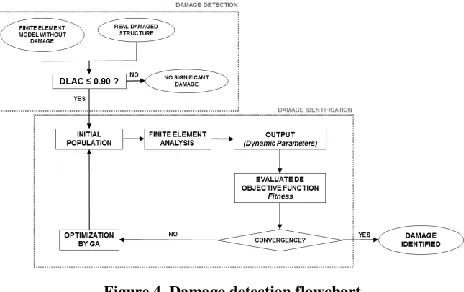
[image:6.612.51.283.370.516.2]The detection method developed in this work, briefly, will take place in two steps. The first step of damage detection, combine data from a finite element modeled structure without damage and with a structure modeled damage previously known, which simulates the actual case of a damaged structure. This first step will employ the DLAC criterion for detecting whether or not the presence of an injury. The second step is the damage identification process. This identification routine optimization algorithm is introduced to make the search for damage to the geometry of the structure, with interaction between the finite element software where the model structure is adapted to receive the design variables and optimization software that will hold a series of calculations in order to generate input data for the finite element software. The flowchart of the Figure 4 displays the steps to be performed during the damage searching. The method for detecting damage in this study meets three of the four criteria proposed by [17], the detection, localization and quantification of damage (damage models studied).
Figure 4. Damage detection flowchart.
Complementing the method discussed in this work in order to verify the robustness of the developed method, the addition of noise in the optimization process was considered. Be Ω defined as the response generated by software elements, being composed exclusively of dynamic parameters (natural frequencies and accelerations). This response becomes input parameter optimization algorithm that generates a sequence of output data which will subsequently input to the finite element software. This coupling between the two software, MEF and optimization generates an ideal cycle search for the location of structural damage.
However, to verify the robustness of the built method adds a white Gaussian noise Ω data output in order to simulate ambient noise coming from a measurement error of the sensors, an acquisition error even errors associated with the external environmental factors. Soon the mathematical modeling of the noise can be given as:
) *
( normal normal
noise nrand
(5)
Where n is the level stipulated rand noise and Gaussian
random variable. For this particular study was done using data with noise levels of 1%, 5% and 10%.
IV. NUMERICAL RESULTS AND DISCUSSION
[image:6.612.333.556.509.573.2]For the initial part of the inverse problem of damage detection, it needed a proper study of the direct problem of modeling using the finite element method in order to have adequate confidence in the results generated by the FEM. The main hypothesis of this work is that the presence of structural damage, it is modeled as a hole or multiple holes a set, generates a variation of the mass matrix, rigidity and damping. Structural dynamic responses, such as natural frequencies, mode shapes and acceleration are directly dependent on such matrices, they are obtained from the equation of motion, just the presence of an arbitrary damage will generate a different response from that which damage is not present in a particular structure. The Fig.5 shows the numerical results in an intact plate and damage modeled as a circular hole in the center of the plate, and you can notice the difference in responses when inserting an injury as a result of interference in these structural matrices.
Figure 5. Changes in natural frequency by the presence of structural damage. Plate without the presence of damage to the fundamental frequency of 41.7760 Hz (left image) and in the presence of damage
with frequency 37.1599 Hz (right image).
International Journal of Emerging Technology and Advanced Engineering
Website: www.ijetae.com (ISSN 2250-2459, ISO 9001:2008 Certified Journal, Volume 6, Issue 5, May 2016)
163
TABLEINONDIMENSIONALIZED FUNDAMENTAL FREQUENCIES AND ERROR.
Analytical ([17], p.284)
Numerical
20 side elem.) Error [%]
2,5190 2,5200 0,0134
4,9860 5,0159 0,0028
8,5150 8,5612 0,0005
10,0770 9,9836 3,0027
A. Circular Hole
Table 2 shows the values obtained for three simulations performed simultaneously for the detection of a central damage. Because optimization technique used it is a heuristic method, it is interesting to get an average of several simulations, because the method is based on a system of random searches (probabilistic). For all simulated cases it was noted that the radius is the design variable with lower sensitivity in the search, which in fact natural frequencies as damage detection criteria are good parameters to check for damage, but still has limitations quantify and predict the extent of structural damage. However, the results of numerical simulations show that the algorithm developed obtained good accuracy in identifying the presence of a relatively small circular hole in the structure in question. Data obtained by any measurement are usually contaminated by noise, typically from different sources. Noise may be associated with environmental factors (climate), human errors, accuracy of measuring devices, systematic errors and other specific ways, affecting in a direct way the measured data. For these reasons noise added in three different levels in order to evaluate the robustness of the proposed optimization algorithm. Initially added to a noise level below 1% output signal sequence and rose up that noise to values of 5% and 10%.
For lower noise levels, it achieved satisfactory values for detecting the circular hole. Although the radius of the bore is presented as a design variable greater variability and errors of larger proportions. Not obtained a relevant concentricity for this case, but averaged protrudes very close to the actual hole. The Gaussian noise in the output response was elevated to values of 5% and 10% to see if the method was robust in detecting the simulated damage as circular holes. As shown in Table, random noise values in the order of 5% has changed little compared to the simulated response without the presence of these.
Likewise, when you add a 10% noise, which can be considered high for a computer simulation, the mean response (hole calculated from the average of three others) still stood near the known response. In both cases the presence of noise, we see constantly the hole radius is the design variable harder to play the global optimum (objective) in the optimization process (Fig.6).
The excellent performance obtained by the method in detecting damage in the presence of high noise (up to 10%) can be explained by the fact that used objective function
(J1) is purely based on natural frequencies, as this function
is taken very sensitive to variations. As stated in the previous chapter, natural frequencies are a good indication for the presence of structural damage but do not have good performance in quantifying it, a fact that can be seen by the biggest mistakes in finding the correct extension of the simulated real damage (hole’s radius). This characteristic of the objective function, other beneficial side when implementing noise in measurements has showed it.
TABLEII
DAMAGE DETECTION RESULTS FOR A CENTRALIZED HOLE.
x1 y1 r1
Objective 0,5000 0,5000 0,0200
No noise 0,4973 0,5087 0,0214
1% noise 0,4879 0,5050 0,0208
5% noise 0,5112 0,5087 0,0189
10% noise 0,4828 0,5109 0,0294
Figure 6. Structural hole detection considering random noise data.
International Journal of Emerging Technology and Advanced Engineering
Website: www.ijetae.com (ISSN 2250-2459, ISO 9001:2008 Certified Journal, Volume 6, Issue 5, May 2016)
164
Iteratively note that individuals reproduce randomly controlled to the point where individuals of the final generation take great features, i.e., those better adaptation to the environment, close to the known global optimum.
B. Multiple Damage Detection
One of the challenges of relevance of this study is to detect multiple damage, shaped as circular holes, parameterized similarly to the previous model. The insertion over a hole doubles the number of design variables used, carrying, if working with two holes then six design variables come into play to be optimized by a genetic algorithm. A large computational effort was required for this part of the job, remained all the constants of genetic operators as usual the previous case.
Due to the inherent problem of damage detection using objective functions consist purely natural frequencies developed by a second objective function was constructed in an attempt to circumvent the problem exposed in the previous item for multiple damage detection. It is known from literature that various authors are working with vibration modes as a structural damage detection parameter, whether specific criteria, such as the MAC (Modal Assurance Criterion) or test compound by frequencies and modes, the latter being normalized. In practice the acquisition of vibration modes may be difficult to obtain and error associated with these data is normally present in the signal acquisition. For these reasons, it constructed a composite function of natural frequencies of vibration and acceleration associated with structural vibration at these frequencies. Accelerations were taken at certain positions where stood sensors (accelerometers) on the frame in nine positions distributed uniformly. No previous study was done in relation to the sensor position to improve the optimization process, because the idea was to distribute as evenly as possible over the surface of the structure, it is intended to implement this method in a real structure instrumenting it in order to acquire their signals in general, without giving most importance certain geometric parts or not.
The objective function J2 then conceived by two
different modal portions (frequencies and accelerations) is an attempt to minimize, in multi-objective character, one function, giving specific weights for each of these installments. In this attempt to verify which portion has a greater importance in the identification of the damage, combined values for weights w1 and w2 for three separate
cases. It is evident that the use of a specific portion relative importance of acceleration is larger than that comprising only frequencies, due to the fact of employing nine sensors spread evenly across the board surface.
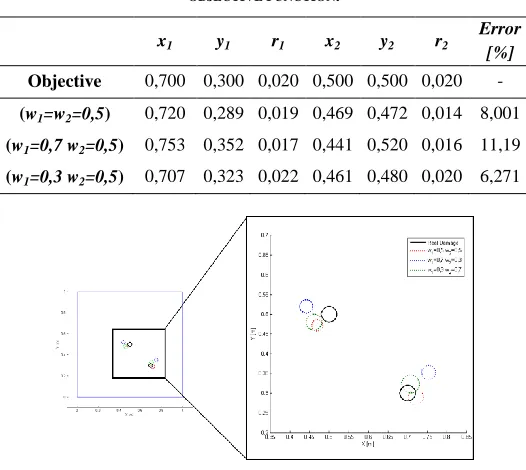
For this case of two structural damage, the result obtained was lower than the mock case with only damages this may be explained by the boundary conditions employed in the plate (simply supported), generating problems of symmetry or combination of damage that are equivalent in response (objective function), a structural damage. Figure 7 and Table 3 shows generally three case studies for different weights for the objective function in question.
TABLEII
DAMAGE DETECTION RESULTS CONSIDERING WEIGHTS FACTORS IN J2
OBJECTIVE FUNCTION.
x1 y1 r1 x2 y2 r2
Error [%]
Objective 0,700 0,300 0,020 0,500 0,500 0,020 -
(w1=w2=0,5) 0,720 0,289 0,019 0,469 0,472 0,014 8,001 (w1=0,7 w2=0,5) 0,753 0,352 0,017 0,441 0,520 0,016 11,19 (w1=0,3 w2=0,5) 0,707 0,323 0,022 0,461 0,480 0,020 6,271
Figure 7. Results for different weight factors in J2.
[image:8.612.312.575.269.504.2]International Journal of Emerging Technology and Advanced Engineering
Website: www.ijetae.com (ISSN 2250-2459, ISO 9001:2008 Certified Journal, Volume 6, Issue 5, May 2016)
165
However, from comparative numerical studies,
multiobjective approach showed a significantly better performance than the traditional approach with a single goal in the detection of various damages. [5]
Thus, to eliminate the shortcomings of mono approach goal, we propose a multi-objective approach considering the modal properties studied in this work in order to find the best settings for the damage method. The simulations for the case of multi-objective optimization aimed at
minimizing the objective function J3, or a simultaneous
minimization of a function consists of purely natural frequencies (J1) and second (J2) for acceleration only. A set
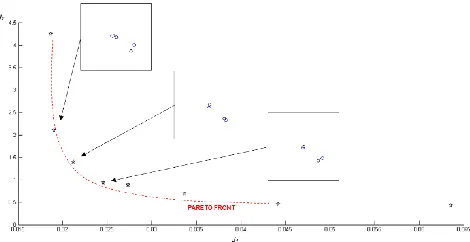
of solutions is called Pareto optimal set-up for each solution set, there is no other feasible solution capable of reducing the value of the problem of criteria without simultaneously causing an increase in at least one of the other criteria.
[image:9.612.51.286.441.562.2]Figure 8 shows the Pareto Front, or the set of Pareto optimal solutions. The points correspond to the non-dominated solutions due to the fact that there are no other points to improve a goal without degrading the other, in the specific case of the figure, obtained eight optimal solutions to the problem. The set of non-dominated solutions is called Pareto-optimal set, and the image of a particular set Pareto-optimal, the objectives of the values of space, is called the Pareto frontier (red dashed curve).
Figure 8. Pareto front for the multiple damage detection case.
It is understood that small damage not significantly affect the modal parameters of a structure, however, various damages in a structure is difficult to detect using traditional methods damage detection based on modal properties. However, the developed method, though not detect the holes with concentricity, has achieved good results and are considered in order of importance, the knowledge of the structural damage location is more significant than its length or geometric shape, because the hole can well simulate a change in the physical properties of an arbitrary damage by losing rigidity and mass.
An improvement in the detection of multiple damage with the formation of Pareto Front with regard to the method of weighted sums It was noted, as the weighted method can lead to solutions in non-convex regions of the Pareto frontier, although all solutions are non-dominated (Pareto optimal). This is because the weighted sums are implementations always made with convex combinations of the various objectives of its composition. [4]
Another important fact of this significant improvement is that the multi-objective optimization algorithm software (gamultiobj) uses a genetic algorithm controlled elitism, a variant of NSGA-II [6]. An elitist GA always favor individuals with better fitness value also favors individuals that can help increase the diversity of the population, even if they have a lower fitness value. It is important to maintain the diversity of the population to catch up to a terrific Pareto front, because such diversity is maintained to control the population of elite members as the algorithm progresses.[13]
Optimization problems for detection of damage for damage up close together show more complex and difficult to detect. Interestingly, two little structural damage can be approximated as a single structural defect, as great candidate in the optimization process [20] and structural Dynamic finite model to a structure need be correlated with the measured data to ensure accuracy of numerical models [15].
V. CONCLUSIONS
This study was focused on the detection and identification of structural damage based on dynamic parameter of vibration of a square plate of composite material, including numerical modeling by finite elements. The genetic algorithm used to solve the inverse problem of detection of damage evaluated efficiently the proposed problem. However, these algorithms are complex and need to be aware of the objective function values in question at various points.
International Journal of Emerging Technology and Advanced Engineering
Website: www.ijetae.com (ISSN 2250-2459, ISO 9001:2008 Certified Journal, Volume 6, Issue 5, May 2016)
166
Natural frequencies purely proved to be a good criterion for detecting the existence of an arbitrary structural damage, however, have limitations on the quantification of the damage (location and size).
Pareto front optimization found to be the best method for detection of multiple damage, because it offers a set of feasible optimal solutions to solve the problem inserted, being one of our choice smaller distance relative to the origin (zero). The multi-objective optimization criterion for forming the front of Pareto took into account controlled elitism, which was superior to the goals of weighting technique and difficulties appear normal at the time of insertion measurement noise in damage detection process.
Acknowledge
The authors would like to acknowledge the financial support from the Brazilian agency CNPq – Conselho Nacional de Desenvolvimento Científico e Tecnológico.
REFERENCES
[1] BALAGEAS, D.; FRITZEN, C.; GUEMES, A.; Structural Health Monitoring. ISTE. 2006.
[2] BORGES, C. C.; BARBOSA, F. S.; CURY, A. A. Detecção de Dano em Estruturas Usando Dados Modais Incompletos. NUMEC. Universidade Federal de Juiz de Fora. 2009.
[3] CAWLEY, P.; ADAMS, R. D.; The Location of Defects in Structures from Measurements of Natural Frequencies. Journal of Strain Analysis. Vol 14 no 2. 1979.
[4] CHA, Y.J.; BUYUKOZTURK, O.; Modal strain energy based damage detection using multi-objective optimization, in Structural Health Monitoring. Proceedings of the Society for Experimental Mechanics Series, Springer. 2014.
[5] CHA, Y.; BUYUKOZTURK, O.; Structural Damage Detection Using Modal Strain Energy and Hybrid Multiobjective Optimization. Computer-Aided Civil and Infrastructure Engineering. 2015. [6] DEB, K.; PRATAP, A.; AGARWAL, S.; MEYARIVAN, T.; A Fast
and Elitist Multiobjective Genetic Algorithm: NSGA-II. IEEE Transactions on Evolutionary Computation. 2002.
[7] DOEBLING, S.W.; FARRAR, C.R.; PRIME, M.B.; HEVITZ, D.W. Damage Identification and Health Monitoring of Structural And Mechanical Systems from Changes in Their Vibration Characteristics: A Literature Review. Los Alamos National Laboratory Report, 1996.
[8] EWINS, D.; Modal Testing theory, practice, and application. Hertfordshire: Research Studies Press LTD. 2000.
[9] FRISWELL, M.; PENNY, J. and GARVEY, S. D., A combined genetic eigensensitivity algorithm for the location of damage in structures. Computers and Structures. 1998.
[10] FRISWELL, M. I.; Damage Identification using Inverse Methods. Philosophical Transactions of The Royal Society. 365, 393-410. 2006.
[11] HESLEHURST, R. B.; Defects and Damage in Composite Materials and Structures. CRC Press. 2014.
[12] JAKHARFANI, R.; MASRI, S. F. Finite Element Model Updating Using Evolutionary Strategy for Damage Detection. Computer-Aided Civil and Infrastructure Engineering. 2011.
[13] MATLAB, Global Optimization Toolbox: User’s Guide. MathWorks. 2015.
[14] MORASSI, A.; VESTRONI, F. Dynamic Methods for Damage Detection in Structures, CISM Courses and Lectures. Vol. 499. 2008.
[15] PAK, C. Finite Element Model Tuning Using Measured Mass Properties and Ground Vibration Test Data. Journal of Vibration and Acoustics. 2009
[16] REDDY, J. N.; Mechanics of Laminated Composite Plates and Shells: Theory and Analysis. CRC Press. 2ed. 2003
[17] RYTTER, A.; Vibration Based Inspection of Civil Engineering Structures, Department of Building Technology and Structural Engineering, Aalborg University, 1993.
[18] SINOU, J. J.; A review of damage detection and health monitoring of mechanical systems from changes in the measurement of linear and non-linear vibrations. Robert C. Sapri. Mechanical Vibrations: Measurement, Effects and Control, Nova Science Publishers, Inc., pp.643-702, 2009.
[19] SOHN, H.; FARRAR, C. R.; HEMEZ, F. M., SHUNK, D. D., STINEMATES, D. W., NADLER, B. R., CZARNECKI, J. J. A Review of Structural Health Monitoring Literature: 1996-2001. Los Alamos National Laboratory. 2004.
[20] SUN, H.; WAISMAN, H.; BETTI, R.; Nondestructive identification of multiple flaws using XFEM and a topologically adapting artificial bee colony algorithm. International Journal for Numerical Methods in Engineering. 2013.
[21] XIA, Y.; XAO, H.; A Genetic Algorithm for Structural Damage Detection Based on Vibration Data. 19th International Modal Analysis Conference. 2001.