A Model of Quantum Economic
Development
Sobey, Craig
20 October 2009
Online at
https://mpra.ub.uni-muenchen.de/36422/
Presented at the World Conference Series with Virtual ParticipationTM:
2009 Interdisciplinary Conference on Chemical, Mechanical and Materials Engineering (2009 ICCMME) Hosted by Australian Institute of High Energetic Materials in Melbourne, Australia
07-20 December 2009
A Model of Quantum Economic Development
Sobey C.1
Overview:
(1) Rationale and objective of the work; The QED Model endeavours to illustrate a global pre-engineered quantum state economy designed for up to 100 billion users and with a design lifespan of one hundred years; including options for inherent and applied evolutionary phasing pursuant to the most likely technological advances in key component materials, designs, functions and human means of interaction.
(2) Approach and methodology; The QED Model is the result of more than ten years research into the evolution of the ‘New Global Economy’ or internet based borderless economies envisaged by many leading thinkers, with the introduction of the en masse commercial use of the internet during the early 1990’s. The evolution of relevant technologies of computing and communications suggested that the phases of analogue, digital to quantum state computing and communication should allow for the creation of an internet based global economy with pre-set or pre-engineered rules for its evolution (inherent and applied) to all parts of the system and to the rules of participants engagement within and about these system(s). Quite early in the research of the technological platforms and economic systems likely evolution, it became evident that the global economic system would eventually be driven by commercial forces into one or more full ‘quantum economic state(s)’, ‘economic universe(s)’, or ‘virtual global economy(s)’. The safety, sustainability and eventual success of these systems is proposed to be measured by their relative ability
to:- Be free to enter, use and exit
Create and distribute equitably an abundance of opportunities to create wealth and happiness for all participants
Provide for free and simple access, information and stable evolutionary economic platform for all of humanity
Provide light speed information and capital trading systems that drive the economy to a point of approaching equilibrium (i.e. Increase global resource use efficiency to practical maximums)
Attain critical mass of active online participants (estimated at 300 million users at the beginning of this century), capital creation and volumes of market trading activities to achieve a defined and identifiable state of ‘Quantum Economic Fusion’.
Have the ability to evolve across phases of core technology advances from analogue to digital to opto-electronic to full light based or quantum state environments without critical system failure, nor flight of participants and capital to other systems .
magnitude and frequency at a variety of scales and dimensions could occur simultaneously about a (pre-engineered) market inertial reference point. A rudimentary capitalist free market model of Adam Smith was drawn on to provide to the pre-engineered governance functions of the market which are designed to provide an abundant creation and equitable distribution of opportunities to create wealth for all participants. Design criteria such as ‘providing same information to all participants at the same time’ were benchmark performance goals of the proposed global system. Light speed transaction and information distribution systems including optic fibre and radio satellite communications allow us to break through time barriers that may distort market interactions, equity, efficiency and distribution of wealth creation opportunities for all people.
The QED Model allows designers to pre-engineer safety and governance thresholds into this critical functions and drivers of the system. Volumetrics and Gauge relationships also are referred to as a means of measuring and thus engineering the methods of mass information and capital transactions. In particular, finding ways to translate between the world we are in and the advanced globalised world we may be creating.
(3) Results and discussion; The QED Model provides a mechanism to test global to local scale economic assumptions of this entirely new form of economic observation, measurement, modelling and derived ‘quantum economic’ engineering. The QED Model is actually a forecast end observation of a global evolutionary path that may have many directions depending on the global economy’s design based on input and impetus from the global economic and engineering schools of thought. However, given the advanced nature of the design and the ease of deployment within current virtual environments it may be that virtual private networks (VPN’s) of multinational organisations already exhibit many of the features and effects of pooling vast amounts of capital and information across the planet and allowing a multitude of transactions to occur simultaneously within, about these virtual economic networks. This model and its evolutionary nature may generate questions and means to answers for designers, regulators and the global community as to these systems implications.
(4) Conclusions. The world’s people need safe, open and equitable local to global scaled economies and should be aware that large pools of information and capital are being networked adhoc, intentionally and for other reasons and this phenomena (as may be observed presently and historically), can at times cause incredible strains of the global economic system. The magnitude and multitude of economic transactions grows near geometrically once opto-electronic phase of technical platforms are reached and therefore systems we design must at least observe semi- to full quantum characteristics of economic transactions. As such we need new economic models that allow designers to forecast how these systems are designed, developed, deployed and operated over longer design life spans than normally required of engineers and economist alike.
Keywords: quantum economic development internet based economy
________________________________________________________________________________
1. INTRODUCTION
The purpose of this paper is to develop the concept of the creation of a new global economic system specifically developed for deployment in Cyberspace to service the needs of all of humanity in the twenty first century. Its preliminary development identifies the following conceptual developments of the proposed Quantum Economic Development Model, per
se:- A universal model can be constructed for use in the new environments of CyperSpace created by the advent of the global internet.
The evolution of global information systems and hence information and capital flows should follow the evolution of the fundamental communications technologies in use from analogue to digital to opto-electronic (present) to photonic transmission systems. Information and capital (and hence the creation thereof) should increase in speed and volume from electronic speeds of transmission to light speed across the entire global surface and this present opportunities and threats for the entire human civilisation.
The newer light speed communications systems should allow us to meet for the first time the primary covenants of Adam Smith’s Wealth of Nations, which is that all participants around the globe should be able to access the same information at the same time and therefore this should fundamentally change market behaviours and more equitably distribute the opportunities to participate in the creation of wealth to all of humanity.
Essentially, the new real-time realms of Cyberspace and modern computing architecture allow us to conceive a new set of rules for the design, development and evolution of entire global economic systems that appear at first to contradict long held premises born of the linear and gravity based world in which we live.
The components and functions of any proposed systems must be simple, scalable and able to be communicated in universal formats to all inhabitants of the planet at a single moment in time (i.e. instantaneously)
The closer we move to true real-time communication systems (photonic) and quantum state computing capabilities the more pressing the need for quantum like properties of our computing and communications architecture and our economic systems.
A New Global Economic Paradigm:
The Quantum Economic Corporation is the proposed ’primary end product’ of a new theorem (or model) proposed herein as a Model of Quantum Economic Development (or QED Model) and sets as an objective the economic equivalent of the sustainable growth continuum referred to as Global ‘Capital (or Economic) Fusion’. This economic behaviour stimulated at all defined scales of the proposed pre-engineered global internet based economy.
This economic inter-reaction is projected to be entirely self-sustainable throughout its open and free interaction with a newly created market space called Cyberspace.
This process draws upon two wellknown schools of theorem, namely:
-a). The Fundamentals of Free Market Economics proposed in the now famous work of ‘The Wealth of Nations’ (Alas. Mr. Adam Smith - AD 1776) and
b). Quantum Physics as proposed in the ‘Theory of Relativity’ (alas. Mr. Albert Einstein - AD 1905).
Through the observation of the relationship between diversely opposed bodies of knowledge, it is possible to consider the first principles of the two, thus leading to a new and powerful method of modelling capital creation. All in accordance with the 'laws of freedom' derived from those two famous theorems and developed therefrom.
Pathway to the QED Model Construct:
The essential steps in the construct of the proposed QED Model
are:-1. Understanding of the new paradigm presented by the real-time internet based global economies of the twenty first century.
2. Identification of elements from both streams of economic and quantum physics knowledge bases in order to begin the process of constructing the fundamental argument of the QED Model
3. Identification of units of measure and hence engineering
4. Quantitative means of translation between realms of traditional capital exchange and new Cyber space based real or zero time market environments (or environs).
5. Construction of basic equation for the total quantum economic potential from a given supply of capital which could also be the basis of basic predictive analysis and model refinement.
2. METHODOLOGY
The QED Model Construct:
The important components of the model
are:-The Universal Business Template – a legal business structure including parent holding and potential scope for subsidiaries each with primary functions supporting the sustainable growth of the entity and the overall market valuation as a result. The simple design template is replicable and scalable allowing an entity to evolve from small to medium enterprise (micro markets) to massive global corporations (macro markets) as is develops and trades its product, services, derivatives and own shares as a means of funding its growth.
Africa/Middle East and the EEC/Russia. This basket is calibrated against the central reserve currency for trade in that trade zone (e.g. presently the Japanese Yen in Asia).
Universal User Interface:
The proposed interface provides all participants the same access and opportunity to trade using a simplified display based on comparative analysis using colour codes and relative scales of objects of displayed entities as compared to the overall markets evolution. The simplicity of the information sets is the key to displaying mass market information in real-time.
Universal System Covenants:
The covenants are agreed by all users prior to participation and designed to largely protect the participants and system from the dangers of real-time mass market transactions. The importance of the system being free to enter, use and exit cannot be understated. Freedom to exit the system is possibly the most important covenant.
Traditional Capitalist Theorem Generally (Profit for Capital Growth) – An Oerview:
Whilst attempting to come to grips with this concept, clarification of the positive intent of the theorem must be understood.
Most people harbour the fear that the proposed change will leave them in poorer and/or less free state than they already are. This is largely due to our traditional capitalist and mass conversion approach.
Whereby, in order to effect socio-economic change the richer members of society have to 'foot the bill' for the poor, or visa versa. Normally this is managed by way of Governmental fiscal distribution and opportunity creation with varying degrees of success.
This is not the case with the Quantum Economic Development concept.
The key distinction is in the governance of the equitable distribution of opportunities to create and enjoy wealth (not riches) rather than the wealth of the richer members of society, that can be summarised as follows:
- Traditional Capitalist Wealth Distribution Model Approach - A free market will equally distribute wealth once equilibrium is achieved. That has always been an obstacle, because we have found it impossible until now to meet the basic criteria of the Free Market design. Hence, the basis of capitalist markets remains just theory and interwoven with complex or biased socio-governmental practice and policy. Therefore, it is nearly impossible to achieve the equal distribution of wealth via free market forces as the market can and is constantly distorted, or influenced and can not reach the desired state of equilibrium. Invariably, there is natural resistance to change because the market is not in equilibrium and hence does not distribute opportunities to create wealth equitably. The rich instigate change and benefit from this, whilst the poor stay poor.
Vs
of new goods and services. This paper suggests that it is possible to meet the free and stable flow of capital movement across the entire globe. Hence, we have met the criteria of the true global free market model. Furthermore, and this is the distinction between the old and this new model; the proposed commercial entity does not distribute wealth equally, but the opportunity to create wealth (not riches) equally. This very principal of economic fusion provides the real power to the system. Power (or applied energy) which is in theory at least, infinitely creating more capital (or wealth).
Theorem Postulate Statement:
To prove by first principles the following outline points through the proposed theory and contextual background. Thus, forming the basis of a design and development, which in it self will prove (or largely prove) the practical application of the theory.
1. The global economies are presently quantitatively defined and measured over time and thus 'valued' by form and function of a 'sovereign' currency (being promise to pay issued by respective nations central reserve under legislative governance). Let us call it 'money', which is exchanged (traded) between participants over time (notional mean time) in 'provision or receipt' of goods and/or services. This exchange is the perceived 'price mechanism' of the currency and hence has measurable and variable effects on free and open global scale markets and is largely provided by the difference in these basic economic identifiers:
-A. Supply/Demand quantity of produced goods and services in the market space.
B. Supply/Demand quantity of currency, in which the product is produced and purchased.
C. Proximity of the production facilities to the point of sale for consumption.
D. Ease of transport in terms of energy employed (normally governed in principle by the atomic mass of the products or service).
E. Human perception at the point of valuation exchange may be measured precisely by machine at a single momentum in time.
3. That ‘money’ is presented in two acceptable forms namely ‘cash’, being at the time of exchange and 'capital' being its form when organised and invested for a given period with the sole purpose of derived profit (or, reward). In addition, that profit is the difference in outcome between income and cost of investment (after deducting all direct cost of investment and receipt of return compared that invested in the pursuit), over notional time.
4. That by comparison, valuation and substitution it is possible to derive formulae for the free conversion of monies and capital into a scientific expression for energy and mass, respectively. From this expression and by first principles, it is possible to provide a computer emulated market measurement model (known herein as the ‘QED MODEL’ or ‘QUANTUM ECONOMIC MODEL’. That this model is utilised in order to test and refine as a method and means of providing a global free market system. The system provides by first principle that is safe, free, open, equitable, sustainable, and efficient real-time market space.
6. That the scientific expression E = MC2 as applied to a four-dimensional universal model for mass-energy relationships, can be enhanced from an internet design perspective rather than traditional gravity bound solutions, of mass perspectives as is typified by the industrial era. Due to the emergence of the Internet as a means to transfer information and capital acts as a multi-dimensional limitless multi-dimensional space without the influence of gravity on these interactions and/or exchanges.
7. That the Universal Energy realm perspective (as opposed to the ‘Universal mass realm physical perspective - traditional mass, energy, time and space universe) is proposed as multi-dimensional and multi-scalar in nature, largely due to the boundless and infinite nature of Cyberspace.
8. That in this QED Model 'economic translated and simulated' nuclear reactions of 'fissile and fusion events' would be identified primarily by way of observing in ‘nuclear’ like economic reactions the following key characteristics after initial reactions.
A. The appearance of global 'fissile' market state is identified in the presence of increasing waste (mass and energy) from any 'fissile’ economic reaction.
B. The appearance of 'fusion' is identified in the presence of continuum of 'initial fissile reaction' without waste. This is the ideal end product of this economic system and fully self sustainable with resources being utilized to their theoretical maxims and opportunities to create wealth (rather than wealth itself), being equitably distributed to all participants.
Terms Defined Briefly:
Various terms that have been simplified for a wider audience that include:
-A. Free Market Economics - global economic theory and practice of open and free market production, exchange and consumption of goods and services in the pursuit of profit.
B. Corporate Economics - being the planning, budgeting and forecasting of resources to undertake a legal mission and sourcing, allocation and managed application of those resources in pursuit of those objectives at all defined scales of the corporate economy.
C. Quantum and Sub-Quantum Physics - the study and application of accepted theorems relating to the atomic structure of mass and sub-atomic scale nuclei. Vital energies, forces and orbits thereof and those energies as defined within particles such has been namely in current studies of the same. Generally covering the following:
-i. Energy in terms of EMF light energy spectra and the fundamental particle, the photon.
ii. Mass in terms of organisation of the photons (particles) of energy organised in a proposed matrix of interacting forces.
iii. Force/Energy Matrix - a definable and quantifiable series of forces acting upon energies influencing the organisation of these into definable mass.
D. General Relativity - the perception of various events on the universe as observed form a definable and measurable central reference point in the universe as compared to another. At least two points must be defined relative to the observer and the observed event.
E. Dynamics - spinning energies or organised mass about a central reference point that is quantifiable.
F. Opto-electronics - The ability of energy as photons to be excited/absorbed from massive objects by way of applied energy, state, or nature of material strata of colour.
G. Money - sovereign bills, notes or coins that are recognised under international laws as legal tender by way of promise to pay the bearer distributed, managed and supported by the People’s Bank (Central or Federal Reserves of each Nation).
H. Cash - Sovereign bills, notes or coins (or digital equivalents) that are fluid in the local, national and intentional (global) economies - M1, M2, and M3.
I. Capital - organised 'cash' in the pursuit of profit by way of the production of goods and services
That this expression be translated and enhanced by creation of a multi-dimensional and scalar realtime free space environs, per se:
-A. The derived elements are taken and thereby expanded for use in the formulation of Quantum Economic Development (QED Model), primarily:
-E = -Energy = cash
M = Mass = organised, applied or invested cash = capital
C = Natural Speed of light (in four dimensions) = 3.0 x 10⁸ m/sec
B. Inertial Reference Point (IRP) in the proposed QED Model is presented as the Universal Time Convention or UTC.
C. Free Space (Vacuum) zero gravity environs with no external influences beyond the primary forces identified.
D. Interactive primary (market) forces are in total five number:
-E. Gravitational Force,
F. Strong Nuclear Force,
G. Weak Nuclear Force,
H. Colour Force (in itself also referred in Quantum Electro-Dynamics known as QED).
I. Proposed Governing Force (‘fifth force’) being identified herein as the ‘force of belonging’ and Governor of Equilibrium (balance) acts all ways about the 'parts' inertial reference point and the ‘whole of the proposed economic system.
K. That ‘photon spin’ and gain are vital determinants of balance and nature (about their own inertial reference point) and growth.
L. That comparative observation with respect to the inertial reference point will provide a means to gauge relative growth to other business (private) entities (within the model).
M. That energy states (Investment Shells or Environs) can be conceived and created at scales of physical and notional energy states in parallel with traditional markets, simultaneously through notional time.
9. That those factors as previously described, must be the minimum design requirements present in the design and development of such a global scalar dimensional economic energy system (and others detailed within the paper). Hence, these will allow formulation to the following equation, derivatives and qualifications:
-A. Traditional Four Dimensional Universal Equation, is as follows:
E = MC2
E represents Energy,
M represents Mass
T represents Time
C represents the natural speed of light = 3.0 x 10⁸ m/sec (as measured in free space, or vacuum).
B. By substitution (first principles, as discussed herein).
E = MC2 where, substitute for T = zero, in the assertion that UTC will be the inertial reference point and G = zero.
Therefore: E (Cash in UCU’s - Universal Currency Units (Energy/Mass Equivalents as Electron Volts, or exchange units of mass to energy to mass translation),
= Mass (organised capital investment) x 3.0 x 10⁸ m/sec x 3.0 x 10⁸ m/sec X 1/0 [being when T= 0].
NB: Measurement, units and syntax (where proposed here and elsewhere) are discussed in detail in the following sections.
This expression would normally considered improbable.
C. However, for the purposes of unique geometrically designed system to effect this equation we arrive at a relative zero time base equation:
E (Cash in UCU’s) = Mass (organised capital investment) x C2
Which is expressed: E = MCInfinity
(as a progression from the inertial reference point)
Total Global Participation Maxim
divided by
TOTAL EARTH POPULATION (expressed as a factor).
The important aspect of this expression is that the context for its existence is proposed as being entirely ‘pre-engineered’ so that it may hold true (i.e. pre-programming a system to calculate according to a pre-set set of rules whether they are true in the four dimensional universe or not).
In Cyberspace we have that luxury and thus we are not held to ‘normal’ expression rules.
The resultant quantity from a simple exchange of capital within this proposed global system would be astronomical and perhaps not in the interests of humanity in the present age. However, it is proposed that as a real time global system that is pre-engineered toward equilibrium, prices, quantities, market forces and energies would accommodate/ allocate the result across the entire market space.
However, this can brought into more moderate realms of consideration and quantification through use of the following qualifiers, filters and suggested calibration factors.
E=MCInfinity
Minus, these physical factors:
-A – Physical Connection Interference (‘mass based’ or gravity influenced components) or in general anything creating impedance of photons within this system including existing analogue/digital infrastructure components.
B – System Design Thresholds for operations (impedance) for balance safety, robustness and sustainability through all states dimensions and scales.
C – Human Optic Perception/Recognition/Consideration/Decision/ & Reaction time as a C relative factor (I.e. the natural limits of human rational mind's reaction does not concur with light speed as the physical mind runs at electron speed.
D - Inefficiencies in allocation of funds in cascade (diminishing) approaching zero (which is UTC plus safety threshold (inherent and applied) in this model assumption
E - Spatial Proximity Factor as being the proximity to theoretical physical infrastructure geometrically compared to theoretical absolutes (i.e. optic and satellite grids position and nodal point's precision to calibration and alignment to theoretical design maxima and minima. This measured as thresholds with a derived axiometric or straight-line comparative measure of impedance against time relative UTC. (I.e. physical user location (flat planar) versus global (spherical) coordinates)
F – Human resistance to change or behavioural based phenomena measured as a factor
X – Any other factor that limits the absolute maxims prescribed.
-D. We observe many conflicting units of measure and relative reference points (tangential and axiometric in some cases), this is a very difficult formula to construct. However can be seen from the other side of the equation if the use of the ‘Law of Absolutes’ holds in geometric designs using spheres.
We can also express this generally as:
-Infinity within Infinities = 1.0 ('Law of Absolutes') X,
Multiplied by (total population participation divided by total participants) as the theoretical maxim growth function about UTC relative point in time at initiation vs. notional time date system in the physical plane.
E. Equates to an expression of total factored and governed economic energy output at maxim potential participation by percentage of total populace of system environs (i.e. global Cyberspace general encompasses all the populace of Earth at system design).
F. Minus the factors outlined above (I.e. A, B, C, D, E. F. and X or other identified during further research & refinement)
Equates to the QED Model expression.
This may be further enhanced and applied to any quantum of UCU’s in real-time (zero time) environs.
This difference being the derived engineering principles for system design vs. theoretical maxims (larger) in a given instant (point) of time or through a short, medium or long-term measured period along notional time measures.
Postulation Summation:
In a pre-designed global system of multiple scales and dimensions with zero gravity and time centred to UTC, economic growth will reach equilibrium of price and quantum and thereby deemed harmonic growth patterns will be apparent. This point is described in this model as the point of Economic ‘Fusion’.
These components are identified and measured in one common, relative and measurable unit using a neutral-point conversion unit of currency. Units thereof allow accurate summation and various other functions to be applied dynamically which are constructed generally exhibiting the theoretical maxim of QED Model conversion of capital growth at fusion point of:
- (Economic Fusion/Equilibrium/Harmonic distribution) E = MC Infinty (UTC relative, where G = Zero, given multi-scalar dimensional and infinitely permeable series/ progression of numeric metric unit values given the name and measured in 'Universal Currency Units' or UCU's).
There is no loss/gain in energy in the process of conversion or applied function to the subject currency and or subsequent valuation of business entity, good, service or derivatives thereof in valuation (e.g. absolute conservation of Energy)
It should be understood that precision of results although deemed absolute by the nature of the design (to avoid rounding where practical), is defined as not the prime purpose at this stage. This cannot be approached with an equal level of confidence without further detailed and dynamic modelling. However, the theory stands as absolute values in instantaneous results, due to remote calibration of matrix filters and thresholds (input/output values) which are deemed not to influence the reaction formulae on either side of the equation.
This modelling conducted using an evolutionary form of the matrix and algorithm design proposed beginning with simple sets toward greater input variable filters and complexities layered thereto.
The Cyberspace Real-time Market Forces Proposed:
NB: These market forces are interpreted for use in an economic setting and it may help to interpret the term ‘Nucleus’ as being an identifiable and distinguishable good or service that is central to the participants attention at any given instant. This is scalar and global in perspective, per
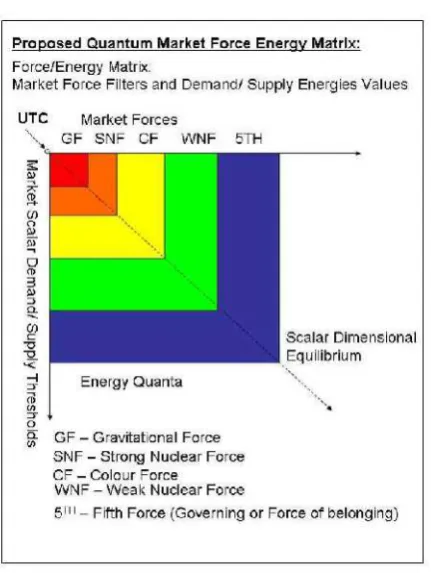
se:- Gravitational Force – The attraction gained from mass recognition by market participants about a discernible idea or ideal as central to a product or service. An example may be a can of Cola. This also relies on a primary core market that is already aware of this product. Its world renowned and recognised logo and hence is quite confident of these products or services exhibit greater benefits over all others, based on various satisfaction criteria and perceptions.
NB: The ‘Great Attractor’ whose attraction force diminishes proportionately with distance from the central reference point and also with relative time or, in the presence of a newer product to capture the attention of the participants.
Strong Nuclear Force – In this case the larger market populous retains basic knowledge of goods and services in that the participants acknowledge one particular product or service, as central to fulfilling needs (e.g. basic foodstuff). However, this diminishes as participants move further into to other markets, either physically, electronically, and soon photonically.
Weak Nuclear Force - An unusual and unqualified force that for some reason defies market models and would be proposed here as a force of ‘Remnant Longing’ that actually increases with distance and time. A fond memory of favourite good or service that leads participants back over an extended period of time due to the longing to fulfil a need for ‘Aunt Sally’s Chockie Biscuit’s’. That only come from Aunt Sally’s oven, even though the ‘desirous’ is on the other side of the planet. I.E. Unique and intrinsic properties identified by market participants.
Colour Force – A participant’s colour preference. The glossy packaging or perhaps the blue, yellow or red ‘Smarties’ that taste best!).
NB: Market psychology studies suggest that the 'power of colour' exhibit interesting and definable effects on one's purchasing habits its ability to attract/detract attention of the consumers.
Belonging’. The motivation of customers to purchase or invest based on a need to belong to set of brand values, philosophy and other non-quantitative attractions.
Fig 1.
Inter-active Forces:
In quantum physics, the relationship between these proposed forces (in this case translated effortlessly to free market economic perspective - assuming a ubiquitous new and fresh sheet to begin with), is the subject to endless debate.
However, in the economic perspective we look at this 'idea set' to establish by first principals the primary forces acting to represent the demands created by all participants. In addition, the proposed model will graphically exhibit the primary resultant reactions and interactions at all scales and dimensions universally. This in terms of business growth transactions for profit and re-investment there-of. In this case, the cycles of the creation of new products, services and derivatives through the perspectives of the Inventor (or innovator), investor, producer and customer.
The QED Model attempts to portray simply the interactive forces between participants in all roles at the same time which can be observed by any participant at a single moment in time about the global economic system.
[image:14.595.192.408.165.452.2]This is the concept of the proposed global economic matrix, which allows:
- All market forces and energies to be graphically represented to all participants.
All supply and demand in the market system to be represented.
All exchanges products and services (including derivatives).
All interactions and exchanges of information and capital between all participants.
All business entities and private that are established and operational with the defined market space.
3. RESULTS AND DISCUSSION
Chaos Model Vs Harmonic Model:
Central to this paper is the candid assumption that these present global cyberspace based market forces are not accommodated in a dynamic model that exists to date nor in the field of contemporary economic study. Rather, that they are fluid and generally follow no set theme or structure. It is proposed that presently these internet based market forced are chaotic (or fissile as later explained), in terms of present global economic measures.
This as a premise for global economic management fails in primary duties to recognise and manage the immediate effects of a real-time system of cross border capital transactions. Although steps by world Governments are being made toward a global economic system, at this point in time they rely on contemporary thinking.
Should this assumption hold true, then equilibrium can not be attained or sustained employing current four-dimensional logic or economic management skills devised therefrom. Hence, perpetually deny the emergence of the equitable distribution of local, national and global resources and exhibit inherent and systemic restrictions in abundant creation of opportunities for all participants to utilise the scalar finite and infinite resources equitably.
This as the theory proposes, can only be resolved on a basis of freedom of choice and open and free markets.
In short, the current global free market economic model does not work!
It is in a fissile state and hence much energy and resources are wasted!
So the QED Model allows a fresh approach in ways to resolves some of the more obvious constrictions. In addition, that any proposed solution should recognise these new environs of real-time global participant interactions and forces acting thereon.
For this reason, we look at the ‘Environs’ (or real time global market environments or networks) in which these participants presently exist to further our refinements of the universal business model. In addition, we strive for the fulfilment of overall objective of the creation of the opportunities to create wealth (not riches) for all participants equally and severally.
application of this system as a simplified and efficient service to all those whom feel this system is of substantially better value than traditional global business models, real time market systems, trading platforms and systems.
This would be difficult to imagine given the proposed system’s absolute covenant of free entry, use and exit (without obligation) to the Real-Time Market Environs proposed herein.
Explanation of the End of Time as a Dimension for Real-Time Environs:
In ‘quantum like’ environments, it is proposed the perception and measurement of T = Time is notional and as such, is excluded at the later stages.
The reason is that a participant within real-time environs theoretically has no perception of time whatsoever. This is beginning to be global phenomena that suggests very concerning trends for those whom have reasonable access time to this incredible 24 hour information and capital system.
From the very beginning of the twenty first century the central reference point of most Internet connected computer systems on the planet is simultaneously set and synchronised with the Universal Time Convention (or UTC). This is a precise time interval measurement that is calculated from the central rotation point of the Earth and that of the Sun’s.
The net affect of these rather unpublished phenomena is the high probability that participants in the global economy will experience a sudden and dramatic change in their working lives, unlike any other in the history of humanity. Given the incredible speed that the participants are ‘connected’ using ever small and more portable end user devices (e.g. mobile phones), these phenomena will provide this unique experience on a global scale.
The reference point that governs the UTC (i.e. centre of the Earth) is essential to the understanding of a QED Model as it is designed to transcend through these major events and emulate into a full real-time global development. Its central reference point will not be a physical locale; rather it will be a singular reference point for the entire dynamic evolution of the proposed global economic system.
A notional point where Time = Zero, or ‘XYZ Ref. 00000.000000.000000’point in a market or industry.
Measurement of Energy and Money Basic Requirements:
To translate coherently, we need to acquire a base unit of measurement that is easily convertible between both states of:
-A. Energy (in Economic Terms - Cash) – free flowing about a central reference point
B. Mass (in Economic Terms - Capital) - organised energy about a central reference point.
The QED Model simply defines it to be expanded once the basic criteria of the models design principles are substantial proven.
Recognising firstly, as with any measurement process that at least two definable scales and dimensions are identified.
Furthermore, it should be able to translate universally into various component units and derivative or denominations of the same (whole) for use in a seemingly unlike realm of global free market economics.
Proposed Law of Absolutes:
At this point, there is a metric decimal standard applied to avoid the use of fractions easily and thus absolutely quantified. This is common industry practice in international engineering.
The aim is to achieve the elimination of non-accountable or quantifiable fractions that still exist in some of the leading markets of global economics. We are looking at absolutes that would not require rounding. Hence, in digital computer engineering terms, elimination of margins of errors that are not absolute or easily processed with great accuracy by modern digital processors.
Now, we look at the basic elements in our attempt to make both economic and quantum systems marry near perfectly!
Metric/ Decimal Measurement Units (actually scientific based)
Time measurement per observation, which we say, will be measured in seconds or decimal parts thereof
No rounding or non-absolute fractions (decimal)
Simple (in this case very simple and common in order to easily translate)
Are able to translate easily in to the base valuation systems of goods or services. In this case currency units.
Thus:
-E - equates to energy units, but not easily transformed into any currency units.
M - in an economic perspective, we desire this to equate to capital that is organised or held by participants. Furthermore, reinvested in the creation of further capital via expenditure that attracts risk in return for added quantum of derived capital. This as profit from the transaction in a dynamic model. That is the market space.
C - Is given as an absolute, regardless of where you apply this.
We shall not consider loss at all for the moment. This impediment to capital growth is normally associated with risk. This is explained in the primary assumption basis of the QED Model that it is possible to cause economic fusion and thereby no loss (and equate to no risk). This theoretical and somewhat implausible phenomenon would be observed at and beyond reaching a zero time and energy state.
This premise does not easily marry with this universal equation for obvious reasons, primarily the units of measure and the component inter-relationships that by first principals originally derived this formula.
Hence:-US$ 1.00 invested in a unit of time (say one second) in the system (QED Model) equates to M (organised dollars and cents – legal tender) x 3.0 x 108 x 3.0 x 108 dollars per conversion. However, what is organised in terms of mass?
Presumably the assumption is that you want to create capital through investment in the proposed system over a period. It is at this is the point, that we have to invent a valuation system to gauge the value of this dollar (or any currency) invested, compared to another dollar invested elsewhere over a specific system time interval.
Gauge Valuations and Volumetrics – Checks and Balances:
Gauge measurement allows comparative value (or perhaps merit); assigned within a system of any component compared to another like component. On the other hand, perhaps the growth (or reduction) of the component measured when compared to the system itself. The key to the proposed gauge measurement system is calibration at absolute tolerances, or limits.
This means gauging or measuring the difference. The QED Model proposes working backward towards zero instantaneously in all parts of the product and/or summation to achieve near zero errors.
For the purposes of prediction of total system growth rates curves, minimum per participant starting values of five universal currency units are applied in our initial example.
This is intended to begin the gain in understanding of this grossly simplified example, in a conversion of a central currency to metric energy units (UCU's). This will be required to allow the proposed system global matrix to allocate these economic energy volumes to a self-balancing equitable summation and carry out various permutations therefrom within the whole of the system confines.
I.e. At what point and the methodology for comparative observation, valuation and exchange value determination is largely governed by the very fundamental growth sequence of the system itself.
Comparative Spot Market Pricing, Perception Thresholds:
We retain a problem of comparative perception of value of $1.00 dollar invested in QED Model compared to one not invested.
Therefore, we look at human perception and judgement, which we generally believe balance based (rational). In addition, in modern traded currency terms, the comparative supply/demand of currencies and the premise of its value within in a given quantity of time. The normal qualifications applied here, are the relative stability and performance of a subject currency over time.
When supply of US Dollars increases in a market space as compared to that of another currency (presently in terms of respective trade weighting), its comparable spot price with that of the object currency's spot price, diminishes over time.
In addition, the analysis of tangible loss or gain over time between currencies reflect to a smaller degree a degree of speculation of background socio-economic factors such as a government monetary policy change or increasing in economic performance indicators.
The price it is denominated in (its face sovereign value), does not change in time as it remains printed as One Untied States Dollars. This price governed by the sovereign authority of the People's Bank.
Again, time in a real-time space environ is zero. Leaving little opportunity to apply these traditional gauging tools and allow a reasonable period of human perception and judgement as to the relative values of compared currencies.
I.E. How will someone value anything in a real-time environ, if the price is changing via computer buy/sell orders, as is presently the case in most of the major capital and currency markets of the world?
How successful and stable will foreign currency trading be conducted, using as fluid exchange rate that may trade through enormous ranges?
This supposed fluid process, carried out in the presence of major central bank activity, institutional activity and market participants speculation.
The reflexes and perceptions of currency traders are at the heart of the issue and much more than that.
NB: This is generally about 0.3 to 0.6 seconds. In a real-time system we presumably will not perceive the difference in currencies as there is no time allotted to observe, compare or for that matter trade.
The ramifications of organised speculative manoeuvres in the market place and excessive and reactive capital flight that is induced through these activities are well known. In the proposed system without due design for safety these effects could be magnified many times over.
We at this point must reconsider the global market mechanisms in respect to these sometime debilitating factors and provide clarity and safety for the general market participants.
Out of all these issues, clarity within the market and greater participation through more open and understandable rules of market participation must be the first priorities.
These are the essential benefits of the proposed QED Model. However, it must be stressed that with a solution, new problems are created that must be modelled out of the system designs. In particular, inherent imbalance or restrictions, that nullifies fair play and open free and unfettered movement of capital about the world.
Possible Perception Solutions to Transaction Time Intervals:
The solution is to work backwards. Or in this case, inwards from a derived model to a form of convergence in monetary terms.
In order to achieve this feat, we apply a metric system using Volumetrics. This allows us to gauge the difference of the dollar across an interval of time, although we may eventually have the system running at the now well quoted zero time base of Real Time. Thus, allowing both the comparative observation of dollar doing nothing with the dollar doing something (invested, working, active or traded).
This should also solve a problem of this paper’s definition of mass. That is, that if a dynamic system of gauging values of currency could be met precisely, then at least we could begin to solve the bigger issue of trade, transactions and valuation over near zero, or zero time intervals. This would allow valuation of capital that is organised or fluid (as cash) in a new and more accurate way, largely on the premise of quantity rather than qualification.
At this point, we still have not identified an absolute linkage (or commonality), between the basic units of measurement between physics formulae and a selected and popular transaction of cash in the pursuit of sustainable capital creation.
This is vital to the translation of energy and mass into cash and capital. This process involving observations and value assigned thereto for comparison by participants within the market. We are still to some extent, at bartering level whereby we are buying apples with carrots. The few whom have the volume of funds (normally borrowed money) use this to stimulate troughs and depressions in the supply and flows of capital about Earth to effect reward by speculation.
Meeting Goal of Data Efficiency - Universal Shapes:
The great properties of the sphere are that they are terribly efficient in terms of dimensional change to area and volume resultants.
With the observation along the notional line of time, we may measure for the occurrence of change in any aspect, of any dimension, area, number or volume of the same. All this creation by adding just one, two, three and four points to a blank space (or vacuum).
Spheres are also symmetrical in all planes. That is that the sphere or circle (in two-dimensional form) allows folding in half in any chosen direction about the centre. In addition, and this is the inherent bonus, changing only one parameter can alter the three-dimensional volume.
As the spheroids primary governing equation for area and volume adjustment utilises the function of PI. It just happens to be an infinite singular function known to the school of mathematics. Inherently, the possibilities for practical use are endless (or infinite).
Spheres within Spheres, Or Law of Infinite Absolutes:
Better way of understanding this proposed Law is that of infinity (progression) within infinity is identical to radius (progression) within radius, thus by its very nature divisible but by itself. I.e. On radius divided by the same radius is equal to one and therefore a sphere of a certain radius divided by a sphere of the same radius is equal to one. We need to know this relationship in order to avoid margins of error across a multitude of simultaneous exchanges and transactions within the economic market universe we are proposing.
In this part, we are exploring an area whereby the geometry of particular shapes exhibit some universal properties and qualities.
So now, we propose the use of the sphere universally in our economic model. That can be scaled or altered easily, governed by only one determinate that of radius as a function of PI.
However, it is worth noting that the value for a volume calculated for a sphere is also always rounded. This problem is solved using the total of infinities within infinities expressed as an absolute number in the absence of time.
To make it easier let us explore the proposed method of measurement:
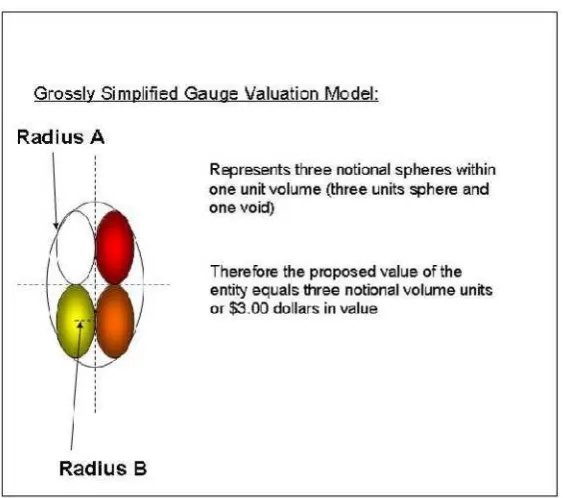
In effect, using a singular determinant PI to provide a function for quantitatively predicting a maximum quantum of spheres with radius A, within a larger sphere within radius B.
Fig. 2 (Repeated)
A simplified version would be to assign absolute numbers to pre-defined metric minima/maxima by way of mathematical differential calculus. In this case, maxims are having values of zero or one at any scale. From the lowest probable scale, to the highest perceivable, these two relationships would be harmonious within increasing larger groupings within larger containment spheres representing absolute values of one.
NB: This is only a notional description, as the entire model proposed is intended to be modelled on a graphical based computer software system. So at this point, a simplistic base is best.
This spherical geometry and proposed generic gauging structure using its inherent and infinite functions, allows treatment of global currencies of various denominations within this new economy (pre-engineered economy). Furthermore, treatment of exchange of currencies at ‘the moment of transition’ to and from external economies that uses traditional currency valuation techniques.
The ‘one’ is a pre-set maxim quantum of spheres for that currency value and simply assigned and updated a new 'fulfilment value' for comparison with another sphere pre-set value. This may sound quite arduous at first, but it has multiple benefits in terms of data efficiencies and balance itself.
The governing gauge relationship in all cases would be the circumference, which in it is a functional relationship to the same radius. It also visual represents the all-encompassing binding force, or force of belonging.
[image:22.595.161.443.150.399.2]Ease of use is a given, through the efficient number of primary instructions in order to effect a change in volume (or the number of volumes) presented in the model. Data processing efficiencies are the key to attaining the speed threshold required that is discussed in the section on the cascade dynamics. In relation to time efficiencies, this form of spheroid gauging tool is critical to the working of the proposed QED Model.
NB: Therein allows the most efficient use of data sets across the globe which is required for speed to meet our good late friend Adam Smith’s principle that all participants have the same market information at the same time.
Supply and Demand vs. Fusion and Fission - ‘What Gives?’ (Or ‘What Takes?’):
The recognition and inter-relationship of the laws of scale are fundamental in any generic based creation, as explained in this paper. Every aspect, at every scale of this proposed global economic system is intended to be simply a re-generation of the same universal design and function template for business design, development, operations and the very important transformation step, that of evolution through spin-off of value adding subsidiaries, merger and acquisition with and of other entities for synergy, scale and speed of development and operations.
In short, we are defining the Fundamental Particle (business idea or entity/ template) based on new requirements or zero time cyber markets. In addition, re-creating the hyper dynamics of these particles (business templates) to allow operation in a real-time global environ to allow equal opportunities to participate at all scales and dimensions thereof. This process and the simplified visual models that will be tested and refined therefrom, allows us infinite space and freedom from normal gravity based environs.
In this free space and with the proposed new governing laws, we are able to propose entirely different set of dynamics and mechanics to allow sustainable growth patterns to emerge for all participants through market interactions.
The benefits of having a simplistic and dynamic model to allow students and theorists to develop derivative or perhaps entirely new models may be of great benefit to so many schools of science..
In the case of Free Market Economics, focusing on the most simple market place, we can see the effects of supply and demand for goods and services and the various effects of changing the inputs and outputs to either sides of the equation. Therefore, we use Quantum Physics to look at the process of supply and demand between both energy and mass states of existence. The best known examples of this today are the processes of nuclear fission and fusion as basic reference models.
The former is the process a taking a given nucleus and deconstructing matter (or in QED, capital) to release various forms of energy, whilst the later is constructing matter (or capital) and is sustainable.
In both processes, energy is given or taken in order to construct or deconstruct matter (capital). In both circumstances, the measure of efficiency will be in the existence and sustenance of a state of equilibrium of the process (or system). This is observed both by the defined continuum of the process and the absence of significant waste.
interaction and high levels of participation, into a higher level or ‘state’ where it provides the market place with an infinite and sustainable range of goods and services.
The question is at what point the market becomes saturated. As density of core reactions (market transactions) is vital to the sustained and explosive growth function and creation of an energetic continuum about a given central reference point.
That question in a demand-led system is answered before the products and service is produced. This vital difference over traditional business practice allows economies at all scales to enjoy the enormous price reductions in the absence of waste an accumulated inventory. Thus addressing, many of the logistical problems that have been tested in the later part of this century. Most notably, ‘Just In Time Inventory Management’ or (JIT).
In this model, unsold products or services (burden or waste) and inventory quantum now become centralised and approach a zero quantum state. Thus, allowing formation of inherent advantages over traditional 'production line management' for goods and services. Another key to this remarkable tangential approach is the ability to allow the market participants to shape and determine the actual definition of products and services based on their interaction at all points in this process.
Customer Participation (at any point on the value construction pathway) in product/service development process in a real-time environ assures quality and quantity, but also insures price, time and End-User education before product/service release. The dynamics and synergism are operating at a full spectrum of participant perceptions and roles as inventor/innovator, investor, quality controller, end-user/customer etc.
The corporate entity proposed herein and the free market environment that it creates about it, will in theory become a creator and provider of an infinite array and quantum of goods and services in an efficient use of given nucleus of resources. This could be regarded a process coined here as ‘quality of economics’ - which is broadly defined as ‘fitness for use of what resources you have available’ defined by the fullest participation of the people as market participants.
Theory and Practice (The Old Problems Require New Solutions):
Application of theories into practical and achievable business solutions requires a suitable technology and environmental base to exist to enable one to determine the result.
The application of Free Market Economics theorem requires the factors that Mr. Adam Smith determined as being present in the defined market environ (then only physical market place). As the requirements for fusion to take place provided by Albert Einstein (considered space and nonphysical environs) these include as bare minima:
- Suitable mass of pre-determined design,
Critical mass of energy transactions (which in itself requires energy to form)
Space free from adverse influences such as gravity or other matter that may influence or contaminate this free formation processes (i.e. a vacuum - or space itself).
achieve the critical mass ratio required for a state of global economic equilibrium or ‘Economic Fusion’ to be achieved and sustained.
CyberSpace provides that medium, as too does the collective energy of the world’s purchasing and investing power. If capital (or cash in fluid form) is able to move freely between spaces (market spaces), with complete freedom.
Quantum Excitement States:
NB: Due to time constraints this section of the QED Model is to be graphically explained in a separate paper as it involves to essence of global economic fusion state a theoretical maxim of the proposed economic model.
Overview
The proposed QED Model shows the various stages of the capital transformation. Whereby the primary state (or, nucleus) of the proposed commercial entity, is provided economic energy (cash for re-investment and expansion), until it achieves a critical mass market for its goods and services.
The primary assumption is that the core market activities provide enough market demand energy and attractive merits for the business idea (product, service or derivative along the value construction pathway) to remain in the immediate attention of online participants. Remembering always, that the system design covenants provide that the participant is free to enter, use and exit the environs without obligation (express or implied). This is fundamental to the very equitable and sustainable nature of the system and establishes the levels of participant's confidence in the sustainability of the system governed by this open expression.
This primary state surpassed via secondary state (or ‘economic fission’), continual further re-investment of critical mass profits leads to the ultimate state of transformation. Whereby the array of goods and services it produces reaches a critical mass market, thereby achieving the tertiary state of ‘economic fusion’.
Scalar Economics:
Speed and scale induced super efficiencies in the allocation of opportunities to create wealth through the real time measurement, allocation, and safe, open and equitable distribution of information, capital and resources.
The business ‘idea’ is the kernel of the universal business template that attracts market participants attention and thereby information and capital.
The Importance of the Inertial Reference Point:
The Inertial Reference Point (IRP) provides real-time instantaneous and relative observation of an entity(s) and the entire market space environs from a single reference point. Thus, a single point for comparative measurement of entity growth and/or recession as compared to other entities and the market space as a whole is provided instantaneously. Such clarity and scalability provides the power of this system as compared an adhoc amalgam of various market places around the world today.
Provides a means to proactively manage the evolution of entities and the marketplace similar in principle to modern market volume trading curbs which regulate sudden and/or unusual trading activity. In this proposed method a series of filters and curbs regulate flows in a multi-dimensional nature using the inertial reference point as a primary and active calibration system. The force energy matrix provides pre-engineering of rules of evolution and interaction of the entity(s) and the market environ.
The difficult force to understand in the proposed matrix is the fifth force or governing force which is proposed as the one force which the system uses to summate itself in all parts of the whole in a single moment in time. This force is the ‘guiding’ hand in the entity(s) and market environs evolution. Given the anticipated hyper growth rates of the market space the importance of having pre-engineered or preset values for these filters cannot be under estimated. Their constant maintenance and update are worthy of extensive modelling exercise before the proposed cyber economy is even attempted.
The rationale is that the rules of evolution and basic operational mechanics of the QED Model are inherent or applied aiming to provide the safe, open and equitable operations for all and the sustainable evolution of the market itself.
The Evolution of a Business (or economic) Idea:
The QED Model provides a framework to observe, measure and manage the real-time evolution of a business idea, attraction of capital and market participation to create and grow new products and services and legal entities to develop, deliver and trade them.
QED Model SWOT Analysis:
Strengths – Simplicity, scalability, universal governance systems are variable, inherent and applied. Safety, Openness and Equity are fundamental pretext for equilibrium to form and hence economic fusion state to be achieved and sustained.
Weaknesses – Technical, cultural and political barriers could inhibit global adoption. Global banking system may see this system as a threat rather than a way of quantifying global risk in a real-time market environment which may provide all participants a more stable economic and market environment.
Opportunities – Technical platform, evolution pathway mapped analogue, digital, opto-electronic, photonic (light speed communications) allows designers and developers to plan ahead and thus minimise waste. Global financial crises precipitate need for homogonous global economic development and trading system.
Threats – The amount of variables, filters and mechanisms designed to mimic universal creation and evolution of energy may be constrictive, corrupting, or otherwise negative influence on overall evolution and free market principles. These should be changed only through democratic forces of participants. Complacency of market governing bodies, regulators and global business leader’s vested interests could lead to a distortion in the perceived need for these form of market systems.
4. CONCLUSION
The description of the proposed concept economic system is based on primary determinants driven by technological developments which suggest that a natural evolution of communications and computing systems will rapidly arrive at global photonic platforms and quantum computational architecture. As such the proposed economic system attempts to marry the primary rules of Free Market Economics with the realm of Quantum Physics to effect a paradigm shift in the way in which humanity allocates resources and the opportunity to create wealth to all people on Earth.
By pre-engineering computational systems we are able to design systems with predetermined rule sets that may allow economic systems to finally meet the first principles of Fee Market Economics. That is that all participants have access to the same information at the same time. In addition, that the design of the system will in time allow a predetermined point of economic equilibrium to form about an Inertial Reference Point (being UTC) and a state of sustainable economic ‘fusion’ to develop and be observed.
Economists and engineers alike need to understand the fundamental changes driven by globalisation and evolution of technical platforms that allow us almost infinite scope to design more safe, open and equitable systems for all through-out the twenty first century and beyond.
A Quantum Economic Model is hope to provide the starting point for the world’s academic and business leaders to address how to develop these systems for the benefit of humanity to avoid the known and unknown pitfalls of globalisation and related political power shifts in this century.
5. REFERENCES
- An Inquiry into the Nature and Causes of the Wealth of Nations, Smith A.
- Theory of Relativity, Einstein A, 1905
- Seven Ideas That Shook The Universe, Spielberg N., Anderson B., 1987
- The Elegant Universe, Green B., 1999