Image Steganography by Variable Embedding and
Multiple Edge Detection using Canny Operator
Geetha C.R.
Senior lecturer, ECE Dept
Sapthagiri College of Engineering
Bangalore, Karnataka.
H. D. Giriprakash
Professor and HOD,ECE, Dept
Sapthagiri College of Engineering
Bangalore, Karnataka.
ABSTRACT
This paper proposes a method for image steganography. According to Human Visual System, any variation in the edges shown in the images has a low probability of being perceived by the human eyes, thus data can be hidden in the pixel of the cover image. These edges can be detected by using sophisticated operators like Canny edge detection operator. The gradient of the pixel of the image is determined and the image edges are detected by taking a threshold value of the gradient image. Here we go for multiple edge detection so that more number of pixels around the edge area is detected using the above method. Thus resulting in embedding of more information bits in the LSB of the image pixels further again we go for variable embedding so the combination of multiple edge detection and variable embedding improves the data hiding capacity. The multiple edge detection is limited to three times so as to reduce the distortions. To further increase the data hiding capacity and at the same time maintain a respectable PSNR variable embedding method is employed. For extraction of data the stego image is compared with the cover image, and the variation in the pixel values are detected, thus the embedded data is efficiently extracted.
General Terms
Security.Keywords
Steganography, Multiple Edge Detection, Variable Embedding,
Canny Operator.
1.
INTRODUCTION
Due to the enormous growth in the field of communication, the security of information is a must need. Many techniques like Cryptography have evolved. Different methods to encrypt and decrypt data in ordered to keep the information secrete are developed over the year. Unfortunately it is sometimes not enough to keep the contents of a message secrete, it may also be necessary to keep the existence of the message secrete. The method hence developed is „Steganography‟.
Steganography is the technique used to hide the information in some other information so that the existence of the secrete message cannot be detected easily. In Image steganography image is used as the cover information. The Cover image is the one in which the secrete data is embedded. The image thus obtained by embedding secrete data into the cover image is called Stego-image.
All digital images are made up of pixels. Each pixel is represented by a value that corresponds to the color level of that pixel. In Gray-scale images each pixel is represented by 8-bits, hence there are 256 distinct levels of shades. Hence all pixels are represented with a value corresponding to their color level. For the image of size 512×512 pixels will have approximately 2.09715×106 bits and if we hide the information
in LSB of each pixel we can hide about 262.144×103 bits of data in an image. This makes steganography to hide large data in the images. And this method of hiding data in LSB of the each pixel is proposed by Marghny Mohamed, Fadwa Al-Afari, and Mohammed Bamatraf [1]. But the extraction of the data was easy as extracting every LSB gives the message and the security was less. Moazzam Hossain, Sadia Al Haque, Farhana Sharmin [2] proposed steganography method using neighborhood pixel information. But the PSNR is obtained was about 43.144dB and the visual quality was poor. Subsequently Chen [3] [4] proposed a method using DWT and DFT to get phase of image and achieve hiding a secrete image into a cover image. The algorithm has advantage in capacity, but vision effect is unsatisfactory.PSNR was less than 40dB. LiLi, Bin Luo, Qiang Xiaojun Fang [5] proposed a method using edge detection using sobel operator. The sobel operator is not enough accurate in finding the edges of image .the capacity for gray scale image is 2 bits per pixel, hence the capacity is less.
To overcome these disadvantages multiple edge detection and variable embedding methods are proposed in this paper. Multiple edge detection is the method in which the edge of the image is detected multiple times. Further instead of sobel operator „canny operator‟ is used which has a more efficient algorithm in finding the edge of the image. This increases the data hiding capacity in the image. But if we only focus on increasing the data hiding capacity the PSNR decreases and the image appears distorted which hampers the main aim of image steganography i.e. stealth hiding.Hence, we propose a method called variable embedding. In variable embedding method the number ofdata bits hidden in each pixel is varied according to the pixel‟s gradient value (i.e. whether it is an edge or not).So using the method in this paper we can hide more data with a good visual clarity and PSNR.
2.
METHODS USED IN THIS PAPER
2.1
Multiple Edge Detection
16 Gaussian filter,
Image
2
4
5
4
2
4
9
12
9
4
5
12
15
12
5
4
9
12
9
4
2
4
5
4
2
1/159
A
G
x
A
1
0
0
1
G
y*
A
0
1
1
0
G
G
x
G
y„A‟ is the smoothened image.
„*‟ is 2-dimensional convolution.
This creates a gradient image. Then a threshold value is taken as the reference and gradient of image pixels are compared with this threshold value. Only those pixels in which the gradient value is more than threshold are considered as edge pixels. Thus the image obtained is edge detected image. If this method is repeated for multiple times, then the number of pixels that are in the vicinity of the edge of the image also increases. It can be seen that the number of pixels nearly doubled using multiple edge detection and hence the data hiding capacity is increased largely.
2.2
Variable Embedding
Variable embedding is the method in which the message to be hidden is converted into bit streams and it is embedded to the image. Optimal number of bits that can be hidden in each pixel is determined and the message is broken accordingly this is known as Variable Embedding Ratio [VER].We know that as per human visual system variation in edge pixel is less detected by human eyes so using this phenomenon we can embed more data bits in edge pixels and less in other pixels. This paper uses 4:2 variable embedding that is 4 bits are embedded in edge detected pixels and 2 bits in other pixels. Thus the visual quality of the stego image is not compromised and more number of data bits can be hided with an allowable PSNR. The variable embedding ratio can be suitably choosed by the user depending on the number of data bits that are to be hidden and quality of stego image that can be allowed.
The VER forms a secret key without which extraction is not possible. This serves the purpose of hiding data into the image in such a way that only an authorized user can retrieve the data that are hidden.
3.
EMBEDDING ALGORITHM
3.1 Embedding Of Secret Data
The algorithm to embed secret data into the cover image as proposed by this paper using the above methods is as follows,
1. The cover image is taken and the areas of the image containing the edges are identified by determining the gradient of the image using canny operator as per (1), (2) and (3).
2. The edge detected image is again subjected to step 1 to further determine extra number of edges and it‟s done till the requirement is met (optimal to use 2 – 3 times for a 512 * 512 gray scale image) so that quality of the stego image formed after embedding is not compromised.
3. Now the pixel containing the edge detected areas of the image, variation of which is insensitive to human vision is identified. These are the selected pixels to hide the secret data. Let the number of edge detected pixels after multiple times edge detection be x.
4. The secret data or the message which has to be embedded into the image is converted into a stream of bits. Let the number of bits in the streams be y.
5. The chosen Variable Embedding Ratio [VER] is 4:2 that is 4 bits are embedded in edge pixels and 2 bits in other pixels. The VER so chosen is a compromise between the visual quality and embedding capacity required. If a higher VER is chosen then the number of bits that can be embedded increases but the visual quality and PSNR decreases. 6. The maximum number of bits that can be embedded for the
given Variable Embedding Ratio [VER] is limited to z = 4*x +2*(512*512 – x), as 512*512 gives the total number of pixels for cover image taken. So the total bits to be embedded(y) should be less than or equal to z otherwise the extra number of data bits are lost.
That is, y <= z.
7. Once the edge pixel is detected 4 bits from the y bits are embedded into the image pixel by LSB
substitution process in all other pixels only 2 bits are embedded using LSB substitution process.
8. This process is carried on till all the y bits are embedded.
3.2 Extraction of Data bits
For extracting data, in our proposed paper, the cover image is correlated with the stego image, for the extraction process the user should know the VER ratio which is used in embedding procedure.
On knowing the VER ratio the inverse process of that done in the embedding procedure is carried on by correlating the cover image with the stego image.
Using this procedure all the y bits that are embedded are retrieved successfully.
4.
EXPERIMENTAL ANALYSIS
A gray scale image of size 512*512, Lena, is used as a test image. As per the paper the edge of the figure is determined using both Sobel and Canny operator using Matlab7.12 tool and it is found that the number of pixel determined by sobel operator is much less than the Canny, and there is also some discontinuity on the image formed by the sobel operator. Thus more number of pixels at the edges is identified by Canny operator which is omitted by sobel operator. Hence more number of bits can be embedded keeping the visual quality high. This forms the main reason for proposing canny operator instead of sobel operator.
… (1)
… (2)
Figure 4 shows Lena image after subjecting to multiple edge detection up to 3 times as proposed by the paper, here we can see that the number of pixels identified is more thus data embedding is also more.
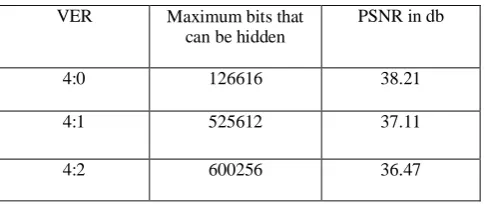
Table 1.comparision between different VER
The Table1 shows that the number of bits that can be embedded is increased at the cost of visual quality and PSNR, of the stego image thus formed.
It can be seen from Table 1 that as VER increases the data hiding capacity also increases at the cost of PSNR which reduces and the maximum hiding capacity is also the function of VER.
There is a sudden increase in the data hiding capacity for 4:1 compared to 4:0 this is because in the later case only the edge detected pixel is considered for embedding not the other pixels compared to the former where data is embedded in all pixels variably. But the visual quality obtained in case of 4:0 is much greater than that obtained in other considered VER.
Table 2. PSNR at different loads for VER of 4:2
The table2 gives the experimental results using VER of 4:2 as the number of bits that are hidden increases and the PSNR reduces.
For a VER of 4:0 the data bits are embedded only in the edge pixels but not in other pixels. Here data embedding is a measure of only the edge pixels detected. Hence for this VER the visual quality of the obtained image is very good but it is at the cost of poor embedding capacity of only 126616 bits which is just slightly more than 0.5bpp, whereas for higher VER the embedding capacity is more than 2bpp(bits per pixel).
The maximum hiding capacity acquired in the Four Neighbor and Diagonal Neighbor Method is 392208 bits and 395680 bits respectively. In our method we acquired a maximum hiding capacity of 600256, hence in our method the hiding capacity has increased greatly with only a little compromise in the
PSNR.
Table 3 Methods proposed by Moazzom Hosain, Sadia Al Haque and Farhana Sharmin
VER Maximum bits that can be hidden
PSNR in db
4:0 126616 38.21
4:1 525612 37.11
4:2 600256 36.47
VER Bitshidden PSNR in db
4:2
524288 37.66
262144 40.48
131072 44.95
Method Maximum Hiding
Capacity(In Bits)
PSNR(In dB)
Four Neighbors 392208 41.1468
Diagonal Neighbors
18
0
100000
200000
300000
400000
500000
600000
700000
Four
Neighbor
Method
Diagonal
Neighbor
Method
VER 4:0
VER 4:1
VER 4:2
Maximum hiding capacity in bits
Maximum hiding capacity in bits
.
Figure 5. Stego image Figure 6. Stego image
formed
formed for 600256 bits for 525612 bits hiding
hiding with VER of 4:2 with VER of 4:1
Figures 5 and 6 are the images formed by hiding data of variable loads at different VER.
Figures 7 and 8 are the enlarged versions of the stego and cover images which show the variation in pixel values of the stego image formed due to embedding of message bits into the cover image. It is by this comparison the original data bits is retrieved from the stego image provided the user knows the VER used in embedding process.
5.
CONCLUSIONS
In this paper an image steganographic method by multiple edges detection using Canny operator and Variable Embedding method is proposed. By using this method the data hiding capacity is improved and secrecy of the embedded data bits can be provided. It is also seen that the stego image formed is of good quality. Further work is to enhance the visual quality of the stego image by further improving the PSNR value.
Figure 1.Cover Image Figure 2. Edge detected
image using canny operator Figure 3.Edge detected
image using sobel operator
Figure 4.Multiple edge detected image
Figure7. Enlarged portion Figure 8. Enlarged portion of
Stego image of Cover image
6.
REFERENCES
[1] Marghny Mohamed, Fadwa Al-Afari, and Mohammed
Bamatrf “Data Hiding by LSB substitution using Genetic Optimal Key Permutation”, International Arab Journal of e-technology, vol 2, No.1 January 2011.
[2] Moazzam Hossain, Sadia Al Haque, Farhana Sharmin. “Variable Rate Steganography in Gray Scale Digital images Using Neighborhood pixel information”, The International Arab Journal of information technology,
vol. 7, No. 1, January 2010.
[3] Chen, W. Y., “Color image steganography scheme using set partitioning in hierarchical trees coding, digital Fourier transform and adaptive phase modulation,” Applied Mathematics and computation, 2007, vol.185, pp.432-448.
[4] Chen, W. Y., “Color image steganography scheme using DFT, SPIHT codec, and modified differential phase shift keying techniques,” Applied Mathematics and computation 2008, vol. 196, pp. 40-54.
[5] Li Li, Bin Luo, and Qiang Li Xiaojun Fang., “A color Images steganography method by multiple embedding strategy based on Sobel operator,” International conference on multimedia information networking and security, IEEE 2009, 978-0-7695-3843-3/09.
[6] Andrew D Ker., “Steganalysis of LSB Matching in Gray scale Images”, IEEE signal Processing letters, volume 12, NO 6, June 2005.
[7] R Amirtharanjan, R Akila, P Deepikachowdavarapu, “A Comparative Analysis of Image Steganography, ” International Journal of Computer Application, 0975-8887 volume-2-no 3, May 2010.