International Research Journal of Natural and Applied Sciences Vol. 4, Issue 1, January 2017 Impact Factor- 5.46 ISSN: (2349-4077)
© Associated Asia Research Foundation (AARF)
Website: www.aarf.asiaEmail : [email protected] , [email protected]
DEVELOPMENT AND VALIDATION OF THE CORE CLINICAL
NURSING COMPETENCE (CCNC) SCALE
Li-Yu Chien, PhD, RN, Shiow-Li Hwang, DNSc, RN, Tsuey-Yuan Huang, PhD, RN
Authors' Affiliations: Assistant Professor (Dr. Chien)1, Professor (Dr. Hwang)2, Associate Professor (Dr. Huang)1
1
School of Nursing, Chang Gung University of Science and Technology & Chang Gung Memorial Hospital, Taoyuan, Taiwan.
2
Department of Nursing, Asia University, Taichung, Taiwan.
Funding information: Funding for this study was provided by the National Science Council
in Taiwan, NSC 100-2511-S-255 -007, and Chang Gung Research Fund (BMRP).
The authors declare no conflict of interest.
INTRODUCTION
Advancements in medical technology and changes in the medical environment have led
to the development of nursing competence, which has become the main focus of nursing
education. Nurses play major and direct roles in clinical patient care; therefore, the main aim
of nursing education is to produce nurses who are competent in meeting clinical care needs.
By focusing on competence in nursing education, the gap between education and practice can
be narrowed, thereby leading to improved patient outcomes, clinical judgments, and
accountability of learners (Tilley, 2008). The assessment and evaluation of nursing
competence have recently attracted attention. Several measures of nursing competence have
(Wilkinson, 2013). In addition, no studies have examined changes in clinical competence
from nursing students to more competent nurses (Yanhua & Watson, 2011). The aim of this
study was to develop and validate a nursing competence instrument that focuses on core
clinical competence and allows for further professional growth.
BACKGROUND/LITERATURE
The recent focus of nursing education has been the assessment and evaluation of clinical
competence to ensure safe and effective practice. Although there is no universal definition of
clinical competence in nursing, it is generally agreed as the ability to integrate knowledge,
skills, attitudes and values required to safely and effectively practice nursing (Yanhua &
Watson, 2011). To ensure that nurses are adequately trained to be competent in clinical
practice, various approaches have been developed to evaluate nurses’ performance.
The approaches developed to test nursing competence include portfolios, objective
structured clinical examinations (OSCEs), and self-report instruments. Portfolios are widely
used by schools of nursing and during professional registration; however, studies have shown
that portfolios lack clear guidelines (Bowers & Jinks, 2004; McMullan, 2006; Timmins &
Dunne, 2009), are ineffective in assessing student learning and competence (McMullan,
2006), and have low interrater reliability (Robertson, Elster, & Kruse, 2004). OSCEs are
another approach that is internationally applied to evaluate medical and nursing competence;
however, they tend to be costly to implement and lack psychometric property testing (Yanhua
& Watson, 2011). Therefore, self-report instruments have recently become alternatives to
measure nursing competence more consistently.
In recent years, more attention has been focused on the development and testing of
nursing competence evaluation tools worldwide. The currently existing tools that have been
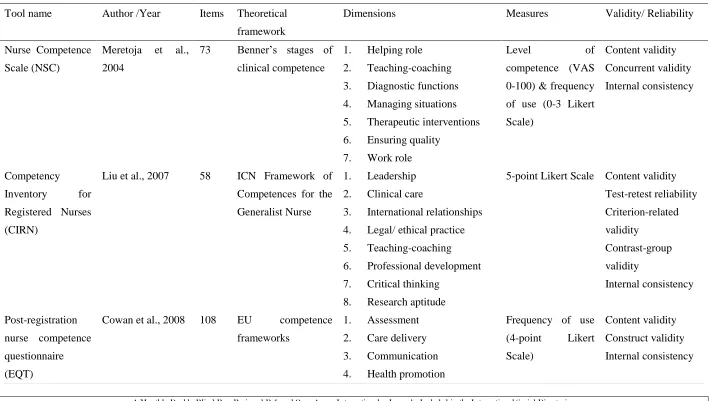
psychometrically tested are listed in Table 1. The Nurse Competence Scale (NSC) was
developed to measure the competence level of nurses by using a VAS (0–100, very low to
Isoaho, & Leino-Kilpi, 2004). It has been used in Australia (Hengstberger-Sims et al., 2008)
and translated into Italian (Dellai, Mortari, & Meretoja, 2009). In collaboration with five
European countries, Cowan et al. (2008) developed a post-registration nursing competence
questionnaire that was based on the competency frameworks of EU countries. However, the
questionnaire comprises 108 items, making it relatively lengthy and therefore rather
infeasible for use in clinical settings (Wilkinson, 2013). Another 27-item competence
assessment scale was developed by Safadi et al. (2010) and tested in Jordan. The scale was
based on hospital evaluation tools and cooperation with nurse supervisors, but its content
validity remains unknown.
(See Table 1 in Annexure Part)
Researchers are also attempting to develop psychometrically sound nursing competency
instruments in Asia as well. Based on the International Council of Nurses’ competency
guidelines, the Competency Inventory for Registered Nurses (CIRN) was developed and
tested in China (Liu, Kunaiktikul, Senaratana, Tonmukayakul, & Eriksen, 2007). The CIRN
comprises 58 items in 7 dimensions; unlike other nursing competency scales, one of the
CIRN’s dimensions is leadership. Hsu and Hsieh (2009) developed the Self-Evaluated Core
Competencies Scale (SECC) in Taiwan. The SECC comprises 8 items to measure how
competent nurses perceive themselves to be in eight core competencies specified by the
Taiwan Nursing Accreditation Council. However, the content validity has not been reported
for the SECC. In Japan, the Holistic Nursing Competence Scale (HNCS) was developed by
Takase and Teraoka (2011) via a concept analysis of 60 international nursing publications.
The HNCS comprises 36 items in 5 dimensions to test how frequently nurses engage in
behaviours related to general aptitude, and how competently they demonstrate the attributes
of a professional.
As can be seen, there has been a gradual increase in the availability of tools.
However, it should be noted that all were used in cross-sectional studies; thus, there is a need
for additional longitudinal studies to assess clinical competence throughout nursing education
(Yanhua & Watson, 2011). Additionally, most nursing competencies are measured in terms of
the frequency of use, which might not be applicable for newly registered nurses, who have
limited practical experience. The scales that contain dimensions of research or leadership also
might not be suitable for a longitudinal evaluation of nursing competence. Assessments of
nursing competency for newly graduated nurses should focus on the development of general
nursing competencies rather than current expectations of advanced and workplace-specific
nursing competencies (Hengstberger-Sims et al., 2008). Considering these points, the present
study aimed to develop a nursing competence tool that focuses on general core nursing
competencies and allows for the examination of changes in the clinical competence of
nursing students as they develop into fully fledged nurses.
METHODS
A methodological study was conducted to develop a general core nursing competency
scale. Items were generated via qualitative interviews, after which the content validity was
tested based on expert opinions and a pilot study. The preliminary scale was then
administered to a convenience sample of 260 clinical nurses from various clinical fields to
determine its psychometric properties.
Step 1: Item construction
In this study, the Taiwan Nursing Accreditation Council’s (2009) framework of core
competencies was selected to define the dimensions of nursing competencies. The 8
dimensions of core competencies were critical thinking and reasoning, general clinical skills,
basic biomedical science, communication and teamwork capability, caring, ethics,
accountability, and lifelong learning. Each dimension comprised a single item rated by five
statements, with each descriptive statement representing the nurse’s competence level in that
comprising novice, advanced beginner, competent, proficient, and expert; this ensured that
participants’ growth in terms of the eight core competencies could be measured (1 = novice
and 5 = expert) and compared longitudinally.
Step 2: Expert opinion and a pilot study for content validity
After constructing the first draft of the Core Clinical Nursing Competence (CCNC) scale,
we conducted content verification, including measurement of the face and content validity, by
gathering consensus from experts. To ensure that experts agreed on the CCNC scale items,
we had them perform two rounds of evaluation on the draft scale. Experts from nursing
education and clinical settings were invited to complete the content validity assessment. They
reviewed each item and determined if the item was appropriate for the CCNC in terms of
representativeness, specificity, and concreteness. Using the technique recommended by Lynn
(1986), the content validity index (I-CVI) was calculated for each item (participants rated
each item by using a 4-point scale; 1 = not relevant, 2 = unable to assess or in need of
extensive revision such that the item would no longer be relevant, 3 = relevant but needs
minor revision, and 4 = very relevant and succinct). Items with an I-CVI of ≥ .78 according
to three or more experts (S-CVI/Ave > .9) were considered to have satisfactory content
validity (Polit & Beck, 2006; Polit, Beck, & Owen, 2007).
Face validity was assessed by 10 recent graduates selected purposively. These graduates
were given the questionnaire and then asked to return it with written comments. Face validity
and think-aloud assessments led to adjustments of the items and changes to the language of
the questionnaire.
Step 3: Statistical analysis using data from a field study
Registered nurses who were currently working in clinical setting were invited to
participate in the study through the snowball method. Google Drive was used to provide an
Internet link for participants to access and complete the CCNC scale. They were asked to
retest. The opening screen contained a consent form, followed by a radio button that, when
selected, indicated their agreement to participate in the study.
Internal consistency reliability
The homogeneity amongst the items was tested with the corrected item-total correlation.
In general, the higher the correlation, the more desirable is the item (DeVellis 2003, p. 93).
Internal consistency reliability was calculated with Cronbach’s α, setting a minimum
acceptable value of > .70.
Construct validity
To confirm the unidimensionality and construct validity of the CCNC scale, exploratory
factor analysis was performed with the principal components method. Varimax rotation with
Kaiser normalisation was performed if the exploratory factor analysis extracted more than
two factors. The criterion for factor extraction was an eigenvalue of >1.
Criterion-related validity
Criterion-related validity was tested with Spearman rank correlations by using a part of
the current instrument. Correlation levels were interpreted as follows: 0–.25, slight
correlation; .26–.49, low correlation; .50–.69, moderate correlation; .70–.89, high correlation;
and .90–1.00, very high correlation (Munro 2005). The original items were as follows:
working satisfaction, self-evaluation regarding clinical ability, intention to stay, and nursing
tenure. The first 3 items were answered on a 5-point Likert scale ranging from 1 (very
unsatisfied/very unconfident, 0%) to 5 (verysatisfied/veryconfident, 100%). The fourth item
was coded as a continuous variable.
Test–retest reliability
To assess test–retest reliability, all participants completed the questionnaire again. The
interval between the first and second administration of the questionnaire was approximately 1
test–retest reliability was tested with Spearman rank correlation and intraclass correlation
coefficient (ICC); a value > .70 was considered acceptable for both.
RESULTS
Participant characteristics
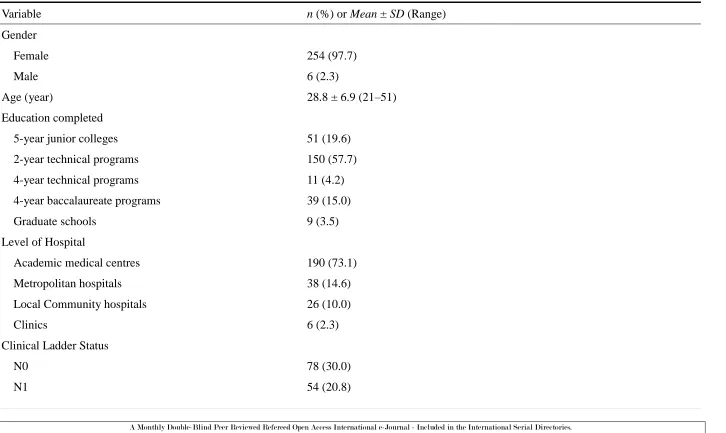
Overall, 260 participants were recruited. Most participants were female, had completed
2-year technical programmes, were N0 in terms of clinical ladder status, and were staff in
academic medical centres. The mean age was 28.8 years and the mean work duration was
90.6 months (See Table 2 in Annexure Part)
Descriptive statistics of items
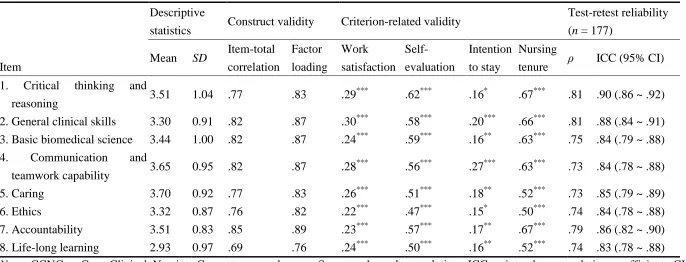
The item means ranged from 2.93 (lifelong learning) to 3.70 (caring) with standard
deviations ranging from .83 (accountability) to 1.04 (critical thinking and reasoning),
indicating appropriate variability. These results showed that the most competent subjects
perceived their competence level as being between competent and proficient, except for
lifelong learning, in which they perceived their competence level as being between advanced
beginner and competent (See Table 2 in Annexure Part)
Internal consistency reliability and construct validity
The corrected item-total correlations ranged from .69 to .85, indicating that all items
showed satisfactory homogeneity. In addition, the Cronbach’s α of the scale was .94, which
suggested satisfactory internal consistency. The exploratory factor analysis revealed that only
one factor was extracted, with factor loadings from .76 to .89; this factor accounted for
70.91% of the variance (eigenvalue = 5.67). Unidimensionality is supported when all items of
a scale load onto a single factor (Netemeyer et al. 2003). Exploratory factor analysis did not
extract any additional interpretable factors, which supports the notion that the CCNC scale is
unidimensional. In addition, the considerable size of the factor loadings and variance
explained indicated that the CCNC had acceptable convergent validity (See Table 3 in
Criterion-related validity
The four criterion-related validity items (work satisfaction, self-evaluation for clinical
ability, intention to stay, and nursing tenure) from the current instrument were defined as
external criteria. All Spearman rank correlation coefficients between the eight items and the
four external criteria were significant, suggesting evidence of criterion-related validity.
Furthermore, the correlations between the 8 items and self-evaluation and nursing tenure
were moderately high, ranging from .47 to 67. In contrast, the correlations between the eight
items and work satisfaction and intention to stay were weak (> .30; Table 2).
Test–retest reliability
Overall, 177 participants completed the questionnaire a second time, with a mean
interval of 12.40 days (SD = 8.31) from the first completion. In comparing the two tests (the
first and second completion), we noted strong correlations and high ICCs: The correlations
between the first and second tests ranged from .73 to .81, while the ICCs ranged from .83
to .90. These results suggest adequate stability between the two tests (See Table 3 in
Annexure Part)
DISCUSSION
The present study results suggested that our instrument is innovative, succinct, and valid
for measuring clinical nursing competence. Compared with previous instruments, our newly
developed instrument required fewer items and more descriptive content focusing on a
specific situation. For the same eight core competencies stipulated by the Taiwan Nursing
Accreditation Council, Hsu and Hsieh (2009) developed the SECC scale to measure the
clinical competence of nursing students. However, unlike the SECC scale, the CCNC scale
developed in this study can be used to both measure fresh graduates’ current level with the
eight core competencies and chart their growth in terms of competence (including novice,
advanced beginner, competent, proficient, or expert). As such, the CCNC scale could be
changes in competency.
Regarding the validity of the CCNC scale, exploratory factor analysis revealed that only
one factor was extracted, with factor loadings from .76 to .89 and a variance explained of
70.91%. As noted, above, unidimensionality is supported when a set of items fits within a
single factor model, and only one factor was extracted in the present study, which was
labelled ‘clinical core competence’. Gonczi (1994) advocated that evaluating competency
should be a holistic integrated approach because competence is context-bound and requires
knowledge, skills, attitudes, values, professional judgments, and related abilities performed in
specific situations (Gonczi 1994). This suggests that the 8-item CCNC was psychometrically
effective in measuring the general clinical core competencies of currently registered nurses.
The stability of the psychometric findings of the CCNC scale obtained across two time
points within 1 week was confirmed by a satisfactory ICC. In addition, a Cronbach’s α of .94
for the instrument indicated its internal consistency (Cronbach 1971)—in other words, that all
items measured the same construct (core nursing competence) and correctly reflected the
degree of a given competency.
Internet data collection enables easy access to potential subjects working in different
shifts and hospitals, thus increasing the diversity of participants. Based on the Taiwan
Nursing Accreditation Council’s (2009) framework of core competencies, the CCNC scale is
a new instrument that measures clinical patient-care-related competencies of nurses instead of
their administration- or academic-related competencies. Therefore, the scale would be helpful
in direct comparison of outcomes of nursing education programmes at schools and in
eliminating the gap between nursing schools and clinical settings. Furthermore, unlike other
measuring scales, the CCNC scale is designed for currently employed full-time nurses, and it
determines their clinical patient-care competencies.
Evaluation of competence by using self-report instruments is an essential and easy
2008). It must be noted, however, that objective instruments are increasing in number,
including OSCEs, the mini-Clinical Evaluation Exercise, and the Direct Observation of
Procedural Skills tools. More valid evaluation schemes would combine self-reported
instruments and objective appraisal methods, which is essential in the future.
CONCLUSION
An innovative, succinct, valid, and reliable instrument for measuring clinical nursing
competence, the CCNC scale, was developed. The trajectories of nursing competencies can
be captured using the CCNC scale; therefore, clinical nursing managers or leaders can
develop effective continued education programmes for registered nurses according to their
clinical ladder status at various stages of their career.
References
1. Allen, P., Lauchner, K., Bridges, R. A., Francis-Johnson, P., McBride, S. G., &
Olivarez, A. (2008). Evaluating continuing competency: A challenge for nursing.
Journal of Continuing Education in Nursing, 39(2), 81–85.
http://dx.doi.org/10.3928/00220124-20080201-02.
2. Benner, P. E. (2001). From novice to expert: Excellence and power in clinical nursing
practice. Upper Saddle River, NJ: Prentice Hall.
3. Bowers, S. J., & Jinks, A. M. (2004). Issues surrounding professional portfolio
development for nurses. British Journal of Nursing, 13(3), 155–159.
http://dx.doi.org/10.12968/bjon.2004.13.3.12112.
4. Cowan, D. T., Wilson-Barnett, J., Norman, I. J., & Murrells, T. (2008). Measuring
nursing competence: Development of a self-assessment tool for general nurses across
Europe. International Journal of Nursing Studies, 45(6), 902–913.
http://dx.doi.org/10.1016/j.ijnurstu.2007.03.004.
5. Cronbach, L. (1971). Test validation. In: R. Thorndike (Ed.), Educational
Education.
6. Dellai, M., Mortari, L., & Meretoja, R. (2009). Self-assessment of nursing
competencies--validation of the Finnish NCS instrument with Italian nurses.
Scandinavian Journal of Caring Sciences, 23(4), 783–791.
http://dx.doi.org/10.1111/j.1471-6712.2008.00665.x.
7. DeVellis, R.F., 2003. Scale development: Theory and applications, 2nd ed. Thousand
Oaks, CA: Sage Publications.
8. Gonczi, A. (1994). Competency based assessment in the professions in Australia.
Assessment in Education: Principles, Policy & Practice, 1(1), 27–44.
http://dx.doi.org/10.1080/0969594940010103.
9. Hengstberger-Sims, C., Cowin, L. S., Eagar, S. C., Gregory, L., Andrew, S., & Rolley,
J. (2008). Relating new graduate nurse competence to frequency of use. Collegian,
15(2), 69–76. http://dx.doi.org/10.1016/j.colegn.2008.02.003.
10. Hsu, L. L., & Hsieh, S. I. (2009). Testing of a measurement model for baccalaureate
nursing students' self-evaluation of core competencies. Journal of Advanced Nursing,
6(11), 2454–2463. doi: 10.11.11/j.1365-2648.2009.05124.x.
11. Liu, M., Kunaiktikul, W., Senaratana, W., Tonmukayakul, O., & Eriksen, L. (2007).
Development of competency inventory for registered nurses in the People's Republic
of China: Scale development. International Journal of Nursing Studies, 44(5),
805–813. http://dx.doi.org/10.1016/j.ijnurstu.2006.01.010.
12. Lynn, M. R. (1986). Determination and quantification of content validity. Nursing
Research 35(6), 382–386.
http://dx.doi.org/DOI: 10.1097/00006199-198611000-00017
13. McMullan, M. (2006). Students’ perceptions on the use of portfolios in
pre-registration nursing education: A questionnaire survey. International Journal of
14. Meretoja, R., Isoaho, H., & Leino-Kilpi, H. (2004). Nurse Competence Scale:
Development and psychometric testing. Journal of Advanced Nursing, 47(2), 124–133.
http://dx.doi.org/10.1111/j.1365-2648.2004.03071.x.
15. Munro, H. B. (2005). Statistical methods for health care research, 5th ed.
Philadelphia, PA: Lippincott Williams & Wilkins.
16. Netemeyer, R. G., Bearden, W. O., & Sharma, S. (2003). Scaling procedures: Issues
and applications. Thousand Oaks, CA: Sage Publications.
17. Polit, D. F., & Beck, C. T. (2006). The content validity index: Are you sure you know
what's being reported? Critique and recommendations. Research In Nursing & Health,
29(5), 489–497. http://dx.doi.org/10.1002/nur.20147.
18. Polit, D. F., Beck, C. T., & Owen, S. V. (2007). Is the CVI an acceptable indicator of
content validity? Appraisal and recommendations. Research In Nursing & Health,
30(4), 459–467. http://dx.doi.org/10.1002/nur.20199.
19. Robertson, J. F., Elster, S., & Kruse, G. (2004). Portfolio outcome assessment:
Lessons learned. Nurse Educator, 29(2), 52–53.
20. Safadi, R., Jaradeh, M., Bandak, A., & Froelicher, E. (2010). Competence assessment
of nursing graduates of Jordanian universities. Nursing & Health Sciences, 12(2),
147–154. http://dx.doi.org/10.1111/j.1442-2018.2009.00507.x.
21. Taiwan Nursing Accreditation Council (2009). Guidelines for Taiwan Nursing
Accreditation Council, Taiwan Nursing Accreditation Council. Taiwan: High
Education Evaluation & Accreditation Council. http://www.heeact.edu.twaasp?xltern=
I 086&CtNo de=355&rnp=S. Accessed on 25 August 2009.
22. Takase, M., & Teraoka, S. (2011). Development of the Holistic Nursing Competence
Scale. Nursing & Health Sciences, 13(4), 396–403.
http://dx.doi.org/10.1111/j.1442-2018.2011.00631.x.
Continuing Education in Nursing, 39(2), 58–66.
http://dx.doi.org/10.3928/00220124-20080201-12.
24. Timmins, F., & Dunne, P. J. (2009). An exploration of the current use and benefit of
nursing student portfolios. Nurse Education Today, 29(3), 330–341.
http://dx.doi.org/10.1016/j.nedt.2008.12.010.
25. Wilkinson, C. A. (2013). Competency assessment tools for registered nurses: An
integrative review. Journal of Continuing Education in Nursing, 44(1), 31–37.
http://dx.doi.org/10.3928/00220124-20121101-53.
26. Yanhua, C., & Watson, R. (2011). A review of clinical competence assessment in
nursing. Nurse Education Today, 31(8), 832–836.
Annexure- Tables & Figures
Table 1
Current nursing competence evaluation tools developed with psychometric testing
Tool name Author /Year Items Theoretical
framework
Dimensions Measures Validity/ Reliability
Nurse Competence
Scale (NSC)
Meretoja et al.,
2004
73 Benner’s stages of
clinical competence
1. Helping role
2. Teaching-coaching
3. Diagnostic functions
4. Managing situations
5. Therapeutic interventions
6. Ensuring quality
7. Work role
Level of
competence (VAS
0-100) & frequency
of use (0-3 Likert
Scale)
Content validity
Concurrent validity
Internal consistency
Competency
Inventory for
Registered Nurses
(CIRN)
Liu et al., 2007 58 ICN Framework of
Competences for the
Generalist Nurse
1. Leadership
2. Clinical care
3. International relationships
4. Legal/ ethical practice
5. Teaching-coaching
6. Professional development
7. Critical thinking
8. Research aptitude
5-point Likert Scale Content validity
Test-retest reliability Criterion-related validity Contrast-group validity Internal consistency Post-registration
nurse competence
questionnaire
(EQT)
Cowan et al., 2008 108 EU competence
frameworks
1. Assessment
2. Care delivery
3. Communication
4. Health promotion
Frequency of use
(4-point Likert
Scale)
Content validity
Construct validity
5. Personal and professional
development
6. Professional and ethical
practice
7. Research and development
8. Teamwork
Self-Evaluated
Core Competencies
Scale (SECC)
Hsu and Hsieh,
2009
8 Taiwan Nursing
Accreditation
Council’s core
competence
framework
1. Humanity/responsibility
2. Cognitive/performance
Level of
competence
(4-point Likert
Scale)
Test-retest reliability
Internal consistency
Principal component
analysis
Confirmatory factor
analysis
Competence
assessment scale
Safadi et al. 2010 27 Currently used
hospitals’ evaluation
tools
Cooperation of
supervisors
1. Management
2. Professionalism
3. Problem-solving
4. Nursing process
5. Knowledge of basic nursing
principles
Level of
competence
(5-point Likert
Scale)
Face validity
Internal consistency
Holistic Nursing
Competence Scale
(HNCS)
Takase and
Teraoka, 2011
36 concept analysis with
60 international
nursing publications
1. Staff education &
management
2. Ethically-oriented practice
3. General aptitude
4. Nursing care in a team
5. Professional development
Frequency &
competence
(7-point Likert
Table 2
Characteristic for the study participant (N = 260).
Variable n (%) or Mean ± SD (Range)
Gender
Female 254 (97.7)
Male 6 (2.3)
Age (year) 28.8 ± 6.9 (21–51)
Education completed
5-year junior colleges 51 (19.6)
2-year technical programs 150 (57.7)
4-year technical programs 11 (4.2)
4-year baccalaureate programs 39 (15.0)
Graduate schools 9 (3.5)
Level of Hospital
Academic medical centres 190 (73.1)
Metropolitan hospitals 38 (14.6)
Local Community hospitals 26 (10.0)
Clinics 6 (2.3)
Clinical Ladder Status
N0 78 (30.0)
N2 75 (28.8)
N3 41 (15.8)
N4 12 (4.6)
Table 3
The summary of results of the descriptive statistics, construct validity, criterion-related validity, and test-retest reliability of the CCNC scale (N =
260).
Descriptive
statistics Construct validity Criterion-related validity
Test-retest reliability
(n = 177)
Item Mean SD
Item-total
correlation
Factor
loading
Work
satisfaction Self-
evaluation
Intention
to stay
Nursing
tenure ρ ICC (95% CI)
1. Critical thinking and
reasoning 3.51 1.04 .77 .83 .29
***
.62*** .16* .67*** .81 .90 (.86 ~ .92)
2. General clinical skills 3.30 0.91 .82 .87 .30*** .58*** .20*** .66*** .81 .88 (.84 ~ .91)
3. Basic biomedical science 3.44 1.00 .82 .87 .24*** .59*** .16** .63*** .75 .84 (.79 ~ .88)
4. Communication and
teamwork capability 3.65 0.95 .82 .87 .28
***
.56*** .27*** .63*** .73 .84 (.78 ~ .88)
5. Caring 3.70 0.92 .77 .83 .26*** .51*** .18** .52*** .73 .85 (.79 ~ .89)
6. Ethics 3.32 0.87 .76 .82 .22*** .47*** .15* .50*** .74 .84 (.78 ~ .88)
7. Accountability 3.51 0.83 .85 .89 .23*** .57*** .17** .67*** .79 .86 (.82 ~ .90)
8. Life-long learning 2.93 0.97 .69 .76 .24*** .50*** .16** .52*** .74 .83 (.78 ~ .88)
Note. CCNC = Core Clinical Nursing Competence scale; ρ = Spearman’s rank correlation; ICC = intraclass correlation coefficient; CI =
confidence interval. Cronbach’s α = .94; Total variance explained = 70.91%. All values of item-total correlation, Spearman’s rank correlation,
and ICC were p < .001.