2019 International Conference on Computer Science, Communications and Multimedia Engineering (CSCME 2019) ISBN: 978-1-60595-650-3
Distributed Dynamic Power Allocation Strategy Based on Energy
Balance in Wireless Sensor Networks for Smart Grid
Gang SHAO
1,2, Wen-qin WU
1,2, Lei YIN
1,2, Chen-yang DING
3and Xiao-yuan ZHANG
3,*1
State Grid Chongqing Electric Power Company Nan'an Power Supply Branch, Chongqing 404100
2
State Grid Corporation of China, Beijing 100031
3
NARI Group Corporation (State Grid Electric Power Research Institute), Nanjing 211000
*Corresponding author
Keywords: Wireless sensor networks, Power allocation, Energy balance, Survival time.
Abstract. The characteristics of wireless sensor networks can solve many problems in smart grid construction. The power allocation strategy can effectively improve the energy efficiency of wireless sensor networks, but the static strategy will lead to unbalanced network energy consumption. So we construct a function of the energy condition of the reaction node. The transmission power of nodes is changed dynamically through the exchanging of information between neighbor nodes. And a distributed dynamic power allocation strategy based on energy balance is proposed. Simulation results show that it can effectively prolong the overall survival time of the network. This method can be used in a power system private network.
Introduction
Wireless sensor networks (WSN) has the characteristics of low cost, self-organization and strong scalability. It has been widely used in power system, environmental monitoring, military and industrial fields [1]. The problem of power control in wireless sensor networks is that the sensor nodes in the network choose the most appropriate power to send data in order to optimize the performance of the network. Since most energy of the nodes in the sensor network is consumed in communication [2], the application of power control technology can reduce the energy consumption in the node communication, and effectively extend the life cycle of the sensor network.
proposed for the case that only one source node and one destination node transmit information in the network. A link can be found to minimize the sum of each node’s power. In [11], a joint optimization game algorithm is designed, which supports parallel transmission and power control. The network capacity is improved by considering the independent and interactive relationship between channel allocation and power control. However, the above-mentioned algorithms do not take into account the balance of energy consumption in the network. The node transmission power will not change any more after it has been determined. In this case, it is easy to lead to premature energy exhaustion of some nodes in the sensor network, resulting in network coverage holes and the reduction of network connectivity.
In this paper, we propose a distributed dynamic power allocation strategy based on energy balance. Through local information exchange, the transmission power of nodes and the energy of the next hop node are considered comprehensively. A better node is selected to forward data. The next hop node and the corresponding power are dynamically adjusted according to the situation that the energy of nodes decreases gradually. It makes the overall energy consumption of the network more balanced, avoids premature energy exhaustion of local nodes, and prolongs the survival time of the network.
Network Model
For periodically reported sensor networks, it is assumed that each node sends the collected data to the SINK node at regular intervals and participates in the forwarding of data from other nodes.
Assume that the network has the following properties:
(1) All nodes are randomly and evenly distributed in the monitoring area, and the nodes are stationary.
(2) All nodes are isomorphic and the initial carrying energy is the same.
(3) It is assumed that the routing of the data sent by the node is determined in advance by the relevant routing algorithm, and the relay node will not aggregate the data but send it directly to the next hop node.
(4) The wireless transmitting power of sensor nodes can be controlled, and the transmitting power can be adjusted according to the need.
(5) The period of data generation is long enough for each node that the interference between nodes has been solved by FDMA or TDMA. We only consider background noise between nodes.
Problem Description
According to the propagation loss model of electromagnetic wave in free space, we can get:
4
r t t r
P P G G
d
, (1)
where Pr is the node receive power, Pt is the node transmit power, is wavelength of
electromagnetic wave, d is the distance of propagation and is the propagation loss coefficient. Gr
and Gt are the antenna gain of transmitter and receiver respectively.
In order for the transmitted data to be received successfully by the forwarding node, the signal
received by each node must satisfy a certain power threshold Pth and signal-to-noise ratio threshold
th
SNR . 2
is the noise power, and the power of received signal has to meet the following requirements
2
10lg
r th
r
th
P P
P
SNR
Combining with (1), the transmission power from node i to node j needs to satisfy:
, 2 /10 , 4 , 4 , 10 th th i j t r SNR i j t rd i j P
P
G G
d i j P G G
, (3)
where d i j
, is the distance between node i and node j.For the equilibrium of node energy consumption, we construct a function that reflects the energy situation of node i:
0 0 1 , 1 0, i i i
i h i h
h c h c
i
i h
h c
E E E E E
V
E E E
, (4)
where Ei is the current remaining energy of node i, ci is the set of neighbor nodes of node i, E0 is
the node initial energy, is an adjustable parameter and 1. This function actually reflects the
equilibrium of node energy in a local range. The larger the function value, the richer the node energy is. The smaller the function value, the shorter the node energy is.
Now we construct a revenue function based on the transmission power and energy selected by the nodes:
, 1 ( ) ,
i j i j i j i
U C P V , (5)
where C1 is the weight parameter, i is the number of nodes i currently needs to help forward and
its constraint condition is (3).
According to this function, the node chooses the most profitable strategy among the nodes with different transmitting power and different energy for the next hop. It considers not only the transmission power of the node, but also the energy situation of the node.
Distributed Dynamic Power Allocation Strategy Based on Energy Balance
In most of the current power control mechanisms of sensor networks, the nodes will not change after finding the appropriate transmission power, which will lead to the energy exhaustion of the nodes with larger transmission power, resulting in network connectivity reduction, coverage holes and other issues. The performance of the network will decline. To avoid premature death of some nodes, we propose a distributed dynamic power allocation strategy based on energy balance (EBDPA), which can improve the overall lifetime of the network by dynamically adjusting the transmission power of nodes. The detailed steps are summarized as follows:
Step 1: Initialize all nodes
Step 2: Each node broadcasts its current energy information Eito a node within a hop range
(neighbor node), and record the received neighbor node’s energy information Ek,kci;
Step 3: According to (4), node i get Vi of its own.
Step 4: If Vi 0, jump to step 8, otherwise move on to next step;
Step 5: Node i broadcasts the amount of data i it needs to forward to its neighbor nodes and
Step 6: Calculate the amount of forwarded data i k, i k and transmitting power Pi j, when selecting each neighbor node, and compute the revenue Ui j, .
Step 7: Node i chooses the neighbor node k with the largest revenue value as its next hop node. Update node i: Pi Pi k, . Update node k: k i k, ;
Step 8: Node i take the selected node as the next hop node. Set transmitting power as Pi and run for a cycle.
Step 9: Jump to step 2.
Simulation Results
We use MATLAB as the simulation software. In the following simulation, all nodes are evenly distributed in the area of 100m*100m. Sink node is located at the center of the area. All nodes need to send data periodically to the Sink node in one or more hops. If not specified, the parameters in the experiment are set as follows: the range of node power is [-60dbm, 0dbm], the noise power of each
node is equal 2 10
10
mW, the path loss exponent 2,the wavelength of the electromagnetic
wave 0.3m, the antenna gain G Gt r 1,the paramenter 5, received noise ratio threshold 5dB
th
SNR , the node initial energy E0 50J,the energy consumption of each data generation cycle
of a node is 0.1J and one cycle of nodes is one round.
Power Savings in Network Nodes
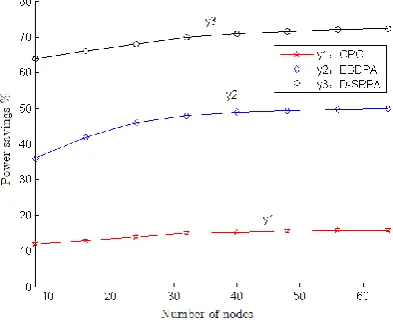
We first compare the proposed EBDPA mechanism with CPC protocol [4] and D-SRPA algorithm [10] which looks for the nearest node as the next hop node. Define the power saving rate of the network as:
1
max
1
n ave i i
P
nP
, (6) [image:4.595.194.391.528.689.2]where n is total number of network nodes and Piave is the average power of node i at different times. The simulation results of power saving in network nodes are shown in Figure 1.
Figure 1. Comparison of power savings in network nodes.
Survival Time of Network
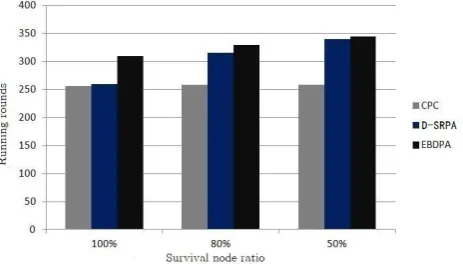
[image:5.595.191.396.189.349.2]The survival time of network refers to the survival time of most nodes in the network, but not the maximum survival time of all nodes. In the later period of network operation, the death of some nodes will lead to a sharp decline in network performance. Therefore, it is necessary to consider the balance of network energy consumption in order to prevent some nodes from exhausting energy too early due to high load. The simulation results of the network lifetime of 50 nodes are compared as shown in Figure 2 and Figure 3.
Figure 2. Time-dependent changes in the number of surviving nodes.
Figure 3. Running time to different proportion of surviving nodes.
As can be seen from Figure 2, node death in D-SRPA algorithm is gradually occurring. While the node death of EBDPA mechanism occurs sharply, but it occurs later than the former. The advantage of this phenomenon is that it prolongs the survival time of most nodes in the network at the same time, as shown in Figure 3. In the current scenario, all nodes of EBDPA mechanism survive at the same time about 16% longer than D-SRPA algorithm, and 80% nodes survive at the same time about 5% longer. It shows that EBDPA mechanism can effectively prolong the survival time of most nodes at the same time, and improve the network lifetime.
Conclusion
In view of the unbalanced energy consumption of nodes in wireless sensor networks, this paper proposes a distributed power allocation strategy based on energy balance. Considering the transmission power of nodes and the energy of the next hop node, the transmitting power and forwarding nodes are dynamically selected to make the overall energy consumption of the network more balanced and prolong the survival time of the network. In the function that reflects the energy
situation of nodes, set the parameter 5. The larger the value of is, the more times the node
[image:5.595.187.419.384.516.2]time, frequent power adjustment will also affect other performance of the network. The next step is
still to study the comprehensive impact of the value of on the network. This method can be used in
power private network.
Acknowledgement
This work is supported by Key project of state grid Chongqing electric power company (Research and demonstration on the application of new technology of wide and narrow band fusion Internet of things for power multi-service).
References
[1] J. Z. Li, H. Gao, Research Progress of Wireless Sensor Networks, Journal of Computer Research and Development, 45 (2008) 1-15.
[2] L. M. Sun, J. Z. Li, Y. Chen, Wireless Sensor Network, Tsinghua University Press, Beijing, 2005.
[3] S. Narayanaswamy, V. Kawadia, R. S. Sreenivas, et al, Power Control in Ad-Hoc Networks: Theory, Architecture, Algorithm and Implementation of the COMPOW Protocol, European wireless conference, 2002:156-162.
[4] S. J. Park, R. Sivakumar, Load-sensitive transmission power control in wireless ad-hoc networks, Global Telecommunications Conference, IEEE, 2002:42-46.
[5] M. B. Pursley, H. B. Russell and J. S. Wysocarski, Energy-efficient transmission and routing protocols for wireless multiple-hop networks and spread-spectrum radios, Eurocomm Information Systems for Enhanced Public Safety and Security, IEEE, 2000:1-5.
[6] R. Valli, A. Sharmila and P. Dananjayan, Utility based power control with pricing using MIDRS codes in wireless sensor networks, International Symposium on Humanities, Science and Engineering Research, IEEE, 2011:84-88.
[7] S. B. Liao, Z. K. Yang and W. Q. Cheng, Joint Power Control and Rate Adjustment in Wireless Sensor Networks, Acta Electronica Sinica, 36 (2008) 1931-1937.
[8] K. W. Li, L. Tu and F. R. Wang, Cross-Layer Optimization of Multi-Channel Wireless Networks with Joint Rate Control and Power Allocation, Acta Electronica Sinica, 37 (2009) 1203-1209.
[9] T. Liu, Distributed Power Control Mechanism Based on Utility Model in Wireless Sensor Networks, Acta Electronica Sinica, 44 (2016) 301-307.
[10] J. B. Si, Z. Li and L. J. Dang, Research on Distributed Cooperative Routing and Power Allocation Algorithms in Wireless Sensor Networks, Journal on Communications, 29 (2008) 67-76.
[11] X. C. Hao, Q. Q. Gong and S. Hou, Joint Channel and Power Optimizing Game Algorithms Supporting Parallel Transmission in Wireless Sensor Networks, Journal of Electronics and Information Technology, 36 (2014) 1720-1727.