A REVIEW ON DECISION MAKING OF RISK MITIGATION
FOR SOFTWARE MANAGEMENT
1
NORAINI CHE PA AND 2BOKOLO ANTHONY JNR
1,2 Faculty of Computer Science and Information Technology, University Putra Malaysia, 43400 UPM,
Serdang, Selangor, Malaysia.
E-mail: [email protected], [email protected]
ABSTRACT
Decision making (DM) is one of the main phases in risk mitigation for software management. DM is undeniably an essential phase in risk mitigation. Every decision has a different level of influence or impact in software management. In order to come up with the best choices, it’s necessary to go through the decision making process and adopt an optimal decision making model or tool to aid risk decisions in risk mitigation. Many studies have been accompanied for viewing the issues from different aspects based on a systematic method which is called Systematic Literature Review (SLR). This review identifies the process, factors, frameworks, models of DM of risk mitigation in software management. The findings of this review indicate that DM is one of the complications in mitigating risk in software management.
Keywords: Decision Making, Risk Mitigation, Risk Management and Software Management
1. INTRODUCTION
A decision can be defined as the act of reaching a conclusion [1]. Decisions can be structured, semi structured, or unstructured. The structured decisions clustering at the operational level of an organization and unstructured decisions at the strategic level. Decision making is becoming the basis of competitive advantage and value creations for organizations. There are four stages in decision making process: intelligence, design, choice, and implementation [2]. In [3] proposed a generic decision making process which follows intelligence-design-choice phases. Making a risk decision is a multistep process.
Nowadays, business environment is volatile,
dynamic, demand for accurate, relevant,
complete, timely and economical information. Poor decision making in software development team are due to unwillingness to commit to a decision, rely on others for decisions, and not taking ownership of decisions, face conflicting priorities for decision and unstable staff availability of team members. In order to cater it’s needed to drive the decision-making process in order to emphasize software team abilities to
manage and mitigate risks in software
management [4]. Risk Mitigation is the process of identifying and selecting suitable actions to reduce risks according to project objectives
through risk identification, risk decision, risk treatment and risk monitoring [5]. In risk mitigation, the management perspective is included in the treatment of risks. The effectiveness of any risk mitigation in software management is dependent on the quality of decisions that informs its operation. If decisions are right, it translates in positive software development outcomes, but where software activities are executed in conditions of poor
decisions resulting from insufficient or
inaccurate information, such software
development could be ruined. Decision making is the most important part of a senior manager’s job in risk mitigation. However, it is also the most challenging task they face in their managerial responsibilities. A number of scholars have contributed to the field of understanding the nature and the process of decision making., In [6] adds that a precise decision making process prevents poorly defined requirements that cause software projects to fall behind schedule, go over budget and result in poor quality software.
Software managers need information to size up
the problem, to take decisions about risks, but also in order to act in a variety of software management functions [5]. According to [3] decision making is vital in risk mitigation and this is why decision making is a major determinant of risk mitigation’s success or failure in software management. Decision
making in risk mitigation for software
management can be performed by project manager or groups of software project team as well as operational, middle, and senior managers. The software team members choose specific course of action in response to risk [3]. Systems to support decision making in risk mitigation do not always produce better decisions that improve risk mitigation in software performance because
of problems with information quality,
management filters, and organizational culture [2]. This is why decision making is a major determinant of quality software success or failure.
Good decision aids software process to be effective. Software management encompasses the knowledge, techniques, and tools necessary to manage the development of software products [7]. Software management guides software
managers to create plans for software
development. Software management ensure that all of the project activities follow a certain predefined process, the activities are usually organized in distinct phases, and the process the activities are usually organized in distinct phases, and the process specifies what artifacts should be developed and delivered in each phase. By effectively mitigating the risks it faces, software teams can guard against poor decision making, complacency and inadvertent exposure to any potentially debilitating consequences of its actions, as well as meet its objectives in delivering services to clients. The structure of this paper is organized as follows: section 2 presents research methods. Section 3 describes the SLR results and lastly the discussion and conclusion section is stated.
2. METHOD OF STUDY
The research method used in this study is a systematic literature review (SLR). An SLR is a well-defined approach to identify, evaluate and interpret all relevant studies regarding a particular research question and topic area or phenomenon of interest [8].
2.1 SLR Process
The SLR process to be followed is according to [9]. The study started with starting the research questions, review protocol and result presentation.
2.2 Research Questions
The following research questions are defined to understand the practice of decision making
process in risk mitigation for software
management;
RQ1: What are the activities and people involved in decision making in risk mitigation for software management?
RQ2: What are decision making processes in risk mitigation for software management and what are the factors that contributes to decision making in SM?
RQ3: What are the frameworks/models of decision making in risk mitigation for software management?
2.3 Review Protocol
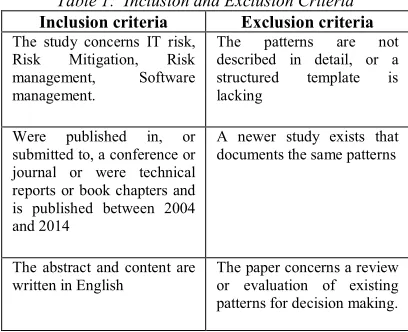
[image:2.595.309.513.564.730.2]A review protocol is essential to any review. Driven by the research questions, the protocol defines inclusion/exclusion criteria to select primary studies, a search strategy, search scope, search term and the data items that will be collected to answer the research questions. In the following sections, we explain in more detail how we have applied the different steps of the protocol. The table 1 shows the criteria of inclusion and exclusion.
Table 1: Inclusion and Exclusion Criteria
Inclusion criteria Exclusion criteria
The study concerns IT risk, Risk Mitigation, Risk management, Software management.
The patterns are not described in detail, or a structured template is lacking
Were published in, or submitted to, a conference or journal or were technical reports or book chapters and is published between 2004 and 2014
A newer study exists that documents the same patterns
The abstract and content are written in English
Reported SLRs or meta-analyses in Risk Management, Risk Mitigation and Decision
2.4 Search Scope
Time Period
We specify the time period of published studies for this SLR from Jan. 2004 to Nov. 2014.
Electronic Databases
According to the suggestion in [8], the following databases are selected as the primary study sources (Table 2). This source consists of articles from conference proceeding and journal (see Table 3 and Table 4).
Table 2: List of Electronic Database
# Electronic databases
DB1 IEEE Xplore DB2 ACM Digital library DB3 ScienceDirect
[image:3.595.318.518.389.488.2]DB4 EI Compendex DB5 ISI Web of Science DB6 SpringerLink DB7 Wiley InterScience DB8 Google Scholar
Table 3: List of Journals
Journals
Journal of Decision Support Systems
International journal of Computer Science and Engineering (IJCSE)
International Journal of Advancements in computing Technology (IJACT)
National Forum of Educational Administration and supervision journal
Table 4: List of Conferences
Conferences
International Conference on Engineering Design
The 3rd International Conference on Agent-oriented Software Engineering
Proceedings of the 38th Hawaii International Conference on System Science
2013 International Conference on Quality, Reliable, Risk,
Maintenance, and Safety Engineering (QR2MSE)
Proceeding of IEEE International Conference on System, Man and Cybernetics
International Conference and Workshops on Engineering of Autonomic and Autonomous Systems
ACS/IEEE International Conference on Computer Systems and Applications
IC-AI’99: The International Conference on Artificial Intelligence
ICSE’99: The 21st International Conference on Software Engineering
2.5 Search Terms
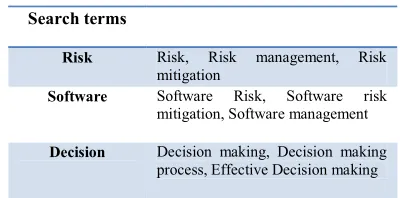
Risk, software and decision are used as criteria to define the search terms for database search in this SLR. The search term shows in Table 5.
Table 5: List of Search terms in Risk, Software and Decision
Search terms
Risk Risk, Risk management, Risk mitigation
Software Software Risk, Software risk mitigation, Software management
Decision Decision making, Decision making process, Effective Decision making
2.6 Search Strategy
The search strategy describes how to combine the search terms. This included an automatic search based on a list of keywords in the electronic databases and then the following Boolean search strings were used; “Risk Mitigation” or “Risk management” or “Software risk” or “Software management” or “Decision Making” or “Decision Making Process”.
3. SLRFINDINGS
year 2012. The inspected publications were [image:4.595.103.295.195.314.2]
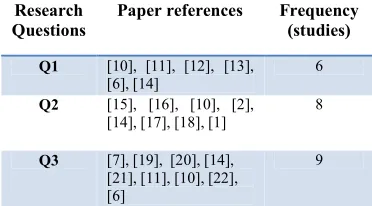
classified as showed in Fig. 1. Table 6 shows the mapping of frequency of studies with RQ1, RQ2 and RQ3.
Figure 1: Number of papers included in the review by
2-year intervals.
Table 6: Mapping of Studies with Research Questions
Research Questions
Paper references Frequency
(studies)
Q1 [10], [11], [12], [13], [6], [14]
6
Q2 [15], [16], [10], [2], [14], [17], [18], [1]
8
Q3 [7], [19], [20], [14], [21], [11], [10], [22], [6]
9
3.1 Activities Involved in Decision Making in Software Management
Answering the first part of RQ1, decision in software management is a process which leads an actor to answer a question, decision-making is a process of information transformation. This process is collective and can be considered as a release mechanism of software development activities [10],[11]. In [12] states that decision making in risk mitigation is a process of choosing a solution from a number of alternatives to mitigate risks, in risk mitigation it is a highly critical process characterized by its complexity. This complexity is characterized with the fact that decision-making is realized by human beings [10].
According to [10] the decision making should involve the activities of the decision within the
overall decision-making process (problem,
criteria identification, alternative selection) and
the organization of the actors involved in the process.
In [13] contributed that decision making is undeniably an essential and vital part of software management. Every decision has a different level of influence or impact in software development. In order to come up with the best mitigation of risk, it may be necessary to go through the decision making process repeatedly until an optimal, a near-optimal, or a satisficing solution is obtained. Hence, a decision-making process may not be structured in a strictly orderly manner.
3.2 People Involved in Decision Making
Answering the second Part of RQ1, Decision is usually understood as combining different individual preferences on a given set of alternatives to a single collective preference. In
risk mitigation pertaining to software
management, it is assumed that the individuals participating in making a group decision face the same common problem and are all interested in finding a risk solution. In software management risk mitigation involves group decision situation involves multiple actors (decision makers), each with different skills, experience and knowledge relating to different aspects (criteria) of the risk [6]. According to [14] Project manager is responsible in monitoring the software project, below are other stack holders involved in risk mitigation in software management.
3.3 Process Involved in Decision Making
Responding the RQ2 decision making in risk mitigation is a complex process involving many variables that sometimes is not fully understand. However, [15] suggested that many aspects of decision making process in risk mitigation for software management are clear and decisions take place at each level of software development. In contemporary risk mitigation, decision making means recognizing risk, generating alternative risk mitigations to the problems, choosing among alternatives, and implementing the chosen alternative [17]. Decision making is a critical managerial function. Software managers need information to size up the software risk, to take decisions, but also in order to act in a variety of management functions. Today decision making is the key to the long term survival of any software development process [16].
2004-2006
2007-2009
2010-2012
2013-Till Date 34%
26%
26%
[image:4.595.94.280.393.496.2]Making good decisions isn't sufficient; software
development team must make them quickly as well. Failure to react to this risk can result for a company going out of business. Making good risk decisions often requires decision making models that can provide the decision maker with risk data, risk information and answer to questions. Without such support decisions may be based hunches or bad information. Making a decision in risk mitigation is a multistep process [17].
The decision-making activities may use knowledge as a resource to build hypothesis, alternatives, and preference and decision criteria [2]. This knowledge is both explicit and tacit. It is linked to experience and collaboration between software team members, therefore decision therefore decision-making process may also be a learning process. Project managers are learning and memorizing while taking decision in the software project [10].
3.4 Factors that contribute to Decision
Making
The last part of RQ2, decision making relating the mitigation of risk in SM is carried out from the beginning of the software project. Software development project, for illustration purpose, consists of 4 typical stages or phases, following a conventional model (note that it could have more phases, if so desired), namely (phase 1) project definition (feasibility), (phase 2) requirements, (phase 3) design, and (phase 4) construction (implementation) [14]. Both academia and practicing software managers are concerned with the development of software that are within cost estimates, and on schedule, with a high quality product that fulfills the requirements, but decision are to be made pertaining the risk incurred in the development process [15]. Some of factors that alter effective decision making in SM includes personal factors such as age, education, background, experience of managing requirements change and characteristics of the organization might influence decision-making behavior [3].
In [3] suggested that individual, peer, group, and organizational and external factors influence decision-making behavior. At the individual level, studies indicate that differences in perception, attitudes, values and beliefs and in personality can lead to different approaches to decision-making. In [3] highlighted that the decision-making of leaders indicates that individuals are often influenced by the views or
likely reaction of their personal network. The desire for approval, and the need to exercise or maintain power, may thus influence decision-making behavior.
Decision-making is also influenced by the mission of the organization, its level of maturity, structural and cultural factors; and internally and externally generated change processes. With regard to mission, the types of decisions taken by managers obviously reflect the nature and purposes of the software process. Structural and cultural factors also may have a significant impact on the decisions taken. The structure and culture of an organization are influenced by its corporate and departmental strategies. These help to define the organization’s goals and guide future development [17].
Changes in departmental strategies may have a more immediate and direct impact on decision-making at lower levels of the organization, as these can generally be actioner more quickly, thus changes in direction at departmental level to influence decision-making in other functional areas and at corporate level [18]. The quality and availability of information has a major impact on the SM and customer satisfaction on decision-making is an important factor that influences
decision-making in SM [17].
Decision-stakeholders at all levels of the SDO have had to cope with an increased rate of change in
requirements, volatility, and uncertainty.
Research suggests that decision-making ability may decline under such conditions in SM [6].
3.5 Framework/Model in Decision Making
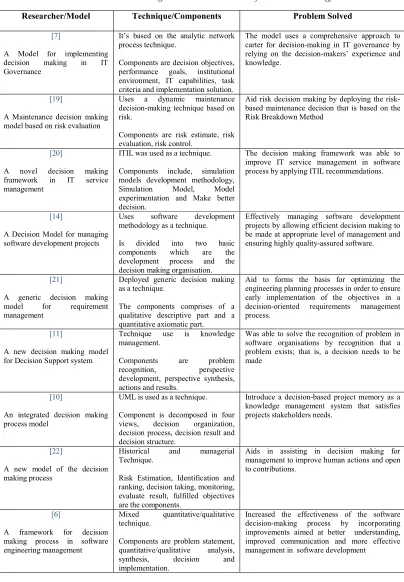
There are numerous decision making models of Information Technology (IT) nowadays. They all have the same basic goal, but very different perspectives and addressing different problems. Some of them applied to all kinds of risk, while others are specific for particular risks. These papers compare and clarify the different techniques, components and problems solved by each decision making model/ framework in IT. The decision making models/framework in IT are shown in Table 7.
In [7] proposed a model for implementing decision making in IT Governance based on
decision objectives, performance goals,
In [19] designed a maintenance decision
making model based on risk evaluation. The model is divided into three modules: risk estimate, risk evaluation, risk control module. In their model decision is made by decomposing the system. The decision makers use on the risk breakdown method help them in the decision making process.
In [20] created a novel decision making framework in IT service management. The main component is a specific methodology to systematically build simulation models that help to solve real-world organization problems which applying ITIL recommendations. The researchers explore the application of simulation modeling to support and improve decision-making in the scope of IT service management.
In [14] contributed a Decision Model for managing software development projects. The model developed is relatively simple and highly quality-assured. It allows efficient decision making to be made at appropriate level of management. The model is based on a set of indicators on deliverables between processes at the completion of tasks. The researcher also developed a prototypical web-based tool for decision making. Lastly the model aids communication among the decision makers by allowing monitoring, evaluation and reporting up by every level of management.
In [21] suggested a generic decision-making model for requirements management. This model forms the basis for optimizing the accelerated and target-oriented simultaneous engineering planning processes. In the model decisions needed for implementation at each stage of a project. Then it’s generically combined into one
decision-making model for requirements
management.
In [11] suggested a new decision making model for decision support system based on knowledge management. The decision process begins with the recognition that a problem exists and a decision needs to be made. The decision making process consists of three phases: intelligence, design and choice. Intelligence is used in the military sense to mean searching the environment for problems, that is, the need to
make a decision. Design involves the
development of alternative ways of solving the problem, and choice consists of analyzing the alternatives and choosing one for implementation In [10] recommended an integrated decision making process model. The researchers introduce a decision-based project memory as a knowledge
management system that satisfies projects
stakeholder’s needs. The decision-making
activities may use knowledge as a resource to build hypothesis, alternatives, preference, and decision criteria. This knowledge is both explicit and tacit. It is linked to experience and collaboration between projects' stakeholders. The decision-making process may also be a learning process. Project managers are learning and memorizing while taking decision in the project. Hence, by handling unstable and unstructured information, multiple views of design and project issues relative to decision, decision-makers improve their knowledge of the domain. In [10] went further to aid that decision-making is a highly critical process characterized by its complexity. This complexity is characterized by the interconnections this process with the various processes across the company together with the fact that decision-making is realized by human beings. The recommended model uses UML (Unified Modeling Language) object oriented language and its components are process, decision organization, decision structure and decision result.
In [22] presented a new model of the decision making process starting that a decision is a process which leads an actor to answer a question by considering decision-making as a process of information transformation. This process is collective and can be considered as a release mechanism of operational activities. The activities of the decision within the overall
decision-making process are problem
identification, criteria identification and
alternative selection.
In [6] suggested a framework for decision
making process in software engineering
management. The framework aids software decision making process by improvements of understanding, communication and management in software development using a mixed quantitative/qualitative technique. The suggested framework facilitates understanding of the requirements in software process management and improvement amongst decision stakeholders.
4. CONCLUSION AND FURTHER
RESEARCH
[16] stated that in decision making for risk mitigation in software management is the study
of identifying and choosing alternatives
decision based on risk implies that there are
alternative risk solutions to be considered. In risk mitigation, software team members need not only to identify as many of these risk alternatives as possible but to choose the one that best
mitigates the risk to achieve software
development goals, objectives and values.
Decision making should start with the
identification of the decision maker(s) in the decision, reducing the possible disagreement about problem definition, requirements, goals and criteria.
In order to mitigate risk effectively; a decision making model has to be adopted in SM to aid risk decisions in risk mitigation for effective
decision-making on quality software
development. 23 papers has been used for the review, each of the papers are form 2004 till 2014. At the end of this study we identified the activities and people involved in decision making in risk mitigation, recognized decision making process and their factors in risk mitigation for software management and presented existing
decision making models/framework in
information technology In future we intend to carry out more research to develop a model for decision making for risk mitigation in software management.
ACKNOWLEDGEMENTS
The authors gratefully acknowledged supports by the Faculty of Computer Science &
Information Technology, Universiti Putra
Malaysia and to our parents.
REFERENCES
[1] Cesar Vasilescu, Effective Strategic
Decision Making, the regional department of defense resources management studies, Journal Of Defense Resources Management (JoDRM), Vol. 2, No. 1, 2011, pp. 101-106.
[2] Kenneth Laudon and Jane Laudon,
Management Information System (Prentice
Hall 2012), 12th Ed 2011, ISBN-13:
978-0132142854.
[3] Gabriel Odinioha and Obara Chukwuma,
Management Information Systems and Corporate Decision Making: A Literature
Review, the International Journal of
Management, Vol. 2, No. 3, July 2013, pp. 78-82.
[4] Katherine Milkmam, Dolly Chugh and Max
Bazerman, How Can Decision Making Be Improve, 2012, pp. 1-11.
[5] Lainhart IV and John Williams, Why IT
governance is a top management issue, The Journal of Corporate Accounting & Finance, 2010, Vol.11, No.5, pp. 33-40
[6] Ddembe Williams and Michael Kennedy,
Towards a Model of Decision-Making for Systems Requirements Engineering Process
Management, Bi-annual conference on
Requirement Engineering, pp. 1-14, UK, 24-26 September, 2012, pp. 1-14
[7] Zhihao Tang, Yekui Wu and Xiao Wen Liu,
Analytic Network Process Model for the Implementation Decision-Making of IT
Governance, International Journal of
Advancements in Computing Technology (IJACT), Vol. 5, Nov.4, 2013, pp. 198-207
[8] Joanna Juziuk, Danny Weyns and Tom
Holvoet, Design Patterns for Multi-Agent Systems: A Systematic Literature Review,
International conference on computer
systems and application, Vol. 1, No. 6, 2012, pp. 1-22,.
[9] Barbara Kitchenham, Rialette Pretorius and
David Budgen, Guidelines for Performing Systematic Literature Reviews in Software Engineering, EBSE Tech. Report, Vol.1, No.1, 2007, pp. 1-14.
[10]Barthelemy Longueville, Julie Stal Le
Cardinal, Jean Claude Bocquet and Pascal Daneau, Toward a Project Memory for Innovative Product Design, a
Decision-Making Process Model, International
Conference on Engineering Design Iced 03 Stockholm, Vol. 5, No. 8, August 19-21 2003, pp. 1-12.
[11]James Courtney, Decision making and
knowledge management in inquiring
organizations: toward a new decision-making paradigm for DSS, Decision Support Systems, Vol. 3, No. 1, 2001, pp. 17-38.
[12]Fred Lunenburg, The Decision Making
Process, National Forum of Educational Administration and Supervision Journal, Vol. 27, No. 4, 2011, pp. 1-10.
[13]Angela Liew and David Sundaram,
Complex Decision Making Processes: their Modelling and Support, Proceedings of the 38th Hawaii International Conference on System Sciences IEEE Transaction, 2005, pp. 1-9.
[14]Thang Nguyen, A Decision Model for
Journal of Information and Management,
Vol 1, No. 1, 2004, pp. 1-15.
[15]Mihane Berisha Namani and Albana Qehaja,
Improving Decision Making with
Information Systems Technology – A theoretical approach, LLiria International Review, Vol. 1, No. 40, 2013, pp. 49-63.
[16]Naelia Sanchez Marono, Amparo Alonso
Betanzos1, Oscar Fontenla Romero, Miguel Rodriguez Garcıa, Gary Polhill, and Tony Craig, A Decision Making Model for Environmental Behavior in Agent-Based Modeling, Part 1 IWANN, Vol. 1, No.1, 2013, pp. 152-160.
[17]Janos Fulop, Introduction to Decision
Making Methods, Journal of Decision Making Systems, Vol, 1, No. 1, 2006, pp. 1-15.
[18]Kalka Prasad Tripathi, Decision Support
System Is a Tool for Making Better Decisions in the Organization, Indian Journal of Computer Science and Engineering (IJCSE), Vol. 2, No. 1, 2011, pp. 112-117.
[19]Chuan Lv, Jiayuan Xiong, Yan. Ding and
Haoran Zhou, A Maintenance Decision-Making Model Based on Risk Evaluation,
International Conference on Quality,
Reliability, Risk, Maintenance, and Safety Engineering (QR2MSE) IEEE Transactions, Vol. 9, No.4 2013, pp. 684-688.
[20]Elena Orta, Mercedes Ruiz, Nuria Hurtado
and David Gawn, Decision-making in IT service management: a simulation based approach, Decision Support Systems, Vol. 6, No. 2, 2014, pp. 1-16.
[21]Nilis Krönert and G. Girmscheid,
Development of a decision-making model for requirements management: Challenges, Opportunities and Solutions in Structural Engineering and Construction (Taylor & Francis Group, London 2010), pp. 729-733.
[22]Dumitru. Bontas and Liviu Drugus, New
Researcher/Model Technique/Components Problem Solved
[7]
A Model for implementing decision making in IT Governance
It’s based on the analytic network process technique.
Components are decision objectives, performance goals, institutional environment, IT capabilities, task criteria and implementation solution.
The model uses a comprehensive approach to carter for decision-making in IT governance by relying on the decision-makers’ experience and knowledge.
[19]
A Maintenance decision making model based on risk evaluation
Uses a dynamic maintenance decision-making technique based on risk.
Components are risk estimate, risk evaluation, risk control.
Aid risk decision making by deploying the risk-based maintenance decision that is risk-based on the Risk Breakdown Method
[20]
A novel decision making framework in IT service management
ITIL was used as a technique.
Components include, simulation models development methodology, Simulation Model, Model experimentation and Make better decision.
The decision making framework was able to improve IT service management in software process by applying ITIL recommendations.
[14]
A Decision Model for managing software development projects
Uses software development methodology as a technique.
Is divided into two basic components which are the development process and the decision making organisation.
Effectively managing software development projects by allowing efficient decision making to be made at appropriate level of management and ensuring highly quality-assured software.
[21]
A generic decision making model for requirement management
Deployed generic decision making as a technique.
The components comprises of a qualitative descriptive part and a quantitative axiomatic part.
Aid to forms the basis for optimizing the engineering planning processes in order to ensure early implementation of the objectives in a decision-oriented requirements management process.
[11]
A new decision making model for Decision Support system
Technique use is knowledge management.
Components are problem recognition, perspective development, perspective synthesis, actions and results.
Was able to solve the recognition of problem in software organisations by recognition that a problem exists; that is, a decision needs to be made
[10]
An integrated decision making process model
UML is used as a technique.
Component is decomposed in four views, decision organization, decision process, decision result and decision structure.
Introduce a decision-based project memory as a knowledge management system that satisfies projects stakeholders needs.
[22]
A new model of the decision making process
Historical and managerial Technique.
Risk Estimation, Identification and ranking, decision taking, monitoring, evaluate result, fulfilled objectives are the components.
Aids in assisting in decision making for management to improve human actions and open to contributions.
[6]
A framework for decision making process in software engineering management
Mixed quantitative/qualitative technique.
Components are problem statement, quantitative/qualitative analysis, synthesis, decision and implementation.
[image:9.595.96.500.137.719.2]Increased the effectiveness of the software decision-making process by incorporating improvements aimed at better understanding, improved communication and more effective management in software development