Adaptive Sentiment Analysis
Andrius Mudinas
Supervisors: Prof. Mark Levene
Dr. Dell Zhang
The Department of Computer Science and Information Systems
Birkbeck, University of London
This dissertation is submitted for the degree of
Doctor of Philosophy
I would like to dedicate this thesis to my loving parents, wife Egidija and wonderful daughter Olivia . . .
Declaration
I hereby declare that except where specific reference is made to the work of others, the contents of this dissertation are original and have not been submitted in whole or in part for consideration for any other degree or qualification in this, or any other university. This dissertation is my own work and contains nothing which is the outcome of work done in collaboration with others, except as specified in the text and Acknowledgements. This dissertation contains fewer than 100 000 words, including appendices, bibliography, footnotes, tables and equations, and has fewer than 150 figures.
Andrius Mudinas December 2018
Acknowledgements
Firstly, I would like to express my sincere gratitude to my advisors, Prof. Mark Levene and Dr. Dell Zhang, for their continuous support of my Ph.D. study and related research, and for their patience, motivation and immense knowledge. Their guidance has helped me throughout the research for and writing of this thesis. I could not have imagined having better advisors and mentors for my Ph.D. study.
Last but not least, I would like to thank my family, my parents, my wife and wonderful daughter for supporting me throughout the writing of this thesis.
Abstract
Domain dependency is one of the most challenging problems in the field of sentiment analysis. Although most sentiment analysis methods have decent performance if they are targeted at a specific domain and writing style, they do not usually work well with texts that are originated outside of their domain boundaries. Often there is a need to perform sentiment analysis in a domain where no labelled document is available. To address this scenario, researchers have proposed many domain adaptation or unsupervised sentiment analysis methods. However, there is still much room for improvement, as those methods typically cannot match conventional supervised sentiment analysis methods.
In this thesis, we propose a novel aspect-level sentiment analysis method that seamlessly integrates lexicon- and learning-based methods. While its performance is comparable to existing approaches, it is less sensitive to domain boundaries and can be applied to cross-domain sentiment analysis when the target domain is similar to the source domain. It also offers more structured and readable results by detecting individual topic aspects and determining their sentiment strengths. Furthermore, we investigate a novel approach to automatically constructing domain-specific sentiment lexicons
based on distributed word representations (aka word embeddings). The induced lexicon has quality on a par with a handcrafted one and could be used directly in a lexicon-based algorithm for sentiment analysis, but we find that a two-stage bootstrapping strategy could further boost the sentiment classification performance. Compared to existing methods, such an end-to-endnearly-unsupervised approach to domain-specific sentiment analysisworks out of the box for any target domain, requires no handcrafted lexicon or labelled corpus, and achieves sentiment classification accuracy comparable to that of fully supervised approaches.
Overall, the contribution of this Ph.D. work to the research field of sentiment analysis is twofold. First, we develop a new sentiment analysis system which can — in a nearly-unsupervised manner — adapt to the domain at hand and perform sentiment analysis with minimal loss of performance. Second, we showcase this system in several areas (including finance, politics, and e-business), and investigate particularly the temporal dynamics of sentiment in such contexts.
Table of contents
List of figures 9
List of tables 11
1 Introduction 14
1.1 Motivation and Objectives . . . 15
1.2 Contributions . . . 16
1.3 Publications . . . 17
2 Background 18 2.1 The Components of Sentiment Analysis . . . 19
2.1.1 Data collection and sources . . . 20
2.1.2 Text preprocessing and transformation . . . 22
2.1.3 Sentiment granularity . . . 25
2.1.4 Opinion holder and sentiment target . . . 27
2.1.5 Aspect detection and aspect-level sentiment classification . . . 28
2.1.6 Subjectivity and objectivity . . . 30
2.2 Sentiment-Detection Methods . . . 31
2.2.1 Lexicon-based sentiment detection . . . 32
2.2.2 Supervised learning . . . 34 2.2.3 Unsupervised learning . . . 37 2.2.4 Deep learning . . . 37 2.2.5 Word embedding . . . 38 2.3 Domain Adaptation . . . 39 2.3.1 Knowledge transfer . . . 40 2.3.2 Lexicon induction . . . 41 2.4 Sentiment Dimensionality . . . 42
2.5 Temporal Analysis and Sentiment Time series . . . 43
2.6 Application Areas . . . 45
Table of contents 7
3 Concept-Level Domain Sentiment Discovery 49
3.1 Introduction . . . 49
3.2 Contribution . . . 50
3.3 Datasets . . . 52
3.4 Model . . . 53
3.4.1 Preprocessing . . . 54
3.4.2 Aspect and view extraction . . . 55
3.4.3 Lexicon-based sentiment-detection evaluation . . . 57
3.4.4 Learning-feature extraction . . . 58
3.4.5 Sentiment scoring . . . 60
3.4.6 Sentiment measurement example . . . 61
3.4.7 Sentiment lexicon information gain evaluation . . . 63
3.5 Experimental Results . . . 65
3.5.1 Same-domain sentiment analysis . . . 65
3.5.2 Cross-style sentiment analysis . . . 68
3.5.3 Distant cross-domainsentiment analysis . . . 69
3.6 Summary and Conclusions . . . 69
4 Domain Lexicon Induction using Word Embedding 72 4.1 Introduction . . . 72
4.2 Contribution . . . 73
4.3 Datasets . . . 74
4.4 Word Embedding . . . 75
4.4.1 Domain-specific sentiment word embedding . . . 75
4.4.2 Cross-domain vector space characteristics . . . 76
4.5 Model . . . 77
4.6 Experimental Results . . . 80
4.6.1 Lexicon Induction . . . 80
4.6.2 Lexicon integration into thepSentisentiment-analysis model . 83 4.7 Summary and Conclusions . . . 85
5 Semi-supervised Sentiment Analysis 87 5.1 Introduction . . . 87
5.2 Contribution . . . 88
5.3 Datasets . . . 89
5.4 Model . . . 90
5.5 Experimental Results . . . 92
5.5.1 Sentiment classification of long texts . . . 92
Table of contents 8
5.5.3 Detecting neutral sentiment . . . 94
5.6 Cross-Domain Sentiment Analysis . . . 97
5.7 Summary and Conclusions . . . 98
6 Case Studies 100 6.1 Introduction . . . 100
6.2 Amazon Product Reviews Case Study . . . 101
6.2.1 Datasets . . . 101
6.2.2 Sentiment time-series analysis . . . 102
6.2.3 Sentiment seasonality . . . 105
6.2.4 Temporal-hybridtemporal sentiment analysis with autoregres-sive sentiment . . . 108
6.3 Temporal Dependency . . . 111
6.4 Market Sentiment Case Study . . . 111
6.4.1 Datasets . . . 113 6.4.2 Causality . . . 114 6.4.3 Time series . . . 115 6.4.4 Experimental setup . . . 118 6.4.5 Experimental results . . . 118 6.4.6 Prediction . . . 122 6.4.7 Baseline . . . 123
6.4.8 Using sentiment signals in news . . . 125
6.4.9 Using sentiment signals in tweets . . . 126
6.5 Political Sentiment Case Study . . . 128
6.5.1 Datasets . . . 128
6.5.2 Stance detection . . . 130
6.5.3 Evaluation of the method on the SemEval 2016 dataset . . . . 132
6.5.4 Demographics of Trump supporters . . . 133
6.6 Summary and Conclusions . . . 137
7 Conclusion 139
List of figures
2.1 Rotten Tomatoes review . . . 21
2.2 Amazon review . . . 26
2.3 Three-class classification performance using a variety of learning meth-ods [116] . . . 31
2.4 Sentiment-detection approaches . . . 32
2.5 Supervised sentiment-analysis architecture . . . 35
2.6 SVM separating hyperplane . . . 36
2.7 Plutchik’s sentiment wheel [190] . . . 43
2.8 The sentiment of “terrific” changed from negative to positive over the last 150 years [86] . . . 44
2.9 Market sentiment . . . 46
3.1 An example ofpSenti’s aspect-oriented output. . . 50
3.2 pSentiarticle temporal sentiment-analysis output . . . 51
3.3 The system architecture ofpSenti. . . 53
3.4 Sentence-levelpSenti’sanalysis interface . . . 54
3.5 Word-levelpSenti’sanalysis interface . . . 55
3.6 Top 40 SVM feature weights . . . 64
3.7 How the performance of lexicon is influenced using feature information gain filtering . . . 64
3.8 The lexicon-based sentiment-analysis results. . . 70
4.1 Visualisation of the sentiment words in the Standard-English domain . 75 4.2 A local region of the vector space zoomed in the Standard-English domain 76 4.3 Sentiment words of Finance in the same/different domain vector space. 77 4.4 Domain lexicon induction and integration intopSenti . . . 78
4.5 How the accuracy and size of an induced lexicon are influenced by the cut-off probability threshold. . . 82
4.6 Sentiment words about movies in the IMDB vector space before/after filtering. . . 83
List of figures 10
5.1 Ournearly-unsupervisedapproach todomain-specificsentiment
classi-fication. . . 90
5.2 The probability calibration plot of our LSTM-based sentiment classifier on the SemEval-2017 Task 4C dataset. . . 96
5.3 The probability curve with a region of intermediate probabilities repre-senting the neutral class. . . 96
6.1 Electronic product sentiment trends . . . 103
6.2 Kitchen products . . . 104
6.3 Video products . . . 104
6.4 Electronic products . . . 105
6.5 Electronic product sentiment fluctuation by year . . . 106
6.6 Average rating autocorrelation . . . 107
6.7 pSentiarticle temporal sentiment analysis . . . 110
6.8 The FT article snapshot . . . 114
6.9 Stationary analysis for DJIA close prices on the FT I dataset. . . 115
6.10 The cross-correlation between sentiment attitudes and S&P 500 prices. 116 6.11 The market close price changes (%). . . 116
6.12 The cross-correlation between sentiment attitudes and S&P 500 price changes. . . 117
6.13 Twitter Market Bot . . . 127
6.14 2016 US presidential election Twitter messages . . . 129
6.15 Twitter messages by tag . . . 129
6.16 Political demographics by age . . . 134
6.17 Political demographics by sex . . . 135
6.18 Political demographics by race . . . 135
6.19 Political demographics by income (thousands) . . . 136
6.20 Political demographics by degree . . . 136
List of tables
2.1 SuTime tagging examples . . . 23
2.2 Some existing definitions of basic emotions . . . 42
3.1 The experimental datasets. . . 53
3.2 The sentiment lexicon snapshot . . . 61
3.3 Weight adjustment stages . . . 63
3.4 Sentiment rating calculations . . . 63
3.5 How the performance of lexicon is influenced using feature information gain filtering . . . 65
3.6 The sentiment-polarity classification performance (accuracy) in the standard (single-style) setting. . . 66
3.7 The sentiment-strength detection performance (RMSE) in the standard (single-style) setting. . . 68
3.8 The sentiment-polarity classification performance (accuracy) in the cross-style setting. . . 68
3.9 The sentiment-polarity classification performance (accuracy) in the cross-domain setting. . . 69
4.1 The “seeds” for domain-specific sentiment lexicon induction. . . 79
4.2 Comparing the induced lexicons with their corresponding known lexi-cons (ground-truth) according to the ranking of sentiment words mea-sured byAUCand Kendall’sτ. . . 81
4.3 Comparing the induced lexicons with their corresponding known lexi-cons (ground-truth) according to the classification of sentiment words measured by macro-averagedF1. . . 82
4.4 Lexicon-based sentiment classification of Amazon kitchen product reviews. . . 84
4.5 pSentisentiment classification. . . 85
5.1 Short-text sentiment classification dataset . . . 89
List of tables 12
5.3 Sentiment classification of short texts into two categories —
SemEval-2017 Task 4B. . . 94
5.4 Sentiment classification of short texts on a five-point scale — SemEval-2017 Task 4C. . . 97
5.5 Cross-domainsentiment classification . . . 98
6.1 Amazon dataset partitioned by categories . . . 101
6.2 Amazon dataset partitioned by products . . . 102
6.3 Seasonality TBATS analysis . . . 107
6.4 Method comparison on electronic products . . . 109
6.5 Method comparison on video products . . . 109
6.6 Dynamic vs. static sentiment analysis (RMSE) . . . 112
6.7 Financial market datasets used in our experiments. . . 114
6.8 Sentiment attitude Granger causality on the FT I dataset. . . 119
6.9 Sentiment emotion Granger causality: S&P 500. . . 120
6.10 Sentiment emotion Granger causality: AAPL. . . 120
6.11 Sentiment emotion Granger causality: GOOGL. . . 121
6.12 Sentiment emotion Granger causality: HPQ. . . 121
6.13 Sentiment emotion Granger causality: JPM . . . 122
6.14 Market trend prediction using main technical indicators — the baseline model. . . 125
6.15 Market trend prediction using FT news articles and RWNC headlines (2011–2015). . . 126
6.16 Market trend prediction using financial tweets from Twitter (01/04/2014 – 01/04/2015). . . 127
6.17 2016 US presidential election dataset . . . 128
6.18 Trump stance classification test datasets . . . 130
6.19 Specific “seeds” for the presidential candidate political-sentiment lexi-con induction. . . 131
6.20 Trump support messages classification into three classes . . . 132
6.21 Trump support messages classification into two classes . . . 132
Listings
Chapter 1
Introduction
During its natural evolution, our species has developed various traits that have helped to improve our ability to survive in our surrounding environment. The ability to express and understand emotions is one such trait. It has a direct impact on our cognition and behaviour, and plays an important role in our everyday lives. Although there is no clear agreement on how to define emotions, some researchers define them using a set of basic states, such asanger,fear,sadness,disgust,surprise,anticipation,
trust, andjoy[61]. Others have expanded this set by including additional emotions
such as moral [84, 225, 170] or even sensory perception [85]. In this thesis, we use the term “sentiment” to describe a variety of affective states [186, 244], and we draw a distinction between sentiment attitudes and sentiment emotions, following the typology proposed by Scherer [216]. By attitude, we mean the narrow sense of sentiment (as in most research papers on sentiment analysis) — whether people are
positive or negative about something. By emotion, we mean the eight “basic
emotions” in four opposing pairs — joy-sadness, anger-fear, trust-disgust,
andanticipation-surprise, as identified by Plutchik [189].
Emotions and sentiment are present in almost all information sources. Every day, a large number of opinionated documents are published on the Internet: people post product reviews, express political views and share their feelings on social networks. Thus, naturally, this sentiment information not only affects our behaviour but also has a significant impact on our decision-making process. Prior to making a purchase or visiting a local restaurant, most individuals check online reviews and read customer feedback. On social media platforms such as Twitter and Facebook, people also share attitudes on personally important topics, day traders provide their trading stances and politicians pitch their messages to voters. More recently, Twitter attracted a lot of negative attention because of attempts by malicious actors to manipulate public opinion and political voting [12]. Therefore, the ability to extract sentiments from various information sources can not only provide invaluable information about people’s views
1.1 Motivation and Objectives 15
on various topics, but also help to predict customer behaviour, stock market movements or even election results.
Sentiment analysis is a domain-specific problem (i.e. all approaches perform well only if targeted at a specific domain, and they suffer significant performance loss once domain boundaries are crossed [200]). Bag-of-words learning approaches [182, 179] are among the most susceptible to the domain dependency problem. Conversely, numerous studies have suggested that a typical lexicon-based system [58, 228, 227] has lower domain sensitivity, may be easier to maintain by a human user, and has an output that is self-explanatory, yet it cannot match the accuracy of bag-of-words supervised learning.
Thus, considerable effort has been invested in finding an automated way of do-main adaptation by designing unsupervised sentiment-detection systems [60], various knowledge transfer methods [65, 27, 25] and systems less prone to cross domain bound-aries [26]. Unfortunately, most of these approaches suffer from various limitations. Supervised domain adaptation requires labelled domain-specific training data, and the collection of such data is an expensive and time-consuming task. Unsupervised ap-proaches typically have inferior performance and cannot match conventional supervised sentiment analysis methods.
Moreover, most domain-adaptation methods are designed with specific domain boundaries and constraints in mind, such as targeting different topics in a social media [126] or various categories of product reviews [76], thus performing domain adaptation between similar domains (also known as neardomains). Attempts to adapt distant
domains [158, 184] suffer from a significant drop in efficiency. Another important aspect is that researchers typically work with clearly defined domain boundaries [126, 76], having their datasets split into distinctive and separable categories. However, many sentiment sources, such as social media, are noisy, having a mix ofcross-styleor near-domaindocuments. In addition to the mentioned limitations, in this thesis we will also highlight that domain adaptation does not eliminate the domain dependency problem. Hence, the thesis attempts to address some of these issues.
1.1
Motivation and Objectives
In order to address the problems described in the section above, this thesis introduces a new approach to domain adaptation and presents our exploration towards answering several related research questions.
First, is it possible to overcome the above lexicon and bag-of-words learning limita-tions and reduce sensitivity to crossing domain boundaries? Second, can lexicon-based systems improve their performance by learning a domain-specific lexicon? Third, can
1.2 Contributions 16
an unsupervised domain-adaptation and sentiment-analysis method close the gap to the performance of supervised methods?
In order to answer the given research questions, the thesis will explore the possibility of combining lexicon- and machine-learning techniques for opinion analysis. In addition, it will investigate methods that are less sensitive to crossing domain boundaries, with lower topic and style dependency compared to a pure bag-of-words machine-learning implementation. It will also evaluate the advantage of inducing domain-specific senti-ment lexicons, as well as evidence that different domains have different sentisenti-ment vector spaces. Moreover, it will explore the possibility of building domain-specific sentiment classifiers with unlabelled documents only, which can achieve sentiment classification accuracy comparable to that of fully supervised approaches.
Finally, to validate the proposed models, we will explore practical applications and evaluate domain adaptation in a series of case studies using a diverse range of domains.
We evaluate the realisation of our objectives and the contributions made by this thesis to the subject of sentiment analysis and domain adaptation in Chapter 7.
1.2
Contributions
As part of the research presented in this thesis, we have made several contributions to adaptive sentiment analysis and explored various domain-adaptation and cross-domain sentiment analysis scenarios. Exploration of these questions contributes to our understanding of adaptive sentiment analysis, which we define as a novel set of sentiment analysis methods that can adapt to any domain at hand, are less sensitive to crossing domain boundaries, and can be applied in both supervised and semi-supervised modes. These features make our approach suitable for a wide range of practical sentiment analysis applications. Specifically, our main four contributions are listed below.
First, to overcome the limitations of lexicon- and bag-of-words learning, we have developed anovel sentiment analysis method,pSenti, which is less sensitive to cross-ing domain boundaries and has similar performance to the pure learncross-ing-based methods. Here, we have shown that the sentiment analysis results produced by ourhybrid ap-proach are favourable compared to the lexicon-only and learning-only baselines.
Second, we created anovel lexicon-induction method and integrated it into the previously builtpSentisentiment-detection system. Using our novel approach, we have demonstrated that a high-quality domain-specific sentiment lexicon can be induced from word embeddings [160, 185] of that domain with just a few seed words. We have also confirmed the advantage of generating domain-specific sentiment lexicons and provided evidence that different domains have different sentiment vector spaces. The
1.3 Publications 17
induced lexicon could be applied directly in a lexicon-based algorithm for sentiment analysis and operate as an nearly-unsupervised sentiment method. It can effortlessly adapt to new domains, give high accuracy in a sentiment analysis task, and offer similar rich features to other lexicon-based sentiment analysis approaches.
Third, we have proposed a system which can, in an nearly-unsupervised man-ner, adapt to the domain at handand perform near-cross-domain sentiment analysis without additional adaptation and with minimum loss of performance. Our results confirm our deep-learning-based [94] method’s superiority over more traditional SVM-based approaches [182, 179] in the domain-adaptation task.
Fourth, we haveevaluated our modelsin several areas: (i) we have investigated the potential of using sentiment attitudes(positive vs. negative) and also sentiment
emotionsextracted from financial news or tweets to help predict stock price movements, (ii) we have considered political-sentiment analysis andstance detection, (iii) we have analysed product reviews rating seasonality and trend analysis, (iv) we have considered multidimensional and temporal model integration with a hybrid sentiment analysis method.
The source code for our implemented systems and the datasets have been made available to the research community1 2 3 4.
1.3
Publications
The following publications by the author are related to this thesis:
[1] A. Mudinas, D. Zhang, and M. Levene. “Combining Lexicon and Learning Based Approaches for Concept-level Sentiment Analysis”. In: Proceedings of the First International Workshop on Issues of Sentiment Discovery and
Opinion Mining. WISDOM ’12. Beijing, China: ACM Press, 2012. ISBN:
9781450315432.
[2] A. Mudinas, D. Zhang, and M. Levene. “Bootstrap Domain-Specific Sentiment Classifiers from Unlabeled Corpora”. In:Transactions of the Association for Computational Linguistics6 (2018), pp. 269–285.
[3] A. Mudinas, D. Zhang, and M. Levene. “Market Trend Prediction using Senti-ment Analysis: Lessons Learned and Paths Forward”. In:Proceedings of the
7th KDD Workshop on Issues of Sentiment Discovery and Opinion Mining.
WISDOM ’18. London, UK: ACM Press, 2018. 1http://www.dcs.bbk.ac.uk/~andrius/psenti/
2https://github.com/AndMu/Wikiled.Sentiment
3https://github.com/AndMu/Unsupervised-Domain-Specific-Sentiment-Analysis 4https://github.com/AndMu/Market-Wisdom
Chapter 2
Background
Sentiment analysis, also known as opinion mining, is the computational study of people’s underlying feelings, opinions, attitudes, appraisals, and emotions towards entities, events, topics, individuals, issues, and their attributes [155]. It is a mature research field, whose origins can be traced back to the 1960s. Stone et al. published a pioneering resource, theGeneral Inquirerlexicon dictionary, which, fifty years later, is still relevant and maintained [221]. However, significant progress in sentiment analysis was not achieved until the 1990s after the technological revolution of the Internet made available enormous volumes of opinionated text. In 1990 Wiebe [245] published work which established many of the ground rules in the sentiment analysis field. Several years later, Hatzivassiloglou and McKeown [89] presented a method of predicting the semantic orientation of adjective words and phrases with a high accuracy of 82%. More research followed [244, 90] and helped to establish opinion mining and sentiment analysis as a research area in its own right. In the 2000s, new sentiment analysis algorithms started to emerge. Turney [232] introduced one of the first algorithms for document-level sentiment analysis, which achieved an average accuracy of 74% for product reviews; but on movie reviews, the performance was much worse, only 66%. In his design, rather than focusing on isolated adjectives, Turney proposed to detect sentiment based on selected phrases chosen via several part-of-speech (POS) patterns [232]. The emergence of social media, the much-increased availability of subjective and opinionated text on the Web, and advances in machine learning and natural language processing (NLP) techniques started another tide of sentiment analysis publications. As Mäntylä et al. [150] in their survey found, 99% of sentiment research papers have been published after 2004.
Nowadays, opinion mining is still attracting interest from many researchers and covers a broad range of research topics and techniques. Over the past few years, deep-learning algorithms have made impressive advances, with the introduction of new NLP techniques such as word embedding [160, 185], creating an opportunity to develop
2.1 The Components of Sentiment Analysis 19
novel sentiment analysis methods and investigate sentiment analysis from a different perspective. The topic has become so popular that various yearly competitions are being organised, one of the most famous of which is SemEval [222, 252, 171, 206, 205, 172, 204], as well as competitions organised by Kaggle1, ESWC [209] and others [15, 162]. Some approaches are so well tweaked, that in one of Kaggle’s events,"Bag of Words Meets Bags of Popcorn", one of the participants managed to achieve the impressive score of 0.99259 for the area under a receiver operating characteristic (ROC) curve (AUC). The area under the ROC curve (AUC) can be used to describe the quality of a classification algorithm, which we will also briefly use in later chapters. The ROC curve is a two-dimensional plot in which the false-positive rate is plotted on the X-axis, and the true-positive rate is plotted on the Y-axis. Calculating the area under the curve is one way to present this in a single value, which lies between 0.5 and 1. If classifier A has a higher AUC than classifier B, then it is considered the better.
The rest of this chapter is organised as follows. In Section 2.1 we describe the main components required for opinion mining and sentiment analysis, describe data collection methods and sentiment sources, and introduce text processing and transformation in the context of the adaptive sentiment analysis story. In Section 2.2 we cover the main sentiment-detection approaches, starting with the lexicon-based approach and ending with deep learning. We also discuss word embedding, its importance for domain adaptation and its integration into existing sentiment analysis approaches, and review both supervised and unsupervised sentiment analysis methods. In Section 2.3 we discuss different domain-adaptation methods, the challenges they face and discuss their importance. Sections 2.4 and 2.5 briefly cover sentiment dimensionality and temporal sentiment analysis. In Section 2.6 we examine areas of applied sentiment analysis and discuss how they are related to the thesis. This chapter also discusses aspect extraction, opinion targets and many other related topics.
2.1
The Components of Sentiment Analysis
Sentiment analysis can be partitioned into components in several ways, depending on scope, approach and learning algorithm selection. We can group components into several major categories: data retrievalandpre-processing,feature extraction,learning methodselection anddomain adaptation. We note that sentiment information is most frequently stored in a text format. Therefore, it must be retrieved, normalised and converted into a machine format, typically numerical feature vectors. Many of the components are shared with other Information Retrieval (IR) methods. They are well defined and were established long before the topic of sentiment analysis became popular.
2.1 The Components of Sentiment Analysis 20
There is also a broad set of various NLP techniques and approaches involved, and their choice depends on the strategy taken and varies from one method to another.
Methods based on machine learning use varied methods to performfeature extrac-tion, as well as additional pre-processing. To extract features, classic machine learning approaches typically use a bag-of-words model [182, 179], in which every single word is a feature, and it also is not uncommon to enrich them with additional steps. We will cover the bag-of-words model in more depth later. In this thesis, we use a variety of strategies to generate features. For example, in Chapter 3, we will limit features to well-known and potential sentiment words. In Chapter 4, to induce a sentiment lexicon, we will use multidimensional word vectors, and, finally, in Chapter 5 we will employ a bag-of-words with multidimensional vectors strategy. A similar feature selection process can be applied to other tasks such as sentiment summarisation and aggregation, aspect extraction, identification of an opinion holder, sentiment target and discussed topics [14, 39].
Component choice also depends on the selection of sentiment analysis learning methodas well as other factors, such as sentiment granularity level selection or the ability to detect neutral-objective information. Domain adaptation, cross-domain and multi-language sentiment analysis may require additional components and techniques (e.g. extracting sentiment analysis from long, professionally edited text is a very different task compared to extracting sentiment from microblogs). Short text extracted from Twitter typically requires a unique approach with additional components to normalise and process irregular language [1]. As we mentioned previously, each of these topics can be a separate research topic, and we will cover them in more depth in later sections.
2.1.1
Data collection and sources
The rise in popularity of research into sentiment analysis can be directly correlated with the information technology revolution and the increased availability of subjective text data sets. Prior to the widespread use of the World Wide Web and social media, there was little need for methods for sentiment mining and collection. With the extensive availability of third-party review sites such as CNET2, IMDB3, and Rotten Tomatoes4 (see Figure 2.1), or, more importantly, the increased use of social networks such as Twitter, Facebook and Reddit, the popularity of sentiment analysis gained significant traction. In a sense, opinion mining opened the possibility of attaining a sneak peek into human thoughts on a broad range of topics.
2https://download.cnet.com 3https://www.imdb.com
2.1 The Components of Sentiment Analysis 21
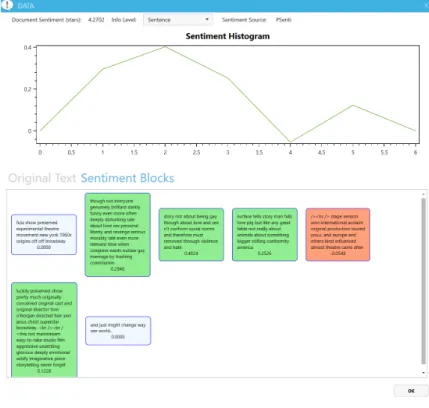
Fig. 2.1: Rotten Tomatoes review
Most early sentiment datasets were acquired by scraping Web pages and normalising retrieved data [208], a procedure that is well covered in the literature [122] and one for which there is a wide selection of open-source tools available. A basic Web scraper can be implemented in a couple lines of Python code. However, in many cases, implementations may be more complicated, as many content providers are continuously trying to prevent scrapers from working [51] and even taking legal action against them [203]. This can also be a challenging problem due to the complexity of page structure. In some of the experiments, we will make use of a Web scraping; for instance, in Chapter 3 we will use product reviews scraped from CNET, and in Chapter 6, datasets collected from the FT and Reuters websites.
Most social networks, including Twitter and Facebook, provide an API to access their data. In this thesis, we will use the Twitter API to download tweets and user information. In Chapter 5 we will use messages collected using the Twitter API to build embeddings and improve semi-supervised domain adaptation. In Chapter 6, we will collect and use two different Twitter datasets. More specifically, to obtain relevant sentiment signals in the financial domain, we will assemble an extensive collection of financial tweets. We will also collect a vast dataset containing 142 million messages from 7.6 million unique users, in which they express their political stance towards Donald Trump. Not all functionality is available via the API, thus to collect additional information from Twitter, such as user profile photos, we will also employ Web scraping.
To annotate datasets and gain quick access to training and testing data, researchers in a variety of disciplines use crowdsourcing platforms such as Amazon Mechanical Turk (MTurk)5, CrowdFlower6and SurveyMonkey7[237]. In Chapter 5 we will use a Twitter dataset annotated using CrowdFlower. In Chapter 6 we will use MTurk to annotate a 2016 US presidential election Twitter dataset. That will allow us to evaluate our proposed sentiment analysis method efficiency in the political-sentiment domain and answer a research question on the demographics of Trump’s supporters.
5https://www.mturk.com 6https://www.crowdflower.com 7https://www.surveymonkey.co.uk
2.1 The Components of Sentiment Analysis 22
Another common strategy for evaluating the proposed sentiment analysis methods is to use standard benchmark datasets. In papers analysing Amazon customer reviews, the dataset collected by McAuley and Leskovec [154] is the most commonly employed. In papers looking into movie reviews, the datasets collected by Maas et al. [144] and Pang and Lee [179] are often used. The Twitter domain is unique, can cover many topics, and thus has many datasets, some of the most important of which are from the SemEval competition [204]. Hence in this thesis, we also use these datasets (Amazon, IMDB, Twitter), to validate our proposed methods and make a direct comparison with other researchers.
There are also plenty of commercial datasets. Big players in the financial news domain and trading, such as Thomson Reuters and Bloomberg, have their own commer-cial solutions. Many companies, such as Amazon, Twitter and Facebook, also provide commercial access to their extensive datasets, including to historical data.
2.1.2
Text preprocessing and transformation
Retrieved information must be processed and transformed into a format suitable for computer processing. The procedure was established as part of the evolution of IR methods and is similar across many of the sentiment analysis approaches [132]. It typically starts with text pre-processing. Pre-processing steps such as tokenisation, stopword removal and morphological normalisation were introduced and developed in the late 1960s [211]. Each of these steps has a number alternative implementations. For example, in its simplest form,text tokenisationcan be done using a whitespace tokeniser, which performs down-casing and splitting of the text into any sequence of whitespace, tab or newline characters. The sample sentence,"I have visited many countries"would be split into the tokens: "i", "have", "visited", "many" and "countries". For more sophisticated tokenisation, a wide selection of open-source NLP software packages is available. Products such as NLTK [19], OpenNlp [7] and CoreNlp [149] provide not only tokenisation options but also additional functionality, such as sentence splitting, part-of-speech (POS) annotations, morphological analysis, Named Entity Recognition (NER), syntactic parsing and co-reference resolution, and can even detect temporal definitions [40]. In this thesis, we make use of various third-party NLP software packages and libraries. The core ofpSentifrom Chapter 3 is a lexicon-based system, so it shares many common components with NLP processing techniques. It supports two different NLP frameworks, CoreNlp and OpenNlp, and uses them in tokenisation, POS and entity tagging. In later chapters, we use NLTK and our custom regular-expression-based tokeniser for the Twitter domain.
In Chapters 3 and 6, we also extracttemporal orientationsfrom a text. A temporal orientation is calculated using two different methods: using theSuTimetemporal tagger
2.1 The Components of Sentiment Analysis 23
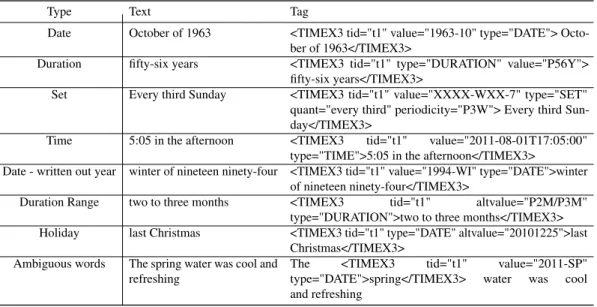
[40], and using the tense of a sentence.SuTimeis a rule-based tagger built on regular-expression patterns to recognise and normalise temporal regular-expressions in English text in the form of TIMEX3 tags. TIMEX3 is part of the TimeML annotation language [193] for marking up events, times and their temporal relationships in documents (see Table 2.1 for some examples).
Type Text Tag
Date October of 1963 <TIMEX3 tid="t1" value="1963-10" type="DATE">
Octo-ber of 1963</TIMEX3>
Duration fifty-six years <TIMEX3 tid="t1" type="DURATION" value="P56Y">
fifty-six years</TIMEX3>
Set Every third Sunday <TIMEX3 tid="t1" value="XXXX-WXX-7" type="SET"
quant="every third" periodicity="P3W"> Every third Sun-day</TIMEX3>
Time 5:05 in the afternoon <TIMEX3 tid="t1" value="2011-08-01T17:05:00"
type="TIME">5:05 in the afternoon</TIMEX3>
Date - written out year winter of nineteen ninety-four <TIMEX3 tid="t1" value="1994-WI" type="DATE">winter of nineteen ninety-four</TIMEX3>
Duration Range two to three months <TIMEX3 tid="t1" altvalue="P2M/P3M"
type="DURATION">two to three months</TIMEX3>
Holiday last Christmas <TIMEX3 tid="t1" type="DATE" altvalue="20101225">last
Christmas</TIMEX3>
Ambiguous words The spring water was cool and
refreshing
The <TIMEX3 tid="t1" value="2011-SP"
type="DATE">spring</TIMEX3> water was cool
and refreshing
Table 2.1. SuTime tagging examples
Not all information extracted from a text is useful. In many IR approaches it is considered that stopwords such as "an", "and", "by", "for" and "the" do not carry any valuable information; they merely represent noise which requires additional unproduc-tive processing and decreases IR efficiency [215]. Thus, it is quite common in sentiment analysis to remove stopwords. That can be done using a simple stopword list or by exploiting POS information. However, as Manning et al. [148] noted, in recent years, there has been a trend in IR to either keep stopwords in place or to reduce the stop list to a minimum, as the overhead is not considerable. Eliminating stopwords can also reduce system performance, as it frequently fails to recognise acronyms such as"IT engineer"
and is thus prone to false positives. In most of our experiments, we remove stopwords, but not in all. We found that our deep-learning models performed better with stopwords in texts.
Many sentiment analysis methods also use morphological normalisation [132], converting words to the singular or applying various stemming procedures. Similar to the situation with stopwords, we found that stemming improvespSentiperformance. However, it does reduce the performance of deep-learning-based models.
Twitter and other microblogs typically require a unique approach. They use irregular language, emoticons, Internet slang words and abbreviations, and are full of misspelled words. As Hogenboom et al. [95] identified, graphical emoticon recognition in these
2.1 The Components of Sentiment Analysis 24
domains significantly improves sentiment classification accuracy. Microblog authors also use misspellings and word lengthening to express their feelings [34]. Short text snippets are also difficult to process using NLP toolkits and frequently require additional pre-processing [169]. To address the issue and domain specifics mentioned above, we incorporate hashtag and emoticon recognition, use a custom-built tokeniser and include word-lengthening recognition.
NLP methods can be useful not only for the initial text pre-processing but also in other applications, such as generating additional machine-learning features or perform-ing many sentiment analysis subtasks. One of the most widely used is so-called POS information. The Penn Treebank, originally introduced by Marcus et al. [151], opened up new research capabilities in syntactic sentence analysis. As we will demonstrate in later chapters, POS information may be employed in stopword removal, aspect detection and candidate sentiment lexicon generation, and can help with the word sense disambiguation problem and provide the ability to understand the surrounding context better. POS information can also be included as a machine-learning feature [165], which can improve sentiment-detection performance, although some researchers have found that is not that useful [182, 77]. Among other NLP methods, it is essential to mention the lexical category and NER information resolution. This information can help with an aspect, author, attribute or sentiment target resolution, which we will cover in more depth in later chapters.
Machine-learning-based approaches typically require an additional vectorisation step, in which selected and processed word tokens are transformed into numerical vectors. Using the bag-of-words model, a document is represented as an unordered list of unigrams also known as terms. Vectors are typically generated using a vocabulary scheme with a high-dimensional feature space, having a tens-of-thousands-element-long vector for each document. Each dimension can be represented by a binary value (with 1 indicating term presence) or using other weight calculation approaches. One of the most common isterm frequencyorterm frequency–inverse document frequency
(tf-idf), which was originally introduced by Salton and Buckley [212].Tf-idf consists of two parts: the term frequency multiplied by the inverse document frequency. Given a document collectionD, a wordw, and an individual documentd∈D, we calculate a word weightwdusing Equation (2.1), wheret fw,Dis the frequency ofwappearance in
d,|D|is the size of the corpus, and fw,Dequals the number of documents in whichw
appears inD[212]. One of the main advantages oftf-idf weighting is that it reduces the impact of words that occur very frequently and emphasises features that occur in a small fraction of in a given corpus. Another, similar approach is one-hot encoding (OHE), which is commonly used in deep-learning models. Using OHE, each word is represented by a vector of zeros except for the element at the index representing the
2.1 The Components of Sentiment Analysis 25
corresponding word from a vocabulary scheme. Vectorised data also typically requires additional data normalisation and standardisation.
wd=t fw,d∗log|D|
fw,D
(2.1)
2.1.3
Sentiment granularity
In its simplest form, sentiment detection can be defined as a procedure of binary
document classification into positive and negative classes [232, 182]. Nowadays, using off-the-shelf machine-learning libraries and a few lines of Python code, it is possible to create a simple linear bag-of-words support-vector machine (SVM) sentiment classifier which can achieve as high as 90% accuracy in the binary sentiment classification task. However, such a document-level approach has many limitations. Most documents are not monolithic items with a single opinion: they can contain areas with positive, negative and factual content, which is also known as sentiment-neutral information. A sentiment author also often expresses multiple opinions and can have different opinions about various aspects of the discussed topic. Therefore, by just detecting that a given document is positive or negative, we would lose a lot of information about which aspects (e.g., product features) the author liked or disliked, and to what degree. To address that, Hatzivassiloglou and Wiebe [90] proposedsentence-levelsentiment analysis, Hu and Liu introduced the two-stepaspect-levelmethod [98], which was later improved by Popescu and Etzioni [191]. Using the two-step method, the sentiment analysis task can be divided into two separate subtasks: aspect identification and sentiment-strength measurement.
According to the output, sentiment analysis can be divided into three families: • Binary classification into positive and negative classes. As we have already
mentioned, many early machine-learning-based sentiment analysis approaches treated sentiment analysis as adocument-levelbinary classification problem [232, 182]. Another flavour of binary classification in sentiment analysis would be clas-sification into subjective and objective classes [246]. This type of clasclas-sification is frequently applied to thesentenceor paragraphlevel and can be employed in multi-stage sentiment analysis to eliminate subjective text [260, 202]. Binary classification can also be utilised to answer sentiment-related questions. For example, market sentiment analysis can generateBUYandSELLsignals [236]. In Chapter 6 we will investigate the financial domain and sentiment analysis in financial news. We will use mood and sentiment to generate binary BUY
and SELL signals and will demonstrate that, in some cases, the model using sentiment information outperforms the baseline method. There are many other ex-amples of binary sentiment classification applications (e.g. Tumasjan et al. [231]
2.1 The Components of Sentiment Analysis 26
demonstrated a model to detect political-sentiment application). In later chapters, we also discuss thebinarysentiment model to find Trump presidential election supporters.
• Three-classclassification into positive, negative and neutral classes. One com-mon way to handle neutral sentiment is to treat the set of neutral documents as a separate “neutral” class, which is the method advocated by Koppel and Schler [116] and investigated by many others [98, 113, 66]. This approach is more representative of how sentiment can be expressed, as it considers the fact that sentiment is not a binary value. In a typical opinionated document, most common areas are not positive or negative, but in fact neutral or factual blocks. Thus, a simple binary classifier is not able to differentiate between factual and opinionated information.
• Multi-classclassification, regression and ordinal regression. All methods in this class attempt to measure the sentiment intensity level on a more granular scale which addresses the fact that many sentiment information sources have a broad sentiment scale. Amazon product reviews (see Figure 2.2) have an ordinal five-star rating scale, and IMDB and Rotten Tomatoes (see Figure 2.1) use a ten-five-star scale. Thus, to reflect this, some researchers have tried to consider the problem as a multi-class classification problem. Koppel and Schler [116] investigated the use of various stacks, and others, such as Almeida et al. [3], designed a multi-class classifier. Pang and Lee [180] investigated various methods, including regression with an ordinal rating score with a possibility to measure sentiment strength, where a value could be measured on a continuous scale from−1 to+1, or from 1 to 5, or from 0 to 100. Goldberg and Zhu [79] also investigated sentiment rating prediction as both an ordinal regression problem and as a metric regression problem.
2.1 The Components of Sentiment Analysis 27
In general, the one-versus-one (OVO) strategy is regarded as one of the most effective SVM strategies available [70] for multi-class sentiment analysis. In later chapters, with the pseudo-labelled training examples of three classes (−1: negative, 0: neutral, and+1: positive), we tried both standard multi-class classification [97] and ordinal classification [68]. However, neither of them could deliver a decent performance. After carefully inspecting the classification results, we realised that it is very difficult to obtain a set of representative training examples with good coverage for the neutral class. This is because the neutral class is not homogeneous: a document could be neutral because it is equally positive and negative, or because it does not hold any sentiment. In practice, the latter case is more often seen than the former, which implies that the absence of sentiment word features more often defines the neutral class rather than their presence, which would be problematic to most supervised learning algorithms. What we have discovered is that the simple method of identifying neutral documents from the binary sentiment classifier’s decision boundary works surprisingly well if appropriate thresholds are found. Specifically, we take the probabilistic outputs of a binary sentiment classifier, and then put all the documents whose probability of being positive is close to neither 0 nor 1 but in the middle range into the neutral class.
In Chapter 5, we will cover theprobability calibrationapplication in more depth.
2.1.4
Opinion holder and sentiment target
Sentiment analysis typically requires identification of both the opinion holder and the target. This information can be used in sentiment summarisation and aggregation to provide a better explanation of sentiment flow and justification. In their study, Choi et al. [45] also found that the incorporation of semantic roles in sentiment improves the performance of the opinion recognition task. In product or service reviews, an opinion holder is typically a review author, and in other sources they can be explicitly mentioned [18]. The presence of an opinion holder in a sentence or text area is also a good indicator of an expressed sentiment, and this may be employed for the identification of subjective areas [32, 249].
In his book, Liu [134] identified two main sentiment types according to their target,
direct sentiment, which is targeted at an object or its feature, andcomparative sentiment, where two or more objects/features are compared to each other. Frequently, both are present in the opinionated text, as illustrated by the following product review snippet.
These phones are exceptionally portable due to the collapsible head bridge. They stand up to everyday use and keep sounding good, even after I sweat on the ear piece. I have not found a better pair after a long search. My only wish would be a lower price and better availability
2.1 The Components of Sentiment Analysis 28
In this example, the author expressed a direct opinion about an item and, at the same time, compared it to other products. In the case of direct opinion, Liu [134] defined it as a quintuple (oj, fjk,si jkl,hi,tl), whereojis an object, fjk is an aspect of the object
oj,si jkl is the sentiment polarity or orientation,hiis the opinion holder, andtl is the
time when the opinion is expressed byhi. This definition can be further extended with
tobeing a temporal sentiment dimension, which defines a temporal opinion target (i.e. expressed with the past, current or future in mind). For example, "I hope the next version will be perfect", has a positive sentiment pointing to the future, and"Last year, I lost my phone"has negative sentiment targeting the past. Each of these dimensions is an important sentiment analysis component and can be the target of a separate research topic.
A sentiment target, which is also referred to as an aspect in the literature, also plays a key role in our thesis and is covered in more depth below and in Chapter 3. Both opinion-holder and sentiment target identification are also tightly related to the problem of stance detection (SD) [218]. As defined by Mohammad et al. [167], a typical sentiment-detection system classifies a text into positive, negative or neutral categories, while in SD the task is to detect a text that is favourable or unfavourable to a specific given target. Most of the existing research on SD is focused on the area of politics [119, 120, 226]. In Chapter 6, in a political-sentiment analysis use case, we briefly investigate SD, opinion holders and their demographics. More specifically, we collected and annotated 6200 user profiles, identified their stances towards Donald Trump, and examined whether Trump supporters prefer whiter areas to move to than Trump opponents.
2.1.5
Aspect detection and aspect-level sentiment classification
Aspect and view extraction can play multiple roles in sentiment analysis. The most common application of aspect extraction is in aspect-level sentiment classification, where the aim is to identify the sentiment polarity of discussed targets [181]. They can also enrich a sentiment-detection process [115], help in domain adaptation [115], or be employed to create domain-specific signatures. It is one of the best ways to present sentiment information [14, 39], as it can provide a quick overview of discussed product features, as well as visualise what was good and what was not so good in each of them. Aggregated by aspects, a sentiment analysis result can be consumed by other automatic processes such as Customer Relation Model (CRM) systems [258], and by doing so, allow companies to take advantage of collected reviews and customer feedback, and to improve their sales [43]. It can also help in a product comparison task [98], which can be presented to both consumers and producers. It has thus attracted the attention of many researchers.
2.1 The Components of Sentiment Analysis 29
Similar to sentiment classification, the aspect-level sentiment-detection task can be divided into [98, 58] and learning-based [105, 264] approaches. A lexicon-based approach typically uses a so-called Separate Aspect Sentiment (SAS) model, which consists of two separate tasks: the aspect detection, and its sentiment pair prediction [152]. In this approach, aspects are extracted independently and later have their sentiment value calculated, aggregating contextual sentiment polarity within a pre-defined token window, sentence or paragraph. A learning-based approach is frequently based on a Joint Multi-Aspect Sentiment (JMAS) model. In a JMAS model, aspect sentiment is predicted in pairs, where the aspect is associated with the sentiment, thus jointly predicting which pairs can be found in the document [152].
Extracting aspects from a “high-quality” text is usually a relatively straightforward procedure and, in many cases, can be solved using an unsupervised task [35]. As Hu and Liu [98] have found in their research, the aspect extraction task can be implemented by selecting frequent nouns and noun phrases. However, customer reviews and microblog messages are usually short, informal, and sometimes even ungrammatical (e.g., consist-ing of incomplete sentences), which makes this task more challengconsist-ing. To overcome this problem, Hu and Liu [99] proposed using Labelled Sequential Rules (LSR), where rules are a special kind of sequential pattern. As in a sentiment lexicon generation task, an aspect’s lexicon can also be generated by exploring synonyms [38]. Similar aspects can also be discovered using word-embedding solutions.
Machine-learning-based approaches traditionally employ topic modelling and clus-tering [137, 143, 156, 35]. As an example, Kohail [115], in their work, demonstrated an aspect extraction method based on Latent Dirichlet Allocation (LDA) topic modelling. They created an unsupervised framework for extracting dominant topics from multi-domain document collections and demonstrated that aspects play an influential role in the domain detection task. The rise in popularity of deep-learning-based methods opened a way for new, neural-network-based methods [152, 121, 250] and various solutions based on word embedding [257]. Jebbara and Cimiano [104] and Marx and Yellin-Flaherty [152] demonstrated that neural networks outperform traditional models by a significant margin. Such a design also allows seamless integration of extracted aspect information into neural networks based on sentiment-analysis models.
In the next chapter, we also discuss another motivation to emphasise aspect/view extraction. We will demonstrate that exclusion of the domain-specific aspect words from the machine-learning step will reduce the dependence on the domain topic, writing style or time period. We will use an aspect extraction method similar to those of Hu and Liu [98], such as generating a list of candidate aspects by including frequent nouns and noun phrases. The main distinctive difference in our approach is that we use additional steps to enhance aspect detection, which we will cover in more depth later.
2.1 The Components of Sentiment Analysis 30
2.1.6
Subjectivity and objectivity
Many researchers frequently focus only on binary positive/negative sentiment classifica-tion and ignore neutral sentiment. However, as Koppel and Schler [116] identified in their research, neutral sentiment detection is a critical part of the sentiment-detection process. Neutral sentiment can typically be defined as objective or factual information which does not express any subjective opinion about a discussed topic. It can be a simple statement of facts, a physical description of an item or any other objective information. In some information sources, objective information can be dominant and even use well-known strong sentiment words to express factual information.
To demonstrate the importance of the ability to distinguish between subjective and objective information, we can take a compelling example from a movie review, in which the author briefly describes the plot: ’The film opens with a flashback, in which Derek brutally kills two men vandalising his car’. This sentence does not carry any sentiment information; the author simply describes the film’s plot. However, what makes this example especially compelling is that it contains so-called strong sentiment words,
kills andvandalising, and most lexicon-based systems would flag this sentence as a strong negative opinion. Therefore, the ability to distinguish between objective and subjective-text blocks is essential for most sentiment-detection systems. This example also illustrates that objective information can be domain dependent. Any human reader can understand that it is impossible to kill or hurt somebody in a movie review, and we tend to ignore such sentiment words depending on the information source and context.
Another excellent example of why the ability to distinguish between subjective and objective information is essential can be found in Chapter 6. More specifically, in the political-sentiment analysis use case, all our sentiment-analysis models performed poorly with the non-related messages class. However, in this case,non-related messages classhas a broader definition and can include sentiment messages targeted at a different (irrelevant) topic.
One of the approaches of how to handle subjective text is to use the so-called two-step approach [260, 202]. In the first two-step, we classify sentences into subjective/objective classes. Then, in the second step, we classify subjective sentences into positive/nega-tive. For the implementation of the first step, there are many different options, from supervised to many different variations of unsupervised methods. As an example, Yu and Hatzivassiloglou [260] proposed a supervised method for subjectivity detection; Riloff and Wiebe [202] demonstrated a semi-supervised expressions learning-based technique; and, more recently, Ortega et al. [174] proposed an unsupervised approach. Another conventional approach is to incorporate subjectivity as a third class and consider the problem as a three-class (negative/positive/neutral) classification problem. In their study, Koppel and Schler [116] compared various three-class sentiment
classi-2.2 Sentiment-Detection Methods 31 0% 25% 50% 75% 100%
Neutral−Band J48 Naive Bayes Ordinal SVM (one vs all) SVM (one vs one) Linear regression Optimal Stack
Name
Result
Fig. 2.3: Three-class classification performance using a variety of learning methods [116]
fication methods and found that this problem might be best handled using a pairwise coupling, where a custom stack-based classifier outperformed all other classification methods. In Figure 2.3 we present the results of various three-class classification meth-ods. The figure shows theoptimal stack, as proposed by Koppel and Schler [116], is superior to other approaches by a significant margin.
2.2
Sentiment-Detection Methods
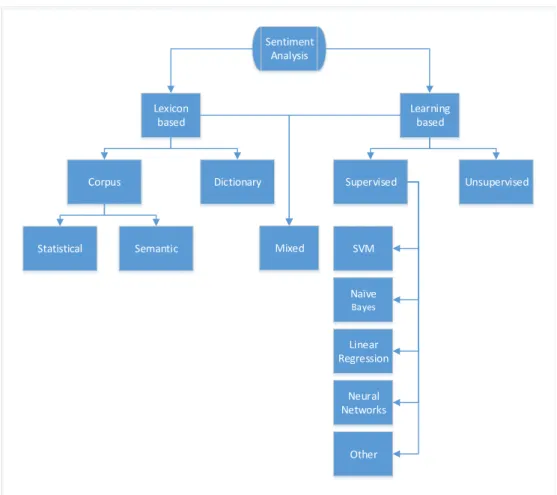
Sentiment analysis includes a diverse family of approaches to how to find and measure sentiment. These can be divided into three main branches (see Figure 2.4): lexicon-based[58, 228, 227],learning-based[179, 232, 105, 8, 130] andhybrid, between the two [169, 262]. Most of the early sentiment-analysis methods werelexicon-based. As the name implies, they are typically designed around a lexicon dictionary. Learning-basedapproaches gained popularity slightly later [182, 179], and instantly established themselves as the default and preferable solutions. Supervised classification is far more accurate thanlexicon-based classification [135, 60]. However, lexicons have not lost their importance: they are usually easier to understand and to maintain by non-experts, and they can also be integrated intolearning-basedapproaches [169].
In this thesis, we make use of almost all sentiment-detection methods. We start Chapter 3 with thelexicon-basedmethod and expand it using thesupervised learning
method (linear SVM). In Chapter 4, to induce a high-quality domain-specific sentiment lexicon, we will use shallow neural networks and compare many supervised and
semi-supervised/transductive learningalgorithms. In Chapter 5, we will develop the
2.2 Sentiment-Detection Methods 32 Sentiment Analysis Lexicon based Learning based Supervised Unsupervised Corpus Dictionary Mixed Statistical Semantic SVM Naïve Bayes Linear Regression Neural Networks Other
Fig. 2.4: Sentiment-detection approaches
word representationsand deep-learningmodels. We will also discuss and compare
its performance with almost all possible sentiment-detection methods, such as lexicon-based,unsupervised,semiandfully supervised learning. Finally, in Chapter 6, we will present several case studies. As in Chapter 5, almost all methods of sentiment detection and their adaptation to various domains will be demonstrated.
2.2.1
Lexicon-based sentiment detection
As mentioned before, lexicon-based systems require a pre-compiled sentiment lexicon corpus, where each word has an assigned sentiment value. Such lexicons can be either manually crafted [221, 133] or automatically generated using seed words [98, 58]. Many research papers use already published and well-known sentiment lexicons, with one of the first being the General Inquirer sentiment lexicon published by Stone et al. [221]. More recently, Liu [133] compiled theOpinion Lexicon, which consists of 2,006 positive words and 4,683 negative words, plus misspelled words, slang words and some morphological variants. Another prominent annotated corpus is the multi-perspective question-answering (MPQA) compiled by Wiebe et al. [247]. Among many
2.2 Sentiment-Detection Methods 33
others, it is worth mentioningSentiStrength[227, 228],SentiWordnetby Baccianella et al. [11] and the lexicon compiled by Warriner et al. [241]. Twitter messages have their lexicons published as part of SemEval tasks [205]. Moreover, in the case of microblogs, the use of emoticons as a universal sentiment indicator is widely accepted. Lexicons are typically domain independent and single lexicons, such as that published by Go et al. [77], can be shared across multiple domains.
The sentiment value of a text snippet in a lexicon-based system can be calculated by aggregating positive and negative words. In Equation (2.2), we present the most straightforward aggregation implementation, in which the total sentiment fSis calculated by counting all the positive wordswpand subtracting this number from the count of all negative wordswn.
fS=
∑
wp−∑
wn (2.2)However, using such a simple approach, a sentiment score would be unscaled and typically skewed by document size. There are many methods for performing a sentiment calculation and scaling, and Lowe et al. [141] highlighted the three most popular:
Absolute proportional differencewith bounds[0,1]. Using this calculation method (see Equation (2.3)), from the sum of all positive words wp we subtract the sum of all negative words wn and divide then by the total number of word occurrences wa. The main disadvantage of this method is that a sentiment score can be affected by non-sentiment words, as the denominator is a count of all words in a document. Besides that, it is well suited to short text snippets.
fS= ∑wp−∑wn
∑wa
(2.3)
Relative proportional difference with bounds: [−1,1]. In contrast to Equa-tion (2.3), in EquaEqua-tion (2.4) the denominator includes only the count of sentiment words. The main disadvantage of this method is that sentiment values cluster around positive and negative poles and are not evenly distributed.
fS= ∑wp−∑wn
∑wp+∑wn
(2.4)
Logit scalewith bounds:[−in f inity,+in f inity]. The logit (also known as log-odds) [93] is given in Equation (2.5).
fS=log( p
p−1) =log(p)−log(1−p) (2.5)
In sentiment-analysis result calculation, we are primarily interested in the relative balance of positive and negative sentiment, or NP and as Lowe et al. [141] identified,
2.2 Sentiment-Detection Methods 34
for such a task thelogitscale is superior compared to other available methods. In the original logit equation, pis between 0 and 1, but in the sentiment-analysis case we use a slightly modified version, where pis the sum of all positive wordswp, and 1−pis the sum of all negativewn(see Equation (2.6)). It has the smoothest sentiment distribution and is symmetric around zero.β is a fixed coefficient to preventlog(0)from occurring.
fS=log(
∑
wp+β)−log(∑
wn+β) (2.6)In other common variations, equations can be expanded to include sentiment strength as a coefficient or weight and re-scale the final value to fit it into the desirable sentiment scale.
As we have already highlighted, the basic lexicon-based system can be implemented by simply counting positive and negative words. On the contrary, most state-of-the-art systems [63, 169] employ a more sophisticated design using various NLP techniques:
• Negations. The most critical part, which can invert sentiment strength (e.g.’not good’has a negative sentiment).
• Intensification. They can decrease or increase sentiment value strength (e.g.
’much better’).
• Text repair. The use of various heuristic rules to replace idioms, slang and irregular language.
• Spelling correction. This is especially important when processing user messages from various microblogging platforms. In the Twitter domain, repeated letters added to the word (e.g. Miiiiike), or the use of multiple exclamations or question marks can also be a reliable indicator of expressed emotion or sentiment [227]. In later chapters, we will employ similar sentiment calculation techniques and design. Unless noted otherwise, we will use Equation (2.6) to calculate the final sentiment value.
2.2.2
Supervised learning
Widely available training and testing data made the supervised learning-based approach the most common sentiment-analysis method. Extracting reviews from Amazon or IMDB and training a linear classifier would give access to a high-accuracy domain-specific sentiment-analysis system [182].
In their paper, Pang et al. [182] evaluated and compared several different supervised machine-learning algorithms for classifying a sentiment extracted from movie reviews. They included the comparison of Naïve Bayes (NB), Maximum Entropy (ME), and
2.2 Sentiment-Detection Methods 35
Supervised Sentiment Analysis Supervised Sentiment Analysis
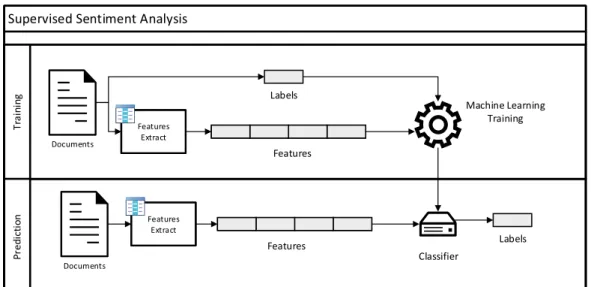
T ra in in g T ra in in g P re d ic ti o n P re d ic ti o n Documents Features Extract Features Extract Machine Learning Training Labels Documents Features Extract Features Extract Labels Features Features Classifier
Fig. 2.5: Supervised sentiment-analysis architecture
Support Vector Machines (SVM), with SVM slightly outperforming other learning algorithms. Using a basic design, SVM trained on unigram features (bag-of-words), they managed to achieve a high accuracy of 82.9%. This design was further improved in their later work [179] and achieved an even higher, 87.2%, accuracy. In Figure 2.5 we present the architecture of a typical supervised sentiment-analysis system consisting of feature extraction, training and classifications steps.
As we already mentioned earlier, the design of a bag-of-words supervised sentiment system can be implemented in just a few lines of Python code, and such an implementa-tion can surpass the method proposed by Pang and Lee [179] and achieve 90% accuracy on the IMDB dataset [144]. In the bag-of-words approach, each word is represented as a separate and independent feature. Using alinear SVM classifier, the hyperplane decision boundary can be calculated using Equation (2.7), and items are separated into positive and negative classes by the straight line (see Figure 2.6).
wtxi+β =0 (2.7)
Still, as other researchers have found [200], such a straightforward design solely based on supervised machine learning typically suffers fromstyle,domain, or eventime
dependencies. In comparison, lexicon-based sentiment-detection systems have lower overall accuracy but suffer less from domain dependency. It is important to mention that lexicon-based systems also have a domain dependency problem but with lower sensitivity to crossing domain boundaries. In later chapters, we will demonstrate that, in some domains, lexicon-based systems can suffer a significant performance loss.
2.2 Sentiment-Detection Methods 36
Fig. 2.6: SVM separating hyperplane
In contrast to lexicon systems, a naive document or sentence-level machine-learning-based implementation is a black-box system, is difficult to understand and maintain by a human user, and solely relies on training dataset quality. It performs a sentiment classifi-cation and provides only an overall sentiment score, without any further explanation or justification. It is possible to extrapolate some explanation using feature weights; how-ever, that will not explain why a model decided to assign such weights in the first place. Thus, many attempts have been made to incorporate lexicon knowledge into machine-learning classifiers [6, 91, 60]. Other researchers have designed so-called multi-stage systems, in which lexicon and machine learning are employed only for certain subtasks, such as extending a sentiment lexicon [260] or identification of subjective-text blocks [179]. In the case of mixed approaches, the first wave followed the increasing popularity of various generative probabilistic models based on Latent Dirichlet Allocation (LDA) [91, 105, 130]. However, their sentiment-analysis performance was often worse than the simple bag-of-words SVM approach [182]. The second, more successful wave followed advances in deep learning and word-embedding techniques [60].
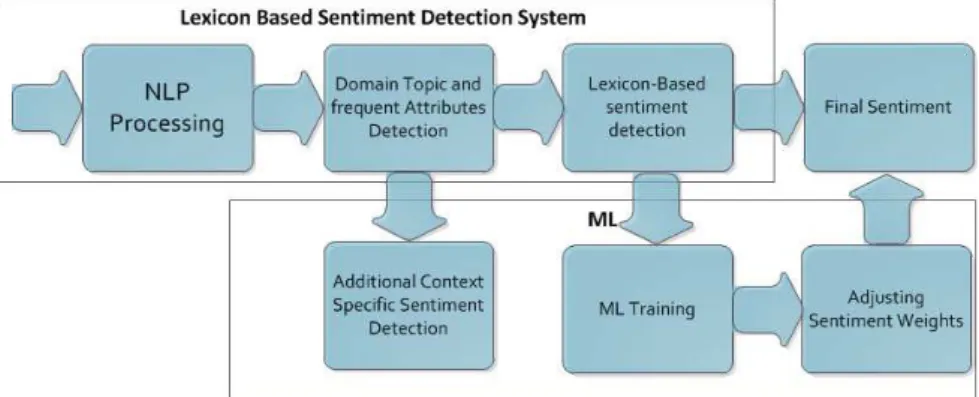
In Chapter 3, we will explore the possibility of combining lexicon and machine-learning techniques for opinion analysis. As Mladeni´c et al. [164] identified, weights extracted from a linear SVM may be a good indicator of feature importance. This observation is based on the fact that a feature weight obtained from the linear model represents a vector coordinate which is orthogonal to the hyperplane, and its direction indicates the predicted class. The magnitude of a vector or distance from the hyperplane also tells us how informative the feature is for the classification and its importance in the data-separation task. By selecting sentiment words and adjectives as SVM features, we will use machine learning to discover a domain-specific sentiment lexicon, measure the importance of sentiment words and adjust other lexicon-inspired components. In
![Fig. 2.3: Three-class classification performance using a variety of learning methods [116]](https://thumb-us.123doks.com/thumbv2/123dok_us/502578.2559304/31.892.286.691.105.389/fig-class-classification-performance-using-variety-learning-methods.webp)

![Fig. 2.7: Plutchik’s sentiment wheel [190]](https://thumb-us.123doks.com/thumbv2/123dok_us/502578.2559304/43.892.287.669.114.522/fig-plutchik-s-sentiment-wheel.webp)
![Fig. 2.8: The sentiment of “terrific” changed from negative to positive over the last 150 years [86]](https://thumb-us.123doks.com/thumbv2/123dok_us/502578.2559304/44.892.282.673.112.353/fig-sentiment-terrific-changed-negative-positive-years.webp)