September 1, 2004
Document of the World Bank
Report No. 29912-PK
Pakistan
De
volution in P
akistan
Report No. 29912-PKPakistan
Devolution in Pakistan
Poverty Reduction and Economic Management Sector Unit South Asia Region
Main Report: An Assessment & Recommendations for Action
Public Disclosure AuthorizedPublic Disclosure Authorized
Public Disclosure Authorized
Public Disclosure Authorized
Table of Contents
Methodology
...
vAcknowledgments
...
v11Acronyms and Abbreviations
...
xExecutive Summary
...
1..
Context...
...
This Study...
...
3Service-delivery Improvements Are Essential
...
3Why Might Devolutio K e y Findings
...
New Incentives for Nazimeen and Senior Staff A Milestone Passed T h e Glass i s More t Recommendations...
.15Key elements of the Suggested Strategy ... 15
16 Supporting Material
...
.181. Service Delivery and Devolution
...
19...
19H o w Can Devolution Assist in Service-delivery improvements?
...
2 1 Strategic Goals and Practical Actions ... Service-delivery Improvements are Essential...
A Framework ... Unpacking the Incentives ... Assessing the Impact o f Devolution on Service Delivery ... 2. Assessment...
27K e y Findings
...
New Incentives for Nuzimeen and Senior Staff ... Access to Justice Visible Wins When...
.48A Challenging Time for Devolution
...
54Managing Inequity Between and Within Provinces ... 55
Re-emergence of private goods strategies ... 57
The K e y Challenges Facing Devolution
...
583. Recommendations
...
60A Strategy from Here
...
60Seize the Opportunity Presented by the NFC Award ... 60
Enforce the Core Principles-and Accommodate Local Differences ... 63
Transmit National Policy Priorities More Effectively ... 64
Practical Actions toward the 7 Goals.
...
70Completing Devolution Accepted as e ... 74
Demonstrable Federal Government Commitment to Strengthened Role o f the Provinces ... 76
Demonstrable Provincial Government Commitment to Strengthening Local Government 79 Local Governments Challenged to Demonstrate that they Merit Confidence ... 86
Judicious Selection from a Menu of Conditional Grants ... 90
Local Governments Held to Account ... 95
Appendix 1: Background to ADBIDfIDNVB DSD Dataset 2
...
102Appendix ~~ 2: Assessment Frameworks Developed for the Study
...
105Glossary
...
107References
...
108Tables Table 1 : Districts and TMAs Studied
...
vTable 2: Progress to Date in Political. Administrative. and Fiscal
...
2Table 3: Gender Profile o f Union Councilors by Province
...
...
10Table 4: Progress in Creating New Incentives for Nazimeen and S
...
12Table 5: Progress in Creating New Incentives for the Service Providers
...
13Table 6: Impact o f Changed Incentives on Sector Service Delivery
...
Table 7: Timetable o f Proposed Key Actions...
...
17Table 8: Pakistan’s Social Indicators in International Persp
...
19Table 9: Key Indicators in SAP Focus Areas
...
21Table 10: Key Incentives in the Devolved Structures
...
...
24la Basis
...
28Table 12: Vertical Programs as a Percentage ofthe District ADP
...
29Table 13: Ownership ofthe Structural Reforms
...
...
36Table 14: Management Structure after Devolution
...
38Table 15: SMC Structure in the Four Provinces
....
...
39Table 16: Per Capita Resource Flows (FY 2003i04)
...
55Table 17: Cumulative Provincial Revenues (Normalized)
...
...
56Table 18: Potential Increase in District Budgets with New NFC Award
...
63Table 19: Characteristics and Impact o f Vertical Programs and Conditional Grants
...
66Table 20: Principles and Better Practices in Grant Design
...
67Table 2 1 : Benchmarks in Moving from Vertical Investment Programs to Conditional Grants
...
67Table 22: Conditional Grants in Major Federations
...
...
69Table 23: Actions to Bring Some Relief Now-and to Prepare for the F
...
71Table 24: Total Outstanding Debt Against Provinces, July 2003
...
78Table 25: Devolution-Friendliness o f ADB and World Bank Projects in the Current Lending Table 26: Possible Table 1 1 : Proportions o f Total Funding Transferred to Local Government Program
.
...
93Table 27: Steps Toward Provincialization o f Accounts
...
99Table 28: State ofthe Provincial Accounting Records
...
103Table 29: Data Sources for Tables in DSD2
...
104Table 30: Assessing Institutional Changes within Local Government
...
105Table 31: Assessing the Location o f the Employer Function
...
106Table 32: Assessing “Verticalness” o f Conditional Grants
... ...
106overnments
...
97Figures Figure 1 : Key Incentives in Devolution
...
4Figure 2: Growth and Female-male Literacy Gap in Pakistan and Comparison Sample. 1970-2000
...
20Figure 3: Growth and Infant Mortality in Pakistan and Comparison Sample. 1970-2000
...
20Figure 4: Interpreting Education Data
...
26Figure 5: Interpreting Health Data
...
26Figure 6: Non-salary as a Percentage o f Total Expenditure (districts)
...
31...
52Figure 8: Distribution o f Positions by Grade for FUG and APUG Staff
...
53Figure 9: Provincial Consolidated Funds under New and Old NFC Scenarios
...
61Figure 7: DMG Staff by Grade
...
Figure 10: The Spectrum o f Autonomy in Tax Revenues...
77Boxes
Box 1 : The Sets o f Incentives Tracked in this Report ... 5
Box 2: Vertical Programs-Health ... 35
Box 4: School-Based Management
..
Box 5: Vertical Programs in Education...
Box 8: Celebrate Modest Diversity... ...
...
64Box 3: Citizens Using Private Medical Care ... 36
...
...
Box 6: Vertical Programs in Water and Sanita Box 7: Provincial Interventions at the District Level...
50Box 9: Incentives for Restructuring in Intergovernmental Transfers in the Russian Federation and Uganda
...
68Box 10: Fine-Tuning Devolution in the PRSP ... 70
Box 1 1 : Fostering Debate on Decentralization Box 13: Technical Capacity Available to Othe Box 14: The PRSP Recognizes the Need to Resolve Jurisdictional Rivalries
...
79Box 15: “Debt Write-off for Performance” in Punjab
...
80Box 16: The PRSP Recognizes the Need for Further Tax Devolution ... 83
Box 17: Potential Short Term Gains from AIT Devolution ... ... 84
Box 18: Potential Revenue Gains for TMAs in Transferring UIPT Collection Responsibility to the Districts
...
84Box 19: Local Innovation: Property Tax Enhancement through Self-Assessment in Hyderabad
...
85...
86Box 2 1 : The Scale o f the District Throw-Forward Problem
...
...
87Box 22: Multiagency Planning in West Bengal and Kerala
...
89Box 23: Donor-Supported Transitional Vertical ProgradGrants
...
91Box 24: Data Needs for Equalization or Conditional Transfers
...
94...
95Box 26: Conflicting Lines o f Management
...
96Box 28: Improving Union-Level Police. Court and Local Government Relations
...
100...
Box 12: Selling Decentralization in Uganda ... Box 20: Reducing the Throw-Forward in NWFP...
Box 25: Administrative Devolution in Indonesia and Uganda Box 27: Key Features o f a Local Government Service ... 97Methodology
The Devolved Service Delivery Study (DSD) is the product o f an agreement between the World Bank, ADB, and DfID, in response to a request from the Government o f Pakistan that the agencies review progress toward improving service delivery through decentralization. The government has emphasized that it i s looking for feasible, practical recommendations that add value to a devolution process that i s well advanced. I t requested a range o f robust technical analyses that provide a summary o f the emerging lessons and implications for both policy and operational practices. The government made the point strongly that this should not be an assessment o f larger legal or political arrangements, rather that the focus o f the review must be on pragmatic actions for service delivery improvements at district (zila) and tehsil level, based o n reasonable assumptions about the likely preconditions for service delivery.
The authors have drawn comprehensively o n the following data in the preparation o f this three- volume report:
Extensive published outputs from the NRB and a range o f informal outputs including presentations and conference notes.
District Studies-new, largely qualitative, data gathered from six districts (and a selection o f tehsils within them) o n their experiences to date
gathered through the use o f a series o f sector-specific templates systematically reviewing experience to date with sectoral concerns including public
expenditure, civil service, politics, water and
sanitation, health, education, and access to justice issues (see Table 1). The districts identified by government for t h ~ s study were Faisalabad and Bahawalpur (Punjab); Karachi and Khairpur (Sindh); Bannu (NWFP); and Killa Saifullah (Balochstan).
Fieldwork was conducted between June and August 2003 by a seven-member team in these six districts. Detailed socioeconomic data for the districts are available in a separate working paper (Qadir: 2003). The team included Shehryar Sanvar, Sajjid Siddique, Ali Murtaza, Syed Ata ur Rehman, Masroor Ahmad, Nasir Jamy, Rehana H a s h , Fareeha Zafar, Mohammed Saboor and Sanvar Ban.
Table 1: Districts and TMAs Studied
The qualitative data from this fieldwork are cited in this report as “ADBIDfIDIWB D S D Dataset 1
.”
Intergovernmental Flows of Funds-a model o f fiscal flows underpinned by a comprehensive database o f revenue and expenditure for district governments and tehsils. The model allows:0 Some analysis o f the overall fiscal architecture and in particular the combined effect o f the
Provincial and National Finance Commission Awards under altemative scenarios-illustrating the impact o f revenue reassignments or o f any changes in funding assumptions;
An assessment o f the impact o f any “lumpiness” in revenue, assessing the cash f l o w problems that the provinces are flagging as the major reason for their slow movement towards the devolution o f civil service pay; and
A comparison to be drawn between the intended and the actual behavior o f provinces in
transferring funds and assessing h o w predictably districts received their anticipated funds.
0
Fieldwork and analysis was conducted between June 2003 and January 2004 by Abdul Wajid Usmani, Mirza Irfan Beg and Adeel Sattar.
T h e fiscal data f r o m this fieldwork are cited in this report as “ADBIDflDIWB D S D Dataset 2.” Background to the dataset and the methodology used to construct it are provided in the appendix to this volume.
Acknowledgments
This report was prepared by Jackie Charlton (DfID), Musharraf Cyan (ADB), Zahid Hasnain (World Bank), N i c k Manning (World Bank), Douglas Porter (ADB) and Hamid Sharif (ADB). Manuela Ferro, Hanid Mukhtar, Jeffrey Rinne, Anwar Shah and Salman Zaidi (World Bank) provided additional contributions on public sector institutional issues. Raja Rehan Arshad and Shahnaz Arshad (World Bank) led the work o n TMA-level reforms and o n water and sanitation. Inaam H a q (World Bank) led the work o n health sector reforms, and M a r k Poston (DfID) o n education sector reforms. Further inputs were provided by Ismaila Ceesay (World Bank) o n accounts and audit, by Mohammad Sarwar Khan (ADB) and Raza Ahmad (ADB) o n legal and judicial reforms, by Richard Slater (ADB consultant) o n South Asian experiences, and by Louis Crouch and Dana Weist (World Bank) o n vertical programs and conditional grants. Ghulam Qadir prepared the socioeconomic background data o n the districts. K a i Kaiser provided particular assistance o n behalf o f the W o r l d Bank Decentralization Thematic Group in reviewing experiences in conditional grants and in
ensuring consistency with the World Development Report framework. Additional helpful comments were provided by Ahmad Ahsan, Ijaz Nabi, and Tara Vishwanath.
The study was conceived and planned by a Steering Committee made up o f representatives o f the Government o f Pakistan Finance and Planning departments, the NRB and three bilateral and international lending agencies: the World Bank, Asian Development Bank and the UK Department for Intemational Development (DfID). Additional financial support was provided by the Canadian Intemational Development Agency (CIDA).
A study as complex and focused as t h ~ s would not have been possible without extensive support and cooperation in each o f the districts studied. The D S D team thanks the DCOs, the administrative officers and the district mayors (nazimeen) o f all six districts visited for the hospitality and the access that they kindly afforded: H a j i Naimutallah o f Karachi, Ms. Nafisa Shah o f Khairpur, Mr. Iqbal Khan o f Bannu, Chaudhry Zahid Nazir o f Faisalabad, Mr. Tariq B a s k Cheema o f
Bahawalpur, and Nawab Hassan Khan Jogezai o f K i l l a Saifullah. They were all generous with their time, valuable information, and insights o n the administrative challenges and successes o f their districts.
The officials interviewed during the fieldwork included:
District: Provincial Government:
District Nnzim
District Nnib Nnzim
DCO Deputy Secretaries, Finance Department, ‘
EDOs for F&P, Health, Education, W&S, Revenue,
Home Secretary, Govemment o f Sindh, NWFP Staff o f Local Govemment Board (all provinces)
Govemment o f Sindh, Punjab Community Development, as well as staff o f
these offices
District Accounts Officer (DAO) and staff o f D A O
office Bahawalpur)
D O F&B, D O Planning, DOIDDO HRM, D O Coordination (Punjab districts), ACO (NWFP),
D O NWFP
Excise and Taxation
DPO Commissions
Commissioner FCR, Bannu Civil Society: District and Sessions Judge
Civil Judge (and Senior Civil Judge where present) Judicial Magistrates, Special Judicial Magistrates
(Punjab)
PPOs, DPOs, and SHOs o f various police stations Probation Officers
Parole Officers Superintendents O f Jail
Tehsil Nuzim in each o f the TMAs visited T M A Naib Nnzim
T M O o f each T M A
TOs o f each T M A (I&S, Planning, Finance,
MD, K S W (Karachi) MD, WASA (Faisalabad) Staff o f PHED (all provinces)
D I G Police (Karachi, Faisalabad, Bannu, Treasury Accountant (and other officers), Karachi Deputy Secretary, Local Govemment Department, Members o f the Provincial And District Election Journalists, members o f NGOs and other civil society organizations including CCBs Members o f the District Bar Association Members o f the CPLC (Karachi, Faisalabad) Members o f lnsauf Committees
TMA:
Regulation)
Preparation o f the report was assisted by valuable comments received from government and from others o n an earlier version o f this paper prepared for the “Forum o n Intergovernmental Relations and Service Delivery in Pakistan,” hosted by the National Reconstruction Bureau and held in
Bhurban in July 2003. Peer reviewers for the workshop paper were Bert Hofman (World Bank), Dana Weist (World Bank) and Clay Wescott (ADB). Informal comments were made by Daniyal Aziz (Chairman NRB). Other very valuable comments on the workshop paper were provided by Ahmad Ahsan (WB), Benjamin Loevinsohn (WB), Inaam H a q (WB), Luis Constantino (WB), Manuela Ferro (WB), M a r k Poston (DfID), Naved Hamid (ADB), Pablo Saavendra (WB), Raja Rehan Arshad (WB), Shahnaz Arshad (WB) and Tahseen Sayed (WB). Administrative and logistical support has been provided throughout by Juliet Teodosio (World Bank) and Shaista Hussain (ADB). Copyediting was undertaken by Alfred Friendly and Rebecca Kary.
The initial findings of the Devolved Service Delivery Study were discussed with all participating
nazimeen and other senior district staff, and Ministry o f Finance Staff, at a workshop held in
September in Islamabad. Comments were also received following the circulation o f a summary note o n the interim findings o f the study in October 2003.
The conclusions were fiuther reviewed at a PFC Workshop o n “Concepts and Practices in Intergovernmental Finance” held o n December 16-18,2003, organized by the Government o f the Punjab, Finance Department and the Provincial Program Support Office, DSP.
An internal pre-review meeting held within the World Bank o n December 19, 2003, and chaired by Shanta Devarajan, Chief Economist (South Asia) endorsed the logic and the structure o f the report.
A summary paper was presented at a retreat o f the National Steering Committee (comprising representatives o f Federal finance, Social Welfare And Women’s Development, the NRB and all provinces, a range o f districts, and civil society organizations) held January 10-1 1, 2004. Further useful comments were provided o n behalf o f the National Steering Committee.
The study builds on an array o f previous analytic and operational reports prepared by the World Bank and ADB-very particularly including:
Report.” ADB. Manila
Fiscal Transfers Report (Volume 11)’’ ADB. Manila Responses.” ADB. Manila
Opportunities.” Washington D C
Asian Development Bank. 1999. “Pakistan Legal and Judicial Reform Project: Integrated Asian Development Bank. 2001. “Fiscal Decentralization Technical Assistance Project : Asian Development Bank. 2002. “Poverty in Pakistan: Issues, Causes, and Institutional Shah, Anwar and others. February 19, 1996. “Fiscal Federalism in Pakistan: Challenges and World Bank. 1999. “Agricultural Taxation in Pakistan.” World Bank. Washington D C World Bank. 2000. “Pakistan-Reforming Provincial Finances in the Context o f World Bank. 2001. “Reforming Punjab’s Public Finances and Institutions.” World Bank. World Bank. 2002. “Pakistan Development Policy Review: A New Dawn? (Report No. World Bank. 2002. Pakistan Poverty Assessment: Poverty in Pakistan-Vulnerabilities, World Bank. 2002. “Primary Education Management: Provincial Case Studies (Punjab).” World Bank. 2003. “Pakistan Public Expenditure Management: Strategic Issues and
Devolution: An Eight Point Agenda.” World Bank. Washington D C
23916-PAK)” World Bank. Washington D C
Social Gaps and Rural Dynamics. Washington DC: World Bank. Unpublished World Bank paper. Washington D C
A C R ADB ADP AEO AG AGP AGPR AIT A P T BHU BKN BPS CBR C C B CDL CDMD CED CEDAW CFAA CGA DA DAO DC DCJCC D C O DDC DDEO DE0 DERA DfID DM DMG D o F DO D P O D P R DPSC DRTA D S
Acronyms and Abbreviations
Annual Confidential Reports Asian Development Bank Annual Development Plan Assistant Education Officer Accountant General Auditor General o f Pakistan Accountant General Pakistan Revenues
Agriculture Income Tax Appointment, Promotion and Transfer
Basic Health Unit
Badan Kepegawaian Negara (Civil Service agency in
Indonesia) Basic Pay Scale
Central Board o f Revenue Citizen Community Board Cash Development Loans City Development and Municipal Department Central Excise Duty
Convention o n Elimination o f All Forms o f Discrimination Against Women
Country Financial
Accountability Assessment Controller General o f Accounts Development Authority District Account Officer Deputy Commissioner District Criminal Justice Coordination Committee District Coordination Officer District Development Committee
Deputy District Education Officer
Deputy District Education Officer
Drought Emergency Relief Assistance
UK Department for International Development District magistrate
District Management Group Department o f Finance District Officer District police officer Development Policy Review District Public Safety Commission
District Regional Transport Authority Deputy Secretary D S D DSSP DTCE ED0 E P I ESR FBS FCF FIR FJA GDP GFS G o W B GRAP GST HIPC H M I S IMF IT JM KMA KPP K W S B LG LGC LG&RDD LFO LGO LHC LHW M I C S MCP MIT M&R MMA MNA M o E M o W D MPA MQM
Devolved Service Delivery Study
Devolved Social Services Program
Devolution Trust for Community Empowerment Executive District Officer Expanded Program for Immunization
Education Sector Reform Federal Bureau o f Statistics Federal Consolidated Fund First Information Report Federal Judicial Academy Gross Domestic Product IMF Government Finance Statistics
Government o f West Bengal Gender Reform Action Plan General Sales Tax
Highly-Indebted Poor Countries
Health Monitoring Information System
International Monetary Fund Information Technology Judicial Magistrate Kolkata Metropolitan Area Khushal Pakistan Program Karachi Water and Sewerage Board
Local Government
Local Government Commission Local Government and Rural Development Dept.
Legal Framework Order Local Government Ordinances Lahore High Court
Lady Health Worker
Multi-Indicator Cluster Survey Malaria Control Program Member Inspection Teams (of the High Court)
Maintenance and Repair Muttahida M a j lis-i-Amal (political party)
Member o f National Assembly Ministry o f Education
Ministry o f Women’s Development, Social Welfare and Special Education Member o f Provincial Assembly
Muttahida Qaumi Movement (political party)
MVT NAM NBP NFC NGO NIH NPA NP
sc
NRB N W F P OPD OSR OZT P&D PCA PCF PCP P E N PFC PHED PIFRA PIHS PLA PML P O PPO PPP PPSC PRGF PRSP M o t o r Vehicle Tax N e w Accounting Model National Bank o f Pakistan National Finance Commission Nongovernmental organization National Institutes o f Health National Plan o f Action National Program Steering CommitteeNational Reconstruction Bureau
North West Frontier Province Outpatients Department Own Source Revenue Octroi and Zila Tax Planning and Development Police Complaints Authority Provincial Consolidated Fund Pakistan Centre for
Philanthropy
Punjab Economic Research Institute
Provincial Finance Commission Public Health Engineering Department
Pakistan Improvement to Financial Reporting and Auditing Project
Pakistan Integrated Household Survey
Personal Ledger Account Pakistan Muslim League (political party)
Police Order
Provincial Police Officer Pakistan People’s Party (political party)
Provincial Public Service Commission
IMF Poverty Reduction and Growth Facility
Poverty Reduction Strategy Paper PSC PSDP PTA PTSMC ROB RTA RWSSP SAP SBP S D M SE SHO SJM SLGO SWAP S M C TAO TB DOT TMA TMO TO UA
uc
U I P T W&S WAPDA W A S A WB WDD WDR XENPublic Service Commission Public Sector Development Program
Parent Teacher Association Parent-Teacher School Management Committee Rules o f Business
Regional Transport Authorities Rural Water Supply and Sanitation Program Social Action Program State Bank o f Pakistan Sub-Divisional Magistrate Superintendent Engineer Station House Officer Special Judicial Magistrate Sindh Local Government Ordinance
Sector Wide Approach School Management Committee
Tehsil Accounts Officer Tuberculosis Directly Observed Treatment Scheme
Tehsil Municipal Administration
Tehsil Municipal Officer Tehsil Officer
Union Administration Union Council
Urban Immovable Property Tax Works and Services
Water and Power Development Authority
Water and Sanitation Authorities
World Bank
Women’s Development Department
World Development Report Executive Engineer
Executive Summary
CONTEXT
Pakistan’s far-reaching devolution initiative has been designed with three broad and inter-related objectives in mind:
0 0 0
To inject new blood into a political system considered to be the domain o f historically entrenched interests;
T o provide positive measures enabling marginalized citizens-women, workers, peasants-to access formal politics; and
To introduce a measure o f stability into a turbulent political scene by creating a stronger line o f accountability between new politicians and local electorates.
Underpinning the political strategy were other technical objectives: improved delivery o f social services; better determination and enforcement o f property and labor rights and regulation o f economic activities; and access to justice in the form o f improved performance by local
administrations, courts and police, with greater awareness o f basic human rights protected under devolution.
Remarkable progress has been achieved. N e w local institutions with new structures for local government, new arrangements for intergovernmental sharing o f resources, new electoral arrangements, new rules for government formation and dismissal and new opportunities for citizens to participate in the affairs o f government have all been created. Installing this array o f new structures and accountability arrangements i s an achievement that can hardly be overstated. The process i s all the more remarkable given the other far reaching reforms that government undertook in parallel. At the same time as the devolution initiative was being implemented, the government also implemented significant reforms in tax, trade, deregulation and privatization, the banking sector, anticorruption, restructuring federal and provincial legislatures and responding to gender concerns.
Table 2: Progress to Date in Political, Administrative, and Fiscal Reforms Pre August 2001 Post August 2001 Cross-cutting reforms. Emerging issues. Pre August 2001 Post August 2001
Constitution entrenches the Federal and Provincial govemments only.
The four provinces were divided into three deconcentrated levels for administration and service delivery.
Unstable and unpredictable local govemment system without commitment o f the higher tiers to strengthen or sustain it. 6,458 new, directly and indirectly elected Local Governments.
Methods established for both the intemal and extemal recall o f the nuzimeen in local government. Citizen Community Boards (CCBs) conceived with a broad govemance mandate.
Responsibilities for regulating the activities o f civil society devolved to district govemments. Particular emphasis on access to justice
New institutional framework for checking police conduct introduced.
Power triad o f local politicians, district commissioner and head o f district police abolished.
O f the 126,462 new union councilors, 25 percent o f the reserved (one-third) seats for women were filled. Elected positions have in the main been won b y people with previous political backgrounds, although some new blood i s evident. Slow progress in the new oversight bodies.
Progress in establishing the District Public Safety Commissions (DPSCs) has been patchy.
District, province, and federal political representatives want greater control over administration and the police. Significant presence o f federal civil servants in the provincial administrations.
Local administrations largely led by federal staff from the District Management Group. Mismanagement o f the police by the executive authority o f the state at every level. The District Deputy Commissioner role combined magisterial and administrative powers. Cross-cutting reforms
District govemments divided into 11 departments.
District Coordination Officer (DCO) established as the highest-ranking civil servant in the district.
Some federal staff remain in the districts, but former rural district council employees now are district employees. However, some ambiguity persists about reporting arrangements for the large numbers o f staff from provincial employment groups. Particular emphasis on access to justice.
Office o f deputy commissioner abolished: powers divided between District and Sessions Judge, District Nazim and the DCO.
Judicial powers exercised only by the judiciary. Emerging issues.
Shifting the employer function to coincide with the new levels o f functional responsibility i s proceeding slowly, resulting in some competing lines o f control.
Determination o f the wage envelope takes place at the provincial level when salaries are still paid from the provincial Account I rather than the district-controlled Account N.
Useful preparatory steps have been taken toward transfemng employer functions to the school level, but this remains more an ambition than a reality.
Autonomy o f the police enhanced without establishment o f the new systems o f accountability. Need to review allocation o f quasi-judicial powers to make local administration more effective.
Pre August 2001
Post August 2001
Cross-cutting reforms.
Constitution specifies the functions o f the federal govemment and the areas o f shared responsibility, primarily treated as federal responsibilities. Centralization o f taxes by agreement with the provinces.
Most buoyant taxes with significant revenue potential assigned to the federal govemment or ceded by the provinces on efficiency grounds.
Main source o f provincial revenues is a transfer based on a share of federal tax collections determined by the National Finance Commission.
The importance o f federal transfers to provinces has significantly increased over time.
District govemments given responsibility for delivering services related to elementary and secondary education, primary and secondary health, agriculture, and so forth. Towns and tehsils have relatively unchanged responsibilities. Union administrations have not been assigned any significant service-delivery responsibilities.
Local govemments given the rights to raise some additional revenues.
Provincial Finance Commissions established which have made awards for the distribution o f provincial resources to local govemments .
NB: No shifts o f responsibility from the federal to the provincial govemments. Particular emphasis on access to justice.
Additional funding provided to subordinate courts and police services.
Progress in creating the necessary secretariats and establishing the required analytic support for the PFCs has been slow. For the majority o f districts, the provincial finance departments support budget-making.
Budget execution procedures made it difficult for the district govemments to control general development expenditures. The cash flow position o f the province has become a factor obstructing the smooth flow o f funds to the districts. Emerging issues.
THIS
STUDYBased on an empirical study o f 6 districts and 12 TMAs, this paper evaluates the extent to which the new structure has succeeded in creating the incentives necessary for local governments to achieve at least some o f the service delivery objectives.
The study uses a framework drawn from the World Development Report 2004 to integrate the analysis o f fiscal, administrative and political dimensions o f devolution
with
sectoral concerns: health, education, water and sanitation and access to justice.The paper addresses three notional readers. First, the “nazim o f good intention”-the recently elected local politicians who are keen to make improvements in service delivery despite the ambiguities in their present situation. It invites them to comment on a set o f new incentives and challenges and opportunities that devolution appears to have introduced. Second, govemment- inviting senior officials who have worked long and hard in introducing these radical reforms to agree, or not, with the views expressed, the lessons learned and the recommendations offered for the next key steps. Third, donors-who, while overwhelmingly sympathetic to devolution and frequently strongly supportive, can nevertheless by their actions occasionally undermine the process.
SERVICE-DELIVERY
IMPROVEMENTS
ARE
ESSENTIAL
Cross-country comparisons illustrate that, in Palustan, growth i s associated with fewer
improvements in key health and education outcomes than in comparable developing countries. The link between increased funding and better education or health indicators i s equally weak.
Thus, as devolution began, Palustan faced a dilemma. I t s public institutions for social service delivery were demonstrably failing, and the evidence suggested that neither economic growth nor increased public expenditures were likely to have significant remedial impact.
The Social Action Program represented an earlier attempt to find a way through. Ultimately SAP failed-perhaps overwhelmed by the deteriorating macroeconomic position that squeezed public expenditures in the social sectors, but more likely because it did not adequately prioritize
institutional reform and did not tackle the thorny issues related to the incentives for staff to improve outcomes either at the policymaking level or at the service-provider level.
WHY
MIGHT
DEVOLUTION
OFFER A W A YFORWARD?
The changes introduced by devolution were summarized in Table 2 above. This report puts into perspective what these imply for service delivery.
Devolution changes the accountability relationships between the actors involved in service delivery. The study focuses on the changed situation that nazimeen find themselves in
-
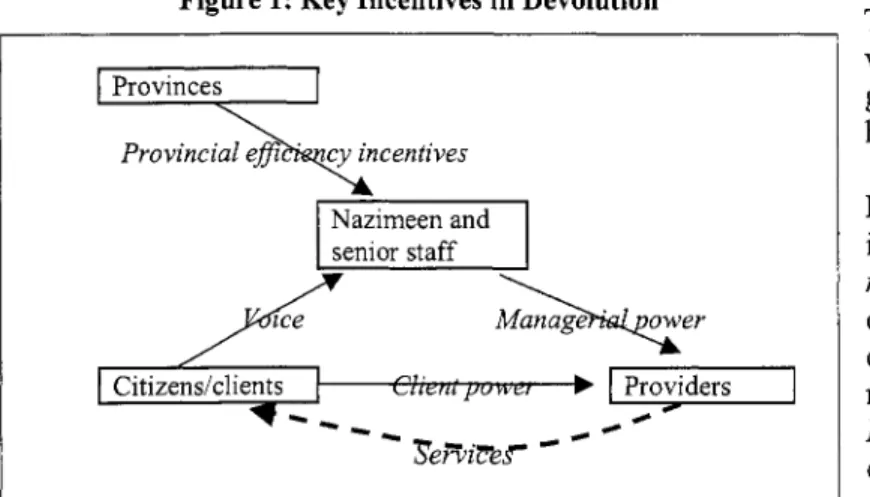
and the degree to which this provides incentives for malung services work at the district and TMA level. Whether the incentives really will in turn lead to better services in health, education,infrastructure, and access to justice across local governments remains an empirical question. Figure 1 summarizes these assumptions in a simplified framework for thinking about the prospect for making services work under Pakistan’s devolution, centered on the nazimeen and their senior staff.
Figure 1: Key Incentives in Devolution
Nazimeen and
I
The incentives to make services work under devolution can be grouped under two broad headings.
First, there i s the set o f incentives that might make
nazimeen want to see service delivery improvements for citizens at reasonable cost. The report considers whether
Nazimeen are influenced by
citizen power, in the form o f
“voice, ” so that they have an
incentive to direct those providers to achieve service delivery improvements (although as Figure
1 illustrates, this assumes that they are in a position to direct the behavior o f the staff that provide the services-motivated nazimeen with n o ability to direct their front line staff will not be able to improve services). It also considers whether voice i s accompanied by provincial eficiency incentives, so that service-delivery improvements are not simply obtained through increased spending.
Second, the report reviews the incentives on those who provide the services-for example, the staff o f schools and clinics-addressing the question o f whether they are likely to want to see improvements. More specifically, it looks at managerial power, the arrangements that ensure that the nazimeen and senior staff have authority over the front line workers and, again, citizen power (this time in the form o f “clientpower”) that provides providing potential service recipients with
some direct means to have an impact on the conduct o f service providers.
The methodology used in this report i s to identify the components o f these four sets o f incentives and to track changes that can be attributed to devolution. Box 1 summarizes these incentives.
If,
on balance, these changing incentives are in fact having some impact on service delivery, then, in principle, improvements could be measured directly. However, there are two difficulties. First,devolution i s recent and it would be premature to attribute any change (positive or negative) in social sector outputs to new arrangements for service delivery. Second, in Pakistan there i s no consensus on which data sources to use to measure intermediate and outcome indicators and little robust district disaggregated data, and it would be dangerous to judge the utility o f devolution on
the basis o f any apparent trends in these indicators.
Box 1: The Sets o f Incentives Tracked in this Report [ncentives o n nazimeen and senior staff:
Provincial efficiency incentives derive from the structure o f the revenue base, including transfers and own source revenues available to meet the new local expenditure responsibilities. If well structured, these fiscal arrangements promote the efficient use o f resources in meeting local preferences. Since
nazimeen will typically face expenditure demands that exceed available resources, budgetary certainty in the form o f predictable resource flows and a hard budget constraint, coupled with adequate
autonomy in resource allocation, will encourage them to use public resources responsibly and efficiently. With these arrangements in place, nazimeen will more likely attempt to make the best trade-offs, for example, in allocations between sectors, between recurrent wage and development expenditures, and attain value for money (for example, through effective procurement arrangements). Voice offers a channel for citizens to make their demands for better services heard-the most obvious form is elections. However, voting may be based o n other criteria than service delivery, as owing to years o f bitter experience voters may not see commitments o n the part o f politicians to provide broad- based public goods over time as credible. Hence, voters and politicians may emphasize directly visible and narrowly targeted projects such as school infrastructure. These schools may not be staffed or maintained, but voters have leamt that they cannot hold politicians to their promises beyond the short term.
Voice i s likely to be stronger, with councilors motivated to listen to citizens, if there i s public assignment o f credit or blame and if there are obstacles to councilors providing private goods targeted at a few influentials rather than public goods that benefit many. To influence nazimeen, citizen voice must compete with the pressures from the provinces o n nazimeen to serve their political interests. That “pull” from the provinces is reduced when the councilors have independent political legitimacy and when provinces themselves have fewer incentives to intervene in local affairs.
[ncentives on the providers:
The local governments, as represented by the nazimeen, engage with service delivery providers (for example, schools and contractors) through managerial power, w h c h reflects their ability to require service providers to adhere to particular standards o f behavior and service. Again, as is explored in more detail in the second volume (Annex 1-Recent History), managerial power is strengthened if the staff that work in the district are employed by the district, with hire and fire authority available to local managers, subject to suitable safeguards. Recognizing that this i s unlikely to be the case for senior staff, nazimeen need distinctive authority over their behavior including input into their performance evaluations, and a credible threat to transfer them if the relationship i s not productive. Managerial power i s strengthened by the external oversight provided by bodies such as Accounts Committees, Monitoring Committees and District Public Safety Commissions. It also assumes that staff with appropriate slulls are available in sufficient numbers and that those staff have the skills and sufficient technical sanction powers to undertake their tasks.
A shorter route o f accountability, client power, directly connects citizens with service provides, such as schools. Client power includes more formal mechanisms as functioning agencies that assist in
dispute resolution (Departmental Grievances Redressal and Complaint Cells and Citizen Police Liaison Committees) and bodies that provide direct citizen inputs into the management o f facilities (Citizen Community Boards and School Management Committees).
KEY
FINDINGS
New Incentives for Nazimeen and Senior Staff
Provincial efficiency incentives
The study assumes that devolution would be providing district and tehsil nazimeen with greater incentives for efficiency in fiscal management
if
it achieved positive movement in three key categories:0 Budgetary certainty-the degree to which they must live within hard constraints and the
predictability o f the budgetary transfers that they depend on;
0 Autonomy in preparing the budget-specifically the development, the non-salary recurrent
and the salary budgets;
0 Incentives for local revenue-raising-the buoyancy and potency o f taxes assigned, the clarity
o f revenue assignments and other incentives for revenue raising.
The scorecard on the creation o f provincial incentives for fiscal efficiency i s mixed. On budgetary certainty, as the report shows, most funding for local government i s in effect negotiated rather than formula-based. All negotiated revenues provide opportunities for gamesmanship-basing current policy decisions on their likely impact on future resource transfers, rather than on their merits. The proportions o f the Provincial Consolidated Fund that ultimately are transferred on formula basis are small. Less than 25 per cent o f all transfers mandated by the Local Government Ordinances (LGOs) are calculated on a formula basis.’ However, while these transfers are negotiated, the data also reveal that there i s considerable predictability in the transfers at the district level, with in most cases districts receiving only slightly less than what was budgeted. The district studies also revealed that local governments have limited autonomy in preparing their budgets. Vertical programs are the main constraint on district and TMA autonomy in preparing the development budget, with often the volume o f funds channeled through vertical programs dwarfing the district’s own Annual Development Plan (ADP) for particular sectors. In the study
districts, more than half o f the ADP i s under the effective control o f the federal and provincial agencies controlling the vertical programs. Local govemments also have limited freedom in preparing the salary budget. Neither local nor provincial govemments are able to determine pay scales, which are de facto set at the federal level. In addition, in Sindh and
NWFP,
districts must seek approval from the province for the release o f the funds from Account I (the provincial account) for their salary payments.’Local govemments are hugely dependent on intergovernmental fiscal transfers. This degree o f vertical imbalance can lead to inefficiencies in both the levels and quality o f public expenditure- specifically, it creates incentives for local govemments to overspend as well as reduces the incentives to spend these resources efficiently. The logic in both cases i s that intergovemmental transfers lower the costs to local residents o f getting services. Arguably, the disconnection between expenditure and taxation encourages “free-riding,” as well as reducing the incentives to monitor public expenditures, as resources are collected from distant taxpayers not likely to be
using the services produced by the local government.
Thus it is at least arguable that local revenues contain intrinsic incentives for efficiency, as local taxpayers might be more vigilant than distant ones and so efforts to improve own source revenues
’
’
re-appropriation authority o f the district or TMA. It i s important to note that transfer has a precise meaning and refers to funds that are non-lapsing and within the In Punjab and Balochistan, the salary budget i s transferred directly in District Account 4.can imply incentives for efficiency. Incentives for local revenue effort are linked to the buoyancy and potency o f taxes assigned to local government, and the clarity o f such assignments. Effort will be deterred if there i s no credible connection to likely revenue results and
if
it i s not evident which level o f government i s to benefit from which tax. While districts have been given rights to raise additional revenues, their tax base i s weak, and some district taxes and user charges are very difficult to impose in practice. In the six study districts, for example, for 2003/04 own source tax revenues ranged from 0 percent to 8 percent o f total revenues. Therefore, even a large tax effort may bring only modest results in total revenue.In addition, although the district and
TMA
taxes are clearly assigned in theory, administrative confusions in the collection arrangements blur the assignments in practice, further reducing incentives to increase collections. Administrative complexity i s most clearly evident in the case o f property tax (UPT).Citizen Power (Voice)
This study argues that there are two necessary conditions for the local political leadership to have incentives for service delivery improvements. First, local councilors themselves must have an interest in serving the needs o f their constituents and in particular the poor. Second, since the relationship between nazimeen and councilors i s a critical intermediate step in the linkage to citizens as nazimeen are indirectly elected by councilors, nazimeen must find the pull from the councilors more demanding than the pull from other political powerbrokers, particularly the provincial governments.
On this basis, devolution has, on balance, created distinct incentives for nazimeen to listen to citizens. However, jurisdictional overlap makes it difficult for politicians to seek credit for improved services. When multiple levels o f government are involved in delivering the same services, the public i s unable to assign credit or blame effectively for that particular service to a particular politician. This overlap weakens incentives to perform well on service delivery and could encourage politicians to target services to their core supporters. Jurisdictional overlap i s particularly an issue in the education and health sectors, as federal and provincial vertical
programs remain principal tools in promoting national policy priorities and represent a significant proportion o f local-government expenditures on service delivery.
The anecdotal evidence from the study districts also suggests the strong incentives workmg on councilors to focus on private goods, such as patronage or locality-specific projects. However, the evidence from the study districts suggests that while the pressures to focus on private goods are strong, devolution has at least not exacerbated this problem. For example, the data shows that there i s no obvious reduction in operations and maintenance expenditures between the allocations
in 2003/04, the first year local governments prepared their own budgets, and that o f earlier years. Similarly, the data suggests that there has not been a significant shift from large to small
development schemes, or that councilors are abandoning existing schemes to gain political glory
by starting new ones.
The importance o f the political relationship between the nazim and the ruling provincial political coalition emerges strongly fi-om the study. In two o f the six districts visited-Bahawalpur and Faisalabad-the District Nazim is allied to the Chief Minister and the ruling provincial political coalition, while in the other four the District Nazim i s in opposition. This relationship has a
This paper's references to private goods include both pure private goods (that is, individual-specific) as well as narrow public goods (for example, locality-specific projects). Local infrastructure projects often encompass both- that is, only the local community benefits, and the contractors for the projects reap the private rewards.
significant impact on the flow o f funds between the province and local governments, on the implementation o f local development schemes and on the manipulation o f appointments and transfers o f personnel. Effectively, the relationship with the province determines the extent o f political control that the District Nazim can exercise within local government as well as the freedom local policymakers have to act to meet their constituents’
demand^.^
New Incentives for the Service Providers
For service delivery to improve, the service providers-and not just their elected superiors-must want to see improvements. This motivation i s provided either by ensuring that the service providers have an incentive to listen to the policymakers-managerial p o w e r - o r by providing potential service recipients with some direct means to have an impact on the conduct o f service providers-client power, in the terminology o f the World Development Report (World Bank: 2003~).
Managerial power over service providers
In reviewing the changed incentives for front line staff and other service providers to “listen to
Nazimeen,” the study examines three key dimensions:
0 0 0
The extent to which staff workmg in the district are employed by the district. The adequacy o f the nazim’s authority over senior staff, including inputs into the performance evaluations for senior staff and ability to require their transfer.
The extent o f external oversight, including a review o f the effectiveness o f bodies, such as Accounts Committees, Monitoring Committees, and District Public Safety
Commissions, which are mechanisms for the monitoring o f front line staff.
Managerial power over service providers i s weak. Administrative devolution remains incomplete and, as yet, has given district staff few reasons to respond to the authority o f the nazimeen. The transfer o f functions and the physical relocation o f staff have not been fully matched by the
transfer o f the employer role. While the LGO provides for a sophisticated sharing o f control over posting o f civil servants based on norms which clearly delineate responsibilities, informal
provincial controls are clearly evident in the area o f Appointment, Promotion and Transfer (APT)
authorities. The result i s that although physically located in the districts, most senior district staff do not consider themselves as district employees and therefore are likely to accommodate provincial pressures to transfer subordinate staff. This attitude has considerably weakened the accountability o f senior staff to local elected representatives. In fact, politically motivated inter- and intra-district staff transfers are a main area o f conflict between. provincial and local
governments and are most severe in districts that are not politically aligned with the province. Since TMA staff largely belong to local government cadres or are the council’s own employees, the problem o f lo w institutional allegiance and weak accountability i s less acute.
These problems o f accountability were clearly evident in the relationship between the District
Nazim and the senior staff in the district, particularly the District Coordination Officer (DCO) and the District Police Officer (DPO). It was generally observed that the authority o f the nazim to write the Annual Confidential Reports (ACRs) o f DCOs was an insufficient mechanism for enforcing accountability since it was an ineffective tool for measuring the performance o f an officer and tended to be viewed as a routine matter to be placed on an officer’s file at the time o f promotion to fulfill a legal or administrative requirement. Officers tended to be given postings
See the second volume (Annex I-Recent History) for a full treatment o f the political relationships between the provinces and local govemments.
regardless o f their performance in previous tenures. Nazimeen also have very little authority over the DPO. Formally, at the time o f the study, only in Punjab had the District Nazim been given the initiating authority for the A C R o f the DPO, although it has been reported that this authority will be extended to the nazim in all provinces. However, in practice in none o f the districts studied were these performance evaluation reports completed in this manner. Some nazimeen, in fact, considered that removing the authority o f the former district magistrate in completing the ACR o f a former district Superintendent o f Police had contributed to deterioration in law and order in
general .5
The LGOs provide for a number o f institutional arrangements-Monitoring Committees, and District Public Safety Commissions-for the oversight o f service providers by elected
representatives.6 However, it was generally observed that thesebmechanisms have either not been established, or have been introduced to only a limited degree. For example, the field visits
revealed that, with some notable exceptions and for several reasons, Monitoring Committees were not performing as the regulations envisioned. Similarly, Public Safety Commissions where formed, were generally unable to elicit compliance from the police in its investigations.
Citizen power (client power)
Service delivery can also be improved by improving client power, that is, strengthening the direct linkage between citizens and service providers. In principle, such an approach can be more effective than focusing on efforts to make service providers more accountable to policymakers and then making policymakers, in turn, more accountable to citizens. The LGOs and Police Orders call for the creation o f various bodies, such as Citizen Community Boards and Citizen Police Liaison Committees, which can serve to improve this client power. The overall conclusion from the field visits i s that it i s too early to tell whether or not devolution has had any impact on client power for the better or the worse. While in general participatory mechanisms, such as Citizen Community Boards and School Management Committees (a pre-devolution initiative) have yet to achieve their full potential, there are numerous examples that suggest that innovative local leadership has had a positive impact on community mobilization and in turn on service delivery.
ASSESSMENT
A Milestone Passed
Devolution has brought a decisive break with the past in two important respects. First, local government now has unambiguous constitutional protection. The agreed changes to the constitution enacted on 30 December 2003, has placed the local government system, as
prescribed by the provincial LGOs, in the sixth schedule o f the 1973 Constitution and thus they cannot be altered, repealed or amended without the sanction o f the President. Second, as a result o f the LGO provisions, the reservation o f 33 percent o f local council seats for women in all three levels o f local government has proven the most strategic step ever undertaken by government toward women’s political empowerment. Most directly, despite the significant number o f vacant seats, it has enabled over 30,000 women to enter into formal politics at the local government level (see Table 3).
Press reports o f a high level meeting held on 14 April 2004 involving the Prime Minister, Provincial Chief Ministers, the NRB and other federal and province officials indicate that significant changes will be introduced to the Police Order 2002 and that a new target date o f December 2004 has been set for complete implementation of these new arrangements. Until these are officially confirmed and clarified, this report will make only passing reference to what has been reported, but will not speculate on their likely impact.
It i s noted that the DPSCs include non-elected members, but that these are appointed from a list provided by the
Province Women Women union Total union Women union
nazimeen councilors council seats councilors as a percentage of total
Devolution marks a decisive departure from the previous arrangements that became associated
with persistent failures in service delivery. This study reaffirms the government’s view that devolution offers the best prospect for improved service delivery and access by the poor to public entitlements, including not just health, drinlung water and education, but much needed
improvements in policing and local justice. While it i s too soon for the proponents o f devolution to point to an overall improvement in service delivery, the study does reveal significant
achievements. For instance, anecdotal evidence suggests that doctors and teachers are now more likely to be at their post and drugs are more often available in clinics. Citizens undoubtedly appreciate the improved access they have to their political representatives. Councilors, both directly and through new dispute resolution arrangements at local level, are now seen to be responding to people’s needs and concerns. This change suggests that devolution may deliver on i t s larger political objectives to create a better match between what governments do and the public’s ability to hold them accountable for performance. This study i s therefore modestly optimistic about the future o f devolution.
Punj ab Sindh NWFP Balochistan TOTAL
The transformation underway through devolution nevertheless faces significant challenges. Detractors argue that in fact devolution has made matters worse. In some respects opponents o f devolution are in the same position as proponents; the evidence i s indeed mixed. Yet, while morale has deteriorated for some civil servants, and law and order i s thought by many to have worsened due to a failure to reestablish oversight o f the police, n o one consulted during this study
saw any merit in a return to the old systems. Moreover, while many are concerned about the possible re-emergence o f “private goods strategies” under which local politicians resume the time-honored practice o f rewarding their constituents with private benefits at the expense o f public goods the study suggests this i s not in fact a fair representation o f what i s occurring.
9 20,007 72,513 27.6
2 5,878 22,974 25.5
- 3,963 20,097 19.7
- 2,374 10,878 21.8
11 32,222 126,462 25.4
The key variable in promoting successful devolution would appear to be the strength o f the provincial incentives to intervene in the districts. The province has few incentives to intervene when:
0
0
0
The Chief Minister andor the main provincial coalition and the district nazim are from the same political alliance.
The Provincial Assembly constituencies within the district are filled with politicians from the same political alliance as the nazim.
When the province has few incentives to intervene, the nazim gains a fairly free hand to direct district staff and, despite the inevitable resource constraints, can achieve results. However, when the provincial incentives for intervention are high, nazimeen often finds their hands tied.
The Glass i s M o r e than H a l f Full
Table 4 and Table 5 summarize the degree to which the incentives for the key actors are changing. Dark cells indicate little progress; lighter cells suggest more forward movement. Overall, the study finds that some appropriate new incentives have indeed been created and that they are undoubtedly promising as they directly address the institutional weaknesses that the failure o f S A P highlighted-weak inter-sectoral allocation o f expenditures, l o w emphasis on non- salary recurrent expenditures and few incentives for efficient utilization o f these expenditures (World Bank: 2002a).
ixr
Devolution i s undoubtedly a fact o f life in Pakistan. It i s implausible that there will be a major return to a discredited set o f institutional arrangements with a proven track record o f failure. Equally, however, no certainty exists that devolution will now
be
developed and entrenched to maximize its potential returns. The risk i s that by failing to deliver visible service delivery improvements in the short term, the devolution project will fall short o f completion and the present hybrid arrangements-part new, part old-will become permanent.RECOMMENDATIONS
The government emphasized the need for a robust technical analysis o f emerging lessons and feasible, practical recommendations that add value to a devolution process that i s well advanced.
With the principle o f practicality very clearly in mind, the study sets out an agenda for furthering devolution. It suggests both a strategy and some practical actions that will offer some relief now to hard-pressed nazimeen and senior staff in local govemments who are attempting to make the
system work.
Key elements of the Suwested Strategy
1. Seize the opportunity presented by the NFC Award to conduct a well-targeted, strategic information campaign using a variety of media-print and electronic media
Note the successes. N o w i s the time for a public information campaign, setting out both progress and challenges.
Look for opportunities that are offered to local governments following the N F C award and the improved financial position that this gives to provinces. Ensure that citizens understand what this means for local govemment budgets and priorities.
Take advantage of the opening up of the electronic media to the private sector-in particular local radio.
2. Enforce the core principles-and accommodate local differences.
NRB,
whilst ensuring that the core principles o f devolution are not diluted, should be willing to allow some marginal local variations to meet the needs o f different areas.Implementation requires new strategies that recognize Pakistan’s diversity while keeping devolution on track. The March 2000 announcement o f the devolution plan and the subsequent August 2000 Local Government Plan presented a broad strategic vision. Since then, the focus has been on the technical, fiscal and administrative aspects o f implementation, superintended by the NRB. Underlying this emphasis has been concern to ensure compliance
with the local government and associated ordinances. N o w might be the time to reassert the broad goals o f devolution.
Allowing diversity wouldpromote wider support. The range o f actors has grown exponentially. The basic structures for devolution have been put in place. Some local diversity in implementation i s now feasible, and accepting marginal differences will avoid needless federal-provincial conflict. It would demonstrate that the federal govemment will hold fast to the core principles, while at the same time allowing local institutions to reflect local circumstances.
3. Transmit national policy priorities more effectively.
Move from an over-reliance on vertical programs. A large share o f financing for health, education, water supply and sanitation i s delivered in ways that systematically undermine local government accountability. Vertical programs represent attempts by higher tiers o f government to influence the policy and behavior o f lower levels o f govemments by direct intervention. Retaining some influence over sub-national policy is sensible. Federal and provincial governments need some levers to influence local performance to support national
objectives. In practice, though, vertical programs have a poor track record and they now risk
damaging the credibility and nascent accountability o f local governments.
Create incentives to encourage local governments to buy into national priorities. Grants coordinated through the mechanism o f N F C and PFC and conditioned on outputs, outcomes or processes are an important part o f a strategy through which to promote nationwide standards and priorities. Conditional grants can interfere with the accountability o f local representatives to their constituents. They must not be used excessively. But they do offer a pragmatic instrument through which federal and provincial governments can maintain a legitimate interest in the institutional reforms and service-delivery arrangements at the sub-
national level.
0
Strategic Goals and Practical Actions
The study identifies 7 strategic goals and practical steps that are achievable given the impressive
progress made to date. The goals, along with the immediately operational, implementing measures, include:
1. Achieve public consensus that completing devolution i s inevitable
2. Demonstrable federal government commitment to strengthened role o f the provinces
0
Issue a White Paper on strategic options for adjusting legal, administrative, political, and fiscal arrangements in support o f devolution.
Timetable for the PRSP commitment on functional devolution with a review o f the
relative roles and responsibilities o f Federal and Provincial levels in the context o f service delivery.
0 Set preparations in motion for the 7th N F C Award now.
3, Demonstrable provincial government commitment to strengthening local government
0 Complete reassignment o f province-administered functions to local governments. 0 Incorporate the Lessons o f Transition in Revisions to the LGOs.
0 Major Commitment to Capacity Development. 0 Undertake provincial-local tax reassignments.
4. Local governments challenged to demonstrate that they merit confidence.
0 Reduce development throw forward. 0 Increase coverage o f user charges.
0 Strengthen inter-jurisdiction planning and coordination.
0 Local governments to regulate and engage with private sector service providers.
5, Judicious Selection from a Menu o f Conditional Grants in PFCNFC Transfer Systems
0 Use conditional grants-cautiously. 0
0
6. Hold local governments to account
0 0
7.
Clarify the separation o f executive and judicial powers.0
0 0 0
0
Review existing vertical programs and redesign proposals.
Broaden available array o f social indicator data and capture district data. Districts employ their own staff.
Districts maintain their own accounts.
Restructure reporting obligations between the District Police Officer and the District
Nazim
.
Assign non-adjudicatory powers to the local government executive.
Train judicial magistrates in new jurisdictions under criminal and local laws. Provide High Court protection for judges interdicting unlawful action by officials. Establish separate civil and criminal courts, and appoint Senior Judicial Magistrates in each district
Table 7 suggests the sequence with which these steps might b e initiated.
~
FY05
* Issue a White Paper on strategic options for adjusting legal, administrative, political and fiscal arrangements in support o f devolution.' Establish High Level Expert Group on federal- provincial tax reassignment (including possible debt-for-performance swaps).
PFC announcements o f framework under which
I
8
2
E3
ir
I
Table 7: Timetable of Proposed Key ActionsI
FY06
Review of the Rules o f
FY07
the provincial govemments might use conditional grants, selectively, within the PFC awards, to achieve overarching policy goals. Develop and promulgate local government public-private partnership rules (as under LGO Schedule 5, Part A).
Provide districts with full APT authority over all staff at grades 19 and below.
Make three major policy announcements: a) Proposed reassignment of province- administered functions to local governments complete. Might reasonably include:
-
TMA debt-for-performance swaps-
Transfer of PHED staff and budgets to the b) Formal reviews of provincial-local tax reassignment, to report within 2 years. c) Major commitment to capacity development.TMAs
Reduce development throw-forward. Increase coverage of user charges. Empower the Mushawarat Committees to provide a platform for district-wide, medium- term planning.
Train judicial magistrates in new jurisdictions under criminal and local laws
1. Such a White Paper might reasonably include:
Business, the constitution o f the Local Government Commission and the facilities and authorities provided to the local government Monitoring Committees.
Prepare and notify the Rules of Business detailing the reporting obligations between the District Police Officer and the District Nuzim.
powers and supervision of pretrial detention' to the local government executive. Establish the Independent Prosecution Service and ensure its extension to the district level.
,
Assign non-adjudicatory
Enhance High Court protection Establish separate
for subordinate judges criminal and civil
interdicting unlawful action by courts established
officials. at district level
and appoint Senior Judicial Magistrates in each district