A note on compatibility and entry in a circular model of
product differentiation
Nicolas Jonard Eric Schenk
CNRS, CREA, Ecole Polytechnique LRPS, INSA Strasbourg and BETA, Universite Louis Pasteur
Abstract
Consider an industry in which network goods are supplied by two horizontally differentiated firms facing the threat of a potential entrant. Firms' dilemma is between occupying the product space by selling very differentiated (incompatible) goods, and supplying compatible goods that offer higher utilities hence can be charged a higher price to consumers but are also closer substitutes. The compatibility−entry−price game is solved backward when firms and consumers are located on a circular product space. It turns out that strong externalities can favour entry, as merging the networks and accommodating entry can be preferred by the incumbents.
Citation: Jonard, Nicolas and Eric Schenk, (2004) "A note on compatibility and entry in a circular model of product differentiation." Economics Bulletin, Vol. 12, No. 1 pp. 1−9
Submitted: July 27, 2003. Accepted: January 8, 2004.
A Note on Compatibility and Entry in a
Circular Model of Product Di
ff
erentiation
∗
Nicolas Jonard
†Eric Schenk
‡,\†
CNRS, CREA, Ecole Polytechnique
1 Rue Descartes, 75005 Paris, France
‡
LRPS, INSA Strasbourg
24 Bld. de la Victoire, 67000 Strasbourg, France
\
BETA, Universit´
e Louis Pasteur
61 Ave. de la Forˆ
et Noire, 67000 Strasbourg, France
November 4, 2003
Abstract
Consider an industry in which network goods are supplied by two horizontally differentiatedfirms facing the threat of potential entry. Firms’ dilemma is between occupying the product space by selling very differentiated (incompatible) goods, and supplying compatible goods that offer higher utilities – hence can be charged a higher price to consumers – but are also closer substitutes. The compatibility-entry-price game is solved backward when firms and consumers are located on a circular product space. It turns out that strong externalities can favour entry, as merging the networks and accommodating entry can be preferred by the incum-bents to intense price competition between them: they choose the lesser of two evils.
Key words: network externalities, compatibility, entry, differentiation, niche. JEL classification: L11, L13.
∗Corresponding author: N. Jonard; E-mail: [email protected]; Phone: 33 1 55 55 81 97; Fax: 33 1 55 55 90 40. We thank Patrick Legros and an anonymous referee of the Economics Bulletin for detailed and helpful comments.
1
Introduction
There is a clear impression nowadays that networks are a central issue. Networks con-nect individuals, communities, firms and structure the workings of society as a whole. Users of specific goods and services are networked, so are members of common interest groups, acquaintances and business relationships,firms operating in knowledge-intensive industries willing to share costs and perform innovation more efficiently.1 An essential motivation is that networks very often give rise to externalities. This is true for iso-lated standards, and even more so when a common standard is achieved, as proprietary networks merge and even larger externalities obtain. The current paper is about this problem: the interconnection of networks via the provision of compatible goods.
The literature on compatibility falls within two broad categories. The “mix-and-match” approach views products as systems made up with several distinct parts, and focuses on changes in product variety and demand triggered by compatibility decisions.2 The second strand of literature, to which this paper belongs, assumes demand-side economies of scale in the form of increasing returns to adoption: the value a consumer derives from purchasing a good increases with its diffusion. Achieving compatibility then permits users to reap the (larger) benefits associated with the group of compati-ble goods. Increasing returns to adoption stem from many sources, among which the major ones probably are direct network externalities; the existence of complementary goods or services (often referred to in the literature as indirect network externalities); and learning-by-using/doing (Rosenberg 1982). Direct network externalities exist when adopters’ benefits directly increase with the sales or market share of compatible prod-ucts: phones, fax machines, more generally communication technologies are of little value in themselves, but they provide network access – the value of the network de-termines that of the good.3 Indirect network externalities, by contrast, obtain via the provision of complementary goods or services: cars have no value in the absence of parts, gasoline and roads; so are compact disc players without compact discs, and computers without software packages.4 Under both direct and indirect network externalities a sim-ilar dilemma arises: on the one hand afirm that chooses to make its product compatible increases the value of the product to the consumer, but on the other hand preserving incompatibility increases market power.
The objective of the present paper is to formally address the effect of direct net-work externalities on entry. The model is derived from the circular address model of 1This is by no means specific to the “new” economy: see Puffert (1991) on railway gauge
standard-ization.
2The essential elements of the components approach can be found in Matutes and Regibeau (1988)
and Economides and Salop (1992).
3See the seminal paper by Katz and Shapiro (1985); de Palma and Leruth (1996) or Economides
and Flyer (1998) for then-output games; de Palma and Leruth (1993) in a compatibility-then-price approach; de Palma, Leruth and Regibeau (1999) for a converter analysis; two-period models are in Farrell and Saloner (1985, 1986) and Katz and Shapiro (1986) with focus on consumers’ excess inertia/momentum rather than compatibility per se; empirical analysis in Saloner and Shepard (1995) on ATM adoption or Greenstein (1993) on government agencies hardware acquisition.
4See Cusumano et al. (1992) on the VHS/Betamax case in the early 1980s; Cottrell and Koput
(1998) on software availability and platform price in the early microcomputer industry (over the period 1980-86); Gandal et al. (2000) CD players and CD variety; Chou and Shy (1990, 1996) and Church and Gandal (1992) provide models where the welfare of consumers is affected by the variety of supporting goods or services that a monopolistically competitive market supplies.
Salop (1979). Two additional effects are accounted for. Firstfirms are eager to supply compatible products for which consumers have a higher valuation – a contention which several case-studies support (Gandal 1994; Harhoff and Moch 1997 for instance). At the same time, consumers perceive compatible products as closer substitutes which yields increased price competition. Choosing to be compatible is renouncing some product dif-ferentiation. We include the additional effect of an increased competition arising from the entry of an outside competitor. Depending on the importance of the loss relative to the increased attractiveness of the product’s larger installed base, different market outcomes obtain. A particularly interesting one is when the losses in terms of diff er-entiation are compensated by the network externality and entry is accommodated. A new incompatible good penetrates the market because it has access to a wide enough market niche granted by incumbentfirms that prefer the additional value from merging their networks to the preservation of monopoly power. A three stage game is examined, in which incumbents make their standardization decisions before the potential entrant makes his entry decision. In the last stage, activefirms engage in price competition.
2
The model
The compatibility-entry-price game considered here is a variant of Salop’s (1979) circle model. Goods’ characteristics are distilled into an aggregate index located on a circular address space. There are two mono-product firms i = 1,2 characterized by a location
zi, a price pi and a network size yi. Depending on the compatibility configuration, the
network of a firm consists of either the firm’s own sales (when incompatibility prevails, and then the twofirms have different networks) or the sum of the two firms’ sales (when compatibility is established, and then 1 and 2 have a common network). The precise formulation is given in Section 3. Each consumer (of which there is a continuum of unit mass) is also located in the address space, at the point where his ‘ideal’ good lies. Without loss of generality, the goods and consumers’ locations are described in a clockwise manner starting from 12 o’clock. Marginal production cost is set equal to zero for all firms. The indirect utility a consumer located atz derives from i is given by
Ui(z) =r−pi+wyi−|z−zi|, (1)
where r stands for the (supposedly large) income of the consumer, w > 0 captures the intensity of network externalities and the match value|z−zi|(the length of the geodesic
between consumerz and firmi) represents the dis-utility from buying a good that does not exactly match the consumer’s taste.
We seek a sub-game perfect Nash equilibrium in which incumbentfirms first choose whether to be compatible or not (C orI), the potential entrant decides to enter or not (e or¯e), and then all firms set prices. In the first stage, the incumbent firms can adopt a common standard (which amounts to a compatibility decision) at the expense of some amount of product differentiation, i.e. a change in their locations z1 and z2. Firms producing incompatible goods locate at z1 = 1/4 and z2 = 3/4. To represent the loss of product differentiation induced by compatibility it is assumed that compatible firms locate at z1 =h and z2 = 1−h, with 1/4< h <1/2, as in Figure 1. Compatiblefirms offer less differentiated products but larger networks.
It is worth insisting on the fact that there is no explicit address/location choice: the decision of a firm to be compatible or not translates directly into a specific pre-defined
z2 z1 z2 z1 Incompatibility Compatibility 3/4 1/4 1−h h 0 0
Figure 1: Incumbents locations in the product space
position for thefirm’s product in the address space. Hencefirms have no control over the reduction in product differentiation that stems from adherence to a common standard. A different framework could be imagined in whichfirms would explicitly choose a position on the circle, possibly combatting the losses in terms of product differentiation resulting from compatibility. This is beyond the scope of this paper which takesfirms’ locations as only affected by compatibility decisions. Hence there are two central parameters: the loss in differentiation (as measured by h), and the strength of network externalitiesw. The potential entranteasks a pricepe and has locationze= 0. A consumerz derives an
indirect utility of Ue(z) =r−pe+wye−|z−ze| from purchasing good e. The entrant
is incompatible with the installedfirms regardless of their decisions (hence his network always consists of its own sales). However, his niche is larger under the compatibility regime (total mass going up to 2h >1/2,see Figure 1) and therefore installedfirms face a dilemma between occupying the product space to deter entry and merging networks in order to raise prices. The potential entrant enters if and only if his expected profits are higher than the fixed cost of entryf ≥0.
3
Price competition
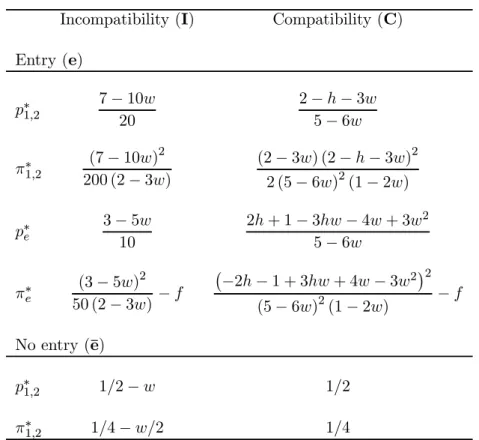
Given standardization and entry decisions, we seek an equilibrium of the price sub-game. The standard maneuver to solve this type of Hotelling-Salop model is to determine indifferent consumers, derive demand functions and solve thefirst-order conditions under all the possible compatibility and entry regimes. Two remarks are important. First it will be assumed that nofirm cuts prices so as to reap the totality of other firms demand (for an instance in which undercutting is allowed see Kohlberg and Novshek 1995); rather we only examine viable firms (as in Eaton and Wooders 1985 for instance) and this simplifies the calculations quite significantly as the consumer indifferent between twofirms is always between them. The second remark is that because there are network externalities, demand addressed to the firms may not be defined uniquely unless the strength of externalities is constrained (see de Palma and Leruth 1993; Anderson et al., 1992). As will be showed below, it is sufficient that w <1/2 for demand functions to be decreasing infirms’ own prices. As a consequence equilibrium will be uniquely defined. Equilibrium outcomes are summarized in Table 1 under the two technical regimes, with
and without entry.
Start with the determination of indifferent consumers in the incompatibility regime under the assumption that entry takes place. Let zi,j denote the consumer indifferent
between goodiand goodj, withi, j ∈{1,2, e}.Assuming thatfirms are viable amounts to assuming thatzi,j always lies betweeniandj.In the incompatibility regimes networks
are proprietary with y1 =z1,2 −ze,1, y2 =z2,e −z1,2 and ye = ze,1+ 1−z2,e. Then the
system of equations satisfied by ze,1, z1,2 and z2,e is written as
−pe+w(ze,1+ 1−z2,e)−ze,1 =−p1 +w(z1,2−ze,1)−(1/4−ze,1) −p1+w(z1,2 −ze,1)−(z1,2−1/4) = −p2+w(z2,e −z1,2)−(3/4−z1,2) −p2+w(z2,e−z1,2)−(z2,e−3/4) =−pe+w(ze,1+ 1−z2,e)−(1−z2,e) and yields ze,1 = 4 (p1−pe) + 1−2w 4 (2−3w) , z1,2 = 2 (p2−p1) + 2−3w 2 (2−3w) , z2,e = 4 (pe−p2) + 7−10w 4 (2−3w) .
Specificallyfirm 1’s profit function under entry and incompatibility isp1(z1,2−ze,1) with first derivative∂π1/∂p1 = z1,2−ze,1−2p1/(2−3w) and second derivative ∂2π1/∂p21 = −4/(2−3w) < 0 which indicates that the profit function of firm 1 is strictly quasi-concave. A similar exercise yields the indifferent consumers under compatibility. In the case network sizes arey1 =y2 =z2,e−ze,1 and ye=ze,1 + 1−z2,e.The system now is
−pe+w(ze,1+ 1−z2,e)−ze,1 =−p1 +w(z2,e−ze,1)−(h−ze,1) −p1−(z1,2−h) =−p2−(1−h−z1,2) −p2+w(z2,e−ze,1)−(z2,e−1 +h) =−pe+w(ze,1+ 1−z2,e)−(1−z2,e) which yields ze,1 = p2w+p1(1−w)−pe−w+h 2 (1−2w) , z1,2 = 1−p1+p2 2 , z2,e = pe−(1−w)p2−p1w+ 2−3w−h 2 (1−2w) .
From there the first order condition for profit maximization yields optimal prices and equilibrium profits in the symmetric equilibrium for firms 1 and 2. The upper part of Table 1 provides equilibrium prices and profits when entry takes place. Note that all prices and profits are positive for any 1/4< h <1/2.
The second part is the determination of indifferent consumers in the two possible regimes under the assumption that entry does not take place. Consider incompatibility first. The system of equations satisfied by z1,2 and z2,1 is cumbersome to write down
Incompatibility (I) Compatibility (C) Entry (e) p∗1,2 7−10w 20 2−h−3w 5−6w π∗1,2 (7−10w) 2 200 (2−3w) (2−3w) (2−h−3w)2 2 (5−6w)2(1−2w) p∗ e 3−5w 10 2h+ 1−3hw−4w+ 3w2 5−6w π∗e (3−5w) 2 50 (2−3w) −f ¡ −2h−1 + 3hw+ 4w−3w2¢2 (5−6w)2(1−2w) −f No entry (¯e) p∗1,2 1/2−w 1/2 π∗1,2 1/4−w/2 1/4
Table 1: Equilibrium prices and profits in the compatibility and incompatibility regimes, with and without entry
unless we shift firms’ locations to be z1 = 0 and z2 = 1/2 (this does not modify the degree of differentiation). The system then is
½ −p1+w(z1,2+ 1−z2,1)−z1,2 =−p2+w(z2,1 −z1,2)−(1/2−z1,2) −p2+w(z2,1−z1,2)−(z2,1−1/2) = −p1+w(z1,2+ 1−z2,1)−(1−z2,1) yielding z1,2 = 2 (p2−p1) + 1−2w 4 (1−2w) , z2,1 = 2 (p1−p2) + 3 (1−2w) 4 (1−2w) .
As for compatibility, similarly relocate firms at z1 = 0 and z2 = 1−2h. Externalities cancel out (networks merge) and this time it should be the case that
½ −p1−z1,2 =−p2−(1−2h−z1,2) −p2−(z2,1−1 + 2h) =−p1−(1−z2,1) which entails z1,2 = p2−p1+ 1−2h 2 , z2,1 = p1−p2 2 + 1−h.
In the lower part of Table 1 the equilibrium prices and profit are provided for the case in which entry does not take place. When no entry takes place,firms can increase their
profits by making their products compatible: total demand is still equally split but prices are higher. However, as can be seen from Table 1, this is not the case when entry takes place. There it can be the case that compatibility entails a profit loss.
Having determined the equilibrium of the last stage of the game, we now consider the decisions of compatibility and entry.
4
Strategic compatibility and the decision to enter
Before entering the general case, assume there are no externalities: w = 0. Incumbents only loose by making their products compatible because they broaden the niche for the entrant without deriving any additional network benefits. Setting w = 0 in Table 1 yields incompatibility as a dominant strategy for the incumbents. The entrant then assesses the benefits from entering an incompatible market,πe(I,e) = 9/100−f.At the
equilibrium incumbents always choose incompatibility and entry takes place if and only if f <9/100. 0 0.1 0.2 0.3 0.4 0.5 w 0.3 0.35 0.4 0.45 0.5 h c i i
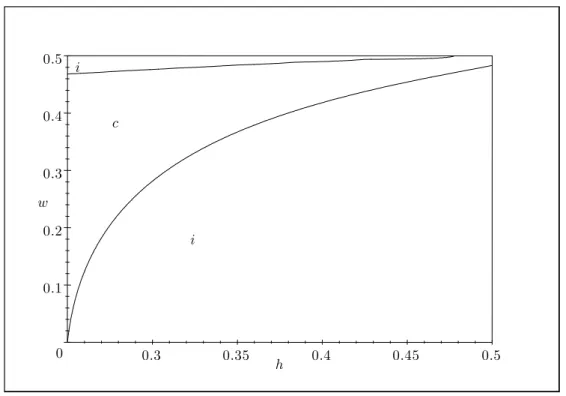
Figure 2: The implicit solution to γh(w) = 0. (The entrant’s preferred market
configu-ration is in lower case letters.)
Consider now the case of positive externalities: w > 0. Here several outcomes are possible, depending on the values of the three parameters h, w and f.5 Define the potential entrant’s net preference for compatibility to be γh(w) =πe(C,e)−πe(I,e),
with the corresponding profits defined in Table 1. In Figure 2 the implicit roots to
γh(w) = 0 are represented. The zone between the two curves is where the entrant
prefers entering an incompatible market,πe(C,e)<πe(I,e), whereas above and below
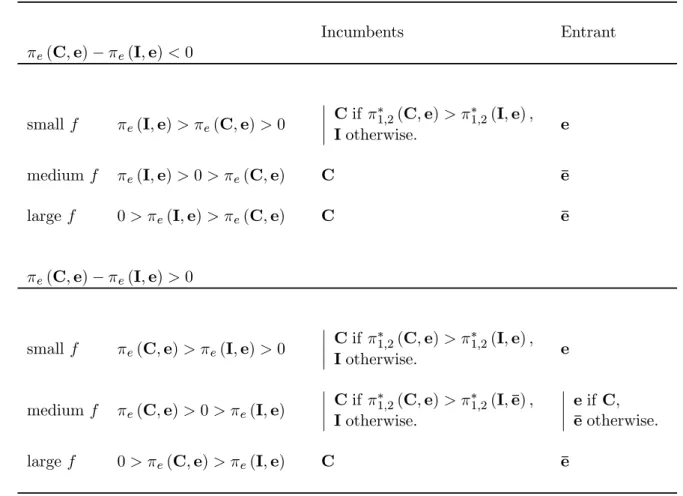
the two curves the preferred market configuration of the entrant is a compatible market. Depending on the magnitude of thefixed entry costf three subcases obtain, leading to a total of 6 distinct parameter regions which we summarize in Table 2.
Incumbents Entrant πe(C,e)−πe(I,e)<0 small f πe(I,e)>πe(C,e)>0 ¯ ¯ ¯ ¯ Cif π ∗ 1,2(C,e)>π∗1,2(I,e), Iotherwise. e mediumf πe(I,e)>0>πe(C,e) C ¯e largef 0>πe(I,e)>πe(C,e) C ¯e πe(C,e)−πe(I,e)>0 small f πe(C,e)>πe(I,e)>0 ¯ ¯ ¯ ¯ Cif π ∗ 1,2(C,e)>π∗1,2(I,e), Iotherwise. e mediumf πe(C,e)>0>πe(I,e) ¯ ¯ ¯ ¯ Cif π ∗ 1,2(C,e)>π∗1,2(I,¯e), Iotherwise. ¯ ¯ ¯ ¯ e¯eifotherwiseC, . largef 0>πe(C,e)>πe(I,e) C ¯e
Table 2: Parameter regions and corresponding equilibrium outcome.
Three situations are easily dealt with: they are characterized by the absence of entry due to relatively large fixed costs.6 In the upper part of Table 2, where π
e(C,e) <
πe(I,e), both large and medium (in the sense that is made explicit in the table) entry
costs lead to the equilibrium choice of compatibility for the incumbents and the decision of staying out for the potential entrant. Similarly in the lower part of Table 2, where
πe(C,e)>πe(I,e),a large entry cost entails compatibility and the decision of staying
out.
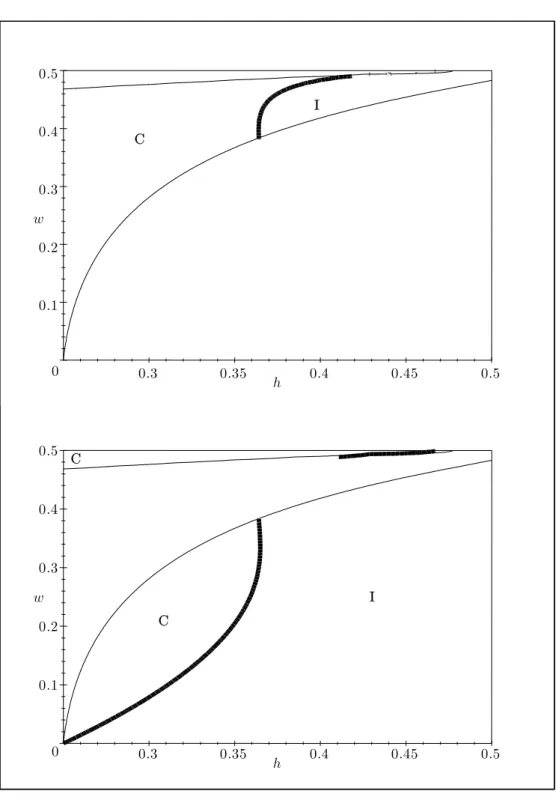
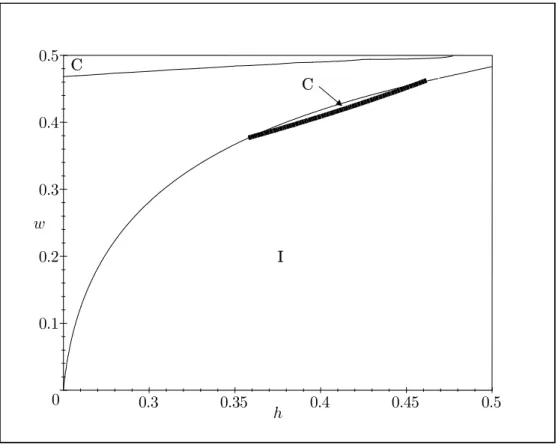
A symmetric situation obtains for low entry costs such that entry always takes place. An additional definition is required. Let ∆h(w) = π∗1,2(C,e) −π∗1,2(I,e) be the in-cumbents preference ¸cfor compatibility under the assumption that entry always takes place. Figure 3 depicts the roots to γh(w) = ∆h(w) = 0 in the (h, w)-space, and
the corresponding optimal compatibility decision. The thin black curves are the roots of
γh(w) = 0,while the thick black one corresponds to∆h(w) = 0.The upper (respectively
lower) panel corresponds to the upper (respectively lower) part of Table 2.
From both panels it is clear that the critical value ofwat which incumbents are indif-ferent between compatibility and incompatibility (the root to ∆h(w) = 0) is increasing
with h. Compatibility indeed has two major effects on incumbents’ profits: it relaxes 6It is useful to note thatπ∗
1,2(C,¯e)−π∗1,2(I,e) = 1/4−(7−10w) 2
0 0.1 0.2 0.3 0.4 0.5 w 0.3 0.35 0.4 0.45 0.5 h I C 0 0.1 0.2 0.3 0.4 0.5 w 0.3 0.35 0.4 0.45 0.5 h I C C
Figure 3: Small entry cost: upper panel corresponds to the upper part of Table 2; lower panel corresponds to the lower part. (Upper case letters refer to the incumbents’ decision.)
price competition by cancelling the multiplier effect of w, but it weakens differentiation and introduces an additional source of competition (the possible entrant). Hence the stronger externalities are for a given value of h, the more likely it is that incumbents prefer compatibility. This is what is visible from the two panels in Figure 3.
Probably the most interesting configuration is the last subcase of the medium entry costs case, when entry only takes place in a compatible market (second row, lower part of Table 2). Defineφh(w) =π∗
1,2(C,e)−π∗1,2(I,¯e) to be the incumbents preference for compatibility under the assumption that entry only takes place in a compatible market. Figure 4 depicts the roots to γh(w) = φh(w) = 0 in the (h, w)-space. The black thin
curves stand for γh(w) = 0 while the implicit root of φh(w) = 0 is depicted in thick black. Here compatibility offers a large market space to the entrant, while at the same time externalities are sufficient for the incumbents to compensate the loss of product differentiation if networks merge, which also avoids intense price cutting.
0 0.1 0.2 0.3 0.4 0.5 w 0.3 0.35 0.4 0.45 0.5 h I C C
Figure 4: The roots toγh(w) =φh(w) = 0.(Upper case letters refer to the incumbents’ decision, while entry only takes place on a compatible market.)
For any 1/4 < h < 1/2, there are two zones in which we observe compatibility and entry being systematically associated.7 The first one is the central lens. It is bounded on the h-axis by (h, h) = (0.35852,0.45931), and it is also bounded on the w-axis by arg©φh(w) = 0
ª
= 0.37731 and arg{φh(w) = 0} = 0.45938. The second zone is in the upper part of the figure, above the largest root to γh(w) = 0. It is characterized by values of w larger than 0.46832, which is the root to γ1/4(w) = 0. As a result, for any 7Though it is not readily visible from the graph, the upper curve only asymptotically approaches
hthere is always at least one open interval Wh of w-values such that, providedw∈Wh,
equilibrium is characterized by incumbentfirms choosing compatibility and entry taking place. In both cases externalities have to be “large enough” to compensate for the loss of product differentiation. Interestingly entry can take place when externalities are strong rather than weak. So at first glance it might seem that network externalities push for entry, when typically large network effects should rather discourage the outsider (this is also the general argument about installed bases). However it should not be forgotten that here competition is driven by prices rather than quantities, and so network externalities and incompatibility entail an increased proclivity to cut prices. So the loss in product differentiation, the threat of entry and the resultant increase in competition are real when incumbents opt for compatibility, but because externalities are so strong they still prefer avoiding the multiplier effect of w on thefierceness of competition. In that sense they choose the lesser of two evils.
5
Conclusion
Several forces are at work when the decision to be compatible is considered. A com-mon result when price competition takes place is thatfirms become compatible because compatibility reduces the incentives firms have to undercut their rivals. This is unclear when compatibility implies a loss in product differentiation, as the subsequent increase in competition might offset the benefits from relaxing the multiplier effect of network externalities. The more intense network externalities, the less likely it is that we ob-serve a desire to preob-serve incompatibility, unless compatible goods are extremely close substitutes in which case the positivity of profits is jeopardized. Another issue was em-phasized in this paper. Compatible goods tend to leave wider unoccupied zones in the address space, which not only strengthens price competition but also favors the entry of an outside competitor in one of the leftover niches.
The fixed structure assumed here imposes an immediate tension for the incumbents between compatibility (hence higher profits) and ease of entry for an outsider. If firms where free to choose their locations (hence controlling the degree of differentiation in order to possibly prevent entry) different outcomes could obtain, and it is likely that an outsider would not want to enter a compatible market in which he would face both large network effects and a better occupied product space.
6
References
Anderson, S. P., A. de Palma, and J. F. Thisse(1992): Discrete Choice Theory of Product Differentiation. MIT Press.
Chou, C., and O. Shy (1990): “Network Effects Without Network Externalities,” International Journal of Industrial Organization, 8, 259—270.
Chou, C.,and O. Shy(1996): “Do Consumers Gain or Lose When More People Buy the Same Brand,” European Journal of Political Economy, 12, 309—330.
Church, J., and N. Gandal (1992): “Network Effects, Software Provision and Standardization,”Journal of Industrial Economics, 40, 85—104.
Cottrell, T., and K. Koput (1998): “Software Variety and Hardware Value: A Case Study of Complementary Network Externalities in the Micro-Computer Soft-ware Industry,”Journal of Engineering and Technology Management, 15, 309—338. Cusumano, M. A., Y. Mylonadis,and R. Rosenblum(1992): “Strategic Maneu-vering and Mass Market Dynamics – the Triumph of VHS over Beta,” Business History Review, 66, 51—94.
de Palma, A., and L. Leruth (1993): “Equilibrium in Competing Networks with Differentiated Products,” Transportation Science, 27, 73—80.
de Palma, A., and L. Leruth (1996): “Variable Willingness to Pay for Network Externalities,” European Journal of Political Economics, pp. 235—251.
de Palma, A., L. Leruth, and P. Regibeau (1999): “Partial Compatibility with Network Externalities and Double Purchase,”Information Economics and Policy, 11, 209—227.
Economides, N. and S. Salop(1992): “Competition and Integration among Com-plements, and Network Market Structure,” Journal of Industrial Economics, 40, 105—123.
Economides, N.,F. Flyer(1998): “Equilibrium Coalition Structures in Markets for Network Goods,”Annales d’Economie et de Statistiques, 49/50, 361—380.
Eaton, B. C. and M. Wooders(1985): “Sophisticated entry in a model of spatial competition,”Rand Journal of Economics, 16, 282—297.
Farrell, J., and G. Saloner (1985): “Standardization, Compatibility, and Inno-vation,”Rand Journal of Economics, 16, 70—83.
Farrell, J., and G. Saloner (1986): “Standardization and Variety,” Economics Letters, 20, 71—74.
Gandal, N.(1994): “Hedonic Price Indexes for Spreadsheets and an Empirical Test for Network Externalities,” Rand Journal of Economics, 25, 160—170.
Gandal, N., M. Kende, and R. Rob (2000): “The Dynamics of Technological Adoption in Hardware/Software System: The Case of Compact Disc Players,” Rand Journal of Economics, 31, 43—61.
Greenstein, S. (1993): “Did Installed Base Give an Incumbent Any Measurable Advantages in Federal Computer Procurement?,”Rand Journal of Economics, 24, 19—39.
Harhoff, D., and D. Moch (1997): “Price Indexes for PC Database Software and the Value of Code Compatibility,”Research Policy, 26, 509—520.
Katz, M., and C. Shapiro (1985): “Network Externalities, Competition and Com-patibility,” American Economic Review, 75, 424—440.
Katz, M., C. Shapiro (1986): “Product Compatibility Choice in a Market with Technological Progress,”Oxford Economic Papers, 38, 146—165.
Kohlberg, E. and W. Novshek (1982): “Equilibrium in a simple Price-Location model,” Economics Letters, 9, 7—15.
Matutes, C., and P. Regibeau (1988): “Mix and Match: Product Compatibility Without Network Externalities,” Rand Journal of Economics, 19, 219—234. Puffert, D. (1991): “The Economics of Spatial Network Externalities and the
Dy-namics of Railway Guage Standardization,” Ph.D. thesis, Stanford University. Rosenberg, N.(1982): Inside the Black Box: Technology and Economics. Cambridge
University Press.
Saloner, G., and A. Shepard(1995): “Adoption of Technologies with Network Ef-fects: An Empirical Examination of the Adoption of Automated Teller Machines,” RAND Journal of Economics, 26, 479—501.
Salop, S. C.(1979): “Monopolistic competition with outside goods,” Bell Journal of Economics, 10, 141—156.