University of Central Florida University of Central Florida
STARS
STARS
Electronic Theses and Dissertations, 2004-2019
2018
Energy Efficient and Secure Wireless Sensor Networks Design
Energy Efficient and Secure Wireless Sensor Networks Design
Afraa AttiahUniversity of Central Florida
Part of the Computer Engineering Commons
Find similar works at: https://stars.library.ucf.edu/etd University of Central Florida Libraries http://library.ucf.edu
This Doctoral Dissertation (Open Access) is brought to you for free and open access by STARS. It has been accepted for inclusion in Electronic Theses and Dissertations, 2004-2019 by an authorized administrator of STARS. For more information, please contact [email protected].
STARS Citation STARS Citation
Attiah, Afraa, "Energy Efficient and Secure Wireless Sensor Networks Design" (2018). Electronic Theses and Dissertations, 2004-2019. 5813.
ENERGY EFFICIENT AND SECURE WIRELESS SENSOR NETWORKS DESIGN
by
AFRAA ZUHAIR ATTIAH B.S. Umm al-Qura University, 2007 M.S. University of Central Florida, 2012
A dissertation submitted in partial fulfilment of the requirements for the degree of Doctor of Philosophy
in the Department of Electrical and Computer Engineering in the College of Engineering and Computer Science
at the University of Central Florida Orlando, Florida
Spring Term 2018
c
ABSTRACT
Wireless Sensor Networks (WSNs) are emerging technologies that have the ability to sense, process, communicate, and transmit information to a destination, and they are expected to have sig-nificant impact on the efficiency of many applications in various fields. The resource constraint such as limited battery power, is the greatest challenge in WSNs design as it affects the lifetime and performance of the network. An energy efficient, secure, and trustworthy system is vital when a WSN involves highly sensitive information. Thus, it is critical to design mechanisms that are en-ergy efficient and secure while at the same time maintaining the desired level of quality of service. Inspired by these challenges, this dissertation is dedicated to exploiting optimization and game theoretic approaches/solutions to handle several important issues in WSN communication, includ-ing energy efficiency, latency, congestion, dynamic traffic load, and security. We present several novel mechanisms to improve the security and energy efficiency of WSNs. Two new schemes are proposed for the network layer stack to achieve the following: (a) to enhance energy efficiency through optimized sleep intervals, that also considers the underlying dynamic traffic load and (b) to develop the routing protocol in order to handle wasted energy, congestion, and clustering. We also propose efficient routing and energy-efficient clustering algorithms based on optimization and game theory. Furthermore, we propose a dynamic game theoretic framework (i.e., hyper defense) to analyze the interactions between attacker and defender as a non-cooperative security game that considers the resource limitation. All the proposed schemes are validated by extensive experi-mental analyses, obtained by running simulations depicting various situations in WSNs in order to represent real world scenarios as realistically as possible. The results show that the proposed schemes achieve high performance in different terms, such as network lifetime, compared with the state-of-the-art schemes.
Keywords– Wireless sensor networks, energy, efficient, security, game theory, routing,
EXTENDED ABSTRACT
In this dissertation, we propose two novel and efficient mechanisms for the layer stack in Wireless Sensor Networks (WSNs). First, we propose EE-MAC, an Energy-Efficient MAC proto-col for distributed WSNs. EE-MAC achieves a low-duty-cycle and hence low energy consumption through optimized sleep intervals while transitioning data between sleep and active states. We consider a weighted linear combination of delay and energy saving as the performance metrics. Next, we introduce ADP, an ADaPtive energy efficient approach that meets the requirement of low energy consumption and, at the same time, considers the underlying dynamic traffic load. ADP enhances energy efficiency by dynamically adjusting sensor nodes sleep and wake-up cycles. ADP utilizes a cost function intended to strike a balance between the conflicting goals of energy conser-vation (i.e., waking up as rarely as possible), and minimizing sensed events reporting latency (i.e., waking up as frequently as possible). ADP also incorporates a feedback mechanism that constantly monitors residual energy levels, the importance of the event to be reported, and predicts when the next sensing event will occur.
The second contribution of this dissertation is its focus on developing the routing and clus-tering algorithms for WSNs by proposing an efficient routing algorithm and developing an energy-efficient clustering algorithm based on optimization and game theory. The proposed routing al-gorithm utilizes an evolutionary game theoretical approach to show how sensor nodes in a WSN could evolve their routing strategies to transmit data packets in an efficient and stable manner. The proposed equilibrium solution aims to alleviate congestion and thereby improve the network lifespan. In addition, we propose a Cost and Payment-based clustering Algorithm (CoPA) for achieving energy efficiency in WSNs under a game theoretical framework. The analysis is based on a non-cooperative, repeated general-sum game, where each node behaves selfishly in order to maximize its lifespan (i.e., payoff). We demonstrate that the correlated equilibrium is a practical solution for clusterhead selection, which provides better performance than the Nash Equilibria.
Correlated equilibrium provides a balance between the fully cooperative solution and the fully non-cooperative solution in terms of implementation overhead.
The final contribution of this dissertation is our proposal of a dynamic game theoretical framework to analyze the interactions between the attacker and the defender as a non-cooperative security game (i.e., hyper defense). The key idea is to model attackers/defenders to have multi-ple levels of attack/defense strategies that vary in terms of effectiveness, strategy costs, and attack gains/damages. Each player adjusts his strategy based on the strategy’s cost, potential attack gain/-damage, and effectiveness in anticipating the opponent’s strategy. We study the achievable Nash equilibrium for the attacker-defender security game where the players employ an efficient strat-egy according to the obtained equilibrium. Furthermore, we present case studies of three different types of WSNs attacks and explain how our hyper defense system can successfully model them.
Through extensive simulations, the performance of the proposed schemes is validated. We observe reduced energy consumption at the cost of increased delay in EE-MAC. Simulation exper-iments with different traffic loads have shown that ADP improves energy efficiency while keeping latency low as well. The results also show that the proposed system of evolutionary routing game is successful in converging strategy choices to evolution stable strategy (ESS) even under dynamic network conditions. CoPA achieves better performance in terms of network lifetime and through-put compared to other popular clustering techniques. In addition, simulation results show that the proposed hyper defense approach achieves a higher level of performance compared to two other fixed-strategy defense systems.
To my mom.. To the soul of my dad.. To my husband and kids.. To my sister and brother..
To my supportive friends, family, teachers and staff.. for always being there
ACKNOWLEDGMENTS
This dissertation would not have been possible without the guidance of my advisor and my committee, and the help, support, encouragement, and love of my family and friends. I would like to express my deepest gratitude to my academic adviser, Dr. Cliff Zou, for his continued guidance, strong support, and valuable advising throughout my Ph.D. journey. Dr.Zou has always been supportive of my choice of research problems and was available whenever I needed his advice. Without his guidance and consistent help, this dissertation would not have been possible. To him, I am eternally grateful.
I would especially like to express my deepest appreciation and eternal gratitude to Dr. Mainak Chatterjee for his vital insight, strong support, and advice on throughout my studies at UCF. Also, I would like to thank Dr. Jun Wang, Dr. Ronald DeMara, Dr. Morgan Wang, and Dr. Murat Yuksel, for serving on my dissertation committee and providing valuable guidance and suggestions.
Next, I would like to thank my lovely family and my sweet friends for providing me with the support I needed. Their love and support has always been so important for my Ph.D. study, and for my life and career. My awesome mother has been supporting me throughout this experience by praying, taking care of me and my kids, and daily phone calls to cheer me up. I also want to thank my soul mate and my friend, Hani Shaikh Omar, my husband, for always believing in me and supporting me in following my dreams since the day we met. My wonderful brother and sister have offered me unwavering love, and their wholehearted support, always with a sense of humor. My adorable children have been patient and made the pursuit of my PhD a joyful undertaking. I am also truly grateful to have made very good friends during my years in the USA. My friends and I have been together through the best and worst of times, and they have shown me how true friends really should be.
Cen-tral Florida who have provided me with a nurturing and fruitful research environment. Thank you for being such good friends and making my Ph.D. studies such an enjoyable and memorable ex-perience. I would also like to express my appreciation to King Abdulaziz University for providing me with the opportunity and all the funding to pursue my PhD degree.
One final word of gratitude goes to someone who always waited for this moment, a person to whom I always dreamt of writing these words, a person who saw his dream in me but left this world too soon; my father. I know that you hear me. Thank you is not enough!
TABLE OF CONTENTS
LIST OF FIGURES . . . xiv
LIST OF TABLES . . . .xviii
LIST OF ALGORITHMS . . . xix
CHAPTER 1: INTRODUCTION . . . 1
1.1 Problem Statement and Motivation . . . 2
1.2 Contributions . . . 7
1.3 Dissertation Organization . . . 11
CHAPTER 2: LITERATURE REVIEW . . . 13
2.1 Medium Access Control (MAC) in WSNs . . . 13
2.2 Sleeping Techniques in any Layers of the Protocol Stack . . . 15
2.3 Routing and Clustering in WSNs under Game Theoretic Framework . . . 16
2.3.1 Optimal Route in WSNs . . . 16
2.3.2 Clustering in WSNs . . . 18
2.4 Security in WSNs under Game Theoretic Framework . . . 20
CHAPTER 3: EE-MAC: AN ENERGY EFFICIENT SENSOR MAC LAYER PROTOCOL 22 3.1 Overview . . . 22
3.2 EE-MAC Protocol . . . 22
3.2.1 State Model . . . 22
3.2.2 Energy and Delay . . . 24
3.2.3 Normalization of Energy and Delay . . . 24
3.3 Summary . . . 25
CHAPTER 4: ADP: AN ADAPTIVE FEEDBACK APPROACH FOR ENERGY-EFFICIENT WSNs . . . 27
4.1 Overview . . . 27
4.2 Motivation for the Proposed Idea . . . 27
4.3 Proposed ADP Approach . . . 28
4.3.1 Wake-up Technique . . . 28
4.3.2 Criticality of Sensor Node . . . 29
4.3.3 Sensing Event Modeling and Prediction . . . 30
4.3.4 Feedback Optimization . . . 31
4.3.4.1 Feedback Optimization Model for General Distribution . . . 31
4.3.4.2 Feedback Optimization Model based on Poisson Distribution . . 32
4.4 Discussion . . . 36
4.5 Summary . . . 37
CHAPTER 5: ENERGY-EFFECINT ROUTING AND CLUSTRING ALGORITHMS UN-DER GAME THEORTIC FRAMEWORK . . . 38
5.1 Basics of Game Theory . . . 38
5.2 Overview . . . 39
5.3 An Evolutionary Game for Efficient Routing in WSNs . . . 41
5.3.1 Motivation for the Proposed Idea . . . 41
5.3.2 System Model and Assumptions . . . 42
5.3.2.1 System Model . . . 42
5.3.2.2 Cost Model . . . 43
5.3.2.3 Assumptions and Notations . . . 44
5.3.3.1 Routing Game Structure . . . 46
5.3.3.2 Pure Strategy Nash Equilibrium and Evolutionary Stability for the Game . . . 48
5.3.3.3 Mixed Strategy Nash Equilibrium and Evolutionary Stability for the Game . . . 51
5.3.3.4 R-Hop Scenario and Replicator Dynamics . . . 55
5.3.3.5 Fairness Analysis . . . 58
5.4 A Game Theoretic Approach for Energy-Efficient Clustering Algorithm in Sensor Networks . . . 59
5.4.1 Motivation for the Proposed Idea . . . 59
5.4.2 Network Model . . . 60
5.4.3 Clustering Game . . . 60
5.4.3.1 Game Framework . . . 61
5.4.3.2 Cost Model . . . 62
5.4.3.3 Analysis and Equilibrium . . . 63
5.4.3.4 Fairness and Efficiency (Pareto Optimality) . . . 68
5.4.3.5 No-Regret Learning Algorithm for CE N-player game . . . 70
5.4.4 Strategy Space Reduction for CoPA . . . 71
5.5 Summary . . . 73
CHAPTER 6: A GAME THEPRITIC AOOROACH FOR ATTACKS AND DEFENSE STARTE-GIES . . . 74
6.1 Overview . . . 74
6.2 Non-Cooperative Attack-Defense Security Game . . . 75
6.2.1 Game Model . . . 76
6.2.3 Nash Equilibria Analysis for Non-cooperation Game . . . 79
6.2.3.1 MSNE for Security Game with Three-level Strategies . . . 80
6.2.3.2 MSNE for Security Game with Two-level Strategies . . . 82
6.3 Case Study of the Attack-Defense Security Game . . . 84
6.3.1 Defense System Against Hello Flood Attack . . . 84
6.3.2 Defense System Against Malware Attack . . . 86
6.3.3 Defense System Against Password Guessing Attack . . . 88
6.4 Summary . . . 90
CHAPTER 7: PERFORMANCE EVALUATION . . . 91
7.1 EE-MAC Experiment and Results . . . 91
7.1.1 Simulation Setup . . . 91
7.1.2 Simulation Results . . . 92
7.2 ADP Experiments and Results . . . 96
7.2.1 Simulation Setup . . . 96
7.2.2 Simulation Results . . . 98
7.3 Routing and Clustering Experiments and Results . . . 102
7.3.1 An Evolutionary Routing Game Algorithm . . . 102
7.3.2 Energy Efficient Clustering Algorithm . . . 109
7.4 Attack and Defense Experiments and Results . . . 112
7.4.1 Simulation Setup . . . 112
7.4.2 simulation Results . . . 113
7.5 Summary . . . 116
CHAPTER 8: CONCLUSIONS AND FUTURE WORK . . . 117
8.1 Conclusions . . . 117
LIST OF FIGURES
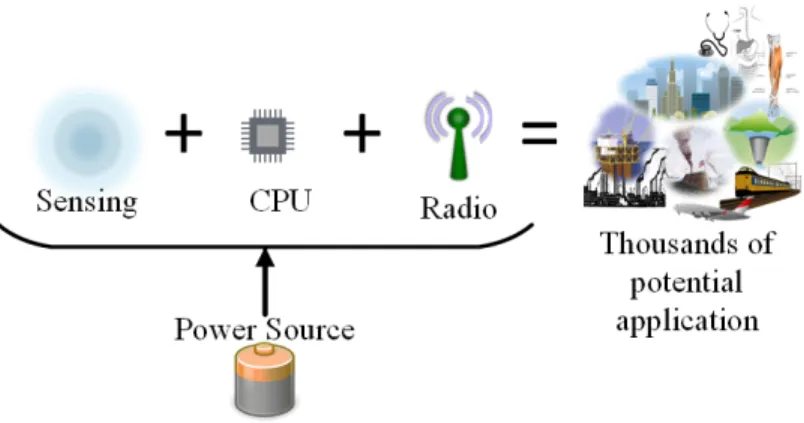
Figure 1.1 Concept of wireless sensor networks based on the equation . . . 1
Figure 3.1 2-state (active and sleep) Markov model. . . 23
Figure 4.1 Illustration of sensing events arrival. Ti is the inter-arrival time between thei-th event and the previous(i−1)-th event;λiis the estimated Poisson arrival rate based onTiwhereλi = 1/Ti. . . 31
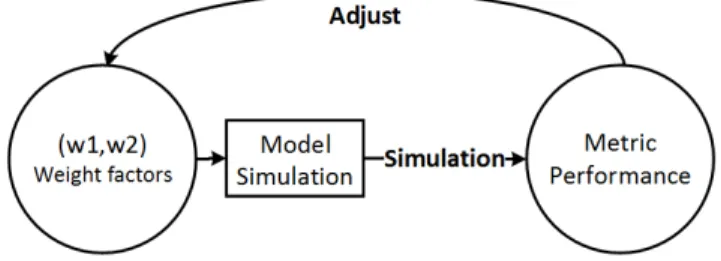
Figure 4.2 Simulation-based framework for designing weight factorsw1andw2based on existence model. . . 36
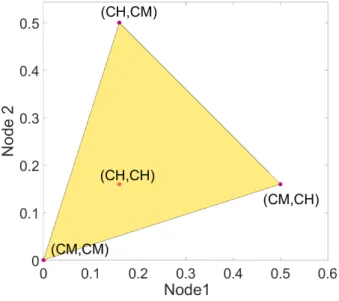
Figure 5.1 Geometrical representation of the set of attainable payoffs under CE for Table 5.5 . . . 69
Figure 6.1 Extensive form of the Attack-Defense game. . . 79
Figure 7.1 Energy consumption vs. sleep times . . . 93
Figure 7.2 Delay vs. sleep times . . . 93
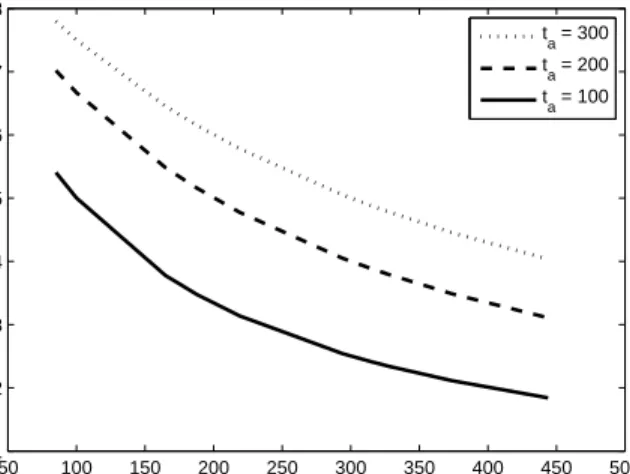
Figure 7.3 Combined utility whenta = 100,ta= 200,ta= 300. . . 94
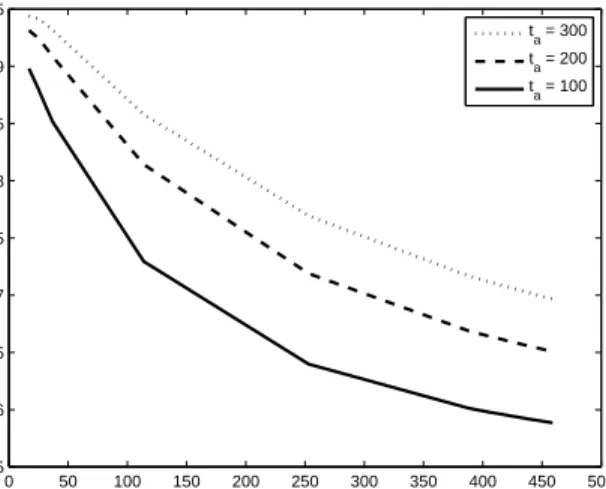
Figure 7.4 Energy consumption forw1 =w2 = 0.5 . . . 94
Figure 7.5 Energy consumption forw1 = 0.9andw2 = 0.1 . . . 94
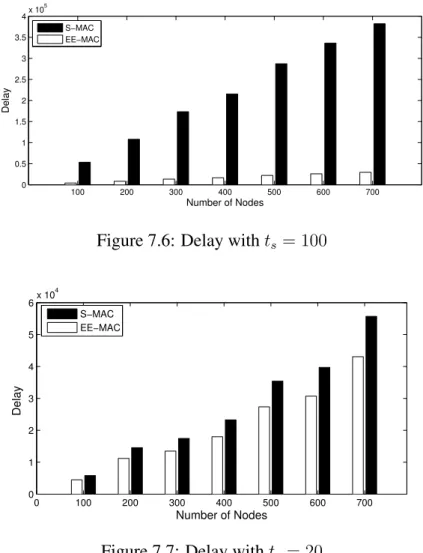
Figure 7.6 Delay withts = 100 . . . 95
Figure 7.7 Delay withts = 20. . . 95
Figure 7.8 Percentage number of nodes that have less than 20% of energy. . . 99
Figure 7.9 Energy Efficiency = ratio of the sum of nodes remaining energy to the sum of nodes initial energy. . . 99
Figure 7.10 Performance of ADP and the base approach in Experiment I.(when the value of fixed sleeping timetsfor base approach is1/λavg.) ADP gains a
high amount of energy saving and keeps latency well below the acceptable latency. In (b), change the middle of the curves refer to the density change of sensing event. . . 100 Figure 7.11 Performance of ADP in Experiment II. (The results similar to Fig. 7.10
when the value of fixed sleeping timets for base approach is1/λhigh
in-stead of 1/λavg (waking up more frequently).) ADP also gains a higher
amount of energy saving. . . 101 Figure 7.12 Performance of ADP in Experiment II. (The results similar to Fig. 7.11
when the value of fixed sleeping timets for base approach is1/λhigh
in-stead of 1/λavg (waking up more frequently).) ADP also gains a higher
amount of energy saving. . . 101 Figure 7.13 Proportion of selecting strategies for both population (i.e.,A& B) when
number of available hops for forwarding is R = 2. (a) Hop selecting probability when the initial probabilities are unequal. (b) Hop selecting probability when the initial probabilities under changing conditions, (i.e., cost of forwarding through hop1higher than hop2at t=350, when initial probabilities are unequal, and (c) when initial probabilities are equal. . . . 103 Figure 7.14 Related Average fitness of selecting strategies in Fig. 7.13 for both
pop-ulation (i.e.,A & B) when number of available hops for forwarding is
R= 2. (a) Average and weighted sum of fitness when the initial probabil-ities are unequal. (b) Related average fitness under changing conditions (i.e., cost of forwarding through hop1higher than hop2at t=35) when ini-tial probabilities are unequal, and (c) when iniini-tial probabilities are equal.
Figure 7.15 Proportion of selecting strategies and related average fitness for both pop-ulation (i.e.,A & B) when number of available hops for forwarding is
R = 3. (a) and (b) Hop selecting probability when under changing con-ditions and initial probabilities are unequal for populationA andB , re-spectively. (b) and (d) Related average. . . 105 Figure 7.16 Proportion of selecting strategies and related Average fitness for both
pop-ulation (i.e.,A & B) when number of available hops for forwarding is
R= 3. (a) and (b) Hop selecting probability when the initial probabilities under changing conditions and initial probabilities are equal for popula-tionAandB, respectively. (b) and (d) Related average. . . 107 Figure 7.17 Proportion of selecting strategies for both population (i.e.,A& B) when
number of available hops for forwarding isR= 4. (a) and (b) Hop select-ing probability for population A andB , respectively. (b) and (d) under changing condition of network (i.e.,t= 45). . . 108 Figure 7.18 Number of nodes that participate in our proposed clustering game (CoPA). 110 Figure 7.19 Average residual energy. . . 110 Figure 7.20 Network Lifetime. . . 111 Figure 7.21 Amount of data sent to Base Station. . . 112 Figure 7.22 Average residual energy and defense success rate when ω is higher than
can and cdn (i.e, ωn > can, cdn, n ∈ {1,2}), and the cost of attack and
defense are equal (i.e.,can =cdn), respectively. . . 114
Figure 7.23 Average residual energy and defense success rate when ω is higher than
can andcdn (i.e,ωn> can, cdn, n∈ {1,2}, andcan < cdn) . . . 114
Figure 7.24 Average residual energy and defense success rate when ω is higher than
Figure 7.25 Average residual energy and defense success rate whenω is significantly higher thancan andcdn(i.e,ωn>> can, cdn, n ∈ {1,2}). . . 116
LIST OF TABLES
Table 4.1 List of Notations . . . 33
Table 5.1 List of Notations and Acronyms . . . 47
Table 5.2 Strategies Competition form of Evolutionary Routing Game (i.e., strate-giessrandst) . . . 48
Table 5.3 Strategies Competition form of Evolutionary Routing Game with Prob-ability Distributionpˆover the Pure Strategies (i.e., strategies sr andst). . . . 51
Table 5.4 Strategic form of 2-player clustering game with strategiesCH andCM. . 62
Table 5.5 An Example of Payoffs Matrix for 2-player . . . 68
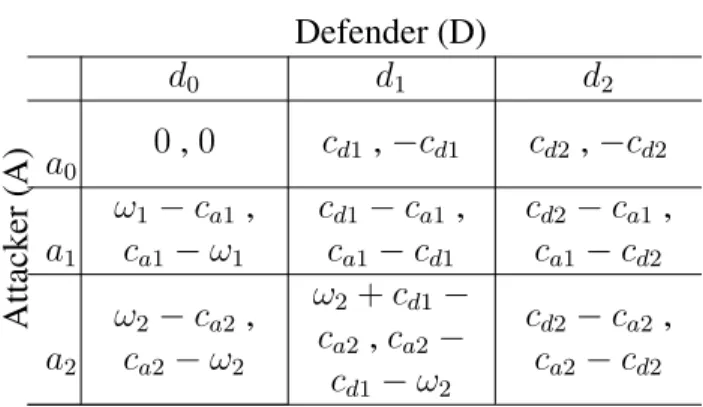
Table 6.1 Strategic form of Attack-Defense security game. . . 78
Table 6.2 Strategic form of the Attack-Defense game with two strategies. . . 82
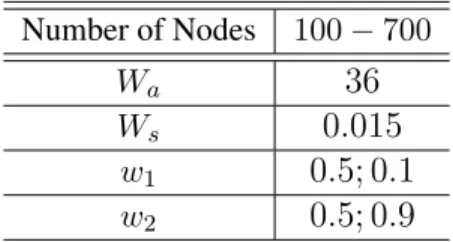
Table 7.1 Simulation Parameters . . . 92
LIST OF ALGORITHMS
Algorithm 4.1 Procedure of proposed adaptive scheduling approach (ADP). . . 35 Algorithm 5.1 Replicator dynamics . . . 57 Algorithm 5.2 Regret-matching (no-regret) learning algorithm . . . 72
CHAPTER 1: INTRODUCTION
A wireless network of sensor nodes is one of the most promising contemporary technolo-gies that unifies the physical and virtual worlds. A wireless sensor network (WSN) is a special network comprised of some autonomous small devices, called sensor nodes, scattered over re-gions of interest in order to monitor the physical conditions of the environments (e.g., temperature, pressure, sound, etc.), and transmit the collected data to a central location.
Wireless sensor networks comprise one of the core next-generation application fields, in-cluding, but not limited to civil engineering, environmental monitoring, medical monitoring, indus-trial automation, home security, military systems, and transportation. A WSN typically consists of a large number of sensor nodes that are capable of sensing and communicating wirelessly to transmit collected sensory data to a destination for future processing. Figure 1.1 uses a simple equation to presents the concept of WSNs [1].
Figure 1.1: Concept of wireless sensor networks based on the equation
The resources of sensor nodes in WSNs are limited in terms of energy, computational capability, communication radius, and storage memory; the nodes operate on battery power and are often deployed in rough environments. Due to the environmental constraints, it is usually
cost-prohibitive or even impossible to replace depleted batteries, and the networks could also become vulnerable to attacks that result in data exposure during transmission. Furthermore, the sensors generally have weak defense capabilities against the network’s attacks/threats. Therefore, energy efficiency and security are critical design goals to prolong the lifetime of a WSN. Consequently, energy efficient and secure mechanisms are employed at various layers of the protocol stack to ensure longevity and trustworthiness of the nodes and the network in general.
1.1 Problem Statement and Motivation
Sensor nodes in wireless networks are responsible for many tasks, such as, sensing events, aggregating data, processing data, and sending and receiving data; some of these data are highly sensitive. Furthermore, a large number of WSNs sensors have unique characteristics, including autonomy, limited energy, constraint processing capability, and contested radio environment that make sensing and communication difficult. These sensors are expected to run autonomously on their battery power for a long period. On the one hand, ensuring security, availability, and con-fidentiality of WSNs data has become critical. Design of sustainable WSNs becomes even more challenging in resource-constrained environments; this implies that a node must effectively utilize its resources, and increase its lifetime by closely monitoring its energy consumption and secu-rity. On the other hand, WSNs are designed for specific applications ranging from small health care systems to large-scale tactical military systems, and have to satisfy a set of specific require-ments that varies from one application to another. In light of these networking constraints, energy efficiency and security has attracted considerable attention from researchers during the past few years [2, 3, 4, 5, 6]. However, there is still more research required to develop energy efficient and secure schemes of the existing algorithms in WSNs.
In a distributed sensor network, the design of the MAC protocol is particularly important because it resolves channel contention among nodes and determines which node should access
the shared channels and for how long. Quality of service provisioning poses additional chal-lenges to the design of MAC protocols as guaranteeing delay requirements and sustaining band-width constraints can be compromised due to increased mutual access interference [7]. MAC protocols developed for WSNs can be broadly classified into two main categories: scheduling-based and contention-scheduling-based. Each protocol is designed for specific topologies or applications [8]. Scheduling-based approaches form schedules, which allow each node in the network to access the channel and communicate with other nodes at predetermined time periods. Therefore, knowl-edge of the network topology is required in these kinds of approaches. The schedule can be ar-ranged according to specific approaches, such as collision avoidance or fairness among nodes. In contention-based approaches, nodes compete for the wireless medium to acquire the access for data transmission.
One of the well-known MAC protocols is S-MAC [9], where nodes periodically sleep and wake-up in order to reduce energy consumption. As events being sensed could be sporadic, sensors do not need to activate their sensing function at all times. Each node turns off its radio for a certain time and then wakes up periodically to check for receptions. These listen and sleep states form a frame. Though listening time is dictated by the limitations of MAC and PHY layers, there are no such restrictions for the sleep time. Thus, the duty-cycle,defined as the ratio of listen interval to frame duration, is small for large sleep time and vice-versa. With events sensed sporadically, it is not necessary that sleep duration intervals remains fixed. In Chapter 3 of this dissertation, we argue that sleep duration intervals should be optimized depending on the frequency of sensed activities.
The design of a WSN depends on the application for which it is being deployed. Among all the aspects of an application, energy efficiency is one of the most critical concerns. Most of the recent WSN studies have focused on how to maximize the lifetime of the system without sacrificing other factors, such as latency and throughput.
In WSN applications, the underlying sensing traffic load can vary during different times of the day, and each node may have different level of participating intensity in activities based
on its location in the system, e.g., whether the node is close to the sink or not. Consequently, different sensor nodes have different levels of energy consumption during sensing and communi-cation activities. The level of energy consumption is one of the most important factors of sensor networks because sensor nodes usually have very limited battery capacity. Dissipation of sensor energy results in quickly diminishing the network lifetime and thus, significantly affects network performance. Sensor sleeping is an effective technique to prolong a network’s lifetime by reducing the energy wasted in idle listening. Scheduling a sensor’s sleep and wake-up cycles can be used in any level of the protocol stack, such as the application layer, network layer, and data link layer. In sleep mode, a node turns off the radio and goes to sleep in order to save energy instead of staying idle.
Optimization method can be conducted either dynamically or statically. Both of the opti-mization methods assist designers in meeting the application requirements: the static optiopti-mization method remains fixed for the WSN’s lifetime and is appropriate for stable environmental events while the dynamic method is appropriate for changing application requirements and real envi-ronmental events. In addition, dynamic methods provide enhanced flexibility and accuracy [10]. Current approaches to sleep and wake-up scheduling are mostly static (i.e., a node always wakes up after a fixed sleep time); this static approach is not efficient for most WSN applications because it does not consider the dynamic occurrence behaviors of most underlying sensing events. Moreover, a static approach does not consider this critical factor: the remaining energy resource of a sensor node. It is intuitively clear that, when a sensor node has limited remaining battery life, it should be more conservative in engaging its wake-up state to report sensing data in order to prolong its lifetime. Therefore, a more energy-efficient sleep and wake-up scheduling scheme should be an intelligent and dynamic approach.
Routing in a WSN is an especially challenging task as it involves energy consumption from all the nodes that lie on a given route for a source-destination pair. Thus, designing routing proto-cols for WSNs requires approaches that extend the network lifetime by utilizing the sensors’
lim-ited battery as efficiently as possible [11]. Because of ever-increasing deployment of customized WSN applications, research is still being conducted that tries to improve network capabilities and to meet the quality-of-service demands for the application in question.
Because it has a significant impact on network performance and energy consumption, con-gestion is one of the vital issues associated with WSNs [12]. While transmitting packets toward their destinations, the nodes of a WSN have multiple paths from which to choose; each path poten-tially can have a different associated cost as per the various routing metrics. Such variation in the cost of energy associated with different routes means that some routes/paths may be more prefer-ablethan others. Therefore, nodes are expected to have a clear preference among a set of available paths. To avoid the overheads of retransmitting dropped packets due to collision, which can cause an additional drain on battery life, every node has an incentive to choose the path with the lowest cost while transmitting packets. When many nodes take this same routing strategy, this rational behavior of sensor nodes will intuitively result in further congestion on the same path and leads to energy depletion of the nodes along that path. A centralized mechanism will balance the traffic load across various paths. However, in the absence of a centralized mechanism, it is challenging to achieve long-term dynamic traffic load balance.
Clustering is a grouping technique that partitions a network into several clusters– each of which has a clusterhead [13]. In WSNs, the selection of clusterheads that use energy efficient clustering algorithms is very crucial as it they affect the lifetime and performance of the network. Typically, a clusterhead is responsible for efficient communication between its cluster members and other clusters. A cluster member communicates with its clusterhead that, in turn, communicates with other clusterheads or the base station (BS)/sink of the network. Thus, the identification of clusterheads must be done in a way that prolongs the lifetime of the entire network and improves the overall scalability of the network. Chapter 5 of this dissertation addresses these routing and clustering challenges.
witnessing an era of unprecedented networking attacks. Ensuring confidentiality, integrity, and availability (CIA) of data, devices, networks, and users has become of utmost and critical impor-tance. This becomes even more challenging in resource-constrained environments, such as WSNs, where energy, computing, and communication resources are strictly limited. The design of ef-fective defense strategies that guard against unauthorized intrusion has been impacted by the fast of adoption of WSN applications. Energy, computing, and communication limitations of WSNs make very challenging the development of security solutions. Typically, most academic research has focused on a static model with a particular attack, or defense of security without consider-ing: (i) the dynamic attack intensity or the dynamic environmental conditions of the system, and (ii) the continuous interactions between the attackers and the defenders that lead to each of them constantly adjusting their attack/defense strategies in order to gain the upper hand. However, in the real world, these two phenomena exist in almost all network security problems. Thus, besides finding a specific defense algorithm, it is equally or even more important to design a dynamic defense system that can adjust its strategies to achieve the best defense performance against in-telligent attackers under varying attack situations. In Chapter 6 of this dissertation, we argue that the dynamic nature of attack intensity, network conditions, and the continuous interaction between attackers and defenders must be considered in order to operate WSNs in a secure way.
Game theory provides many effective tools to model strategic interactions between entities. Numerous areas of research have employed various concepts of a game theoretic approach involv-ing conflict, cooperation, fairness, and competition. Game theory has been applied in different areas of wireless communication for modeling, analyzing, and predicting the rational and selfish behaviors of agents that may or may not be cooperative in nature. Nash equilibrium (NE) is a significantly important solution concept in game theory, describing a steady state condition of the game. Among the various models of computation in game theory, evolutionary game provides a powerful modeling tool to 1) study the behavior of populations and 2) design efficient strategies in communication networks.
Although WSNs have achieved great success in many fields, research on this topic is still far from fully-fledged in terms of both theory and application. More specifically, More specifically, there are many open issues in developing better energy efficient and secure schemes for designing WSNs. Therefore, it is essential to study two of the major issues in WSNs: energy efficiency and security, while at the same time considering the characteristics of the sensor networks. These characteristics give rise to numerous challenges in WSNs developments, which form the motivation of this dissertation. In order to improve the energy efficiency and security designs of WSNs, we based our research around four goals, which we will subsequently highlight. The first goal is to design an energy efficient sensor MAC layer protocol. Designing an adaptive feedback approach for energy-efficient WSNs is the second goal of this dissertation. The third goal is to formulate an evolutionary game theoretic framework and an anti-coordination game for the efficiency of the routing layer, and clustering. The last one is to design an energy efficient defense mechanism to guard against several types of threats to WSNs while considering the limitations of the network resources and the dynamic intensity of attacks.
1.2 Contributions
Motivated by the great potential of designing wireless sensor networks for different applica-tions, as well as the limitations of the current research, we focus on energy efficiency and security research in this dissertation. Specifically, this dissertation addresses the fundamental challenges of designing WSNs. Its major contributions consists of energy efficiency and secure mechanisms that are employed at various layers of the protocol stack in WSNs in order to ensure longevity and trustworthiness of the nodes, and the networks. In addition, we focus on extending the sensor nodes’ lifetimes while, at the same time maintaining the quality of service.
In our first contribution [14], EE-MAC, an Energy Efficient MAC layer protocol with vari-able sleep intervals for WSNs is designed. This work is motivated by the well-known MAC
pro-tocol S-MAC [9], in which nodes sleep in a periodic manner to reduce energy consumption. We compute the duty-cycle usage of EE-MAC and propose the selection of sleep intervals based on a two-state Markov model [15]. We define the duty cycle as the fraction of time a node is active and that is used to define the consumed energy and the incurred delay. As for the objective function, we propose a weighted linear combination of energy and delay after normalization. The objec-tion funcobjec-tion is then minimized to find the optimal value of the sleep time. Through extensive simulations, we show how EE-MAC performs better compared with S-MAC in terms of energy consumption and delay.
We further propose an additional solution for the energy efficiency challenge in WSNs while considering the underlying dynamic traffic load [16]. In this study, we focus on extending the sensor node’s lifetime by saving on energy consumption and keeping latency low. We intro-duce an energy efficient dynamic, and adaptive sensing scheduling approach towards each sensor node’s wake-up/sleep time called ADP. This approach adjusts the optimal sleeping period of each sensor node adaptively according to three feed-back-driven factors: (1) the prediction of the next occurrence time of an underlying sensing event, (2) the sensor node’s residual battery, and (3) the importance of event reporting by this sensor node. Control of a sensor waking up can be internal or external [17]. We follow the internally controlled wake-up policy, wherein the node periodically wakes up (duty- cycling).
Our adaptive feedback approach (ADP) is designed to maximize a network’s lifetime and save on energy consumption by optimizing the duty cycle of the nodes. When the frequency of the sensing traffic is high, the node should be adjusted to wake up more frequently in order to quickly report each sensing event without much latency. When the sensor node has a low battery level, its sleeping time will be adjusted to be longer in order to extend its lifetime. When the sensing event is more critical to report, the node wakes up more frequently in order to reduce the reporting latency. Our simulation experiments showed that ADP could greatly extend a sensor node’s lifetime compared with a well known scheduling base approach [18] without introducing
much latency, which is especially suitable for a scenario when sensing events occur with varying frequency.
Another area of focus in this dissertation involved the clustering and routing layer of the WSNs protocol stack. Although the route selection problem of WSNs is a well-investigated prob-lem, we are motivated to explore further the goal of alleviating energy consumption and reducing collisions through a game theoretic framework. Game theory is a powerful mathematical tool that has been applied to numerous areas of wireless communications for analyzing and predicting the rational and selfish behaviors of various entities– the decisions of which determine the outcome of the game [19].
In this dissertation, we leverage concepts from evolutionary game theory to model the rout-ing decisions in a WSN as a non-cooperative evolutionary game [20]. We demonstrate that usrout-ing the mixed strategy Nash Equilibrium (NE) in our routing game is an evolutionary stable strategy (ESS), where there are no other strategies except this ESS that can dominate the population. The payoff for every node, also referred to a s a player, is determined by the packet transmitting cost, which varies based on the distance between the nodes. In the routing game, choosing the shortest distance between the source and the next neighbor hop is beneficial for each player because the shortest route will consume the least amount of energy for the transmission, thereby increasing the payoff. The players who transmit the packets through the shortest path will gain a higher pay-off (lower cost) compared with the players who transmit through longer paths. However, if every player tries to select the shortest path to the target, it will result in collisions and lead to energy depletion at the nodes. Thus, forwarding the packet through the lowest energy path may not always be optimal way to extend network’s lifetime.
To model the adaptation of the hop selection strategies and to show the behavior of the system over a period of time, we present the replicator dynamics of our game. We study how the sensor nodes improve their strategy selection over time until they converge to an evolutionary stable strategy. Furthermore, once the strategies converge to ESS, the population cannot be invaded
by any other populations of the nodes, and the system will reach stability. The process of selecting the path of transmission for the packets in our routing game continues until the destination node is reached. The objective of the game is to reduce the load and avoid collisions on the most used routes by distributing the data transmission task to all possible routes.
Furthermore, we take a game theoretic approach to devise a clustering algorithm for WSNs. In our approach, the nodes are the players who play the clustering game. We propose a Cost and Payment-based clustering Algorithm (CoPA) where we formalize the profits and losses for each node. Coat and payment-based clustring algorithm divide the responsibility of a clusterhead among the nodes, thereby balancing energy using a weighted metric that combines the transmission power and energy of each node. Our anti-coordination clustering game is formulated for 2 players as well as N players using only local information. We derived the correlated equilibrium (CE) for the clustering game by determining the linear optimization. An adaptive regret matching (no-regret) algorithm is used to guarantee convergence of the probability distribution to the CE. Moreover, we determine the optimality of CE solution for the clustering game, and compared it to the pure and mixed strategy Nash Equilibrium (MSNE) solutions in terms of efficiency and fairness among the nodes. We also evaluated the performance of our clustering algorithm with two popular clustering techniques, and demonstrate that CoPA has superior performance in terms of network lifetime and system throughput.
Finally, we design a network-warfare framework, rooted in game theory, which considers dynamic interactions and evolutions between attackers and defenders. We introduce a novel mech-anism for defending against several types of attacks/threats on WSNs– a hyper defense mechmech-anism that considers the limitation of the resources as well as the security value of the network’s assets. Our models defender responds suitably to attacks by considering the different intensities of at-tacks and the relative cost to launch them. We model the interactions between the attackers and defenders as a network-warfare game; this approach has proven to be a highly efficient mathe-matical method to analyzing and modeling scenarios with conflicting objectives. Furthermore, in
order to control future threats to the model’s security systems, game theory is useful in suggest-ing various probable actions and in predictsuggest-ing their related outcomes. Ultimately, We develop a non-cooperative zero-sum attacker-defender game. We formulate the security game between an attacker and defender to study the dynamic interactions between rational players with conflicting interests. In addition, we create optimal strategies for the defender and the attacker taking into account that they can dynamically choose their strategies in order to maximize their payoff based on cost minimization. Generally speaking, we classified the actions of attacking and defending into three categories: Level Zero, Level One, and Level Two. The attacker can alternate between these three strategies, where level zero represents no attack, level one represents a low intensity of attack, and level two represents a high intensity attack. Likewise, we classified the defender’s actions into three corresponding defense levels. For level zero, the defender decides to not defend at all. The second one is a low level of defense, which may cost some of the resources (i.e., energy, memory space, etc.). The third one is a high level of defense, which requires more computational, battery power, or memory, but results in strong countermeasures against any threats. In practice, the strategies of attackers and defenders for any network security problems could be categorized into more fine-grained levels, but for the sake of clarity and modeling purposes, we believe such a three-level classification of attack or defense is generalized enough and can well represents the majority of attack and defense activities in real practice. Simulation results show that the proposed system achieve a high level of performance compared to two other fixed-strategy defense systems.
1.3 Dissertation Organization
This dissertation is organized as follows: In Chapter 2, we survey and discuss the signif-icant literature review related to our study. In Chapter 3, we present an energy efficient medium access control protocol for distributed wireless sensor networks. Chapter 4 presents a dynamic and adaptive energy efficient approach for sensor networks. Two energy-efficient routing, and
cluster-ing algorithms based on game theory in WSNs are proposed in Chapter 5. In Chapter 6, we present a game theoretic approach to modeling WSNs attack and defense strategies. Finally, Chapter 7 presents the simulation models and results. Conclusions and future works are drawn in Chapter 8.
CHAPTER 2: LITERATURE REVIEW
In this chapter, a review of the relevant literature is surveyed to discuss and analyze the research that has been done in this area, and determine the status of our current research within the large paradigm of wireless sensor networks (WSNs) communication. We introduce the literature pertaining to the energy efficient design in the medium access control layer, the feedback approach design in any layers of the protocol stacks by utilizing sleeping technique, the energy efficient design in the routing layer, and secure design in WSNs under game theoretic frameworks.
2.1 Medium Access Control (MAC) in WSNs
There is a rich literature on energy efficient MAC protocols in WSNs [21]. The proposed protocols focus on reducing all sources of wasted energy such as idle listing or overhearing. Col-lisions also waste energy due to the extra transmissions needed to handle the discarded packets. Control packet overhead can consume extra energy by the unnecessary transition unless designed according to the network requirements.
Ye et al. [9] proposed S-MAC, a contention-based MAC protocol for WSNs. S-MAC establishes low-duty-cycle operation to reduce energy consumption on the sensor nodes by period-ically putting nodes into sleep and active states. Nodes coordinate their sleep schedules rather than having random sleep periods. Each node chooses a schedule and exchanges it with its neighbors before starting its low-duty-cycle operation. The node select its time schedule randomly if it does not hear any a schedule from another node. Then, the node broadcasts its schedule in a SYNC message and the node receiving the schedule sets up the same schedule. T-MAC by van Dam and Koe [22] performs better than S-MAC in terms of traffic load. The active period in T-MAC ends when no activation occurs for a certain time. This can be advantageous for energy consumption but it affects the channel throughput [8]. ADC-SMAC by Hu et al. [23] is another improved version of
S-MAC, designed specifically for the chain and cross topologies. ADC-SMAC adjusts duty cycle dynamically based on average sleeping delay, the upper and lower bound cycles.
QA-MAC by Gao [24], which is also based on S-MAC protocol, improves energy effi-ciency by coordinating the contention window dynamically. AsyMAC by Wang et al. [25, 26] is designed for wireless networks with asymmetric links. AsyMAC uses a set of concepts and metrics characterizing the ability of MAC to silence nodes which could cause collisions. Adap-tive Coordinated Medium Access Control (AC-MAC) protocol proposed by Ai et al. [27] is a contention-based MAC protocol for WSNs. AC-MAC introduces adaptive duty cycle technique that depends on the different loads of traffic and provides optimized trade-off strategies for energy, throughput and latency.
DCMAC by Zheng et al. [28] uses a dynamic duty cycle with dynamic sleeping intervals and a fixed listening interval. DCMAC reduces energy consumption and the latency by utilizing the cooperation of the dual channel and the selection strategy for candidate nodes. Cho and Bahk [29] use a multi-hop data packet in a single duty-cycle in Hop Extended MAC (HE-MAC) to set up the path for multi-hop transmission. This approach also utilizes a state to extend the relay of the packet beyond the start of the sleep period. The multi-token based MAC protocol with sleep scheduling for WSNs [30] by Dash et al. aims to improve energy efficiency along with faster data transmission, data aggregation, data accuracy and low latency in hop-by-hop delivery. The limitation of this protocol is the high latency for finding a new neighbor. E-BMA by Shafiullah et al. [31] is proposed to achieve energy efficiency for wireless data communication networks with low and medium traffic. Sender-centric MAC (SC-MAC) by Liu et al. [32] is an asynchronous duty cycling MAC protocol designed for bursty traffic loads. SC-MAC provides a collision free environment without additional overhead. A latency optimization mechanism is also introduced by SC-MAC for multi-hop networks.
Liu and Yao [33] propose An Appointment Based MAC Protocol (AB-MAC), which also improves the asynchronous duty cycle and overcomes the effect of channel contention of multiple
senders. AB-MAC utilizes a fusion appointment scheme to enable scheduled batch transmission for multiple senders with low overhead to improve the transmission efficiency, latency and energy efficiency in many-to-one traffic patterns.
2.2 Sleeping Techniques in any Layers of the Protocol Stack
Most WSN’s protocols have been based on application requirements. Recently, researchers have been using sleeping techniques to reduce energy consumption in all layers of the protocol stack in WSNs [17]. Previous works have shown a broad range of the use of sleeping techniques in different categories. Sleeping techniques can be divided into scheduled wake-up, radio controlled wake-up, and environmentally controlled wake-up. Scheduled wake-up is divided based on time synchronization, where it could be synchronous or asynchronous duty cycling [17] [34].
(here!) ER-MAC [35] is a TDMA based MAC protocol that selects sleep and wake sched-ules based on a node’s criticality, letting the more critical nodes sleep longer. As some studies shown, sleeping techniques can also save energy in routing protocols [17]. [36] proposed a sleep-ing multipath routsleep-ing approach that can be applied to any routsleep-ing protocol by selectsleep-ing the mini-mum number of disjoint paths to meet reliability demands and by turning off the rest of the sensor nodes. GTC (Geographical Topology Control protocol) [37] extends the network’s lifetime by dividing the network into zones and selecting one active node in each zone.
Sensors have two major operations: sensing and forwarding data [38]. In our dissertation, we focused on producing an energy-efficient way to sense an event based on the feedback infor-mation. Other researches, such as PW-MAC [39], focus on the forwarding and transmission of sensed data. PW-MAC [39] is an energy-efficient predictive wakeup MAC protocol that enables senders to accurately predict receivers wake-up times. This protocol minimized idle listing and overhearing by enabling a sender to rendezvous with a receiver quickly according to the predicted receiver wake-up time. It may be beneficial to combine PW-MAC techniques and our proposed
approach to have a complete energy efficient scheduling system.
2.3 Routing and Clustering in WSNs under Game Theoretic Framework
In this section, some of the literature pertaining to the routing and clustering in WSNs is provided as well as applications of some game theoretic solution concepts in the context of communication networks.
2.3.1 Optimal Route in WSNs
Finding optimal routes is one of the most interesting research topics in communication networks. Various research tools have been proposed to investigate this issue, including game theory. Game theoretic techniques have been applied to numerous areas of wireless communication for analyzing and predicting the rational behaviors of agents that have also proven very useful in the design of WSNs [40]- [41]. Important and essential issues in WSNs, including routing protocol design, energy saving, packet forwarding, security, and other sensor management tasks, have been modeled and described by game theoretic approaches for efficient solutions that maximize network lifetime. In one of our publications [20], we present a game theoretic model with utility functions that consider forwarding and routing in the presence of adversaries.
The pricing and payment model is presented as a cooperative game in [42]. The goal of the game is to find an optimal path in a WSN by considering reliability, energy, and traffic load, where the nodes have incentives to cooperate in the game. Buttyan and Hubaux [43] proposed Nuglets, which is virtual currency in the system, to stimulate the cooperation of the nodes participating in forwarding packets in mobile ad hoc networks. Furthermore, a reliable length-energy constrained routing scheme in WSNs has been presented in [44], where a game-theoretic approach is utilized. In this approach, sensors cooperate as rational agents in order to find the optimal route and max-imize their payoffs in the game. Two different possible payoff models and utility functions were
illustrated.
The issue of energy efficiency in WSNs has been addressed in [45]. It provides a game theoretic adaptive algorithm in order to manage sensor behavior for achieving complete decentral-ized control in an energy-constrained sensor network. Evolutionary game theory has emerged as a robust tool to investigate and solve dynamic networking issues. An evolutionary game theory was applied in [46] where the authors proposed a three-dimensional game theoretic energy bal-ance (3D-GTEB) routing protocol to enhbal-ance routing decisions and to decrease the overhead in a WSN. They addressed the unbalanced energy consumption problem by applying evolutionary and classical game theory at two levels of game theoretic decision-making. The two levels were called wedge level energy balance and node level energy balance. In this dissertation, we formulated this routing problem by utilizing an evolutionary game to study the behavior of the population and induce equilibrium even under dynamic WSN conditions.
In [47], a joint duty cycle scheduling and energy aware routing approach (DREG) is pre-sented based on evolutionary game theory. The proposed solution for this game is evolutionary equilibrium. The authors aimed to prolong the network lifetime in WSNs by finding an optimal wakeup/sleep scheduling policy, based on a trade-off between network throughput and energy effi-ciency for each sensor. The issues of duty-cycle scheduling and energy conservation are modeled as a multi-agent non-cooperative game, and the game is repeated until a steady state is reached. Authors of [48] have also applied evolutionary game theory to solve the routing problem in a gen-eral network topology. The authors also considered the link costs that are linear in the link flow.
Furthermore, authors of [49] model evolutionary game design to study the dynamic cooper-ative behavior of selfish nodes under AODV routing. In this game, packet-forwarding is repeated, and includes two distinct modes, in order to learn and predict neighbors’ node behavior to improve network performance. The first mode is deterministic, analyzing the behavior of the network for standard strategic patterns. Random mode is the second mode that applies a genetic algorithm to predict the best strategy randomly. Proposed in [50] is an adaptive and distributed routing
al-gorithm for correlated data that gathers and exploits the data correlation between nodes based on a game theoretic framework.Specifically, the issue of effective energy minimization is addressed and a routing solution is presented. The energy metric, interference awareness and opportunity for multi-hop partial data aggregation are considered. The authors formulate the game by incor-porating a general multi-hop data aggregation model into the problem definition to describe data reduction in a congestion game.
A reliable delivery routing issue in WSNs is addressed in [51] through the game theoretic framework. The authors aim to ensure stable cooperation among nodes for delivering the packet while at the same time minimizing the routing costs. The proposed reliable coalition formation routing protocol (RCFR) is presented using coalitional game theory, which selects the route ac-cording to the principle of lowest cost. In order to introduce a fair allocation method for payoff division, a characteristic function is designed by leveraging performance metrics. RCFR protocol is elaborated by extending the AODV protocol, where the path with the lowest cost will be se-lected to transmit packets, and route maintenance is achieved by adding route residual energy ratio monitoring.
In our dissertation, we provide a game theoretic model, with utility functions, considering forwarding and routing. We leveraged concepts from evolutionary game theory and modeled the routing decisions in a WSN as an anti-coordination evolutionary game. We generated detailed analysis of the system’s stability and fairness of the solution as well. The payoff for every node, also referred to as a player, was determined by the packet transmitting cost, which depends on the distance between the nodes. We studied the behavior of the population and induce equilibrium even under dynamic network conditions [52].
2.3.2 Clustering in WSNs
Clustering in WSNs is an interesting topic especially when it is studied under the game theoretic framework. Various clustering algorithms have been proposed such as the well-known
LEACH [53] where the mechanism of selecting a clusterhead to ensures rotation of the roles be-tween the nodes in a probabilistic manner. Weighted clustering algorithm (WCA) [54] is another clustering scheme that considers several metrics, including ideal degree, transmission power, mo-bility, and battery power of the nodes. This algorithm can be optimized according to the particular needs of the applications and adapt itself with changing topology of the network. Also, the algo-rithm distributes the load as much as possible between the nodes, and it executes only on-demand, instead of periodically.
In [55], the authors proposed an energy-efficient adaptive alustering hierarchy routing algo-rithm based on game theory. The clusterhead selection is centralized and decided by the sink based on the locations and remaining energy of the nodes. The authors show that the algorithm is suitable for the statically distributed WSNs and is more energy-efficient than a random one. However, no theoretical analysis has been provided besides the centralized selection mechanism that could lead to higher energy consumption.
In CROSS [13] (Clustered Routing for Selfish Sensors), each sensor behaves selfishly in a non-cooperative manner in order to conserve its energy. The authors provided the pure and mixed strategy NE and the related expected payoffs of the games. The possibility of clusterhead absence could occur continuously because of the dependency on selecting the clusterheads based on each node’s probability. In [56], the authors proposed a clustering algorithm based on game theory for energy efficiency in WSNs. The probability that a node serves as a clusterhead depends on the energy model. Furthermore, a game theory based energy efficient CH selection approach is proposed in [57] based on the Subgame Perfect NE (SPNE). The clusterheads are selected based on SPNE decision.
In our dissertation, we attempted to provide a new solution from a game theory prescriptive for clustering in WSNs. To that end, we studied the correlated equilibrium and its properties. The CE achieves a strictly better performance compared to the NE and therefore maximizes the network lifetime and throughput [58].
2.4 Security in WSNs under Game Theoretic Framework
Security under a game theoretic framework is an interesting topic, where several proba-ble actions along with the predicted outcome can be suggested through game theoretic methods in order to control future threats. Game theory is suitable for modeling various issues and has been successfully used in cyber security, including communication networks [59] [6] [60]. Vari-ous issues in security and privacy in networking and mobile application have been addressed and modeled through game theoretic frameworks [61].
In [62], the author addresses the issue of defending against denial-of-service (DoS) at-tacks in the network and proposes a puzzle-based defense solution that can be distributed or non-distributed using the concept of Nash equilibrium. A non-non-distributed DoS attack and the puzzle-based defense were modeled as a two-player infinitely repeated game of discounted payoffs and an optimal defense strategy that would be gained for the service provider. The defense strategy is de-termined by the difficulty of the puzzle level. A distributed DoS attack is considered a two-player stochastic game as well, and the solution is based on the non-distributed DoS solution.
The authors of [63] propose a Bayesian game approach for intrusion detection in wireless ad hoc networks to analyze the interactions between pairs of attacking and defending nodes. The concept of Nash equilibrium is utilized in both static and dynamic scenarios. A player can be either a malicious or regular node. A defending node can choose to a monitor or not monitor, whereas a malicious node can employ the attack or not attack strategy. Two methods are proposed to reduce the resource consumption. The first method is adopting a probability of defending when there is a sign of attack. The second one is employing two different monitors (i.e., lightweight and heavyweight monitors).
In [64], a secure routing protocol is proposed by modeling the interaction of nodes in WSN and intrusion detection system as a Bayesian game formulation. In the game, at least one player has incomplete information about the other players, and each node/player has a reputation score. The
selfish nodes can cooperate by sending the packets (to avoid detection) or dropping packets, and malicious nodes are then eliminated from the network. Therefore, the nodes are motivated to act rationally and gain the score of reputation through this approach. Two Bayesian Nash equilibriums are provided to detect selfish nodes or to force selfish nodes to cooperate.
Unlike most security mechanisms that focus on a particular attack or defense, we provide in this dissertation a dynamic defense system that considers variations in the intensity of attack and defense [65].
CHAPTER 3: EE-MAC: AN ENERGY EFFICIENT SENSOR MAC
LAYER PROTOCOL
3.1 Overview
Energy efficiency is of utmost importance for wireless sensor networks deployed without any possibility of battery replenishment. In this chapter, we propose an Energy Efficient Medium Access Control protocol (EE-MAC) for wireless sensor networks, which achieve a low-duty-cycle and low energy consumption through optimized sleep intervals based on a 2-state Markov model. The duty cycle is defined as the fraction of time a node is active. Energy consumption, and the incurred delay when the node switch between sleep and active states, are defined as well. We formulate a weighted linear combination in order to find the optimal sleep time for each node.
The rest of the chapter is structured as follows: Section 3.2 describes details of the proposed EE-MAC protocol, and section 3.3 provides a summary of the chapter.
3.2 EE-MAC Protocol
The main goal of EE-MAC is to reduce energy consumption and to optimize delay per-formance. This goal is achieved by determining the optimal value of the sleep interval based on prevailing conditions. EE-MAC changes the state of each node between sleep and active. During the sleep state, a node’s radio is turned off which decreases the power consumption. During the active state, the node wakes up and listens, receives, or transmits data. As a result, the consumed power increases.
3.2.1 State Model
The node activities in EE-MAC can be represented using the Gilbert-Elliott model [15] [66]. This 2-state Markov model is shown in Fig. 3.1 where transitions from ‘sleep’ state to ‘active’ state
occurs with probability Psa. Similarly, transitions from ‘active’ state to ‘sleep’ state occurs with
probabilityPas. Transitions from each state to itself is also shown. Thus, the probability of being
in the active state is:
Pa=Psa+Paa.
Similarly, the probability of being in the sleep state is:
Ps =Pas+Pss.
It is to be noted that we do not treat receiving, transmitting, and listening as different states as they are included in the ‘active’ state.
as P
P sa
Pss Sleep Active Paa
Figure 3.1: 2-state (active and sleep) Markov model.
It is assumed that the active times and sleep times are exponentially distributed. Let us defineta as the average time a node spends in the active state. Similarly,ts is the average time a
node spends in the sleep state. Thus, we can define the duty cycle of the node as:
ρ= ta
ta+ts
3.2.2 Energy and Delay
Although it is desirable to have a low duty cycle, it compromises the delay performance. For instance, if a node sleeps while there is data transmission to it, the node will incur some delay in its response, which increases as the sleep times become longer. Thus, while optimizing the sleep intervals, the deterioration in the delay response must be taken into account. Given different energy consumptions of two states, we define the total energy consumed per unit time per node, E, as follows:
E =EActive+ESleep (3.1)
whereEActiveis the average energy consumed per unit time in active state andESleepis the average
energy consumed per unit time in sleep state. IfWaandWsare the energy consumed per unit time
during the active and sleep states respectively, thenEActive =ρWaandESleep= (1−ρ)Ws. Thus,
the total consumed energy is defined as follows:
E =ρWa+ (1−ρ)Ws (3.2)
For a sleeping node, the expected time to wake ists, irrespective of the time it has been
sleeping. This is a result of the assumption of exponential sleep time distribution, hence memory-less. Thus, delay can be defined asD=ts.
3.2.3 Normalization of Energy and Delay
To include both energyE and delayDin a combined metric, we must normalize them in a way so that they map to a number between 0 and 1. If we assumemax(Wa, Ws) =Waas energy
spent in active mode is more than the energy spent in the sleep mode, then the maximum value for
normalized energy,Enorm, as:
Enorm =
ρWa+ (1−ρ)Ws
Wa
(3.3)
Similarly, we seek a function forD such that whents → 0,D → 0and whents → ∞,D → 1.
We define the normalized delay,Dnorm, asDnorm = 1− t1s.
3.2.4 Combined Metric
We define the combined metric as a linear combination ofEnormandDnorm as:
U =w1×Enorm+w2×Dnorm (3.4)
wherew1andw2 are the corresponding weighing factors andw1+w2 = 1.
We seek to find the value of ts for which U will be minimized. Thus, we take partial
derivatives and equate to 0. Thus,
∂U ∂ts = ∂Enorm ∂ts + ∂Dnorm ∂ts = 0 (3.5)
Solving equation (3.5), we get
ts= s
w1Wata−w2Wa
Wsw1ta
(3.6)
Forts to have a real value,w1 ta≥w2.
3.3 Summary
Achieving energy efficiency in WSNs is of utmost importance. Since sensor nodes con-sume more power while sensing and transmitting compared to idle time, achieving a low duty
cycle improves the performance in terms of energy consumption. We achieve this goal by putting nodes to sleep at the cost of degraded delay performance. We presented energy efficient medium access control layer protocol, Energy Efficient MAC layer protocol, called EE-MAC. We derived the energy consumption and the incurred delay when the node switches between the two states (i.e.,sleep and an active state). We also proposed a combined metric which is a linear sum of the two and find the optimal sleep time.
CHAPTER 4: ADP: AN ADAPTIVE FEEDBACK APPROACH FOR
ENERGY-EFFICIENT WSNs
4.1 Overview
Numerous design of WSNs has been considered in order to satisfy the requirements of real-world applications. One of the most common approaches for energy conservation is to alternate each sensor node between sleep and wake-up states in order to address the challenges aspect of protocols design: limited battery power in the sensor nodes. In this chapter, ADP is proposed as ADaPtive energy efficient approach that meets the requirement of low energy consumption and, at the same time, considers the underlying dynamic traffic load. ADP enhances energy efficiency by dynamically adjusting sensor nodes’ sleep and wake-up cycles. ADP thereby utilizing a cost function to strike a balance between the conflicting goals of conserving energy (waking up as rarely as possible) and minimizing sensed events’ reporting latency (waking up as frequently as possible), simultaneously. It also constantly monitors and provides feedback concerning the residual energy level and the importance of the event to be reported, as well as predicting the next sensing event occurrence time.
The rest of this chapter is structured as follows: Section 4.2 highlights the motivation for the proposed idea. In section 4.3, we present the ADP approach. Section 4.4 is a further detailed discussion. Finally, we summarize the chapter in section 4.5.
4.2 Motivation for the Proposed Idea
In all layers of the protocol stack in wireless sensor networks, sleeping techniques for re-ducing energy consumption have been used by researchers to satisfy the application requirements of the protocols design [17]. Sensors have two major operations: sensing and forwarding data [38]. In this chapter, we focus on producing an adaptive and energy-efficient scheduling approach for
sensors to sense and report events. It can be readily combined with many previous developed sys-tems that focus on energy-efficient data forwarding in order to have a completely energy efficient scheduling system that covers both data sensing and data forwarding operations of sensors. Com-pared with a well-known scheduling base approach [18], our simulation experiments show that ADP can extend a sensor node’s lifetime without introducing much latency, an especially suitable for a scenario since sensing events can occur with varying frequency. Our approach can be used on different scenarios of underlying sensing events. Other research studies, such as [39], has focused on the forwarding and transmission of sensed data. Part of our research puts forth a new dynamic and adaptive scheduling approach that aims to adjust the optimal sleeping period of each sensor node adaptively according to the following: the importance of reporting an event for this sensor node, the prediction of the next occurrence time of an underlying sensing event, and the sensor node’s residual battery. The ADaPtive energy approach (ADP) is designed to maximize network lifetime and save on energy consumption by optimizing the duty cycle of the node. The node should be adjusted to wake-up more frequently when it senses traffic is high in order to quickly re-port each sensing event without much latency. In order to extend its lifetime, the sensors’ sleeping time will be adjusted when the sensor node has a low battery level. Conversely, the node should wake-up more frequently when the sensing event is more critical, thereby reducing the reporting latency.
4.3 Proposed ADP Approach
4.3.1 Wake-up Technique
Waking a node up and putting it to sleep periodically instead of keeping the node awake all the time saves significant amount of energy. A periodical scheduling technique could be synchro-nized, where all the nodes will adjust to the periodic wake-up time synchronously. On the other hand, the scheduling technique could be asynchronous, where each node’s wake-up time does not