Exact Decoding with Multi Bottom-Up Tree Transducers
∗Daniel Quernheim
Institut f¨ur Maschinelle Sprachverarbeitung University of Stuttgart
Abstract
We present an experimental statistical tree-to-tree machine translation system based on the multi-bottom up tree trans-ducer including rule extraction, tuning and decoding. Thanks to input parse forests and a “no pruning” strategy during decod-ing, the obtained translations are compet-itive. The drawbacks are a restricted cov-erage of 70% on test data, in part due to exact input parse tree matching, and a rel-atively high runtime. Advantages include easy redecoding with a different weight vector, since the full translation forests can be stored after the first decoding pass. 1 Introduction
In this contribution, we present an implementation of a translation model that is based on`-XMBOT (the multi bottom-up tree transducer of Arnold and Dauchet (1982) and Lilin (1978)).1 Intuitively, an MBOT is a synchronous tree sequence substitution grammar (STSSG, Zhang et al. (2008a); Zhang et al. (2008b); Sun et al. (2009)) that has discon-tiguities only on the target side (Maletti, 2011). From an algorithmic point of view, this makes the MBOT more appealing than STSSG as demon-strated by Maletti (2010). Formally, MBOT is expressive enough to express all sensible trans-lations (Maletti, 2012)2. Figure 2 displays sam-ple rules of the MBOT variant, called`-XMBOT,
∗
This work was supported by Deutsche Forschungsge-meinschaft grant MA/4959/1–1.
1The system presented in this paper is variant of the
sys-tem presented at last year’s workshop (Quernheim and Cap, 2014), without morphological enhancements.
2A translation is sensible if it is of linear size increase
and can be computed by some (potentially copying) top-down tree transducer.
that we use (in a graphical representation of the trees and the alignment). Recently, a shallow ver-sion of MBOT has been integrated into the popular Moses toolkit (Braune et al., 2013). Our imple-mentation is exact in the sense that it does abso-lutely no pruning during decoding and thus pre-serves all translation candidates, while having no mechanism to handle unknown structures. (We added dummy rules that leave unseen lexical ma-terial untranslated.) The coverage is thus limited, but still considerably high. Source-side and target-side syntax restrict the search space so that decod-ing stays tractable. Only the language model scor-ing is implemented as a separate reranker. This has several advantages: (1) We can use input parse forests (Liu et al., 2009). (2) Not only is the out-put optimal with regard to the theoretical model, also the space of translation candidates can be ef-ficiently stored as a weighted regular tree gram-mar. The best translations can then be extracted using the k-best algorithm by Huang and Chiang (2005). Rule weights can be changed without the need for explicit redecoding, the parameters of the log-linear model can be changed, and even new features can be added. These properties are espe-cially helpful in tuning, where only the k-best al-gorithm has to be re-run in each iteration. A model in similar spirit has been described by Huang et al. (2006); however, it used target syntax only (using a top-down tree-to-string transducer backwards), and was restricted to sentences of length at most 25. We do not make such restrictions.
The theoretical aspects of `-XMBOT and their use in our translation model are presented in Sec-tion 2. Based on this, we implemented a machine translation system that we are going to make avail-able to the public. Section 4 presents the most im-portant components of our`-XMBOT
tation, and Section 5 presents our submission to the WMT15 shared translation task.
2 Theoretical Model
In this section, we present the theoretical genera-tive model that is used in our approach to syntax-based machine translation: the multi bottom-up tree transducer (Maletti, 2011). It is a variant of the linear and nondeleting extended multi bottom-up tree transducers without states. We omit the technical details and give graphical examples only to illustrate how the device works, but refer to the literature for the theoretical background. Roughly speaking, a local multi bottom-up tree transducer (`MBOT) has rules that replace one nonterminal symbolN on the source side by a tree, and a se-quence of nonterminal symbols on the target side linked to N by one tree each. These trees again have linked nonterminals, thus allowing further rule applications.
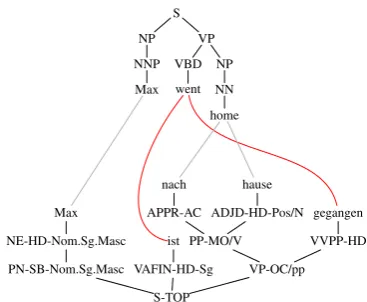
Our `MBOT rules are obtained automatically from data like that in Figure 1. Thus, we (word) align the bilingual text and parse it in both the source and the target language. In this manner we obtain sentence pairs like the one shown in Fig-ure 1. To these sentence pairs we apply the rule extraction method of Maletti (2011). The rules extracted from the sentence pair of Figure 1 are shown in Figure 2. Note the discontiguous align-ment ofwenttoistandgegangen, resulting in dis-contiguous rules.
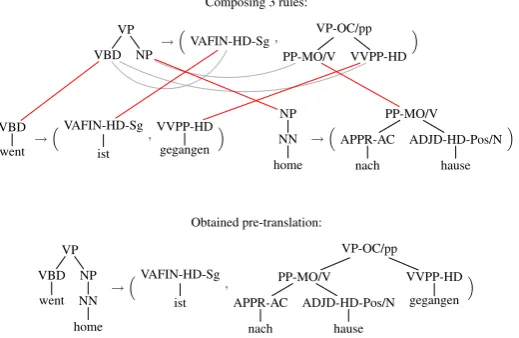
The application of those rules is illustrated in Figure 3 (apre-translationis a pair consisting of a source tree and a sequence of target trees). While it shows a synchronous derivation, our main use case of`MBOT rules isforward applicationor in-put restriction, that is the calculation of all target trees that can be derived given a source tree. For a given synchronous derivationd, the source tree generated bydiss(d), and the target tree ist(d). The yield of a tree is the string obtained by con-catenating its leaves.
The theoretical justification for decomposing the translation model into a source model and a target model is a theorem that states that every `MBOT can be replaced by a composition of a linear nondeleting extended top-down tree trans-ducer (XTOP) and a linear homomorphic MBOT (Engelfriet et al., 2009). We implemented the first step of the composition as an XTOP that gener-ates possible derivation trees. Stgener-ates in this
de-vice are linked nonterminals in the`MBOT rules, and it translates left-hand sides into rule identi-fiers. The second step is implemented as a homo-morphic multi bottom-up tree transducer. While we construct the first step of the composition ex-plicitly, we only use the second device to evaluate single trees.
Apart from `MBOT application to input trees, we can even apply `MBOT to parse forests and even weighted regular tree grammars (RTGs) (F¨ul¨op and Vogler, 2009). RTGs offer an ef-ficient representation of weighted forests, which are sets of trees such that each individual tree is equipped with a weight. This representation is even more efficient than packed forests (Mi et al., 2008) and moreover can represent an infinite num-ber of weighted trees. The most important prop-erty that we utilize is that the output tree language is regular, so we can represent it by an RTG (cf. preservation of regularity (Maletti, 2011)). In-deed, every input tree can only be transformed into finitely many output trees by our model, so for a given finite input forest (which the output of the parser is) the computed output forest will also be finite and thus regular.
3 Translation Model
Given a source language sentence e and corre-sponding weighted parse forest F(e), our trans-lation model aims to find the best corresponding target language translationg;ˆ3i.e.,
ˆ
g= arg maxgp(g|e) .
We estimate the probabilityp(g|e)through a log-linear combination of component models with pa-rametersλm scored on the derivationsdsuch that
the source trees(d)ofdis in the parse forest ofe and the yield of the target treet(d)readsg. With D(e, g) ={d|s(d)∈F(e)and yield(t(d)) =g}, we thus have:4
p(g|e)∝ X d∈D(e,g)
11
Y
m=1
hm(d)λm
Our model uses the following featureshm(·)for a
derivation:
3Our main translation direction is English to German. 4While this is the clean theoretical formulation, we make
S NP NNP Max
VP VBD went
NP NN home
S-TOP PN-SB-Nom.Sg.Masc NE-HD-Nom.Sg.Masc
Max
VAFIN-HD-Sg ist
VP-OC/pp PP-MO/V APPR-AC
nach
ADJD-HD-Pos/N hause
[image:3.595.205.389.59.210.2]VVPP-HD gegangen
Figure 1: Aligned parsed sentences.
NP NNP Max
→
PN-SB-Nom.Sg.Masc NE-HD-Nom.Sg.Masc
Max
VBD
went →
VAFIN-HD-Sg
ist
,VVPP-HD
gegangen
NP
NN home
→
PP-MO/V APPR-AC
nach
ADJD-HD-Pos/N hause
VP
VBD NP →
VAFIN-HD-Sg, VP-OC/pp
PP-MO/V VVPP-HD
S
NP VP →
S-TOP
PN-SB-Nom.Sg.Masc VAFIN-HD-Sg VP-OC/pp
Figure 2: Extracted rules.
(1) Translation weight normalized by source root symbol
(2) Translation weight normalized by all root symbols
(3) Lexical translation weight source→target (4) Lexical translation weight target→source (5) Target side language model:p(g)
(6) Input parse tree probability assigned tos(t)by the parser ofe
The rule weights required for (1) are relative frequencies normalized over all extracted rules with the same root symbol on the left-hand side. In the same fashion the rule weights required for (2) are relative frequencies normalized over all rules with the same root symbols on both sides. The lexical weights for (3) and (4) are obtained by mul-tiplying the word translations w(gi|ej)
[respec-tively,w(ej|gi)] of lexically aligned words(gi, ej)
across (possibly discontiguous) target side se-quences.5 Whenever a source word ej is aligned to multiple target words, we average over the word
5The lexical alignments are different from the links used
to link nonterminals.
translations:6
h3(d)
= Y
lexical item
eoccurs ins(d)
average{w(g|e)|galigned toe}
4 Implementation
Our implementation is very close to the theoretical model and consists of several independent compo-nents, most of which are implemented in Python. The system does not have any dependencies other than the need for parsers for the source and target language, a word alignment tool and optionally an implementation of some tuning algorithm.
Rule extraction From a parallel corpus of which both halves have been parsed and word aligned, multi bottom-up tree transducer rules are extracted according to the procedure laid out in (Maletti, 2011). In order to handle unknown words, we add dummy identity translation rules for lexical material that was not present in the training data.
6If the worde
jhas no alignment to a target word, then
VP
VBD NP →
VAFIN-HD-Sg, VP-OC/pp
PP-MO/V VVPP-HD
VBD
went →
VAFIN-HD-Sg
ist
,VVPP-HD
gegangen
NP
NN home
→
PP-MO/V APPR-AC
nach
ADJD-HD-Pos/N hause
Obtained pre-translation: VP
VBD went
NP NN home
→VAFIN-HD-Sg
ist ,
VP-OC/pp PP-MO/V APPR-AC
nach
ADJD-HD-Pos/N hause
VVPP-HD gegangen
[image:4.595.170.430.65.234.2]
Figure 3: Synchronous rule application.
Translation model building Given a set of rules, translation weights (see above) are com-puted for each unique rule. The translation model is then converted into a source, a weight and a tar-get model. The source model (an RTG represented in an efficient binary format) is used for decod-ing and maps input trees to trees over rule iden-tifiers representing derivations. The weight model and the target model can be used to reconstruct the weight and the target realization of a given deriva-tion.
Decoder For every input sentence, the decoder transforms a forest of parse trees to a forest of translation derivations by means of forward appli-cation. These derivations are trees over the set of rules (represented by rule identifiers). One of the most useful aspects of our model is the fact that de-coding is completely independent of the weights, as no pruning is performed and all translation candidates are preserved in the translation forest. Thus, even after decoding, the weight model can be changed, augmented by new features, etc.; even the target model can be changed, e.g. to support parse tree output instead of string output. In all of our experiments, we used string output, but it is conceivable to use other realizations. For instance, a syntactic language model could be used for out-put tree scoring. Also, recasing is extremely easy when we have part-of-speech tags to base our de-cision on (proper names are typically uppercase, as are all nouns in German).
Another benefit of having a packed representa-tion of all candidates is that we can easily check whether the reference translation is included in the candidate set (“force decoding”). The freedom to
allow arbitrary target models that rewrite deriva-tions is related to current work on interpreted reg-ular tree grammars (Koller and Kuhlmann, 2011), where arbitrary algebras can be used to compute a realization of the output tree.
k-best extractor From the translation derivation RTGs, a k-best list of derivations can be extracted (Huang and Chiang, 2005) very efficiently. This is the only step that has to be repeated if the rule weights or the parameters of the log-linear model change. The derivations are then mapped to tar-get language sentences (if several derivations re-alize the same target sentence, their weights are summed) and reranked according to a language model (as was done in Huang et al. (2006)). This is the only part of the pipeline where we deviate from the theoretical log-linear model, and this is where we might make search errors. In principle, one could integrate the language model by inter-section with the translation model (as the stateful MBOT model is closed under intersection with fi-nite automata), but this is (currently) not computa-tionally feasible due to the size of models.
Tuning Minimum error rate training (Och, 2003) is implemented using Z-MERT7 (Zaidan, 2009). A set of source sentences is (forest-)parsed and decoded; the translation forests are stored on disk. Then, in each iteration of Z-MERT, it suf-fices to extract k-best lists from the translation forests according to the current weight vector.
5 WMT15 Experimental setup
We used the training data that was made avail-able for the WMT15 shared translation task on English–German8. It consists of three parallel cor-pora (1.8M sentences of European parliament pro-ceedings, 216K sentences of newswire text, and 2.3M sentences of web text after cleanup) and additional monolingual news data for language model training.
The English half of the parallel data was parsed using Egret9 which is a re-implementation of the Berkeley parser (Petrov et al., 2006). For the Ger-man parse, we used the BitPar parser (Schmid, 2004; Schmid, 2006). The BitPar German gram-mar is highly detailed, which makes the syntac-tic information contained in the parses extremely useful. Part-of-speech tags and category label are augmented by case, number and gender informa-tion, as can be seen in the German parse tree in Figure 1. We only kept the best parse for each sentence during training.
We then trained a 5-gram language model on monolingual data using KenLM10 (Heafield, 2011; Heafield et al., 2013). Word alignment was achieved using the fast align11 word aligner fromcdec(Dyer et al., 2010). As usual, we dis-carded sentence pairs where one sentence was sig-nificantly longer than the other, as well as those that were too long or too short.
For tuning, we chose the WMT12 test set (3,003 sentences of newswire text), available as part of the development data for the WMT13 shared translation task. Since our system had limited cov-erage on this tuning set, we limited ourselves to the first a subset of sentences we could translate.
When translating the test set, our models used parse trees delivered by the Egret parser. After translation, recasing was done by examining the output syntax tree, using a simple heuristics look-ing for nouns and sentence boundaries as well as common abbreviations. Since coverage on the test set was also limited, we used a simple word-based fallback system whenever an untranslated state was encountered in a derivation tree.
8http://www.statmt.org/wmt15/
translation-task.html
9https://sites.google.com/site/
zhangh1982/egret
10http://kheafield.com/code/kenlm/ 11http://www.cdec-decoder.org/guide/
fast_align.html
BLEU BLEU-cased TER
[image:5.595.344.486.62.92.2]15.3 14.4 .777
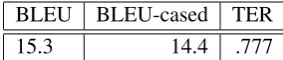
Table 1: BLEU and TER scores of our system.
6 Results
We report the overall translation quality, as listed
on http://matrix.statmt.org/,
mea-sured using BLEU (Papineni et al., 2002) and TER (Snover et al., 2006), in Table 1.
Results are significantly worse compared to last year’s system which used morphological enhance-ments such as compound splitting (Quernheim and Cap, 2014) and a phrase-based fallback system for sentences that the exact decoder could not han-dle. However, we should note that where the fall-back system was not needed, we achieved a BLEU score of 16.7.
From a linguistic point of view, constructions that involve long-distance reordering and agree-ment are typically handled well. Figure 4 shows some example sentences from the WMT13 test set in comparison to a phrase-based baseline system.
On the other hand, our system frequently makes mistakes in lexical choice, and often uses rules that have been extracted from erroneous alignments. Sometimes, these mistakes cannot be alleviated by the language model due to data sparsity (no com-peting good candidate translation).
7 Conclusion and further work
We presented our submission to the WMT15 shared translation task based on a novel, promising “full syntax, no pruning” tree-to-tree approach to statistical machine translation, inspired by Huang et al. (2006). There are, however, still major draw-backs and open problems associated with our ap-proach. Firstly, the coverage can still be signifi-cantly improved. In these experiments, our model was able to translate only 70% of the test sen-tences. To some extent, this number can be im-proved by providing more training data. Also, more rules can be extracted if we not only use the best parse for rule extraction, but multiple parse trees, or even switch to forest-based rule extrac-tion (Mi and Huang, 2008). Finally, the size of the input parse forest plays a role. For instance, if we only supply the best parse to our model, transla-tion will fail for approximately half of the input.
Verb missing:
(M) wir haben zwei spezialisten f¨ur ihre stellungnahmegebeten. (“we have two specialists for their statement asked .”)
(P) wir haben zwei spezialisten f¨ur ihre stellungnahme . (“we have two specialists for their statement .”)
(R) wir haben die meinung von zwei fach¨arzteneingeholt. (S) Weaskedtwo specialists for their opinion.
Plural noun with singular verb:
(M) auchdas technische personal hatmir sehr viel gebracht . (“also the technical staff has me much brought .”)
(P) auchdie technischen mitarbeiter hatmir sehr viel gebracht . (“also the technical co-workers has me much brought .”) (R)das technische personalhat mir ebenfalls viel gegeben . (S)The technical staff hasalso brought me a lot.
No agreement between noun and adjective:
(M) in diesem sinne werden die maßnahmen zum teildas amerikanische demokratische systemuntergraben . (“in this sense will the measures to part (the american democratic system)NEUTundermine .”)
(P) in diesem sinne werden die maßnahmen teilweise ,die amerikanischen demokratische systemuntergraben . (“in this sense will the measures partially , theFEMamerican democratic systemNEUTundermine .”)
(R) in diesem sinne untergraben diese maßnahmen teilweisedas demokratische system der usa. (S) In this sense, the measures will partially underminethe American democratic system. Long-distance reordering:
(M) er z¨ogert nicht , zu antworten , dass er einen antrag von einer unbekannten person nieakzeptieren w¨urde. (“he hesitates not , to reply , that he a request from an unknown person never accept would .”)
(P) er z¨ogert nicht , sagen , dass er niemalsakzeptieren w¨urdeeinen antrag von einer unbekannten person . (“he hesitates not , say , that he never accept would a request from an unknown person .”)
(R) gefragt antwortet er , dass er nie eine einladung von einem unbekanntenannehmen w¨urde. (S) He does not hesitate to reply that hewouldneveraccepta request from an unknown person. Garbled output:
(M) wie ich versprochen habe , ist meine t¨atigkeit teilweise reduziert worden . (“as I promised have , has my activity partially reduced been .”)
(P) wie ich ihnen zugesichert hatte , best¨atigte , die meine aktivit¨aten wurden teilweise reduziert . (“as I you assured had , confirmed , the my activities were partially reduced .”)
(R) wie versprochen , habe ich meine aktivit¨aten teilweise zur¨uckgefahren . (S) As I promised, my activities have been partially reduced.
Figure 4: Examples from the test set where our`MBOT system performed better, linguistically speaking; (M =`MBOT system; P = phrase-based baseline system; R = reference translation; S = source sentence). Rough interlinear glosses are provided.
be able to translate sentences whose parse trees contain structures it has never seen before, since it has to match at least one input parse tree ex-actly. While we implemented a simple solution to handle unknown words, the issue with unknown structures is not so easy to solve without breaking the otherwise theoretically sound approach. Pos-sibly, glue rules can help.
The second drawback is runtime. We were able to translate about 20 sentences per hour on one processor. Distributing the translation task on different machines, we were able to translate the WMT15 test set (3k sentences) in roughly three days. Given that the trend goes towards paral-lel programming, and considering the fact that our decoder is written in the rather slow language Python, we are confident that this is not a major problem. We were able to run the whole pipeline of training, tuning and evaluation on the WMT15
shared task data in less than one week. We are cur-rently investigating whether A* k-best algorithms (Pauls and Klein, 2009; Pauls et al., 2010) can help to guide the translation process while maintaining optimality.
References
Andr´e Arnold and Max Dauchet. 1982. Morphismes et bimorphismes d’arbres. Theoret. Comput. Sci., 20(1):33–93.
Wilker Aziz, Marc Dymetman, and Sriram Venkatap-athy. 2013. Investigations in exact inference for hierarchical translation. In Proc. 8th WMT, pages 472–483.
Fabienne Braune, Nina Seemann, Daniel Quernheim, and Andreas Maletti. 2013. Shallow local multi-bottom-up tree transducers in statistical machine translation. InProc. 51th ACL, pages 811–821. David Chiang. 2007. Hierarchical phrase-based
trans-lation. Computat. Linguist., 33(2):201–228. Chris Dyer, Adam Lopez, Juri Ganitkevitch, Johnathan
Weese, Ferhan Ture, Phil Blunsom, Hendra Seti-awan, Vladimir Eidelman, and Philip Resnik. 2010. cdec: A decoder, alignment, and learning framework for finite-state and context-free translation models. InProc. 48th ACL.
Joost Engelfriet, Eric Lilin, and Andreas Maletti. 2009. Extended multi bottom-up tree transducers: Compo-sition and decompoCompo-sition. Acta Inf., 46(8):561–590, October.
Zolt´an F¨ul¨op and Heiko Vogler. 2009. Weighted tree automata and tree transducers. In Manfred Droste, Werner Kuich, and Heiko Vogler, editors, Hand-book of Weighted Automata, EATCS Monographs on Theoret. Comput. Sci., chapter 9, pages 313–403. Springer.
Kenneth Heafield, Ivan Pouzyrevsky, Jonathan H. Clark, and Philipp Koehn. 2013. Scalable modified Kneser-Ney language model estimation. In Proc. 51st ACL.
Kenneth Heafield. 2011. KenLM: faster and smaller language model queries. In Proc. 6th WMT, pages 187–197.
Liang Huang and David Chiang. 2005. Better k-best parsing. InProc. IWPT, pages 53–64.
Liang Huang, Kevin Knight, and Aravind Joshi. 2006. Statistical syntax-directed translation with extended domain of locality. InProc. 7th Conf. AMTA, pages 66–73.
Alexander Koller and Marco Kuhlmann. 2011. A gen-eralized view on parsing and translation. InProc. IWPT, pages 2–13.
Eric Lilin. 1978.Une g´en´eralisation des transducteurs d’´etats finis d’arbres: les S-transducteurs. Th`ese 3`eme cycle, Universit´e de Lille.
Yang Liu, Yajuan L¨u, and Qun Liu. 2009. Improving tree-to-tree translation with packed forests. InProc. 47th ACL, pages 558–566.
Andreas Maletti. 2010. Why synchronous tree sub-stitution grammars? In Proc. HLT-NAACL, pages 876–884.
Andreas Maletti. 2011. How to train your multi bottom-up tree transducer. InProc. 49th ACL, pages 825–834.
Andreas Maletti. 2012. Every sensible extended top-down tree transducer is a multi bottom-up tree trans-ducer. InProc. HLT-NAACL, pages 263–273. Haitao Mi and Liang Huang. 2008. Forest-based
trans-lation rule extraction. InProc. EMNLP, pages 206– 214.
Haitao Mi, Liang Huang, and Qun Liu. 2008. Forest-based translation. In Proc. 46th ACL, pages 192– 199. ACL.
Franz Josef Och. 2003. Minimum error rate training in statistical machine translation. InProc. 41st ACL, pages 160–167.
Kishore Papineni, Salim Roukos, Todd Ward, and Wei jing Zhu. 2002. BLEU: a method for automatic
evaluation of machine translation. In Proc. 40th ACL, pages 311–318.
Adam Pauls and Dan Klein. 2009. K-best A* parsing. InProc. 47th ACL, pages 958–966.
Adam Pauls, Dan Klein, and Chris Quirk. 2010. Top-down k-best A* parsing. InProc. 48th ACL, pages 200–204.
Slav Petrov, Leon Barrett, Romain Thibaux, and Dan Klein. 2006. Learning accurate, compact, and in-terpretable tree annotation. InProc. COLING-ACL, pages 433–440.
Daniel Quernheim and Fabienne Cap. 2014. Large-scale exact decoding: The ims-ttt submission to wmt14. InProc. 9th WMT, pages 163–170.
Alexander M. Rush and Michael Collins. 2011. Ex-act decoding of syntEx-actic translation models through lagrangian relaxation. InProc. 49th ACL, pages 72– 82.
Helmut Schmid. 2004. Efficient parsing of highly am-biguous context-free grammars with bit vectors. In
Proc. 20th COLING, pages 162–168.
Helmut Schmid. 2006. Trace prediction and recov-ery with unlexicalized PCFGs and slash features. In
Proc. 44th ACL.
Matthew Snover, Bonnie Dorr, Richard Schwartz, Lin-nea Micciulla, and John Makhoul. 2006. A study of translation edit rate with targeted human annotation. InProc. AMTA.
Omar F. Zaidan. 2009. Z-MERT: A fully configurable open source tool for minimum error rate training of machine translation systems. The Prague Bulletin of Mathematical Linguistics, 91:79–88.
Min Zhang, Hongfei Jiang, Aiti Aw, Haizhou Li, Chew Lim Tan, and Sheng Li. 2008a. A tree sequence alignment-based tree-to-tree translation model. InProc. 46th ACL, pages 559–567.