84
Bi-Directional Neural Machine Translation with Synthetic Parallel Data
Xing Niu
University of Maryland [email protected]
Michael Denkowski
Amazon.com, Inc. [email protected]
Marine Carpuat
University of Maryland [email protected]
Abstract
Despite impressive progress in high-resource settings, Neural Machine Trans-lation (NMT) still struggles in low-resource and out-domain scenarios, of-ten failing to match the quality of phrase-based translation. We propose a novel technique that combines back-translation and multilingual NMT to improve perfor-mance in these difficult cases. Our tech-nique trains a single model for both di-rections of a language pair, allowing us to back-translate source or target mono-lingual data without requiring an auxiliary model. We then continue training on the augmented parallel data, enabling a cycle of improvement for a single model that can incorporate any source, target, or par-allel data to improve both translation di-rections. As a byproduct, these models can reduce training and deployment costs significantly compared to uni-directional models. Extensive experiments show that our technique outperforms standard back-translation in low-resource scenarios, im-proves quality on cross-domain tasks, and effectively reduces costs across the board.
1 Introduction
Neural Machine Translation (NMT) has been rapidly adopted in industry as it consistently out-performs previous methods across domains and language pairs (Bojar et al., 2017;Cettolo et al., 2017). However, NMT systems still struggle com-pared to Phrase-based Statistical Machine Transla-tion (SMT) in low-resource or out-of-domain sce-narios (Koehn and Knowles, 2017). This perfor-mance gap is a significant roadblock to full adop-tion of NMT.
In many low-resource scenarios, parallel data is prohibitively expensive or otherwise impractical to collect, whereas monolingual data may be more abundant. SMT systems have the advantage of a dedicated language model that can incorporate all available target-side monolingual data to signifi-cantly improve translation quality (Koehn et al., 2003;Koehn and Schroeder, 2007). By contrast, NMT systems consist of one large neural network that performs full sequence-to-sequence transla-tion (Sutskever et al., 2014; Cho et al., 2014). Trained end-to-end on parallel data, these mod-els lack a direct avenue for incorporating monolin-gual data. Sennrich et al. (2016a) overcome this challenge by back-translating target monolingual data to producesyntheticparallel data that can be added to the training pool. While effective, back-translation introduces the significant cost of first building a reverse system.
Another technique for overcoming a lack of data is multitask learning, in which domain knowl-edge can be transferred between related tasks (Caruana,1997). Johnson et al.(2017) apply the idea to multilingual NMT by concatenating par-allel data of various language pairs and marking the source with the desired output language. The authors report promising results for translation be-tween languages that have zero parallel data. This approach also dramatically reduces the complexity of deployment by packing multiple language pairs into a single model.
• A single NMT model with standard architec-ture that performs all forward and backward translation during training.
• Training costs reduced significantly com-pared to uni-directional systems.
• Improvements in translating quality for low-resource languages, even over uni-directional systems with back-translation.
• Effectiveness in domain adaptation.
Via comprehensive experiments, we also con-tribute to best practices in selecting most suitable combinations of synthetic parallel data and choos-ing appropriate amount of monolchoos-ingual data.
2 Approach
In this section, we introduce an efficient method for improving bi-directional neural machine trans-lation with synthetic parallel data. We also present a strategy for selecting suitable monolingual data for back-translation.
2.1 Bi-Directional NMT with Synthetic Parallel Data
We use the techniques described byJohnson et al. (2017) to build a multilingual model that combines forward and backward directions of a single lan-guage pair. To begin, we construct training data by swapping the source and target sentences of a parallel corpus and appending the swapped ver-sion to the original. We then add an artificial to-ken to the beginning of each source sentence to mark the desired target language, such as<2en> for English. A standard NMT system can then be trained on the augmented dataset, which is natu-rally balanced between language directions.1 A shared Byte-Pair Encoding (BPE) model is built on source and target data, alleviating the issue of unknown words and reducing the vocabulary to a smaller set of items shared across languages ( Sen-nrich et al.,2016b;Johnson et al.,2017). We fur-ther reduce model complexity by tying source and target word embeddings. The full training process significantly saves the total computing resources compared to training an individual model for each language direction.
Generating synthetic parallel data is straight-forward with a bi-directional model: sentences
1Johnson et al.(2017) report the need to oversample when
data is significantly unbalanced between language pairs.
from both source and target monolingual data can be translated to produce synthetic sentence pairs. Synthetic parallel data of the form synthetic → monolingual can then be used in the for-ward direction, the backfor-ward direction, or both. Crucially, this approach leverages both source and target monolingual data while always placing the real data on the target side, eliminating the need for work-arounds such as freezing certain model parameters to avoid degradation from training on MT output (Zhang and Zong,2016).
2.2 Monolingual Data Selection
Given the goal of improving a base bi-directional model, selecting ideal monolingual data for back-translation presents a significant challenge. Data too close to the original training data may not provide sufficient new information for the model. Conversely, data too far from the original data may be translated too poorly by the base model to be useful. We manage these risks by leveraging a standard pseudo in-domain data selection tech-nique, cross-entropy difference (Moore and Lewis, 2010;Axelrod et al.,2011), to rank sentences from a general domain. Smaller cross-entropy differ-ence indicates a sentdiffer-ence that is simultaneously more similar to the in-domain corpus (e.g. real parallel data) and less similar to the average of the general-domain monolingual corpus. This allows us to begin with “safe” monolingual data and in-crementally expand to higher risk but potentially more informative data.
3 Experiments
In this section, we describe data, settings, and ex-perimental methodology. We then present the re-sults of comprehensive experiments designed to answer the following questions: (1) How can synthetic data be most effectively used to im-prove translation quality? (2) Does the reduc-tion in training time for bi-direcreduc-tional NMT come at the cost of lower translation quality? (3) Can we further improve training speed and translation quality training with incremental training and re-decoding? (4) How can we effectively choose monolingual training data? (5) How well does bi-directional NMT perform on domain adaptation?
3.1 Data
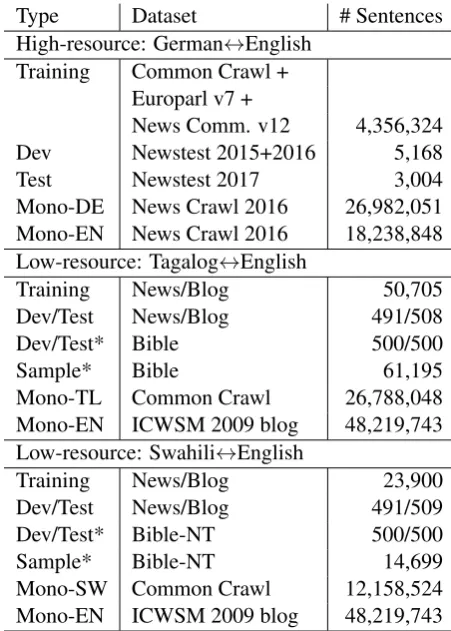
Type Dataset # Sentences High-resource: German↔English
Training Common Crawl + Europarl v7 +
News Comm. v12 4,356,324 Dev Newstest 2015+2016 5,168 Test Newstest 2017 3,004 Mono-DE News Crawl 2016 26,982,051 Mono-EN News Crawl 2016 18,238,848 Low-resource: Tagalog↔English
Training News/Blog 50,705 Dev/Test News/Blog 491/508 Dev/Test* Bible 500/500
Sample* Bible 61,195
Mono-TL Common Crawl 26,788,048 Mono-EN ICWSM 2009 blog 48,219,743 Low-resource: Swahili↔English
[image:3.595.70.296.62.378.2]Training News/Blog 23,900 Dev/Test News/Blog 491/509 Dev/Test* Bible-NT 500/500 Sample* Bible-NT 14,699 Mono-SW Common Crawl 12,158,524 Mono-EN ICWSM 2009 blog 48,219,743
Table 1: Data sizes of training, development, test, sample and monolingual sets. Sample data serves as the in-domain seed for data selection.
German↔English (DE↔EN), Tagalog↔English TL↔EN, and Swahili↔English (SW↔EN). Paral-lel and monolingualDE↔ENdata are provided by the WMT17 news translation task (Bojar et al., 2017). Parallel data for TL↔EN and SW↔EN contains a mixture of domains such as news and weblogs, and is provided as part of the IARPA MATERIAL program.2 We split the original cor-pora into training, dev, and test sets, therefore they share a homogeneous n-gram distribution. For these low-resource pairs,TLandSWmonolingual data are provided by the Common Crawl (Buck et al., 2014) while EN monolingual data is pro-vided by the ICWSM 2009 Spinn3r blog dataset (tier-1) (Burton et al.,2009).
Diverse Domain Settings: For WMT17
DE↔EN, we choose news articles from 2016 (the closest year to the test set) as in-domain data for back-translation. For TL↔EN and SW↔EN, we identify in-domain and out-of-domain
mono-2https://www.iarpa.gov/index.php/
research-programs/material
lingual data and apply data selection to choose pseudo in-domain data (see Section2.2). We use the training data as in-domain and either Common Crawl or ICWSM as out-of-domain. We also include a low-resource, long-distance domain adaptation task for these languages: training on News/Blog data and testing on Bible data. We split a parallel Bible corpus (Christodoulopoulos and Steedman, 2015) into sample, dev, and test sets, using the sample data as the in-domain seed for data selection.
Preprocessing: FollowingHieber et al. (2017), we apply four pre-processing steps to paral-lel data: normalization, tokenization, sentence-filtering (length 80 cutoff), and joint source-target BPE with 50,000 operations (Sennrich et al., 2016b). Low-resource language pairs are also true-cased to reduce sparsity. BPE and true-casing models are rebuilt whenever the training data changes. Monolingual data for low-resource settings is filtered by retaining sentences longer than nine tokens. Itemized data statistics after pre-processing can be found in Table1.
3.2 NMT Configuration
We use the attentional RNN encoder-decoder ar-chitecture implemented in the Sockeye toolkit (Hieber et al.,2017). Our translation model uses a bi-directional encoder with a single LSTM layer of size 512, multilayer perceptron attention with a layer size of 512, and word representations of size 512 (Bahdanau et al.,2015). We apply layer normalization (Ba et al., 2016) and tie source and target embedding parameters. We train us-ing the Adam optimizer with a batch size of 64 sentences and checkpoint the model every 1000 updates (10,000 for DE↔EN) (Kingma and Ba, 2015). Training stops after 8 checkpoints with-out improvement of perplexity on the development set. We decode with a beam size of 5.
For TL↔EN and SW↔EN, we add dropout to embeddings and RNNs of the encoder and decoder with probability 0.2. We also tie the output layer’s weight matrix with the source and target embed-dings to reduce model size (Press and Wolf,2017). The effectiveness of tying input/output target em-beddings has been verified on several low-resource language pairs (Nguyen and Chiang,2018).
decod-ID Training Data TL→EN EN→TL SW→EN EN→SW DE→EN EN→DE
U-1 L1→L2 31.99 31.28 32.60 39.98 29.51 23.01
U-2 L1→L2+L1*→L2 24.21 29.68 25.84 38.29 33.20 25.41
U-3 L1→L2 +L1→L2* 22.13 27.14 24.89 36.53 30.89 23.72 U-4 L1→L2+L1*→L2+L1→L2* 23.38 29.31 25.33 37.46 33.01 25.05
L1=EN L2=TL L2=SW L2=DE
B-1 L1↔L2 32.72 31.66 33.59 39.12 28.84 22.45
B-2 L1↔L2+L1*↔L2 32.90 32.33 33.70 39.68 29.17 24.45 B-3 L1↔L2 +L2*↔L1 32.71 31.10 33.70 39.17 31.71 21.71
B-4 L1↔L2+L1*↔L2+L2*↔L1 33.25 32.46 34.23 38.97 30.43 22.54
B-5 L1↔L2+L1*→L2+L2*→L1 33.41 33.21 34.11 40.24 31.83 24.61
B-5* L1↔L2+L1*→L2+L2*→L1 33.79 32.97 34.15 40.61 31.94 24.45
[image:4.595.75.531.62.231.2]B-6* L1↔L2+L1*→L2+L2*→L1 34.50 33.73 34.88 41.53 32.49 25.20
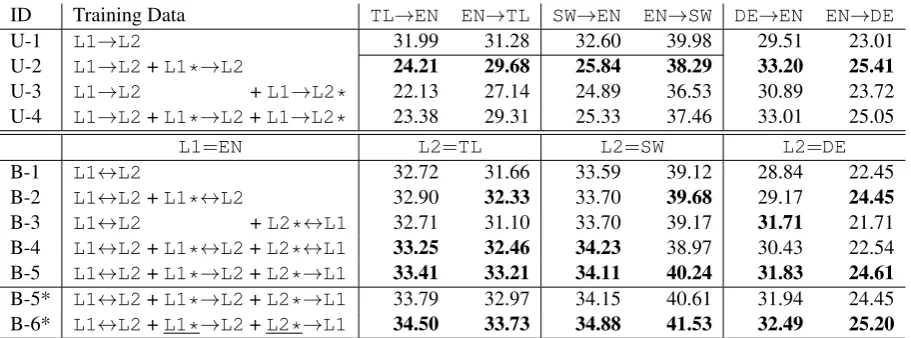
Table 2: BLEU scores for uni-directional models (U-*) and bi-directional NMT models (B-*) trained on different combinations of real and synthetic parallel data. Models in B-5* are fine-tuned from base models in B-1. Best models in B-6* are fine-tuned from precedent models in B-5* and underscored synthetic data is re-decoded using precedent models. Scores with largest improvement within each zone are highlighted.
ing. For DE↔EN experiments, we train a sin-gle model and average the parameters of the best four checkpoints for decoding (Junczys-Dowmunt et al., 2016). We report case-insensitive BLEU with standard WMT tokenization.3
3.3 Uni-Directional NMT
We first evaluate the impact of synthetic parallel data on standard uni-directional NMT. Baseline systems trained on real parallel data are shown in row U-1 of Table 2.4 In all tables, we use L1→L2 to indicate real parallel data where the source language isL1 and the target language is L2. Synthetic data is annotated by asterisks, such asL1*→L2indicating thatL1* is the synthetic back-translation of real monolingual dataL2.
We always select monolingual data as an integer multiple of the amount of real parallel datan, i.e. |L1→L2*|=|L1*→L2|=kn. ForDE↔EN mod-els, we simply choose the top-n sentences from shuffled News Crawl corpus. For all models of low-resource languages, we select the top-3n sen-tences ranked by cross-entropy difference as de-scribed in Section 2.2. The choice of k is dis-cussed in Section3.4.2.
Shown in rows U-2 through U-4 of Table 2, we compare the results of incorporating
differ-3We use the script https://github.com/
EdinburghNLP/nematus/blob/master/data/ multi-bleu-detok.perl
4Baseline BLEU scores are higher than expected on
low-resource language pairs. We hypothesize that the data is ho-mogeneous and easier to translate.
ent combinations of real and synthetic parallel data. Models trained on only real data of tar-get language (i.e. in U-2) achieve better perfor-mance in BLEU than using other combinations. This is an expected result since translation qual-ity is highly correlated with target language mod-els. By contrast, standard back-translation is not effective for our low-resource scenarios. A signif-icant drop (∼7 BLEU comparing U-1 and U-2 for TL/SW→EN) is observed when back-translating English. One possible reason is that the quality of the selected monolingual data, especially En-glish, is not ideal. We will encounter this issue again when using bi-directional models with the same data in Section3.4.
3.4 Bi-Directional NMT
outper-Model TL→EN EN→TL SW→EN EN→SW DE→EN EN→DE
Baseline 76 78 63 66 41 48
Uni-directional Synthetic 177 176 137 104 88 75
TOTAL 507 371 252
Baseline 125 93 61
Bi-directional Synthetic 285 218 113
TOTAL ↓19% 410 ↓14% 311 ↓31% 174
[image:5.595.87.517.63.173.2](fine-tuning) Synthetic ↓23% 219 ↓44% 122 ↓24% 86
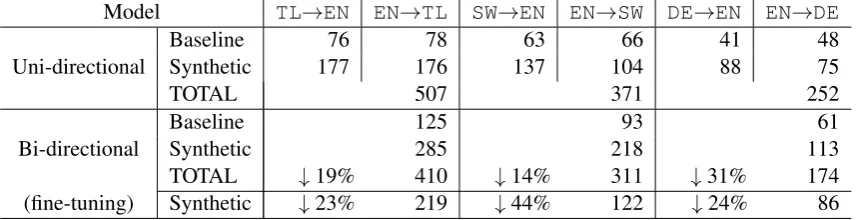
Table 3: Number of checkpoints (= |updates|/1000 for TL/SW↔EN or |updates|/10,000 for DE↔EN) used by various NMT models. Bi-directional models reduce the training time by 15-30% (com-paring ‘TOTAL’ rows). Fine-tuning bi-directional baseline models on synthetic parallel data reduces the training time by 20-40% (comparing ‘Synthetic’ rows).
form independent models. We hypothesize that in low-resource scenarios the neural model’s capac-ity is far from exhausted due to the redundancy in neural network parameters (Denil et al.,2013), and the benefit of training on twice as much data surpasses the detriment of confusing the model by mixing two languages.
We generate synthetic parallel data from the same monolingual data as in the uni-directional experiments. If we build training data symmet-rically (i.e. B-2,3,4), back-translated sentences are distributed equally on the source and target sides, forcing the model to train on some amount of synthetic target data (MT output). ForDE↔EN models, the best BLEU scores are achieved when synthetic training data is only present on the source side while for low-resource models, the re-sults are mixed. We see a particularly counter-intuitive result when using monolingual English data — no significant improvement (see B-3 for TL/SW→EN). As bi-directional models are able to leverage monolingual data of both languages, bet-ter results are achieved when combining all syn-thetic parallel data (see B-4 forTL/SW→EN). By further excluding potentially harmful target-side synthetic data (i.e. B-4→ B-5), the most unified and slim models achieve best overall performance. While the best bi-directional NMT models thus far (B-5) outperform the best uni-directional models (U-1,2) for low-resource language pairs, they struggle to match performance in the high-resourceDE↔ENscenario.
In terms of efficiency, bi-directional models consistently reduce the training time by 15-30% as shown in Table 3. Note that checkpoints are summed over all independent runs when ensemble decoding is used.
3.4.1 Fine-Tuning and Re-Decoding
Training new NMT models from scratch after generating synthetic data is incredibly expensive, working against our goal of reducing the overall cost of deploying strong translation systems. Fol-lowing the practice of mixed fine-tuning proposed byChu et al.(2017), we continue training baseline models on augmented data as shown in B-5* of Ta-ble2. These models achieve comparable transla-tion quality to those trained from scratch (B-5) at a significantly reduced cost, up to 20-40% comput-ing time in the experiments illustrated in Table3.
We also explore re-decoding the same monolin-gual data using improved models (Sennrich et al., 2016a). Underscored synthetic data in B-6* is re-decoded by models in B-5*, leading to the best results for all low-resource scenarios and compet-itive results for our high-resource scenario.
3.4.2 Size of Selected Monolingual Data
In our experiments, the optimal amount of mono-lingual data for constructing synthetic parallel data is task-dependent. Factors such as size and lin-guistic distribution of data and overlap between real parallel data, monolingual data, and test data can influence the effectiveness curve of synthetic data. We illustrate the impact of varying the size of selected monolingual data in our low-resource scenario. Shown in Figure 1, all language pairs have an increasing momentum and tend to con-verge with more synthetic parallel data. The op-timal point is a hyper-parameter that can be em-pirically determined.
3.4.3 Domain Adaptation
35.03
33.87 35.31 42.76
31 32 33 34 (39) 35 (40) 36 (41) (42) (43)
0 n 2n 3n 4n 5n 6n 7n 8n
BLE
U
Size of synthetic data
[image:6.595.141.457.62.224.2]TL→EN EN→TL SW→EN EN→SW
Figure 1: BLEU scores for four translation directions vs. the size of selected monolingual data. n in x-axis equals to the size of real parallel data. EN→SWmodels use BLEU in parentheses in y-axis. All language pairs have an increasing momentum and tend to converge with more synthetic parallel data.
L2=TL L2=SW ID Training Data (L1=EN) TL→EN EN→TL SW→EN EN→SW
A-1 L1↔L2 11.03 10.17 6.56 3.80
A-2 L1↔L2+L1*→L2+L2*→L1 16.49 22.33 8.70 7.47
A-3 L1↔L2+L1*→L2+L2*→L1 18.91 23.41 11.01 8.06
Table 4: BLEU scores for bi-directional NMT models on Bible data. Models in A-2 are fine-tuned from baseline models in A-1. Highlighted best models in A-3 are fine-tuned from precedent models in A-2 and underscored synthetic data is re-decoded using precedent models. Baseline models are significantly improved in terms of BLEU.
domain adaptation task: News/Blog to Bible. This task is particularly challenging because out-of-vocabulary rates of Bible test sets are as high as 30-45% when training on News/Blog. Significant linguistic differences also exist between modern and Biblical language use. The impact of this do-main mismatch is demonstrated by the incredibly low BLEU scores of baseline News/Blog systems (Table4, A-1). After fine-tuning baseline models on augmented parallel data (A-2) and re-decoding (A-3),5we see BLEU scores increase by 70-130%. Despite being based on extremely weak baseline performance, they still show the promise of our approach for domain adaptation.
4 Related Work
Leveraging monolingual data in NMT is challeng-ing. For example, integrating language models in the decoder (G¨ulc¸ehre et al.,2015) or initializing the encoder and decoder with pre-trained language models (Ramachandran et al.,2017) would require
5The concatenation of development sets from both
News/Blog and Bible serves for validation.
significant changes to system architecture.
In this work, we build on the elegant and ef-fective approach of turning incomplete (monolin-gual) data into complete (parallel) data by back-translation. Sennrich et al.(2016a) used an aux-iliary reverse-directional NMT system to gener-ate synthetic source data from real monolingual target data, with promising results (+3 BLEU on strong baselines). Symmetrically,Zhang and Zong (2016) used an auxiliary same-directional transla-tion system to generate synthetic target data from the real source language. However, parameters of the decoder have to be frozen while training on synthetic data, otherwise the decoder would fit to noisy MT output. By contrast, our approach ef-fectively leverages synthetic data from both lation directions, with consistent gains in trans-lation quality. A similar idea is used by Zhang et al. (2018) with a focus on re-decoding itera-tively. However, their NMT models of both di-rections are still trained independently.
[image:6.595.110.492.289.358.2]Sup-pose sentence f from a monolingual dataset is translated forward to e and then translated back to f0, then f0 and f should be identical (Brislin, 1970). Cheng et al. (2016) optimize arg maxθP(f0|f;θ) as an autoencoder; Wang et al. (2018) minimize the difference between P(f)andP(f0|θ)based on the law of total prob-ability, while He et al. (2016) set the quality of botheandf0 as rewards for reinforcement learn-ing. They all achieve promising improvement but rely on non-standard training frameworks.
Multitask learning has been used in past work to combine models trained on different parallel cor-pora by sharing certain components. These com-ponents, such as the attention mechanism (Firat et al.,2016), benefit from being trained on an ef-fectively larger dataset. In addition, the more pa-rameters are shared, the faster a joint model can be trained — this is particularity beneficial in in-dustry settings. Baidu built one-to-many transla-tion systems by sharing both encoder and attentransla-tion (Dong et al., 2015). Google enabled a standard NMT framework to support many-to-many trans-lation directions by simply attaching a language specifier to each source sentence (Johnson et al., 2017). We adopted Google’s approach to build bi-directional systems that successfully combine ac-tual and synthetic parallel data.
5 Conclusion
We propose a novel technique for bi-directional neural machine translation. A single model with a standard NMT architecture performs both for-ward and backfor-ward translation, allowing it to back-translate and incorporate any source or target monolingual data. By continuing training on aug-mented parallel data, bi-directional NMT models consistently achieve improved translation quality, particularly in low-resource scenarios and cross-domain tasks. These models also reduce train-ing and deployment costs significantly compared to standard uni-directional models.
Acknowledgments
Part of this research was conducted while the first author was an intern at Amazon. At Maryland, this research is based upon work supported in part by the Clare Boothe Luce Foundation, and by the Office of the Director of National Intel-ligence (ODNI), IntelIntel-ligence Advanced Research Projects Activity (IARPA), via contract
#FA8650-17-C-9117. The views and conclusions contained herein are those of the authors and should not be interpreted as necessarily representing the official policies, either expressed or implied, of ODNI, IARPA, or the U.S. Government. The U.S. Gov-ernment is authorized to reproduce and distribute reprints for governmental purposes notwithstand-ing any copyright annotation therein.
References
Amittai Axelrod, Xiaodong He, and Jianfeng Gao. 2011. Domain adaptation via pseudo in-domain data
selection. InEMNLP, pages 355–362. ACL.
Lei Jimmy Ba, Ryan Kiros, and Geoffrey E. Hinton.
2016. Layer normalization. CoRR, abs/1607.06450.
Dzmitry Bahdanau, Kyunghyun Cho, and Yoshua
Ben-gio. 2015. Neural machine translation by jointly
learning to align and translate. InICLR.
Ondrej Bojar, Rajen Chatterjee, Christian Federmann, Yvette Graham, Barry Haddow, Shujian Huang, Matthias Huck, Philipp Koehn, Qun Liu, Varvara Logacheva, Christof Monz, Matteo Negri, Matt Post, Raphael Rubino, Lucia Specia, and Marco
Turchi. 2017. Findings of the 2017 conference
on machine translation (WMT17). InWMT, pages
169–214. Association for Computational Linguis-tics.
Richard W Brislin. 1970. Back-translation for
cross-cultural research. Journal of cross-cultural
psychol-ogy, 1(3):185–216.
Christian Buck, Kenneth Heafield, and Bas van Ooyen. 2014. N-gram counts and language models from the
common crawl. InLREC, pages 3579–3584.
Euro-pean Language Resources Association (ELRA).
Kevin Burton, Akshay Java, and Ian Soboroff. 2009. The ICWSM 2009 Spinn3r dataset. InProceedings of the Third Annual Conference on Weblogs and So-cial Media (ICWSM 2009), San Jose, CA.
Rich Caruana. 1997. Multitask learning. Machine
Learning, 28(1):41–75.
Mauro Cettolo, Marcello Federico, Luisa Bentivogli, Jan Niehues, Sebastian St¨uker, Katsuitho Sudoh, Koichiro Yoshino, and Christian Federmann. 2017. Overview of the IWSLT 2017 evaluation campaign. In International Workshop on Spoken Language Translation, pages 2–14.
Yong Cheng, Wei Xu, Zhongjun He, Wei He, Hua
Wu, Maosong Sun, and Yang Liu. 2016.
Kyunghyun Cho, Bart van Merrienboer, C¸ aglar G¨ulc¸ehre, Dzmitry Bahdanau, Fethi Bougares, Hol-ger Schwenk, and Yoshua Bengio. 2014. Learning phrase representations using RNN encoder-decoder
for statistical machine translation. InEMNLP, pages
1724–1734. ACL.
Christos Christodoulopoulos and Mark Steedman.
2015. A massively parallel corpus: the bible in
100 languages. Language Resources and
Evalua-tion, 49(2):375–395.
Chenhui Chu, Raj Dabre, and Sadao Kurohashi. 2017. An empirical comparison of domain adaptation
methods for neural machine translation. InACL (2),
pages 385–391. Association for Computational Lin-guistics.
Misha Denil, Babak Shakibi, Laurent Dinh,
Marc’Aurelio Ranzato, and Nando de Freitas. 2013. Predicting parameters in deep learning. In
NIPS, pages 2148–2156.
Daxiang Dong, Hua Wu, Wei He, Dianhai Yu, and Haifeng Wang. 2015. Multi-task learning for
mul-tiple language translation. InACL (1), pages 1723–
1732. The Association for Computer Linguistics.
Orhan Firat, Kyunghyun Cho, and Yoshua Bengio.
2016. Multi-way, multilingual neural machine
translation with a shared attention mechanism. In
HLT-NAACL, pages 866–875. The Association for Computational Linguistics.
C¸ aglar G¨ulc¸ehre, Orhan Firat, Kelvin Xu, Kyunghyun
Cho, Lo¨ıc Barrault, Huei-Chi Lin, Fethi Bougares, Holger Schwenk, and Yoshua Bengio. 2015. On us-ing monolus-ingual corpora in neural machine
transla-tion. CoRR, abs/1503.03535.
Di He, Yingce Xia, Tao Qin, Liwei Wang, Nenghai Yu, Tie-Yan Liu, and Wei-Ying Ma. 2016. Dual learning
for machine translation. InNIPS, pages 820–828.
Felix Hieber, Tobias Domhan, Michael Denkowski, David Vilar, Artem Sokolov, Ann Clifton, and Matt Post. 2017. Sockeye: A toolkit for neural machine
translation. CoRR, abs/1712.05690.
Melvin Johnson, Mike Schuster, Quoc V. Le, Maxim Krikun, Yonghui Wu, Zhifeng Chen, Nikhil Tho-rat, Fernanda B. Vi´egas, Martin Wattenberg, Greg Corrado, Macduff Hughes, and Jeffrey Dean. 2017. Google’s multilingual neural machine translation
system: Enabling zero-shot translation. TACL,
5:339–351.
Marcin Junczys-Dowmunt, Tomasz Dwojak, and Rico Sennrich. 2016. The AMU-UEDIN submission to the WMT16 news translation task: Attention-based NMT models as feature functions in phrase-based
SMT. InWMT, pages 319–325. The Association for
Computer Linguistics.
Diederik P. Kingma and Jimmy Ba. 2015. Adam: A
method for stochastic optimization. InICLR.
Philipp Koehn and Rebecca Knowles. 2017. Six
challenges for neural machine translation. In
NMT@ACL, pages 28–39. Association for Compu-tational Linguistics.
Philipp Koehn, Franz Josef Och, and Daniel Marcu.
2003. Statistical phrase-based translation. In
HLT-NAACL. The Association for Computational Lin-guistics.
Philipp Koehn and Josh Schroeder. 2007. Experiments in domain adaptation for statistical machine
transla-tion. InWMT@ACL, pages 224–227. Association
for Computational Linguistics.
Robert C. Moore and William D. Lewis. 2010. Intel-ligent selection of language model training data. In
ACL (Short Papers), pages 220–224. The Associa-tion for Computer Linguistics.
Toan Q. Nguyen and David Chiang. 2018. Improv-ing lexical choice in neural machine translation. In
HLT-NAACL. The Association for Computational Linguistics.
Ofir Press and Lior Wolf. 2017. Using the output
em-bedding to improve language models. InEACL (2),
pages 157–163. Association for Computational Lin-guistics.
Prajit Ramachandran, Peter J. Liu, and Quoc V. Le. 2017. Unsupervised pretraining for sequence to
se-quence learning. InEMNLP, pages 383–391.
Asso-ciation for Computational Linguistics.
Rico Sennrich, Barry Haddow, and Alexandra Birch. 2016a. Improving neural machine translation
mod-els with monolingual data. InACL (1). The
Associ-ation for Computer Linguistics.
Rico Sennrich, Barry Haddow, and Alexandra Birch. 2016b. Neural machine translation of rare words
with subword units. In ACL (1). The Association
for Computer Linguistics.
Ilya Sutskever, Oriol Vinyals, and Quoc V. Le. 2014. Sequence to sequence learning with neural
net-works. InNIPS, pages 3104–3112.
Yijun Wang, Yingce Xia, Li Zhao, Jiang Bian, Tao
Qin, Guiquan Liu, and Tie-Yan Liu. 2018. Dual
transfer learning for neural machine translation with
marginal distribution regularization. InAAAI. AAAI
Press.
Jiajun Zhang and Chengqing Zong. 2016.
Exploit-ing source-side monolExploit-ingual data in neural machine
translation. InEMNLP, pages 1535–1545. The
As-sociation for Computational Linguistics.
Zhirui Zhang, Shujie Liu, Mu Li, Ming Zhou, and En-hong Chen. 2018. Joint training for neural machine
translation models with monolingual data. InAAAI.