THE EFFECT OF HIGH PRESSURE GASSES ON HETEROGENEOUS CATALYSTS
Robert G. L. Mitchell
A Thesis Submitted for the Degree of PhD at the
University of St Andrews
2009
Full metadata for this item is available in St Andrews Research Repository
at:
http://research-repository.st-andrews.ac.uk/
Please use this identifier to cite or link to this item:
http://hdl.handle.net/10023/955
A thesis presented by
Robert G. L. Mitchell
The Effect of High Pressure Gasses on Heterogeneous
Catalysts
In application for
THE DEGREE OF DOCTOR OF PHILOSOPHY
I, Robert Mitchell hereby certify that this thesis, which is approximately 35000
words in length, has been written by me, that it is the record of work carried out
by me and that it has not been submitted in any previous application for a higher
degree.
I was admitted as a research student in September 2002 and as a candidate for the
degree of Doctor of Philosophy in September 2003; the higher study for which
this is a record was carried out in the University of St Andrews between 2002
and 2006.
date………….. signature of candidate ………
I hereby certify that the candidate has fulfilled the conditions of the Resolution
and Regulations appropriate for the degree of Doctor of Philosophy in the
University of St Andrews and that the candidate is qualified to submit this thesis
in application for that degree.
date………….. signature of supervisor………..
In submitting this thesis to the University of St Andrews we have requested the
appropriate embargo below.
Embargo on both all of printed copy and electronic copy for the same fixed
period of 5 years on the following ground:
publication would be commercially damaging to the researcher, or to the
supervisor, or the University;
Acknowledgements
Firstly I would like to thank David Cole-Hamilton for devising the
project and his guidance throughout. It is probably fair to say that I gave his
patience a thorough testing throughout the last 4 years but never managed to find
its limit. It is greatly appreciated that in spite of his busy schedule he would
always find the time to listen to a half-baked theory and tactfully dismiss it.
I would like to thank Thomas Swan & Co Ltd and EPSRC for funding the
project, and would further like to thank Stephen Ross and the employees of
Thomas Swan for their suggestions and comments throughout the project.
A great debt of gratitude is owed to Pete Pogerzelec, in particular for his
help with GC-MS. Thanks also to Dr Paul Webb, Bobby Cathcart and the
workshop staff, without whom the rig building and maintenance would have
been an even longer process.
I would like to thank Dave Tunstall, Melanjna Smith, Ross Blackely and
Sylvia Williamson for their help with various analytical techniques. I would also
like to thank the Zhou, Wright, Irvine, and Morris groups for use of equipment
and advice on its usage.
I would like to thank the other members of the DCH group, who are too
I would like to thank my ex-flatmates the 3 doctors (stooges), Tom, Stu,
and Dr Daws who at all times made working as hard as possible.
Finally I would like to thank Lorna Murray whose constant support
(moaning) and encouragement (nagging) has probably been the biggest factor in
Abstract
Several heterogeneously catalysed reactions have been studied at
pressures above and below the critical pressure of carbon dioxide in both carbon
dioxide and nitrogen. The purpose of this study was to ascertain if carbon
dioxide above its critical pressure and temperature would have a beneficial effect
on the active life time of the catalysts
When the Beckmann rearrangement of cyclohexanone oxime was studied
it was discovered that using carbon dioxide above its critical pressure and
temperature was beneficial to catalyst lifetime at both 250°C and 300°C,
however the beneficial effect was also observed in nitrogen under the same
conditions. It is proposed that the benefits at higher pressures are due to an
increased residence time in the reactor or increased competition for active sites.
When the process was performed at 380°C, a previously unreported impurity was
observed in the collected samples. This was shown to be N-ethyl caprolactam, it
is proposed that this is formed by a Ritter style reaction with 5-cyanopent-1-ene
known to be formed during the reaction
When the Fries rearrangement of phenyl acetate was studied it was
below the boiling point of phenyl acetate, and that the reaction being observed
occurs purely in the liquid phase.
When the Diels-Alder addition of isoprene to methyl acrylate was
studied, it was discovered that using carbon dioxide above its critical pressure
had the effect of improving catalyst lifetime and conversion to desired product,
with the greatest effect being at 50 bar. It was discovered that using nitrogen
under the same conditions led to a greater improvement in conversion and
catalyst lifetime. It is thought that the reactions in carbon dioxide are in a near
critical state at 50 bar leading to the maximum effect at this pressure, and at
higher pressures the reactions are bi- or multi-phasic, leading to the decrease in
the effect.
In the process of studying the above reactions an effective rig for the
Abbreviations
atm atmospheres
CBI Confederation of British Industry
CO2 Carbon Dioxide
FEP Fluorinated Ethylene Propylene
GAS Gas Anti-Solvent process
H/C Hydrogen to Carbon ratio
HOMO Highest Occupied Molecular Orbital
HPLC High Performance Liquid Chromatography
LUMO Lowest Unoccupied Molecular Orbital
MS Mass Spectrometry
NMR Nuclear Magnetic Resonance
PGSS Particles from Gas Saturated Solutions
RESS Rapid Expansion of Supercritical Solutions
SAS Supercritical Anti-Solvent process
SEDS Solution Enhanced Dispersion by Supercritical fluids
SFC Supercritical Fluid Chromatography
TFE TertraFlouroEthylene
Contents
Chapter 1-Introduction 1
1.1-The Peculiar State of Matter 2
1.2-Definition of a Supercritical Fluid 4
1.3-Properties of Supercritical Fluids 6
1.4-Application 10
1.4.1-Supercritical Fluid Extraction 11
1.4.2-Polymers 14
1.4.3-Homogeneous Catalysis 16
1.4.4-Analytical Techniques 18
1.5-Heterogeneous Catalysis 19
1.5.1-Catalyst Deactivation 19
1.5.2-Supercritical Fluids and Catalyst Deactivation 23
1.5.3-Alkylation Reactions 26
1.5.4-Isomerization Reactions 30
1.5.5-Cracking Reactions 31
1.5.6-Other Reactions 31
1.6-This Project 32
1.7-References 35
2.2-Original Rig Design 43
2.3-Design of Project Rig 45
2.4-Rig Maintenance 57
2.5-Rig Operation 62
2.5.1-Beckmann Reactions 62
2.5.2-Fries Reactions 65
2.5.3-Diels Alder Reactions 67
2.5.4-Catalyst Preparation 69
2.5.5-Analysis 70
2.5.6-Sythesis of N-Ethylcaprolactam 72
2.5.7-Synthesis of Al-HMS 72
2.6-Rig Development 73
Chapter 3-The Beckmann Rearrangement 80
3.1-Introduction 81
3.2-The Beckmann Process on the Rig 88
3.3-The Beckmann Rearrangement at 380°C 91
3.4-The Beckmann Rearrangement at 250°C 102
3.5-The Beckmann Rearrangement at 300°C 112
3.6-References 118
4.2-The Fries Rearrangement at 150°C 124
4.3-References 132
Chapter 5-The Diels-Alder Process 133
5.1-Introduction 134
5.2-The Addition of Isoprene to Methyl Acrylate 136
5.3-Al-HMS Catalyst 148
5.4-References 156
Chapter 6-Conclusions 158
6.1-Catalysis Rig 159
6.2-The Beckmann Rearrangement 161
6.3-The Fries Rearrangement 167
1-Introduction
Since the critical point of ethanol was first discovered in the 19th century,
slow and steady research has been carried out to discover the properties of matter
at the critical point and beyond; in the supercritical region. It is only within the
last fifteen years there has been an explosion of interest in supercritical fluids,
mainly due to their application as environmentally benign alternatives to toxic
organic solvents in chemical processes.
This chapter will review the initial research into the properties of
supercritical fluids, and then discuss some of these properties in further detail.
The current applications of supercritical fluids and the main areas of research
will be looked at, with particular reference to their use in the area of
heterogeneous catalysis. Finally there will be a brief discussion of catalyst
deactivation in heterogeneous catalysis.
1.1-The Peculiar State of Matter
The supercritical phase was first observed in the first half of the 19th
century. Baron Charles Cagniard de LaTour was investigating the suppression of
the boiling point of liquids by increasing pressure. His experiments involved
sealing a ball in a gun barrel containing ethanol1. During the experiment, by
tipping the barrel from side to side, he expected to show that ethanol under
pressure would remain liquid beyond its boiling point at atmospheric pressure
the barrel. However, upon heating he heard the ball bounce rather than come to a
halt, suggesting no liquid was present. In order to observe the change visually
Cagniard de LaTour performed a similar experiment in a glass container, this
time he was able to observe the liquid greatly expand in volume before the
meniscus between liquid and gas phases disappeared to yield a single phase of
ethanol. He christened his finding the peculiar state of matter, and what we now
know as the critical point was given the name of Cagniard de LaTour’s point.
Inspired by Cagniard de LaTour’s work, Dr Thomas Andrews became an
early leader in the field of supercritical fluids. He focused primarily on the
behaviour of carbon dioxide and recorded the most accurate values for its critical
point for years to come at 31.1C and 73.8 bar.2It was Dr Andrews that first used the phrase critical point, and his work led to an increased interest in supercritical
fluids, ultimately resulting in the publication of a journal devoted entirely to
research into supercritical fluids towards the end of the 19thcentury.3
Indeed, it was Andrews who first described the difficulty at this time of
assigning the behaviour of supercritical fluids.4 Talking about the properties of
his favoured subject, carbon dioxide, he declared that, at just above the critical
point, carbon dioxide ‘stands nearly midway between the gas and the liquid and
we have no valid grounds for assigning it to one form of matter any more than
the other.’ This led to speculation about the specific liquid-like or gas-like
properties that the supercritical phase possessed, and inspired Hannay and
followed that a solution could be passed through the critical point without
precipitation of the solute occurring. They were able to show that potassium
iodide salt could be dissolved in supercritical ethanol.6 They went on to show
other strongly coloured ionic salts could be dissolved in supercritical ethanol and
that the colours of these solutions were not affected by the transition from the
liquid phase. The similar behaviour of organic compounds studied showed this
result was not exclusive for ionic salts, indeed in some cases the solute remained
in solution over 100C above the critical point of the solvent being studied. Other important observations by Hannay and Hogarth included the shifting of the
critical point by addition of the solute and that a fine solid could be precipitated
by transition to the gas phase by rapid expansion of the supercritical mixture.7
The work by Hannay and Hogarth was truly groundbreaking as solvation had
previously been thought to be an exclusively liquid property and it is upon this
solvating power of supercritical fluids that nearly all of their modern day
applications are based. Understandably this triggered a marked increase in
activity in the research into supercritical fluids and Villard produced a review of
solubility in supercritical fluids in 1896,8 work in this field continued well into
the 20th century with several more reviews being published,9-12 the most
complete overview was provided by Franck.13
1.2-Definition of a Supercritical Fluid
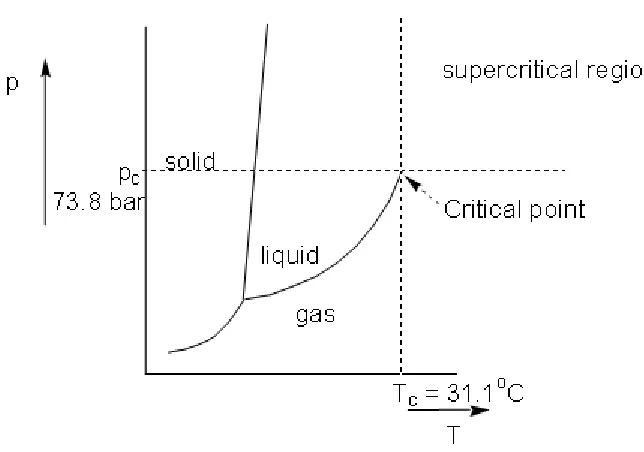
When defining a supercritical fluid, it is conventional to look first at a
phase diagram with respect to temperature and pressure. Figure 1.1 shows the
solid, liquid and gas and the boundaries between these states. The sublimation
curve between solids and gases exists until the triple point; this is the only
pressure and temperature at which all three phases of matter can co-exist. At the
triple point the sublimation curve terminates and splits into the vapour curve,
between liquid and gas, and the fusion curve, between liquid and solid.
However, whereas the fusion curve seems to extend forever, the vapour curve
terminates at the critical point. The critical point, as has already been discussed,
is the beginning of the supercritical region; at this point the boundary between
liquids and gases is no longer well defined and matter exists as a phase
displaying properties both liquid-like and gas-like but cannot be assigned to
[image:16.595.166.488.380.606.2]either state.
Figure 1.1- Phase Diagram of Carbon Dioxide. Reproduced from reference 14.
state matter exists in above its critical temperature and critical pressure. In
theory the phase diagram for carbon dioxide should be representative of all
substances, and a critical point should exist for all substances, however in certain
cases decomposition occurs before reaching the critical temperature.
1.3-Properties of Supercritical Fluids
The position of the critical point is different for each substance. In
general the critical temperature increases with increasing molecular weight. This
trend is obeyed in simple chemical families such as the alkanes as shown in table
1.1.
Alkane Critical Critical
Temperature (°C) Pressure (bar)
Methane -83 46
Ethane 32 49
Propane 97 42
Butane 152 38
Table 1.1- Critical temperatures and pressures of simple alkanes
This correlates well with other physical properties such as melting point,
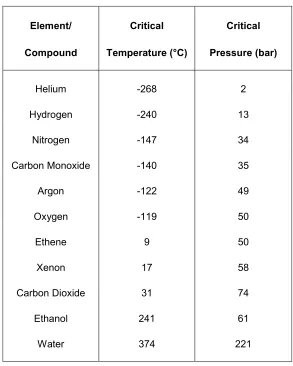
as is also true when dealing with simple elements and compounds. Table 1.2
shows a number of such substances and illustrates that both the critical
melting points, this general trend is not followed when dealing with hydrogen
bonded or polar molecules such as water and ethanol (Table 1.2). The elevated
critical temperatures of these compounds come from the extra energy that is
required to break the strong polar or hydrogen bonds, rather than just the van der
[image:18.595.162.455.236.602.2]Waals interactions present in the simple cases of less polar compounds.
Table 1.2- The critical pressure and temperature of various elements and
compounds
Element/ Critical Critical
Compound Temperature (°C) Pressure (bar)
Helium -268 2
Hydrogen -240 13
Nitrogen -147 34
Carbon Monoxide -140 35
Argon -122 49
Oxygen -119 50
Ethene 9 50
Xenon 17 58
Carbon Dioxide 31 74
Ethanol 241 61
Table 1.2 also shows that, in general, the critical pressure increases with
molecular weight as is the case for critical temperatures, although this trend is
less strictly followed.
As has been previously outlined, a supercritical fluid just above the
critical point can be thought of as half-way between a liquid and gas. It therefore
follows that the properties displayed by a supercritical fluid are properties that
are otherwise associated with either the liquid or gas states. As was discovered
by Hogarth and Hannay,5 supercritical fluids possess the liquid-like property of
solvation, and as was observed by Cagnaird de LaTour they expand to fill all
available space like a gas.
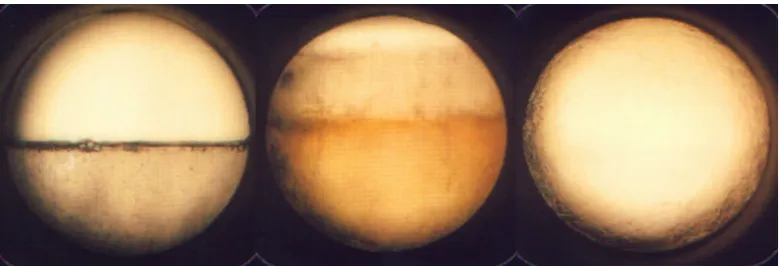
Figure 1.215 illustrates the dual identity of supercritical fluids. In 1.2(a)
we see carbon dioxide below its critical pressure and temperature; under these
conditions we see that carbon dioxide exists in both the liquid and gas phases
with a clearly defined boundary between the two phases. In 1.2(b) we see the
same vessel upon heating, causing both the temperature and pressure to rise as
the carbon dioxide approaches its critical pressure and temperature. Here it is
seen that the liquid layer expands and the boundary between liquid and gas is less
clearly defined. When we look at figure 1.2(c) it can be seen that no phase
boundary exists and the carbon dioxide appears to be in a single phase. In this
case the carbon dioxide has been raised above its critical pressure and
temperature, and it can be seen that the supercritical carbon dioxide, unrestrained
Figure 1.2 (a)- (left) Carbon Dioxide in a sealed vessel below its critical
temperature and pressure.
Figure 1.2 (b)- (middle) Carbon dioxide approaching its critical temperature and
pressure.
Figure 1.2 (c)- (right)Carbon Dioxide as a single phase above its critical
pressure and temperature. Reproduced from reference 15.
The solubility of solids in supercritical fluids differs from the solubility of
solids in liquids in an important way. The solubility of solids in supercritical
fluids can be tuned by changing the density of the supercritical fluid by varying
the pressure or temperature of a system. For example, in figure 1.2 (c) above if
the temperature were maintained and the pressure lowered, the supercritical fluid
would become diffuse, its density would drop and its solvating power would be
reduced. In this case the supercritical fluid is becoming more gas-like in
character. Alternatively the pressure could be maintained and the temperature
reduced, the density of the supercritical fluid would increase and it would be a
better solvent. In this case the supercritical fluid would become more liquid-like
in its character. This unique property of supercritical fluids means that, by
[image:20.595.116.506.70.203.2]In addition to their unique solvating abilities, supercritical fluids possess
gas-like properties. It has already been shown that a supercritical fluid will
expand to fill all the available volume, but they also have gas-like mass transport
properties. The rate of diffusion through a medium is inversely proportional to its
density; it follows, therefore, that diffusion in a supercritical fluid is much more
rapid than in a liquid, although not as quick as in a gas. It also follows that the
rate of diffusion can be varied, like solubilising power, by tuning the density.
This ability to rapidly transport matter to and away from reaction sites when
allied to their unique solvating properties means supercritical fluids are often put
forward as alternatives to more traditional reaction media.
However, when considering supercritical fluids as alternatives to more
traditional reaction media, several issues need to bourn in mind. Firstly, for
reactions which require an activation temperature in excess of the critical
temperature of the medium, the density of the medium will be lower than its
density at the critical point, and will thus display more gas-like properties. The
pressure of the reaction would then have to be raised accordingly to increase the
density of the reaction medium. Secondly, the introduction of other components
into the medium will effect the position of the critical point and the phase
behaviour17. For a binary system the greater the concentration of the solute the
more the critical point of the mixture will move from the critical point of the
solvent towards that of the solute. The phase behaviour of multi-component
systems is more complex than for a single component system, as the number of
number of phases that can co-exist in equilibrium (equal to the number of
components plus two)17. This means that even for a simple rearrangement with
only substrate, product and reaction medium in the mixture there are several
combinations of phases possible depending on the concentrations, pressure and
temperature, and under the correct conditions it will be possible to have five
phases in equilibrium.
1.4-Applications
With their unique combination of properties, supercritical fluids have
found applications in many branches of chemistry. Supercritical extraction has
been used industrially for many years, but supercritical fluids are now also used
as solvents in organic reactions, in chromatography, destruction of toxic waste,
polymer synthesis, as well as in both homogeneous and heterogeneous catalysis.
Recognition of the growing importance of supercritical fluids was given in 1999
when an entire issue ofChemical Reviewswas devoted to research in the field.18
1.4.1-Supercritical Fluid Extraction
Supercritical fluid extraction is an application where supercritical fluids
are used in place of conventional solvents to extract chemicals. While it is
simpler to use conventional solvents in most cases for extractions, in certain
circumstances the properties of supercritical fluids make them ideal for the
One of the earliest examples of natural product extraction using
supercritical fluids was discovered by chance by Kurt Zosel.19 Zosel was
working on the Aufbau reaction, the reaction of triethylaluminium with ethylene
for the preparation of primary alcohols, when he made his discovery. His
experiments involved adding triethylaluminium to an autoclave filled with
ethylene and heating. At room temperature ethylene is already above its critical
temperature and the rise in pressure due to heating makes the ethylene
supercritical under the reaction conditions. However this was not given any
thought at the time. Several years later a licensee researching the Aufbau
reaction found large quantities ofα-olefins in the product, which had been absent
from Zosel’s experiments.19 Zosel hypothesised that in his experiments the α
-olefins had been removed by the supercritical ethylene, and quickly realised that
this was the basis for a method of separating substances, filing a patent for his
process soon after.20
Zosel’s discovery was to be of particular significance to the food
industry. In this industry conventional solvents have become undesirable as
more is understood about their effects upon the human body and the
environment. Whereas conventional organic solvents, particularly common
halogenated or aromatic solvents, can be extremely toxic to humans and
detrimental to the environment, carbon dioxide is completely non-toxic to
humans.
As well as being a by-product from human respiration, carbon dioxide is
However the large quantity of carbon dioxide released annually by industry has
led to carbon dioxide being classified as a greenhouse gas and recently western
countries have signed up to the Kyoto agreement.21 The Kyoto agreement is a
commitment by the participating countries to reduce carbon emissions,
specifically carbon dioxide and carbon particles, to set levels by 2008 and further
by 2012.
The Kyoto agreement is both advantageous and disadvantageous for
processes using supercritical extraction. To perform supercritical carbon dioxide
extraction a source of carbon dioxide is required, and carbon dioxide is a
by-product of several industrial processes, most prominently fermentation.
Companies performing fermentation will now be under pressure to reduce
emissions of carbon dioxide and one way of doing this would be to collect it and
sell it for use in supercritical extraction. This should provide cheap available
carbon dioxide. However while not creating any extra carbon dioxide as part of
the process, venting of the carbon dioxide at the end of such processes would still
be considered as localised emission of carbon dioxide, which would be frowned
upon by both the government and the CBI (Confederation of British Industry)
and could lead to financial penalties. Therefore, wherever possible, processes
should recycle carbon dioxide to avoid this penalty and also reduce costs.
One process that has used supercritical carbon dioxide extraction and
recycled the carbon dioxide for several decades is the decaffeination of coffee
chlorinated solvents replaced benzene most commonly trichloroethane,
chloroform and carbon tetrachloride. Chlorinated solvents are now known to be
mutagens and carcinogens. Given that the process was not 100% efficient at
removing the solvents from the coffee beans after extraction, the process was
extremely undesirable.21 However today over 100 000 tonnes of decaffeinated
coffee are produced worldwide using supercritical fluid extraction, completely
free of toxic solvents. Caffeine is extracted from coffee beans using supercritical
carbon dioxide, which is not harmful to humans. The caffeine is then extracted
into water, leaving the carbon dioxide free to be recycled into the extractor. In
addition the caffeine can be isolated from water and sold on.
Supercritical fluid extraction is now a widely known technique in the
food industry and can be used in a similar way to the decaffeination process to
extract undesirable compounds or functional ingredients from a variety of foods
and natural sources.22The technique is not limited to the food industry, having a
wide range of applications, and recently supercritical carbon dioxide has been
shown to be effective as a environmentally benign cleaning agent.23 It has been
shown that, by passing supercritical carbon dioxide through chemically
contaminated soil, it is possible to remove both organic contaminants, such as
hydrocarbons, and inorganic contaminants, such as heavy metals and radioactive
1.4.3-Polymers
A major area of research involving supercritical fluids is in the field of
polymer chemistry and this is reflected in the volume of reviews in this area.
Two main areas of research are polymer particle formation,24-26 and
polymerization reactions.27, 28
There are several well-known techniques for the formation of particles
using supercritical fluids these include RESS (rapid expansion of supercritical
solutions), GAS (gas anti-solvent process), SAS (supercritical anti-solvent
process), SEDS (solution enhanced dispersion by supercritical fluids) and PGSS
(particles from gas saturated solutions). Although commonly used for polymer
particle formation these techniques can be used for any substance with the
required solubility or insolubility in supercritical fluids, and are used frequently
in pharmaceutical research.29, 30
RESS is a process for substances that are soluble in supercritical fluids.
The substance is dissolved into a supercritical fluid, this solution is then passed
through a nozzle to a lower pressure chamber. Upon this depressurization, the
solution is no longer supercritical, resulting in precipitation of the dissolved
substance. By changing the dimensions of the nozzle used, it is possible to
change the size of particle produced.24
substance to be precipitated must first be dissolved in a liquid solvent. In GAS
the supercritical fluid is injected into the solution and, as the concentration of
supercritical fluid in the solution increases, precipitation occurs. In SAS this
process is reversed with the liquid solution being sprayed into a chamber
containing the supercritical fluid resulting in rapid precipitation. SEDS differs
slightly from SAS. Here the liquid solution and supercritical fluid are sprayed
into a precipitation chamber through a nozzle.24-26, 29
PGSS differs from the other techniques described as the supercritical
fluid is acting as a solute. The substance to be precipitated is heated until molten
or dissolved in a liquid and heated. The supercritical fluid is then dissolved into
the system, before the resultant solution is depressurized through a nozzle
leading to particle formation.24, 30
The above techniques can be used to produce particles of various sizes,
and supercritical fluids can be used as media for polymerization reactions. The
obvious environmental advantages of using supercritical carbon dioxide as
solvent instead of toxic organic solvents are increased by the non-flammable
nature of carbon dioxide and in certain cases higher monomer conversion.27Two
of the most common polymerizations industrially can be performed in
supercritical carbon dioxide.
DuPont are constructing a plant for the production of Teflon FEP which
will use supercritical carbon dioxide as a solvent instead of the previously used
an environmentally benign, solvent this has the added advantage that the TFE
monomer is less susceptible to ignition in carbon dioxide.27
It has also recently been shown that the formation of Nylon-6 is possible
in supercritical carbon dioxide.32 The polymerization of caprolactam with an
enzyme catalyst is normally performed in toluene. Again this would replace a
toxic solvent with an environmental benign solvent. In this case it was shown
that monomer conversion matched that of the reaction in toluene and a slightly
wider operating temperature was available.
1.4.4-Homogeneous Catalysis
Supercritical carbon dioxide has been used in homogeneous catalysis
research for many years, and has been shown to be a viable solvent for many
well known processes including hydrogenation, dehydrogenation,
hydroformylation, oxidation, metathesis and numerous oxidation and cyclisation
reactions.33, 34 One of the major advantages of supercritical fluids is their total
miscibility with gases, which can be a problem for purely liquid solvents in
homogeneous catalysis. The low critical temperature of carbon dioxide means it
is relatively easy to apply to most current homogeneous processes.
Hydroformylation is one of the most studied reactions in supercritical
fluids. The reaction was first performed in carbon dioxide in 1991,35 when a
aldehyde comparable to those obtained utilising benzene as the reaction solvent.
Supercritical fluids are particularly beneficial to hydroformylation reactions as
they are much more effective at transporting the required syn gas to the catalyst
than organic solvents. Since this initial discovery, a variety of cobalt and
rhodium catalysts have been shown to be effective for the process in a
supercritical medium.35
Supercritical fluids have also been used in conjunction with ionic
liquids.36In these reactions an ionic catalyst contained in an ionic liquid is used.
These reactions take advantage of the solubility of supercritical fluids in ionic
liquids combined with the ionic liquid’s insolubility in supercritical fluids. This
means that the supercritical fluid can transport syn gas and alkene to the reaction
chamber and transport aldehyde away but all insoluble ionic material should be
left behind. As the catalyst is ionic, leaching of the catalyst to the product stream
is reduced considerably.
Recently supercritical fluids have been used in conjunction with organic
solvents in the hydroformylation of 1-octene. Carbon dioxide expanded liquids
are created when up to half of the organic solvent volume is replaced by
supercritical carbon dioxide; this creates a solvent with improved mass transport
capabilities.37 When the hydroformylation was performed, TOF, linear to
branched ratio, and selectivity were all found to be comparable with or improved
by the use of a carbon dioxide expanded liquid relative to results obtained in the
absence of supercritical carbon dioxide. It was also possible to perform the
1.4.5-Analytical Techniques
In addition to providing solvents for reactions, there exist analytical
techniques that use supercritical fluids. The most prominent being supercritical
chromatography (SFC).
Supercritical chromatography is similar to HPLC and GC, but differs in
that it uses supercritical carbon dioxide as a mobile phase as opposed to a liquid
or gas.38As with HPLC and GC, the system can be run with a mass spectrometer
attached to give SFC-MS analysis. The main use of SFC is for the separation of
enantiomers. Separation of chiral mixtures can be achieved using HPLC;
however, the lower viscosity and higher diffusivity of supercritical fluids mean
that higher flow rates of the mobile phase can be used. The higher flow rates
lead to considerable savings on the time for analysis, in some cases cutting the
retention time of compounds to less than half when compared with HPLC.39
Another analytical technique to use supercritical fluids is NMR.40
Supercritical NMR is limited by the need to construct specialist high pressure
and high temperature cells. Despite this drawback supercritical NMR has proven
useful in determining phase behaviour and reaction intermediates in
1.5-Heterogeneous Catalysis
For the purposes of this project the main area of interest is heterogeneous
catalysis. It should be noted that the use of supercritical fluids in heterogeneous
catalysis has become a popular area for research worldwide. This review is not
an attempt to provide a comprehensive guide to all the work in this field. There
are several reviews and books available which provide fuller coverage of the
scope of research in this field.41-43
1.5.1-Catalyst Deactivation
This project is concerned with the effect of supercritical fluids on the
deactivation rates of heterogeneous catalysts; it is appropriate therefore briefly to
consider deactivation of heterogeneous catalysts.
Catalyst deactivation, the loss of catalytic activity over time, is a problem
of major concern in the chemical industry. Costs to industry for catalyst
replacement and process shutdown total billions of pounds a year worldwide.44
Actual timescales for catalyst deactivation vary considerably. In the case
of cracking catalysts mortality may be on the order of seconds, while in ammonia
While catalyst deactivation is inevitable for most catalytic processes,
some of its more immediate consequences can be avoided or postponed. Thus
catalyst deactivation issues impact greatly on catalytic chemical research.
In his review on the subject Bartholomew44 stated that catalyst
deactivation can be split into six main types;
(i) Poisoning- Strong chemisorption of species on catalytic sites
thereby blocking sites for catalytic reaction
(ii) Fouling- Physical deposition of species from the fluid/gaseous
phase onto the catalytic surface and into the catalyst pores
(iii) Thermal degradation- Thermally induced loss of catalytic surface
area, support area, and active phase support reactions.
(iv) Vapour formation- Reaction of gas with catalyst phase to produce
volatile compounds.
(v) Vapour-Solid and Solid-Solid reactions- Reaction of fluid, support
or promoter with catalytic phase to produce an inactive phase.
(vi) Attrition- Loss of catalytic material due to abrasion.
This report is primarily concerned with the second on the list, fouling,
defined as the physical or mechanical condensation of material from the reaction
medium onto the catalyst surface, resulting in a loss in activity due to blockage
of the pores or active site. There are two main types of fouling, carbon
carbon on the surface, such as in reactions using ‘syn-gas’ (mixtures of hydrogen
and carbon monoxide gases), while coking refers to condensation of
hydrocarbons onto the catalyst surface. Coke usually consists of polymerised
heavy hydrocarbons, but can vary from high molecular weight hydrocarbons to
graphite structures depending on the conditions under which the coke was
formed and aged.
Menon45 suggested that coke forming reactions can be loosely grouped
into two types, coke-sensitive and coke-insensitive. In coke-sensitive reactions
unreactive coke is layered in the pores leading to a decline in activity, and
eventually to the need to replace the catalyst. In coke-insensitive reactions,
relatively reactive coke precursors are deposited on the active sites; these can be
removed by ‘burning’ out the coke with oxygen or another suitable gas at high
temperatures. Further to this hypothesis, Menon also observed that generally the
mechanism of the coke formation is significantly different for supported metal
catalysts and supported metal oxide catalysts. For this review, it is appropriate to
focus on supported-metal oxide catalysts.
In reactions over supported metal oxide catalysts involving hydrocarbons
coke formation can occur at several points; in the gas phase, in catalytic pores, on
inactive catalytic sites. However all coke is principally formed by cracking style
reactions which generate coke precursors. Dehydration and cyclisation reactions
generally proceed by the formation of carbocation intermediates on acid sites,
these intermediates can react further to former larger carbocations or aromatics,
out as coke on the catalyst surface. Due to the relatively high stability of larger
polyatomic carbocations, they can remain growing for a relatively long time
before termination occurs. With this in mind, it is clear that the larger
unsaturated hydrocarbons should be more susceptible to coke formation, and a
general order of speed of coke formation is; poly-ringed aromatics > benzene
derivatives > alkenes > branched alkanes > normal alkanes.
Figure 1.3-Initial formation of a coke precursor from butene
In addition to the structure of the starting material, the acidity and
pore-size of the catalyst also play major roles in the rate of coke formation, especially
with reference to zeolite catalysts. For catalysts with small pores coking rates are
lower. However, a smaller amount of coke can lead to a substantial loss of
activity; it is also seen in such cases that there is a large difference in coke yield
between surface and pore sites. As carbocation formation plays an important
role in coke reactions, it follows that the acid sites are important to coke
formation, with a higher concentration of strong acidic sites leading to a more
rapid build up of coke precursors in the system. Several studies of coke
formation in reactions over zeolites46-48 have all reached similar conclusions; it
appears that both acid-site poisoning and pore blockage play a significant role in
catalyst deactivation. At low coking rates and coverage, and high temperatures
H+ +
and coverage and low temperatures pore blockage is the major factor.
Commercially speaking the latter seems the more important, with catalysts with
small pores, such as H-ZMS-5, typically having higher deactivation rates.
The effect of substrate should also not be underestimated, for example
using H-ZMS-5 with mesitylene forms coke predominantly on the external
zeolite surface whereas with an isobutene substrate, coking occurs inside the
pores of the zeolite. When toluene is used large poly-ring aromatic coke
structures are formed both in the pores and on the external surface of the
zeolite.49
1.5.2-Supercritical Fluids and Catalyst Deactivation
With their unique combination of liquid and gas like properties, an
increasing body of evidence has built up suggesting that supercritical fluids could
be ideal reaction media to counteract catalyst deactivation due to coking.
The possibilities of using supercritical fluids in this way were illustrated
by Wei’s50study of the dehydrogenation of medium chain length normal alkanes
over an alumina catalyst. When this reaction was performed in sub critical
conditions, the catalyst deactivated steadily; however when the reaction was
performed above the critical pressure and temperature of the alkane being studied
an improvement in the rate of the reaction was observed. This improvement was
accompanied by an elimination of catalyst deactivation for over one hundred
Subramaniam has carried out in depth studies in the field.51 Of particular
interest was his research on the isomerisation of hex-1-ene over a
platinum/aluminium catalyst.52 Normally this process would deactivate in under
10 hours. However, using conditions above the critical point of hexane, it was
possible to prolong the life of the catalyst as well as halving the lay down of coke
(measured as a percentage increase in weight of the catalyst). A more dramatic
effect was observed when a feed pre-treated to remove peroxides was used in
conjunction with supercritical conditions. In this case no coke lay down was
observed over a forty-hour period. The pre-treatment had such a dramatic effect
because peroxides form radicals under the reaction conditions, and these radicals
promote the coking process.
Another process that has been studied is the alkylation of isobutene over a
solid acid catalyst.53 In this case, initial attempts at the process under
supercritical conditions at the normal reaction temperature (140˚C) slowed the
rate of coking but did not prolong the catalyst lifetime greatly. By performing
the reaction at a lower temperature (50˚C) the yield of the desired alkylate was
reduced; however the reaction could be run for over 30 hours without any major
loss of catalytic activity.
The concept of coke removal by supercritical fluids was first reported by
Tiltscher, when investigating the isomerisation of hex-1-ene on a platinum doped
attributed this result to the removal of oligomers from the catalyst and cited the
increased presence of higher molecular weight oligomers in the effluent stream
as evidence.
Tiltscher’s findings led to investigation of supercritical fluids for use in
regenerating spent catalysts. One such study focused on Zeolite Y catalysts that
had been deactivated in the liquid phase alkylation of isobutene.55 After the
catalyst had been completely deactivated, isobutene was passed over the catalyst
at various pressures and temperatures, for various lengths of time. For all of
these variables they observed an optimum regenerating value, managing to
recover 80% of the original activity in some cases. It was also observed that
manipulating the way in which the coke was formed and aged on the catalyst
surface would have a knock-on effect on the ability of the catalyst to regain its
activity.
A separate study compared the regeneration of different zeolites,
deactivated under the same conditions.56 Mordenite, Y, and β zeolites were
deactivated using the isobutene alkylation reaction. The catalysts were
regenerated under supercritical isobutene for one hour. It was found that, while
none of the chosen solid acids completely recovered their initial activity, all did
display an improvement in catalytic activity due to the regeneration process. It
was noted that the loss of activity and regeneration was less pronounced in the
cycle for β-zeolite; this was thought to be due to the narrow-pores of the zeolite
These results would appear to show that supercritical fluids can extract
coke form solid-acid zeolite catalysts. In a review57Subramaniam stated that the
reasons for activity enhancement in supercritical fluids where threefold, not
simply due to solution of coke precursors;
(i) Extraction of heavy hydrocarbons from the catalyst surface and
their transportation away from the reactive sites
(ii) Complete miscibility of reactants in reaction mixture and
enhanced transportation to active site
(iii) Control of temperature rises in exothermic reactions
1.5.3-Alkylation Reactions
One of the largest areas of research using supercritical fluids and zeolitic
catalysts is alkylation reactions. Of particular interest is isoparaffin alkylation,
this reaction is of importance to the petroleum industry were it is used to produce
a high-octane blend product. It is run industrially as a homogeneous process
because heterogeneous alternatives suffer badly from coking. It has been shown
that performing the reaction under supercritical conditions for the reaction
mixture can suppress catalyst deactivation.58However, the elevated temperatures
required led to the promotion of undesirable side-reactions.59
It is possible to lower the critical temperature of the reaction mixture by
temperatures the undesirable side-reactions where less prevalent. Under these
conditions stable conversions to alkylate were observed for over 40 hours.
Querini discovered that the coke left on the surface of the catalyst from
such supercritical mixtures is similar in character to that laid down by
liquid-phase reactions, having a higher H/C ratio than coke left by gas-liquid-phase
reactions.63
As discussed above Ginosar et al have shown recovery of catalytic
activity is possible by supercritical regeneration of the catalyst.56 Further
research into regeneration with various supercritical fluids, the nature of the coke
deposited, and supercritical co-solvents,64-66 led to the development of a system
for in-line catalyst regeneration for a commercial feed for the reaction.67 This
system performed the reaction in the liquid phase for several hours. The runs of
the liquid phase reaction was interspersed with two hour periods under flow of
supercritical isobutane to regenerate the catalyst. This system greatly enhanced
the catalyst lifetimes. After 3 regeneration cycles, activity was still above 70%
of its original value. The authors speculated that, by improving the catalyst and
reactor design, even better results could be achieved.
The alkylation of benzene with ethene in supercritical carbon dioxide was
investigated by Shi et al.68 It was shown that enhanced selectivity and reduced
deactivation for the reaction could be achieved for a zeolite Y catalyst when
compared to gas or liquid phase reactions. These results were attributed to better
study on the same reaction over a zeolite catalyst, Gao hypothesised that high-pressure conditions in the near critical and supercritical regions required for these
reactions may be harmful for the structure of the catalyst. This was evidenced by
the change in structure observed by XRD of the catalyst before and after
reaction.69
Improved catalyst activity has also been shown for Zeolite when alkylating benzene with ethene when performing the reaction above the critical
parameters for the reaction mixture, although this was accompanied by a loss in
selectivity to the desired product when compared to the liquid phase reaction.70
The alkylation of toluene with ethylene was studied over zeolite Y using
a co-solvent above its critical temperature and pressure, propane.71 In this case
increased catalyst deactivation was observed above the critical parameters.
However this was accompanied by an increase in selectivity to the desired
product. This ‘selective’ deactivation was attributed to the loss of Brønsted
acidity disfavouring the cracking and coking side reactions.
There have been various other studies of alkylation of aromatics in
supercritical fluids.72-75All these investigations report improved catalyst lifetime
through the use of a supercritical medium in the reaction.
It should be remembered that microporous zeolites are not the only solid
anisole have been shown to be possible in various supercritical fluids using
DELOXAN, a solid supported acid catalyst.76
More recently the alkylation of anisole with propan-2-ol in supercritical
carbon dioxide was studied over a variety of solid-supported acid catalysts, and
zeolite Y.77 In general it was discovered that the inorganic supported catalysts,
and zeolite Y had higher optimum performance temperatures than the organic
supported catalyst studied.
In a similar study, the alkylation of m-cresol with isopropanol and
propylene in supercritical carbon dioxide was compared over an
organic-supported catalyst and γ-Aluminium oxide.78In this case it was discovered that it
was possible to perform the alkylation with isopropanol over the aluminium
oxide catalyst with good conversions and selectivity. However the authors note
that similar conversions can be achieved with no carbon dioxide present.
1.5.4-Isomerization Reactions
Most activity in this field has centred round the isomerisation of
hex-1-ene. The initial findings of Tiltscher54 and the work of Subramaniam and his
conclusions51, 52, 57 have already been discussed. More recently Subramanium
has been varying the catalyst used for this reaction,79in particular comparing the
rates of diffusion under supercritical conditions through catalysts with different
The isomerisation of n-butane over a modified zirconia catalyst is of
interest to the petroleum industry.80 Unfortunately, despite good conversions, the
catalyst is prone to rapid deactivation due to coke formation on the catalyst
surface, when the transformation is performed as a gas phase reaction.
Krasushaar-Czarnetzki et al81, 82 studied the reaction above the critical
temperature for butane at various pressures. They discovered that, when the
pressure was above the critical pressure a steady level of conversion was
observed over a three-hour period. An increase in initial conversion of up to 5
times was also observed under supercritical conditions. It was noted that at
higher temperatures under supercritical conditions the catalyst became denatured
and accordingly deactivated with time. In a separate study similar effects where
observed for the isomerisation of n-pentane over a similar catalyst.83
1.5.5-Cracking Reactions
Cracking is another important reaction for the petroleum industry, in
which the catalyst suffers rapid deactivation. Dardas et al84 showed that the
cracking of heptane over zeolite Y is possible under supercritical conditions. In
these reactions it was noted that there was an increased concentration of heptane
inside the pores of the catalyst and that the deactivation of the catalyst was
slowed.
Supercritical fluids have also been used in the cracking of bitumen.85, 86
lifetime the use of a supercritical fluid alone was not enough; the presence of
hydrogen gas was also required.
1.5.6-Other Reactions
There is a wide range of other heterogeneous reactions that have been
performed in supercritical fluids including disproportionation,87 etherfication,88
Fischer-Tropsch reactions,89hydrogenation,90 in supercritical carbon dioxide and
oxidation in supercritical water.91-93This review is far from comprehensive and is
only intended to give the reader an outline of the capabilities of supercritical
fluids as reaction media for heterogeneously catalysed reactions.
1.6-This Project
The results reported would appear to indicate that supercritical fluids can
greatly improve heterogeneous catalysts lifetime when used as the reaction
medium. This project intends to look at processes that can be catalysed by
simple cheap commercially available zeolites, but suffer from rapid catalyst
deactivation. The catalyst activity over time will be compared above and below
the critical pressure for carbon dioxide, in the hope of seeing an enhancement in
catalyst lifetime.
In order to facilitate the study of heterogeneously catalysed reactions at
high pressures and temperatures it will firstly be necessary to design and
required to meet many criteria. The most important of these requirements being
to be able to withstand and control high pressures and temperatures for reaction,
facilitate the use of supercritical carbon dioxide, allow access for highly volatile
liquids, allow access for gases other than the reaction medium, and provide a
simple method of sampling the product stream.
The first reaction to be studied will be the Beckmann rearrangement of
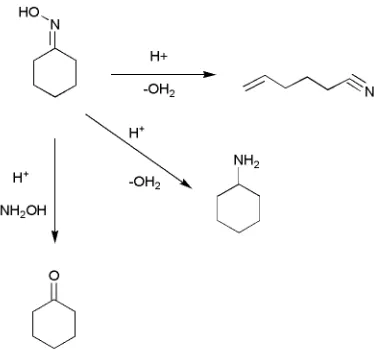
cyclohexanone oxime to ε-caprolactam. This process is well known industrially
as ε-caprolactam is used in the synthesis of nylon. Industrially a homogeneous
process is used to affect the rearrangement; however, due to a number of
perceived short-comings of the homogeneous process there has been extensive
research into the possibility of viable heterogeneously catalysed alternative
process. Rapid catalyst deactivation has plagued the studied heterogeneous
alternatives. This makes the reaction ideal to study in this project. However, the
high temperatures required for the heterogeneous process will lower the density
of the carbon dioxide used in the reaction at higher pressures. An important area
of the study will, therefore, be the comparison of results obtained at high
pressures of carbon dioxide to results obtained under the same pressures with
nitrogen.
The second reaction to be studied will be the Fries rearrangement of
phenyl acetate to hydroxyacetophenones. This process is well known
industrially as a route to acylated phenols, and is generally performed as a
into finding an alternative method of this rearrangement, either through use of a
heterogeneous process or photolysis. Using photolysis generally leads to poor
yields of the desired product and the heterogeneous catalyst studied suffer badly
from catalyst deactivation. The process is, therefore, ideal for study in this
project. The process can be affected at considerably lower temperatures than the
Beckmann rearrangement of cyclohexanone oxime (150°C) and it will thus
enable the use of higher densities of carbon dioxide. Once again the comparison
of carbon dioxide with nitrogen will form a key part of the study.
The third process to be studied will be the Diels-Alder addition of methyl
acrylate to isoprene. This reaction is well known industrially as a route to
cyclohexene derivatives, and the process is most commonly performed using a
Lewis acid as a catalyst. As these Lewis acid catalysts are generally corrosive
and toxic there has been a considerable amount of research into finding a viable
heterogeneous alternative. As with the Beckmann and Fries rearrangements
above these studies have been plagued by rapid catalyst deactivation. The
heterogeneous process is possible under 100°C and is therefore ideal for the
purposes of this project to study under higher densities of carbon dioxide. The
comparison of the results obtained with carbon dioxide to results obtained with
nitrogen will be key in determining the effect of using carbon dioxide as the
1.7-References
(1) Cagniard de La Tour, C.Annales de Chimie et de Physique,1822, 21, 127
& 178
(2) Andrews, T.,Annales de Chimie et de Physique,1870, 21, 208
(3) Zeitschrift fur Komprimierte and Flussige Gase,1897-date
(4) Andrews, T.,Philosophical Transactions,1869, 588
(5) Hannay, J.B.; Hogarth, J.,Proc R Soc,1879, 29, 324
(6) Hannay, J.B.; Hogarth, J.,Proc R Soc London,1880, 30, 178
(7) Krukonis, V.J.,Proc Annu Am Inst Chem Eng,1984, 140
(8) Villard, P.,J. Phys.,1896, 5, 455
(9) Eucken, A.; Bressler, F., Z.Physikal. Chem. A,1928, 134, 230
(10) Braune, H.; Strassman,Z. Physikal. Chem. A,1929, 143, 225
(11) Robin, S.; Vodar, B.,Discussions of the Faraday Society,1953, 15, 238
(12) Ewald, A.;Jepson, W.B.; Rowlinson, J.S., Discussions of the Faraday
Society,1953, 15, 238
(13) Franck, E.U.,Angew Chem,1961, 73, 309
(14) Gordon, C.M.; Leitner, W., Catalyst Separations, Recovery & Recycling,
Springer Dordrecht,2006
(15) Clifford, T.,private communication
(16) Lucien, F.P.; Foster, N.R., Chemical Synthesis in Supercritical Fluids,
Jessop, P.G., Leitner, W., Eds, Wiley-VCH: Weinheim,1999
(17) McHugh, M.A., Krukonis V.J.; Supercritical Fluid Extraction;
(18) Chem Rev,1999
(19) Zosel, K.,Angew Chem,1978, 17, 702
(20) Zosel, K., US Patent 3969196,1976
(21) Grubb, M.,Financial Times,2005, 15 Feb
(22) Herrero, M.; Cifuentes, A.; Ibanez, E.,Food Chem,2006, 98, 136
(23) Saldana, M.D.A.; Nagpal, V.; Guigard, S.E., Environ Technol, 2005, 9,
1013
(24) Sang-Do, Y.; Erdogan, K.,J Supercrit Fluids,2005, 34, 287
(25) Jung, J.; Perrut, M.,J Supercrit Fluids,2001, 20, 179
(26) Reverchon E.,J Supercrit Fluids,1999, 15, 1
(27) Wood, C.D.; Cooper, A.I.; DeSimone, J.M., Current Opinion in SS and
Mat Sci,2004, 8, 325
(28) Kendall, J.L.; Canelas, D.A.; Young, J.L.; DeSimone, J.M., Chem Rev,
1999, 99, 543
(29) Subramaniam, B.; Rajewski, R.; Snavely, K.,J Pharm Sci,1997, 86, 885
(30) Stanton, L.A.; Dehghani, F.; Foster, N.R.,Aust J Chem,2002, 55, 443
(31) DeSimone, J.M.,Science,2002, 297, 799
(32) Nakaoki, T.; Kitoh, M.; Gross, R.A., ACS Symposium Series,2005, 900,
393
(33) Jessop, P.G.; Ikariya, T.; Noyori, R.,Chem Rev,1999, 99, 475
(34) Beckman, E.J.,J Supercrit Fluids,2004, 28, 121
(35) Rathke, J.W.; Klingler, R.J.; Krause, T.R., Organometallics, 1992, 116,
4772
(36) Webb, P.B.; Sellin, M.F.; Kunene, T.E.; Williamson, S.; Slawin, A.M.Z.;
(37) Jin, H.; Subramaniam, B.; Ghosh, A.; Tunge, J., AICHE Journal,2006,
52, 2575
(38) Yonker, C.H.,Anal Chem,2006, 78, 3909
(39) Phinney, K.W.,Anal Bioanal Chem,2005, 382, 639
(40) Yonker, C.R.; Linehan, J.C.,Prog NMR Spec,2005, 47, 95
(41) Baiker, A.,Chem Rev,1999, 99, 453
(42) Hyde, J.R.; Licence, P.; Carter, D.; Poliakoff, M., Appl Catal A, 2001,
222, 119
(43) Gopolan, A.S.; Wai, C.M.; Jacobs, H.K., ACS Symposium Series, 2003,
860, American Chemical Society
(44) Bartholomew, C.H.,Appl Catal A,2001, 212, 17
(45) Menon, P.G.,J Mol Catal,1990, 59, 207
(46) Guisnet, M.; Magnoux, P.,Appl Catal,1989, 54, 1
(47) Grotten, W.A.; Wojciechowski, B.W.; Hunter, B.K., J Catal,1992, 138,
343
(48) Bellare, A.; Dadyburjor, D.B.,J Catal,1993, 140, 510
(49) Uguina, M.A.; Serrano, D.P.; Grieken, V.R.; Venes, S., Appl Catal A,
1993, 99, 97
(50) Wei, W.; Sun, Y.H.; Zhong, B.,Chem Commun,1999, 2499
(51) Subramaniam, B.,Appl Catal A,2001, 212, 199
(52) Clark, M.C.; Subramaniam, B.,Chem Eng Sci,1996, 51, 2369
(53) Clark, M.C.; Subramaniam, B.,Ind Eng Chem Res,1998, 37, 1243
(54) Tiltscher, H.; Wolf, H.; Schelchshorn, J., Agnew Chem Int Ed, 1981, 20,
(55) Thompson, D.N.; Ginosar, D.M.; Burch, K.C.; Appl Catal A, 2005, 279,
109
(56) Petkovic, L.M.; Ginosar, D.M.; Burch, K.C.;J Catal,2005, 234, 328
(57) Subramaniam, B.,Appl Catal A,2001, 212, 199
(58) Husain, A., US Patent 5304698,1994
(59) Fan, L.; Nakamura, I.; Ishida, S.; Fujimoto, K.,Ind Eng Chem Res,1997,
36, 1458
(60) Clark, M.C.; Subramaniam, B.,Ind Eng Chem Res,1998, 37, 1243
(61) Ginosar, D.M; Thompson, D.N.; Coates, K.; Zalewski, D.J., Ind Eng
Chem Res,2002, 41, 2864
(62) Santana, G.M.; Akgerman, A.;Ind Eng Chem Res,2001, 40, 3879
(63) Querini, C.A.,Catal Today,2000, 62, 135
(64) Thompson, D.N.; Ginosar, D.M.; Burch, K.C., Appl Catal A,2004, 262,
223
(65) Ginosar, D.M.; Petkovic, L. M.,Appl Catal A,2004, 275, 235
(66) Thompson, D.N.; Ginosar, D.M.; Burch, K.C.; Zalewski, D.J., Ind Eng
Chem Res,2005, 44, 4534
(67) Thompson, D.N.; Ginosar, D.M.; Burch, K.C.,Ind Eng Chem Res,2006,
45, 567
(68) Gao, Y.; Liu, H.-Z.; Shi, Y.-F.; Yuan, W.-K., 4th International
Symposium on Supercritical Fluids, Sendai, Japan,1997, 531
(69) Gao, Y.; Shi, Y.-F.; Yuan, W.-K.,Catal Today,2002, 74, 91
(70) Meng, X.; Qin, Z.; Zhang, Y.; Dong, M.; Wang, J.,Catal Lett,2002, 3-4,
(71) Ginosar, D.M.; Coates, K.; Thompson, D.N., Ind Eng Chem Res, 2002,
41, 6537
(72) Kamalakar, G.; Komura, K.; Sugi, Y.,Catal Lett,2006, 108 (1-2), 31
(73) Horikawa, Y.; Uchino, Y.; Shichijo, Y.; Sako, T., J Jpn Pet Inst, 2004,
47, 136
(74) Kamalakar, G.; Komura, K.; Sugi, Y.,Chem Lett,2005, 34, 1446
(75) Bai, X.F.; Wu, W.; Hu, H.Q.,Chem Res Chin Uni,2005, 21, 680
(76) Hitzler, M.G.; Smail, F.R.; Ross, S.K.; Poliakoff, M., Chem Commun,
1998, 359
(77) Armandi, R.; Licence, P.; Ross, S.K.; Aaltonen, O.; Poliakoff, M., Org
Process Res Dev,2005, 9, 451
(78) Armandi, R.; Hyde, J.R.; Ross, S.K.; Lotz, T.J.; Poliakoff, M., Green
Chem.,2005, 7, 288
(79) Arunajatesan, V.; Wilson, K.A.; Subramaniam, B., Ind Eng Chem Res,
2003, 42, 2639
(80) Funamoto, T.; Nakagawa, T.; Segawa, K.,Applied Catal A,2005, 286, 79
(81) Kraushaar-Czarnetzki, B.; Sander, B.; Thelen, M., Ind Eng Res Chem,
2001, 40, 2767
(82) Kraushaar-Czarnetzki, B.; Zerrer, B.,Ind Eng Res Chem,2005, 44, 1698
(83) Hou, Z.; Han, B.; Zhang, J.; Liu, Z.; He, J.; Zhang, X.; Yang, G., J
Supercrit Fluids,2003, 25, 81
(84) Dardas, Z.; Suer, M.G.; Ha, Y.H.; Moser, W.R.,J Catal,1996, 159, 204
(85) Scott, D.S.; Radlein, D.; Piskorz, J.; Majerski, P.; deBruijn; T.J.W.,Fuel,
(86) Zhao, S.; Kotlyar, L.S.; Woods, J.R.; Sparks, B.D.; Hardacre, K.; Chung,
K.H.,Fuel,2001, 80, 1155
(87) Niu, F.; Hofmann, H.,J Chem Eng,1997, 75, 346
(88) Walsh, B.; Hyde, J.R.; Licence, P.; Poliakoff, M., Green Chem, 2005, 7,
456
(89) Li, X.; Liu, X.; Liu, Z.-W.; Asami, K.; Fujinoto, K., Catal Today,2005,
106, 154
(90) Macher, M.B.; Holmqvist, A.,Euro J Lipid Sci Tech,2001, 103, 81
(91) Nunoura, T.; Lee, G.; Matsumura, Y.; Yamamoto, K.,Ind Eng Chem Res,
2003, 42, 3718
(92) Oshima, Y.; Inaba, K.; Koda, S.,J Jpn Pet Inst,2001, 44, 343
(93) Garcia-Verdugo, E.; Fraga-Dubreuil, J.; Hamley, P.A.; Thomas, W.B.;
Chapter 2-Catalysis Rig- Design,
2-Catalysis Rig- Design, Maintenance & Operation
2.1-Introduction
As detailed in the previous chapter, the purpose of this project was to
assess the use of carbon dioxide above its critical temperature and pressure as a
medium for heterogeneously catalysed reactions. The first step of this project
was, therefore, to design and assemble a rig that was appropriate to the work that
was intended to be performed.
In the initial project proposal three areas of study where discussed, these
where the Cyclar process, the Caprolactam process, and the possibility of
immobilised catalysts in hydroformylation. For these processes to be studied
using supercritical carbon dioxide the rig would be required to meet many
criteria. The most important of these requirements being to be able to withstand
and control high pressures and temperatures for reaction, facilitate the use of
supercritical carbon dioxide, allow access for highly volatile liquids, allow access
for gases other than the reaction medium, and provide a simple method of
sampling the product stream.
The design and assembly of a rig meeting these requirements would take
a considerable length of time; therefore it was fortunate for this project that at
this time an inactive rig was in the possession of the research group to form the
2.2-Original Rig Design
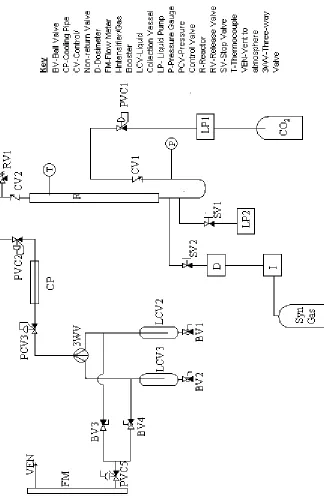
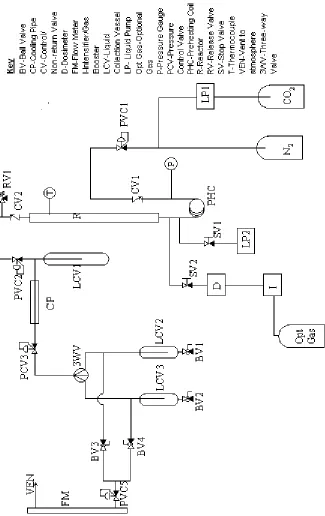
The rig (figure 2.1) had been used to investigate the possibility of using
solid supported catalysts in hydroformylation in conjunction with supercritical
fluids. As would be expected this rig already met many of the requirements for
the project. The rig could be broadly split into two sections, a high-pressure
section and a low-pressure section. The high-pressure section begins with a
Pickel Supercritical Fluid Pump. This, when connected to a carbon dioxide
liquid feed cylinder, can deliver carbon dioxide at pressures up to 600 bar. The
pressure of carbon dioxide in the system was controlled by an inlet valve
(PCV1), which could allow up to 300 bar of gas to pass into the system.
Immediately after the inlet valve, there was a pressure gauge, to monitor the
pressure before the reactor, and a non-return valve to prevent gas, liquid, or
supercritical fluid from the system flowing back to the Pickle pump.
Just before the reactor there were connections to allow the introduction of
liquids and gases. A syn gas cylinder was connected to a Haskell gas booster
capable of increasing the pressure of syn gas up to 800 bar. This was connected
to a dosimeter (D), which controlled the rate at which syn gas was allowed into
the system.
After this pair of connections was the reactor. The reactor was made
block, which was heated by two heating elements. The temperature was
controlled using a J-type thermocouple placed inside the reactor and connected to
the heating elements.
Downstream of the reactor there was a filter; this was added to the
apparatus due to problems of the catalyst blowing out from the reactor. Beyond
the filter was a pressure control valve (PCV2), at which point the high-pressure
section of the rig crossed to the low-pressure section. This pressure control valve
lowers the pressure to below 10 bar; the product stream is then passed through a
brass condenser pipe to cool it, before passing through another pressure control
valve (PCV3). After this final pressure control valve the product stream can be
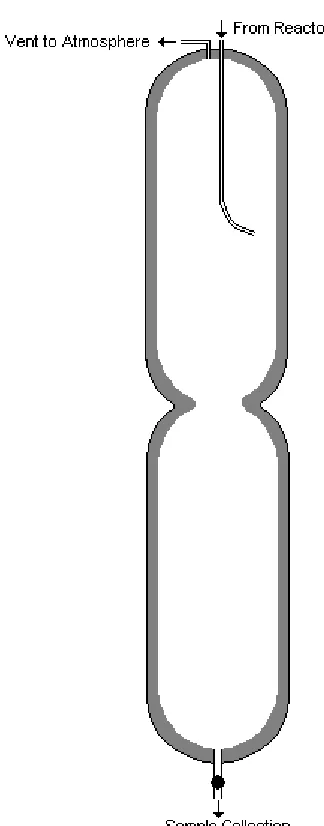
passed through one of two collection chambers from which samples can be taken
without disrupting the flow of gas from the system. Finally the gas is vented
from the system through a flow meter, with the rate of venting being controlled
by a needle valve located just before the flow meter.
2.3-Design of Project Rig
The original rig design met all of the stated criteria to a certain extent, but
there were still several areas in which it was felt that the design could be
improved in order to facilitate ease of handling and maintenance of the rig.