Stress-Oriented Structural Optimization for Frame Structures
Abstract
To fabricate a virtual shape into the real world, the physical strength of the shape is an important consideration. We in-troduce a framework to consider both the strength and com-plexity of 3D frame structures. The key to the framework is a stress-oriented analysis and a semi-continuous condition in the shape representation that can both strengthen and sim-plify a structure at the same time. We formulate a novel semi-continuous optimization and present an elegant method to solve this optimization. We demonstrate our approach with applications such as topology simplification and struc-tural strengthening.
Keywords: 3D printing, fabrication, stress analysis, opti-mization, topology simplification
1
Introduction
We have witnessed many developments in the area of com-putational fabrication in recent years [1, 2, 3, 4]. As 3D print-ers become increasingly common and affordable, there is a great need for tools that consider the physical properties of virtual meshes. When bringing virtual objects into the real world through 3D printing, the strength of an object is one such important consideration. We present a framework to analyze both the strength and complexity of 3D frame struc-tures, where a structure consists of a set of beams. The motivations for focusing on frame structures are that these structures are common in architectural models, they can also represent general 3D shapes, and they can be 3D printed as a real-world frame structure to represent the virtual shape without an excessive amount of printing material.
There has been some recent work exploring the idea of strength analysis of 3D printed shapes [5, 6, 7]. There also exists work that analyze structural parts and reduce the cost of 3D printing by building a skin-frame structure [8] or a honeycomb-cells structure [9]. In this paper, we introduce a single stress-oriented framework to analyze the strength and complexity of 3D frame structures at the same time. A key contribution different from previous work is that we have a problem formulation and a semi-continuous condition in our shape representation. This condition can remove structurally redundant elements to reduce the overall shape complexity without sacrificing its structural strength.
We formulate our problem to optimize scalar parameters of a frame structure such that it is 3D printable with high strength, while taking into account the volume, symmetric,
semi-continuous, and sparsity constraints. These constraints are quite intuitive, as they limit the size and complexity of the output structure while maintaining its aesthetics. The idea is to strengthen weak parts while maintaining the overall volume of the shape, and optionally changing the topology and maintaining the shape symmetry. In particular, the semi-continuous constraint is key to our formulation, as it includes a choice between lower and upper bounds and a value of zero for each parameter in the shape representation. An element within a shape with a parameter value of zero will disappear. Our formulation of this condition in the problem allows us to explore the tradeoffs between strength and complexity in frame structures. The user can also control the tradeoff to choose among structures with various simplified topologies and high strength.
We use stress as a measure of strength of an object. We consider the frame structure as a set of beam elements and compute the stress of each element. Our stress-oriented structural optimization then minimizes the maximal stress of all elements. The semi-continuous condition in our shape representation requires a non-trivial solution to this prob-lem. Hence we formulate a novel semi-continuous optimiza-tion and present an elegant method, the alternaoptimiza-tion direcoptimiza-tion method of multipliers (ADMM) algorithm, to solve it.
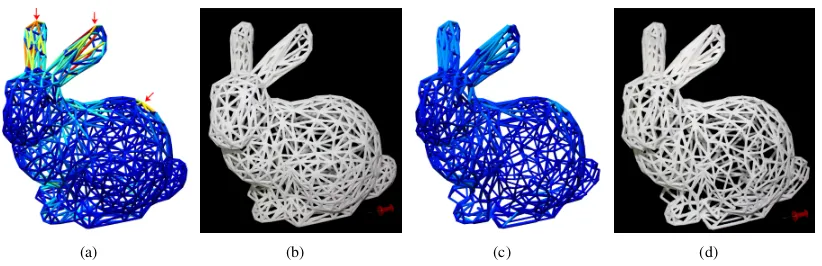
We demonstrate our framework with various 3D models of frame structures. Figure 1 shows one example of the bunny frame structure. We show the applications of the strength-ening of weak parts and topology simplification while main-taining structural symmetry. Our results highlight the main concepts of the stress-oriented structural optimization.
2
Related Work
(a) (b) (c) (d)
Figure 1: Our approach analyzes an input 3D frame structure to perform simultaneous structural strengthening and simplifi-cation for 3D printing. (a) The input bunny frame model with 1569 beams. The external loads are denoted as red arrows. (b) A photo of the SLS 3D printed models of the input. A small red drawing pin is placed under the object as a size reference. (c) The resulting model obtained by our approach. The number of beams is reduced to 1319. (d) A photo of the SLS 3D printed models of our output.
Chen et al. [11] analyze elastic deformation caused by grav-ity to solve the inverse problem of computing a shape that when fabricated deforms naturally to a target shape. Yang et al. [12] design a support-free structure to print a balanced object without interior supports. Among this area of work, we contribute a stress-oriented problem formulation for auto-matically strengthening a frame structure while simplifying its structural complexity.
Structural Simplification for Fabrication There has been work on problems which aim to simplify the complex-ity of the structure of 3D shapes for fabrication. Many meth-ods are based on decomposing a 3D shape into smaller pieces and then assembling them to form the original shape or a resemblance of it. Luo et al. [13] suggest a method to 3D print large objects by first segmenting an object into smaller parts and then assembling the parts to form the larger shape. Hildebrand et al. [14] create parts from a 3D shape that can then be fabricated and assembled in an optimal direction. Interlocked planar [15, 16] or solid pieces [17, 18] can be used to form a shape that resembles the original. Zimmer et al. [19] describe an approach to approximate mesh surfaces by building physical structures with the Zometool construc-tion system. Vanek et al. [20] present a method to divide a mesh into parts which are then efficiently packed into space for 3D printing. Instead of decomposing a shape into smaller pieces, we simplify a frame structure by possibly removing elements from it. We contribute a semi-continuous optimiza-tion for this purpose.
Special Structure Design Motivated by existing architec-tural structures, some types of special 3D printed structures have been explored. Some structures, such as the skin-frame structure [8] and honeycomb-cells structure [9], are designed to reduce the cost of 3D printing via stress anal-ysis. These methods are used for constructing the interior
supporting structure of a solid object and these structures are cost-effective and are stable with high strength. Some struc-tures are designed as the support structure necessary for 3D printing. The reduction of support structure can save printing time and material [21]. A bridge structure [4] can reduce the cost and meet stability conditions. Recently, Jiang et al. [22] propose a framework to generate a frame structure with dif-ferent types of cross sections, which is statically sound and materially efficient. In this paper, we focus on strengthening and simplifying frame structures consisting of beams.
3
Preliminaries
This section describes the stress analysis and the representa-tion of an input 3D shape of our algorithm as a frame struc-ture. The stress computation described here is used in our optimization in Section 4.
3.1
Stress Computation
In continuum mechanics, stress is a physical quantity that ex-presses the internal forces that neighboring particles of a con-tinuous material exert on each other [23, 24]. The strength of a material is measured in force per unit area, which depends on its capacity to withstand axial stress, shear stress, bend-ing, and torsion. A static elastic object satisfies the following equilibrium equation:
−divσ(u) =f, inΩ
u=0, onΓH
σ(u)·n=g, onΓN
(1)
where u is the displacement, σ is the stress tensor, f is the body force, and gis the surface force. This differen-tial equation is defined in the region of an objectΩ,ΓHand
∂Ω = ΓH∪ΓN andΓH∩ΓN =∅. We take the discretized form of this system, which becomes the linear equilibrium equation:
Ku=F (2)
whereK is the stiffness matrix andF is the external loads including body forces and surface forces.
3.2
Frame Structure
A frame structure consists of a set of beams and nodes where the beams are connected to each other at the nodes. Each beam is a cylindrical shape with a radius. The beams de-fines the topology (i.e. the connectivity between nodes) of the frame structure. According to theory on the frame struc-ture [25, 26], the stiffness matrixK in Equation (2) can be computed for a frame structure, where K depends on the node positions and beam radii [8]. The forces in this equa-tion are gravity or external loads we specify. We can then solve for the displacement and compute the stress for each beam in the frame structure. Although the stress is different in different part of the beam, we only consider the largest stress for each beam.
4
Problem and Formulation
We describe our problem formally in this section, includ-ing the objective function in our optimization, various con-straints, and the problem formulation. The stress analysis from Section 3 allows us to compute the stress in our opti-mization. The solution to the optimization is presented in Section 5.
4.1
Problem
Stress Strengthening Our problem involves two compo-nents and the first component is structural strengthening. Structural optimization aims to determine the best design according to some objectives (e.g. greatest strength, maxi-mum rigidity, lowest cost) under some constraints. A struc-ture fails the strength criterion when the stress (force divided by area of material) induced by the load is greater than the capacity of the structural material to resist the load with-out breaking, or when the strain (percentage extension) is so great that the element no longer fulfills its function. As acknowledged in the literature [27, 28, 29], it is natural to use stress or strain as criteria for the weakness measure of a target structure. Hence we use stress as a criterion for the purpose of structural strengthening.
Structural Complexity The second motivation is com-plexity. There exists many beams in our frame structures and some of these beams are not significant to the stress of the overall structure. We may therefore remove some of them without affecting the stress of the overall shape and to sim-plify its structural complexity.
Problem The input to our problem is a frame structure of beams. Considering the above two components, our problem is to perform simultaneous stress strengthening and struc-tural complexity reduction of the input shape under some external loads. The output is a modified frame structure with a smaller number of beams while the stress of the shape is maintained or strengthened. The radii of some beams are ad-justed while some beams are removed. The resulting shape may be 3D printed as a structure with high strength and sim-plified complexity.
4.2
Objective Function
Objective Function Let M be a mesh representing the frame structure. We adopt stress as a criterion for the weak-ness measure of an object and minimize the maximal stress of the beams in the structure. The stress-oriented structural optimization problem can thus be formulated as
s∗= arg min
s∈Θ
max
p∈M(s)σ(p) (3) where s is the vector of structural design variables, Θ is the collection of all feasible design variables, andθ is the stress function. The solution of the above problem iss∗, and
M(s∗)is then the output shape.
Design Variables The degree of freedom of the structural design space is large in general. Hence we simplify the prob-lem by focusing on a piecewise scaling transformation for each element of the shape. LetK= (VK, EK)be the frame
structure of a shape, whereVKandEK represent the set of
nodes and beams respectively. For every beam, we define a scalarsi, i ∈ {1,· · ·,|EK|}which is the scaling factor
of the radius of each beam. Lets= (s1, s2,· · · , s|EK|)be
our set of structural design variables. We can perform many changes to the shape by adjusting these scalar variables. For example, we can adjustsito strengthen weak parts. We can
re-distribute volume in the overall shape by adjustingsi for
multiple parts. If we setso=1= (1,1,· · ·,1), thenM(so)
is the original object. If we set somesi = 0then the
corre-sponding part will disappear and we can perform topological changes to the overall shape.
4.3
Constraints
We consider various constraints in our framework to main-tain the size, aesthetics, and complexity of the output shape.
Volume Constraint We compute the shape’s volume by adding the volume of all beams. Each beam’s volume is es-timated as the cross sectional area multiplied by its length. We can write the volume constraint as:
Vol(s)≤γVol(1) (4)
Symmetry Constraint In many practical applications, it is important to maintain the symmetry of a shape during its structural optimization, so as to maintain its overall aesthet-ics. Our approach can achieve this by adding symmetry con-straints as follows:
si−sj= 0,(i, j)∈ S (5)
whereS is the set of index pairs of beams that we wish to maintain symmetry with.
Semi-continuous Constraint In order to satisfy the print-ability of the object, the scalarsishould be within an interval [ai, bi]. For example, the scalar should be set such that the
thickness of the shape is not less than the minimum manufac-turable size of the 3D printer. Each scalarsican also take a
zero value. Hence this leads to a semi-continuous condition:
si∈[ai, bi]∪ {0}, i∈ I ={1,2,· · · ,|EK|}. (6)
Sparsity Constraint Moreover, we can add a cardinality constraint to control the overall complexity of the structure:
ksk0≤τ. (7)
4.4
Formulation
We can now formulate our stress-oriented structural opti-mization as follows
arg min
s
max e∈E σe(s) s.t. Vol(s)≤γVol(1)
si−sj = 0, (i, j)∈ S
si∈[ai, bi]∪ {0}, i∈ I
ksk0≤τ
(8)
whereE is the set of beams in the frame structure, andσeis
the stress function described in the previous section.
5
Semi-Continuous Optimization
In the formulation of our optimization (Equation (8)), the scaling factorssare a set of semi-continuous decision vari-ables [30, 31]. Theoretically, it is in general NP-hard to solve this kind of highly nonlinear optimization problem which has combinatorial nature (semi-continuous sparsity) [32, 33]. Thus we reformulate our problem and then mathematically derive an algorithm based on the ADMM (alternating direc-tion method of multipliers) strategy [34, 35] to solve it. The ADMM method is designed to solve convex optimization problems by breaking them into smaller pieces, and it has been applied to a number of problems arising in statistics and machine learning [35, 36]. The semi-continuous condition in our problem formulation leads to two sets of variables. The idea of ADMM is to split the optimization into sub-problems that iteratively find solutions to the two sets of variables.
5.1
Problem Reformulation
We add a new variableδto represent the maximum stress and introduce a variable splitting strategy (and a new variabley) to reformulate the problem in Equation (8) as:
arg min
(s,δ,y)
δ
s.t. σe(s)−δ≤0, e∈ E Vol(s)≤γVol(1) si−sj= 0, (i, j)∈ S
s−y= 0
y∈ Y
(9)
where Y = {y | aizi ≤ yi ≤ bizi, zi ∈ {0,1}, i ∈
I;1Tz≤τ}. The optimals∗is our solution. The advantage
of introducing the variableyis that it allows the decoupling of the continuous constraint and the semi-continuous spar-sity constraint, since each of them now applies to one specific optimization variablesory. Although we introduce an ad-ditional constraint, it is now easier to solve the reformulated problem (Equation (9)) than the original one (Equation (8))
5.2
Solution
Our solution is based on ADMM which is itself based on an augmented Lagrangian function and two sub-problems within the overall optimization. We describe these in detail in this sub-section.
Augmented Lagrangian One typical way for solving such an optimization problem is to use an augmented Lagrangian approach [37]. We use this method and define the problem’s augmented Lagrangian function as follows:
Lρ(s, δ,y,λ) =δ+λT(s−y) +ρ 2ks−yk
2 (10)
withλbeing the Lagrangian multipliers andρa positive pa-rameter that balances the quadratic penalization.
Pseudocode Instead of a joint optimization on the two variables, the idea of ADMM is to optimize alternatively over (s, δ) and y. Algorithm 1 gives the pseudocode of our solution with ADMM. The stopping criterion in the op-timization is: the value of the function has almost no change or the number of iteration steps reaches a given upper bound.
(s, δ)-subproblem The (s, δ)-subproblem in the ADMM algorithm involves a quadratic objective and the continuous constraint. We use the interior-point method to solve the sub-problem:
min
(s,δ)∈Dδ+ ρ 2ks−(y
k−λk
/ρ)k2 (11)
where D = {(s, δ) | σe(s)−δ ≤ 0, e ∈ E; Vol(s) ≤
γVol(1);si−sj = 0,(i, j)∈ S}is the feasible set of
(a) (b) (c) (d)
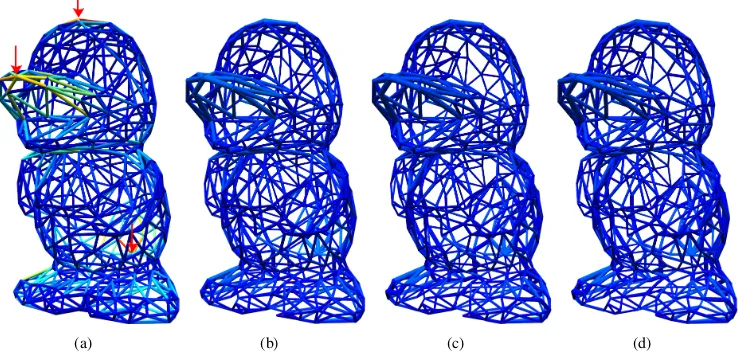
Figure 2: The results of applying our approach on a frame structure of a duck. (a) The input duck model with 1107 beams. Three external loads (marked as red arrows) are applied on the model. (b,c,d) The simplified duck models (with 1007, 957, 907 beams respectively) obtained with our approach. The resulting models are increasingly simplified while their structures still remain strong.
Algorithm 1The ADMM algorithm for structural optimiza-tion
Input:an initial structureM(so)
Step 0: Set k = 0and initialize y0,λ0. Set the penalty parameterρand the step-sizeα.
Repeat
Step 1:Solve the(s, δ)-subproblem
(sk+1, δk+1) = arg min
(s,δ)∈D
Lρ(s, δ,yk,λk)
Step 2:Solve they-subproblem
yk+1= arg min
y∈Y
Lρ(sk+1, δk+1,y,λk)
Step 3:Update the Lagrangian multipliers
λk+1=λk+αρ(sk+1−yk+1)
Untilstopping criterion is met.
Output:an optimized structureM(s∗)with its optimal vari-ables
y-subproblem We rewrite the y-subproblem as a close-form solution, starting with:
min
y∈Y ky−(s
k+1+λk
/ρ)k2=P
i
(yi−ti)2 (12)
withti=ski+1+λ k
i/ρ. Ifyi6= 0, we denote
ζi= min
y∈Y(yi−ti)
2
=
(ai−ti)2 ti< ai,
0 ai≤ti≤bi,
(bi−ti)2 ti> bi.
Then this subproblem can be further simplified as:
min
z
X
i
t2i(1−zi) +ζizi
=X
i t2i −
X
i
(t2i −ζi)zi
s.t. zi∈ {0,1}, i∈ I; 1Tz≤τ.
(13) Let{t2
`1−ζ`1, t
2
`2−ζ`2,· · · , t
2
`τ−ζ`τ}be the firstτpositive
numbers of sequence{t2
i −ζi}i∈Iin descending order. The
problem in Equation (13) has the solutionz`1 =z`2 =· · ·=
z`τ = 1; zi = 0, i /∈ {`1, `2,· · ·, `τ}. Finally, we get a
closed-form solution
yi= max(ai,min(ti, bi))·zi ∀i∈ I
for they-subproblem (Equation (12)).
6
Experimental Results
We have implemented our algorithm and tested it on vari-ous models. All the examples presented in this paper were created with a dual-core 3.5 GHz machine with 8G memory. We have 3D printed some of the models to demonstrate our results.
[image:5.612.123.492.65.241.2](a) (b) (c) (d) (e) (f)
Figure 3: Results of applying our approach on the eiffel tower model. (a) The input Eiffel Tower frame model with 1521 beams. (b) The computed stress of the input model under an external load of 2N (shown by red arrow). (c) A photo of the SLS 3D printed model of the input. A small red pin is placed under the object as a size reference. (d) The simplified frame model with 1341 beams obtained by our approach. (e) The computed stress of the output model under the same external load as that of the input in (b). We can see that the output model has higher strength and reduced complexity. (f) The photo of the SLS 3D printed model of our output.
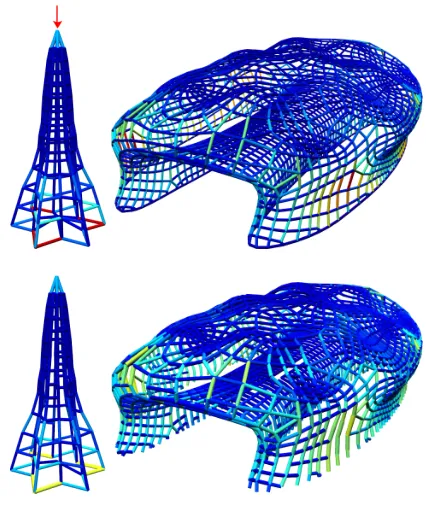
[image:6.612.66.279.355.608.2]Figure 4: Results of applying our approach on the boomerang model (left) and the airport model (right). An ex-ternal load (shown in red arrow) is applied on the boomerang model. Gravity is applied as external load to the airport model. The original models (top) have 312 and 5045 beams respectively. Our results (bottom) have 284 and 4585 beams respectively and they are both structurally simplified and strengthened compared to the originals.
Figure 2 shows the results of our algorithm on a frame structure of a duck model. We set different values of the sparsity parameterτand obtain a sequence of results. The re-sulting structural shapes in Figure 2(b,c,d) are progressively simplified in the number of beams while their strengths are maintained.
Figure 3 shows an example of eiffel tower. In this exam-ple, since the feet of the tower are fixed, the beams connect-ing fixed nodes have zero stress, thereby beconnect-ing removed.
Figure 4 shows two examples whose external loads are vertical down. The left one is the frame structure of boomerang. Since the given external force is vertical down, some horizontal beams have less contribution to the sound-ness, thus being removed by our optimization. The right one is the airport model with a constant gravity on each node. Note that there are also some horizontal beams removed due to the similar reason.
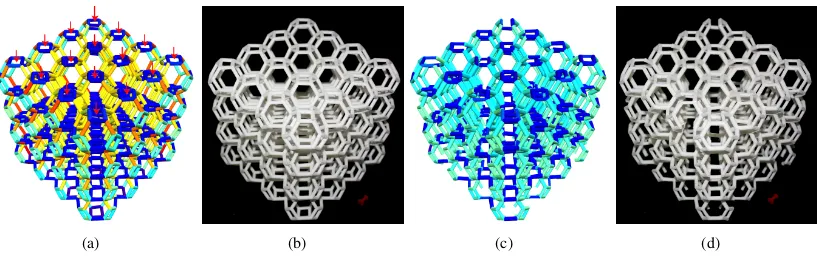
Figure 5 show the result of a complicated structure. The model demonstrate the application of our method to both structural simplification and strengthening, as the results have reduced complexity and higher structural strength.
7
Conclusion
semi-(a) (b) (c) (d)
Figure 5: Results of applying our approach on the “hardstruct” model. (a) The input model where external loads are denoted as red arrows. The hardstruct model has 1728 beams. (b) We 3D printed the input model with a Sinterstation SLS 3D printer. A small red pin is placed under the object as a size reference. (c) The resulting model obtained by our approach is structurally simplified and strengthened with our approach. The hardstruct model has 1548 beams. (d) We physically demonstrate our results by 3D printing the output model.
continuous condition. We then derive an algorithm based on the ADMM method to solve the optimization and show its applicability and feasibility towards topology simplification and structural strengthening. Although this paper focuses on frame structures, our framework can be extended to general meshes by considering them as skeletal tetrahedral structures and we leave this for future work.
One limitation of our work is that we do not move the po-sitions of the nodes in a structure. This means that although the structure can be much simplified, the inherent topology of the original structure remains the same. Moving the posi-tions of the nodes can potentially be done in our optimization framework. However, this will enlarge the dimensions of the variable space and will need higher computational cost. We leave this as a future research direction.
Another area of future work that is relevant for fabrica-tion is the computafabrica-tion of supporting structures for FDM 3D printing. There has already been previous work in this area recently. Applying our stress-oriented structural optimiza-tion to this problem would be an interesting direcoptimiza-tion.
References
[1] Bernd Bickel, Moritz B¨acher, Miguel A. Otaduy, Hyunho Richard Lee, Hanspeter Pfister, Markus Gross, and Wojciech Matusik. Design and fabrication of ma-terials with desired deformation behavior.ACM Trans-actions on Graphics, 29(4):63:1–63:10, July 2010.
[2] Stelian Coros, Bernhard Thomaszewski, Gioacchino Noris, Shinjiro Sueda, Moira Forberg, Robert W. Sum-ner, Wojciech Matusik, and Bernd Bickel. Computa-tional design of mechanical characters. ACM Transac-tions on Graphics, 32(4):83:1–83:12, July 2013.
[3] Romain Pr´evost, Emily Whiting, Sylvain Lefebvre, and Olga Sorkine-Hornung. Make it stand:
Balanc-ing shapes for 3D fabrication. ACM Transactions on Graphics, 32(4):81, 2013.
[4] J´er´emie Dumas, Jean Hergel, and Sylvain Lefebvre. Bridging the gap: Automated steady scaffoldings for 3D printing.ACM Transactions on Graphics, 33(4):98, 2014.
[5] Ondrej Stava, Juraj Vanek, Bedrich Benes, Nathan Carr, and Radom´ır Mˇech. Stress Relief: Improving structural strength of 3D printable objects.ACM Trans-actions on Graphics, 31(4):48, 2012.
[6] Qingnan Zhou, Julian Panetta, and Denis Zorin. Worst-case structural analysis. ACM Transactions on Graph-ics, 32(4):137, 2013.
[7] Yue Xie, Weiwei Xu, Yin Yang, Xiaohu Guo, and Kun Zhou. Agile structural analysis for fabrication-aware shape editing. Computer Aided Geometric Design, 35-36(5):163C179, 2015.
[8] Weiming Wang, Tuanfeng Y Wang, Zhouwang Yang, Ligang Liu, Xin Tong, Weihua Tong, Jiansong Deng, Falai Chen, and Xiuping Liu. Cost-effective printing of 3D objects with skin-frame structures. ACM Transac-tions on Graphics, 32(6):177, 2013.
[9] Lin Lu, Andrei Sharf, Haisen Zhao, Yuan Wei, Qingnan Fan, Xuelin Chen, Yann Savoye, Changhe Tu, Daniel Cohen-Or, and Baoquan Chen. Build-to-last: Strength to weight 3D printed objects. ACM Transactions on Graphics, 33(4):97, 2014.
[10] Timothy Langlois, Ariel Shamir, Daniel Dror, Woj-ciech Matusik, and David IW Levin. Stochastic struc-tural analysis for context-aware design and fabrication.
[11] Xiang Chen, Changxi Zheng, Weiwei Xu, and Kun Zhou. An asymptotic numerical method for inverse elastic shape design. ACM Transactions on Graphics, 33(4):95, 2014.
[12] Yang Yang, Shuangming Chai, and Xiao-Ming Fu. Computing interior support-free structure via hollow-to-fill construction.Computers & Graphics, 2017.
[13] Linjie Luo, Ilya Baran, Szymon Rusinkiewicz, and Wo-jciech Matusik. Chopper: Partitioning models into 3d-printable parts. ACM Transactions on Graphics, 31(6):129, 2012.
[14] Kristian Hildebrand, Bernd Bickel, and Marc Alexa. Orthogonal slicing for additive manufacturing. Shape Modeling International (SMI), 37(6):669–675, 2013.
[15] Yuliy Schwartzburg and Mark Pauly. Fabrication-aware design with intersecting planar pieces.Computer Graphics Forum, 2013.
[16] Paolo Cignoni, Nico Pietroni, Luigi Malomo, and Roberto Scopigno. Field-aligned mesh joinery. ACM Transactions on Graphics, 33(1):11:1–11:12, 2014.
[17] Peng Song, Chi-Wing Fu, and Daniel Cohen-Or. Re-cursive interlocking puzzles. ACM Transactions on Graphics (SIGGRAPH Asia), 31(6), 2012. Article 128.
[18] Peng Song, Zhongqi Fu, Ligang Liu, and Chi-Wing Fu. Printing 3d objects with interlocking parts. Com-puter Aided Geometric design (Proc. of GMP 2015), 35-36(5):137C148, 2015.
[19] Henrik Zimmer, Florent Lafarge, Pierre Alliez, and Leif Kobbelt. Zometool shape approximation. Graph-ical Models, 76(5):390–401, 2014.
[20] J. Vanek, J. A. Garcia Galicia, B. Benes, R. Mˇech, N. Carr, O. Stava, and G. S. Miller. Packmerger: A 3d print volume optimizer.Computer Graphics Forum, 33(6):322–332, 2014.
[21] J. Vanek, J. A. Garcia Galicia, and B. Benes. Clever support: Efficient support structure generation for digi-tal fabrication. Computer Graphics Forum, 33(5):117– 125, 2014.
[22] Caigui Jiang, Chengcheng Tang, Hans-Peter Seidel, and Peter Wonka. Design and volume optimization of space structures. ACM Transactions on Graphics (TOG), 36(4):159, 2017.
[23] Lev D Landau and E. M. Lifshitz.Theory of Elasticity. Course of Theoretical Physics 3. Elsevier, 1986.
[24] Mohammed Ameen.Computational Elasticity: Theory of Elasticity and Finite and Boundary Element Meth-ods. Alpha Science Int’l Ltd., 2005.
[25] Thomas JR Hughes. The finite element method: lin-ear static and dynamic finite element analysis. Courier Corporation, 2012.
[26] Lorna J Gibson and Michael F Ashby.Cellular solids: structure and properties. Cambridge university press, 1999.
[27] Clive L Dym.Structural Modeling and Analysis. Cam-bridge University Press, 1997.
[28] Jacques Heyman. The Science of Structural Engineer-ing. Imperial College Press, London, UK, 1999.
[29] Keith D Hjelmstad. Fundamentals of Structural Me-chanics. Springer Science & Business Media, Inc, 2007.
[30] I. de Farias and M. Zhao. A polyhedral study of the semi-continuous knapsack problem. Mathematical Programming, 142(1-2):169–203, 2013.
[31] X. Sun, X. Zheng, and D. Li. Recent advances in math-ematical programming with semi-continuous variables and cardinality constraint. Journal of the Operations Research Society of China, 1(1):55–77, 2013.
[32] D. Bienstock. Computational study of a family of mixed-integer quadratic programming problems.
Mathematical Programming, 74(2):121–140, 1996.
[33] G. Fung and O. Mangasarian. Equivalence of mini-mal l(0)- and l(p)-norm solutions of linear equalities, inequalities and linear programs for sufficiently small p. Journal of Optimization Theory and Applications, 151(1):1–10, 2011.
[34] J. Eckstein and D. P. Bertsekas. On the Douglas-Rachford splitting method and the proximal point algo-rithm for maximal monotone operators. Mathematical Programming, 55(1-3):293–318, 1992.
[35] S. Boyd, N. Parikh, E. Chu, B. Peleato, and J. Eck-stein. Distributed optimization and statistical learn-ing via the alternatlearn-ing direction method of multipliers.
Foundations and Trends in Machine Learning, 3(1):1– 122, 2011.
[36] E. Chu, A. Keshavarz, and S. Boyd. A distributed al-gorithm for fitting generalized additive models. Opti-mization and Engineering, 14(2):213–224, 2013.