Realization of Manufacturing Execution System
for a Batched Process Manufacturing Industry
Muhammad Younus, Lu Hu, Yu Yong, Fan Yuqing
Abstract—Today’s manufacturing industries face more
opportunities, pressure, and change than ever. Because of globalization, new competitors bring new tools and approaches to market. They compete for the same customers and offer high quality products with minimum lead time and reduce cost. The customers are also well-informed and their demands persist price-sensitive without compromising on the quality of the product. In striving to remain competitive, manufacturing industries must deliver products to customer at the lowest cost, at the best quality and in the minimum lead time. As a result, it becomes compulsory to design and implement the Manufacturing Execution System (MES) that support shorter product cycles with high quality and low cost. The MES is responsible of the comprehensive scheduling of manufacturing activities in the production system. It launches work orders, track production activities and quickly respond to random events. This paper presents a suitable manufacturing execution system for a batched process manufacturing industry. The batched process manufacturing industry was experiencing problems in inventory control, scheduling, material flow, equipment management and real time data collection. By analyzing the design need of the industry, a suitable manufacturing execution system is proposed. The proposed MES not only be implemented in the batched process industry but it can also be implemented in any manufacturing industry with a minor adjustment according to the requirement of the other industries. The architecture of the MES for a manufacturing industry is described in this paper. System Module Functions are also discussed.
Index Terms—Manufacturing, MES, Batch.
I. INTRODUCTION
Because of the globalization, the batched manufacturing industries are facing enormous competition and challenges. The current century business situation is increasing product diversity and lowering demand [1]. The attitudes of customers have been changed because of the globalization of manufacturing industries. To get the customer confidence,
Muhammad Younus is with the Aircraft Manufacturing Department, School of Mechanical Engineering and Automation, Beihang University, Beijing 100083,, China (phone: 86-13426072274; fax: 86-10-82317735; e-mail: [email protected]).
Lu Hu is with the Aircraft Manufacturing Department, School of Mechanical Engineering and Automation, Beihang University, Beijing 100083,, China (phone: 86-13426072274; fax: 86-10-82317735; e-mail: [email protected]).
Yu Yong is with the Aircraft Manufacturing Department, School of Mechanical Engineering and Automation, Beihang University, Beijing 100083,, China (phone: 86-13426072274; fax: 86-10-82317735; e-mail: [email protected]).
Fan Yuqing is with the Aircraft Manufacturing Department, School of Mechanical Engineering and Automation, Beihang University, Beijing 100083,, China (phone: 86-13426072274; fax: 86-10-82317735; e-mail: [email protected]).
every manufacturing industry has to improve their product quality, reduce production cost and minimum lead time to deliver the part in time. The manufacturing industries can gain higher output and better quality at lower cost and real time monitoring of the product by imposing a suitable MES. MES links Enterprise Resource Planning (ERP) at higher level and workshop control at the lower level [2], [3]. MES provides integration of all its system modules functions in a framework based architecture. MES can be defined based on MESA definition as
Manufacturing Execution System (MES) guide, initiate, respond to, and report on plant activities as they occur from order launch to finished goods. Functions provided by MES include:
1) Resource allocation and status, 2) Dispatching production units, 3) Data collection/acquisition, 4) Quality management, 5) Maintenance management, 6) Performance analysis, 7) Operation/detail scheduling, 8) Document control,
9) Labor management, 10) Process management and 11) Product tracking and genealogy.
MES provides mission-critical information about production activities across the enterprise and supply chain via bidirectional communications [4], [5].The manufacturer in a fully integrated manufacturing industry can take action swiftly to changes in demand and rescheduling. It can efficiently serve both small customers needing only a few parts and major customers needing large quantities of many discrete parts. Work in process (WIP) and unscheduled downtimes can be reduced considerably.
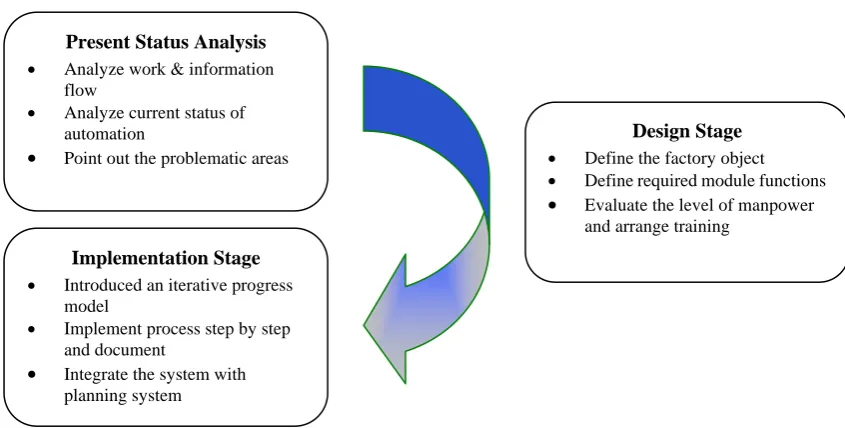
Fig 1.Road map for MES development and implementation
II. PRESENT STATUSOFTHEINDUSTRY The manufacturing industry understudy is experiencing problems in inventory control, scheduling, material flow, equipment management and real time data collection for decision making. The industry is already working in island of automation. These islands of automation have improved the local output, but are not enough to put forward the essential support to improve productivity and worth of the entire industry [6]. No scheduling system exists that can enable the planner to know about when a certain part must be started and when they are required for onward use in their parent items/assemblies. It is extremely complicated to carry out any production statistics analysis on the available data for decision making because manual compilation of report involves many calculations. The real time data access for further planning and rescheduling is unavailable.
III. DESIGNSTAGEOFMES
The design stage incorporated to describe a factory object model that broadly describe the work and information flow in the industry, define product, material and resources. Define different module function like Production scheduling module function, Production Process module function, quality module function, Material flow module function, Equipment module function, Production analysis module function. These module functions are integrated with one another for 1) Scheduling the production activities to carry out the
production plan,
2) Monitoring the manufacturing activities in all phases of operations,
3) Tracking the material flow,
4) Keeping the resources status and available capacity up-to-date before dispatching many parts for processing,
5) Keeping track record of quality control on shop floor level in real time, and
6) Analyzing the real time data collected to reschedule the production activity.
The proper integration of these module functions of MES guarantee the industry resources are prudently and efficiently used to achieve the production targets well in time and customer satisfaction. To implement the system, evaluate the skill level of the employees and arrange training for them.
IV. IMPLEMENTATIONSTAGEOFMES An iterative progress model is introduced by the development group. In the process of implementation each step is completed and documented before going further. The release package sequence is carefully selected to ensure that there is incremental delivery of module functions with each package and the over all system will be built progressively. This will reduce risk and help the development group to keep the good schedule performance throughout the developing period. After the complete system integration, final system integration test will be performed before acceptance.
V. MESINTEGARTIONSTRUCTURE
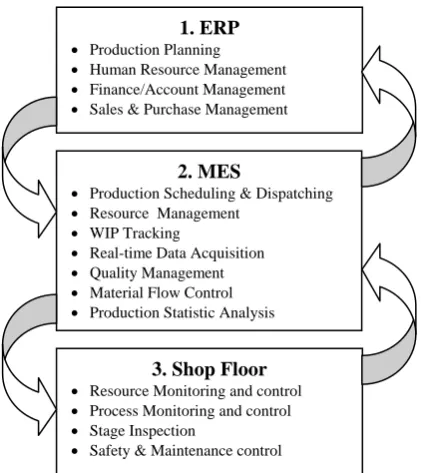
A fully integrated MES coupled with interlinked module functions ensure sharing of information at all essential levels and will promote quick decision making. This paper presents a three-layer structural model which is to be used for the Manufacturing Execution System integration. The linkage between the shop floor control and office planning and office information i.e. Enterprise Resource planning (ERP) is integrated through MES as shown in “Fig 2”. Development of the MES for a discrete part manufacturing industry ensures low product cost, Implementation Stage
• Introduced an iterative progress model
• Implement process step by step and document
• Integrate the system with planning system
Present Status Analysis • Analyze work & information
flow
• Analyze current status of automation
• Point out the problematic areas
Design Stage • Define the factory object • Define required module functions • Evaluate the level of manpower
greater flexibility, and real time data gain necessary for the effective implementation of production plan. MES carry out the production activity according to the plan received from the ERP and feedback the real time production information to the ERP efficiently.
Figure 2. Industry-wide information integration via MES
VI. MESMODULEFUNCTIONSARCHITECHTURE Manufacturing Execution System (MES) in a batched process manufacturing industry provides an interface between business and manufacturing. The MES is a production scheduling and tracking system used to analyze and report resource availability and status, schedule orders, collect real time data such as material use, WIP parameters, work order and equipment status, and other critical information. MES used for real-time shop floor reporting and monitoring that feeds activity data back to the ERP.
Our proposed MES consists of following module functions that is Production scheduling module function,
Production Process module function, quality module function, Material Flow module function, Equipment module function, and Production analysis module function as shown in “Fig.3”.
The main task of Production scheduling module function is to manage the production activities of entire industry according to the production plan issued by ERP. The production scheduling can automatically sequence production to minimize production time and cost. It can also decide what quantity of product should be batch together to increase the efficiency of the operation. It significantly shatters older manual scheduling methods. The proposed MES provide the production scheduler which can be used to optimize real-time workloads in various stages of production.
Production Process management function related to the production operations. It specifies a sequence of tasks that are performed to produce the target product in a process operation. Same operation can be assigned to multiple route steps. It constantly keep track record of the production process and route according to the production schedule. If production process is behind the schedule an alarm will be generated and a delay report will be generated for the concern manager who has to manage the rescheduling or plan overtime to meet the production targets according to schedule.
Quality Module Function record and report manufacturing quality for production managers and customers. It reduces losses because of quality problems, and increases customer satisfaction. Since the Managers have the real time information of the product quality so they can respond quickly and direct to problems as they arise and to report and analyze quality information for process and production. It collects and analyzes manufacturing data captured during in process inspection at every stage from raw material to delivered product. The outcome is reduced costs with improved quality, faster decision making, reduced scrap and higher profits. 1. ERP
• Production Planning
• Human Resource Management
• Finance/Account Management
• Sales & Purchase Management
2. MES
• Production Scheduling & Dispatching
• Resource Management
• WIP Tracking
• Real-time Data Acquisition
• Quality Management
• Material Flow Control
• Production Statistic Analysis
3. Shop Floor • Resource Monitoring and control
• Process Monitoring and control
• Stage Inspection
• Safety & Maintenance control
Quality Module
Production Analysis
Module M E S FRAMEWORK
Equipment Module
Material Production
Scheduling Module Flow
Module
Dat
a Acqui
si
tion
Pl
anni
ng
[image:3.595.69.567.583.762.2]Material flow management is often a difficult task within a manufacturing industry. Materials in a manufacturing industry are elements, parts, or substances used for manufacturing a target product. Material management function provides the material types, lot/batch numbers, and quantities that must be recorded for material used or created in the manufacturing process. A template for material editor is shown in “Fig 4”.
Fig 4 Material editor provides material information Equipment management function provides the current status of the equipment. It keeps details of equipment that is equipment identification number, nomenclature, make, type, model, accessories, capacity, use, and maintenance record. It keeps record of schedule maintenance, preventive maintenance, and break down maintenance and Machine hours available for manufacturing. In case of machine break down a maintenance work order is generated by the MES system for the maintenance department to repair the machine. It provides status of equipment i.e. at what time which equipment/machine is free for next job and breakdown of machines/equipments which may cause production delay.
Production analysis module function manages the real time data gaining through MES system about equipment status data, production process data, material flow data and part quality data. This production data analysis helps statistical process control, performance management and quality management. Based on the collected data, daily, weekly, monthly and yearly progress reports are automatically generated. These reports mainly describe that parts are produced according to schedule or not and their quality. It also includes the material consumption because of rejection etc. Based on these reports production planning and scheduling can be reorganized and overtime can be plan to meet the production target without any delay. Production analysis module function provides real time information about product to the management for better decision making.
[image:4.595.55.272.160.343.2]VII. DEFINEUSERANDWORKINSTRUCTIONS Define users and groups by assigning them user name and password. Access privileges are also established for those users and groups. Group inherits access privileges defined for that group. Template of user editor is shown in “Fig 5”.
Fig 5.User editor template
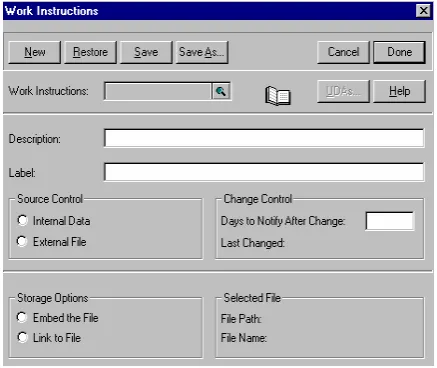
Work instructions are defined which are associated with an operation as a text. These are created as Microsoft word document and can be located in the system. Many work instructions can be linked to a particular operation.
Fig 6. Work instruction editor
VIII. PRODUCT DATACOLLECTIONBY BAR-CODING
[image:4.595.314.533.428.612.2]number one option for carrying out an automatic identification system. Because of the simplicity, universality and low-cost of bar codes, we have adapted bar-coding in our proposed MES system. Product or part identification (ID) schematic diagram is shown in “Fig 7. Carrying out a bar-coding system keeps efficient shop floor control.
[6] L. Raymond, P. A. Julien, J. B. Carriere and R. Lachance, “Manag-ing technology change in manufacturing SMEs: A multiple case analysis”, International Journal of Technology Management, 11(3/4), pp. 270~284, 1996.
Year code Part number
Part code
Batch Number
Figure 7. Part bar- coding
IX. CONCLUSION
The Condition of the Manufacturing Execution System (MES) in a batched process manufacturing industry provides the base-level tracking of manufacturing orders and the proper use of resources. It allows for tracking particular customer orders and materials bills at the product and part levels. It allows planners to identify accurately where each product is in the manufacturing cycle, what materials are needed and when. It allows industries to reduce the inventory they hold and notify planners when there are product shortages. This level of visibility allows customers to find out accurately when to expect their products. MES integration of data from distinct systems provides management with a tool to make cost, quality, and production decisions in real-time.
To carry out the proposed MES in a batched process manufacturing industry provides consistency in product quality and quantity with reducing product cycle time. It also provides the good traceability and genealogy of produced products. Production managers can have good monitor and control of the production schedule, WIP, quality and equipment because of real-time feedback from the shop floor.
.
REFERENCES
[1] Chatwin,H. Abdullah and I. Watson, “A knowledge-based system for operations management in a small and medium sized enterprise”, International Journal of Advanced Manufacturing Technology, 11, pp. 381–389, 1996. [2] A.C. Deuel,” Benefits of a MES for Plant wide
Automation,”ISA Transactions., Vol.33, No.10, pp.123-129, 1994.
[3] J.Martocci,”MES and Planning Systems depend on each other,”Intech, Vol.42, No.2, pp.52-54, 1995.
[4] MESA,”MES functionalities and MRP to MES data flow possibilities,” MESA International, White paper2, 1997.Available at http://www.mesa.org.