Review Article
Association between SCN5A gene variant H558R and
arrhythmias: a systemic review and meta-analysis
Wei Feng1*, Ning Chen2*, Yi Zhu3
1Puyan District Community Health Center, Hangzhou, China; 2Department of Laboratory Medicine, School of Medi-cine, Ruijin Hospital, Shanghai Jiaotong University, Shanghai, China; 3The Second Affiliated Hospital of Zhejiang University, Hangzhou, China; *Equal contributors and co-first authors.
Received September 8, 2016; Accepted November 16, 2016; Epub February 15, 2017; Published February 28, 2017
Abstract: Background: The SCN5A H558R polymorphism is potentially associated with several arrhythmias,
includ-ing Brugada syndrome, atrial fibrillation, and sick sinus syndrome. Here we conducted a comprehensive meta-anal -ysis to investigate the association between this polymorphism and arrhythmia risk. Methods and materials: Eligible studies extracted from the databases of PubMed, Web of Science, and Cochrane Library were evaluated. Statistical analysis was performed using Revman 5.3 and STATA 14.0 software. Results: Five studies with 746 cases and 1085
controls were extracted for the current meta-analysis. The results revealed no significant association was found be -tween SCN5A H558R polymorphism group and arrhythmia risks in all five genetic models. In the stratified analysis of different arrhythmia types, a significantly increased risk of the atrial fibrillation was found to be associated with genotype change in all these five models (AG/AA: OR=1.78, 95% Cl=1.33-2.39, P=0.001; GG/AA: OR=2.76, 95% Cl=1.48-5.16, P=0.001; AG+GG/AA: OR=1.89, 95% Cl=1.43-2.50, P=0.001; GG/AG+AA: OR=2.24, 95% Cl=1.21-4.13, P=0.01; G/A: OR=1.70, 95% Cl=1.35-2.13, P=0.001). Furthermore, we found that the significantly increased risk of arrhythmias in caucasian was associated with the heterzygous genotype AG in codominant (AG/AA: OR=1.93, 95% Cl=1.50-2.49, P=0.001) and allele (G/A: OR=1.59, 95% Cl=1.30-1.94, P=0.001) models. Conclusion: SCN5A
H558R polymorphism may increase the risk of atrial fibrillation and the risk of arrhythmias in caucasian.
Keywords: SCN5A H558R polymorphism, arrhythmia, atrial fibrillation, meta-analysis
Introduction
The SCN5A gene encodes the alpha-subunit of the Nav1.5 ion channel protein, which has a key
role in the sodium inward current (INa) [1]. This
current is responsible for the synchronous and rhythmic contraction of the heart [2]. The
SCN5A encoded protein is mainly found in the
heart, however it has been identified in smooth
muscle cells of the intestines [3] and in macro-phages [4]. Few research has paid attention on the functional role of SCN5A in these non-cardi-ac tissues. However, previous studies have re- vealed correlations between SCN5A gene vari-ants and multiple cardiac diseases including Brugada syndrome, long QT syndrome [5], atrial
fibrillation [6], sick sinus syndrome [7] and car -diomyopathies [8].
Lots of variations of the SCN5A gene have
been identified. The histidine-558-to-arginine
(H558R) polymorphism of SCN5A was firstly
reported in patients with torsades de pointes in 2002 [9]. Several studies have been proved that it can change the expression of arrhyth- mogenic genotypes by modulating the pheno-typic expression of several coexisting arrhyth-mogenic mutations [10-12]. Therefore, the ass- ociation between SCN5A gene variant H558R and susceptibility to of arrhythmias including
atrial fibrillation, atrioventricular conduction
block and sick sinus syndrome has been wildly studied [13-15]. However, the results were inconsistent.
Materials and methods
Publication search and data extraction
Studies published in English (from their
incep-tion to July 2016) were mainly identified by
conducting a systematic search in PubMed, Web of Science, and Cochrane Library data- bases using the following terms: ‘SCN5A’, ‘H558R’, and ‘polymorphism’. Reference lists from relevant articles were also examined to
find additional publications. Data were extract -ed independently by two authors using stan-dard forms. The collected data included author name, publication year, country, ethnicity, age, gender, arrhythmia types, and genotype distri-butions. All the included studies met the follow-ing criteria: 1) case-control study and prospec-tive cohorts, 2) evaluation of the association between SCN5A H558R polymorphism and arrhythmia risks, 3) including details of geno-type frequency in cases and controls and the frequency was tested by HWE. Evaluation of evidence strength was carried out according to
the modified Newcastle-Ottawa Scale (shown
in Supplementary Table 1) [16].
Statistical analysis
Revman 5.3 and STATA 14.0 software was used
studies was assessed using the I2 statistic.
Dichotomous variables were quoted as a odds ratios (ORs) with 95% CI (confidence intervals).
The random-effects model was used when I2>
50%. Otherwise, the calculations were per
-formed with the fixed-effects model [17, 18]. We used the codominant model (AG/AA, GG/ AA), dominant model (AG+GG/AA), recessive model (GG/AG+AA), and allele model (G/A) to
evaluate the association between polymor-phism and arrhythmia risk. Subgroup analysis based on arrhythmia type and ethnicity was carried out. Sensitivity analysis and publication bias were also performed [19, 20]. P < 0.05
was considered statistically significant.
Results
Characteristics of the studies
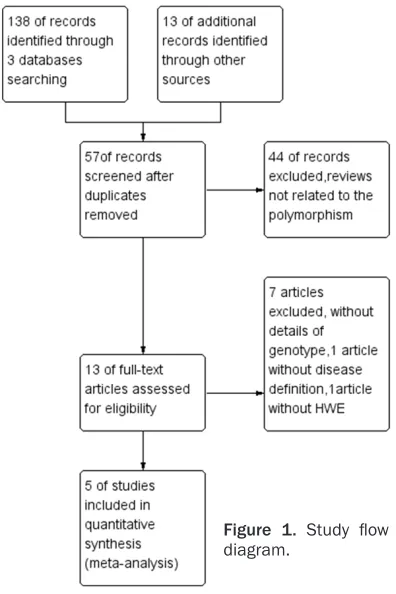
The initial search yielded 151 articles in the database; 94 reports were excluded owing to
duplication. Of the remaining 57 articles, 50
did not meet the set inclusion criteria. Finally,
five studies [13, 15, 21-23] with 746 cases
and 1085 controls were included in the curr- ent meta-analysis (Figure 1). Of five studies,
three were conducted in Asia and the other two were conducted in Europe or North America. Two studies focused on the relationship
between polymorphism and atrial fibrillation.
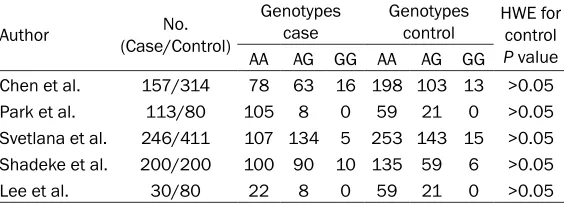
The rest three studies reported the sick sinus syndrome, idiopathic cardiac conduction disor-ders and atrioventricular conduction block respectively. Furthermore, the genotype distri-butions were also collected and shown in Tables 1 and 2.
Results of the meta-analysis for all studies
We evaluated the association between SCN5A
H558R polymorphism and arrhythmia risks
within five genetic models mentioned in the
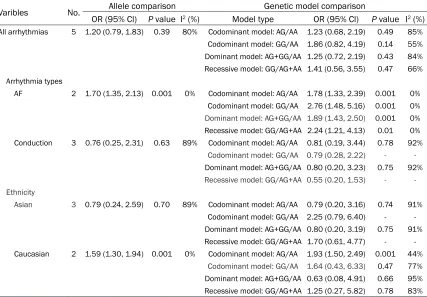
methods section. The results of this meta-anal-ysis were shown in Table 3. The pooled results
revealed no significant association was found
between SCN5A H558R polymorphism group
and arrhythmia risks in all five genetic models. Next, we performed stratification analysis
according to the arrhythmia types and
[image:2.612.91.289.71.368.2]ethnici-ties. First, all these five studies were divided into two groups (atrial fibrillation group and con -duction system disease group) according to their arrhythmia types. Sick sinus syndrome, idiopathic cardiac conduction disorders and Figure 1. Study flow
the conduction system disease group. In the
atrial fibrillation group, the significantly
incre-ased risk of the disease was found to be
asso-ciated with genotype change in all these five models (AG/AA: OR=1.78, 95% Cl=1.33-2.39, P=0.001; GG/AA: OR=2.76, 95% Cl=1.48-5.16, P=0.001; AG+GG/AA: OR=1.89, 95% Cl=1.43-2.50, P=0.001; GG/AG+AA: OR=2.24, 95% Cl=1.21-4.13, P=0.01; G/A: OR=1.70, 95% Cl=1.35-2.13, P=0.001). We found that the sig
-nificantly increasd risk of c arrhythmias in cau -casian was associated with the heterzygous
genotype AG in codominant (AG/AA: OR=1.93, 95% Cl=1.50-2.49, P=0.001) and allele (G/A: OR=1.59, 95% Cl=1.30-1.94, P=0.001) mod
-els. However, stratified analysis of ethnicity
showed no statistically differences of arrhyth-mia risk with genotype change in Asians.
Sensitivity analysis and publication bias
To assess the stability of the results, sensiti- vity analysis was performed (shown in Suppl- ementary Figure 1). Funnel plots were used to estimate the publication bias of the articles included in this study. There was no evidence of asymmetry in the shape of funnel plots in the
codominant model (AG vs. AA) (Figure 2). Begg’s test showed no evidence of publication
bias (P=0.142).
we performed stratification analysis, we found that for atrial fibrillation, the association analy
-ses of the codominant model (AG/AA), codomi
-nant model (GG/AA), domi-nant model (AG+GG/ AA), recessive model (GG/AG+AA), and allele model (G/A) consistently supported that this
polymorphism statistically increased the risk of
atrial fibrillation. On the contrary, we also identi
-fied that cases have a SCN5A H558R polymor-phism had higher risks to have the overall car-diac arrhythmias in caucasian than controls in
codominant (AG/AA) and allele (G/A) models.
The exact function of SCN5A H558R polymor-phism is still controversial. It has been reported that SCN5A H558R polymorphism modulates changes of the Na+ channel caused by other gene mutations [10, 24]. However, no differ-ence in Na+ channel activation and inactivation has been observed between the hH1-H558 and the hH1-R558 clones in a vitro study [24]. For instance, Maragoni et al. showed that H558R polymorphism restored the defect caused by the LQT-3 mutation S216L [25]. Viswanathan et al. reported that H558R polymorphism could modify the abnormal gating effect caused by the proximal mutation [24]. Jiang et al. provided some evidences for the role of SCN5A H558R polymorphism in reducing the susceptibility to Keshan disease [26]. All these studies demon-Table 1. Characteristics of studies included in this meta-analysis
Author Year Country Ethnicity (case/control)Age (case/control)Gender Type of arrhythmia
Chen et al. 2007 US Caucasian 52.0±9.8/N N/N Atrial fibrillation
Park et al. 2012 Korean Asian N/N N/N Atrioventricular conduction block Svetlana et al. 2015 Russian Caucasian N/37.16±17.05 122M124F/348M63F Idiopathic Cardiac Conduction disorders Shadeke et al. 2016 China Asian 60.1/53.5 117M83F/122M78F Astrial fibrillation
Lee et al. 2016 Korean Asian 55.6/N 9M21F/N Sick sinus syndrome
[image:3.612.90.522.85.177.2]N: no details. M: male. F: female.
Table 2. Genotypes details of five studies included in this
meta-analysis
Author (Case/Control)No.
Genotypes
case Genotypes control HWE for control
P value
AA AG GG AA AG GG
Chen et al. 157/314 78 63 16 198 103 13 >0.05 Park et al. 113/80 105 8 0 59 21 0 >0.05 Svetlana et al. 246/411 107 134 5 253 143 15 >0.05 Shadeke et al. 200/200 100 90 10 135 59 6 >0.05 Lee et al. 30/80 22 8 0 59 21 0 >0.05 HWE: Hardy-Weinberg equilibrium.
Discussions
The SCN5A H558R polymor-phism, located in the Na+
channel cytoplasmic linker, is the most common missense polymorphism in SCN5A cau- sed by a single nucleotide
change (1673A>G). In this study, we found there was no association between SCN5A
[image:3.612.93.375.231.334.2]strated H558R polymorphism may play a role in
preventing some specific cardiac arrhythmias.
However, several studies also reported that
SCN5A H558R polymorphism carriers have a
[image:4.612.94.521.110.407.2]from each other. So the grouping method is still debatable. Second, many other clinical fac-tors such as age, sex or other mixed mutations in each study might lead to bias and haven’t Table 3. Pooled ORs and 95% CIs of the overall and stratified meta-analysis for Allele model (G/A),
codominant model (AG/AA), codominant model (GG/AA), dominant model (AG+GG/AA), and recessive model (GG/AG+AA)
Varibles No. Allele comparison Genetic model comparison
OR (95% Cl) P value I2 (%) Model type OR (95% Cl) P value I2 (%)
All arrhythmias 5 1.20 (0.79, 1.83) 0.39 80% Codominant model: AG/AA 1.23 (0.68, 2.19) 0.49 85% Codominant model: GG/AA 1.86 (0.82, 4.19) 0.14 55% Dominant model: AG+GG/AA 1.25 (0.72, 2.19) 0.43 84% Recessive model: GG/AG+AA 1.41 (0.56, 3.55) 0.47 66%
Arrhythmia types
AF 2 1.70 (1.35, 2.13) 0.001 0% Codominant model: AG/AA 1.78 (1.33, 2.39) 0.001 0% Codominant model: GG/AA 2.76 (1.48, 5.16) 0.001 0%
Dominant model: AG+GG/AA 1.89 (1.43, 2.50) 0.001 0% Recessive model: GG/AG+AA 2.24 (1.21, 4.13) 0.01 0%
Conduction 3 0.76 (0.25, 2.31) 0.63 89% Codominant model: AG/AA 0.81 (0.19, 3.44) 0.78 92%
Codominant model: GG/AA 0.79 (0.28, 2.22) - -Dominant model: AG+GG/AA 0.80 (0.20, 3.23) 0.75 92%
Recessive model: GG/AG+AA 0.55 (0.20, 1.53) -
Ethnicity
Asian 3 0.79 (0.24, 2.59) 0.70 89% Codominant model: AG/AA 0.79 (0.20, 3.16) 0.74 91% Codominant model: GG/AA 2.25 (0.79, 6.40) -
-Dominant model: AG+GG/AA 0.80 (0.20, 3.19) 0.75 91% Recessive model: GG/AG+AA 1.70 (0.61, 4.77) - Caucasian 2 1.59 (1.30, 1.94) 0.001 0% Codominant model: AG/AA 1.93 (1.50, 2.49) 0.001 44%
Codominant model: GG/AA 1.64 (0.43, 6.33) 0.47 77% Dominant model: AG+GG/AA 0.63 (0.08, 4.91) 0.66 95% Recessive model: GG/AG+AA 1.25 (0.27, 5.82) 0.78 83% AF: atrial fibrillation. Conduction: conduction system disease.
Figure 2. Funnel plots for assessing publication bias in the meta-analysis.
higher risk to the cardiac
dis-eases, such as atrial fibrilla -tion [27]. Addi-tional studies will be required not only to detect its more prevalence rate in cardiac arrhythmia but also to investigate the possi-ble biophysical mechanisms of H558R on the channel function in coordination with other mutations.
[image:4.612.92.372.440.631.2]been considered in the study. Last, we re-strict-ed our includre-strict-ed studies publishre-strict-ed in English. Conclusion
In sum, this meta-analysis investigated the relationship between SCN5A H558R polymor-phism and cardiac arrhythmias risk. Although there are several limitations, our work indicates that the SCN5A H558R polymorphism may
increase the risk of atrial fibrillation and the
risk of arrhythmias in Caucasian. Disclosure of conflict of interest
None.
Abbreviations
AF, atrial fibrillation.
Address correspondence to: Wei Feng, Puyan
District Commu nity Health Center, Hangzhou, China.
E-mail: [email protected]
References
[1] Grant AO. Molecular biology of sodium chan -nels and their role in cardiac arrhythmias. Am J Med 2001; 110: 296-305.
[2] Aronsen JM, Swift F, Sejersted OM. Cardiac
sodium transport and excitation-contraction coupling. J Mol Cell Cardiol 2013; 61: 11-19. [3] Holm AN, Rich A, Miller SM, Strege P, Ou Y, Gib
-bons S, Sarr MG, Szurszewski JH, Rae JL, Far
-rugia G. Sodium current in human jejunal cir
-cular smooth muscle cells. Gastroenterology
2002; 122: 178-187.
[4] Black JA, Newcombe J, Waxman SG. Nav1.5 sodium channels in macrophages in multiple sclerosis lesions. Mult Scler 2013; 19: 532-542.
[5] Veltmann C, Barajas-Martinez H, Wolpert C,
Borggrefe M, Schimpf R, Pfeiffer R, Caceres G, Burashnikov E, Antzelevitch C, Hu D. Further
insights in the most common scn5a mutation causing overlapping phenotype of long qt syn-drome, brugada synsyn-drome, and conduction defect. J Am Heart Assoc 2016; 5.
[6] Chiang DY, Kim JJ, Valdes SO, de la Uz C, Fan Y, Orcutt J, Domino M, Smith M, Wehrens XH, Mi -yake CY. Loss-of-function scn5a mutations as-sociated with sinus node dysfunction, atrial arrhythmias, and poor pacemaker capture. Circ Arrhythm Electrophysiol 2015; 8: 1105-1112.
[7] Benson DW, Wang DW, Dyment M, Knilans TK, Fish FA, Strieper MJ, Rhodes TH, George AL Jr.
Congenital sick sinus syndrome caused by re-cessive mutations in the cardiac sodium chan-nel gene (scn5a). J Clin Invest 2003; 112: 1019-1028.
[8] Zaklyazminskaya E, Dzemeshkevich S. The
role of mutations in the scn5a gene in cardio-myopathies. Biochim Biophys Acta 2016; 1863: 1799-1805.
[9] Yang P, Kanki H, Drolet B, Yang T, Wei J, Viswa -nathan PC, Hohnloser SH, Shimizu W, Schwa-
rtz PJ, Stanton M, Murray KT, Norris K, George AL Jr, Roden DM. Allelic variants in long-qt dis -ease genes in patients with drug-associated torsades de pointes. Circulation 2002; 105: 1943-1948.
[10] Ye B, Valdivia CR, Ackerman MJ, Makielski JC. A common human scn5a polymorphism
modi-fies expression of an arrhythmia causing muta
-tion. Physiol Genomics 2003; 12: 187-193.
[11] Poelzing S, Forleo C, Samodell M, Dudash L,
Sorrentino S, Anaclerio M, Troccoli R, Iacoviello
M, Romito R, Guida P, Chahine M, Pitzalis M, Deschenes I. Scn5a polymorphism restores trafficking of a brugada syndrome mutation on
a separate gene. Circulation 2006; 114: 368-376.
[12] Lizotte E, Junttila MJ, Dube MP, Hong K, Benito B, DE Zutter M, Henkens S, Sarkozy A, Huikuri
HV, Towbin J, Vatta M, Brugada P, Brugada J,
Brugada R. Genetic modulation of brugada
syndrome by a common polymorphism. J Car-diovasc Electrophysiol 2009; 20: 1137-1141. [13] Park HS, Kim YN, Lee YS, Jung BC, Lee SH,
Shin DG, Cho Y, Bae MH, Han SM, Lee MH. Genetic analysis of scn5a in korean patients
associated with atrioventricular conduction
block. Genomics Inform 2012; 10: 110-116.
[14] Chen L, Zhang W, Fang C, Jiang S, Shu C, Cheng H, Li F, Li H. Polymorphism h558r in the human cardiac sodium channel scn5a gene is
associated with atrial fibrillation. J Int Med Res
2011; 39: 1908-1916.
[15] Lee YS, Olaopa MA, Jung BC, Lee SH, Shin DG, Park HS, Cho Y, Han SM, Lee MH, Kim YN. Ge -netic variation of scn5a in korean patients with sick sinus syndrome. Korean Circ J 2016; 46: 63-71.
[16] Zhao L, Roffey DM and Chen S. Association be -tween the estrogen receptor beta (ESR2) Rs1256120 single nucleotide polymorphism and adolescent idiopathic scoliosis: a system-atic review and meta-analysis. Spine (Phila Pa 1976) 2016; [Epub ahead of print].
[17] Egger M, Davey Smith G, Schneider M, Minder
C. Bias in meta-analysis detected by a simple, graphical test. BMJ 1997; 315: 629-634. [18] Lau J, Ioannidis JP, Schmid CH. Quantitative
[19] Wang X, Lu X, Fang Y, Chen H, Deng X, Peng C,
Li H, Shen B. Association between mir34b/c polymorphism rs4938723 and cancer risk: A meta-analysis of 11 studies including 6169 cases and 6337 controls. Med Sci Monit 2014; 20: 1977-1982.
[20] Begg CB, Mazumdar M. Operating characteris -tics of a rank correlation test for publication bias. Biometrics 1994; 50: 1088-1101. [21] Chen LY, Ballew JD, Herron KJ, Rodeheffer RJ,
Olson TM. A common polymorphism in scn5a is associated with lone atrial fibrillation. Clin
Pharmacol Ther 2007; 81: 35-41.
[22] Nikulina SY, Chernova AA, Shulman VA,
Maksi-mov VN, Gavrilyuk OA, Tretyakova SS, Marilov-ceva OV. An investigation of the association of
the h558r polymorphism of the scn5a gene with idiopathic cardiac conduction disorders.
Genet Test Mol Biomarkers 2015; 19:
288-294.
[23] Shadeke Y, Wulasihan M, Liu Z, Yang Y, He P. Association between the SCN5A gene H558R
polymorphism and atrial fibrillation in the Uygur and Han populations of Xinjiang. Int J
Clin Exp Med 2016; 9: 11663-11668.
[24] Viswanathan PC, Benson DW, Balser JR. A
common scn5a polymorphism modulates the biophysical effects of an scn5a mutation. J Clin Invest 2003; 111: 341-346.
[25] Marangoni S, Di Resta C, Rocchetti M, Barile L,
Rizzetto R, Summa A, Severi S, Sommariva E, Pappone C, Ferrari M, Benedetti S, Zaza A. A brugada syndrome mutation (p.S216l) and its modulation by p.H558r polymorphism: stan-dard and dynamic characterization. Cardio-vasc Res 2011; 91: 606-616.
[26] Jiang S, Li FL, Dong Q, Liu HW, Fang CF, Shu C, Cheng H, Cui J, Ma HX, Chen DQ, Li H. H558r
polymorphism in scn5a is associated with kes-han disease and qrs prolongation in keskes-han
disease patients. Genet Mol Res 2014; 13:
6569-6576.
[27] Chen J, Xie X, Zhu J, Tao Q, Wang X. Single-nu -cleotide polymorphisms in scn5a gene in chi-nese han population and their correlation with
Supplementary Table 1. Quality assessment of studies included in the systematic review
according to the modified Newcastle-Ottawa scale
Author Chen et al. et al.Park Svetlana et al. Shadeke et al. et al.Lee Selection
Adequacy of case definition a★ a★ a★ a★ a★
Representativeness of the cases a★ a★ a★ a★ a★
Selection of controls a★ b a★ b a★
Definition of controls a★ a★ a★ a★ a★
Comparability
Cases and controls of homogeneous ethnic descent a★ a★ a★ a★ a★
Population stratification b b b b b
Exposure
Ascertainment of exposure b b b b b Same method of ascertainment for cases and controls a★ a★ a★ a★ a★
Genotyping call rate b b b b b
Total 6★ 5★ 6★ 5★ 6★