The NYU System for the CoNLL–SIGMORPHON 2018 Shared Task on
Universal Morphological Reinflection
Katharina Kann1
Stanislas Lauly1
Kyunghyun Cho1,2
1Center for Data Science
New York University New York, USA
2Dept. of Computer Science
New York University New York, USA
Abstract
This paper describes the NYU submission to the CoNLL–SIGMORPHON 2018 shared task on universal morphological reinflection. Our system participates in the low-resource setting of Task 2, track 2, i.e., it predicts morphologi-cally inflected forms in context: given a lemma and a context sentence, it produces a form of the lemma which might be used at an indicated position in the sentence. It is based on the stan-dard attention-based LSTM encoder-decoder model, but makes use of multiple encoders to process all parts of the context as well as the lemma. In the official shared task evaluation, our system obtains the second best results out of 5 submissions for the competition it entered and strongly outperforms the official baseline.
1 Introduction
The extreme type sparsity in text in a morpho-logically rich language, i.e., a language which relies strongly on changes in the surface form of words to express properties like gender, tense or number, requires natural language process-ing (NLP) systems which are able to handle in-flected words in a systematic way. The SIGMOR-PHON and CoNLL–SIGMORSIGMOR-PHON shared tasks on morphological reinflection, which have been held since 2016 (Cotterell et al.,2016,2017a), en-courage the development of computational models for inflection in a large number of languages.
This year’s edition (Cotterell et al., 2018) fea-tures two different tasks. The datasets for Task 1 consist of triplets of lemma, morphological tag (also called the “target tag”) and the correspond-ing inflected form, which is given for traincorrespond-ing and should be produced at test time. This is the stan-dard inflection setup which has also been subject of the shared tasks in the last years. Task 2, in contrast, is again split into two different subtasks (called “tracks”). Both are focused on inflection in
context. Here, a sentence is given, in the context of which the inflected form of which only the lemma is known should be used. The setup of the first subtask assumes that the lemmas and tags of all surrounding words are available and can be used for predicting. These might be used as desired, e.g., the tags of the previous and next words are often strong indicators for the tag of the form to be produced, which is unknown. Track 2, on the other hand, requires systems to produce inflected forms only from their lemma and the inflected context words; no tags or lemmas are given for the context. Thus, track 2 is both a more realistic and a harder version of track 1. All tasks and tracks feature 3 different settings: a low-resource setting (LOW), a medium-resource setting (MEDIUM) and a high-resource setting (HIGH).
In this paper, we describe the New York University (NYU) submission to the CoNLL– SIGMORPHON 2018 shared task on universal morphological reinflection. The system we sub-mitted was exclusively designed for Task 2, track 2, LOW. Thus, we only focus on this particu-lar competition and do not report numbers for other setups (though, in theory, every system which works for track 2 of Task 2 can also pro-duce output for track 1; the same holds true for LOW/MEDIUM/HIGH). Overall, our system ob-tains the second highest test accuracy out of 5 sub-mitted systems and outperforms the official shared task baseline by a wide margin.
2 Morphological Inflection in Context
The system presented in this paper is designed for morphological inflection in context, i.e., predict-ing an inflected form which fits an indicated posi-tion in a sentence, given its lemma. Here, we will describe the task in a more formal way.
Let T be the set of morphological tags being
expressed in a language and w a lemma in the same language. We then define the morphologi-cal paradigmπofwas follows:
π(w) =n fk[w], tk o
k∈T(w) (1) Here,fk[w]denotes the inflected form which cor-responds to tag tk, and both w and fk[w] are strings consisting of letters from an alphabet Σ.
Note that, even though we follow the convention to describe word forms as functions of the lemma, in the huge majority of the cases, each inflected form is uniquely defined given any other word form of the same paradigm together with its morphologi-cal tag.
The task ofmorphological inflectionconsists of predicting a target form fi[w] from a paradigm,
given the lemma w, as well as the tag ti of the target form.
Building on this, the task ofmorphological in-flection in context consists of predicting a target formfi[w]from the lemmaw, as well as the con-text c, i.e., the sentence surrounding the target form. For the track of the shared task we are inter-ested in, the context consists of inflected forms. Further, this task is ambiguous: for many lan-guages, usually several morphological tags and, thus, inflected forms are acceptable for any given context.
3 Model Description
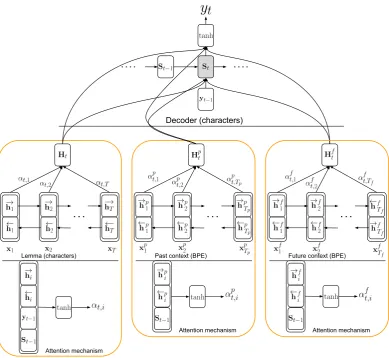
Our model is based on the standard LSTM encoder-decoder model with an attention mecha-nism (Bahdanau et al., 2015). Following several previous approaches (cf. Section 5), we apply it at the character level, i.e., the input to the system is the character sequence of the input lemma, rep-resented by embeddings. The output is the (pre-dicted) character sequence of the inflected form.
Additionally, we include the sentence con-text as follows: Given a sentence s = [w1, w2, . . . , wi−1, l, wi+1, . . . , wn], wherelis the lemma of the inflected form of interest, and w1, . . . , wn withn 6= iare the surrounding con-text words, we split the past concon-text cprev =
[w1, w2, . . . , wi−1]and the future contextcf ut =
[wi+1, . . . , wn]into subword units using byte pair encoding (BPE,Sennrich et al.(2016)). We then use two additional encoders to encode the se-quences of subword units of both contexts.
Using bidirectional encoders, the final hidden states produced by each encoder are
concatena-tions of the respective forward and backward hid-den states:
hi = [−→hi,←h−i] (2)
with − →
hi =LSTM(emb1, . . . , embi),and (3) ←−
hi =LSTM(embz, . . . , embi) (4)
emb= emb1, . . . , embz represents the respective sequence of embeddings, i.e., either the embed-dings of the lemma’s characters or the embedembed-dings of the subword units of either context.
Our model then uses 3 attention mechanisms— one for each encoder—to produce a context vector for each output position: Ht for the lemma, Htp for the past context andHtf for the future context. The input to the decoder LSTM at each timestep is the concatenation of all contexts and the em-bedding of the last output character. Emem-beddings are shared between the character encoder and the decoder, BPE embeddings are shared between the two context encoders.
An overview of our model architecture is shown in Figure1. Our final system in an ensemble of 5 random restarts of the model, combined via ma-jority voting.
3.1 Training and Hyperparameters
Using the shared task development sets, we de-cide on the following hyperparameters: We em-ploy 100-dimensional BPE and character embed-dings, and the encoder and decoder hidden states are 300-dimensional. Dropout (Srivastava et al.,
2014) is used with a probability of 0.5 for all hid-den states when used as input to the next layer, as well as for the embedding layer. For training, we employ ADAM (Kingma and Ba, 2014). When-ever performance does not improve for 20 steps, we halve the learning rate and restart from the best performing model. Training stops when the learn-ing rate gets below 0.0001; the best performing
model is used for the final predictions. We do not use batching, since it hurts performance in our ex-periments on the development sets.
For decoding, we apply beam search with a beam of width 5.
4 Official System Evaluation 4.1 Datasets
. . .
Lemma (characters)
Attention mechanism
Decoder (characters)
. . .
Past context (BPE)
Attention mechanism
. . .
Future context (BPE)
[image:3.595.105.495.62.420.2]Attention mechanism
Figure 1: Overview of our employed model architecture.
(UD) treebanks (Nivre et al., 2017). All context forms, as well as the lemma of the target inflected form are given for each sentence. Training and development sets feature exactly one correct tar-get form, while, for the test set, additional plausi-ble target forms have been manually given by the shared task organizers (Cotterell et al.,2018).
The languages we experiment on are German, English, Spanish, Finnish, French, Russian and Swedish.
4.2 Baseline System
The official baseline system of the shared task is a character-level LSTM encoder-decoder model with attention (Bahdanau et al.,2015). The main input to the system is the lemma of the inflected form which is to be generated. Further, the con-text is taken into account: each character of the lemma is concatenated with 7 additional embed-dings representing (i) the lemma of the word at the previous position in the sentence, (ii) the previous word itself, (iii) the tag of the previous word, (iv)
the lemma of the word at the next position in the sentence, (v) the next word itself, (vi) the tag of the next word, (vii) the lemma of the inflected form to generate and given to the encoder. Note that, since no tags or lemmas are available for track 2 of Task 2, but the architecture is identical to that used for track 1 of the same task, all embeddings but those for the previous and the next word, as well as the lemma are set to default vectors.
Given the character embedding-context repre-sentations produced by the encoder, the LSTM de-coder generates the character sequence of the out-put inflected form, using an attention mechanism. More details on the shared task baseline system can be found inCotterell et al.(2018).
4.3 Official Test Results
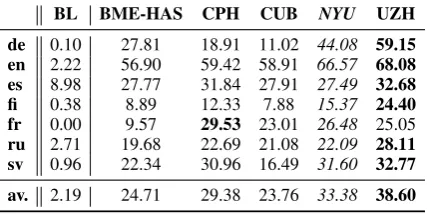
com-BL BME-HAS CPH CUB NYU UZH de 0.10 27.81 18.91 11.02 44.08 59.15 en 2.22 56.90 59.42 58.91 66.57 68.08 es 8.98 27.77 31.84 27.91 27.49 32.68 fi 0.38 8.89 12.33 7.88 15.37 24.40 fr 0.00 9.57 29.53 23.01 26.48 25.05
ru 2.71 19.68 22.69 21.08 22.09 28.11 sv 0.96 22.34 30.96 16.49 31.60 32.77 av. 2.19 24.71 29.38 23.76 33.38 38.60 Table 1: Test accuracies when considering only the gold solution; BL = BASELINE; CPH = COPEN-HAGEN; CUB = CUBoulder. Best results per language in bold; our results in italic.
BL BME-HAS CPH CUB NYU UZH de 0.10 31.14 21.54 11.53 48.43 61.38 en 2.92 62.64 66.87 66.36 72.21 74.02 es 11.08 33.52 37.31 31.42 31.98 37.17
[image:4.595.75.289.64.171.2]fi 0.89 11.18 16.14 10.04 18.68 28.21 ru 2.71 21.29 24.40 22.59 23.29 30.42 sv 0.96 27.34 36.38 19.04 37.13 39.36 av. 3.11 31.18 33.77 26.83 38.62 45.09 Table 2: Test accuracies when counting all plausible forms as correct; BL = BASELINE; CPH = COPEN-HAGEN; CUB = CUBoulder. Best results per language in bold; our results in italic.
puted by taking all plausible target inflected forms into account, i.e., all forms that could be correct
in any way of reading the sentence are accepted as correct. The final results for all systems are shown in Tables1and2, respectively.
As can be seen, the baseline performs poorly in the low-resource setting we consider here. In particular, its accuracy is far worse than that of any participating system.
Looking at our system’s performance, we can see that it is the second best one for German, En-glish, Finnish, French, and Slovene, as well as on average, when only considering the gold solution. Taking all plausible forms into account, our sys-tems obtains the second highest accuracy for Ger-man, English, Finnish, and Slovene, as well as on average.1
The best performing system on average is UZH, and CPH outperforms our model for Spanish, French and Russian for gold solutions, and Span-ish and Russian for all plausible forms. BME-HAS and CUB perform worse than our system for all languages.
A final observation is that the accuracy
differ-1No results with all plausible forms are available for
French.
ence between the evaluation with the gold solu-tion and the evaluasolu-tion with all plausible forms is
0.92−6.49, depending on the system.
5 Related Work
Most recent work on morphological reinflec-tion was done in the context of the SIGMOR-PHON 2016 and the CoNLL–SIGMORSIGMOR-PHON 2017 shared tasks.
The first edition of the shared task in 2016 ( Cot-terell et al., 2016) resulted in 3 different types of systems: “pipeline approaches” (unsupervised alignment algorithms applied to the source-target pairs, followed by a model which predicts edit operations), “neural approaches”, and “linguisti-cally inspired systems”. The winning system was a neural network, namely a character-based RNN encoder-decoder model with attention, similar to the one we use here (Kann and Sch¨utze, 2016). Hence, neural models gained popularity in the 2017 edition of the shared task (Cotterell et al.,
2017a). In 2017, explicit low-resource settings were first introduced to the shared task. These settings demonstrated the effectiveness of hard at-tention in neural sequence-to-sequence models if training data are limited (Makarov et al.,2017).
Research not immediately done for the shared tasks included papers on multi-source reinflec-tion (Cotterell et al.,2017b; Kann et al., 2017a), cross-lingual transfer for reinflection (Kann et al.,
2017b), or first intents of neural inflection sys-tems which make use of context for lemmatization (Bergmanis and Goldwater,2018).
Older work on morphological inflection in-cludesAhlberg et al.(2014);Durrett and DeNero
(2013);Nicolai et al.(2015);Faruqui et al.(2016), inter alia.
6 Conclusion
References
Malin Ahlberg, Markus Forsberg, and Mans Hulden. 2014. Semi-supervised learning of morphological paradigms and lexicons. InEACL.
Dzmitry Bahdanau, Kyunghyun Cho, and Yoshua Ben-gio. 2015. Neural machine translation by jointly learning to align and translate. InICLR.
Toms Bergmanis and Sharon Goldwater. 2018. Con-text sensitive neural lemmatization with lematus. In
NAACL.
Ryan Cotterell, Christo Kirov, John Sylak-Glassman, G´eraldine Walther, Ekaterina Vylomova, Arya D. McCarthy, Katharina Kann, Sebastian Mielke, Gar-rett Nicolai, Miikka Silfverberg, David Yarowsky, Jason Eisner, and Mans Hulden. 2018. The CoNLL– SIGMORPHON 2018 shared task: Universal mor-phological reinflection. InCoNLL–SIGMORPHON.
Ryan Cotterell, Christo Kirov, John Sylak-Glassman, G´eraldine Walther, Ekaterina Vylomova, Patrick Xia, Manaal Faruqui, Sandra K¨ubler, David Yarowsky, Jason Eisner, and Mans Hulden. 2017a. The CoNLL-SIGMORPHON 2017 shared task: Universal morphological reinflection in 52
lan-guages. InCoNLL-SIGMORPHON.
Ryan Cotterell, Christo Kirov, John Sylak-Glassman, David Yarowsky, Jason Eisner, and Mans Hulden. 2016. The SIGMORPHON 2016 shared task— morphological reinflection. InSIGMORPHON.
Ryan Cotterell, John Sylak-Glassman, and Christo Kirov. 2017b. Neural graphical models over strings for principal parts morphological paradigm comple-tion. InEACL.
Greg Durrett and John DeNero. 2013. Supervised learning of complete morphological paradigms. In
NAACL-HLT.
Manaal Faruqui, Yulia Tsvetkov, Graham Neubig, and Chris Dyer. 2016. Morphological inflection genera-tion using character sequence to sequence learning. InNAACL-HLT.
Katharina Kann, Ryan Cotterell, and Hinrich Sch¨utze. 2017a. Neural multi-source morphological reinflec-tion. InEACL.
Katharina Kann, Ryan Cotterell, and Hinrich Sch¨utze. 2017b. One-shot neural cross-lingual transfer for paradigm completion. InACL.
Katharina Kann and Hinrich Sch¨utze. 2016. MED: The lmu system for the SIGMORPHON 2016 shared task on morphological reinflection. In SIGMOR-PHON.
Diederik P Kingma and Jimmy Ba. 2014. Adam: A method for stochastic optimization. arXiv preprint arXiv:1412.6980.
Peter Makarov, Tatiana Ruzsics, and Simon Clematide. 2017. Align and copy: UZH at SIGMORPHON 2017 shared task for morphological reinflection. In
CoNLL-SIGMORPHON.
Garrett Nicolai, Colin Cherry, and Grzegorz Kondrak. 2015. Inflection generation as discriminative string transduction. InNAACL-HLT.
Joakim Nivre, ˇZeljko Agi´c, Lars Ahrenberg, Maria Je-sus Aranzabe, Masayuki Asahara, Aitziber Atutxa, Miguel Ballesteros, John Bauer, Kepa Ben-goetxea, Riyaz Ahmad Bhat, Eckhard Bick, Cristina Bosco, Gosse Bouma, Sam Bowman, Marie Candito, G¨uls¸en Cebirolu Eryiit, Giuseppe G. A. Celano, Fabricio Chalub, Jinho Choi, C¸ar C¸¨oltekin, Miriam Connor, Elizabeth Davidson, Marie-Catherine de Marneffe, Valeria de Paiva, Arantza Diaz de Ilarraza, Kaja Dobrovoljc, Tim-othy Dozat, Kira Droganova, Puneet Dwivedi, Marhaba Eli, Tomaˇz Erjavec, Rich´ard Farkas, Jen-nifer Foster, Cl´audia Freitas, Katar´ına Gajdoˇsov´a, Daniel Galbraith, Marcos Garcia, Filip Ginter, Iakes Goenaga, Koldo Gojenola, Memduh G¨okrmak, Yoav Goldberg, Xavier G´omez Guinovart, Berta Gonz´ales Saavedra, Matias Grioni, Normunds Gr¯uz¯itis, Bruno Guillaume, Nizar Habash, Jan Hajiˇc, Linh H`a M, Dag Haug, Barbora Hladk´a, Petter Hohle, Radu Ion, Elena Irimia, Anders Jo-hannsen, Fredrik Jørgensen, H¨uner Kas¸kara, Hiroshi Kanayama, Jenna Kanerva, Natalia Kotsyba, Simon Krek, Veronika Laippala, Phng Lˆe Hng, Alessan-dro Lenci, Nikola Ljubeˇsi´c, Olga Lyashevskaya, Teresa Lynn, Aibek Makazhanov, Christopher Man-ning, C˘at˘alina M˘ar˘anduc, David Mareˇcek, H´ector Mart´ınez Alonso, Andr´e Martins, Jan Maˇsek, Yuji Matsumoto, Ryan McDonald, Anna Mis-sil¨a, Verginica Mititelu, Yusuke Miyao, Simon-etta Montemagni, Amir More, Shunsuke Mori, Bo-hdan Moskalevskyi, Kadri Muischnek, Nina Musta-fina, Kaili M¨u¨urisep, Lng Nguyn Th, Huyn Nguyn Th Minh, Vitaly Nikolaev, Hanna Nurmi, Stina Ojala, Petya Osenova, Lilja Øvrelid, Elena Pascual, Marco Passarotti, Cenel-Augusto Perez, Guy Per-rier, Slav Petrov, Jussi Piitulainen, Barbara Plank, Martin Popel, Lauma Pretkalnia, Prokopis Proko-pidis, Tiina Puolakainen, Sampo Pyysalo, Alexan-dre Rademaker, Loganathan Ramasamy, Livy Real, Laura Rituma, Rudolf Rosa, Shadi Saleh, Manuela Sanguinetti, Baiba Saul¯ite, Sebastian Schuster, Djam´e Seddah, Wolfgang Seeker, Mojgan Ser-aji, Lena Shakurova, Mo Shen, Dmitry Sichinava, Natalia Silveira, Maria Simi, Radu Simionescu, Katalin Simk´o, M´aria ˇSimkov´a, Kiril Simov, Aaron Smith, Alane Suhr, Umut Sulubacak, Zsolt Sz´ant´o, Dima Taji, Takaaki Tanaka, Reut Tsarfaty, Fran-cis Tyers, Sumire Uematsu, Larraitz Uria, Gert-jan van Noord, Viktor Varga, Veronika Vincze, Jonathan North Washington, Zdenˇek ˇZabokrtsk´y, Amir Zeldes, Daniel Zeman, and Hanzhi Zhu. 2017.
Universal dependencies 2.0. LINDAT/CLARIN
Rico Sennrich, Barry Haddow, and Alexandra Birch. 2016. Neural machine translation of rare words with subword units. InACL.