Security of Cloud Computing using Genetic
Algorithm
Shivani1, Rajnish Kansal2
1
Mtech Student, 2Assistant Professor, Computer Science and Engineering, ASRA College of Engineering and Technology, Bhawanigarh, Punjab, India
Abstract: The cloud is being increasingly used to store and process the big data. The main advantage of cloud computing is cloud data storage where the data is not stored on their data servers. Cloud security is one of the most analytical aspects because of its confidential information and responsive data. Many researchers have been trying to protect big data in cloud computing environment. Here, a new security framework is provided where genetic algorithm is applied on the data when it is stored by the user. Because Genetic algorithm is a stochastic algorithm; randomness plays an important role. Genetic Algorithm considers a population of solutions. Many solutions at every iteration offer a lot of advantages. Also, for better solutions it can recombine different solutions. In the new security framework, the data is converted into binary bits. These binary bits are then divided into block of bits of size 8 bits. On every two blocks of bits genetic algorithm is applied. Only crossover and mutation Genetic Algorithm operations and pseudorandom number is used in encryption process of data. Every genetic operation generates blocks of bits which will be ciphertext. This ciphertext will be stored on cloud at different locations. An attacker cannot detect the location of ciphertext. Encrypted data parts are stored on cloud and Cloud Service Provider cannot see the encrypted data. Keywords: Ciphertext, Cloud Service Provider, Cloud security, Crossover, Genetic Algorithm, Mutation, Pseudorandom number
I. INTRODUCTION
Cloud computing is the virtual platform where computer system resources are available online on-demand on the internet. For example: Amazon EC2, it provides scalable computing capacity in the Amazon Web Services (AWS) cloud. Applications can be developed and deployed faster with Amazon EC2. The example of cloud computing can be found everywhere from the small and single messaging apps to audio and video streaming services.
[image:1.612.195.435.480.655.2]A. Why to Chose Cloud Computing?
Figure 1. Advantages of cloud computing
B. Cloud Application Services
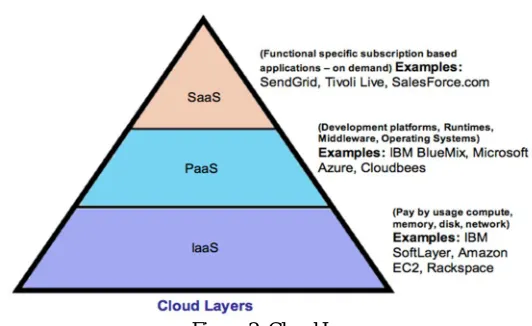
Figure 2. Cloud Layers
1) SaaS: Software as a Service, SaaS deliver applications to its users by utilizing the internet. There is no need of downloads or installations on the client side when using SaaS applications. Examples of SaaS are SalesForce, Google Apps, BigCommerce etc.
2) PaaS: Platform as a Service, PaaS provides a platform for software creation. PaaS offers high level integrated environment to build, test, and deploy custom apps.
3) IaaS: Infrastructure as a Service, IaaS is fully self-service for accessing and monitoring things like compute, networking, storage and other services. It allows businesses to purchase resources on-demand instead of buying the hardware or infrastructure. Example: Eucalyptus
C. Cloud Types
1) Public Cloud: In public cloud, computing services are available to anyone who wants to use or purchase them. The cloud provider manages all hardware, software and other supporting infrastructure. Example: Microsoft Azure
2) Private Cloud: In private cloud, all hardware and software are dedicated solely to the particular organization.
3) Hybrid Cloud: In hybrid cloud, data and applications can move between private and public clouds for greater flexibility and more deployment options.
4) Community Cloud: A community cloud is shared between organizations or a specific community with a common goal.
D. What is Cloud Security?
Hello Cloud computing security is a vast service that provides services and functionalities as IT security. It includes the security of confidential data, critical information and authorized data. It protects the data from data leakage, theft, unauthorized access and breaching. Cloud security gives the ability to perform security of data in an agile manner.
II. PROPOSEDWORK
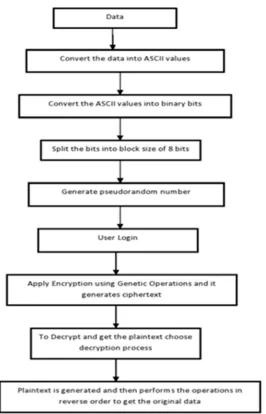
The representation of proposed work is shown in Figure 3. The steps are explained here.
1) The data is taken from the user. This data is converted into ASCII values (American Standard Code for Information
Interchange) using MATLAB.
2) These ASCII values will be converted into binary bits having block size of 8 bits.
3) Generate pseudorandom number using formula:
= (2-0)*rand+0
It generates random numbers between 0 and 2 because 0, 1 and 2 numbers are required to choose the crossover operation. Otherwise ‘rand’ function generates random number between [0,1]. Then apply round function on it. Save it for further use.
4) Go to user login, the user has to fill username and password. The new user has to get registered first then the new user can
5) Select encryption from the process of encryption and decryption first. Genetic operations (crossover and mutation) are implemented here for security of cloud data.
6) Choose crossover operation type on the basis of output of round function of pseudorandom number. Enter the blocks of size 8
bits and generate offspring. Then apply mutation and it gives the ciphertext. Save this ciphertext. This ciphertext is used further for the process of decryption.
7) If the data is to be decrypted, select the process of decryption. It applies reverse mutation on the ciphertext. Choose crossover
operation types. It is implemented in reverse during decryption process. It generates plaintext.
[image:3.612.175.441.189.603.2]8) The plaintext is converted into original data in MATLAB.
Figure 3. Representation of Proposed Work
III. ANALYSIS
IV. SIMULATIONANDRESULTS
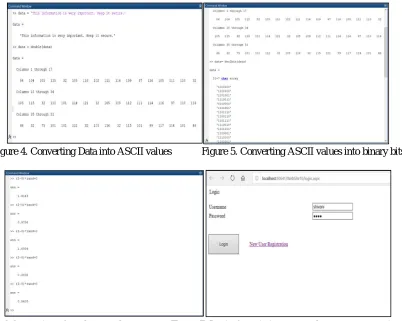
[image:4.612.108.510.168.489.2]The proposed framework is implemented using MATLAB and Microsoft Visual Studio tool. Encryption is done first. In Figure 4. Data is converted into ASCII values, Figure 5. Data is converted into binary bits. Random numbers are generated as shown in Figure 6. The existing user has to login and new user has to register to proceed as shown in Figure 7. Choose crossover operation type shown in Figure 8. One point crossover is chosen here and mutated points after mutation which is ciphertext which is saved as shown in Figure 9. Then select decryption to generate plaintext as shown in Figure 10. The plaintext is converted into original data in MATLAB as shown in Figure 11.
[image:4.612.110.503.509.697.2]Figure 4. Converting Data into ASCII values Figure 5. Converting ASCII values into binary bits
Figure. 6 Generation of random numbers Figure 7. Login for existing user and new user can register here
Figure 10. Plaintext generated after decryption Figure 11. Plaintext is converted into original data
V. COMPARISONWITHEXISTINGWORK
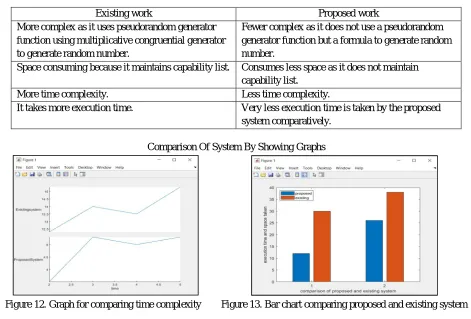
In this section, the existing work is compared with the proposed work. It compares the existing and proposed work in all terms.
Existing work Proposed work
More complex as it uses pseudorandom generator function using multiplicative congruential generator to generate random number.
Fewer complex as it does not use a pseudorandom generator function but a formula to generate random number.
Space consuming because it maintains capability list. Consumes less space as it does not maintain capability list.
More time complexity. Less time complexity.
It takes more execution time. Very less execution time is taken by the proposed
system comparatively.
Comparison Of System By Showing Graphs
Figure 12. Graph for comparing time complexity Figure 13. Bar chart comparing proposed and existing system
VI. CONCLUSION
VII. FUTUREWORKANDSCOPE
Here, block size taken is of 8 bits. Block size can be smaller also. It can be of 4 bits or 2 bits etc. The number of blocks to data will also increase if block size is of smaller size correspondingly. Then genetic operations will also be more in number which will be
required accordingly. Therefore, more number of random bits will be there for the corresponding data in the ciphertext. Hence,
confidentiality of data increases as randomness increases. The scheme proposed here can be simulated at a platform only if these tools are integrated. Integration of tools is also one of the scopes of this proposed system. Other Genetic algorithm functions like replacement and selection can be applied in a different manner. If an unauthorized user or malicious activity is going to happen then the method can alert the system so that it is easier to detect and prevented further.
REFERENCES
[1] Akashdeep Bhardwaj, GVB Subrahmanyam, Vinay Avasthi, Hanumat Sastry, “Security Algorithms for Cloud Computing”, International Conference on Computational Modeling and Security (CMS 2016)
[2] B. Hari Krishnaa, Dr.S. Kiranb, G. Muralia,b, R. Pradeep Kumar Reddy, “Security Issues In Service Model Of Cloud Computing Environment”, Procedia Computer Science 87 ( 2016 ) 246 – 251
[3] Chaimae Saadi, Habiba Chaoui, “Cloud Computing Security Using IDS-AM-Clust, Honeyd, Honeywall and Honeycomb”, International Conference on Computational Modeling and Security (CMS 2016)
[4] El Balmany Chawki, Asimi Ahmed, Tbatou Zakariae, “IaaS Cloud Model Security Issues on Behalf Cloud Provider and User Security Behaviors”, The 2nd International Workshop on Big Data and Networks Technologies (BDNT’2018)
[5] Hefei Jia, Xu Liu, Xiaoqiang Di, Hui Qi, Ligang Cong, Jinqing Li, Huamin Yang, “Security Strategy for Virtual Machine Allocation in Cloud Computing”, 2018 International Conference on Identification, Information and Knowledge in the Internet of Things, IIKI 2018
[6] Hefei Jia, Xu Liu, Xiaoqiang Di, Hui Qi, Ligang Cong, Jinqing Li, Huamin Yang, “Security Strategy for Virtual Machine Allocation in Cloud Computing”, Procedia Computer Science 147 (2019) 140–144
[7] Jayant D. Bokefodea, Avdhut S. Bhiseb, Prajakta A.Satarkara and Dattatray G. Modani, “Developing A Secure Cloud Storage System for Storing IoT Data by Applying Role Based Encryption”, Twelfth International Multi-Conference on Information Processing-2016 (IMCIP-2016)
[8] Mr. Ajay Bhaisare, Prof. Ashwini Meshram, “Data Protection Outsourcing of Cloud Data to Maintain Trust between Cloud Service and Data Owner Using RC5 Algorithm”, International Journal of Computer Science and Mobile Computing, Vol.3 Issue.5, May- 2014, pg. 608-616
[9] Mr. Manish M Potey, Dr C A Dhote, Mr Deepak H Sharma, “Homomorphic Encryption for Security of Cloud Data”,7th International Conference on Communication, Computing and Virtualization 2016
[10] Nabeel Khan, Adil Al-Yasiri, “Identifying Cloud Security Threats to Strengthen Cloud Computing Adoption Framework”, The 2nd International Workshop on Internet of Thing: Networking Applications and Technologies (IoTNAT’ 2016)
[11] Nandita Sengupta and Ramya Chinnasamy, “Contriving Hybrid DESCAST Algorithm for Cloud Security”, Eleventh International Multi-Conference on Information Processing-2015 (IMCIP-2015)
[12] Rizwana Shaikh, Dr. M. Sasikumar, “Trust Model for Measuring Security Strength of Cloud Computing Service”, International Conference on Advanced Computing Technologies and Applications (ICACTA-2015)
[13] Santosh Kumar Majhi, Sunil Kumar Dhal, “Placement of Security Devices in Cloud Data Centre Network: Analysis and Implementation”, International Conference on Information Security & Privacy (ICISP2015), 11-12 December 2015, Nagpur, INDIA
[14] Selvamani K, Jayanthi S, “A Review on Cloud Data Security and Its Mitigation Techniques”, International Conference on Intelligent Computing, Communication and Convergence (ICCC- 2015)
[15] ShaluMall, Sushil Kumar Saroj, “A New Security Framework for Cloud Data”, 8th International Conference on Advances in Computing and Communication (ICACC-2018)