ISSN 2307-3748 (Print) ISSN 2310-3841 (Online) Volume 7 Issue 4 [2019]
Case Report
Denture Induced Stomatitis-
A Case Report
Ahsan Inayat, Syed Zahid Hassan, Ayesha Aziz & Rida Ibrahim
Dow University of Health Sciences, Karachi, Pakistan
Abstract
Background: Denture hygiene habits are liable to change from one person to another. There has been a close relationship between irregular denture surfaces, poor oral hygiene or ill-fitted denture and opportunistic oral microorganism which leads to diseases like denture induced stomatitis.
Case Presentation: A 70-year-old patient reported to the Department of Prosthodontics with a chief complaint of broken denture and pain in oral mucosa. The patient history, oral and denture examination indicated that the patient had denture stomatitis.
Management & Results: The patient was advised to have good oral hygiene and anti-microbial gels. After a week of follow up, the patient showed good results with the treatment.
Conclusion: It can be concluded that the patient needs to be educated regarding denture and oral hygiene is the most important step to prevent this type of disease.
Keywords
Oral Hygiene, Candida Albicans, Denture Stomatitis.
DOI:10.29052/IJEHSR.v7.i4.2019.183-187 Corresponding Author Email:
[email protected] Received 11/07/2019 Accepted 27/11/2019 Published 01/12/2019
ISSN 2307-3748 (Print) ISSN 2310-3841 (Online) Volume 7 Issue 4 [2019]
Introduction
Denture stomatitis is chronic inflammation of oral mucus membrane, especially gingival and palatal mucosa, present under the denture, sometimes occurred with pain, burning or tingling sensation1,2.Other names also include denture sore mouth, chronic atrophic stomatitis, denture associated erythematous stomatitis, candida associated denture stomatitis, depending upon the source and symptoms of the condition3. It is a known factor that Candida albicans is the major cause of this condition. Maxilla is the most common site of his condition because fungal growth is aggravated by Candidal adhesion to maxillary denture fitting surface3,4.
Other associated factors may be systemic or local, systemic factors may include physiological (elderly age), endocrine dysfunction, malnutrition, neoplasias, immunosuppression and autoimmune disease, broad spectrum antibiotics and topical or inhaled corticosteroids. Local factors may constitute dexterity, poor oral hygiene, constant contact of denture to oral soft tissues, carbohydrate rich diet, increased consumption of tobacco and alcohol, decrease salivary flow, ill-fitted denture and persistent wear of denture especially throughout the duration of night. Excessive amount of trauma can also be a factor in contributing to this condition2,5. Despite being a common condition, the exact cause of denture stomatitis is not understood. According to various studies, incidence of denture stomatitis was more common in women and old age patients. Epidemiologic studies report that candida is the main causative agent of denture induced stomatitis, 60%-70% dentures are found to have fungal hyphae4.
Changes in oral environment due to continual wear of denture along with poor denture and oral hygiene, plaque accumulation, age of the denture, geriatric patient, and microorganism contamination of denture surface can be the
main etiological factors of denture stomatitis2. Candidal colonization to denture and oral mucosa as an opportunistic pathogen can be increased because of these etiologic factors. Well maintained oral hygiene, correction of faulty denture and anti-fungal can eradicate this condition6. Older denture can lead to poor fitting, accumulation of food particles and plaque and difficulty in regular cleaning. This can predispose to denture stomatitis. Lack of cleaning can lead to increase pathogenicity of impacted food and plaque accumulation. Moreover, elderly patients are more prone to having denture stomatitis, because of their dexterity and systemic conditions like diabetes mellitus, hypertension and heart diseases etc7. Irradiation, immune disorders, malnutrition can also predispose an individual to denture stomatitis. These conditions affect the salivary flow leading to opportunistic microorganism contamination. The aim of this article was to explore the significance of early diagnosis and treatment along with proper counselling in order to prevent complications7.
Case Presentation
A 70-year-old male patient presented to the department of Prosthodontics at Dr. Ishrat ul Ebad Institute of Oral Health Sciences, with a chief complaint of broken denture which he was wearing since last one month which accompanied with mild burning sensation since last ten days. It was revealed that patient lost his teeth due to accident that led him to wear dentures since last twenty years. Medical history revealed that patient has controlled diabetes and has been under medication since last ten years. He wore the denture overnight and cleaned it rarely.
ISSN 2307-3748 (Print) ISSN 2310-3841 (Online) Volume 7 Issue 4 [2019]
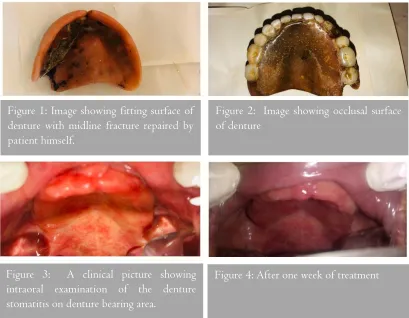
hyperplasia involving the area. It was non-tender on palpation. Denture examination was done. Upon Denture examination the occlusal surface of teeth were seen wear off as noticed as seen in figure 2. The fitting surface of denture in figure 1 was examined and it was seen that it was repaired by the patient himself (on history taking) and is using home adhesive for retention of the denture. Based on the history and the clinical examination, a provisional diagnosis of denture stomatitis was
given. Patient’s hemoglobin A1c (HbA1c) is
7.1% and he visited his family doctor a couple of weeks back. Due to uncooperative behaviour
of the patient smear was not taken for histopathology although patient was advised to discontinue using his old denture. Massage to mucosa was also advised with topical application of antimicrobial gel was prescribed to the patient to use it for 3-4 times in a day along with the use of anti-inflammatory mouthwashes. Follow-up visit of one week revealed that the patient compliance with the prescription medication and showed great deal of improvement which is quite apparent in figure 4. After general management, patient was advised to get new denture fabricated.
Figure 1: Image showing fitting surface of denture with midline fracture repaired by patient himself.
Figure 2: Image showing occlusal surface of denture
Figure 3: A clinical picture showing intraoral examination of the denture stomatitis on denture bearing area.
ISSN 2307-3748 (Print) ISSN 2310-3841 (Online) Volume 7 Issue 4 [2019]
Discussion
The case reported comes under type II of this classification. It was chronic infection caused by the microbial agents associated with mechanical injury due to wearing denture constantly day and night, along with poor oral hygiene4. In order to prevent this condition maintenance of a good oral hygiene is pivotal. It is also essential for dental health professionals to give proper guidance and counsel the patient correctly. To manage denture stomatitis, following attributes must be acquired i.e. denture sanitization and disinfection, wearing the denture as advised by the dental health professional, mechanical plaque control and mouthwashes like chlorhexidine should be advised to keep mouth free of periodontal disease, Correct faulty and ill-fitted dentures8. Topical therapy of antifungals should be prescribed as the first line of treatment from its surface by soaking denture in any anti septic solution. This also reduces the microorganism colonies present on the surface of denture9. Underlying systemic disease like diabetes mellitus should also be treated. Patients taking corticosteroids should be given advise about the precautions taken with the medication like rinsing mouth after inhaling corticosteroid etc10,11. Angular Cheilitis is the one of the most frequently seen condition associated with denture stomatitis but it can be related to any intraoral candidiasis. A study conducted by Iqbal Z et al., concluded that tissue conditioners are also been used to improve adaptation of the denture and, allow recovery of denture bearing tissues and also for the reduction of candida colonies8. Due to poor condition of the denture and self-repairing tissue conditioner was not used although patient was advised for denture removal and was informed about tissue massaging with topical gels and anti-inflammatory mouth wash before fabrication of a new prosthesis.
Despite the name, denture stomatitis i.e. soma
“mouth” and “-itis” which means
inflammation, this condition is usually asymptomatic2. It may give the impression of being just simple inflammation, localized to just one area or generalized i.e. involving all areas covered by the denture. Granular inflammation especially papillary hyperplasia is also included in this condition depending upon the severity level6.
Conclusion
The current case report gives emphasis on the etiology, clinical factors, diagnostic investigations and management of denture stomatitis along with a treated case. Denture stomatitis is multifaceted. Correct history and examination are important to diagnose the condition and treat accordingly. Furthermore, there is a need of oral health care projects for patient counselling which can enhance the awareness and knowledge of denture wearers regarding the consequences of poor oral hygiene habits.
Conflicts of Interest
None.Acknowledgement
We would like to thank the study patient, whose case is presented in the current study.
Funding
None.References
1. Peter M, Rao KP, Kini VR, Kashyap BRR, Gitish YR. Denture Stomatitis- A Case Report; Paci J Med Sci 2016; 16(1):50-53. 2. Naik AV, Pai R.C, A Study of Factors
ISSN 2307-3748 (Print) ISSN 2310-3841 (Online) Volume 7 Issue 4 [2019]
3. Mago J, Mittal K, Kaur M, Kaur A, Kaunda M. Denture stomatitis–a case report and an update. World J Pharm Med Res. 2016;2(4):224-226.
4. De Vasconcellos AA, Gonçalves LM, Cury AA, Da Silva WJ. Candida-associated denture stomatitis: Clinical relevant aspects. In Ribeiro Rosa EA., editor. Oral Candidosis [Internet] Berlin, Heidelberg: Springer; 2015. pp. 53-57. Available at: https://link.springer.com/chapter/10.100 7/978-3-662-47194-4_7
5. Gauch LM, Pedrosa SS, Silveira-Gomes F, Esteves RA, Marques-da-Silva SH. Isolation of Candida spp. from denture-related stomatitis in Pará, Brazil. Braz J Microbiol. 2018;49(1):148-151.
6. Emami E, De Grandmont P, Rompré PH, Barbeau J, Pan S, Feine JS. Favoring trauma as an etiological factor in denture stomatitis. J. Dent. Res. 2008;87(5):440-444.
7. Gendreau L, Loewy ZG, Epidemiology and Etiology of Denture Stomatitis. J Prosthodont. 2011 ;20: 251-260
8. Iqbal Z, Kazmi SM, Askari J, Yazdanie N. Application of Tissue Conditioner reduces Candida colonies count in Paitent with Denture Related Stomatitis, J Pak Dent Assoc. 2009;18(3):114-118.
9. Dar-Odeh NS, Al-Beyari M, Abu-Hammad OA. The role of antifungal drugs in the management of denture-associated stomatitis. Int J Antimicrob Agents. 2012 ;2(1).
10. Zissis A, Yannikakis S, Harrison A. Comparison of denture stomatitis prevalence in 2 population groups. Int J Prosthodont. 2006;19(6): 621-625.