in the population sciences published by the Max Planck Institute for Demographic Research Konrad-Zuse Str. 1, D-18057 Rostock · GERMANY www.demographic-research.org
DEMOGRAPHIC RESEARCH
VOLUME 27, ARTICLE 17, PAGES 455-486
PUBLISHED 5 OCTOBER 2012
http://www.demographic-research.org/Volumes/Vol27/17/ DOI: 10.4054/DemRes.2012.27.17
Research Article
The intermediate effect of geographic
proximity on intergenerational support:
A comparison of France and Bulgaria
Leen Heylen
Dimitri Mortelmans
Maarten Hermans
Kim Boudiny
This publication is part of the proposed Special Collection "Intergenerational family ties in Europe: Multiple linkages between individuals, families and social contexts", edited by Pearl Dykstra.
© 2012 Leen Heylen et al.
This open-access work is published under the terms of the Creative Commons Attribution NonCommercial License 2.0 Germany, which permits use, reproduction & distribution in any medium for non-commercial purposes, provided the original author(s) and source are given credit.
1 Introduction 456 2 Theoretical background: Intergenerational solidarity within the
family 457
2.1 Hypotheses 459
2.2 The Bulgarian and French contexts 461
3 Data and methodology 462
4 Results 465
4.1 Descriptive results: Structural and functional solidarity 465
4.2 Multivariate analyses 468
4.2.1 Receiving support: Childcare 468 4.2.2 Providing support: Personal care 470 4.2.3 Additional analyses: The impact of co-residence 472 5 Discussion and conclusion 474
References 478
The intermediate effect of geographic proximity on intergenerational
support:
A comparison of France and Bulgaria
Leen Heylen1
Dimitri Mortelmans2
Maarten Hermans3
Kim Boudiny4
Abstract
BACKGROUND
The geographic proximity of parents and adult children is a key element of intergenerational solidarity. Many studies have identified geographical distance as an important determinant of intergenerational support: living nearby increases the amount of mutual support provided. It can, however, also be regarded as a dimension of intergenerational solidarity: the current degree of proximity is the result of past migration decisions made by both generations, in which present and future care demands potentially played a key role.
OBJECTIVE
We take this endogenous nature of geographical distance into account by examining the indirect effect of the determinants of the actual level of support through geographical distance. Both upward support (personal care provided to mother) and downward support (help with childcare received from mother) are considered.
METHODS
Path analyses are performed on data from the Generations and Gender Survey for France and Bulgaria using a general latent-variable modelling framework in multiple-group models.
1 PhD, Research Centre for Longitudinal and Life Course Studies (CELLO), University of Antwerp.
Kleinhoefstraat 4 2440 Geel. Tel:0032/14 56 23 10. E-mail: [email protected].
2 PhD, Research Centre for Longitudinal and Life Course Studies (CELLO), University of Antwerp. 3 Research Centre for Longitudinal and Life Course Studies (CELLO), University of Antwerp. 4 PhD Fellow Research Foundation-Flanders (FWO), Research Centre for Longitudinal and Life Course
RESULTS
In addition to strongly affecting the level of support provided and received, geographical distance itself is affected by several individual and family-related variables, which in turn have an indirect effect on the level of intergenerational support. The results suggest that proximity can be used as an adaptive strategy: e.g., working adult children in France receive more help with childcare because of their greater proximity to their mothers. Having a greater care need may have triggered this choice of residence. Similarly, single parents with no partner to rely on tend to live closer to their mothers, and therefore receive more help.
CONCLUSIONS
Geographic proximity can be considered a latent form of solidarity that functions as a mediator between background factors and manifest, functional solidarity.
1. Introduction
The amount of geographical distance between parents and their adult children has been proven to be a key factor in understanding the actual provision of care (Komter and Vollebergh 2002; Mulder 2007; Rogerson, Burr, and Lin 1997). Many studies have pointed to geographical distance as an important determinant of intergenerational support: living nearby increases the amount of mutual support provided (Knijn and Liefbroer 2006). These studies introduced geographic proximity as an independent variable, or as an explanation of the level of intergenerational support. Geographic proximity can be considered a dimension of intergenerational solidarity in its own right as well (Konrad et al. 2002; Mulder and Kalmijn 2006; Tomassini, Wolf, and Rosina 2003). The current geographical distance can be understood as the result of migration decisions made by both generations over the life course, based on their needs and resources (Hank 2007). The proximity of family members can play a key role in this decision making process. For example, couples with young children may choose to live closer to their parents in order to take advantage of a potential source of low-cost childcare (Tomassini, Wolf, and Rosina 2003).
the actual level of support, affect proximity as well, and thereby indirectly affect the actual level of support.
Path analysis is applied in order to test the intermediate effect. Our analyses draw upon data from the Generations and Gender Survey (GGS). From this dataset, we selected one Western European country (France) and one Eastern European country (Bulgaria). These two countries differ greatly in terms of the geographic proximity of adult children and their parents. Intergenerational co-residence is a well-established living arrangement in Bulgaria (Ahmed and Emigh 2005), whereas it is less common in France (Hank 2007). Structural and cultural differences at the macro level (e.g., economic resources, welfare regime, and the cultural orientation of the two countries) can account for this (Igel et al. 2009). Nevertheless, both countries are confronted with similar socio-demographic trends, including population ageing, declining fertility rates, and increasing rates of non-marital cohabitation and divorce (Hoem and Kostova 2008; Puur et al. 2010).
2. Theoretical background: Intergenerational solidarity within the
family
In recent decades, concerns have been raised about the level of intergenerational support between family members. Increasing intergenerational separation, and, more specifically, the decline in co-residence among adult family members of different generations, have led some scholars to express concerns about the “decline of the family” (Kohli 1999; Malmberg and Petterson 2007; Shelton and Grundy 2000). In contrast, other studies have found that intergenerational ties continue to be strong, and that “intimate but distant” relationships continue to allow for the provision of support (Bengtson 2001; Daatland and Herlofson 2003). In the latter case, exploring the genesis of geographic proximity may offer valuable insights. Of specific importance in this regard is determining whether geographic proximity explains differences in support levels; and, if so, who lives farther away, and whether these individuals constitute vulnerable groups (Glaser and Tomassini 2000; Rogerson, Weng, and Lin 1993).
opportunity structure for interaction between family members, such as the geographic proximity and the number of family members. Functional solidarity can be understood as the degree of actual support (Bengtson and Roberts 1991). It comprises various kinds of support, including financial, emotional, and instrumental support (Attias-Donfut, Ogg, and Wolff 2005; Bengtson and Roberts 1991). As geographic proximity is considered to be of specific importance for instrumental support (Mulder and van de Meer 2009; Rogerson, Burr, and Lin 1997), we will focus on this type of support.
This six-dimensional categorisation of intergenerational solidarity can be divided into two domains of solidarity: latent and manifest (Silverstein, Bengtson, and Lawton 1997). Structural solidarity is considered a latent resource of solidarity that can trigger manifest, functional solidarity in times of need (Silverstein, Gans, and Yang 2006).
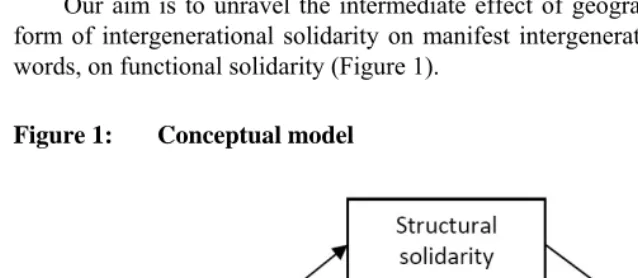
Our aim is to unravel the intermediate effect of geographic proximity as a latent form of intergenerational solidarity on manifest intergenerational support, or, in other words, on functional solidarity (Figure 1).
Figure 1: Conceptual model
As the correlates of geographic proximity are often considered to be important determinants of intergenerational instrumental support as well, some socio-demographic features may influence intergenerational support both directly and indirectly, through geographical distance (Kalmijn and Saraceno 2008; Knijn and Liefbroer 2006). While direct and indirect effects can reinforce each other, it is equally plausible that some socio-demographic features may counteract each other through direct and indirect effects that operate in opposite directions.
children to their older parents) and downward support (from older parents to their adult children). Information concerning personal care provided to parents is used to measure upward support. Downward support is measured based on information from the survey regarding help with childcare for children younger than age 14 living in the household. This grandparent role is considered to be of specific importance in terms of intergenerational support (Hank and Buber 2009). We focus on intergenerational support between women and their adult children, as women tend to function as kin-keepers in the family (Rossi and Rossi 1990). More specifically, the childcare provided by grandparents is generally performed by grandmothers (Hank and Buber 2009).
In Section 2.2, we elaborate on the particular macro contexts of the two countries (France and Bulgaria), and on how each context can affect the degree of intergenerational solidarity within the family. More specifically, we look at how they can affect the two dimensions in question, and the relationship between them.
2.1 Hypotheses
When formulating the hypotheses, we explicitly distinguished between direct effects on intergenerational support and indirect effects, through geographical distance. Important correlates include the age of the adult child, health, gender, socio-economic status and family characteristics.
With respect to socio-economic status, working adult children with young children in the household have a greater need for support (i.e., childcare), and we therefore expect to find that they receive more help from their mothers (Hank and Buber 2009). Adult children with higher incomes have more options for purchasing formal care, and this may have a negative effect on the level of instrumental support provided to mothers (Attias-Donfut, Ogg, and Wolff 2005; Silverstein, Gans, and Yang 2006). People with higher levels of education could be expected to have a greater sense of obligation to provide support (De Koker 2009). On the other hand, working adult children with higher levels of income or education are hypothesised to live farther away (Hank 2007), which may counteract the direct effects. For those who are unemployed, having parents who live nearby could serve as a form of “unemployment insurance” (Malmberg and Petterson 2007).
Regarding partner status, we expect to find that single parents receive more help with childcare, as singles have no partners they can count on for support. In addition, single parents are hypothesised to live closer to their parents as an adaptive strategy: the need for support may have triggered a move towards the parents (Bumpass and Raley 1995). Singles are expected to provide more support as well (Rossi and Rossi 1990), as having a lower level of competing demands (no partner) may result in the provision of more support. The indirect effect of partner status through geographical distance is expected to show that single adult children are more likely to reside with their parents. When they do live separately, they are likely to live farther away, as singles have fewer constraints with regard to their residential choices (Shelton and Grundy 2000).
As a final indicator of family structure, the number of siblings is hypothesised to have negative direct and indirect effects. A larger family size may reduce the number of interactions between parents and their children, due to the competing needs of the other children (Tomassini et al. 2004; Tomassini, Wolf, and Rosina 2003). Second, a larger family size and a lower level of obligation to provide support may have negative effects on geographic proximity in cases involving a high number of siblings. A higher number of siblings is expected to correlate with a lower degree of obligation of individual siblings to support their parents.
2.2 The Bulgarian and French contexts
At the macro level, we selected two European countries that differ significantly in terms of their welfare regimes, economic resources, and cultural attitudes regarding family responsibilities. In general, these societal-level structural and cultural differences are expected to explain differences in the degree of both geographic proximity and intergenerational support (Broese van Groenou et al. 2006; Hank 2007).
Structural differences (e.g., socio-economic conditions) have a strong effect on the prevalence of multigenerational households. In Bulgaria, household extension is used as an adaptive strategy, particularly amongst the poor. Co-residence makes it possible to pool economic resources. Furthermore, the need for kinship care can trigger co-residence as well, particularly for single mothers and retirees (Ahmed and Emigh 2005). In France, the nuclearisation of families resulted in a decline in multigenerational households and an increase in older people living alone or as couples (Kalmijn and Saraceno 2008). The welfare regimes of France and Bulgaria also differ greatly. France is characterised by a high degree of de-familialisation with respect to obligations towards both the elderly and children, as family responsibilities and dependencies are reduced by the individualisation of social rights. In France, 6.5% of all people aged 65 or older live in care institutions, and 43% of all children under the age of three are in formal childcare (kindergarten) (Keck, Hessel, and Saraceno 2009). In addition, with regard to young children, the intergenerational regime in France can be described as a form of supported familialism, in which policies support families in meeting their financial and caregiving responsibilities. Bulgaria, by contrast, is characterised by a high degree of familialism by default. Support to families is neither publicly provided nor financially supported (Saraceno and Keck 2010). Only 0.5% of all people aged 65 or older live in care institutions, and only 7% of children under the age of three are covered by formal childcare (Keck, Hessel, and Saraceno 2009).
Bulgarian population agree that children should allow their parents to live with them when they are no longer able to care for themselves, whereas a significant minority of the French population disagree with this idea. Similarly, support for the premise that parents should help their adult children is significantly weaker in France than it is in Bulgaria (Herlofson et al. 2011). Because of these structural and cultural differences, we expect to observe a higher level of intergenerational support in Bulgaria, specifically with regard to personal care for older parents.
The two countries are similar in some respects, as both are confronted with the ageing of the population and the emergence of new family constellations (Hoem, Kostova, and Jasioniene 2009). By using a conceptual model that focuses specifically on the intermediate effects of geographic proximity to compare a country characterised by low levels of co-residence and greater travelling distances between family members to a country characterised by high levels of multigenerational co-residence, we expect to gain greater insight into the manifestation of intergenerational solidarity in contemporary societies (Glaser, Tomassini, and Grundy 2004). More specifically, we intend to investigate the ways in which differences between the opportunity structures for support in France and Bulgaria relate to the actual level of support provided in the two countries in light of these socio-demographic trends.
3. Data and methodology
For the analyses, we drew upon data from the Generations and Gender Survey (GGS), a panel survey of a nationally representative sample of the non-institutionalised population between the ages of 18 and 79 (Vikat et al. 2007). The data were collected in 2004 for Bulgaria and in 2005 for France. Since no weight variables were available for these countries, the analyses are unweighted. With regard to the selection of the two countries, it is important to note that, in addition to the substantive considerations mentioned above, methodological considerations played a role. The considerable overlap in variables and the categorisation of these variables enhances the comparability of the two countries, and crucial information (e.g., categorisation of educational level) was missing for other countries.
everyday activities due to physical or mental health problems or disabilities (Igel et al. 2009). We excluded students from our analyses, as they are, generally, still dependent on their parents, and are therefore significantly more likely to reside with their parents. Students’ reasons for living with their parents are expected to differ substantively from those of adult children in the working population, as the personal income of the latter group reduces the need to live in the parental home (Aassve et al. 2001). Based on these selections, we retained 3119 Bulgarian respondents and 2233 French respondents for the analyses on childcare. For personal care, these selection criteria resulted in a sample of 770 Bulgarian and 1557 French respondents. Although this procedure necessarily eliminated some of the variation in geographic proximity, this did not pose a problem, as our goal was not to unravel the diversity in geographic proximity, but was, rather, to test whether and in what manner the geographical distance functions as a mediator between the background variables and the actual level of support.
Help with childcare received from the mother of an adult child was measured according to respondents’ answers to the question of whether they received regular help with childcare from relatives, friends, or other people who were not professional childcare providers; and, if so, from whom. The other dependent variable, personal care provided to the mother, was measured according to the response to the following question: “Over the last 12 months, have you provided others with regular help with personal care, such as eating, getting up, dressing, bathing, or using the toilets?” For this item as well, respondents were asked whom they had helped.
The mediator variable, the distance between the respondent and his or her mother, is measured in minutes: the time needed to travel from the respondent’s home to the mother’s current residence. Given the high prevalence of multigenerational co-residence in Bulgaria, our analyses should include co-residing adult children as well. We therefore constructed an ordinal variable in which the first category (1) corresponds to co-residence. The other four categories were based on distance, as measured in minutes of travelling time between the home of the mother and home of the adult child: a travelling distance of 10 minutes or less (2), a travelling distance of 11-30 minutes (3), a travelling distance of 31-60 minutes, (4) and a travelling distance of more than one hour (5). This categorical measure allowed us to include co-resident adult children in our analyses, and helped to compensate for problems related to skewness in the distance measure. In addition, the introduction of the distance measure in minutes into a regression analysis could lead to faulty conclusions, as it would assume that a one-minute increase in travelling time is proportionally equivalent for all travelling distances. For those living farther away, an additional minute of travelling time is of less consequence (Silverstein 1995).
considerations. The one-hour travelling time “cut off” is often applied in research on proximity (Lawton, Silverstein, and Bengtson 1994). For example, Ha and Carr (2005) showed that living more than an hour away from their adult children increases the level of psychological distress of widowed parents. By drawing an additional distinction between respondents who reported a travelling distance of 10 minutes, half an hour, or between half an hour and an hour, we introduced more variety in our analyses. These distinctions correspond to the first two quartiles of the distance in minutes for those respondents who were not co-residing, in both France and Bulgaria: 25% of the respondents who were not co-residing had a travelling distance of 10 minutes, and the next 25% had a travelling distance of between 11 and 30 minutes.
For the individual, micro-level factors, we included age, sex, and subjective health status. The socio-economic background characteristics included are educational level, working status (containing four categories: employed, unemployed, retired, or other activities), homeownership status (dichotomous), the ability to make ends meet at the household level, and a class variable. We used the respondents’ ISCO88 occupational-unit group indicators (UN-ILO 1990) to derive their class position within the ESeC class schema (Rose and Harrision 2010), collapsing the resulting nine-class model into four categories. The substantive categories are “salariat” (Class I), “intermediate” (Class II), and “working class” (Class III). The respondents we were unable to place into one of these three categories were classified as “other.”
Next, we included in the analyses the following factors: partner status (living with a partner or not), ever having been divorced, marital status of the older mother (married, widowed or divorced, separated or never having lived together), the presence of the respondents’ own children living in the household (only for personal care), health status of the mother (only for childcare), and the number of siblings. In the analyses of childcare received, we also considered whether the respondents made use of formal childcare. This allowed us to test the relative complementarity of formal and informal care.
The initial model included all respondents, including those living with their mothers. The large proportion of adult children living with their mothers in Bulgaria raises the question of whether geographic proximity can still function as a mediator when co-residing adult children are excluded. For this reason, the second model excluded co-residing adult children from the analyses.
The results of the multivariate analyses are represented in figures two to four. The tables containing the unstandardised probit regression coefficients for childcare, personal care, and distance can be found in the appendix. This appendix also contains a table with the total effects, based on the indirect and direct effects. The figures enabled us to develop a simultaneous picture of the direct and indirect effects on the actual level of support, mediated by geographical distance.
4. Results
4.1 Descriptive results: Structural and functional solidarity
In Bulgaria, 28% of the adult children with young children (<14 years old) living in the household received help with childcare from their mothers, compared with around 24% in France. With regard to the personal care provided to the mother, the differences between the two countries were larger. In Bulgaria, 15% of the respondents provided personal care to mothers who were limited in their normal daily activities due to health problems, compared to only 6% of the respondents in France.
With regard to the distribution of geographic proximity by country, large differences emerged, as hypothesised. In Bulgaria, 34% of the adult children whose mothers were alive were living with their mothers, compared to 5% of the adult children in France (see Table 1). At the other extreme, 14% of the adult children in Bulgaria were living more than an hour away from their parents. This proportion was much higher in France (33%).
The need for support may have triggered a move (or return move) on the part of either the parent or the adult child towards the other.
Table 1: Relative distribution of geographical distance by country (Bulgaria, GGS 2004; France, GGS 2005)
Bulgaria France
All respondents
Respondents with young children in hh
Respondents with disabled
mother All respondents
Respondents with young children in hh
Respondents with disabled
mother
Living in same
household 33.85 18.01 30.04 5.25 0.31 0.00
< = 10 minutes
travelling distance 18.52 25.26 19.96 27.38 30.99 31.58
11-30 minutes
travelling distance 22.14 28.40 21.06 22.66 23.87 25.86
31-60 minutes
travelling distance 11.51 13.05 11.90 11.90 11.29 11.85
More than 60 minutes travelling
distance 13.97 15.29 17.03 32.81 33.54 30.71
N 7714 3119 770 5596 2233 1557
Table 2: Percentage receiving and giving help by geographic proximity (row percentages), Bulgaria (GGS 2004)
Help with child care Care to mother
Living in same household 58.72 24.37
< = 10 minutes travelling distance
31.68 10.19
11-30 minutes travelling distance
20.52 14.47
31-60 minutes travelling distance
13.51 6.90
More than 60 minutes travelling distance
9.22 9.30
N 3119 770
Chi²-test Chi²=422.43, df=4, p<0.0001 Chi²=27.14, df=4, p<0.0001
The results for France (see Table 3) for help with childcare were similar. Given the low number of respondents with young children in the household who were living with their older mothers, the first two categories were combined for the bivariate analyses. The adult children who were living close to their mothers were far more likely to have reported receiving help from their mothers with childcare than those living far away. Only 6% of adult children who were living more than an hour away from their mothers received help with childcare from their mothers, compared to 40% of the adult children who could reach their mothers in 10 minutes or less. The relationship between proximity and care provided is weaker with regard to personal care provided to the mother. The largest differences were observed between respondents living at a travelling distance of more than one hour and those in the other categories. Only 3% of the first-mentioned respondents provided personal care to their mothers.
Table 3: Percentage receiving and giving help by geographic proximity (row percentages), France (GGS 2005)
Help with child care Care to mother
< = 10 minutes travelling distance 40.20 8.04
11-30 minutes travelling distance 28.14 5.04
31-60 minutes travelling distance 18.65 6.99
More than 60 minutes travelling distance 6.28 3.08
N 2233 1557
4.2 Multivariate analyses
4.2.1 Receiving support: Childcare
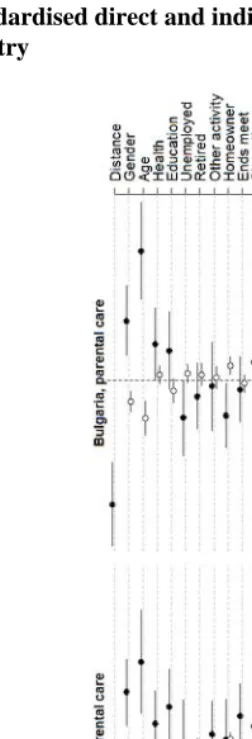
We now present the results of the path analyses of childcare in the two countries (Figure 2). First, the standardised effects reveal that geographic proximity has a strong negative direct effect on the level of actual support received in both countries. Greater distance was associated with less support received.
Older adult children received less help with childcare. These negative effects are reinforced by the fact that the older adult children lived farther away from their mothers. In France, the distance between disabled older mothers and their adult children was smaller compared to mothers who do not suffer from any disabilities; they consequently provided more help, regardless of their health status. Our analyses show that women in France received more help from their mothers. Women in Bulgaria received less help and they were more likely to live separately or far away from their mothers.
Also of interest is the effect of educational level. In both countries, highly educated respondents received more help with childcare from their mothers, although the indirect effects were in the opposite direction. Adult children with higher levels of education lived farther away from their mothers and therefore received less help from them. For France, these opposite effects neutralised each other. For Bulgaria, the total effect remains significant, as the negative indirect effect did not completely cancel out the positive direct effect. The data from France also showed a significant effect of socio-economic status on geographical distance: respondents of higher classes lived farther away from their mothers, and therefore received less help from them with childcare. On the other hand, regardless of the class variable, respondents who were unemployed or engaged in other activities (e.g., housework) lived significantly farther away from their mothers, and consequently received less help from their mothers. In Bulgaria, these variables exerted neither direct nor indirect effects.
Figure 2: Standardised direct and indirect effects on childcare received, by country
The marital status of the mother significantly affected the odds of receiving help: e.g., respondents whose parents were divorced or separated, or had never lived together, received significantly less help from their mothers. In France, this effect was reinforced by the larger geographical distance. While widowed mothers in France provided less help with childcare, in Bulgaria they helped more, as they lived closer to their children. With respect to the number of siblings, we observed in both countries strong negative effects, both direct and indirect.
We also considered whether the respondents were using formal childcare. In Bulgaria, adult children who were using formal childcare were also more likely to be receiving help with childcare from their mothers.
4.2.2 Providing support: Personal care
We now present the results regarding personal care provided to mothers (Figure 3). For these analyses, we selected respondents whose mothers were unable to perform the normal activities of daily living due to physical or mental problems, and who may therefore be expected to have been in need of care. Again, the geographical distance between older mothers and their adult children had a strong negative effect on personal care provided to the mother, although the effect is significantly stronger in Bulgaria (p<0.05).
Daughters provided more support in both France and Bulgaria. The indirect effect ran in the other direction for Bulgaria, diminishing the total positive effect: adult daughters were living farther away. In both countries, older respondents provided more support, although this effect was weakened by the indirect effect, as older respondents tended to live farther away. While health status had no significant direct or indirect effect in either France or Bulgaria, the total effect was significant in Bulgaria with children with a better self-reported health status providing more personal care. Indicators of socio-economic status exerted little effect. In Bulgaria, only homeownership exerted an indirect, positive effect on support provided. In France, this effect ran in the same direction. As before, French respondents of higher classes lived further away. Although significant direct and indirect effects of education were noticed in France, the total effect shows that these effects cancel each other out.
(p<0.01). The marital status of the mother exerted a significant effect on personal care received: in both countries, widowed mothers received more care. This effect was reinforced in France, as adult children and widowed mothers tended to live closer to each other.
4.2.3 Additional analyses: The impact of co-residence
Co-residence as a prevalent living arrangement in Bulgaria raises the question of whether the indirect effects through distance would remain similar if the co-residing respondents were excluded. In order to determine whether the mediated effect of the correlates could be explained by greater distance or by residence, we excluded co-resident adult children for the final analysis.
5. Discussion and conclusion
In general, the results point to the importance of considering the intermediate effect of the amount of geographical distance between adult children and their mothers. Our analyses showed that geographic proximity is a key determinant of the actual level of support. Geographical distance between adult children and their mothers is affected by several correlates, and these effects all have an indirect effect on the level of intergenerational support. Geographic proximity can be considered a dimension of solidarity, as hypothesised: geographic proximity, as a latent form of solidarity, functions as a mediator between individual background factors, and is a manifestation of functional solidarity.
In line with our hypotheses, we found that older adult children received less help with childcare, but provided more personal care. The increasing risk of frailty among the mothers of the older respondents affected the level of personal care provided, as hypothesised. The indirect effect was negative in both countries: in both cases older adult children tended to live farther away from their mothers. This can be attributed to a higher probability of successive moves among older people. The negative effect is likely to have the most detrimental impact on support provided to older mothers, as their need for support is likely to increase with advancing age. The results confirm the kin-keeper role of women. In both France and Bulgaria, women provided more support. In France, they also received more help with childcare. In Bulgaria, on the other hand, women were less likely than their male siblings to live in the parental home. This had a negative impact on the level of intergenerational support, on top of a direct negative effect. The family system in Bulgaria has historically been characterised as a “patrivirilocal-lifecycle complexity: newly-weds live with the groom’s parents and any other of his married brothers or unmarried siblings” (De Vos and Sandefur 2002:23). This cultural tradition could explain the differences by gender in co-residence (Ahmed and Emigh 2005).
important to note that we ruled out the effect of educational level and other indicators of socio-economic status. This nevertheless implies that working adult children received more help with childcare, as hypothesised, although this was due to the fact that they lived closer to their mothers. A possible explanation for this could be that the working status of adult children with young children of their own may have led them to move closer to their mothers in the past in order to receive more help with childcare.
Of specific interest are the effects of the family constellation. Our analyses showed that single parents received more help, again because they tended to live closer to their mothers. In Bulgaria, they were more likely to live with their mothers. This supports the hypothesis that single parents live closer to their parents as an adaptive strategy. Having experienced a divorce positively affected the level of childcare received in Bulgaria, regardless of respondents’ current partner status. In France, divorce was not directly associated with less grandparental help, but the distance between adult children and their mothers was greater resulting in a negative indirect effect. The geographical distance between French adult children and their mothers was also larger in case of a divorce or separation on the part of the mother.
The results confirm the importance of considering the reciprocal nature of intergenerational ties. In addition to being the recipients of care, older adults are important providers of support. The amount of geographical distance between adult children and their mothers strongly affects both the level of support provided and the level of support received. In both cases, it functions as a mediator between background factors and the actual level of support. The “choice” of residence is therefore important for both generations.
maternal employment. Occasional grandparental help may still be necessary as a supplement to publicly provided childcare (Hank and Buber 2009). The fact that the adult children using formal childcare services were also more likely to receive help with childcare from their parents in Bulgaria confirms this observation.
In both countries, geographic proximity functioned as a mediator between the background variables and the actual level of support (Figure 1). Of specific interest is the fact that the manifestation of geographic proximity as a determinant of instrumental support differs between Bulgaria and France. In France, living farther away implies less intergenerational support, while living separately makes the difference in Bulgaria. Each of the countries represents a different context, as reflected in the amount of geographical distance between family members. A typical argument in the debate on the decline of the family has been that the residential independence of older adults reflects a loss of intergenerational support (Silverstein, Bengtson, and Lawton 1997). These results suggest that living separately does not necessarily mean a lack of support in countries characterised by a low level of multigenerational co-residence and a stronger welfare regime. Living nearby has replaced living together as an antecedent of support (Kohli, Künemund, and Lüdicke 2005). On the other hand, the patterns observed in Bulgaria suggest that the following observation, made about Southern European countries, applies there as well (Albertini, Kohli, and Vogel 2007): co-residence is a “way of transferring resources from parents to children and vice versa” (Albertini, Kohli, and Vogel 2007:326).
situation of older fathers. Several studies have indicated that strong gender differences are apparent in terms of intergenerational support in later life (see, e.g., Shapiro 2003).
References
Aassve, A., Billari, F.C., Mazzuco, S., and Ongaro, F. (2001). Leaving home ain't easy. A comparative longitudinal analysis of ECHP data. MPIDR Working Papers. Rostock: Max Planck Institute for Demographic Research: 32. (MPIDR Working Papers).
Ahmed, P. and Emigh, R.J. (2005). Household composition in post-socialist Eastern Europe. International journal of sociology and social policy 25(3): 9-41.
doi:10.1108/01443330510791117.
Albertini, M., Kohli, M., and Vogel, C. (2007). Intergenerational transfers of time and money in European families: Common patterns - different regimes? Journal of European Social Policy 17(4): 319-334. doi:10.1177/0958928707081068.
Attias-Donfut, C., Ogg, J., and Wolff, F.-C. (2005). European patterns of intergenerational financial and time transfers. European Journal of Ageing 2(3): 161-173. doi:10.1007/s10433-005-0008-7.
Bengtson, V.L. (2001). Beyond the nuclear family: the increasing importance of multigenerational bonds. Journal of Marriage and the Family 63(1): 1-16. doi:10.1111/j.1741-3737.2001.00001.x.
Bengtson, V.L. and Roberts, R.E.L. (1991). Intergenerational solidarity in aging families: an example of formal theory construction. Journal of Marriage and the Family 53(4): 856-870. doi:10.2307/352993.
Brandt, M., Haberken, K., and Szydlik, M. (2009). Intergenerational help and care in Europe. European Sociological Review 25(5): 585-601. doi:10.1093/esr/jcn076. Broese van Groenou, M., Glaser, K., Tomassini, C., and Jacobs, T. (2006).
Socio-economic status differences in older people's use of informal and formal help: A comparison of four European countries. Ageing & Society 26(5): 745-766.
doi:10.1017/S0144686X06005241.
Brown, T.A. (2006). Confirmatory Factor Analysis for Applied Research. New York - London: The Guilford Press.
Bumpass, L.L. and Raley, K.R. (1995). Redefining single-parent families: cohabitation and changing family reality. Demography 32(1): 97-109. doi:10.2307/2061899. Cheung, M.W. (2009). Comparison of methods for constructing confidence intervals of
standardized indirect effects. Behavior Research Method 41(2):425-438.
Daatland, S.O. (2007). Marital history and intergenerational solidarity: The impact of divorce and unmarried cohabitation. Journal of Social Issues 63(4): 809-825.
doi:10.1111/j.1540-4560.2007.00538.x.
Daatland, S.O. and Herlofson, K. (2003). 'Lost solidarity' or 'changed solidarity': A comparative European view of normative family solidarity. Ageing & Society 23(5): 537-560. doi:10.1017/S0144686X03001272.
De Koker, B. (2009). Socio-demographic determinants of informal caregiving: Co-resident versus extra-Co-resident care. European Journal of Ageing 6(1): 3-15.
doi:10.1007/s10433-008-0103-7.
De Vos, S. and Sandefur, G. (2002). Elderly living arrangements in Bulgaria, the Czech Republic, Estonia, Finland and Romania. European Journal of Population 18(1): 21-38. doi:10.1023/A:1013877606584.
Dykstra, P.A. (1999). The effects of divorce on intergenerational exchanges in families. The Netherlands' Journal of Social sciences 33(2): 77-93.
Glaser, K. and Tomassini, C. (2000). Proximity of older women to their children: A comparison of Britain and Italy. The Gerontologist 40(6): 729-737.
doi:10.1093/geront/40.6.729.
Glaser, K., Tomassini, C., and Grundy, E. (2004). Revisiting convergence and divergence: support for older people in Europe. European Journal of Ageing 1(1): 64-72. doi:10.1007/s10433-004-0006-1.
Ha, J.-H. and Carr, D. (2005). The effect of parent-child geographic proximity on widowed parents' psychological adjustment and social integration. Research on Aging 27(5): 578-610. doi:10.1177/0164027505277977.
Hank, K. (2007). Proximity and contacts between older parents and their children: a European Comparison. Journal of Marriage and the Family 69(1): 157-173.
doi:10.1111/j.1741-3737.2006.00351.x.
Hank, K. and Buber, I. (2009). Grandparents caring for their grandchildren. Journal of Family Issues 30(1): 53-73. doi:10.1177/0192513X08322627.
Herlofson, K. et al. (2011). Intergenerational family responsibility and solidarity in Europe. Multilinks Project. Norwegian Social Research (NOVA). (104 Multilinks Project)
Hoem, J.M., Kostova, D., Jasioniene, A., and Mureşan, C. (2009). Traces of the second Demographic transition in four selected countries in Central and Eastern Europe: Union formation as a demographic manifestation. European Journal of Population 25(3): 239-255. doi:10.1007/s10680-009-9177-y.
Igel, C., Brandt, M., Haberkern, K., and Szydlik, M. (2009). Specialization between Family and State Intergenerational Time Transfers in Western Europe. Journal of Compartive Family Studies 40(2): 203-226.
Kalmijn, M. and Saraceno, C. (2008). A comparative perspective on intergenerational support. Responsiveness to parental needs in individualistic and familialistic countries. European Societies 10(3): 479-508. doi:10.1080/146166907017443 64.
Keck, W., Hessel, P., and Saraceno, C. (2009). Database on Intergenerational Policy Indicators. Methodological Report .Multilinks Project. Social Science Research Center Berlin: 87. (Multilinks Project).
Ikkink, K.K. and Van Tilburg, T. (1999). Broken ties: Reciprocity and other factors affecting the termination of older adults' relationships. Social networks 21(2): 131-146. doi:10.1016/S0378-8733(99)00005-2.
Knijn, T. and Liefbroer, A.C. (2006). More kin than kind: instrumental support in families. In: Dykstra, P.A., Kalmijn, M., Knijn, T., Komter, A., Liefbroer, A.C., and Mulder, C.H. (eds.). Family solidarity in the Netherlands. Amsterdam: Dutch University Press: 89-105.
Kohli, M. (1999). Private and public transferrs between generations: linking the family and the state. European Societies 1(1): 81-104.
Kohli, M., Künemund, H., and Lüdicke, J. (2005). Family structure, proximity and contact. In: Börsch-Supan, A., Brugiavini, A., Jürges, H., Siegrist, J., and Weber, G. (eds.). Health, ageing and retirement in Europe. First results from the Survey of Health, Ageing and Retirement in Europe. Mannheim: Mannheim Resarch Institute for the Economics of Aging: 164-170.
Komter, A. and Vollebergh, W.A.M. (2002). Solidarity in Dutch families. Journal of Family Issues 23(2): 171-188. doi:10.1177/0192513X02023002001.
Konrad, K.A., Künemund, H., Lommerud, K.E., and Robledo J.R. (2002). Geography of the family. The American Economic Review 92(4): 981-988. doi:10.1257/000
Lawton, L., Silverstein, M., and Bengtson, V.L. (1994). Affection, social contact, and geographic distance between adult children and their parents. Journal of Marriage and the Family 56(1): 57-68. doi:10.2307/352701.
Malmberg, G. and Petterson, A. (2007). Distance to elderly parents: Analyses of Swedish register data. Demographic Research 17(23): 679-704. doi:10.4054/
DemRes.2007.17.23.
Michielin, F., Mulder, C.H., and Zorlu, A. (2008). Distance to parents and geographical mobility. Population, space and place 14(4): 327-345. doi:10.1002/psp.509. Motel-Klingebiel, A., Tesch-Römer, C., and Kondratowits, H.J.V. (2005). Welfare
states do not crowd out the family: Evidence for mixed responsibility from comparative analysis. Ageing & Society 25(6): 863-882. doi:10.1017/S01446
86X05003971.
Mulder, C.H. (2007). The family context and residential choice: a challenge for new research. Population, space and place 13(4): 265-278. doi:10.1002/psp.456. Mulder, C.H. and Kalmijn, M. (2006). Geographical distances between family
members. In: Dykstra, P.A., Kalmijn, M., Knijn, T., Komter, A., Liefbroer, A.C., and Mulder, C.H. (eds.). Family solidarity in the Netherlands. Amsterdam: Dutch University Press Logo: 43-61.
Mulder, C.H. and van de Meer, M.J. (2009). Geographical distances and support from family members. Population, space and place 15(4): 381-399. doi:10.1002/psp.
557.
Muthén, B.O. (2002). Beyond SEM: general latent variable modelling. Behaviormetrika 29(1): 89-117.
Putney, N. and Bengtson, V.L. (2005). Family relations in changing times: A longitudinal study of five cohorts of women. International journal of sociology and social policy 25(3): 92-119. doi:10.1108/01443330510791144.
Puur, A., Sakkeus, L., Schenk, N., and Põldma, A. (2010). Family constellations in Europe. Rotterdam: Estonian Interuniversity Population Research Centre - Erasmus University Rotterdam: 104.
Rogerson, P.A., Burr, J.A., and Lin, G. (1997). Changes in geographic proximity between parents and their adult children. International Journal of Population Geography 3(2): 121-136.
Rogerson, P.A., Weng, R.H., and Lin, G. (1993). The spatial seperation of parents and their adult children. Annals of the association of American Geographers 83(4): 656-671. doi:10.1111/j.1467-8306.1993.tb01959.x.
Rose, D. and Harrision, E. (2010). Social class in Europe: an introduction to the European socio-economic classifications. London: Routledge.
Rossi, A.S. and Rossi, P.H. (1990). Of human bonding. Parent-child relations across the life-course. New York: Aldine de Guyter.
Saraceno, C. and Keck, W. (2010). Can we identify intergenerational policy regimes in Europe? European Societies 12(5): 675-696. doi:10.1080/14616696.2010.483
006.
Shapiro, A. (2003). Later-life divorce and parent-adult child contact and proximity. Journal of Family Issues 24(2): 264-285. doi:10.1177/0192513X02250099. Shelton, N. and Grundy, E. (2000). Proximity of adult children to their parents in Great
Britain. International journal of population geography 6(3): 181-195.
doi:10.1002/1099-1220(200005/06)6:3<181::AID-IJPG181>3.0.CO;2-U.
Silverstein, M. (1995). Stability and change in temporal distance between the elderly and their children. Demography 32(1): 29-45. doi:10.2307/2061895.
Silverstein, M., Bengtson, V., and Lawton, L. (1997). Intergenerational solidarity and the structure of adult child-parent relationships in American families. The American Journal of Sociology 103(2): 429-460. doi:10.1086/231213.
Silverstein, M., Gans, D., and Yang, F.M. (2006). Intergenerational support to aging parents. The role of norms and needs. Journal of Family Issues 27(8): 1068-1084. doi:10.1177/0192513X06288120.
Smits, A. (2010). Moving close to parents and adult children in the Netherlands: The influence of support needs. Demographic Research 22(31): 985-1014.
doi:10.4054/DemRes.2010.22.31.
Stuifbergen, M.C., Van Delden, J.J.M., and Dykstra, P.A. (2008). The implications of today's family structures for support giving to older parents. Ageing and Society 28(3): 413-434. doi:10.1017/S0144686X07006666.
Tomassini, C., Wolf, D.A., and Rosina, A. (2003). Parental housing assistance and parent-child proximity in Italy. Journal of Marriage and the Family 65(3): 700-715. doi:10.1111/j.1741-3737.2003.00700.x.
Tomassini, C. et al. (2004). Living arrangements among older people: an overview of trends in Europe and the USA. Population Trends 115(Spring): 23-34.
UN-ILO (1990). International standard classification of occupations: ISCO-88. Geneva: International Labour Office.
Appendix
Table A1: Probit regression coeffients for childcare support and distance
France Bulgaria
Childcare Distance Childcare Distance
(0.026) (0.024)
Distance -0.498*** -0.469***
(0.067) (0.056) (0.056) (0.045)
Gender (ref. male) 0.320*** 0.051 -0.110* 0.620***
(0.005) (0.005) (0.005) (0.004)
Age -0.019*** 0.024*** -0.043*** 0.028***
(0.042) (0.036) (0.036) (0.032)
Subjective health -0.008 0.000 0.015 0.035
(0.055) (0.046) (0.047) (0.039)
Educational level 0.161** 0.225*** 0.210*** 0.142***
(0.132) (0.099) (0.068) (0.056)
Unemployed a -0.234 0.201* 0.016 -0.066
(1.499) (0.687) (0.519) (0.253)
Retired a -0.077 0.557 0.429 0.029
(0.105) (0.083) (0.080) (0.068)
Other activities a -0.140 0.220** 0.120 -0.015
(0.065) (0.059) (0.053) (0.042)
Homeowner -0.007 -0.245*** -0.157** -0.401***
(0.026) (0.023) (0.025) (0.022)
Subjective wealth 0.023 0.004 0.032 -0.013
(0.085) (0.068) (0.087) (0.070)
Class II -0.059 -0.305*** -0.086 -0.025
(0.097) (0.076) (0.077) (0.061)
Class III -0.053 -0.395*** -0.062 -0.008
(0.224) (0.182) (0.108) (0.090)
Class other -0.147 -0.350 -0.196 0.106
(0.066) (0.055)
Formal childcare 0.053 0.117**
(0.100) (0.086) (0.108) (0.109)
Living with partner 0.025 0.288*** -0.154 1.131***
(0.074) (0.060) (0.096) (0.086)
Experienced divorce 0.138 0.173** 0.212* 0.022
(0.020) (0.013) (0.024) (0.019)
Number of siblings -0.083*** 0.049*** -0.098*** 0.069***
(0.072) (0.057) (0.094) (0.081)
Mother disabled 0.027 -0.137* -0.004 -0.098
(0.087) (0.065) (0.060) (0.053) Mother widowed b
-0.264** 0.057 -0.047 -0.105* (0.076) (0.068) (0.073) (0.077) Mother non-married b
-0.402*** 0.263*** -0.462*** 0.117 a Reference category: employed.
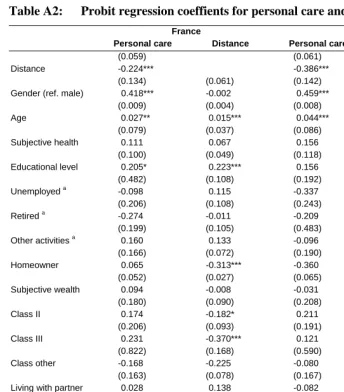
Table A2: Probit regression coeffients for personal care and distance
France Bulgaria
Personal care Distance Personal care Distance
(0.059) (0.061)
Distance -0.224*** -0.386***
(0.134) (0.061) (0.142) (0.090)
Gender (ref. male) 0.418*** -0.002 0.459*** 0.416***
(0.009) (0.004) (0.008) (0.006)
Age 0.027** 0.015*** 0.044*** 0.033***
(0.079) (0.037) (0.086) (0.057)
Subjective health 0.111 0.067 0.156 -0.065
(0.100) (0.049) (0.118) (0.086)
Educational level 0.205* 0.223*** 0.156 0.139
(0.482) (0.108) (0.192) (0.115)
Unemployed a -0.098 0.115 -0.337 -0.167
(0.206) (0.108) (0.243) (0.197)
Retired a -0.274 -0.011 -0.209 -0.204
(0.199) (0.105) (0.483) (0.271)
Other activities a 0.160 0.133 -0.096 -0.121
(0.166) (0.072) (0.190) (0.117)
Homeowner 0.065 -0.313*** -0.360 -0.404***
(0.052) (0.027) (0.065) (0.045)
Subjective wealth 0.094 -0.008 -0.031 0.029
(0.180) (0.090) (0.208) (0.165)
Class II 0.174 -0.182* 0.211 0.053
(0.206) (0.093) (0.191) (0.124)
Class III 0.231 -0.370*** 0.121 0.113
(0.822) (0.168) (0.590) (0.195)
Class other -0.168 -0.225 -0.080 -0.008
(0.163) (0.078) (0.167) (0.137)
Living with partner 0.028 0.138 -0.082 0.650***
(0.148) (0.071) (0.221) (0.174)
Experienced divorce 0.068 0.136 -0.050 0.133
(0.028) (0.015) (0.057) (0.040)
Number of siblings 0.020 0.041** 0.078 0.112**
(0.148) (0.070) (0.153) (0.100)
Mother widowed b 0.428** -0.168* 0.426** -0.144
(0.215) (0.089) (1.609) (0.243)
Mother non-married b 0.249 0.099 -0.448 0.287
(0.141) (0.072) (0.155) (0.118)
Children -0.051 -0.042 0.056 0.530***
a Reference category: employed.
Table A3: Probit regression coeffients for total effects on childcare and personal care
France Bulgaria
Childcare Personal care Childcare Personal care
(0.072) (0.134) (0.058) (0.143)
Gender (ref. male) 0.295*** 0.418** -0.401*** 0.299*
(0.005) (0.009) (0.005) (0.008)
Age -0.031** 0.024** -0.056*** 0.031***
(0.044) (0.078) (0.038) (0.086)
Subjective health -0.008 0.096 -0.001 0.181*
(0.057) (0.098) (0.050) (0.125)
Educational level 0.049 0.155 0.143** 0.103
(0.134) (0.482) (0.072) (0.191)
Unemployed a
-0.334* -0.124 0.047 -0.273
(1.549) (0.209) (0.572) (0.255)
Retired a
-0.354 -0.272 0.416 -0.130
(0.109) (0.201) (0.083) (0.510)
Other activities a
-0.250* 0.131 0.127 -0.050
(0.069) (0.167) (0.055) (0.192)
Homeowner 0.115 0.135 0.031 -0.204
(0.027) (0.052) (0.026) (0.065)
Subjective wealth 0.021 0.096 0.038 -0.042
(0.089) (0.181) (0.090) (0.214)
Class II 0.092 0.215 -0.074 0.190
(0.100) (0.210) (0.081) (0.190)
Class III 0.143 0.313 -0.058 0.078
(0.239) (0.819) (0.115) (0.595)
Class other 0.027 -0.118 -0.245* -0.077
(0.066) (0.055)
Formal childcare 0.053 0.117**
(0.102) (0.167) (0.111) (0.165)
Living with partner -0.118 -0.003 -0.685*** -0.333*
(0.076) (0.140) (0.104) (0.228)
Experienced divorce 0.051 0.037 0.201 -0.101
(0.020) (0.028) (0.025) (0.059)
Number of siblings -0.107*** 0.011 -0.130*** 0.035
(0.074) (0.099)
Mother disabled 0.095 0.042
(0.090) (0.147) (0.066) (0.157)
Mother widowed b
-0.292** 0.466** 0.002 0.482**
(0.080) (0.215) (0.075) (1.601)
Mother non-married b
-0.533*** 0.227 -0.517*** -0.559
(0.141) (0.150)
Children -0.042 -0.148
a
Reference category: employed.