Available Online at www.ijpret.com
1
INTERNATIONAL JOURNAL OF PURE AND
APPLIED RESEARCH IN ENGINEERING AND
TECHNOLOGY
A PATH FOR HORIZING YOUR INNOVATIVE WORKSEMI DISCRETE FORMULATION OF GALERKIN -PARTIAL ARTIFICIAL DIFFUSION
FINITE ELEMENT METHOD FOR COUPLED BURGERS' PROBLEM
NAJAT JALEEL NOON
Basrah University, Education College, Mathematics Department
Accepted Date: 22/10/2013 ; Published Date: 01/12/2013
Abstract: The viscous Burgers’ equation is an example of an equation that has unstable
Galerkin finite element approximation for the convection-dominated case. In this paper, a stabilized finite element method for solving coupled Burgers’ equation in 2-D is studied, the method consists of adding artificial viscosity acting only on the small scales. We consider a semi-discrete formulation, the theoretical evidence proved the stability and proved that the
error estimate is of order (ℎ ). The discretization with respect to space variables only is
applied, whereas time remains continuous. This leads to a large system of ordinary differential equations which are solved using the MATLAB function ODE45 where the numerical results are compared with the exact solution.
Keywords: Galerkin -Partial Artificial Diffusion, Error Estimate, Burgers' Equation.
Corresponding Author: NAJAT JALEEL NOON
Access Online On:
www.ijpret.com
How to Cite This Article:
Najat Jaleel Noon, IJPRET, 2013; Volume 2 (4): 1-24
Available Online at www.ijpret.com
2
INTRODUCTION
In recent years, Burgers’ equation have received a considerable amount of attention due to the large number of physically important phenomena that can be modeled using this equation. Some attention has been given to the convection-dominated case. Several methods have been intensively studied to remove such a drawback for this problem and relevant problem, we can summarize some of the most relevant literature. Atwell and King [1] used the Galerkin and Galerkin Least-Squares approximation for 1-D Burgers' equation with the linear feedback control law designed for the non-stabilized problem. Heitmann[5] applied subgrid scale eddy viscosity for convection dominated diffusive transport. The method consists of adding artificial
viscosity term ( , ∇ ) of orthogonal projection acting only on the fine scales, he
give a comprehensive analysis of this method, in [6] he applied this method in a finite
difference method by using an appropriate interpretation of the term ( ,∇ )≡
( ,∇ )− ( ,∇ ), where is an average over itself and its five nearest discrete
neighbors. Volkwein [10] considered upwind techniques and mixed finite elements for the steady-state Burgers' equation in 1-D to compute solutions for small viscosity parameters . Diez, Gunzburger and Kunoth [4] studied the multiscale finite element viscosity method for hyperbolic conservation laws which was applied to 1-D inviscid Burgers’ equation developed in terms of hierarchical finite element bases to a wavelet basis for a controlled adaptive resolution of discontinuities of the solution. Chan, Demkowicz, Moser and Roberts [3] applied Discontinuous Petrov-Galerkin to 1-D Burgers’ and compressible Navier–Stokes equations, they
were able to solve problems with Reynolds number up to Re =10 . Kashkool and Noon [7]
used the classical artificial diffusion for Galerkin and Galerkin-Conservation finite element methods for coupled Burgers’ problem in 2-D for the convection-dominated case. The fully discrete formulation with the backward Euler -Galerkin and Galerkin-Conservation schemes
were considered. the error estimate of these methods were of order (ℎ, ) and the
numerical results were compared with the exact solution. In this paper, we present a stabilized finite element method for solving coupled Burgers’ problem in 2-D, the method consists of adding artificial viscosity acting only on the fine scales to a variational formulation of the problem. We consider a semi-discrete formulation, we prove the stability and convergence for the approximation. The numerical solution of this method is compared with the exact solution . This paper is organized as follows. In section 2, definitions and some important theorems are given. In Section 3, we present the time-dependent modeling problem and a
weak form of 2-D Burgers’ problem and we show the continuity and −elliptic. The
Available Online at www.ijpret.com
3
finite element approximation, test problem and numerical results are introduced. The conclusions is shown in section 6.
2- Definitions and some important theorems
It is beneficial to mention the definitions and some important theorems which will be used frequently in the equal .
Definition 2.1 [5] For Ω ⊂ the ( , ) weighted norm of a function ∶ Ω → is defined by,
║ ║ , = ║ ║ + ║∇ ║ .
Definition 2.2 [5] For Ω ⊂ the ( , , ) weighted norm of a function ∶ Ω → is defined
by, ║ ║ , , =║ ║ , + ║ ║ .
The operator is a projection operator which will be discussed in section 4.
Definition 2.3 [5] Given any real number define the weighted norm ║.║( :( , )) on Ω×
(0, ] to be, ║ ║( :( , )) =∫ ( )║ ║ .
Theorem 2.1 (Poincaré Inequality). [8] Let Ω ⊂ be a bounded domain. Then, there is
constant = (Ω), such that for any ∈ , ║ ║ ( )≤ ║ ║ ( ). (2.1)
Theorem 2.2 (Lax–Milgram Theorem).[8] Let be a Hilbert space with inner product (. , . ) and
let (. , . ) be a coercive continuous bilinear form on , and let (. ) be a continuous linear form
on . Then, there exist a unique solution ∈ to the abstract variational problem: find ∈
such that, ( , ) = ( ), ∀ ∈ .
Theorem 2.3 (Inverse Estimate). [8] On a quasi-uniform mesh any ∈ satisfies the inverse
estimate, ║ ║ ( ) ≤ ℎ ║ ║ ( ). (2.2)
Abstract Results [2]
Let be a separable Hilbert space , let be a bounded symmetric bilinear form on
with the property that for some δ > 0, ( , )≥ ║ ║ , ∀ ∈ , (2.3)
and let be a trilinear form on such that there exists a constant > 0 such that
Available Online at www.ijpret.com
4 Remark 2.1 [5]: We shall state the following inequality which will be used frequently in this
paper, ‖ − ‖ ≤ ℎ ║ ║ , 1≤ ≤ , ≥2. (2.5)
3- Time-Dependent Modeling Problem
Consider the nonlinear time-dependent for the two dimensional coupled Burgers’ problem[11].
− є∆u+ + = , (3.1.a)
− є∆ + +v = , (3.1.b)
with boundary conditions
( , , ) = 0 × (0, ], ( , , ) = 0 × (0, ],
and initial conditions
( , , 0) = ( , ) , ( , , 0) = ( , ),
Where >0 is a viscosity constant, ⊂R with boundary ∂Ω, = ( , , ), = ( , , ),
and ∈L ( ).
The weak formulation of (3.1) is : find , ∈ = (Ω) such that:
( , ) + ( , ) + ( , , )+ ( , , )=( , ), (3.2.a)
( , )+ ( , )+ ( , , )+ ( , , )= ( , ),∀ ∈ (Ω), (3.2.b)
( ( , ,0), ) = ( , ), ( ( , , 0), ) = ( , ),
Where ( , ) = (є , ) and ( , ) = (є , ), ( , , ) = ( ,φ), ( , , ) =
( , ), ( , , ) = ( , ), ( , , ) =( , ),
The weak formulation (3.2) with artificial viscosity term ( , ∇ ) is : find
, ∈ = (Ω) such that:
( , ) + ( , )=( , ), (3.3.a)
Available Online at www.ijpret.com
5
Where, ( , )= ( , )+ ( , )+ ( , , )+ ( , , ),
( , )= ( , )+ ( , ∇ )+ ( , , )+ ( , , ).
Assumption 3.1:
(A1)There exists a constant such that: ≥ > 0.
We assume that the solution and of problem (3.2) satisfied the following condition
(A2) , ∈ (0, , (Ω))∩ (0, , (Ω)), , , , , , ∈ (0, , (Ω)).
Lemma 3.1: (u, ) and (v, ) given by (3.3) are continuous and V-elliptic(coercive).
Proof: 1-For continuity ,we have,
| ( , )|≤ |є( , )|+| ( , )|+|( , )|+|( , )|,
| ( , )|≤ |є( , )|+| ( , )|+ |( , )|+ |( , )|,
| ( , )|≤|є( , )|+| ( , )|+|( , )|+|( , )|,
| ( , )|≤|є( , )|+| ( , )|+|( , )|+|( , )|,
Applying Cauchy-Schwartz inequality gives,
| ( , )|≤є║ ║║ ║+ ║ ║║ ║+║ ║║ ║║ ║+║ ║║ ║║ ║,
| ( , )|≤є║ ║║ ║+ ║ ║║ ║+║ ║║ ║║ ║+║ ║║ ║║ ║,
From (2.1) we have,
| ( , )|≤є║ ║║ ║+ ║ ║║ ║+║ ║║ ║║ ║+ ║ ║║ ║║ ║,
| ( , )|≤є║ ║║ ║+ ║ ║║ ║+ ║ ║║ ║║ ║+║ ║║ ║║ ║.
From (A2),we have ║ ║≤ ║ ║ ( ( ))≤ and ║ ║≤ ║ ║ ( ( ))≤
Available Online at www.ijpret.com
6
| ( , )|≤ є║ ║║ ║+ ║ ║║ ║+ ║ ║║ ║ + ║ ║║ ║,
| ( , )|≤ є║ ║║ ║+ ║ ║║ ║ + ║ ║║ ║ + ║ ║║ ║,
| ( , )|≤ (√ ║ ║,║ ║,║ ║,√ ║ ║). (√ ║ ║, ║ ║,║ ║,√ ║ ║),
| ( , )| ≤ (√ ║ ║,║ ║,║ ║,√ ║ ║). (√ ║ ║,║ ║,║ ║,√ ║ ║),
From [5] implies,
| ( , )|≤ ║ ║ +║ ║ +║ ║ + ║ ║ .
║ ║ +║ ║ +║ ║ + ║ ║ ,
| ( , )| ≤ ║ ║ +║ ║ +║ ║ + ║ ║ .
║ ║ +║ ║ +║ ║ + ║ ║ ,
from definition 2.2, we have,
| ( , )|≤ ║ ║ , , ║ ║ , , ,
| ( , )|≤ ║ ║ , , ║ ║ , , .
2- For ellipticity , we have,
( , ) =є( , ) + ( , ) + ( , ) + ( , ),
( , ) =є( , ) + ( , ) + ( , ) + ( , ),
( , ) ≥ ║ ║ + ║ ║ +║ ║ ║ ║+║ ║║ ║║ ║,
( , ) ≥ ║ ║ + ║ ║ +║ ║║ ║║ ║+║ ║ ║ ║,
Available Online at www.ijpret.com
7
( , )≥ ║ ║ + ║ ║ +║ ║ +║ ║║ ║,
( , ) ≥ ║ ║ + ║ ║ +║ ║║ ║+║ ║ ,
From (2.1), we get, ( , )≥ ║ ║ + ║ ║ +║ ║ + ║ ║ ,
( , )≥ ║ ║ + ║ ║ + ║ ║ +║ ║ ,
( , ) ≥ ║ ║ + ║ ║ + ║ ║ + ║ ║ ,
( , )≥ ║ ║ + ║ ║ + ║ ║ + ║ ║ ,
from definition (2.1) and (2.2) we have,
( , )≥ ║ ║ , + ║ ║ , ( , )≥ ║ ║ , + ║ ║ ,
( , ) ≥ ║ ║ , , , ( , ) ≥ ║ ║ , , .
4- The Semi-Discrete Approximation
The discrete standard Galerkin finite element method of (3.2), reads: Find an approximation
solution , ∈ ⊂ such that :
( , , ) + ( , ) + ( , , )+ ( , , )= ( , ),
( , , ) +( , ) + ( , , ) + ( , , )= ( , ), ∀ ∈ .
4.1-Mathematical Formulation of an Artificial Viscosity Term
It is well known that when <ℎ , whereℎ is mesh size, the convection term dominates over
diffusion and the standard Galerkin finite element method produce an oscillating solution which is not close to exact solution. In the following we analyze an approach stabilizing the approximation through the introduction of an artificial viscosity term which acts only on the
fine scales of the finite element mesh. We add and subtract (∇ ,∇ )and (∇ ,∇ ) to
(3.2.a) and (3.2.b) respectively where = (ℎ) is a positive constant. This gives,
Available Online at www.ijpret.com
8 ( , )+(є+ )(∇ ,∇ )− (∇ ,∇ )+ ( , , )+ ( , , )=( , ), ∀ ∈ (Ω).
This suggests a mixed methods formulation wherein we define ≡ ∇ and ≡ ∇ ∈
( (Ω)) [5]. We obtain the system, find (( , ), ( , ))∈( , ( (Ω)) ) satisfying
( , )+(є+ )(∇ ,∇ )− ( ,∇ )+ ( , , )+ ( , , ) =( , ),
( , )+(є+ )(∇ ,∇ )− ( ,∇ )+ ( , , )+ ( , , )=( , ),
( − ∇ , ) = 0 , ( − ∇ , ) = 0 , ∀ ∈ (Ω), ∈( (Ω)) .
In the discretized problem, let ℎ and represent two mesh widths (with ℎ < ). Let ⊂
( (Ω)) and ⊂ (Ω) be finite element spaces. The problem then is to find
(( , ),( , )) ∈ ( , ) satisfying
( , , )+(є+ )(∇ ,∇ )− ( ,∇ )+ ( , , )+ ( , , )=( , ) , (4.1.a)
( , , )+(є+ )(∇ ,∇ )− ( ,∇ )+ ( , , )+ ( , , )=( , ), (4.1.b)
( − ∇ , )=0, ( − ∇ , )=0,∀ ∈ , ∈ . (4.1.c)
We note that, If ={0} , is small, then , = 0, and we have a straight artificial viscosity
formulation, if guided by numerical analysis so to obtain a beneficial balance, we set =
and = [5]. Where is the orthogonal projection of onto and
=( − ) is orthogonal projection of on , where ={ ∈ (Ω), ( , )=0, ∀ ∈ }.
Then we have = + ∇ and = ∇ + .
Lemma 4.1 If = and = then the system (4.1) is equivalent to:
( , , )+a( , )+ ( , ∇ )+ ( , , )+ ( , , ) = ( , ) ,
( , , )+a( , )+ ( , ∇ )+ ( , , )+ ( , , ) = ( , ).
Proof : Using decomposition and orthogonality, the equation (4.1.c) is satisfied as
( − ∇ , )=( − ∇ , )
= ( −( ∇ + ) , )
Available Online at www.ijpret.com
9
= 0 (from the definition of ),
Similarly we get, ( − ∇ , )=0. For the equation(4.1.a), we get,
(є+ )(∇ ,∇ )=є(∇ ,∇ )+ ( ,∇ )+ ( ,∇ )
=є(∇ ,∇ )+ ( ,∇ )+ ( , ∇ )+ ( , ∇ )
=є(∇ ,∇ )+ ( ,∇ )+ , ∇ ,
also for the equation(4.1.b), we get,
(є+ )(∇ ,∇ )=є(∇ ,∇ )+ ( ,∇ )+ ( , ∇ ),
Substituting this into (4.1), we have Galerkin with a partial artificial diffusion finite element method which are denoted by (G.P.A.D.),
( , , )+a( , )+ ( , ∇ )+ ( , , )+ ( , , )= ( , ), (4.2.a)
( , , )+a( , )+ ( , ∇ )+ ( , , )+ ( , , ) = ( , ), (4.2.b)
Lemma 4.2 The method described by (4.2) is stable over finite time. specifically, there exist a
constant C ˃ 0 such that,
║ ( )║ + ║ ║
( :( , ))
≤ ║ ║ + ║ ║ ( :( , )),
║ ( )║ + ║ ║
( :( , ))
≤ ║ ║ + ║ ║ ( :( , )).
Proof : Choosing = in (4.2.a) and = in (4.2.b) gives,
( , , )+ ( , )+ ( , ∇ )+ ( , , )+ ( , , ) = ( , ) ,
( , , )+ ( , )+ ( , ∇ )+ ( , , )+ ( , , ) = ( , ) ,
Available Online at www.ijpret.com
10
From(2.3) we have, ( , ) ≥ ║ ║ , ( , ) ≥ ║ ║ . From(2.4) we get,
( , , ) ≤ ║ ║ ║ ║, ( , , )≤ ║ ║ ║ ║,
( , , ) ≤ ║ ║ ║ ║, ( , , )≤ ║ ║ ║ ║.
By using Cauchy-Schwartz inequality and Young's inequality for the right hand sides we have,
( , )≤║ ║║ ║≤ ║ ║ + ║ ║ , ( , ) ≤║ ║║ ║≤ ║ ║ + ║ ║ .
Then,
║ ║ + ║ ║ +α║ ║ + ║ ║ ║ ║+ ║ ║ ║ ║ ≤ ║ ║ + ║ ║
║ ║ + ║ ║ +α║ ║ + ║ ║ ║ ║+ ║ ║ ║ ║ ≤ ║ ║ + ║ ║
Multiplying by two and rearranging gives,
║ ║ + ║ ║ +2 ║ ║ +2 ║ ║ ║ ║+2 ║ ║ ║ ║≤ ║ ║ ,
║ ║ + ║ ║ +2 ║ ║ +2 ║ ║ ║ ║+2 ║ ║ ║ ║ ≤ ║ ║ .
Since, ║ ║ ║ ║, ║ ║ ║ ║, ║ ║ ║ ║ and ║ ║ ║ ║ are
non-negative, we have, ║ ║ + ║ ║ +2 ║ ║ ≤ ║ ║ ,
║ ║ + ║ ║ +2 ║ ║ ≤ ║ ║ .
Multiplying by the integrating factor e and integrating from = 0 to = gives,
║ ( )║ −║ ║ +2 ∫ ║ ║ ≤ ∫ ║ ║ ,
║ ( )║ −║ ║ +2 ∫ ║ ║ ≤ ∫ ║ ║ ,
this implies, ║ ( )║ + ∫ ║ ║ ≤ ∫ ║ ║ +║ ║ ,
Available Online at www.ijpret.com
11
║ ( )║ + ∫ ( )║ ║ ≤ ∫ ( )║ ║ + ║ ║ ,
║ ( )║ + ∫ ( )║ ║ ≤ ∫ ( )║ ║ + ║ ║ .
Using definition (2.3) the proof complete.
For the error analysis we first need to establish the existence of the equilibrium projection
, ∈ of and respectively which is given by,
( − , )= ( − , )+ ( ∇ ( − ), ∇ )+ ( , , )−
( , , )+ ( , , )− ( , , )=0, (4.3.a)
( − , )= ( − , )+ ( ∇( − ), ∇ )+ ( , , )
− ( , , )+ ( , , )− ( , , )=0 ∀ ∈ . (4.3.b)
Lemma 4.3 Let , ∈ (Ω), the equilibrium projection , of , respectively, given by
(4.3) exist uniquely.
Proof: we define for any , ∈ (Ω), ( )≡ ( , ), ( )≡ ( , ), with these definitions
we can rewrite (4.3) as, ( , )= ( ), ( , )= ( ).
( ), ( ) is a continuous linear functional where lemma 3.1 implies, | ( )| =
| ( , )|, | ( )| = | ( , )|. Also since all norms in (Ω) are equivalent in the finite
dimensional space , thus from lemma 3.1, ( , ), ( , ) is continuous and
coercive, so the hypotheses of Lax-Milgram theorem are satisfied.
Lemma 4.4 Let , ∈ (Ω) , let , ∈ be the equilibrium projection given by (4.3) the
assumptions of the finite element space there exists a constant and independent of є, ,
ℎ and such that
║ − ║ ≤ (ℎ +ℎ + ℎ +ℎ ),║ − ║ ≤ (ℎ +ℎ + ℎ +ℎ ).
Proof: Let = − , = − , = − and = − where , are the
interpolant of and in the space . By the triangle inequality we have,
Available Online at www.ijpret.com
12
For the first terms we have, ║ ║ = max ║ − ║, from (2.5) we have,
║ ║ ≤ max ℎ ║ ║ ≤ ℎ ║ ║ ( )
≤ ℎ (4.4.a)
also ║ ║ ≤ ℎ ║ ║ ( ) ≤ ℎ . (4.4.b)
To bound the and terms we rewrite equation (4.3)
( , ) = ( , ) , (4.5.a)
( , ) = ( , ) , ∀ ∈ (4.5.b)
subtracting ( , ) from (4.5.a) and ( , ) from (4.5.b), choosing = and =
respectively give,
( , )+ ( , ∇ )+ ( , , )− ( , , )+ ( , , )−
( , , )= ( , )+ ( , ∇ ) + ( , , )− ( , , )+ ( , , )−
( , , ) , (4.6.a)
( , )+ ( , ∇ )+ ( , , )− ( , , ) + ( , , )−
( , , )= ( , )+ ( , ∇ ) + ( , , )− ( , , )+ ( , , )−
( , , ), (4.6.b)
Consider the left hand side of (4.6.a), from (2.3) we have, ( , ) ≥ ║ ║ .
From(2.4) we have, ( , , )− ( , , )≤ ║ ║ −║ ║ ║ ║ ≤
║ − ║ ║ ║= ║ ║ ║ ║,
( , , )− ( , , )≤ (║ ║║ ║−║ ║║ ║)║ ║.
Similarly for (4.6.b) we get, ( , ) ≥ ║ ║ ,
( , , )− ( , , )≤ (║ ║║ ║−║ ║║ ║)║ ║,
( , , )− ( , , )≤ ║ ║ ║ ║,
Available Online at www.ijpret.com
13
( , )≤ ║∇ ║║∇ ║, Using the (2.2) on║∇ ║gets, ( , )≤ ℎ ║∇ ║║ ║,
using Young's inequality gives, ( , ) ≤ ║∇ ║ + ║ ║ .
From (2.4) we have, ( , , )− ( , , )≤ (║ ║ −║ ║ )║ ║
≤ ║ − ║ ║ ║= ║ ║ ║ ║
≤ ║ ║ + ║ ║ .
( , , )− ( , , )≤ ║ ║║ ║−║ ║║ ║ ║ ║, using Young's inequality for
the first term gives,
( , , )− ( , , ) ≤ ║ ║ ║ ║ + ║ ║ − ║ ║║ ║║ ║.
Similarly for the right hand side of (4.6.b) we get,
( , )≤ ║∇ ║ + ║ ║ .
( , , )− ( , , ) ≤ ║ ║ ║ ║ + ║ ║ − ║ ║║ ║║ ║.
( , , )− ( , , ) ≤ ║ ║ + ║ ║ .
Inserting these inequalities into (4.6) with using Cauchy-Schwartz inequality and Young's
inequality to ( , ∇ ) and ( , ∇ ) we have,
║ ║ + ║ ∇ ║ + ║ ║ ║ ║+ ║ ║║ ║−║ ║║ ║ ║ ║
≤ ║∇ ║ + ║ ║ + ║ ║ + ║ ║ + ║ ║ + ║ ║
+ ║ ║ ║ ║ + ║ ║ − ║ ║║ ║║ ║,
║ ║ + ║ ∇ ║ + ║ ║ ║ ║+ (║ ║║ ║−║ ║║ ║)║ ║
≤ ║∇ ║ + ║ ║ + ║ ║ + ║ ║ + ║ ║ ║ ║ + ║ ║
− ║ ║║ ║║ ║ + ║ ║ + ║ ║ ,
Available Online at www.ijpret.com
14
║ ║ +2 ║ ║ ║ ║+2 ║ ║║ ║║ ║≤ ║∇ ║ +
║ ║ + ║ ║ + ║ ║ ║ ║ ,
║ ║ +2 ║ ║ ║ ║+2 ║ ║║ ║║ ║≤ ║∇ ║ +
║ ║ + ║ ║ ║ ║ + ║ ║ ,
Since ║ ║ , ║ ║, ║ ║║ ║, ║ ║ , ║ ║ and ║ ║║ ║ are nonnegative,
we have,
║ ║ ≤ {ℎ ║∇ ║ +║ ║ +║ ║ +║ ║ ║ ║ },
║ ║ ≤ {ℎ ║∇ ║ +║ ║ + ║ ║ +║ ║ ║ ║ },
Inside the brackets, from(2.5 ) we have,
{ℎ ║∇ ║ +║ ║ +║ ║ } ≤ {(ℎ +1)ℎ ( )║ ║ +ℎ ║ ║ }, (4.7.a)
{ℎ ║∇ ║ +║ ║ +║ ║ }≤ {(ℎ +1)ℎ ( )║ ║ +ℎ ║ ║ } , (4.7.b)
So, ║ ║ ≤ {(ℎ ║ ║ ( )+( ℎ ( )+ℎ ( ))║ ║
( )+║ ║ ( )║ ║ ( )},
║ ║ ≤ {(ℎ ║ ║ +( ℎ ( )+ℎ ( ))║ ║
( )+║ ║ ( )║ ║ ( )}, which implies
║ ║ ≤ {(ℎ ║ ║ ( )+( ℎ +ℎ )║ ║ ( )+║ ║ ( )║ ║ ( )} ≤
(ℎ + ℎ +ℎ ),
║ ║ ≤ {(ℎ ║ ║ ( )+( ℎ + ℎ )║ ║ ( )+║ ║ ( )║ ║ ( )} ≤
(ℎ + ℎ +ℎ ).
Available Online at www.ijpret.com
15 Theorem 4.1: Let , , and be the solutions of (3.2) and (4.2) respectively , then there
exists constants , independent of independent of є, , ℎ and such that,
║ − ║ ≤ ℎ +ℎ + ℎ +ℎ +√ ,
║ − ║ ≤ ℎ +ℎ + ℎ +ℎ +√ .
Proof: We write the errors in terms of equilibrium projection and
̶ =( − ) ̶ ( − )= – , ̶ = ( − ) ̶ ( − ) = – , then ,
║ − ║ ≤║ ║ +║ ║ , ║ − ║ ≤║ ║ +║ ║ .
By lemma (4.4) we have bounds on both ║ ║ and║ ║ . To estimate and ,
subtracting equation(4.2) from (3.2) we have,
( , − ,, )+ ( − , )− ( , )+( − , , ( − , , )=0,
(4.8.a)
( , − , , )+ ( − , )− ( , ) +( − , , ) +( − , , )=0,
(4.8.b)
The third term on the left hand side of (4.8.a) and (4.8.b) can be rewritten using
=∇ − ∇ +∇ , =∇ − ∇ +∇
also − , = − , )−( , − , ,
− , = − , − , − , ,
− , =( − , )−( , − , ) and
Available Online at www.ijpret.com
16
( , , )+ ( , )+ ( , ∇ )+( , − , , )+( , − , , )
=( ,, ) + ( , )+ ( , ∇ )+ − , , + − , ,
− ( , ∇ ), (4.9.a)
( , , )+ ( , )+ ( , ∇ )+( , − , , ) +( , − , ,
)=( , , ) + ( , )+ ( , ∇ )+ − , , + − , ,
− ( , ∇ ), (4.9.b)
From (4.3), ( , ) = 0, ( , ) = 0 and by choosing = , and = in (4.9.a) and
(4.9.b) respectively we have,
( ,, )+a( , )+ ( , ∇ )+( , − , , )+ ( , − , , ) =
( , , )− ( , ∇ ),
( , , )+a( , )+ ( , ∇ )+( , − , , ) +( , − , , ) =
( , , )− ( , ∇ ),
Since, (θ ,,θ )= ║θ ║ , (θ ,,θ ) ║θ ║ , also from(2.3) , ( , )≥ ║ ║ ,
( , )≥ ║ ║ , from(2.4), ( , − , ,θ ) ≤ (║ ║ +║ ║ )║ ║, similarly,
( , − , ,θ ) ≤ (║ ║║ ║+║ ║║ ║)║ ║,
( , − , ,θ ) ≤ (║ ║║ ║+║ ║║ ║)║ ║
and ( , − , ,θ )≤ (║ ║ +║ ║ )║ ║.
Using Cauchy-Schwartz inequality and Young's inequality for the right hand sides we have ,
║ ║ + ║ ║ + ║ ∇ ║ + (║ ║ +║ ║ )║ ║ + (║ ║║ ║+
Available Online at www.ijpret.com
17
║ ║ + ║ ║ + ║ ║ + (║ ║║ ║+║ ║ ║ ║) ║ ║+
(║ ║ +║ ║ )║ ║ ≤ ║ , ║ + ║ ║ + ║ ║ + ║ ║ ,
since,║ ║ ,║ ║ ,║ ║║ ║,║ ║║ ║,║ ║ ,║ ║ ,║ ║and║ ║ are
nonnegative terms , by multiplying by two and rearranging we get,
║ ║ + ║ ║ ≤ ║ , ║ + ║ ║ , ║ ║ + ║ ║ ≤ ║ , ║ + ║ ║ ,
using the integrating factor , integrating from = 0 to = and rearranging give
║ ( )║ ≤║ (0)║ +∫ ║ , ║ + ║ ║ ,
║ ( )║ ≤║ (0)║ +∫ ║ , ║ + ║ ║ ,
multiplying by gives
║ ( )║ ≤ ║ (0)║ +∫ ( ) ║ , ║ + ║ ║ , (4.10.a)
║ ( )║ ≤ ║ (0)║ +∫ ( ) ║ ,║ + ║ ║ , (4.10.b)
note that, there exist 0≤ t∗≤ such that, ║θ (t∗)║ =║θ ║
( )and ║θ (t
∗)║ =║θ ║
( ),
such that , ║ ║ ( )≤ ║ (0)║ +∫ ( )[ ║ , ║ + ║ ║ ] ,
║ ║ ( )≤ ║ (0)║ +∫ ( )[ ║ , ║ + ║ ║ ] ,
as the above implies that each of ║ ║ ( )and║ ║ ( ) are bounded by the right hand
side, we can write,
║ ║ ≤ {║ (0)║+(∫ ║ , ║ ) +√ (∫ ║ ║ ) } ≤
{║ (0)║+║ , ║ ( ) +√ ║ ║ ( )
Available Online at www.ijpret.com
18
║ ║ ( )≤ {║ (0)║+(∫ ║ ,║ ) +√ (∫ ║ ║ ) } ≤
{║ (0)║+║ , ║ ( ) +√ ║ ║ ( )
} .
The first terms on right hand sides give,
║ (0)║≤ ║ −p ║≤ ║ − ║+║ − p ║
≤ ║ − ║+Cℎ ║ ║ , from (A2) we have║ (0)║ ≤ ℎ , (4.11.a)
║ (0)║≤ ║ −p ║≤ ║ − ║+║ − p ║
≤ ║ − ║+Cℎ ║ ║ ≤ ℎ . (4.11.b)
Form Lemma 4.4 the second terms imply ,
║ , ║ =║ − , ║ ≤ ║ , ║ +║ ,║
≤ {(ℎ ║ ║ ( )+( ℎ +ℎ )║ ║ ( )+ ║ ║ ( )║ ║ ( )},
≤ (ℎ + ℎ +ℎ ), (4.12.a)
║ ,║ = ║ − , ║ ≤║ ,║ +║ ,║
≤ {(ℎ ║ ║ ( )+( ℎ +ℎ )║ ║ ( )+ ║ ║ ( )║ ║ ( )},
≤ (ℎ + ℎ +ℎ ). (4.12.b) then ,
║ ║ ≤ [ℎ +(ℎ + ℎ +ℎ ) +√ ║ ║ ], from (A2) we have,
║ ║ ≤ (ℎ +ℎ + ℎ +ℎ +√ ), (4.13.a)
║ ║ ≤ [ℎ +(ℎ +(√ ℎ +ℎ ) +√ ║ ║ ]
≤ (ℎ +(ℎ +√ ℎ +ℎ +√ ) . (4.13.b)
Combining the bound (4.13) with those of lemma (4.4) the proof complete.
5. The Finite Element Approximation
Available Online at www.ijpret.com
19
∇ = ∇ + ∇ , ∇ = ∇ − ∇ , then
, ∇ = ( ,∇ )− ( , ∇ )
From the definition of the second term equal to zero, this implies
( , ∇ ) ≡ ( ,∇ ), similarly, ( , ∇ ) ≡ ( ,∇ ).
The main point comes in finding an appropriate interpretation of the ( ,∇ ) and
( ,∇ ) terms. Since , = + , = + ,
We rewrite, ,∇ = ( ,∇ )− ,∇ ,
,∇ = ( ,∇ )− ,∇ .
As noted in section four, is chosen such that is a projection onto fine scales and is a
projection onto the large scales, we can think of the large scale as representing average values,
this implies, ( ,∇ )− ,∇ ≈ ( ,∇ )− ( ,∇ ),
( ,∇ )− ,∇ ≈ ( ,∇ )− ( ̅ ,∇ ).
Where and ̅ is an average over itself and its five nearest discrete neighbors.
5.1 Test problem
In this subsection ,we present the test problem to illustrate G.P.A.D. for the time - dependent Burgers' equation (4.2). The exact solution of Burgers’ equation(3.1) can be generated by using the Hopf–Cole transformation (see [9]) which are :
( , , ) = − ( ) , ( , , ) = + ( ) .
In this problem can take on various values and = = 0. The domain where the
problem is to be solved is the unit square domain = [0,1] × [0,1]. We are discretized it using
a uniform triangular mesh with mesh width parameter ℎ= where we take =18 .
Available Online at www.ijpret.com
20
This subsection consists of two case was discussed as follows:
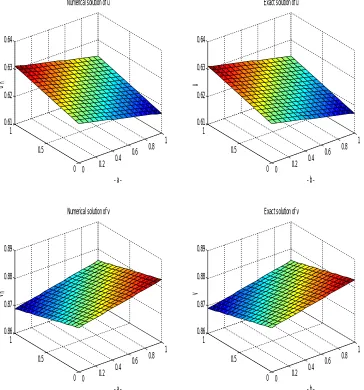
Case 1: In this case the problem was run with =1.14 at = 0.5, we note that >ℎ, there is no
need to run this problem with P.A.D.(i.e = 0), the numerical solution of the standard
Galerkin(G.) finite element method are convergent to the exact solution{see Figure (5.2.1)}.
Figure 5.2.1: a- Numerical solution of G. method of and , b-Exact solution of and ,
at =18, =.5 and =1.14 . 0 0.2 0.4 0.6 0.8 1 0 0.5 1 0.61 0.62 0.63 0.64
a -Numerical solution of u
uh 0 0.2 0.4 0.6 0.8 1 0 0.5 1 0.61 0.62 0.63 0.64
b -Exact solution of u
u 0 0.2 0.4 0.6 0.8 1 0 0.5 1 0.86 0.87 0.88 0.89
a -Numerical solution of v
vh 0 0.2 0.4 0.6 0.8 1 0 0.5 1 0.86 0.87 0.88 0.89
b -Exact solution of v
Available Online at www.ijpret.com
21
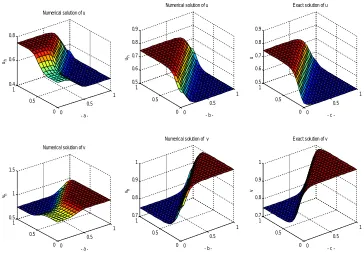
Case 2: In this case we take = and = respectively at = 0.5, we note that <ℎ, thus
we expect to see instability for standard G. finite element method, in Figure{(5.2.2)(a) and
(5.2.3)(a)}the problem run without P.A.D.(i.e. = 0), we see that the standard G. finite
element method produce an oscillating solution which is not close to the exact solution
especially when decreasing with respect to ℎ. In Figure{(5.2.2)(b) and (5.2.3)(b) the problem
run with G.P.A.D. finite element method. where, = 0.25∗ ℎ, where the numerical solution
became more convergent to the exact solution.
Figure 5.2.2 : a- Numerical solution of G. method without P.A.D. of and ,
b- Numerical solution of G.P.A.D. of and , c- Exact solution of and , at =18, =.5 and = .
0 0.5 1 0 0.5 1 0.4 0.6 0.8
a -Numerical solution of u
uh 0 0.5 1 0 0.5 1 0.5 1 1.5
a -Numerical solution of v
vh 0 0.5 1 0 0.5 1 0.5 0.6 0.7 0.8 0.9
b -Numerical solution of u
uh 0 0.5 1 0 0.5 1 0.5 0.6 0.7 0.8 0.9
c -Exact solution of u
u 0 0.5 1 0 0.5 1 0.7 0.8 0.9 1
c -Exact solution of v
v 0 0.5 1 0 0.5 1 0.7 0.8 0.9 1
b -Numerical solution of v
Available Online at www.ijpret.com
22
Figure 5.2.3 : a- Numerical solution of G. method without P.A.D. of and ,
b- Numerical solution of G.P.A.D. of and , c- Exact solution of and , at =18, =.5 and = .
6 - CONCLUSIONS
From the theoretical analysis and the numerical results ,we can conclude the following :
1-The continuity and V-elliptic of ( , ) and ( , ) is satisfied.
2-The G.P.A.D. finite element method satisfy the stability .
3-Theoretical analysis shows that G.P.A.D. finite element method are convergent with (ℎ ).
4-The G.P.A.D. method removed all oscillations occur when we use the standard Galerkin in the convection-dominated case, and the numerical solutions obtained from this method are consistent with the exact solution.
0 0.5 1 0 0.5 1 0 0.5 1
a -Numerical solution of u
uh 0 0.5 1 0 0.5 1 0.5 1 1.5
a -Numerical solution of v
vh 0 0.5 1 0 0.5 1 0.4 0.5 0.6 0.7 0.8
b -Numerical solution of u
uh 0 0.5 1 0 0.5 1 0.5 0.6 0.7 0.8 0.9
c -Exact solution of u
u 0 0.5 1 0 0.5 1 0.7 0.8 0.9 1
c -Exact solution of v
v 0 0.5 1 0 0.5 1 0.7 0.8 0.9 1 1.1
b -Numerical solution of v
Available Online at www.ijpret.com
23
REFERENCES
1. Atwell, J. A. and King, B.B., 2000, ''Stabilized finite element methods and feedback control
for Burgers' equation'', Interdisciplinary center for applied Mathematics ,Virginia tech, Blacksburg, VA 24061-0531, Proceedings of the American Control Conference Chicago, Illinois, pp. 2745-2749 .
2. Boules, A. N. , 1998 , "On the existence of the solution of Burgers' equation for n ≤4",
Department of Mathematical Sciences, University of North Florida, Internat. J. Math. & Math. Sci. VOL. 13 NO. 4, pp. 645-650 .
3. Chan, J., Demkowicz, L., Moser, R. and Roberts, N., 2010, ''A New Discontinuous
Petrov-Galerkin Method with Optimal Test Functions. Part V: Solution of 1-D Burgers’ and Navier-Stokes Equations '' , The Institute for Computational Engineering and Sciences, The University of Texas at Austin, Austin, TX 78712, USA.
4. Diez, D. C., Gunzburger, M. and Kunoth, A., 2008, ''An Adaptive Wavelet Viscosity Method
for Hyperbolic Conservation Law'' , Wiley Inter Science, DOI 10.1002/num.20322, pp.1388– 1404.
5. Heitmann ,N.F., 2002,''Subgridscale eddy viscosity for convection dominated diffusive
transport'', Department of Mathematics ,Pittsburgh University.
6. Heitmann, N. F., 2002,"A stabilization scheme for convection dominated diffusive
transport", Department of Mathematics , Pittsburgh University.
7. Kashkool, H. A. and Noon, N. J., 2012, "The Modification of Galerkin and
Galerkin-Conservation Finite Element Methods For Solving Coupled Burgers' Problem", (To appear) in Misan Journal of Academic Studies.
8. Larson, M., G., Bengzon, F., 2013,"The Finite Element Method: Theory, Implementation,
and Applications", Texts in Computational Science and Engineering, ISSN 1611-0994, Verlag Berlin Heidelberg.
9. Srivastava,V. K., Tamsir, M., Bhardwaj, U., Sanyasiraju, Y., 2011, ''Crank Nicolson finite
Available Online at www.ijpret.com
24
10. Volkwein, S., 2003, ''Upwind techniques and mixed finite elements for the steady-state
Burgers' equation", Institute of Mathematics, Karl -Franzens-University of Graz, Heinrichstrasse36, A-8010 Graz, Austria.
11. Yang, Q., 2013, "The Upwind Finite Volume Element Method for Two-Dimensional Burgers