Address for correspondence
Aseema Nasreen*,
Department of Pharmaceutics
Teegala Krishna Reddy College Of
Pharmacy
Meerpet, Telangana, India
ISSN- 2230-7346
FORMULATION AND EVALUATION OF FAST DISSOLVING TABLETS OF
POORLY SOLUBLE DRUG ACECLOFENAC
INTRODUCTION
Aceclofenac, (2-[2-[2-(2, 6-dichlorophenyl) amino phenyl] acetyl] oxy acetic acid); a nonsteroidal anti-inflammatory drug acting by an inhibition of the synthetic of prostaglandins by inhibiting the activity of the enzyme, cyclooxygenase-2 (COX-2)1, 2, 3. It is more selective for COX-2 than COX-14. Aceclofenac is preferred over conventional NSAIDS as they may lead to serious gastrointestinal complications such as ulcer, severe bleeding and perforation, resulting in hospitalization and even death5. It is used for post traumatic pain and rheumatoid arthritis6. Aceclofenac is practically insoluble in water and peak blood level reaches between1.25 to 3 hrs after oral administration.
The rate and extent of dissolution of the drug from any solid dosage form determines the rate and extent of absorption of the drug. In the case of poorly water-soluble drugs, dissolution is the rate-limiting step in the process of drug absorption. The rate of dissolution can be increase by increasing the surface area of available drug by various method (micronization, complexation and solid dispersion)7. The dissolution of a drug can also be influenced by disintegration time of the tablets. Faster disintegration of tablets delivers a fine suspension of dug particles resulting in a higher surface area and faster dissolution. Numbers of drug have been shown to improve their dissolution character when converted to solid dispersion8-12. Because of its poor aqueous solubility Aceclofenac may pose dissolution related absorption problem. In context of the above principles, a strong need is felt to developed a solid unit dosage form that deliver Aceclofenac in the GIT in a form that dissolve very rapidly to reduce its onset time to produce quick pharmacological effect.
Out of all the orally administered dosage forms, a tablet is most preferred because of ease of administration, compactness and flexibility in manufacturing. Because of change of various physiological functions associated with aging including difficulty in swallowing, administration of
Aceclofenac is a potent Non-steroidal Anti-inflammatory Drug (NSAIDS) belonging to BCS Class II with good analgesic and anti-pyretic properties. Conventional tablets of Aceclofenac are not capable of producing rapid action which is required for treatment of pains. The present investigation deals with fast dissolving tablets of Aceclofenac to produce benefits. Different batches of tablets were prepared using super disintegrants and co-processed super disintegrants. Tablets were prepared by direct compression technique. The compatibility study of drug and excipients was performed by FTIR spectroscopy. The powder mixture of Aceclofenac and other ingredients was evaluated for pre-compressional properties. The tablets were formulated and evaluated for weight variation, hardness, friability, in-vitro disintegration time, in-vitro dissolution studies. Among all the formulation, F-7 containing co-processed super disintegrants (Crosspovidone: sodium starch glycolate) 1:1 ratio shows the highest improvement in disintegration time (35 sec) and dissolution profile of Aceclofenac.
Keywords: Aceclofenac, NSAIDS, Super disintegrants, Fast dissolving tablets.
ABSTRACT
Aseema Nasreen*,
C.V.S. Raghu Kiran
Department of Pharmaceutics
Teegala Krishna Reddy College Of
Pharmacy
Meerpet, Telangana, India.
Journal of Global Trends in Pharmaceutical Sciences
intact tablet may lead to poor patient compliance and ineffective therapy. The pediatrics and geriatrics patients are of particular concern. To overcome this, dispersible tablets and fast- dissolving tablets have been developed13, 14. Most commonly used method to prepare these tablets are; freeze drying/ Lyophilization, tablet molding and direct compression methods15-17. Lyophilized tablet show a very porous structure, which causes quick penetration of saliva into the pores when placed in oral cavity15. The main disadvantages of tablet produced are, in addition to the cost intensive production process, a lack of physical resistance in standard blister packs and their limited ability to incorporate higher concentrations of active drug13. Molded tablets dissolve completely and rapidly. However lack of strength and taste masking are of great concern16. Main advantages of direct compression are low manufacturing cost and high mechanical integrity of the tablets17. Therefore, direct compression appears to be a better option for manufacturing of tablets. The fast dissolving tablets prepared by direct compression method, in general, are based on the action established by super disintegrants such as sodium starch glycolate and Crosspovidone.
Thus an attempt is made in the present investigation to improve the dissolution of Aceclofenac through the formulation of solid dispersion using water soluble carriers like PVP, PEG-6000, Crosscarmellose sodium and urea and to convert the optimized solid dispersion in fast dissolving tablet formulation.
OPTIMIZATION USING SIMPLEX DESIGN
METHOD18-20
A simplex design was adopted to optimize the formulation variables. In the design, three factors were evaluated by changing their concentration simultaneously and keeping their total concentration constant. The simplex design for three component system was represented by an equilateral triangle
Figure 1 in two dimensional space. Seven batches (A to ABC) were prepared; one at each vertex (A, B, C), one at half way between vertices (AB, BC, AC), and one at the center point (ABC). Each vertex represents a formulation containing the maximum amount of one component, with the other two components at a minimum level. The half way between the two vertices represents a formulation containing the average of the minimum and maximum amount of the two ingredients represented by two vertices. The center point represents a formulation containing one third of each ingredient. The amounts of Micro crystalline cellulose pH-102, Crosspovidone and sodium starch glycolate were selected as independent variables and hardness (crushing strength) and disintegration time was taken as dependent variables.
MATERIALS AND METHODS Materials
Aceclofenac was purchased from KP labs (A Division of Karthikeya Drugs and Pharmaceutical Pvt Limited); Crosspovidone and sodium starch glycolate was obtained from Sanofi Aventis Pvt. Ltd., Goa. All other materials were of analytical grades.
Method
Preparation of Solid Dispersion
Solid dispersions are prepared using Aceclofenac as a drug and various carriers like PVP, PEG-6000, Crosscarmellose and urea. Drug and carriers physical mixture prepared by lightly grinding drug Aceclofenac and carriers in mortar for 2 min at the required drug/ carrier level (1:1). Then the powder was passed through the sieve no # 80. Product was stored in desiccator to carry out further analysis.
Preparation of Co-Processed Superdisintegrant
The Co-Processed superdisintegrant was prepared by solvent evaporation method. A blend of Crosspovidone and sodium starch glycolate (in the ratio of 1:1, 1:2 & 1:3) was added to 10 ml of ethanol. The contents of the beaker (250 ml capacity) were mixed thoroughly and stirring was continued till most of ethanol evaporated. The wet coherent mass was granulated through # 44-mesh sieve. The wet granules were dried in a hot air oven at 60º C for 20minutes. The dried granules were sifted through # 44-mesh sieve and stored in airtight container till further use.
Description of Manufacturing Process:
Formulation of fast dissolving tablets of Aceclofenac was carried out by direct compression technique. The procedure followed for each batch has been described as follows:
Method:
Preparation of fast dissolving tablets required quantity of solid dispersion (drug: polymer, 1:1 ratio) was weighed and sifted through #40 mesh and then taken in a polybag. Superdisintegrant via Crosspovidone and sodium starch glycolate was weighed and sifted through #40 mesh and added to the above and mixed for 5 minutes. Other excipients such as Mannitol (diluent), Micro crystalline cellulose (diluent) and Aspartame (sweetener) were weighed and passed through # 40 mesh separately and added to the above mixture one after the other. The lubricant magnesium stearate was weighed and sieved through # 80 mesh added and mixed for 5 minutes. The final blend was directly compressed to obtain a tablet weighing~200mg.
Design of experiments
was used for the final optimization of direct compression method, we have fixed the constrains for the level of independent variables (X1, X2 and X3) i.e., M.C.C (X1), Crosspovidone (X2) and S.S.G (X3), as shown in Table 1. In this study, a simplex was adopted to optimize the variables. In this design, two factors were evaluated and experiments were performed on all seven-possible combinations.
COMPATIBILITY STUDIES
Fourier Transform Infrared Spectroscopy (FTIR) Studies
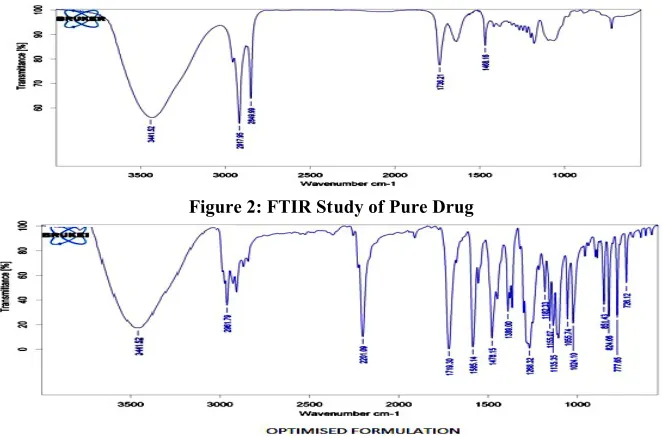
FTIR spectra for pure drug Aceclofenac and F7 powdered tablet were recorded in infrared spectrophotometer with KBr pellets. IR spectrums were depicted in Figures 2, 3.
EVALUATION OF FAST DISSOLVING TABLETS
Pre-Compression Parameters
The tablets blends were evaluated for their bulk density, tapped density, Carr’s index and flow properties.
Post-Compression Parameters
The prepared tablets were evaluated for weight variation, hardness, friability, thickness and drug content studies, the results were shown in
Table 5.
Drug Content Uniformity
Three tablets were powdered, and 50 mg equivalent weight of drug (Aceclofenac) in tablet powder was accurately weighed and transferred into a 100ml of volumetric flask. Initially 10 ml of Phosphate buffer pH 6.8 was added and shaken for 10 min. Then, the volume was made up to 100 ml with phosphate buffer pH 6.8. Subsequently, the solution in the volumetric flask was filtered and 1ml of filtrate was taken in 10 ml of volumetric flask and diluted up to the mark with phosphate buffer pH 6.8 and analyzed spectrophotometrically at 205 nm. The amount of Aceclofenac was estimated by using standard calibration curve of the drug.
Wetting Time
A piece of tissue paper folded twice was placed in a small Petridish (i.d. = 6.5 cm) containing 6 ml of Phosphate buffer pH 6.8, a tablet was put on the paper, and the time for complete wetting was measured. Three trials for each batch were performed and standard deviation was also determined.
Water Absorption Ratio
A piece of tissue paper folded twice was placed in a small Petridish containing 6ml of Phosphate buffer pH 6.8. A tablet was put on the paper and time required for complete wetting was measured. The wetted tablet was then weighed. Water absorption ratio, R, was determined using equation
R = 100 x Wa – Wb/Wb
Where, Wb = weight of the tablet before water absorption
Wa = weight of the tablet after water absorption Three tablets from each formulation were performed and standard deviation was also determined.
In-vitroDisintegration Time
The process of breakdown of a tablet into smaller particles is called as disintegration. The in vitro disintegration time of a tablet was determined using disintegration test apparatus as per I.P. specifications. Place one tablet in each of the 6 tubes of the basket. Add a disc to each tube and run the apparatus using pH 6.8 (simulated saliva fluid) maintained at 370±20C as the immersion liquid. The assembly should be raised and lowered between 30 cycles per minute in the pH 6.8 maintained at 370±20C. The time in seconds taken for complete disintegration of the tablet with no palpable mass remaining in the apparatus was measured and recorded.
In-vitroDispersion Time
In vitro dispersion time was measured by dropping a tablet in a measuring cylinder containing 6 ml of pH 6.8 (simulated saliva fluid). Three tablets from each formulation were randomly selected and in vitro dispersion time was performed. Standard deviation was also determined and in vitro dispersion time is expressed in seconds
In-vitroDissolution Studies
In vitro release studies were carried out using tablet dissolution test apparatus. Two objectives in the development of in vitro dissolution tests are to show (1) that the release of the drug from the tablet is as close as possible to 100% and (2) that the rate of drug release is uniform from batch to batch and is the same as the release rate from those batches proven to be bioavailable and clinically effective.
Drug release kinetics
To establish a relationship between the release kinetics of the dissolution study, data obtained from in vitro dissolution study was fitted into various kinetic models. Zero order as cumulative percent of drug dissolved vs. time, first order as log cumulative percentage of drug remaining vs. Time.
Stability Studies
The stability study of the tablets was carried out according to International conference on Harmonization guidelines. The formulation F7 was stored at 400C/ 75% RH for Three month by storing the samples in stability chamber.
RESULTS AND DISCUSSION
to O-H), 2849.99cm-1 (due to C-H), 1736.21cm-1 (due to C=O) and 1468.16cm-1 (due to Aromatic ring). These prominent peaks of Drug were also present in the IR spectrum of formulation F7. From this it clearly indicates that, the drug was not interacted with the polymers used in the formulations. That there is no shift in the position of characteristic absorption bands of pure drug and its formulations. It means that the drug remains in the same normal form in its pure state and after its formulations. Hence it can be concluded in the present study the drug doesn’t undergo any type of any change during its formulations indicating that there is no interaction of the drug with the polymers and other excipients used for the study. The values of pre-compression parameters evaluated were within prescribed limits and indicated good free flowing property (Table 4). All the post compression parameters are evaluated were prescribed limits and results were within IP acceptable limits. Results were shown in Table 5. In all the formulations, hardness test indicated good mechanical strength ranges from 2.5kg/cm2 to 3.2kg/cm2.The friability range is 0.42 to 0.49 % to be well within the approved range (<1%) indicated that tablet had good mechanical resistance. The weight variation was found in all designed formulations in the range 198 to 203mg. All the tablets passed weight variation test as the average percentage weight variation was within 7.5% i.e. in the pharmacopoeia limits. The thickness was almost uniform in all the formulations and values ranged from 4.51mm to 4.60mm.The standard deviation values indicated that all the formulations were within the range.
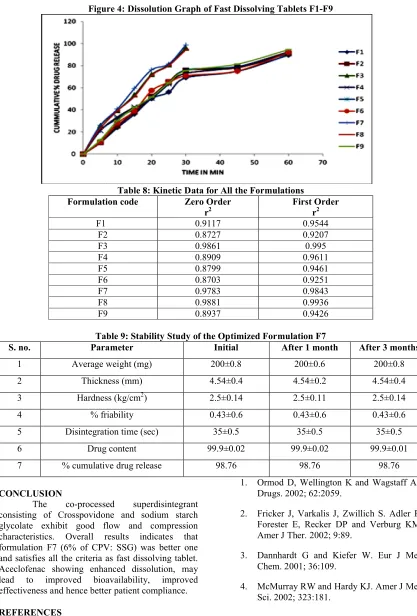
The water absorption ratios were found between 32.6 to 74.5% and wetting time is between 20 to 129sec. The results of water absorption ration and wetting time were tabulated in Table 6. Rapid disintegration within several minutes was observed in all the formulations. The in-vitro disintegration data is tabulated in the Table 6. The in-vitro disintegration time of fast dissolving tablets were found to be 30sec to 4min 480sec which is in the range of fulfilling the official requirements. By the addition of co-processed super disintegrants, the disintegration time increased significantly (P<0.05) tablets prepared. Based on the in-vitro disintegration time, formulation F7 (6% of CPV: SSG) were found to be promising and showed a disintegration time of 35sec. These results suggest that the disintegration times can be decreased by using co-processed super disintegrants (CPV: SSG). In-vitro dissolution studies (Figure 4) of all the formulations were carried out in pH 6.8 buffer as dissolution medium.
The release study results are shown in Table 7. The rapid increase in dissolution of Aceclofenac with the increase in CPV may be due to rapid swelling and disintegrating tablets rapidly into apparently primary particles. While tablets formulated with SSG, disintegrate by rapid uptake of water, followed by rapid and enormous swelling into primary particle but more slowly due to the formation of a viscous gel layer by SSG. CPV and SSG containing tablets rapidly exhibits high capillary activity and pronounced hydration with a little tendency to gel formation and disintegrates the tablets rapidly but into larger masses of aggregated particles. Thus difference in the size distribution generated with different superdisintegrant might have contributed to difference in the % drug release values with the same amount of superdisintegrant in the tablets. The kinetic study results are shown in Table 8. From the r2 values it was observed that the optimized formulation is best fitted in first order equation. Among all the formulation F7 (6% of CPV: SSG) were found to be promising and showed a disintegration time of 35sec, 50% of drug released in15min, and 90% of drug released in 30min.The Table 9 shows the parameters of the tablets after stability study. The promising formulation F7 were subjected to short term stability study by storing the formulations at 40oC/75% RH for 3months. After the month the tablets were again analyzed for the hardness, friability, drug content uniformity and disintegration time. Stability studies showed no significant difference between in- vitro drug release of formulation F7 before and after stability study.
Figure 1:Equilateral triangle representing simplex design method for three components A, B and C represents maximum amount of component;
Figure 2: FTIR Study of Pure Drug
Figure 3: FTIR Study of Optimized Formulation
Table 1: Combination as per the Chosen Experimental Design (Simplex Design Method)
Formulation code Coded Factor Levels
X1(mg) X2(mg) X3(mg)
A 56 4 4
B 48 12 4
C 48 4 12
AB 52 8 4
AC 52 4 8
BC 48 8 8
ABC 50 7 7
Coded level X1-M.C.C, X2- Crosspovidone, X3- S.S.G
Table 2: Formulation of 200mg Aceclofenac Fast Dissolving Tablets Sl.
No Ingredients Formulation code
F1 F2 F3 F4 F5 F6 F7 F8 F9
1 Aceclofenac 100 100 100 100 100 100 100 100 100
2 Soluble starch 12 - - - - - - -
-3 Sodium starch glycolate - 12 - - - - - -
-4 Crosspovidone(CPV) - - 12 - - - - -
-5 Superdisintegrants
(Physical mixture) - - - 12 12 12 - - -6 Superdisintegrants
(Co-processed) - - - - - - 12 12 12
7 Mannitol 20 20 20 20 20 20 20 20 20
8 Microcrystalline cellulose
(Avicel PH-102) 56 56 56 56 56 56 56 56 56
9 Aspartame 10 10 10 10 10 10 10 10 10
10 Magnesium stearate 2 2 2 2 2 2 2 2 2
Total weight (mg) 200 200 200 200 200 200 200 200 200
Table 3: The following procedure was employed throughout the study to determine the In Vitro dissolution rate for all the formulations
Parameters Conditions
Dissolution medium 900 ml of pH 6.8 Phosphate buffer solution Temperature 370C±10C
Tablet taken One tablet (Known drug content). Volume withdrawn 5 ml every 5 minutes
λmax 205 nm
Table 4: Pre-Compression Parameters of F1-F9 Formulations
Formulation Angle of repose
(θ)± S.D
Bulk density (gm/ml) ± S.D
Tapped density gm/ml) ± S.D
Carr’s index (%) ± S.D
Hausner’s ratio ± S.D
F1 28.00±0.03 0.67±0.03 0.78±0.02 12.8±0.01 1.16±0.03 F2 25.01±0.01 0.59±0.04 0.66±0.04 10.6±0.02 1.11±0.03 F3 27.03±0.11 0.62±0.01 0.70±0.03 11.4±0.03 1.12±0.02 F4 26.06±0.04 0.68±0.04 0.76±0.01 13.1±0.03 1.11±0.04 F5 29.58±0.31 0.66±0.01 0.74±0.02 10.8±0.02 1.12±0.03 F6 27.44±0.14 0.63±0.03 0.71±0.01 11.2±0.03 1.12±0.01 F7 24.36±0.12 0.59±0.01 0.65±0.03 9.2±0.04 1.10±0.01 F8 24.52±0.02 0.66±0.02 0.73±0.01 9.5±0.01 1.10±0.04 F9 25.30±0.23 0.58±0.02 0.79±0.02 26.5±0.03 1.36±0.04
Table 5: Post-Compression Parameters of F1-F9 Formulations
Formulation Weight variation
(mg) ± S.D Hardness (kg/cm
2)
± S.D Friability (%) ± S.D (mm) ± S.DThickness Drug Content(%) ± S.D
F1 198±0.3 3.2±0.21 0.46±0.3 4.51±0.3 97.9±0.05 F2 200±0.0 3.2±0.18 0.47±0.1 4.53±0.4 98.7±0.07 F3 200±0.2 2.9±0.12 0.45±0.3 4.55±0.7 99.8±0.05 F4 199±0.8 3.0±0.16 0.44±0.1 4.52±0.1 99.3±0.1 F5 201±0.2 2.9±0.20 0.44±0.4 4.57±0.6 99.0±0.2 F6 203±0.4 3.0±0.18 0.48±0.9 4.60±0.3 98.9±0.07 F7 200±0.8 2.5±0.14 0.43±0.6 4.54±0.4 99.9±0.02 F8 202±0.3 2.8±0.12 0.49±0.0 4.53±0.7 98.6±0.3 F9 199±0.6 2.9±0.08 0.42±0.1 4.57±0.2 99.1±0.4
Table 6: Post-Compression Parameters of F1-F9 Formulations
Formulation Wetting Time
(sec) ± S.D Absorption Ratio Water ± S.D
In-Vitro
Dispersion Time ± S.D
Disintegration TIME (min) ± S.D
F1 129±0.4 55.9±0.2 5min40sec±0.1 4min48sec±0.2 F2 109±0.6 32.6±0.6 4min30sec±2.0 3min±0.3
F3 20±0.3 74.5±0.2 43sec±0.3 30sec±0.3
F4 57±0.4 69.3±0.4 2min51sec±0.6 1min27sec±0.4 F5 59±0.2 65.6±0.1 2min64sec±0.2 1min20sec±0.7 F6 53±0.1 67.5±0.2 2min43sec±0.1 1min30sec±0.5
F7 25±0.2 71.6±0.3 58sec±0.4 35sec±0.5
F8 62±0.1 64.8±0.1 2min30sec±0.7 1min45sec±0.7 F9 66±0.5 53.8±0.3 4min43sec±0.4 2min35sec±0.3
Table 7: In-VitroDissolution Studies of F1-F9 Formulations Time in
min. F1 F2 F3 F4 F5 F6 F7 F8 F9
0 0 0 0 0 0 0 0 0 0
5 10.47 10.40 25.71 21.27 21.34 11.19 25.99 23.19 12.71 10 24.00 25.59 39.31 33.58 32.17 27.92 40.78 39.25 30.19 15 36.25 38.17 53.72 42.57 41.19 39.15 59.52 52.32 42.21 20 50.29 52.23 71.99 50.37 50.35 57.50 76.30 71.43 51.68 25 56.11 65.35 80.78 64.80 63.45 64.92 81.55 80.21 64.48 30 69.18 75.78 95.91 73.14 76.13 70.98 98.76 94.55 75.41
45 75.03 78.23 79.00 79.17 75.17 81.41
Figure 4: Dissolution Graph of Fast Dissolving Tablets F1-F9
Table 8: Kinetic Data for All the Formulations
Formulation code Zero Order
r2 First Orderr2
F1 0.9117 0.9544
F2 0.8727 0.9207
F3 0.9861 0.995
F4 0.8909 0.9611
F5 0.8799 0.9461
F6 0.8703 0.9251
F7 0.9783 0.9843
F8 0.9881 0.9936
F9 0.8937 0.9426
Table 9: Stability Study of the Optimized Formulation F7
S. no. Parameter Initial After 1 month After 3 months
1 Average weight (mg) 200±0.8 200±0.6 200±0.8 2 Thickness (mm) 4.54±0.4 4.54±0.2 4.54±0.4 3 Hardness (kg/cm2) 2.5±0.14 2.5±0.11 2.5±0.14
4 % friability 0.43±0.6 0.43±0.6 0.43±0.6
5 Disintegration time (sec) 35±0.5 35±0.5 35±0.5 6 Drug content 99.9±0.02 99.9±0.02 99.9±0.01 7 % cumulative drug release 98.76 98.76 98.76
CONCLUSION
The co-processed superdisintegrant consisting of Crosspovidone and sodium starch glycolate exhibit good flow and compression characteristics. Overall results indicates that formulation F7 (6% of CPV: SSG) was better one and satisfies all the criteria as fast dissolving tablet. Aceclofenac showing enhanced dissolution, may lead to improved bioavailability, improved effectiveness and hence better patient compliance.
REFERENCES
1. Ormod D, Wellington K and Wagstaff AJ. Drugs. 2002; 62:2059.
2. Fricker J, Varkalis J, Zwillich S. Adler R, Forester E, Recker DP and Verburg KM, Amer J Ther. 2002; 9:89.
3. Dannhardt G and Kiefer W. Eur J Med Chem. 2001; 36:109.
5. Baker DE. Review Gastroenterology Disorder.2002; 2:16.
6. Hinz B., Auge D., Rau T., Rietbrock S., Brune K., Werner U. Simultaneous determination of Aceclofenac and three of its metabolites in human plasma by high-performance liquid chromatography. Biomed Chromatogr. 2003; 17:268-75.
7. Martin A., editor. Physical pharmacy. 4th ed. Philadelphia: Lippincott Williams and Wilkins; 1993; 324-62.
8. Goldberg AH, Gibaldi M and Kanig JL. J Pharma Sci. 1966; 55:482.
9. Hilton JE and summers MP. Int J Pharm. 1986; 31:157.
10. Najib MM, Suleiman M and Malakh AN. Int J Pharm. 1986; 32: 229.
11. Rani G, Venkataramana D, Suryakumar J and Krishna DR. Indian J Pharm Sci. 1993; 55:61.
12. Patel DM, Shah RR and Jogani PD. Indian J Pharm Sci. 2003; 65:264.
13. Schiermeier S., Schmidt P.C. Fast dispersible Ibuprofen tablets. Eur J Pharm Sci. 2002; 15: 295-305.
14. Mizumoto T., Masuda Y., Yamamoto T., Yonemochi E., Tarada k. Formulation
design of a novel fast-disintegrating tablet. Int J Pharm. 2005; 306: 83-90.
15. Virley P., Yarwood R. Zydis-A novel fast dissolving dosage form. Manuf Chem. 1990; 61: 22-29.
16. Dobetti L. Fast-melting tablets: Developments and technologies. Pharm Technol Eur. 2000; 12: 32-42.
17. Bi Y., Sunada H., Yonezawa Y., Danjo K., Otsuka A., Iida K. Preparation and evaluation of a compressed tablet rapidly disintegrating in the oral cavity. Chem Pharm Bull. 1996; 44: 2121-7.
18. Deming SN, King PG, Banker Gilbert S., Rhodes Christopher T. Modern Pharmaceutics. 4th ed. New York: Marcel Dekker. Res. /Dev; 1974; 22.
19. Spendly W, Hext GR, Himsworth FR. Sequential application of simplex designs in optimization and evolutionary operation. Techno metrics. 1962; 4:441.
20. Podczeck F. Aims and objective of experimental design and optimization in formulation and process development In: Larry LA, Hoag SW, editors. Pharmaceutical Dosage forms: Tablets. 3rd ed. London: Library of congress catalogin-in-publication data 2008; 105–35.
All © 2010 are reserved by Journal of Global Trends in Pharmaceutical Sciences.