This is an open access journal, and articles are distributed under the terms of the Creative Commons Attribution-Non Commercial-ShareAlike 4.0 License, which allows others to remix, tweak, and build upon the work non-commercially, as long as appropriate credit is given and the new creations are licensed under the identical terms.
© 2018 Journal of Advanced Pharmacy Education & Research | Published by SPER Publication 135
The effect of ethanol extract oak gall (Quercus infectoria G. olivier) on
the cellular immune response of mice
Marline Nainggolan
1*, Novembrina H Sinaga
2, Edy Suwarso
21Department of Pharmaceutical Biology, Faculty of Pharmacy, Universitas Sumatera Utara, Medan, 20155, Indonesia, 2Department of Pharmacology, Faculty of Pharmacy,
University of Sumatera Utara, Medan, Indonesia.
Correspondence: Marline Nainggolan, Department of Pharmaceutical Biology, Faculty of Pharmacy, Universitas Sumatera Utara, Medan, 20155, Indonesia. E_mail: [email protected]
ABSTRACT
Oak gall (Quercus infectoria G. Olivier) has many benefits. It is used as natural astringen material for treating infections such as candidiasis and also as a burn remedy to help heal the skin and prevent infection. The purpose of this research was to determine the characteristic of simplicia, phytochemical screening and the ethanol extract effect of oak gall on cellular immune response of mice. Determination of simplicia characterization was carried out on dry powder oak gall simplicia. Phytochemical screening was performed to simplicia and extract. The extract was macerated with 80% ethanol then evaporated using rotary evaporator to get a thickened extract and dried using freeze dryer. Ethanol extract oak gall was tested for its cellular immune response in mice by counting the total number of white blood cells (leukocytes) and differential count of leukocytes. The results of characteristics’ examination of dried powder simplicia oak gall showed a water content 7.97%, water soluble extract 56.46%, ethanol soluble extract 60.59%, total ash content 1.60% and acid soluble ash content 0%. Phytochemical screening result showed that ethanol extract oak gall positively contains alkaloids, glycosides, flavanoids and tannins. Leukocytes count decreased after cyclophosphamide induction and increased after administration of ethanol extract oak gall at dose of 50, 75 and 100 mg/kgBW. The differential leukocyte count obtained the neutrophil cells, lymphocytes and monocytes. Ethanol extract oak gall (quercus infectoria g. olivier) has an effect on the cellular immune response of mice and it showed a dose-dependent manner.
Keywords:
Oak Gall, Leukocyte, Mice, Cyclophosphamide.
Introduction
Herbal medicine has been used for a long time in worldwide, according to World Health Organization (WHO), 65% population of developed countries and 80% population of developing countries use herbal medicine as alternative remedies. WHO support the campaign “back to nature”, by giving recommendations for using herbal medicine, which include maintaining health and diseases’ prevention, especially infectious, chronic degenerative diseases and cancer
[1-6].
Indonesia Health Profile 2010 showed that the prevalence and case number of infectious diseases in Indonesia are higher compared with ASEAN countries (Association of Southeast Asian Nations). The status of immunity becomes important in maintaining health, because one of the causes of infection is decreased immune system [2,7-10].
Immune system is the body's defense against infectious. Prevention of infectious diseases can be done by improving the individual's immune system. Immune system is affected by white blood cells (leukocytes). Leucocytes are one of the blood cells’ component that play a role in the defense system of the body, which is partially formed in bone marrow and tissues lymph. There are five different types of leukocytes normally found in the blood that are neutrophils, eosinophils, basophils, monocytes and lymphocytes. These cells are formed and then transported to blood toward various body parts to use. Most of leukocytes are specifically transported to the infected and inflammation areas [3,11].
One of the medicinal plants is oak gall (Quercus infectoria G. Olivier) that has been used as natural remedies. Initial Access this article online
Website: www.japer.in E-ISSN: 2249-3379
How to cite this article: Marline Nainggolan, Novembrina H Sinaga, Edy Suwarso.The effect of Ethanol Extract Oak Gall (Quercus Infectoria G. Olivier) on the Cellular immune response of Mice. J Adv Pharm Edu Res 2018;8(1):135-139.
136 Journal of Advanced Pharmacy Education & Research | Jan-Mar 2018 | Vol 8 | Issue1 research showed that oak gall was used for postpartum care.
Arabian, Persian, Indian, Malaysian, and Chinese have traditionally used it to treat vaginal candidiasis and post-infection labor. Moreover, it can be used to treat various diseases, including the diseases related to the immune system
[4,12,13].
The main component of oak gall is tannin (50-70%) especially the galicine acid that is formed of tannin acid, gallic acid (2-4%), ellagic acid, siringat acid, calcium oxalate, resin and starch [5].
Blood examination is a parameter that can be used to describe the condition of the body. Effectiveness of oak gall to the immune system can be observed through examination the blood including the total count leucocyte and differential cells
[6]. Based on the above description, researchers are interested
in determining the characteristic of simplicia, phytochemical screening, and effects ethanol extract oak gall on the cellular immune response.
Material and Methods
Plant Material
Oak gall sample was collected from a traditional medicine store Sambu Market at Medan, Northern Sumatra, Indonesia.
Extraction of oak gall
An amount of 1800 g dried material plant samples were crushed in a blender, then macerated in ethanol 80% for 5 days, thereafter countinued to remecerate for 2 days. The solvent was evaporated at low pressure with a temperature of not more than 40°C using a Rotary evaporator, then dried using freeze dryer [7].
Preparation of Simplicia Characterization
Simplicia characterization includes macroscopic examination, microscopic examination, determination of water content, determination of total ash content, determination of ash content not soluble in acid, determination of ethanol soluble extract and determination of water soluble extract [8].
Animals and blood sample
Animals used in this study were 25 male mice, weighing 20-30 g, which were divided into 5 groups, each group consisting of 5 mice. The blood sample was collected from tail vein.
Preparation suspension of ethanol extract
of oak gall 0.5%
An amount of 125 mg ethanol extract of oak gall was crushed in mortar, then a 0.5% CMC suspension up to 25 ml was added.
Determination of leukocytes count and
differential of leukocytes
25 male mice divided into 5 groups, each group consists of 5 mice. The group I was a normal control without treatment, groups II, III, IV, V were induced with 0.5% cyclophosphamide at a dose of 30 mg / kgBW by
intra-peritoneal. After 30 hours
of cyclophosphamide administration, groups III, IV, V were given ethanol extract oak gall at a dose of 50 mg / kg BW, 75 mg / kg BWand 100 mg / kg BW respectively, for 7 days. After that, the blood was collected from the mouse's tail and put in microtub to determine the total count of leukocytes and differential leukocytes.
Determination of leukocytes was performed by using Thoma's pipette. Blood sample given anticoagulants (EDTA) was drawn to the 0.5 mark with a pipette. Blood in pipette was immediately drawn to turk solution until reaching "11" mark while rotating the pipet to mix the specimen and diluent for 3-5 minutes, in order to obtain 1:20 dilution. The first 2-3 drops of blood were thrown away. Then the blood was dropped to counting chamber and was left for one minute to lysis the erythrocyte. The leukocytes were counted under 40 magnification microscope to 4 counting chamber. The number of leukocytes each millimeter cubed (mm3) is the number of cells multiplied by 50 [9].
Determination of differential leukocytes was done by blood smear method. One drop of blood was taken from each group and put in object glass. Using the corner of another object glass, the blood drop was spread. Blood smear preparations were fixed with methanol for 3-5 minutes, then allowed to dry. Blood smear is further stained with Giemsa solution for 15-20 minutes. After washing in tap water, the slides were air-dried and examined under 100 magnification.
Results and Disscusion
Phytochemical screening result of ethanol
extract oak gall
Phytochemical screening result showed that ethanol extract oak gall positively contains Flavonoids, Alkaloids, Tanins and Glycosides.
Journal of Advanced Pharmacy Education & Research | Jan-Mar 2018 | Vol 8 | Issue` 137 Table 1: Determination of Simplicia Characterization of
oak gall
Caracterization % content
Water content 7.91
Total ash content 1.6
Ash content is not soluble in acid 0
Content of ethanol soluble extract 60.59
Content of water soluble extract 56.46
Immun Response Test Results
Total leukocytes count
Table 2: Leukocytes count
Experimental groups
leukocytes count (Cells/mm3) Total
leukocyte s count
(Cells /mm3)
Mean leukocytes count (Cells
/mm3)
1 2 3 4 5
Group I (normal Control)
11100 10700 9750 9500 9600 50650 10130
Group II (cyclophosphamide
control)
4400 4200 3800 3800 2900 19100 3820
Group III
(treatment group) 4650 4500 4500 4200 4000 21850 4370 Group IV
(treatment group) 4800 4650 4500 4500 4200 22650 4530 Group V
(treatment group) 5500 4800 4650 4650 4500 24100 4820 Leukocytes of the immune system are involved in protecting the body against both infectious disease and foreign invaders. All white blood cells are produced and derived from multipotent cells in the bone marrow known as hematopoietic
stem cells. Leukocytes are found throughout the body, including the blood and lymphatic system [10].
As Table 2 shows, group II-V have an amount of leukocyte cells lower than group I (normal group). Leukocyte has decreased by cyclophosphamide induced that work as immunosuppressant by killing activated lymphocyte cells and also depress bone marrow, which causes lymphopenia that decreases in number lymphocytes in the blood [11].
Group III-V that was induced by cyclophosphamide and given ethanol extract oak gall at doses of 50, 75 and 100 mg/kgBW respectively, have increased in number of leukocytes compared to group II that was given cyclophosphamide without any treatment. The phytochemical constituent of oak gall which has an immunostimulant effect is Gallic acid. Previous study revealed the immunostimulatory potential of gallic acid against two anticancer drugs, cyclophosphamide and cisplatin which induced immunosuppression in Swiss albino mice [12].
Gallic acid improved the antibody response effects, indicating that it may facilitate humoral immune response. The immunity involves interaction of B cells with the antigen and its subsequent proliferation and differentiation into antibody-secreting plasma cells. Antibody functions as the effector of the humoral response by binding to antigen and neutralizing it or facilitating its elimination by cross-linking to form clusters that are more readily ingested by phagocytic cells [13].
The immunomodulatory activity ethanol extract of oak gall showed a dose-dependent manner.
Leukocytes differential count
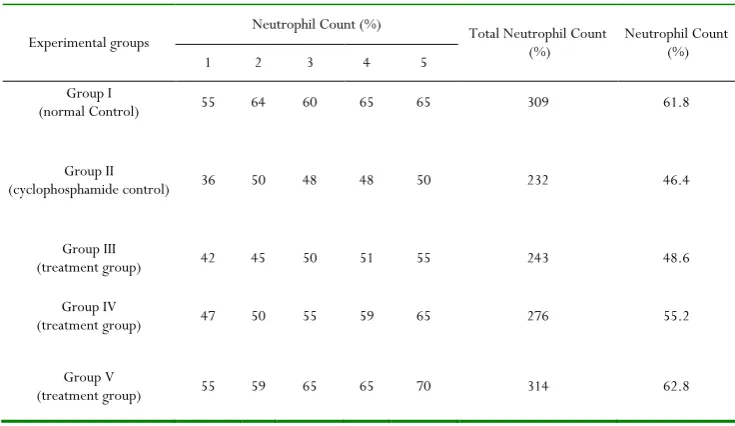
Table 3: Percentage of neutrophil count
Experimental groups Neutrophil Count (%) Total Neutrophil Count (%) Neutrophil Count (%) 1 2 3 4 5
Group I
(normal Control) 55 64 60 65 65 309 61.8
Group II
(cyclophosphamide control) 36 50 48 48 50 232 46.4
Group III
(treatment group) 42 45 50 51 55 243 48.6
Group IV
(treatment group) 47 50 55 59 65 276 55.2
Group V
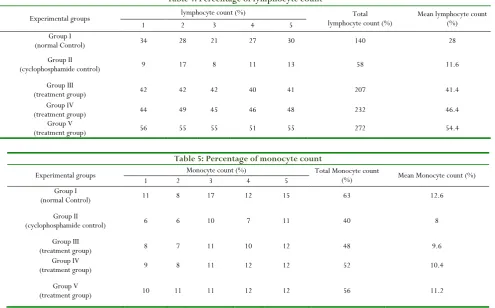
138 Journal of Advanced Pharmacy Education & Research | Jan-Mar 2018 | Vol 8 | Issue1 Table 4: Percentage of lymphocyte count
Experimental groups lymphocyte count (%) lymphocyte count (%) Total Mean lymphocyte count (%)
1 2 3 4 5
Group I
(normal Control) 34 28 21 27 30 140 28 Group II
(cyclophosphamide control) 9 17 8 11 13 58 11.6
Group III
(treatment group) 42 42 42 40 41 207 41.4 Group IV
(treatment group) 44 49 45 46 48 232 46.4 Group V
(treatment group) 56 55 55 51 55 272 54.4
Table 5: Percentage of monocyte count
Experimental groups Monocyte count (%) Total Monocyte count (%) Mean Monocyte count (%) 1 2 3 4 5
Group I
(normal Control) 11 8 17 12 15 63 12.6
Group II
(cyclophosphamide control) 6 6 10 7 11 40 8
Group III
(treatment group) 8 7 11 10 12 48 9.6 Group IV
(treatment group) 9 8 11 12 12 52 10.4
Group V
(treatment group) 10 11 11 12 12 56 11.2
The leukocyte cell differential count only found neutrophil cells, lymphocytes and monocytes, whereas eosinophils and cells basophile were not found. Administration of ethanol extract of oak gall increaced the percentage of neutrophils, lymphocytes and monocytes. The neutrophil, lymphocyte and monocyte levels of the mice given 50 mg, 75 mg and 100 mg/kgBW garlic per day for seven days’ duration were higher than the cyclophosphamide control animals.
Conclusion
Ethanol extract of oak gall at doses of 50, 75 and 100 mg /kgBW increased total leukocytes and differential count of mice which is induced by cyclophosphamide and it showed a dose-dependent manner.
Acknowledgement
The authors are grateful to Faculty of Pharmacy University of Sumatera Utara for supporting this research.
References
1. World Health Organization. National policy on traditional medicine and regulation of herbal medicines: Report of a WHO global survey.2005;5-6
2. Basta SS, Karyadi D, Scrimshaw NS. Iron deficiency anemia and the productivity of adult males in Indonesia. The American Journal of Clinical Nutrition. 1979 Apr 1;32(4):916-25 3. Friedl P, Weigelin B. Interstitial leukocyte
migration and immune function. Nature immunology. 2008 Sep;9(9):960.
4. Grieve M. A Modern Herbal (1931). Jonathan Cape Ltd, London. 1992.
5. Claus EP. Pharmacognosy. Academic Medicine. 1962 Jan 1;37(1):79.
6. Barlough JE, Ackley CD, George JW, Levy N, Acevedo R, Moore PF, Rideout BA, Cooper MD, Pedersen NC. Acquired immune dysfunction in cats with experimentally induced feline immunodeficiency virus infection: comparison of short-term and long-term infections. Journal of acquired immune deficiency syndromes. 1991;4(3):219-27.
Journal of Advanced Pharmacy Education & Research | Jan-Mar 2018 | Vol 8 | Issue` 139 8. Ain AN, Sakti ER, Syafnir L. Characterization of
Simplicia and Extract Mareme (Glochidion borneense (Müll. Arg.) Boerl.) Leaves.
9. Živorad AB, Nevenka M. White blood cell
differential count in rabbits artificially infected with intestinal coccidia. J. Protozool. Res. 2006; 16:42-50
10. Weiner JS, Lourie JA. Practical human biology. Academic Pr; 1981.
11. Mayumi H, Umesue M, Nomoto K.
Cyclophosphamide-induced immunological
tolerance: an overview. Immunobiology. 1996 Jul 1;195(2):129-139.
12. Shruthi S, Vijayalaxmi KK, Shenoy KB. Immunomodulatory Effects of Gallic Acid against Cyclophosphamide-and Cisplatin-induced Immunosuppression in Swiss Albino Mice. Indian Journal of Pharmaceutical Sciences. 2018 Feb 28;80(1):150-60.