Vol. 6, No. 2, 2014 Article ID IJIM-00471, 7 pages Research Article
Robust stabilization of a class of three-dimensional uncertain
fractional-order non-autonomous systems
AR. Haghighi∗ †, M. Pourmahmood Aghababa‡, M. Roohi §
————————————————————————————————–
Abstract
This paper concerns the problem of robust stabilization of uncertain fractional-order non-autonomous systems. In this regard, a single input active control approach is proposed for control and stabilization of three-dimensional uncertain fractional-order systems. The robust controller is designed on the basis of fractional Lyapunov stability theory. Furthermore, the effects of model uncertainties are fully taken into account. Also, the robust stability and access to the equilibrium point of the control scheme are analytically proved. Moreover, fast response and easy realization in real world applications are some special features of the suggested method. Finally, as a numerical simulation, control and stabilization of three-dimensional uncertain fractional-order Chen system is provided to illustrate the usefulness
and applicability of the proposed approach in practice. It is worth to notice that the proposed
active control approach can be employed for robust stabilization of a large class of three-dimensional uncertain nonlinear fractional-order non autonomous dynamical systems.
Keywords: Control; Single input control; Fractional-order system.
—————————————————————————————————–
1
Introduction
F
rthe early 17th century, deals with integrationactional calculus, which was introduced in and derivatives of arbitrary noninteger orders. In recent years, it has been reported in many areas such as electrical circuit, population models, epi-demiology models, etc [2]. Due to the existence of chaos in real fractional-order systems, control and stabilization of fractional-order systems have at-tracted the attention of many scholars in the past decade [3]. Therefore, studying the fractional-order chaotic systems has become an activere-∗Corresponding author. [email protected] †Department of Mathematic, Urmia University of Tech-nology, Urmia, Iran.
‡Electrical Engineering Department, Urmia University of Technology, Urmia, Iran.
§Department of Mathematic, Urmia University of Tech-nology, Urmia, Iran.
search field. Up to now, some methods have been suggested to achieve chaos control in fractional-order chaotic systems, such as optimal control [17], active control [9], feedback control [18], PC control [12], adaptive control [19,28], non-fragile nonlinear observer method [10], sliding mode con-trol [4, 5, 6, 7, 8, 11], fuzzy logic control [21], etc. However, in most of the above mentioned approaches, the ideal conditions for the systems have been considered without paying attention to the unknown uncertainties which exist in reality. Moreover, in previous works the formulation of the chaos stabilization problem and the proposed controllers are complex both in design and appli-cation.
In this paper, we design a single input ac-tive controller with one driving variable to con-trol a class of three-dimensional fractional-order systems. The effects of model uncertainties are fully taken into account. The proposed scheme is
based on the fractional version of Lyapunov sta-bility theory. The robust stasta-bility property and simplicity of the design are interesting capabilities of the designed method. A numerical example demonstrates the applicability and efficiency of the proposed control technique in practice. The rest of this paper is arranged as follows. Some preliminaries of fractional calculus and a lemma are given in Section 2. In Section 3, system de-scription and problem formulation are presented. Also, the proposed control scheme is introduced in Section 3. Section 4 presents an illustrative example. Finally, in Section 5, some conclusions are included.
2
Definitions and Preliminaries
Here, some definitions about the fractional differ-ential equations (FDEs) and an essdiffer-ential lemma are expressed.
Definition 2.1 The Riemann-Liouville frac-tional integration of order α is presented by [25]:
t0It= t0D−
α t f(t) =
1 Γ(α)
∫ t
t0
f(τ) (t−τ)1−αdτ.
(2.1)
where t0 is the initial time. Also Γ(.) is the
Gamma function.
Definition 2.2 Theαth order Caputo fractional derivative of a function f(t) is defined as [25]:
t0D
α
tf(t) = t0D
−(m−α)
t
dm dtmf(t)
= 1
Γ(m−α)
∫ t
t0
f(m)(τ) (t−τ)α−m+1 dτ.
(2.2)
where where m is the smallest integer number, larger than α.
It is noted that in this paper the Caputo defini-tion is adopted.
Definition 2.3 Suppose that h(t) is the impulse response of a linear system. The diffusive representation ofh(t) is called µ(ω)with relation as follows [27]:
h(t) =
∫ ∞
0
µ(ω)e−ωtdω (2.3)
Remark 2.1 The fractional order integral (2.1) can rewrite as [27]:
t0I
α
tf(t) = h(t) ∗f(t) (2.4)
where ∗ is the convolution operator and h(t) is defined as
h(t) = t
α−1
Γ(α).
Also, the diffusive representation of h(t) is defined as:
µ(ω) = sin(απ)
π ω
−α (2.5)
Definition 2.4 Let have the nonlinear FDE [27]:
t0D
α
tX=f(X) (2.6)
According to the continuous frequency distributed model of the fractional integrator, the nonlinear system (2.6) can be rewritten as:
{ ∂z(ω,t)
∂t =−ωz(ω, t) +f(x(t))
x(t) =∫0∞ µ(ω)z(ω, t)dω (2.7)
while µ(ω) is the same as (2.5).
Lemma 2.1 Consider w1 = ax2 and w2 =
∫∞
0 µ(ω)z(ω, t)dω. The quadratic form w =
w1+w2 is positive definite if and only if a > 0
[27].
3
Main results
Consider the following class of uncertain three-dimensional non-autonomous fractional0order systems with a single control input.
{
DαX =f1(X, y, t)
Dαy =f2(X, y, t) + ∆f(X, y, t)−u(t) (3.8) where α ∈ (0,1) is the order of the system and
X(t) = [x1, x2]T ∈ R2 and y(t) ∈ R are the states of the system, f1(X, y, t) and f2(X, y, t) are the bounded nonlinear functions of X, y and t ,∆f(X, y, t) is the system uncertainty term and
u(t)∈R is the single control input.
Assumption 3.1. The uncertainty terms ∆f(X, y, t) is bounded by
whereρ is a known positive constant.
Assumption 3.2. The function f1(X, y, t) is smooth in a neighborhood of the point y = 0 and the subsystem DαX = f1(X, y, t) will be asymptotically stable about the origin X= 0 for all X.
Remark 3.1 The system (3.8) is very general, where it includes most of the canonical fractional-order systems, such as fractional-fractional-order Genesio-Tesi system and fractional-order Arneodo sys-tem, order unified syssys-tem, fractional-order Lu system, fractional-fractional-order Lorenz system, fractional-order Chen system and fractional-order Tigan system.
The control goal of this paper is to design a suit-able robust controller for stabilization of system (3.8) around zero.
Theorem 3.1 Consider the fractional-order sys-tem (3.8). If this system is controlled by the single active controller (3.10), then the system trajecto-ries will converge to zero.
u(t) =λζsign(y) +ρ+f2(X, y, t) (3.10)
where ζ =q|y| and λ, q are positive constants.
Proof by using Definition 2.4,Dαy in (3.8), can be rewritten as
∂z(ω,t)
∂t =−ωz(ω, t) +f2(X, y, t)
+∆f(X, y, t)−u(t)
y(t) =∫0∞ µ(ω)z(ω, t)dω
(3.11)
We define two Lyapunov function where the first is
v(ω, t) = z 2(ω, t)
2 .
For v(ω, t) one can has ∂z∂v((ω,tω,t)) = z(ω, t) and by using (3.11) we can obtain
∂v(ω, t)
∂t =
∂v(ω, t)
∂z(ω, t) ·
∂z(ω, t)
∂t
=z(ω, t)[−ωz(ω, t) +f2(X, y, t)
+ ∆f(X, y, t)−u(t)]
≤z(ω, t)[−ωz(ω, t) +f2(X, y, t) +|∆f(X, y, t)|
| {z }
<ρ
−u(t)]
< z(ω, t)[−ωz(ω, t) +f2(X, y, t)
+ρ−|(λξsign(y) +{zρ+f2(X, y, t))}
u(t)
]
<−ωz2(ω, t)−λζsign(y)z(ω, t)
Therefore,
∂v(ω, t)
∂t <−ωz
2(ω, t)−λζsign(y)z(ω, t).
(3.12)
Now we introduce the main Lyapunov function as
V(t) =
∫ ∞
0
µ(ω)v(ω, t)dω
= 1 2
∫ ∞
0
µ(ω)z2(ω, t)dω (3.13)
ObviouslyV(t)>0 and based on Lyapunove sta-bility theorem, we must demonstrate that dVdt <0 is holden. Therefor, by attention to (3.12), one obtains
dV dt =
∫ ∞
0
µ(ω)∂v(ω, t)
∂t dω
< ∫ ∞
0
µ(ω) [−ωz2(ω, t)
−λζsign(y)z(ω, t)]dω
< − ∫ ∞
0
µ(ω)ωz2(ω, t)dω
−λζsign(y)
∫ ∞
0
µ(ω)z(ω, t)dω
| {z }
y
< − ∫ ∞
0
µ(ω)ωz2(ω, t)dω
−λ q|y|
|{z}
ζ
sign(y)y
< −(
∫ ∞
0
µ(ω)ωz2(ω, t)dω+λq|y|2)
4
Numerical example
Here, the robust stabilization problem of the fractional-order Chen system is splved numeri-cally. Numerical simulation is performed using MATLAB software. The numerical approach de-scribed in [13,14,15,16] with a step time of 0.001 is applied to solve the fractional-order equations.
0 5 10 15
−30 0 30
x1
0 5 10 15
−20 0 20
y
0 5 10 15
0 20 40
T(sec)
x2
Control in action
Control in action Control in action
Figure 1: State trajectories of chaotic Chen
system controlled with (3.10)
0 5 10 15
−40 0 40 80 120
u(t)
u(t)
Control in action
Figure 2: Time history of the single control
input (3.10) applied to the Chen system.
4.1 Numerical method for solving
fractional differential equations
There are several analytical and numerical methods such as the fractional difference method [25, 26], the Adomian decomposition method [22], the homotopy perturbation method [1], the variational iteration method [23,24], the Adams-BashforthMoulton method [13, 14, 15, 16] to
solve the fractional-order differential equations. In this paper, a modification of AdamsBash-forthMoulton algorithm which is proposed by Diethelm et al. in [13, 14, 15, 16] is used to solve FDEs. Consider the following initial value problem (IVP) of FDEs
{
Dαy(t) =f(y, t), 0≤t≤T
y(k)(0) =y0(k), k= 0,1, ... , m−1 (m=⌈α⌉) (4.14)
which is equivalent to the following Volterra in-tegral equation
y(k) =
m∑−1
k=0
y0(k)t
k
k!
+ 1 Γ(α)
∫ t
t0
f(y(s), s)
(t−s)1−αds (4.15)
Setting h = NT, tn = nh , n = 0,1, ..., N the
above equation becomes
yh(tn+1) =
m∑−1
k=0
ck
tkn+1 k!
+ h
α
Γ(α+ 2)f(y (p)
h (t(n+1)), t(n+1))
+ h
α
Γ(α+ 2)
n
∑
j=0
aj,n+1f(yh(tj), tj)
(4.16)
subject to
aj,n+1=
nα+1−(n−α)(n+ 1)α, if j = 0 (n−j+ 2)α+1+ (n−j)α+1
−2(n−j−1)α+1, if 1≤j≤n
1, if j =n+ 1
yh(p)(t(n+1)=
m∑−1
k=0
ck
tk n+1
k!
+ 1 Γ(α)
n
∑
j=0
bj,n+1f(yh(tj), tj)
bj,n+1 =
hα
α ((n+ 1−j)
The error in this method is
e= max
j=0,1,...,n |y(tj)−yh(tj)|=O(h
p) (4.18)
wherep=min(2,1 +α)
4.2 Robust stabilization of the
fractional-order Chen system
Consider the following fractional-order Chen sys-tem [20]
Chen:
Dαx1 = 35(x2−x1),
Dαx2 = 28x2−7x1−x1x3,
Dαx
3 =x1x2−3x3.
(4.19)
It is easy to see that if x2(t) = 0, the two-dimensional subsystem
{
Dαx1 =−35x1,
Dαx3 =−3x3
of system (4.20) will be asymptotically stable about the origin x1(t) = 0 and x3(t) = 0 for all
x1 and x3. Now, let X = [x1, x3] and y = x2, then the controlled uncertain system (4.19) becomes
Dαx1 = 35(y−x1),
Dαy =−7x1+ 28y−x1x2 +∆f(X, y, t)−u(t), Dαx2 =x1y−3x2
(4.20)
where ∆f(X, y, t) = 0.56 cos(3t)y and α = 0.98. The initial values of the Chen system are
x1(0) = 7, x2(0) = 10 and y(0) = 7. Besides, control parameters are selected as λ = 3 and
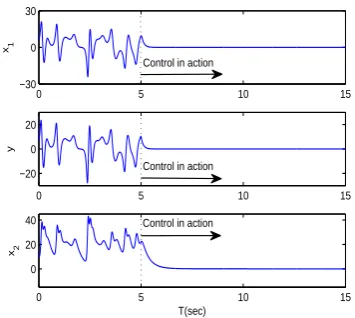
q = 3. The state trajectories of the controlled fractional-order chaotic Lorenz system are displayed in Figure 1, where the controller is switched at t =5. It can be seen that the state trajectories converge to zero, which indicates that the fractional-order Chen system is indeed controlled. The time history of the control input is depicted in Figure 2. It is obvious that the control signal tends to zerobimplying that the proposed mode controller is feasible in real world applications.
5
Conclusion
This paper investigates control of three-dimensional non-autonomous fractional-order uncertain systems via a single input control technique. The analytical results of the method are proved on the basis of fractional Lyapunov stability theory. The designed active controller has several useful features such as fast response, low sensitivity to the system uncertainties and easy realization in practice. Finally, a numerical example confirm that the proposed approach can effectively stabilize the fractional-order non-autonomous systems in practice. It is worth noticing that the proposed control method can be applied to control a broad range of three-dimensional non-autonomous fractional-order dynamical systems.
References
[1] O. Abdulaziz, I. Hashim, and S. Momani, Solving systems of fractional differential equations by homotopy-perturbation method, Physics Letters A 372 (2008) 451459.
[2] M. P. Aghababa, Robust Finite-Time Stabi-lization of Fractional-Order Chaotic Systems based on Fractional Lyapunov Stability The-ory, Journal of Computational and Nonlin-ear Dynamics 7 (2012) 21-31.
[3] M. P. Aghababa, Finite-time chaos control and synchronization of fractional-order non autonomous chaotic (hyperchaotic) systems using fractional nonsingular terminal slid-ing mode technique, Nonlinear Dynamics 69 (2012) 247-261.
[4] M. P. Aghababa, Robust stabilization and synchronization of a class of fractional-order chaotic systems via a novel fractional sliding mode controller, Communications in Non-linear Science and Numerical Simulation 17 (2012) 2670-2681.
[5] M. P. Aghababa, A novel terminal slid-ing mode controller for a class of non-autonomous fractional-order systems, Non-linear Dynamics 73 (2013) 679-688.
com-plex systems, Nonlinear Dynamics 73 (2013) 2329-2342.
[7] M. P. Aghababa, A fractional-order con-troller for vibration suppression of uncertain structures, ISA Transactions 52 (2013) 881-887.
[8] M. P. Aghababa, Design of a chatter-free terminal sliding mode controller for nonlin-ear fractional-order dynamical systems, In-ternational Journal of Control 86 (2013) 1744-1756.
[9] S. Bhalekar and V. Daftardar-Gejji, Syn-chronization of different fractional order chaotic systems using active control, Com-munications in Nonlinear Science and Nu-merical Simulation 15 (2010) 3536-3546.
[10] E. A. Boroujeni and H. R. Momeni, Non-fragile nonlinear fractional order observer design for a class of nonlinear fractional order systems, Signal Processing 92 (2012) 2365-2370.
[11] S. Dadras, H. R. Momeni, and M. P. Aghababa, Corrigendum to Fractional ter-minal sliding mode control design for a class of dynamical systems with uncertainty [Com-mun Nonlinear Sci Numer Simulat 17 (2012) 367377], Communications in Nonlinear Sci-ence and Numerical Simulation 17(2012) 234-243.
[12] W. Deng and C. Li,Chaossynchronizationof fractional-orderdiffeentiel systems, Interna-tional Journal of Modern Physics B 20 (2006) 791-803.
[13] K. Diethelm, N. J. Ford, and A. D. Freed,A predictor corrector approach for the numer-ical solution of fractional differential equa-tions, Nonlinear Dynamics 29 (2002) 322.
[14] K. Diethelm and G. Walz, Numerical solu-tion of fracsolu-tional order differential equasolu-tions by extrapolation, Numerical Algorithms 16 (1997) 231-253.
[15] K. Diethelm, N. Ford, and A. Freed, De-tailed Error Analysis for a Fractional Adams Method, Numerical Algorithms 36 (2004) 31-52.
[16] K. Diethelm and N. J. Ford, Analysis of fractional differential equations, Journal of Mathematical Analysis and Applications 265 (2002) 229248.
[17] S. Djennoune and M. Bettayeb,Optimal syn-ergetic control for fractional-order systems, Automatica 49 (2013) 2243-2249.
[18] A. S. Hegazi, E. Ahmed, and A. E. Matouk, On chaos control and synchronization of the commensurate fractional order Liu system, Communications in Nonlinear Science and Numerical Simulation 18 (2013) 1193-1202.
[19] J. Hu, Y. Han, and L. Zhao, Synchronizing chaotic systems using control based on a spe-cial matrix structure and extending to frac-tional chaotic systems, Communications in Nonlinear Science and Numerical Simulation 15 (2010) 115-123.
[20] C. Li and G. Chen, Chaos in the fractional order Chen system and its control, Chaos, Solitons & Fractals 22 (2004) 549-554.
[21] T. C. Lin and C. H. Kuo,synchronization of uncertain fractional order chaotic systems: Adaptive fuzzy approach, ISA Transactions 50 (2011) 548-556.
[22] S. Momani, Analytic and approximate solu-tions of the space-and time-fractional tele-graph equations, Applied Mathematics and Computation 170 (2005) 11261134.
[23] S. Momani, Z. Odibat, and A. Alawneh, Variational iteration method for solving the space- and time-fractional KdV equation, Numerical Methods for Partial Differential Equations 24 (2008) 262-271.
[24] Z. Odibat and S. Momani, The varia-tional iteration method: An efficient scheme for handling fractional partial differential equations in fluid mechanics, Computers & Mathematics with Applications 58 (2009) 2199-2208.
[26] J. Sabatier, O. P. Agrawal, and J. A. T. Machado, Advances in Fractional Calculus: Theoretical Developments and Applications in Physics and Engineering, Springer, Berlin 2010.
[27] J. C. Trigeassou, N. Maamri, J. Sabatier, and A. Oustaloup, A Lyapunov approach to the stability of fractional differential equa-tions, Signal Processing 91 (2011) 437-445.
[28] C. Yin, S. Dadras, S.-m. Zhong, and Y. Chen,Control of a novel class of fractional-order chaotic systems via adaptive sliding mode control approach, Applied Mathemati-cal Modelling 37 (2013) 2469-2483.
Ahmad Reza Haghighi is an Assis-tant Professor in the department of mathematics at Urmia Univer-sity of technology, Urmia, Iran. He completed his Ph. D degree in ap-plied mathematics from Pune Uni-versity, India. His research in-terest includes Bio-Mathematics, Computational Fluid Dynamics, Partial Differential Equations and Control.
Mohammad Pourmahmood Aghababa received his B.S. degree in Biomedical Engineering from Isfahan University in 2005. He re-ceived his M.S. and Ph.D. degrees both in Control Engineering from University of Tabriz in 2007 and 2011, respectively. He is currently an Assistant Professor in the Department of Electrical Engi-neering of the Urmia University of Technology in Urmia, Iran. Dr. Aghababa has published over 50 ISI journal papers and is an editorial member of 5 international journals. He is a reviewer of 45 international journals and a member of technical committee of 2 international conferences. His research interests include nonlinear control, frac-tional calculus, chaos theory, industrial control and artificial intelligence.