www.ijper.org
Solid State Characterization and Tableting Studies
of Ethanol Based Cocrystals of Fenofibrate with
Nicotinamide
Amol Somanath Shete1*, Vishwajeet V Khandagale2, Srinivasa M Murthy3,Adhikrao Vyankatrao Yadav4, Sfurti Shamling Sakhare4, Rajendra Chandrashekhar Doijad1
1Department of Pharmaceutics, Krishna Institute of Pharmacy of Krishna Institute of Medical Sciences Deemed University,
Karad, INDIA.
2Department of pharmaceutics and Quality Assurance, Shree Santkrupa College of Pharmacy, Ghogaon, Karad, INDIA. 3Vignan Institute of Pharmaceutical Sciences, Deshmukhi, Nalgonda, INDIA.
4Gourishankar Institute of Pharmaceutical Education and Research, Limb, Satara, INDIA.
ABSTRACT
Objectives: The pharmaceutical cocrystals can be defined as dissociable “API-excipient” molecular complexes or Co-crystals are solids that are crystalline materials composed of two or more molecules in the same crystal lattice as per U.S. Department of Health and Human Services Food and Drug Administration Center for Drug Evaluation and Research (CDER) April 2013. The objectives of present investigation were to formulate cocrystals of fenofibrate with nicotinamide by solution cocrystallization technique. Methods: The
cocrystals were prepared by solution cocrystallization technique by using ethanol as a solvent and nicotinamide as a coformer in the ratio of 1:1 & 1:2. The prepared cocrystals were evaluate for, solid state characterization by FTIR, PXRD, Raman spectroscopy and evaluated for tableting performance. Results: The formation of cocrystals has been confirmed by FTIR and Raman spectroscopy. The formulations 1:1 and 1:2 ratios showed better flow properties. The order of tableting performance 1:2 ratio cocrystals > 1:1 ratio cocrystals > Recrystallized nicotinamide > Nicotinamide >> Recrystallized Fenofibrate >> Fenofibrate. Conclusion: The cocrystals showed superior tableting performance. This might be due to the co-crystals, contains hydrogen-bonded two dimensional flat slip planes which exhibits higher plasticity.
Key words: Cocrystals, Crystallizaton, Fenofibrate, Nicotinamide, Tableting
DOI: 10.5530/ijper.52.1.8
Correspondence: Mr.Amol Somanath Shete, Department of Pharma-ceutics, Krishna Institute of Pharmacy of Krishna Institute of Medical Sciences Deemed University, Karad, - 415110 INDIA.
Phone no: 09822916129 E-mail: [email protected]
INTRODUCTION
Cocrystals can be defined as crystalline materials consist of two or more different components (or commonly called multi-component crystals). For the pharmaceutical cocrystals, one component is an active pharmaceutical ingredient and other com-ponents are called as coformers. Cocrystals have gained considerable interest in pharma-ceutical research due to its ability to improve physicochemical characteristics of an API such as such as mechanical behavior, com-pressibility, solubility, dissolution rate, moisture stability, and bioavailability of drugs with their chemical structure unchanged.1,2 In a short time span cocrystals are of the interest
Submission Date: 13-07-2017;
Revision Date: 25-09-2017;
Accepted Date: 10-01-2018 of the researchers because fast forward to
in phase III clinical development is a cocrystal with 5-oxo-proline.
Fenofibrate is a neutral, lipophilic compound that is practically insoluble in water, making it challenging to consistently achieve therapeutic levels.6 Our previous investigation showed nicotinamide forms stable cocrys-tals theoretically and practically with fenofibrate with improved dissolution rate.7
In general, fenofibrate products can be grouped with regard to their food effects. For example, fenofibrate formulations that should be taken with meals include non-micronized tablets (Fenoglide ®, Lofibra®, generic), micronized capsules (Lofibra® and generic), micro coated micronized tablets (Lofibra®), and fenofibrate hard gelatin capsules (Lipofen®). Fenofibrate formula-tions that can be taken with or without meals include nanoparticle tablets (Tricor®), IDD-P tablets (Triglide ®), micronized capsules (Antara®), and the choline salt of fenofibric acid (Trilipix®) in a dosage range of 40 to 200 mg.8
Literature reveals that Fenofibrate (FNO) shows poor flowability and compaction properties. To enhance the compressibility spherical crystallization, highly plastic granules.9 and melt sonication techniques has been reported.10
Cocrystallization of the drug powder to control the crystal packing and modulate tabletability which describes the capacity of a powder to be transformed into a tablet in a broader manufacturing perspective and compaction which enables bonding between particles are impor-tant improvement at the preformulation stage. The objectives of present investigation were to formulate cocrystals of fenofibrate with nicotinamide by solution cocrystallization technique, solid state characterization of cocrystals by FTIR, PXRD and Raman spectroscopy and to evaluate cocrystals for tableting performance.
MATERIALS AND METHODS
Materials
Fenofibrate was obtained as a gift sample from Alembic pharma, Pvt.Ltd. Vadodara. Nicotinamide were procured from Loba Chemie Pvt. Ltd. Mumbai. All other chemicals were of analytical grade.
Preparation of Cocrystals by Solution crystallization technique
Fenofibrate and nicotinamide were weighed in 1:1 molar ratio, dissolved in 20 ml of ethanol with sonication. The saturated solution was kept overnight to evaporate solvent. The crystals were obtained after evaporation of ethanol; crystals were allowed to dry in the air.3
Fourier Transform Infrared spectroscopy (FTIR)
IR spectroscopy was conducted using a Shimadzu FTIRAffinity-1S Spectrophotometer (Shimadzu) and the spectrum was recorded in the wavelength region of 7800-350 cm-1.The procedure consisted of dispersing a sample (drug alone, or prepared cocrystals) in KBR.
Powder X-Ray Diffraction Studies (P-XRD)
The X-ray diffraction patterns of pure drug and the optimized crystals formulation were recorded using Bruker analytical X-ray diffraction (D2 Phase, Bruker) (Germany) with a copper target over the interval of 5-700 2θ -1 . The conditions were voltage 20kV, current 30 mA, scanning speed 20 /min, temperature of acqui-sition: room temperature, detector: scintillation counter detector, sample holder: non-rotating holder.1
Raman Spectroscopy
The Raman spectra of the pure drug and prepared formulations were recorded in the spectral range of 0–5000 cm−1 using a Raman spectrometer (Bruker MultiRAM, Germany Make) equipped with an Nd: YAG laser source with an at excitation wavelength of 1064 nm and resolution 4 cm−1.
Tableting Studies
Approximately 250 mg of powder was manually filled into a KBR press die and compressed at predetermined pressures (1 to 2.5 tons) to get flat-faced round tablets (8 mm) diameter, and thickness was measured by using digital venire caliper. The hardness was measured by using Monsanto Hardness Tester. The prepared formu-lations were also evaluated for Micromeritic properties
RESULTS AND DISCUSSION
Fourier Transform Infrared spectroscopy (FTIR)
indicated by appearance of characteristics peak of aromatic –NH2 group at 3151.69 cm-1 that might be involved in the interaction as shown in Figure 1.Those phenomena may be caused by the hydrogen bond inter-actions involved in co-crystal formation which changes the symmetry characteristic.
Powder X-Ray Diffraction Studies (P-XRD)
PXRD of all powders showed intense sharp diffraction peaks without amorphous halo observed. The PXRD pattern of fenofibrate as shown in Figure 2 indicates crystalline nature of drug. The sharp intense peaks at 2θ -11.880, 16.130, 20.750, 22.170, 24.550 showed that the
sample was fenofibrate. The pure nicotinamide showed intense peak at diffraction angle of 14.730 and 22.200. The PXRD pattern of 1:1 ratio cocrystals showed shifting in 2θ to 11.820, 14.730, 20.680, 22.120, 25.670 and 1:2 ratio showed intense peak at 2θ – 14.670, 22.040, 25.140, 27.050 as shown in Figure 2. This revealed a character-istic diffraction pattern, which differed from those of the two individual components. Hence shifting of the peaks has been observed in formulations. This shifting is a clear indication of formation of new phase’s i.e. cocrystals.11,12as confirmed from FTIR.
Raman Spectroscopy
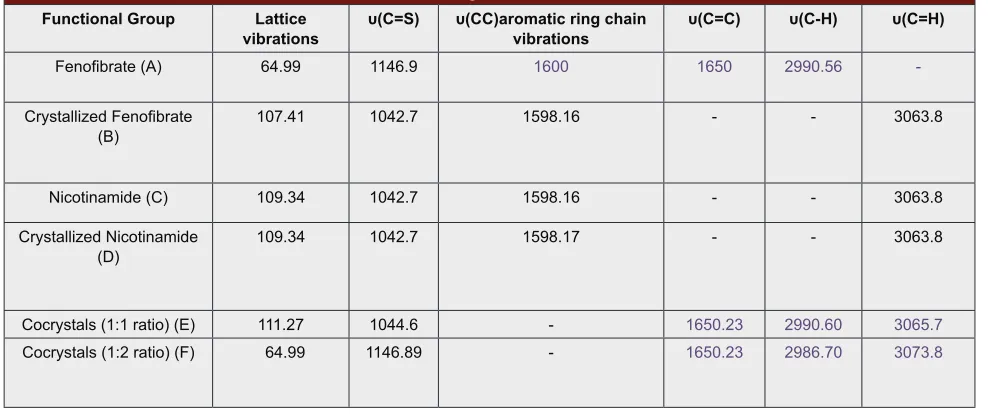
The fenofibrate showed Raman bands at 1600cm-1 and 1650cm-1 for aromatic chain vibrations, C=O functional group respectively. The C=C bond is always strong and very reliable. “To form a salt with amine bases the carbonyl group bands shift to lower side by 30-40 cm-1”.
Such type of shifting has not been observed with formulations so it confirms the formed phases are Figure 1: FTIR spectra’s A.Pure fenofibrate B. Recrystallized
Fenofibrate C. Pure Nicotinamide D. Recrystallized Nicotinamide E. 1:1 ratio cocrystals F. 1:2 ratio cocrystals.
Figure 2: PXRD spectra’s A.Pure fenofibrate B. Recrystallized Fenofibrate C. Pure Nicotinamide D. 1:1 ratio cocrystals E. 1:2
Figure 4: Photographs of tablets compressed at a pressure and weight (1.0 ton and 250 mg) respectively.
Figure 3: Raman Spectra’s A.Pure Fenofibrate B. Recrystallized Fenofibrate C. Pure Nicotinamide
D. 1:1 ratio cocrystals E. 1:2 ratio cocrystals.
cocrystals. The C-H stretching region in between (3000-2850 cm-1) is a very good diagnostic bond for the pres-ence of the aldehyde functional group.13,14,15 Similar to FTIR, some peak shift also take place for Raman spectra which can be attributed to intermolecular hydrogen-bonding. The results are mentioned in Table 2 and Figure 3.
Tableting Studies
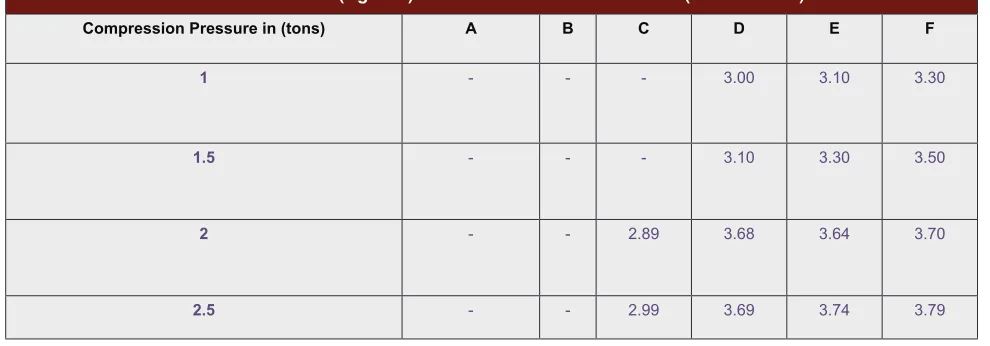
The Table 3 shows among all the formulations the 1:1 and 1:2 ratios of formulations showed better micromeritic
properties. The pure fenofibrate showed good angle of repose but moderate type of Hausner’s ratio 1.399 and the having poor Carr’s index 28.52 %.16,17
Table 1: Summary of FTIR Peaks of Different Formulations
Formulation s C=O
Str. C=C Aryl estersC=O H-X CN NH2
Fenofibrate (A) 1587 1647.21 1726.29 757 -
-Crystallized Fenofibrate (B) 1587.06 1647.21 1724.36 763.81 -
-Nicotinamide (C) 1571.99 1683.86 - 763.81 1288.52
-Crystallized Nicotinamide (D) 1571.99 1674.21 - 776.30 1263.76 3067.17
Cocrystals (1:1 ratio) (E) 1595.13 1645.34 1726.29 763.81 1283.52 3047
Cocrystals (1:2 ratio) (F) 1597.66 1645.39 1726.29 763.81 1283 3151.69
Table 2: FT RAMAN Ranges of Different Formulations
Functional Group Lattice
vibrations υ(C=S) υ(CC)aromatic ring chain vibrations υ(C=C) υ(C-H) υ(C=H)
Fenofibrate (A) 64.99 1146.9 1600 1650 2990.56
-Crystallized Fenofibrate
(B) 107.41 1042.7 1598.16 - - 3063.8
Nicotinamide (C) 109.34 1042.7 1598.16 - - 3063.8
Crystallized Nicotinamide
(D) 109.34 1042.7 1598.17 - - 3063.8
Cocrystals (1:1 ratio) (E) 111.27 1044.6 - 1650.23 2990.60 3065.7
Cocrystals (1:2 ratio) (F) 64.99 1146.89 - 1650.23 2986.70 3073.8
Table 3: Micromeritic Properties of Formulations
Formulation code Angle of repose Bulk density (gm/
cm3) Tapped density(gm/cm3) Index (%)Carr’s Hausner’s ratio
Fenofibrate (A) 26.51±1.25 0.238±0.012 0.333±0.013 28.52±1.20 1.399±0. 13
Crystallized Fenofibrate
(B) 31.54±1.41 0.274±0.021 0.333±0.015 17.71±1.32 1.21±0.21
Nicotinamide (C) 26.51±1.75 0.274±0.31 0.320±0.028 14.375±1.52 1.167±0.24
Crystallized Nicotinamide
(D) 25.032±1.20 0.245±0.023 0.316±0.023 22.46±2.02 1.28±0.26
Cocrystals (1:1 ratio) (E) 29.42±1.34 0.304±0.024 0.337±0.027 9.55±1.52 1.10±0.32
Table 4: Thickness (Mm) of Tablet at Deferent Pressure
Compression Pressure in (tons) A B C D E F
1 - - - 3.65±0.04 3.44±0.02 3.60±0.02
1.5 - - - 3.40±0.04 3.34±0.02 3.45±0.02
2 - - 3.13±0.04 2.90±0.04 2.95±0.02 2.88±0.02
2.5 - - 3.00±0.04 2.88±0.04 2.85±0.02 2.82±0.02
Table 5: Hardness (Kg/Cm2) Of Tablet at Different Pressure (Mean Values)
Compression Pressure in (tons) A B C D E F
1 - - - 3.00 3.10 3.30
1.5 - - - 3.10 3.30 3.50
2 - - 2.89 3.68 3.64 3.70
2.5 - - 2.99 3.69 3.74 3.79
CONCLUSION
The cocrystals of antihyperlipedimic drug, fenofibrate with coformer nicotinamide have been successfully prepared. Cocrystals gives reliable thickness and hard-ness of the tablets. The cocrystal displayed superior tableting performance. This might be due to the co-crystals, containing hydrogen-bonded two dimensional flat slip planes exhibit higher plasticity.
ACKNOWLEDGEMENT
The authors are thankful to the management of Krishna Institute of Medical Sciences Deemed University’s, Krishna Institute of Pharmacy Karad for providing excellent research facilities. Also grateful to Shivaji University, Kolhapur for providing the sophisticated analytical instrumentation facility (SAIF) of Shivaji University.
CONFLICT OF INTEREST
The authors report no conflicts of interest. The authors alone are responsible for the content and writing of the paper.
ABBREVIATIONS USED
FNO: Fenofibrate.
REFERENCES
1. Gadade DD, Pekamwar SS. Pharmaceutical Cocrystals: Regulatory and Strategic Aspects, Design and Development. Adv Pharm Bull. 2016; 6(4):479-94.
2. Bolla G, Nangia A. Pharmaceutical cocrystals: walking the talk. Chem Commun (Camb). 2016; 52(54):8342-60.
3. Guidance for industry regulatory classification of pharmaceutical co-crystals.
U.S. Department of health and human services food and drug administration
center for drug evaluation and research (CDER) April 2013.
4. Aitipamula S, Banerjee R, Bansal AK, Biradha K, Cheney M L, Choudhury A,
5. Harrison WTA, Yathirajan H S, Bindya S, Anilkumar HG, Devaraju. Escitalopram oxalate: co-existence of oxalate dianions and oxalic acid molecules in the same crystal. Acta Cryst. 2007; 63(2):0129-31.
6. Vogt M, Kunath K, Dressman JB. Dissolution enhancement of fenofibrate by micronization, cogrinding andspray-drying: comparison with commercial preparations. Eur J Pharm Biopharm. 2008; 68(2):283-8.
7. Shewale S, Shete AS, Doijad R C, Kadam SS, Patil V A, Yadav AV.
Formulation and Solid State Characterization of Nicotinamide-based
Co-crystals of Fenofibrate. Ind J Pharm Sci. 2015; 77(3):328.
8. Linga H, Luomab JT, Hilleman D. A Review of Currently Available Fenofibrate and Fenofibric Acid Formulations. Cardiol Res. 2013; 4(2):47-55.
9. Patent - CA 2524806 A1, Highly plastic granules for making fast melting tablets.
10. Patil SV, Patil SS, Kavathekar G. Influence of Process Parameters
Compressibility, Solubility and Release Characteristics of Melt Sonocrystallized
Fenofibrate. BJPR. 2016; 12(1):1-12.
11. Changquan CS, Hou H. Improving Mechanical Properties of Caffeine and Methyl Gallate Crystals by Cocrystallization. Crystal Growth and Design.
2008; 8(5):1575-9.
12. Grossjohanna C, Ecclesb KS, Maguirec AR, Lawrenceb SE, Tajbera L,
Corrigana OI, et al,. Solubility and intrinsic dissolution behavior of benzamide: dibenzyl sulfoxide cocrystal. Int J Pharm. 2012; 422(4):24-32.
13. Mayo DW, Miller FA, Hannah RW. Course Notes on the Interpretation of Infrared and Raman Spectra: John Wiley and Sons, Inc, 2003, 0-471.
14. Paudel A, Raijada D, Rantanen J. Raman spectroscopy in pharmaceutical product design. Adv Drug Del Rev. 2015; 89:3-20.
15. Qiao N, Wang K, Schlindwein W, Davies A, Li M. In situ monitoring of carbamazepine–nicotinamide cocrystal intrinsic dissolution behavior. Eur J
Pharm Biopharm. 2013; 83(3):415-26.
16. Martin A, Swarbrick J, Cammarata A, Chun AHC. (1991). Physical pharmacy, physical and chemical principles in the pharmaceutical sciences. Bombay:
Varghese Publishing House.
17. Staniforth JN. Powder flow, the science of dosage forms designs. ELBS.1990;
610-13.
18. Chattoraj S, Shi L, Changquan CS. Understanding the relationship between
crystal structure, plasticity and compaction behavior of theophylline, methyl
gallate, and their 1: 1 co-crystal. CrystEngComm.2011; 11(8):2489-503.
SUMMARY PICTORIAL ABSTRACT
• Fenofibrate forms the cocrystals with Nicotinamide which has been confirmed by instrumental methods of analysis and the order of tableting performance 1:2 ratio cocrystals > 1:1 ratio cocrystals > Recrystallized nicotinamide > Nicotinamide >> Recrystallized Fenofibrate >> Fenofibrate. This might be due to the co-crystals, containing hydrogen-bonded two dimensional flat slip planes exhibit higher
plasticity.
Mr.Amol S.Shete: Presently he is working as an assistant professor department of pharmaceutics at Krishna Institute of Pharmacy of Krishna Institute of Medical Sciences Deemed University Karad. His area of interest is crystal engineering, evaluation of natural substances as pharmaceutical excipients, particulate drug delivery system.
About Authors