The Thirty-Third AAAI Conference on Artificial Intelligence (AAAI-19)
Distant Supervision for Relation Extraction with Linear
Attenuation Simulation and Non-IID Relevance Embedding
Changsen Yuan,
1Heyan Huang,
1,2∗Chong Feng,
1Xiao Liu,
1Xiaochi Wei
3 1Department of Computer Science, Beijing Institute of Technology, China2Beijing Engineering Research Center of High Volume Language Information Processing
and Cloud Computing Applications, China
3Baidu Inc. , China
{yuanchangsen, hhy63, fengchong, xiaoliu}@bit.edu.cn [email protected]
Abstract
Distant supervision for relation extraction is an efficient method to reduce labor costs and has been widely used to seek novel relational facts in large corpora, which can be identified as a multi-instance multi-label problem. However, existing distant supervision methods suffer from selecting im-portant words in the sentence and extracting valid sentences in the bag. Towards this end, we propose a novel approach to address these problems in this paper. Firstly, we propose a linear attenuation simulation to reflect the importance of words in the sentence with respect to the distances between entities and words. Secondly, we propose a non-independent and identically distributed (non-IID) relevance embedding to capture the relevance of sentences in the bag. Our method can not only capture complex information of words about hidden relations, but also express the mutual information of instances in the bag. Extensive experiments on a benchmark dataset have well-validated the effectiveness of the proposed method.
Introduction
Relation extraction, aiming to categorize semantic relations between entity pairs in plain texts, has been widely adopted in many natural language processing (NLP) tasks, such as question answering (Sadeghi, Divvala, and Farhadi 2015), text categorization (Huynh et al. 2011) and web search (Yan et al. 2009). Traditional supervised methods for relation ex-traction require a large amount of high-quality corpus for model training, which is extremely expensive and time-consuming. Additionally, these datasets are often restricted to certain domains. In recent years, distant supervision for relation extraction has been proposed to find abundant rela-tional facts with large amount auto-generated labels. How-ever, it has two major flaws in existing distant supervision methods.
Firstly, the existing approaches acquiescently assume that each word in the sentence has the same weight in relation extraction. This hypothesis is too strong and usually leads to wrong labels. The relationship between entities and words gradually decreases with the creasing of the distant between them. Therefore, words can not maintain the same weight in distant supervision. For example, (South Korea, Seoul,
∗
Corresponding author
Copyright c2019, Association for the Advancement of Artificial Intelligence (www.aaai.org). All rights reserved.
Country) is a relational fact in KB. Each word in the sen-tence “many foreign investors say the investigation is em-blematic of the political uncertainty they face in investing in South Korea, a concern that looms large as Washington and Seoul are negotiating a free trade agreement.” is not always useful for “Country”. Some invalid words exist in the long sentence. Moreover, (Mcdonald and Nivre 2007) showed that the accuracy of syntactic parsing decreases sig-nificantly with increasing sentence length. In the bag, we find that some instances are too long and contain some in-valid words about target relation. And these inin-valid words are usually far away from entities. Long distance between entity and word indicates a weak correlation between them. Conversely, short distance between entity and word pos-sesses strong correlation. These phenomena sometimes lead to wrong labels in distant supervision. Therefore, if we use the same weights about words in relation extraction, weights of words will not only affect the expression of sentences, but also have an important impact on the judgement of labels.
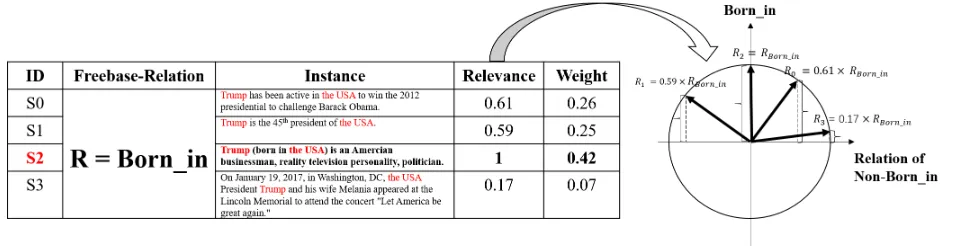
Figure 1: An example of non-IID relevance embedding in a bag. There are 4 sentences and 3-rd sentence is the best sentence to express relation of “Born in”. The right of Figure 1 represent the relevance of sentences. The vertical axis represents relation of “Born in” with coordinating value from -1 to 1, while other directions represent other relations.
USA” from the S1. This phenomenon illustrates that there is the connection between two sentences. Therefore, non-independent and identically distributed (non-IID) are pro-posed to solve the relevance of instances and enhance valid sentences.
In this paper, we propose linear attenuation simulation and non-IID relevance embedding to increase valid instances and enhance the results of relation extraction. To address the first problem, we assume that the connection of entity and word changes with the distance between entity and word. This variation is linear attenuation. Linear attenuation sim-ulation can reduce the weight of word with the increase of distance between entity and word. Thus, we use linear atten-uation simulation to work out this problem.
To solve the next problem, we adopt non-IID relevance embedding to learn the relevance of instances. Non-IID rel-evance embedding builds non-IID representations via mod-eling each bag along with its corresponding neighbors. Con-cretely, we use the cosine similarity between two sentences (S1,S2) to represent the relevance of S2 aboutS1, where
S1 is the best sentence to express the relation. If the
sen-tence has lower similarity with the best sensen-tence which can perfectly perform relation in the bag, this sentence will be assigned to a low weight. Therefore, the non-IID relevance embedding can improve the weights of valid sentences and enhance the correct labels for relation extraction. The ex-perimental results show that our method achieves significant and consistent improvements in relation extraction as com-pared with the state-of-the art methods.
The main contributions of this paper are summarized as follows:
• We propose a linear attenuation simulation to select useful words and alleviate the wrong labels which are caused by long distance between entity and word.
• To address the relevance of sentences, we develop innova-tive solutions that introduce non-IID relevance embedding to distant supervised relation extraction.
• In the experiments, results show that our model achieves better performance in distant supervised relation extrac-tion.
Methodology
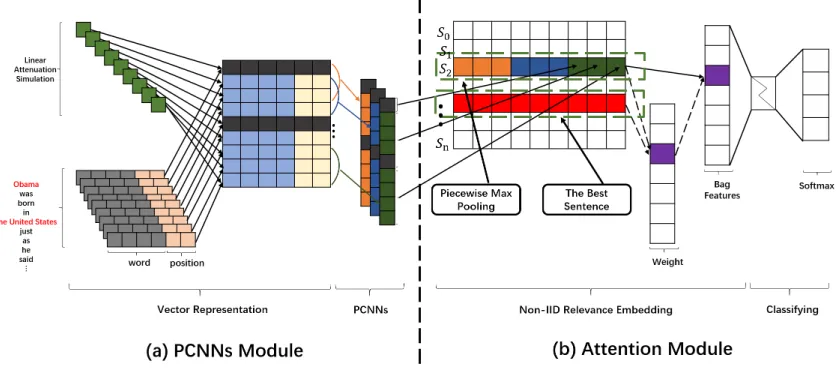
We propose a new model for relation extraction containing linear attenuation simulation and non-IID relevance embed-ding. Linear attenuation simulation not only can provide and remain important words, but also improve the representa-tion of sentences in our model. Non-IID relevance embed-ding provides more information between each sentence in the bag, which is able to select valid instances and bring more relevant information. The overall structure of our proposed model is illustrated in Figure 2, our model consists of two main components: PCNNs Module and Attention Module. The PCNNs Module is used to extract features and compute the weights of words from a sentence in a bag. And the PC-NNs Module is further comprised ofVector Representation,
Linear Attenuation Simulation, andPiecewise Convolution Neural Networks (PCNNs). The function ofVector Represen-tationis to transform words into low-dimensional vectors. The function ofLinear Attenuation Simulationis to assign weights to words.PCNNsis used to extract feature vector of the sentence. The Attention Module is used to compute the weights of all sentences in a bag, and feed the bag features into a softmax classifier. And the Attention Module is com-prised ofNon-IID Relevance EmbeddingandClassifying. We elaborate on these parts in following paragraphs.
Vector Representation
When using relation extraction, we require to translate each word to a low-dimensional vector. In this paper, we trans-late words into vectors by looking up the pre-trained word embeddings. In addition, position features (PFs) are used to specify entity pairs, which are also transformed into vectors by looking up the position embeddings.
Word Embeddings: Word embeddings are language modeling and feature learning techniques in NLP that map each word or phrase to a real-valued vector. They represent words between semantic and syntactic information. Given a sentence X = {w1,w2, . . . ,wk}, where each wordwi
Figure 2: The architecture of model. The red segment is the best sentence which can express the relation of r.
Position Embeddings: In distant supervised relation ex-traction, we focus on assigning labels to entity pairs. Simi-lar to (Zeng et al. 2014), we use position embeddings (PFs) to specify entity pairs. PFs are regarded as the combination of the relative distances from the current word to head en-tity and tail enen-tity. For example, in the sentence “Obama was born in the United States just as he has always said.”, the relative distances from “he” to head entity (Obama) and tail entity (the United States) are 7 and 3. Relative distances from “in” to head entity (Obama) and tail entity (the United States) are 4 and -1, respectively.
Figure 3: Position Embeddings
The position embedding matrices about entities are ran-domly initialized. Similar to the word embeddings, we trans-form the relative distances into real-valued vectors through looking up the position embedding matrices.
We assume that the size of word embedding isdw = 5
and that the size of position embedding is dp = 1.
Fi-nally, we combine the word embeddings and position em-beddings of all words and transform it as a vector sequence
X={w1,w2, . . . ,wk}, wherekis the sentence length and wi∈ Rd(d=dw+dp∗2).
Linear Attenuation Simulation
In relation extraction, words which close to the target entities often contain more information about relations. On the con-trary, when some words have long relative distances, these words are regarded as less or useless information about re-lations.
Suppose there is a sentence X consisting of k words (X = {w1,w2, . . . ,wk}), containing a head entity and a
tail entity. To exploit the information of all words, our model represents the sentence Xwith a real-valued matrix when predicting relationr. It is straightforward that the sentence is made up all words,{w1,w2, . . . ,wk}. Each word
con-tains different information which could decide relation of entity pairs. Then, the vectorXis calculated as:
X={γ1w1, γ2w2, . . . , γiwi, . . . , γkwk} (1)
whereγiis the weights of each word. In general, we define
γiin two ways.
Constant=1: Normally, we think that each word in the sentence has the same weight to express the information of relation. We hence setγi= 1. Then, the sentence vectorX:
X={w1,w2, . . . ,wk} (2)
Constant6=1: However, with the increase of sentence length, the weight continues to decrease about the relation. Therefore, if we regard each word as the same weight, the unimportant and the low-weight words will be equally com-puted with the high-weight words during the training and testing.
Figure 4: Linear Attenuation Simulation
So, we use linear attenuation simulation to reduce the im-pact of words with low weight. Hence,γiis calculated as:
γi=
(1−|di1|
D ) + (1− |di2|
D ) if dij≤D
0 if dij > D
(3)
wheredi1is referred as the relative distance about head
en-tity.di2is referred as the relative distance about tail entity.j
If the distance of some words about entities is greater than
D, their weights will be regarded as0. Weights of “in” about “Obama” and “the United States” are1−3
Dand1− 1 D. Thus,
the weight of “in” is2− 4
D. Finally, we use the newXto
accomplish the task of distant supervision.
PCNNs
In relation extraction, this model is employed to extract fea-ture vectors of an instance.
CNN: Convolution neural networks is a typical neural net-works. Convolution is an operation between the weight ma-trix A, and the input matrix B. A is regarded as the fil-ter for the convolution. For example, we assume thatA = (aij)m×n and B = (bij)m×n, then C = A ⊗ B = Pm
i=1 Pn
j=1aijbijis defined as convolution, whereCis
con-volution,mis the length of filter (m= 3) andn=dw+dp∗ 2. We considerSto be a sequence{q1,q2,· · ·,qs}.
Nor-mally, letQi:j refer to the concatenation ofqi toqj. Thus,
the convolution operation between the matrix of sentence,
Q, and the matrix of weight,W, results in another vector.
cj=A⊗Qi:j (4)
wherej=i+m−1.
Piecewise Max-pooling: PCNNs (Zeng et al. 2015), a variation of CNN, adopts piecewise max-pooling in rela-tion extracrela-tion to extract features. This method can obtain the structural information. Each convolution,cj, is divided
into three parts cj = {cj1,cj2,cj3} by head entity and
tail entity. Then, the max-pooling procedure is performed in three parts separately. Next, we can concatenate all vectors
pj = [pj1, pj2, pj3], whichpjh =max(cjh) (h= 1,2,3).
Finally, we compute the feature vectors by a non-linear func-tion at the output.
Non-IID Relevance Embedding
Given a bagB={s0,s1,· · ·,sn}, if we assume the
prede-fined semantic relation isr, we can select the best sentence,
si, which can better perform therthan the rest of sentences
in the bag via multi-instance learning (MIL). And we con-sider that sentences in the bag can expressrand are non-IID. Traditionally, these sentences are often viewed as indepen-dent, which inevitably leads to loss of information for distant supervision. To incorporate the non-IID, we compute simi-larity of remaining sentences withsi. There is a sentence,sj,
in the bag. Ifsjhas a high similarity withsi,sj could have
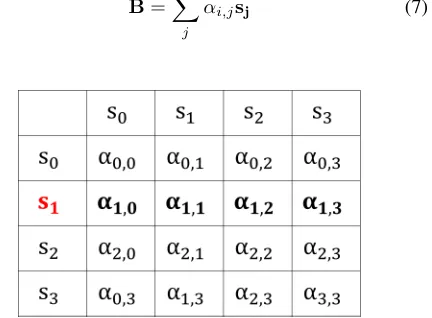
a high weight in the bag. Higher similarity is, higher weight is in the bag. As shown in Figure 5, the bag has 4 sentences, ands1is the best performance ofrby MIL. The weight of
s2 about r can be computed byα1,2. In other words,α1,2
can select the weight ofs2about the relation ofr. Hence,
the weights of sentences aboutris calculated as:
αi,j=
ei,j X
k
ei,k
(5)
whereαi,jis the weight of each sentence andei,jis the
sim-ilarity of sentence about ther.ei,jis calculated as:
ei,j =
si·sj ||si|| × ||sj||
(6)
wheresiis the best sentence ofr, andsjis sentence in the
bag. The set vector B is calculated as a weighted sum of these sentence vectors:
B=X
j
αi,jsj (7)
Figure 5: Non-IID Relevance Embedding. The part of bold font is the weights of sentences in a bag.
Classifying
In this section, we use softmax to get the conditional proba-bility, as:
p(r|B, θ) = Xexp(or)
k=1
exp(ok)
(8)
whereris the representation of relationr, andois the final output, which is defined as:
o=MB+D (9)
where M is the matrix of relations and D is a bias vector. We define the objection function using cross-entropy(Shore and Johnson 1980) as:
J(θ) = n X
i=1
log (p(ri|Bi, θ)) (10)
wherenis the number of sentences andθindicates all pa-rameters of our model. In this paper, we combine dropout to prevent overfitting.
Experiments
Dataset and Evaluation Metrics
We evaluate our model on the New York Times (NYT)1 corpus which is developed by (Riedel, Yao, and McCallum 2010) and has also been used by (Hoffmann et al. 2011; Surdeanu et al. 2012; Lin et al. 2016). This dataset was gen-erated by aligning Freebase relations. The sentences from 2005 to 2006 are used for training, and the sentences from 2007 are used for testing.
Following the previous work (Lin et al. 2016; Ji et al. 2017), we evaluate our method in the held-out evaluation. It evaluates our model by comparing the relation facts dis-covered from the test articles with those in Freebase. In the experiments, we assume that the NYT has the similar data structure every year. So, the held-out evaluation provides an approximate measure of precision without consuming hu-man evaluation. We report both the precision/recall curves and Precision@N (P@N) in our experiments.
Experimental Settings
Word Embedding: In this paper, we employ the Skip-gram model2 (Mikolov et al. 2013) to train the word
em-beddings on the NYT corpus. The vector representations of words which learned by word2vec models have been shown to carry semantic meanings and are useful in NLP tasks.
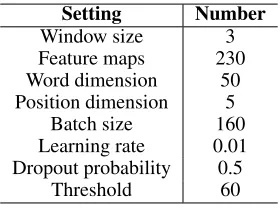
Parameters Setting: In this section, we study the influ-ence of one parameter on our model: the threshold valueDis defined in Equation (3). We tune our models using three-fold validation on the training set. We use a grid search to deter-mine the optional parameter:D ∈ {30,40,50,60,70,80}. For other parameters, we follow the settings used in (Lin et al. 2016). For training, we set the iteration number over all the training data as 14. Table 1 shows all parameters used in the experiments.
Setting Number
Window size 3 Feature maps 230 Word dimension 50 Position dimension 5
Batch size 160 Learning rate 0.01 Dropout probability 0.5
Threshold 60
Table 1: Parameters Setting
Effect of Linear Attenuation Simulation and
Non-IID Relevance Embedding
To prove the influence about linear attenuation simulation and non-IID relevance embedding, we compared with differ-ent methods by held-out evaluation. We selectPCNNs+ATT
as our baseline. PCNNs represents CNN with piecewise max-pooling, and ATT represents sentence-level attention.
PCNNs+ATThas better performance than other methods in
1
http://iesl.cs.umass.edu/riedel/ecml.
2
http://code.google.com/p/word2vec/
distant supervision. In order to demonstrate the validity of our method, we carried out some experiments. PCNNs+W
represents linear attenuation simulation with PCNNs. PC-NNs+N represents non-IID relevance embedding with PC-NNs.PCNNs+WN represents linear attenuation simulation and non-IID relevance embedding with PCNNs. To deter-mine the threshold value,D, we select the different values in the experiments,D∈ {30,40,50,60,70,80}. Experimental results are in Figure 6(b).
(a) Comparison of baseline and our approach.
(b) Comparison of different values (D).
Figure 6: Effect of Linear Attenuation Simulation and Non-IID Relevance Embedding.
Figure 6 shows that when linear attenuation simulation and non-IID relevance embedding is used in PCNNs, our method has achieved good results in relation extraction. Figure 6(a) shows that when linear attenuation simulation or non-IID relevance embedding is used alone inPCNNs, they all perform better thanPCNNs+ATT. AndPCNNs+WN
rel-P@N(%)
PCNNs+MIL
PCNNs+ATT
PCNNs+W
PCNNs+N
PCNNs+WN
P@100
72.3
76.2
83.0
81.0
83.0
P@200
69.7
73.1
77.0
79.5
82.0
P@300
64.1
67.4
72.0
76.7
80.3
Average
68.7
72.2
77.0
79.1
81.8
Table 2: P@N for relation extraction
evance of sentences, and enhance the correct labels. Figure 6(b) shows that whenDis 60, our method can get the best performance. Hence, linear attenuation simulation and non-IID relevance embedding are important factors in distant su-pervision.
Comparison with Traditional Approaches
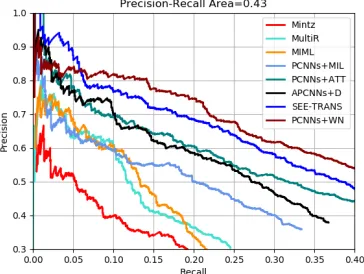
Held-out Evaluation: To evaluate the proposed method, we select the following seven traditional methods for com-parison.
• Mintz(Mintz et al. 2009) proposed a traditional distant supervision model.
• MultiR(Hoffmann et al. 2011) proposed a probabilistic graphical model with multi-instance learning.
• MIML(Surdeanu et al. 2012) proposed a multi-instance and multi-label model.
• PCNNs+MIL(Zeng et al. 2015) proposed piecewise con-volutional neural networks (PCNNs) with multi-instance learning.
• PCNNs+ATT(Lin et al. 2016) proposed a selective at-tention over instances with PCNNs and CNNs.
• APCNNs+D(Ji et al. 2017) proposed background infor-mation of entities by an attention layer to help relation classification.
• SEE-TRANS(He et al. 2018) proposed syntax-aware en-tity embedding with PCNNs+ATT.
• PCNNs+WNis our method with PCNNs.
Figure 7: Performance comparison among different methods
Figure 7 shows that the precision-recall curves for each method. We can observe that: (1) PCNNs+WN achieves
higher precision. PCNNs+WN enhance the mean average precision to approximately43%. When the recall is greater than 0.07, performance of our method drops out quickly. The results demonstrate that our method is an effective way to distant supervised relation extraction and PCNNs+WN
can alleviate the error propagation. (2) The precision of our method has declined when recall is less than 0.07. Because linear attenuation simulation reduces some words in long sentences. Maybe these words have effects on certain per-formance of relations. But in the experiments, our method has better performance than other methods and improves the overall effect of relation extraction. These results demon-strate that our method possesses important effects for distant supervision.
P@N Evaluation: In this section, we report the P@100, P@200, P@300 and the average of them forPCNNs+MIL,
PCNNs+ATT,PCNNs+W,PCNNs+W, andPCNNs+WN. Table 2 shows that: (1)PCNNs+WNachieves the best per-formance in all test settings.PCNNs+WN outperforms PC-NNs+ATTover9.6%in the average. It demonstrates the va-lidity of linear attenuation simulation and non-IID relevance embedding for distant supervision. (2) For bothPCNNs+W
andPCNNs+N, the results of these methods are better than
PCNNs+ATT. Because linear attenuation simulation can al-leviate words of low weight and non-IID relevance embed-ding can capture valid information of each sentence about relation in a bag.
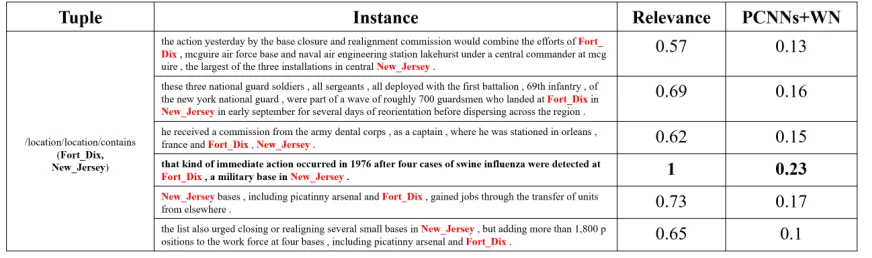
Case Study
Figure 8 shows an example ofPCNNs+WNfrom the testing data. The entity-relation tuple is (Fort-Dix,New-Jersey, con-tains). There are 6 sentences containing the entity pair. The 4-th sentence, being the part of bold font, is the best sentence to express “contains”. Our model not only can capture rela-tion of sentences, but also can analyze correlarela-tions between 4-th sentence and each sentence in this bag. Relevance rep-resents the correlation between 4-th sentence and each sen-tence in a bag. Hence, our model assigns high weights to valid sentences for our task. We argue that linear attenua-tion simulaattenua-tion and non-IID relevance embedding can en-hance the performance in distant supervision. We can clearly distinguish valid sentences and invalid sentences. Therefore, linear attenuation simulation and non-IID relevance embed-ding can provide more information of sentences and allevi-ate wrong labels.
Related Work
extrac-Figure 8: Some examples of PCNNs+WN in the NYT
tion, such as bootstrapping, unsupervised relation discov-ery and supervised classification. Supervised methods are the classical approaches to deal with the relation extraction and perform good expression (Bunescu and Mooney 2005; Zhang and Zhou 2006; Zelenko, Aone, and Richardella 2003). However, these approaches heavily depend on high quality training data.
Recently, deep learning has been widely used to automati-cally extract relation. It is the most representative progress in deep neural networks to cope with relation extraction, such as convolutional neural network (CNN) (Zeng et al. 2014; Santos, Xiang, and Zhou 2015), recurrent neural networks (RNN) (Cho et al. 2014; Liu et al. 2015), long short-term memory network (LSTM) (Miwa and Bansal 2016; Yan et al. 2015; Sundermeyer, Schluter, and Ney 2012) and attention-based bidirectional LSTM (Zhou et al. 2016). In general, relation extraction need mass high quality train-ing data, which could spend much time and energy. To fig-ure out this issue, (Mintz et al. 2009) used distant super-vision to automatically produce training data via aligning KBs and texts. They assume that if two entities have a re-lation in KBs, all sentences which contain these two enti-ties will express the same relation. Distant supervision is an effective method to automatically label datasets, but it often suffers from incorrect information. To alleviate this issue, some researchers regarded relation classification as a multi-instance multi-label learning problem (Riedel, Yao, and McCallum 2010; Hoffmann et al. 2011; Sundermeyer, Schluter, and Ney 2012). The term ‘multi-instance learn-ing’ was proposed to predict the drug activity (Dietterich, Lathrop, and Lozano-P´erez 1997). In multi-instance learn-ing, the uncertainty sentences can be regarded as the label of bag. Thus, the focus of multi-instance learning is to dis-criminate the label of bag. However, multi-instance learn-ing is difficult to apply in neural network models. (Zeng et al. 2015) proposed at-least-one multi-instance learning and piecewise convolutional neural networks(PCNNs+MIL) to extract the relations in distant supervision. ButPCNNs+MIL
ignores a lot of useful information. To capture the informa-tive sentences and reduce the influence of wrong labelled sentences, a sentence-level attention mechanism over multi-ple instances was proposed (Lin et al. 2016; Ji et al. 2017; Liu et al. 2017). To exploit impact between syntax
infor-mation and relation extraction, (He et al. 2018) proposed to learn syntax-aware entity embedding for relation extraction. Learning from non-IID data is a recent topic (Cao 2014; Shi et al. 2017; Pang et al. 2017) to address the intrinsic data complexities, with preliminary work reported such as for clustering (Wang et al. 2011). However, the non-IID in distant supervision is seldom exploited.
Traditional methods assume that each word of the sen-tence is regarded as the same weight and each sensen-tence are independent in a bag. Actually, each word could not have the same weight in the sentence and each sentence are not independent in a bag. To address these issues, we propose a novel model which can capture informative words and sen-tences.
Conclusion
In this paper, we exploit linear attenuation simulation and non-IID relevance embedding with piecewise convolutional neural networks (PCNNs) for distant supervised relation ex-traction. We apply the linear attenuation simulation to cap-ture the words of high weights in the sentence, and then we use the non-IID relevance embedding to extract connections about surrounding sentences in the bag. We conduct exper-iments on a widely used benchmark dataset. The experi-ments show that proposed method has better performance than comparable methods. These results demonstrate that our approach can effectively deal with the task of relation extraction.
In the future, we will explore the following directions:
• Our method not only can be used in distant supervised relation extraction, but also can be used in other fields, such as event detection and question answering.
• Reinforcement learning (RL) is one of the effective meth-ods for NLP task. In the future, we can combine our method with reinforcement learning for distant supervi-sion.
Acknowledgments
our work. This work is supported by National Key R&D Plan(No.2017YFB0803302), National Natural Sci-ence Foundation of China (No.61751201) and Research Foundation of Beijing Municipal Science & Technology Commission (Grant No. Z181100008918002).
References
Bunescu, R. C., and Mooney, R. J. 2005. Subsequence ker-nels for relation extraction. InProceedings of NIPS, 171– 178.
Cao, L. 2014. Non-iidness learning in behavioral and social data.The Computer Journal57(9):1358–1370.
Cho, K.; Van Merrienboer, B.; Gulcehre, C.; Bahdanau, D.; Bougares, F.; Schwenk, H.; and Bengio, Y. 2014. Learning phrase representations using rnn encoder-decoder for statis-tical machine translation.Computer Science.
Dietterich, T. G.; Lathrop, R. H.; and Lozano-P´erez, T. 1997. Solving the multiple instance problem with axis-parallel rectangles. Artif. Intell.89(1-2):31–71.
He, Z.; Chen, W.; Li, Z.; Zhang, M.; Zhang, W.; and Zhang, M. 2018. SEE: syntax-aware entity embedding for neural relation extraction. InProceedings of AAAI.
Hoffmann, R.; Zhang, C.; Ling, X.; Zettlemoyer, L.; and Weld, D. S. 2011. Knowledge-based weak supervision for information extraction of overlapping relations. In Proceed-ings of ACL, 541–550.
Huynh, D.; Tran, D.; Ma, W.; and Sharma, D. 2011. A new term ranking method based on relation extraction and graph model for text classification. InProceedings of ACSC, 145– 152.
Ji, G.; Liu, K.; He, S.; and Zhao, J. 2017. Distant supervi-sion for relation extraction with sentence-level attention and entity descriptions. InProceedings of AAAI, 3060–3066.
Lin, Y.; Shen, S.; Liu, Z.; Luan, H.; and Sun, M. 2016. Neu-ral relation extraction with selective attention over instances. InProceedings of ACL, 2124–2133.
Liu, Y.; Wei, F.; Li, S.; Ji, H.; Zhou, M.; and Wang, H. 2015. A dependency-based neural network for relation classifica-tion. InProceedings of ACL, 285–290.
Liu, T.; Wang, K.; Chang, B.; and Sui, Z. 2017. A soft-label method for noise-tolerant distantly supervised relation extraction. InProceedings of EMNLP, 1790–1795.
Mcdonald, R. T., and Nivre, J. 2007. Characterizing the errors of data-driven dependency parsing models. In Pro-ceedings of EMNLP-CoNLL, 122–131.
Mikolov, T.; Chen, K.; Corrado, G.; and Dean, J. 2013. Ef-ficient estimation of word representations in vector space.
CoRRabs/1301.3781.
Mintz; Mike; Steven; Jurafsky; and Dan. 2009. Distant supervision for relation extraction without labeled data. In
Proceedings of ACL-IJCNLP, 1003–1011.
Miwa, M., and Bansal, M. 2016. End-to-end relation ex-traction using lstms on sequences and tree structures. In
Proceedings of ACL, 1105–1116.
Pang, G.; Cao, L.; Chen, L.; and Liu, H. 2017. Learning homophily couplings from non-iid data for joint feature se-lection and noise-resilient outlier detection. InProceedings of IJCAI, 2585–2591.
Riedel, S.; Yao, L.; and McCallum, A. 2010. Modeling rela-tions and their menrela-tions without labeled text. InProceedings of ECML/PKDD, 148–163.
Sadeghi, F.; Divvala, S. K.; and Farhadi, A. 2015. Viske: Vi-sual knowledge extraction and question answering by viVi-sual verification of relation phrases. In Proceedings of CVPR, 1456–1464.
Santos, C. N. D.; Xiang, B.; and Zhou, B. 2015. Classify-ing relations by rankClassify-ing with convolutional neural networks.
Computer Science86(86):132–137.
Shi, Y.; Li, W.; Gao, Y.; Cao, L.; and Shen, D. 2017. Beyond IID: learning to combine non-iid metrics for vision tasks. In
Proceedings of AAAI, 1524–1531.
Shore, J. E., and Johnson, R. W. 1980. Axiomatic derivation of the principle of maximum entropy and the principle of minimum cross-entropy. Information Theory IEEE Trans-actions on26(1):26–37.
Sundermeyer, M.; Schluter, R.; and Ney, H. 2012. Lstm neural networks for language modeling. InProceedings of INTERSPEECH, 601–608.
Surdeanu, M.; Tibshirani, J.; Nallapati, R.; and Manning, C. D. 2012. Multi-instance multi-label learning for relation extraction. InProceedings of EMNLP-CoNLL, 455–465. Wang, C.; Cao, L.; Wang, M.; Li, J.; Wei, W.; and Ou, Y. 2011. Coupled nominal similarity in unsupervised learning. InProceedings of CIKM, 973–978.
Yan, Y.; Okazaki, N.; Matsuo, Y.; Yang, Z.; and Ishizuka, M. 2009. Unsupervised relation extraction by mining wikipedia texts using information from the web. In Proceedings of ACL/IJCNLP, 1021–1029.
Yan, X.; Mou, L.; Li, G.; Chen, Y.; Peng, H.; and Jin, Z. 2015. Classifying relations via long short term memory net-works along shortest dependency path. Computer Science
42(1):56–61.
Zelenko, D.; Aone, C.; and Richardella, A. 2003. Kernel methods for relation extraction. Journal of Machine Learn-ing Research3(3):1083–1106.
Zeng, D.; Liu, K.; Lai, S.; Zhou, G.; and Zhao, J. 2014. Re-lation classification via convolutional deep neural network. InProceedings of COLING, 2335–2344.
Zeng, D.; Liu, K.; Chen, Y.; and Zhao, J. 2015. Distant su-pervision for relation extraction via piecewise convolutional neural networks. InProceedings of EMNLP, 1753–1762. Zhang, M. L., and Zhou, Z. H. 2006. Adapting rbf neu-ral networks to multi-instance learning.Neural Proceedings Letters23(1):1–26.