Volume 2 Number 4 2011 pp. 135-158
ISSN: 1309-2448 www.berjournal.com
Mediating Role of Affective Commitment in HRM Practices and
Turnover Intention Relationship: A Study in a Developing Context
Mohd H. R. Joarder
aMohmad Yazam Sharif
bKawsar Ahmmed
ca
Abstract: The present study was designed to examine the dimensions of HRM practices that may cause faculty turnover decision among the private university faculty members in Bangladesh. The role of affective commitment as the mediator in the proposed relationship was also investigated. A total of 317 faculty members of the private universities participated, completed and returned the questionnaire which represented 57% response rate of the study. Multiple regression analyses were used to test the hypotheses of the study. The results of the study revealed that out of six HRM practices used in this study three were found highly significant and negatively related to turnover intention. The study also found that affective commitment mediates the proposed relationship between HRM practices and turnover intention. Limitations and suggestions for future research are forwarded.
Keywords: HRM practices, Affective commitment, Turnover intention, Private Universities in Bangladesh.
JEL Classification:M12, M54, C12
1. Introduction & Background of the Study
What determines employee turnover and how can it be managed? Or, what can be done to reduce employee turnover? Answers to these queries certainly have great relevance to the individual who may be thinking to quit his or her current organization, and for managers experiencing high turnover within the organization. Employee turnover is considered a serious issue for many organizations, thus scholars view this phenomenon as a persistent problem for the organization (Ahmad & Omar, 2010). The detrimental effects of high turnover, especially when the high performing employees leave, on the organization are the major concern for the organizational managers. Excessive turnover is dangerous for the organizations, and it undermines the efficiency and productivity of the organization. Moreover, in some occasions, it threats the organization’s long term survival (Brereton, Beach, & Cliff, 2003). Therefore, retention of top performing employees has become a big challenge for the employers (Samuel & Chipunza, 2009; Ovadje, 2009) because employers have nothing much to do except the arrangement for hiring and training new employees once the employee has quitted as argued by Dalessio, Silverman, and Schuck (1986).
Mitchell, Lee, & Eberly, 2008). This is because employees have different reasons for turnover decision in different countries, and even reasons are quite different within the same industry. It is unfortunate that most of the empirical studies on turnover were conducted in western context mainly in US, Canada, UK, and Australia (Ovadje, 2009; Maertz, Stevens, & Campion, 2003). The results of these studies may not be generalized to other contexts for instance Asian context which is characterized by collectivism and high power distance. Scholars still continue searching the answer of what determine employee turnover in different contexts as context is important to understand the turnover phenomenon (Chen & Francesco, 2000). Therefore, it is expected that a study of turnover in a collectivist context should provide additional insights into the turnover phenomenon. Thus, this paper is expected to enrich the current turnover literature in the context of Bangladesh in particular and Asian in general.
Bangladesh came into being in 1971 when two parts of Pakistan split after a nine-month long liberation war. Presently, with little over 150 million people in a small land having national literacy rate of 47.9%, Bangladesh is the eighth largest in the world in population with high density (World Fact Book, 2008). According to United Nations report (2002), Bangladesh is one of the 49 ‘least developed countries’ in the world where 45 percent of the population are under the poverty line. With such a large population where poverty is rampant and the lack of educational resources, the nation has considered education sector as the top most priority, thus, the sector has been receiving the highest national budget for last several years (Bangladesh Economic Review, 2007). In fact, the higher learning institutions are expected to produce the most potential and skilled human resources for the nation. In addition, the country is trying to diversify its economy with industrial development which requires highly skilled workforce. Thus, the establishment of the private higher education institutions was inevitable. The private university act 1992 was enacted permitting the operations of the private university in the country. This initiative has resulted 54 private universities where more than 6000 full-time faculty members are engaged in teaching till to date (Ali & Akhter, 2009).
Faculty turnover is an enduring problem at many private universities in Bangladesh (Akhter, Muniruddin, & Sogra, 2008). Similarly, the recent finding is that frequent switching of faculty members from one university to another or sometimes to the outside of academia is a major problem for private university management. In addition, shortage of qualified faculty, and the high demand made this situation serious for private university management (Ashraf, 2009). Frequent faculty switching is now a common scenario for private universities. The article published in the national newspaper on the faculty turnover issue clearly considered this phenomenon as ‘critical situation’ especially for private universities. The author argued that most of the private universities are experiencing 16% to 17% turnover rate per year, and this is even higher for some universities; while it is only 2% to 3% per year for public universities (Jalil, 2009).
added that, in many private universities there is no prescribed and defined human resource practices. However, the findings need to be empirically examined to identify the factors contributing to faculty turnover decision in the context of Bangladesh in particular.
To the best of the researchers’ knowledge, there is limited research that attempted to examine the relationship among the HRM practices, affective commitment and turnover intentions particularly at private higher education sector in the context of developing countries such as Bangladesh. The present paper, therefore, outlines research that aims to achieve three important research objectives. The first objective is to investigate the turnover phenomenon in the private higher education sector in Bangladesh. Second objective is to examine the impact of HRM practices of the private universities on faculty turnover intentions. Third objective is to examine the mediating effect of affective commitment on the relationship of HRM practices and turnover intentions. These important research objectives have not been addressed before in the context of Bangladesh as the majority of HRM studies have been conducted in developed countries. Hence, the present study is expected to contribute to the literature in general, and especially in Bangladesh context. This paper is structured as follows: First, we briefly review the literature relating to the concept of employee turnover and turnover intention; Second, we empirically examine the relationship among the HRM practices, affective commitment, and turnover intention in the context of non-western sample; Third, we also investigate the mediating effects of AC on the relationship of HRM practices and turnover intentions. Finally, we discuss the results of the study and highlight the managerial implications, limitations and future research directions.
2. Literature Review
2.1. The Concept of Employee Turnover
Employee turnover, although it is mainly a concern to the professionals of human resource department (Peterson, 2004), academics and organizational managers have paid much attention to this current phenomenon (Ton & Huckman, 2008) due to its detrimental effects on the organizations. Practically, among all the organizational resources, people are the most important resources, while on the other hand, they are most difficult to control as well (Szamosi, 2006; Perez & Ordonez de Pablos, 2003). According to Mobley (1982), employee turnover is the cessation or termination of membership with the organization by an individual employee. In other words, turnover is a permanent leaving of an employee from the organization. Scholars commonly view turnover and its proxy, turnover intentions as the form of withdrawal (Price, 2001). However, there is a distinction between turnover and turnover intention which needs to be discussed first. It can clearly be argued that the term ‘turnover’ represents the actual turnover behavior, the movement of the employees’ to other organizations (Price, 2001), while the terms ‘turnover intention’ represent the employees’ behavioral intention which is employees’ perceived probability of leaving the current organization (Cotton & Tuttle, 1986).
(Abbasi & Hollman, 2008). As people are the most valuable asset for the organizations (Szamosi, 2006), the organizations invest great deal of resources to attract and retain talented employees. Thus it is undoubtedly unfortunate and costly when employees leave organization willingly or voluntarily. That is why academics and organizational managers paid much attention to employee turnover issue, particularly the voluntary nature of turnover (Ton & Huckman, 2008).
Turnover is an actual employee’s behavior of leaving the organization. Practically, the study of actual turnover behavior is difficult because employees who left are hardly traceable and usually the response rate to survey is quite low (Johnsrud & Rosser, 2002). In studies, turnover intention was found highly correlated with actual turnover behavior in 13 empirical studies out of 14 studies (Bluedorn, 1982). Consistent with this view, Fang (2001) argued that turnover intention can safely be used as a substitute for turnover behavior (Fang, 2001). Turnover intention is considered important in the turnover literature. In many studies, turnover intention has been viewed as the best predictor of actual turnover (Herrbach, Mignonac, & Gatignon, 2004; Allen, Shore, & Griffeth, 2003; Griffeth et al. 2000; Tett & Meyer, 1993).
2.2. HRM Practices
Like many other managerial topics, there is a lack in research pertaining to turnover and HRM in developing countries despite calls to expand the international HR perspective (Baruch & Budhwar 2006). This lack of knowledge limits contexts relating to HRM theory (Wright, Scott, Snell & Dyer, 2005). Consequently, HR practitioners face, in developing countries, an absence of focused strategies for combating high turnover rates and improving organizational performance (Khiiji & Wang 2006).
The importance of managing human resources, the essence of the organization, has been growing over the past years in academia and in practice because the HRM practices help employees to form their attitudes and behaviors (Meyer & Smith, 2000). Earlier, one of the studies found that perceptions of human resource practices are more important than the actual practices in developing employee commitment (Kiniki, Carson, Bohlander, 1992). Management scholars and practitioners have exerted continuous efforts in learning more about human resource practices and how these practices enhance employees’ performance and achieve organizational goals (Ahmad & Schroeder, 2003; Boselie et al. 2001; Guest, 1997; Huselid, 1995). The influence of human resource practices on performance at organizational level, individual level, or group level is an important issue in the area of human resource management and organizational psychology. In this regard, positive perceptions of human resource practices cause employees to believe in social exchange relationship between employees and the organization (Wayne et al. 1997; Lee & Bruvold, 2003). Generally, employees who are satisfied with the organization are willing to contribute to the organization (Eisenberger et al. 2002).
the practices (Deery, 2002; Harley, 2002; Grant & Shields, 2002). Furthermore, little explanation has been given in relation to how these human resource practices influence individual turnover decision (Allen et al. 2003). The plethora of literature of human resource practices have been reported exclusively undertaken in the context of western countries including few other developed nations (Nasurdin, Hemdi, & Guat, 2008; Su & Yeganeh, 2008). There is a lack of information regarding dynamic nature of human resources in the context of developing countries. Moreover, it is difficult to generalize the human resources practices of the western context, and adopt the western concept of human resources practices to the developing countries.
Therefore, more research is needed in the developing context to understand the dynamic nature of human resources and the influence of various human resources practices on the employees of developing countries. According to Budhwar and Debrah (2004), there is a greater need to know how employees in various parts of the world perceive human resource practices in different context. Thus, the current study is also expected to fill the gap in our knowledge on human resource practices in the context of developing countries such as Bangladesh. For the present study, the following human resource practices are considered as the influencing dimensions of HRM practices on turnover decision in the case of private universities in Bangladesh.
2.2.1. Job Security
According to Herzberg (1968), job security is the extent to which organization provides stable employment for its employees. Job security has been conceptualized as the degree to which an employee could expect to stay in the job for over an extended period of time (Delery & Doty, 1996). Researcher identified job security as one of the most important components of human resource practices (Pfeffer, 1995) which indicate organization’s commitment to their workforce, while there are evidences that job security enhances employees’ organizational commitment (Chang & Chen, 2002; Meyer & Smith, 2000; Wong, Ngo, & Wong, 2002). The organization’s commitment to the employees (through secured job) motivates employees to exchange their obligation by showing reciprocal commitment to the organization. Similarly, Chang (2005) argued that through job security the organization demonstrates commitment to the employees, and in return employees reciprocate the commitment to the organization. This supports the concept of social exchange theory (Blau, 1964), and the theory of norm of reciprocity (Gouldner, 1960).
According to Samuel and Chipunza (2009), job security was found to be significantly influencing factor in employee retention in both public and private organizations. They stated that there is strong evidence of an association between job security and retention, thus it reduces employee turnover. There are some empirical evidences that show a significant negative relationship between turnover intention and job security (Cotton & Tuttle, 1986; Shaw et al. 1998; Batt & Valcour, 2003).
2.2.2. Compensation
telecommunication industry, Batt, Colvin, and Keefe (2002) found that pay is significantly and negatively related to turnover. However, different views have been reported by other researchers such as Griffeth et al. (2000) claimed modest relationship between pay and actual turnover; while pay is not an important variable for turnover research in Asian context (Khatri et al. 2001); and Iverson and Deery (1997) concluded that pay has insignificant influence on turnover decision in Australian context. Moreover in the academic setting, Smart (1990) and Ehrenberg et al. (1991) found that compensation is only important at lower level of faculty members such as assistant professor levels. However, other study of Weiler (1985) presented contradictory results where the researcher argued that pay has been identified as important reason for both associate professor and professor in regards to turnover decision. In the field of information technology, employees’ compensation is positively related to their commitment to organization, and negatively related to their turnover intentions (Igbaria & Greenhaus, 1992). However, some researchers found compensation as not important factor for their employees’ turnover decision process. The recent finding of Kim (2005) argued that compensation is not statistically significant reason for employees leaving the US state government information technology department. The recent study finding indicated that compensation alone will not be sufficient to retain talents (Chew & Chan, 2008). Thus, the inconsistent relationship between compensation and turnover requires further research to understand the relationship. That is why this variable has been included in the present study.
2.2.3. Job Autonomy
Price (1997) defined job autonomy as the employee’s ability to set organizational goals and structure of the organization to maximize professional concerns. In other words, job autonomy is considered as the freedom of an employee of doing his or her own work or the control over his or her job activities such as scheduling, work procedures, and task variety (Iverson, 1996). In fact, when employees perceive that they have control over their jobs, they are less likely to leave (Iverson, 1999).
Recent research suggests that employees who enjoy greater job autonomy at work will show less likelihood of quitting the current employment (Batt & Valcour, 2003). The belief is that job autonomy decreases turnover by its positive impact on job satisfaction (Price, 2001). Consistent with this idea, Ahuja, Chudoba, Kacmar, McKnight and George (2007) argued that lack of job autonomy lowers the organizational commitment and increases turnover. This is a salient feature for faculty members. Researchers explained that faculty members with high job autonomy are much more satisfied in terms of teaching and research, have less or no job stress, and are likely to stay with the job (Perry, Menec, Struthers, Hechter, Schonwetter, & Menges, 1997). Job autonomy is an important component of human resource practices especially in the western context due to individualistic pattern of the society (Geller, 1982). In fact, by having job autonomy, employees perceive it as the organizational support to the employees which in turn may increases job satisfaction and reduces turnover intention (Spector, 1986). Generally, one can argue that employees will be much more satisfied and committed to their organization when employees enjoy job autonomy as compared to the employees with no such freedom.
2.2.4. Working Conditions
environment. According to Kramer and Schmalenberg (2008), healthy working conditions are empirically linked to reduced employee turnover, increased job satisfaction and lower degree of job stress and burnout among employees. Therefore, creating better conditions are crucial to maintain an adequate workforce for any organization. To reinforce the importance of working conditions, Pejtersen and Kristensen (2009) argued that positive working conditions will not only reduce employee strain but also contribute to a more motivated workforce and in the long-run greater organizational effectiveness, and lower employee turnover. In this regard, researcher explained that working conditions may not increase employee commitment; however dissatisfaction with this factor may create negative effect on employee commitment which in turn may affect turnover decision (Herzberg, 1968).
In the context of Bangladesh, the study of Ashraf and Joarder (2010) on employees of mobile phone companies found working conditions or atmosphere as the second most important factor for employee work satisfaction which in turn may influence employees’ decision to stay longer with the organization or to leave. Another study of Billah (2009) on commercial banks’ employees found that working conditions are highly significant factor and they are negatively related to turnover intention. However, the opposite result was also found in the study of Joarder, Sharif, and Sabiha (2011) where researchers argued that working conditions were not important factor for faculty members and this factor may not influence their turnover decision. Therefore, it is clear that the relationship between working conditions and turnover intention is not well-established. Thus, due to inconsistent findings on the relationship between working conditions and turnover intention may require further investigation about this variable. This in fact encourages researcher to include the variable in the current study.
2.2.5. Training and development
Training and development has been recognized as one of the important components of human resource practices in the field of human resource management. Training and development is a human resource practice that can provide competitive advantage to organizations, if properly organized and implemented (Schuler & MacMillan, 1984). This component has been included in the high performance HRM practices of the organizations (Huselid, 1995; MacDuffie, 1995). Generally, it is believed that organizations with better training and development programs may experience lower employee turnover. Employee training is an indication of management commitment to building a life-long relationship with the employees, thus increases retention and reduces turnover decision (Samuel & Chipunza, 2009). In fact, training is one of the important ways to assist individual employee to gain new knowledge and skills required to maintain the standard performance in the competitive changing environment. As a matter of fact, success depends on to what extent the employees receive training for their professional development. Invariably, organization may adopt various human resource practices to enhance employees’ skills, but certainly training is unique to improve the quality of current employees which may produce high commitment and lower intention to quit the organization. In reality, training and development increases and enriches one’s capability, and it guides and supports employees to achieve long-term career development and competency at work (Pare & Trembley, 2007; Liu, 2004).
provided, the more satisfied employees were; and more likely to stay longer with the organization (Chang, 1999). In consistent with this view, Martin (2003) argued that the organization that provides training to enhance existing employees’ skills and competency face lower turnover than the organization with no such activities for employee development.
However, there are some researchers who claimed that training and development may actually increase employee turnover by making employees more attractive to other organizations (Haines, et al., 2010). Consistent with this view, thorough investigation on three different organizations (i.e. telecommunication, manufacturing plants, trucking organizations) researchers found no significant relationship between employee training and turnover, and revealed no evidence of turnover reducing effect (Batt, et al. 2002; Lincoln & Kalleberg, 1996; Shaw et al. 1998). The other study on the US small business sector, the researcher found no significant association between training and turnover (Way, 2002). In a more recent research, Fairris (2004) noticed a small negative relationship between training and turnover. There is still lack of clear evidence regarding the nature of association between training and turnover. Thus, due to the inconsistent results and lack of clear evidences of the relationship pattern, more research is necessary to better understand the relationship between training and turnover. This in fact inspired the researcher to include this variable in the present study.
2.2.6. Supervisory Support
Supervisory support refers to positive evaluation and instruction of one’s performance, job direction, career mentoring, and the expansion of one’s career network (Tan, 2008), and the provision of such support is essential for developing, motivating and retaining knowledge workers (Bigliardi, Petroni, & Dormio, 2005). According to Eisenberger et al. (2002), supervisory support is the employees’ global perceptions concerning the extent to which supervisor values their contributions and cares about their (employees) well-being. Specifically, supervisory support refers the interpersonal relationship between supervisor and subordinate in the workplace, and the nature of relationship may influence employees’ job satisfaction, and their turnover decision in the long-run (Zhao & Zhou, 2008; Aquino, Griffeth, Allen, & Hom, 1997). Organizational support theory explained that supportive treatment from supervisors results increased POS, which makes employees obligated to repay the organization by achieving its goals and feel more committed, which in turn reduce their intention to leave (Rhoades et al. 2001). Similarly, according to Price and Mueller (1986) supervisory support is expected to reduce employees’ turnover decision.
also increases job satisfaction and organizational commitment, and reduce turnover. In line with this thought, according to Batt and Valcour (2003) supportive supervisor was associated with lower turnover intentions. Even though there are some evidence that supervisory support was negatively related to turnover intention, Billah (2009), Abeysekera (2007), Hatton and Emerson (1998) did not find any significant relationships between supervisory support and turnover, which suggests more in-depth analysis of this relationship (Cho, Johanson, & Guchait, 2009).
2.3. Affective Commitment
Organizational commitment represents a psychological attachment of an employee to the employing organization, and according to Allen and Meyer (1990), it may take different forms. Thus, it is a multidimensional construct (Meyer & Allen, 1997) comprised of three components: affective commitment refers to employees’ emotional attachment, loyalty, identification and involvement with an organization, continuance commitment refers to commitment based on costs that employees associate with leaving the organization, and finally normative commitment refers to feelings of obligation to an organization. According to Allen and Meyer (1990), affective commitment is the most accepted dimension of commitment. In fact, of these three components, affective commitment has been found to be the most consistent and strongest predictor of positive organizational outcomes; and high organizational commitment is associated with decreased turnover intentions (Iverson, 1996; Wasti, 2003; Mathieu & Zajac, 1990), contributes to higher productivity and competitive advantage for an organization (Deery & Iverson, 1996). Continuance and normative commitment were not included in the study because there was less support for these commitment dimensions in the literature (Iverson & Buttigieg, 1999). The theoretical explanation of the study is that the HRM practices positively influence employees’ affective commitment, which in turn reduces their intention to leave the institution as postulated by Allen et al. (2003). The influence of HRM practices on affective commitment is more strongly and positively related to desirable work behaviors than other types of organizational commitment (Meyer & Allen, 1997).
3. Research Framework and Hypotheses Development
The research framework proposed that the employees’ perceptions about the organization’s human resource management practices will directly influence their affective commitment (AC). This proposition is in line with the previous results of turnover research of Allen et al. (2003) who opined that positive perceptions of human resource management practices will lead to increased affective commitment. They further proposed that AC will negatively influence employees’ turnover decision i.e. turnover intention (Wayne et al., 1997).
4. Hypotheses of the Study
The proposed hypotheses are as follows:
H2: HRM Practices are positively and significantly related to Affective Commitment (AC).
H3: Affective Commitment (AC) is negatively and significantly related to TI.
H4: AC mediates the relationship between HRM Practices and TI.
5. Research Methods
5.1. Sample
The population of this study covers all private universities mainly located in the Dhaka Metropolitan Area. The employment of simple random sampling may not be possible for this study due to unavailability of the complete list of the population. Therefore, in selecting the sample for the present study, the employment of an area sampling method was appropriate. In fact, area sampling is the most accepted type of cluster sampling when the design constitutes geographic clusters (Sekaran, 2003). According to the argument of Zikmund (2003), the major objective of using cluster sampling is to have economic sample and the retention of the characteristics of probability sample where the clusters are randomly selected. There are fifteen clusters for the present study as identified on the basis of postal area code of Dhaka Metropolitan Area.
5.2. Data Collection
The researcher collected data for this study by distributing questionnaires to the respondents with a cover letter explaining the purpose of the study. The survey questionnaire method was chosen because a large sample size was considered for the study. Besides, it provides a quick means of assessing information (Zikmund, 2003), and the respondents could complete the survey items at their own time without affecting their workplace productivity (Ashraf & Joarder, 2010). Furthermore, questionnaire survey is
Job Security Compensation Job Autonomy Working Condition
Training & Development Supervisory Support
Turnover Intention AC
H2(+) H3(-)
H1(-)
arguably the most common technique in management research (Veal, 2005). Then, after a week or two according to respondent’s convenient time, researcher called the respondents to make sure that they have filled in the survey document. A total of 550 survey questionnaires were distributed. Researcher received 317 useable questionnaires for final data analysis. The response rate was 57% for this study. The survey documents were distributed personally to each respondent during the period of May, 2010 to July 2010. The majority of the sample was male (57.4%), while less than half of the sample (42%) were represented by female respondents. Most of the respondents were married, while the majority of the respondents were relatively young (92.4%) and age below 40 years.
5.3. Instruments
The survey questionnaire contained the measures of human resource management practices, affective commitment, and turnover intentions. There were four sections in the questionnaire including the demographic section. Section one covers all the study variables of human resource management practices (i.e. job security, compensation, job autonomy, working conditions, training & development, and supervisory support) comprised a total of 29 items; section two covers affective commitment (AC) with 5 items and section three includes turnover intentions with 5 items; and finally section four includes demographic information of the respondents with 7 items. All the study variables items were adopted from previous researchers with little modification. The Cronbach alpha values were within .71 to .92 which was sufficient for analysis (Hair et al. 2006; Ho, 2006; Nunnally, 1978). All the items were measured on a 7-point Likert scale ranging from 1(strongly disagree) to 7 (strongly agree). Several analytical techniques such as Correlation analyses, multiple regression analyses have been used to measure the relationship between HRM practices, affective commitment and turnover intention of the faculty members of the private universities in Bangladesh.
6. Results and Discussions
6.1. Descriptive Statistics and Correlation Analyses
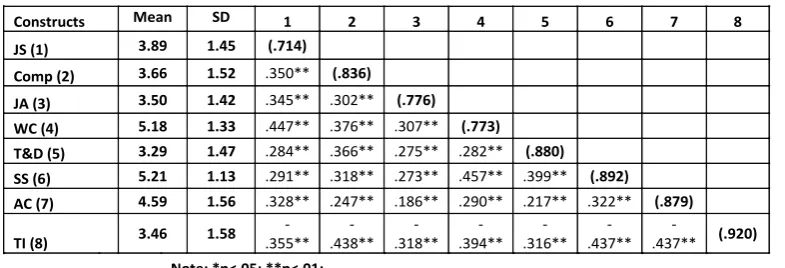
Table 1 presents the means, standard deviations and correlations among all the variables used in this study. On average, faculty members expressed their attitudes towards the disagreement in relation to the job security, compensation, training and development and job autonomy. In other words, the institutions should be more concerned about these
Table 1: Mean, Standard deviation, Correlation Coefficient, & Cronbach Alpha.
Constructs Mean SD 1 2 3 4 5 6 7 8
JS (1) 3.89 1.45 (.714) Comp (2) 3.66 1.52 .350** (.836)
JA (3) 3.50 1.42 .345** .302** (.776) WC (4) 5.18 1.33 .447** .376** .307** (.773) T&D (5) 3.29 1.47 .284** .366** .275** .282** (.880) SS (6) 5.21 1.13 .291** .318** .273** .457** .399** (.892) AC (7) 4.59 1.56 .328** .247** .186** .290** .217** .322** (.879)
TI (8) 3.46 1.58 -.355**
-.438**
-.318**
-.394**
-.316**
-.437**
-.437** (.920) Note: *p<.05; **p<.01;
variables which are currently not strongly established. Pearson correlation was conducted to examine the correlation coefficient among the study variables. All the correlations among the study variables are within satisfactory levels as suggested by Ho (2006). The general rule of thumb is that the value of correlation coefficient should not exceed .7 (Anderson et al. 2009).
6.2. Regression Results
Testing Hypothesis 1: (Relationship between HRM practices & turnover intention)
To test the hypothesis 1, HRM practices were regressed on to turnover intention. The regression results of the relationship between various dimensions of HRM practices and turnover intention is tabulated in Table 2. It shows that job security, compensation and supervisory support are highly significant and negatively related to turnover intention. However, it can be noticed that compensation (β=-.238, p<.001) was found to have strongest negative influence on turnover intention, followed by supervisory support (β=-.236, p<.001) and job security (β=-.109, p<.05). The other three HRM practices such as job autonomy, working condition, and training & development were statistically insignificant but negatively related to turnover intention. All these dimensions of HRM practices explained 33.4 percent of the total variation in turnover intention, and the regression model is significant at .000 level (F=25.91, P<.001). Thus, hypothesis 1 is partially supported.
Testing Hypothesis 2: (Relationship between HRM practices & Affective commitment)
Table 2: Regression Results for Hypothesis 1
Variables Standardized
Coefficient β Value
t-value Significant level
JS -.109 -2.000 .046
Comp -.238 -4.437 .000
JA -.099 -1.926 .055
WC -.104 -1.817 .070
TD SS
R²
-.047 -.236
.334
-.885 -4.261
.377 .000
Adj. R² .321
F-value 25.91**
N=317
Table 3: Multiple Regression Analysis Results for Hypothesis 2
Variables Standardized
Coefficient β value
t-value Significant level
JS .202** 3.323 .001
Comp .073 1.215 .225
JA .010 0.182 .856
WC .072 1.135 .257
TD .033 0.561 .575
SS
R²
.191**
.176
3.103 .002
Adj. R² .160
F-Value 11.02**
To test the hypothesis 2, HRM practices were regressed on to affective commitment. Table 3 depicts the regression results of this analysis. From Table 3, it can be seen that all the dimensions of HRM practices used in this study are positively related to affective commitment. However, only job security (β=.202, p<.01) and supervisory support (β=.191, p<.01) were found statistically significant. A closer scrutiny reveals that HRM practices are able to explain 17.6 percent of the total variation in affective commitment. The model is significant at .000 levels. Therefore, hypothesis 2 is also partially supported.
Testing Hypothesis 3: (Relation between Affective commitment & Turnover intention)
To test the relationship of affective commitment and turnover intention i.e. hypothesis 3, AC was regressed on to turnover intention. Table 4 summarizes the regression results for testing this hypothesis. It can be viewed from table 4 that AC (β=-.451, p<.001) is negatively and significantly related to turnover intention. Table 4 also explains that AC alone can explain 20.4 percent of the turnover variation. Model is highly significant at .000 levels. Thus, hypothesis 3 is fully supported.
Testing Hypothesis 4: (The mediation effect of AC on HRM practices & TI)
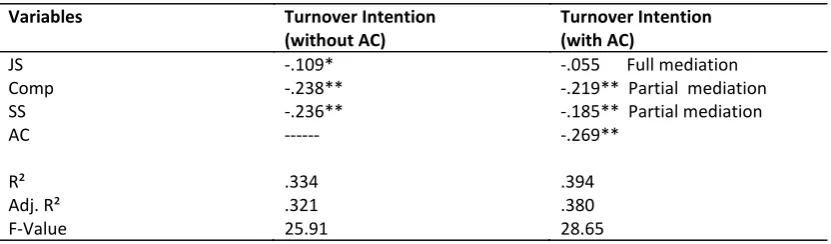
To test the mediation effect on affective commitment on HRM practices and turnover intention relationship (Hypothesis 4), a four-step procedure suggested by Baron and Kenny (1986) was undertaken. Table 5 provides the summary of regression results to ascertain the mediation effect of AC on the relationship between human resource management practices and turnover intention. From table 5, it can be observed that all three (job security, compensation, and supervisory support) HRM practices were able to meet the conditions for mediation as suggested by Baron and Kenny (1986). Interestingly, the effects of job security (β=-.055, p>.05) on turnover intention became statistically insignificant, while the effects of
Table 4: Multiple Regression Analysis Results for Hypothesis 3
Variables Standardized
Coefficient β value
t-value Significant value
AC -.451 -8.97 .000
R² .204
Adj. R² .201
F-value 80.51
N=317
Table 5: Multiple Regression Analysis Results for Hypothesis 4
Variables Turnover Intention
(without AC)
Turnover Intention (with AC)
JS -.109* -.055 Full mediation Comp -.238** -.219** Partial mediation SS -.236** -.185** Partial mediation
AC --- -.269**
R² .334 .394
Adj. R² .321 .380
F-Value 25.91 28.65
compensation (β=-.219, p<.01) and supervisory support (β=-.185, p<.01) became little weaker but remain significant in the presence of AC in the regression equation (refer to table 5). This implies that the relationship of job security and turnover intention is fully mediated by the third variable for example AC in this case, and the relationship of compensation and supervisory support and turnover intention is partially mediated by AC. Thus, the hypothesis 4 is also fully supported.
6.3. Discussion
The statistical results of this study indicated that the faculty members’ perceptions of human resource management practices particularly faculty compensation, job security and supervisory support are negatively and significantly related to turnover decision. The result also highlighted that these HRM practices are positively related to employees’ affective commitment, and this commitment is negatively and significantly related to employees’ turnover intention. As far as the direct relationship is concerned, faculty compensation is the most important reason for faculty turnover decision followed by their supervisory support and job security. However, the other dimensions of HRM practices such as working condition, job autonomy, and training & development became statistically insignificant though they were negatively related to faculty turnover intention. Thus, the result indicated the importance of compensation, supervisory support and job security for faculty members, and the private university management should pay much more attention to this area of HRM practices to retain their potential faculty.
In terms of compensation, the study result is consistent with the previous results such as Ovadje (2009), Shahzad et al. (2008), Batt and Valcour (2003). The previous studies explained that pay is highly considered among other human resource practices especially in the context of underdeveloped countries. For instance, Ovadje (2009) found pay as highly significant variable in the turnover research in the Nigerian context, while Shahzad et al. (2008) explained that faculty pay might be a great tool in retaining competent faculty in the context of Pakistan. However, the present study result is not conforming to some of the previous studies, thus contradicts with Khatri et al. (2001) where researchers stated that pay is not an important component in the turnover research in Asian context, for instance Singapore in particular. It should be noted that Singapore belongs to the group of highly developed nations. This also highlighted that the determinants of turnover may differ even in the same continental or geographical location. Again, Iverson and Deery (1997) reported an insignificant relationship between pay and turnover in Australian sample, while Griffeth et al. (2000) only found modest relationship between pay and actual turnover.
such expected result in Bangladesh context due to higher inflation rate, the living expenses are relatively higher in the developing countries.
The finding of the study indicates that faculty perception of job security is significant and it is negatively related to turnover intention. In other words, the higher the perception of employees’ job security, the lower the employees’ intention of leaving the current organization is, and vice versa. Thus, it can be argued that employees with high job security are less likely to leave the employing organization. According to Wong et al. (2002) argument the organizations that provide high assurances of job security invoke a reciprocal employee attitudinal and behavioral commitment to the organization. Therefore, it can be argued that higher the perception of job security, the higher the commitment to the organization and the lower the turnover intention are, and vice versa.
The result of the study is consistent with the previous results, such as Samuel and Chipunza (2009), Conklin and Desselle (2007), Zhou and Volkwein (2004), Batt and Valcour (2003), Shaw et al. (1998), Cotton and Tuttle (1986). In the academic setting, researchers argued that job security for faculty members is the top most priority in the decision making process of staying with or leaving the organization. It is, in fact, negatively related to turnover decision (Chughtai & Zafar, 2006; Conklin & Desselle, 2007). The plausible explanation for such consistent results in the case of present study is that higher education for instance university education in the private sector is reasonably new in the context of Bangladesh, and the private university management was not serious about the faculty job security issue. Realistically, the authority did not pay much attention to this area of faculty job security. Another reason perhaps important to explain the finding of the present study is that most of the private universities are sponsored and managed by influential businessman. They also consider the investments on higher educational institutions like any other investments in different areas. Therefore, the profit maximization motives make them somewhat indifferent about the issue for instance job security in this regard. Another possible explanation for such results as why faculty members recognized job security as the significant human resource management practices is that Bangladesh is one of the least developed countries in the world with increasing unemployment rates, where individuals with high family bondage who are a household’s primary earner are less likely to leave a stable job and face the risks associated with seeking a new job.
The result of the study indicated that faculty perceptions of job autonomy (β=-.15, p>.01) influence turnover intention negatively and significantly. This means that the higher the perceptions of faculty job autonomy the lower the intention of leaving the organization is. However, the strength of the relationship was little weaker as compared to other human resource practices, for instance, compensation and job security that used in this study. The finding of this study was in line with previous research suggestion that employees who enjoy greater job autonomy at work will experience lower intention to quit the current employment (Batt & Valcour, 2003).
Bangladesh. In addition, faculty members can easily get employment to other institutions if they do not get enough freedom of work, and availability of employment opportunity particularly in the teaching position may influence faculty job autonomy issue in this context. Therefore, the result is the true reflection of what people think about the job autonomy in the context of the study.
When employees have positive attitudes about the organization, they are likely to remain loyal and committed, resulting in lower turnover intention. In social exchange (Blau, 1964) and the norm of reciprocity (Gouldner, 1960), positive perceptions of organization’s human resource management practices are bound to create an obligation for employees to reciprocate by displaying higher level of affective commitment, which in turn resulted in lower turnover intention. The findings of the study also highlighted the importance of indirect influences of employees’ compensation, job security, and supervisory support on turnover intention through their affective commitment. This indicates that affective commitment plays a significant role in predicting the relationship between HRM practices and turnover intention apart from the direct relationship. A closer look on the results indicated that AC fully mediated the relationship of job security and turnover intention (refer to table 5), while it partially mediated the relationship among compensation and supervisory support with turnover intention. In other words, job security has strong indirect effect on turnover intention besides the direct effect, while compensation and supervisory support have relatively lower indirect effects on turnover intention apart from their direct effects.
6.4. Limitations, Implications, Future Research and Conclusion
Whereas the present study offers some insights into the importance of HRM practices and turnover intention, the contributions of the study should be viewed in light of several limitations. First, the present study examined the faculty turnover intention, not the actual turnover. Thus, future research should include turnover as the outcome variable in the causal model of turnover research. Second, the present study examined the process of turnover intentions of faculty members of the private university. Future research should include public universities in the turnover research. Third, the present study is a cross-sectional in nature, thus data were collected at one point in time. Therefore, longitudinal or experimental designs are required to confirm the causality of the hypothesized relationships. Fourth, another limitation of the present study is that the study did include only the universities located in capital city in Bangladesh. Therefore, it is difficult to generalize the results of the study, and findings cannot be applied to other situations. To determine whether the study results can be applicable to other populations, future study should employ a better sampling procedure and should include all the private universities which can provide some variability in turnover intention behavior. Fifth, the present study relied on self-reported questionnaire data, thus the possibility of common method variance may exist since all the variables were measured using a single survey instrument. Therefore, future research should include a method that could reduce common method variance, for instance, instead of using perceptions data, the objective measure of human resource management practices could be used.
attitudes and behavioral intention in the non-western context. Furthermore, the present study is expected to bridge the gap in turnover literature in the context of Bangladesh in particular, and Asia in general. The main practical implication of the present study is that private university management experiencing problems with high turnover may particularly be interested in this study. The management should have closer look at the significant human resource practices as an initiative action to reduce turnover intention of faculty members and to prevent high turnover in the institutions. The findings of this study may assist to develop faculty retention strategies in the context of under-developed research context. The research framework provides guidelines to managers about what is needed to reduce turnover intention.
In summary, since managers can actively influence the factors causing employee's turnover intention, as the employee has not left the organization yet, understanding of turnover intention is of more value for managers. The findings of the present study are expected to enrich manager’s understanding about which human resource practices are important for the organizations and which are not. In fact, managers need to be aware that employee perceptions of the supportiveness of the organization will impact on turnover intentions, and therefore adapt their decisions and actions accordingly. The results of the present study point the importance of examining the role of employees’ perceptions of human resource practices in predicting their turnover intention. In addition, the study has also examined the mediating role of affective commitment in understanding turnover behavior especially in the context of higher educational institutions. This study adds further knowledge on the importance of HRM practices as the predictors of turnover intention. In the future, it is recommended that more HRM practices should be included in the turnover research, for instance, promotion opportunity and performance appraisal can be tested or may be different attitudinal variables other than AC such as POS can be introduced as the mediating factor in the HRM practices and turnover relationship. In addition, it is important to consider the cultural aspects of the context of the study it is conducted as the national culture and its domination over organizational HRM practices is significant. It is because employees behave similarly and perform better in the organization when national culture and organizational practices are fully synchronized (Newman & Nollen, 1996).
References
Abbasi, S. M., & Hollman, K. W. (2000). Turnover: The Real Bottom Line. Public Personnel Management, 29(3), 333-342.
Abbasi, S. M., Hollman, K. W., & Hayes, R. D. (2008). Bad Bosses and How Not to Be One. Information Management Journal, 42 (1), 52-56.
Abeysekera, R. (2007). The Impact of Human Resource Management Practices on Marketing Executive Turnover of Leasing Companies in Sri Lanka: The Role of Shocks in Employee Turnover. British Journal of Management, 15, 335- 349.
Ahmad, S., & Schroeder, R. (2003). ‘The Impact of HR Practices on Operational Performance: Recognizing Country and Industry Differences’. Journal of Operations Management, 21, 19-43.
Ahuja, M., Chudoba, K., Kacmar, C., McKnight, D., & George, J. (2007). IT road warriors: Balancing work-family conflict, job autonomy, and work overload to mitigate turnover intentions. MIS Quarterly, 31, 1-17.
Akhter, I; Muniruddin, G & Sogra, K. J. (2008). “A Trend Analysis of Faculty Turnover a t the private universities in Bangladesh: A Business School Perspective”. Journal of Business Studies, 4(1).
Ali, T., & Akhter, I. (2009). Job satisfaction of faculty members in private universities in the context of Bangladesh. International Business Research, 2(4).
Allen, D. G., Shore, L. M., & Griffeth, R. W. (2003). The role of perceived organizational support and supportive human resource practices in turnover process. Journal of Management, 29, 99-118.
Anderson, D. R., Sweeney, D. J., & Williams, T. A. (2009). Essentials of statistics for Business and Economics (5th ed.). Thomson South-Western: USA.
Aquino, K., Griffeth, R., Allen, D. G., & Hom, P. W. (1997). ‘Integrating justice constructs into the turnover process: a test of referent cognitions models’. The Academy of Management Journal, 40(5), 1208-1227.
Ashraf, M. (2009, March 25). “Faculty shifting at private universities in Bangladesh: Blessing or bane”. The Daily Independent, P 7.
Ashraf, M. A., & Joarder, H. R. (2010). Corporate Work Satisfaction: An Empirical Investigation on the Employees of Mobile Phone Companies in Bangladesh. The South East Asian Journal of Management, 4(1), 1-16.
Bangladesh Economic Review (2007). Book Published. Ministry of Finance, Government of Bangladesh.
Baron, R. M., & Kenny, D. A. (1986). The Moderator-Mediator Variable Distinction in Social Psychological Research: Conceptual, Strategic, and Statistical Considerations. Journal of Personality and Social Psychology, 51(6), 1173-1182.
Baruch, Y., & Budhwar, P. (2006). A comparative study for career practices for management staff in India and Britain. International Business Review, 15(1), 84-101.
Batt, R., & Valcour, M. (2003). Human resources Practices as Predictors of Work-family Outcomes and Employee Turnover. Industrial Relations, 42(2), 189- 220.
Batt, R., Alexander, J. S., Colvin, A., & Keefe, J. (2002). Employee voice, human resource practices, and quit rates: Evidence from the telecommunications industry. Industrial and Labor Relations Review, 55, 573-594.
Bigliardi, B., Petroni, A., & Dormio, A. I. (2005). Status, role and satisfaction among development engineers. European Journal of Innovation Management, 8(4), 453-470.
Billah, M. M. (2009). Human Resource Management Practices and Employee Turnover Intention to Leave: A Study on Commercial Banks in Bangladesh. AMDIB Management Review, 1, 23-42.
Bluedorn, A. C. (1982). "A unified model of turnover from organizations". Human Relations, 35, 135-153.
Boselie, P., Paauwe, J., & Jansen, P. (2001). ‘Human Resource Management and performance: Lessens from the Netherlands’. International Journal of Human Resource Management, 12(7), 1107-1125.
Brereton, D., Beach, R., & Cliff, D. (2003). “Employee Turnover as a Sustainability Issue”, Paper presented to the Mineral Council of Australia’s 2003 Sustainable Development Conference, Brisbane 10-14 November.
Budhwar, P. S., & Debrah, Y. A. (2004). Human Resource Management in Developing Countries. Routledge, London.
Chang, E. (1999). Career commitment as a complex moderator of organizational commitment and turnover intentions. Human Relations, 52, 1257-1278.
Chang, E. (2005). Employee’s overall perception of HRM effectiveness. Human Relations, 58 (4), 523-544.
Chang, P., & Chen, W. (2002). The effect of human resource management practices on firm performance: Empirical evidence from high-tech firms in Taiwan. International Journal of Management, 19(4), 622-631.
Chew, J., & Chan, C. (2008) ‘Human Resources Practices, Organizational Commitment a n d Intention to Stay’, International Journal of Manpower, 29, 503-522.
Chen, Z. X., & Francesco, A. M. (2000). “Employee demography, organizational commitment, and turnover intentions in China: Do cultural differences matter?” Human Relations, 53(6), 869-887.
Cho, S., Johanson, M. M., & Guchait, P. (2009). Employee intent to leave: A comparison of determinants of intent to leave versus intent to stay. International Journal of Hospitality Management, 28(3), 374-381.
Chughtai, A. A., & Zafar, S. (2006). Antecedents and Consequences of O r g a n i z a t i o n a l Commitment among Pakistani University Teachers. Applied HRM Research, 11(1), 39-64.
Conklin, M. H., & Desselle, S. P. (2007). Job Turnover Intentions among pharmacy faculty. American Journal of Pharmaceutical Education, 71(4), 1-9.
Cooper, D. R., & Schindler, P. S. (2003). Business Research Methods (8th ed.). Boston, MA: McGraw Hill.
Cotton, J. L., & Tuttle, J. M. (1986). Employee turnover: A meta-analysis and review with implications for research. The Academy of Management Review, 11(1), 55–70.
Dalessio, A., Silverman, W., & Schuck J. (1986). Paths to turnover: A re-analysis and review of existing data on the Mobley, Horner, and Hollingsworth’s turnover model. Human Relations, 39, 245-264.
Daly, C. J., & Dee, J. R. (2006). Greener Pastures: Faculty Turnover Intent in Urban Public Universities. The Journal of Higher Education, 77(5), 776-803.
Delery, J. E., & Doty, D. H. (1996). Modes in theorizing in strategic HRM: tests of universalistic, contingencies, and configurational performance predictions. Academy of Management Journal, 39, 802-835.
Ehrenberg, R., Kasper, H., & Rees, D. (1991). Faculty turnover at American colleges and universities: Analyses of AAUP Data. Economics of Education Review, 10(2), 99-110.
Eisenberger, R., Stinglhamber, F., Vandenberghe, C., Sucharski, I., & Rhoades, L. (2002). “Perceived Supervisor Support: Contributions to POS and Employee Retention”. Journal of Applied Psychology, 87(3), 565-573.
Fang, Y. (2001). Turnover propensity and its causes among Singapore nurses: an empirical study. International Journal of Human Resource Management, 12 (5), 859-871.
Fairris, D. (2004). “Internal Labor Markets and Worker Quits”. Industrial Relations, 43(3), 573 -594.
Geller, L. (1982). The failure of self-actualization therapy: A critique of Cart Rogers and Abraham Maslow. Journal of Humanistic Psychology, 22, 56-73.
Gouldner, A. W. (1960). The norm of reciprocity: A preliminary statement. American Sociological Review, 25, 161-178.
Grace, D. H., & Khalsa, S. A. (2003). Re-recruiting faculty and staff: The antidote to today’s high attrition. Independent school, 62(3), 20-27.
Grant, D., & Shields, J. (2002). “Employee reactions to human resource management: Debate and Perspectives”. The Journal of Industrial Relations, 44(3), 409-412.
Griffeth, R. W., Hom, P. W., & Gaertner, S. (2000). "A meta-analysis of antecedents and correlates of employee turnover: update, moderator tests, and research implications for the next millennium". Journal of Management, 26(3), 463-88.
Guest, D. (1997). ‘Human resource management and performance: a review an research agenda’. International Journal of Human Resource Management, 8, 263–276.
Haines, V. Y., Jalette, P., & Larose, K. (2010). The Influence of Human Resource Management Practices on Employee Voluntary Turnover Rates in the Canadian non-governmental sector. Industrial and Labor Relations Review, 63(2), 228-246.
Hair, J. F., Anderson, R. E., Tatham, R. L., & Black, W. C. (2006). Multivariate Data Analysis with Readings (6th ed.). Prentice Hall Inc., Englewood, New Jersey: USA
Hatton, C., & Emerson, E. (1998). Brief report: organizational predictors of actual staff turnover in a service for people with multiple disabilities. Journal of Applied Research in Intellectual Disabilities, 5, 166-171.
Harley, B. (2002). “Employee responses to high performance work system practices: an analysis of AWIRS95 data”. The Journal of Industrial Relations, 44(3), 418-435.
Herrbach, O., Mignonac, K., & Gatignon, A-L. (2004). Exploring the role of perceived external prestige in managers’ turnover intentions. International Journal of Human Resource Management, 15, 1390-1407.
Herzberg, F. (1968). One more time: How do you motivate employees? Harvard Business review, 46, 53-62.
Holtom, B. C., Mitchell, T. R., Lee, T. W., & Eberly, M. B. (2008). Turnover and Retention Research: A glance at the past, a closer review of the present, and a venture into the future. The Academy of Management Annals, 2(1), 231-274.
Hom, P. W., & Griffeth, R. W. (1995). Employee Turnover. South Western College Publishing, Cincinnati, Ohio.
Huselid, M. A. (1995). The impact of human resource management practices on t u r n o v e r, productivity and corporate financial performance. The Academy of Management Journal, 38, 635-672.
Iverson, R. D. (1996). Employee acceptance of organizational change: The role of organizational commitment. International Journal of Human Resource Management, 7, 122-149.
Iverson, R. D., & Deery, M. (1997). Turnover culture in the hospitality industry. Human Resource Management Journal, 17(4), 71-82.
Igbaria, M., & Greenhaus, J. H. (1992). “Determinants of MIS Employees’ Turnover Intentions: A Structural Equation Model”. Communications of the ACM, 35(2), 35-49.
Iverson, R. D. (1999). “An event history analysis of employee turnover: The case of hospital employees in Australia”. Human Resource Management Review, 9(4), 397-418.
Iverson, R. D., & Buttigieg, D. M. (1999). “Affective, normative, and continuance commitment: can the ‘right kind’ of commitment be managed?” Journal of Management Studies, 36 (3).
Jalil, M. B. (2009, December 27). Improving human resource management in private universities. The New Nations, Dhaka.
Joarder, M. (2009). Faculty Turnover Rate: The critical issue for private university in Bangladesh. UniLife, 1(11), 31-32.
Joarder, H. R., Sharif, M. Y., & Sabiha, B. (2011). Faculty Turnover in Private Universities in Bangladesh: The Qualitative Study. East West Journal of Business and Social Studies (Forthcoming).
Johnsrud, L. K., & Rosser, V. J. (2002). Faculty Members' Morale and Their Intention to Leave: A Multilevel Explanation. The Journal of Higher Education, 73(4), 518-542.
Khatri, N., Budhwar, P. & Chong, T. F. (2001). ‘Explaining employee turnover in an Asian context’. Human Resource Management Journal, 11, 54–74.
Khiiji, S., & Wang, X. (2006), Intended and implemented HRM: The missing lynchpin in strategic human resource management. The International Journal of Human Resource Management, 17(7), 1171-118
Kinicki, A. J., Carson, K. P., & Bohlander, G. W. (1992). Relationship between a n organization’s actual human resource efforts and employee attitudes. Group and Organizational Management, 17, 135-152.
Kramer, M., & Schmalenberg, C. (2008). Confirmation of Healthy Work Environment. Critical Care Nurse, 28, 56-63.
Lincoln, J. R., & Kalleberg, A. L. (1996). “Commitment, Quits, and Work Organizations in Japanese and US plants”. Industrial and Labor Relations Review, 50(1), 39-59.
Liu, W. (2004). Perceived organization support: Linking human resource management practices with important work outcomes. Unpublished doctoral dissertation, University of Maryland, College Park, USA.
MacDuffie, J. P. (1995). ‘Human resource bundles and manufacturing performance: organizational logic and flexible production systems in the world auto industry’. Industrial and Labor Relations, 48, 197-221.
Maertz, C. P., Stevens, M. J., & Campion, M. A. (2003). A Turnover Model for the Mexican Maquiladoras. Journal of Vocational Behavior, 63, 111-135.
Mathieu, J. E., & Zajac, D. M. (1990). A review and meta-analysis of the antecedents, correlates and consequences of organizational Commitment. Psychological Bulletin, 108(2), 171-194.
Martin C. (2003). ‘Explaining labor turnover: Empirical evidence from UK establishments’. Labor, 17(3), 391-412.
Meyer, J., & Allen, N. (1997). Commitment in the Workplace: Theory, Research and application. Sage, Newbury Park, CA.
Meyer, J. P., & Smith, C. A. (2000). HRM practices and organizational commitment: Test of a mediation model. Canadian Journal of Administrative Sciences, 17(4), 319-331.
Mobley, W. H., Griffeth, R. W., Hand, H. H., Meglino, B. M. (1979). Review and conceptual analysis of employee turnover process. Psychological Bulletin, 86(3), 493-522.
Nasurdin, A. M., Hemdi, M. A., & Guat, L. P. (2008). Does perceived organizational support mediate the relationship between HRM practices and OC? Asian Academy of Management Journal, 13(1), 15-36.
Newman, L. K., & Nollen, D. S. (1996). Culture and Congruence: The Fit Between Management Practices and National Culture. Journal of International Business Studies, 27(4), 753-779.
Nunnally, J. C. (1978). Psychometric Theory (2nd ed.). NY: McGraw Hill.
Ovadje, F. (2009). Exploring turnover among middle managers in a non-western context. International Journal of Business Research, 10(2), 64-80.
Pare΄, G., & Tremblay, M. (2007). The Influence of High-involvement human r e s o u r c e practices, Procedural justice, Organizational commitment, and Citizenship behaviors on Information technology Professionals’ Turnover Intentions. Group & Organization Management, 32(3), 326-357.
Perry, R., Menec, V., Struthers, C., Hechter, F., Schonwetter, D., & Menges, R. ( 1 9 9 7 ) . ‘Faculty in transition: A Longitudinal Analysis of the role of perceived control and type of institution in adjustment to post-secondary institutions’. Research in Higher Education, 38(5), 519-556.
Peterson, S. L. (2004). Toward a Theoretical Model of Employee Turnover: A Human Resource Development Perspective. Human Resource Development Review, 3(3), 209-227.
Pejtersen, J. H., & Kristensen, T. S. (2009). The development of the psychosocial work environment in Denmark from 1997 to 2005. The Scandinavian Journal of Work, Environment, & Health, 35(4), 284-293.
Price, J. (1997). Handbook of organizational measurement. International Journal of Manpower, 18(4/5/6), 303–558.
Price, J. L. (2001). Reflections on the determinants on the voluntary turnover. International Journal of Manpower, 22(7/8), 600-624.
Price, J. L., & Muller, C. W. (1986). Handbook of organizational measurement. Marshfield, MA: Pitman.
Rhoades, L., Eisenberger, R., & Armeli, S. (2001). Affective commitment to the organization: the contribution of perceived organizational support. Journal of Applied Psychology, 86, 825-836.
Rosser, V. J. (2004). Faculty members’ intentions to leave: A national study on their work-life and satisfaction. Research in Higher Education, 45(3), 285–309.
Samuel, M. O., & Chipunza, C. (2009). Employee retention and turnover: using motivational variables as a panacea. African Journal of Business Management, 3 (8), 410-415.
Sekaran, U. (2003). Research methods for business, a skill building approach (4th ed.). New York: John Wiley & Sons, Inc.
Shahzad, K., Bashir, S., & Ramay, M. I. (2008). Impact of HR Practices on Perceived Performance of University Teachers in Pakistan. International Review of Business Research Papers, 4(2), 302-315.
Shaw, J. D., Delery, J. R., Jenkins, G. D., & Gupta, N. (1998). ‘An organization-level analysis of voluntary and involuntary turnover’. Academy of Management Journal, 41, 511-525.
Schuler, R. S., & MacMillan, I. C. (1984). Gaining competitive advantage through human resource management practices. Human Resource Management, 23(3), 241-255.
Smart, J. C. (1990). A causal model of faculty turnover intentions. Research in Higher Education, 31(5), 405-424.
Su, Z., & Yeganeh, H. (2008). An examination of human resource management practices in Iranian public sector. Personnel Review, 37(2), 203-221.
Szamosi, L. T. (2006). Just what are tomorrow’s SME employees looking for? Education & Training, 48(8/9), 654-665.
Tan, F. M. (2008). Organizational support as the mediator of career related HRM practices and affective commitment: Evidence from knowledge workers in Malaysia. Research and Practices in Human Resource Management, 16(2), 8-24.
Tett, R., & Meyer, J. (1993). Job satisfaction, organizational commitment, turnover intention, and turnover: Path analyses based on meta-analytic findings. Personnel Psychology, 46 (2), 259–294.
United Nations (2002). The Least Developed Countries Report: Escaping the poverty trap, New York: United Nations.
Veal, A. J. (2005). Questionnaire Surveys in Business Research Methods. A managerial approach (2nd ed.). Pearson Education Australia. Australia.
Wasti, S. A. (2003). Organizational commitment, turnover intentions, and the influence of cultural values. Journal of Occupational and Organizational Psychology, 76, 303-321.
Wayne, S. J., Shore, L. M., & Liden, R. C. (1997). Perceived organizational support and leader-member exchange: A social exchange perspective. Academy of Management Journal, 40, 82-1
Wong, Y. T., Ngo, H. Y., & Wong, C. S. (2002). Affective organizational commitment of workers in Chinese joint ventures. Journal of Managerial Psychology, 17(7/8), 580-598.
World Fact Book (2008). Section: Bangladesh. Accessed on December 20, 2010
Wright, P. M., Gardner, T. M., & Moynihan, L. M. (2003). The impact of HR practices on the performance of business. Human Resource Management Journal, 13, 21-36.
Wright, P., Scott, A., Snell, A., & Dyer, L (2005). New models of strategic HRM in a global context. International Journal of Human Resource Management, 16(6), 875-881.
Zhang, H., & Agarwal, N. C. (2009). The mediating roles of organizational justice on the relationships between HR practices and workplace outcomes: an investigation in China. The International Journal of Human Resource Management, 20(3), 673-693.
Zhao, W., & Zhou, X. (2008). Intra-organizational career advancement and voluntary turnover in a multinational bank in Taiwan. Career Development International, 13(5), 402-424.
Zhou, Y., & Volkwein, J. F. (2004). Examining the influence on faculty departure intentions: A comparison of tenured versus non-tenured faculty at research universities using NSOPF -99. Research in Higher Education, 45(2).